Asia · Volume 57
Kazakhstan, Kyrgyzstan & Turkmenistan
The Nomad Steppe
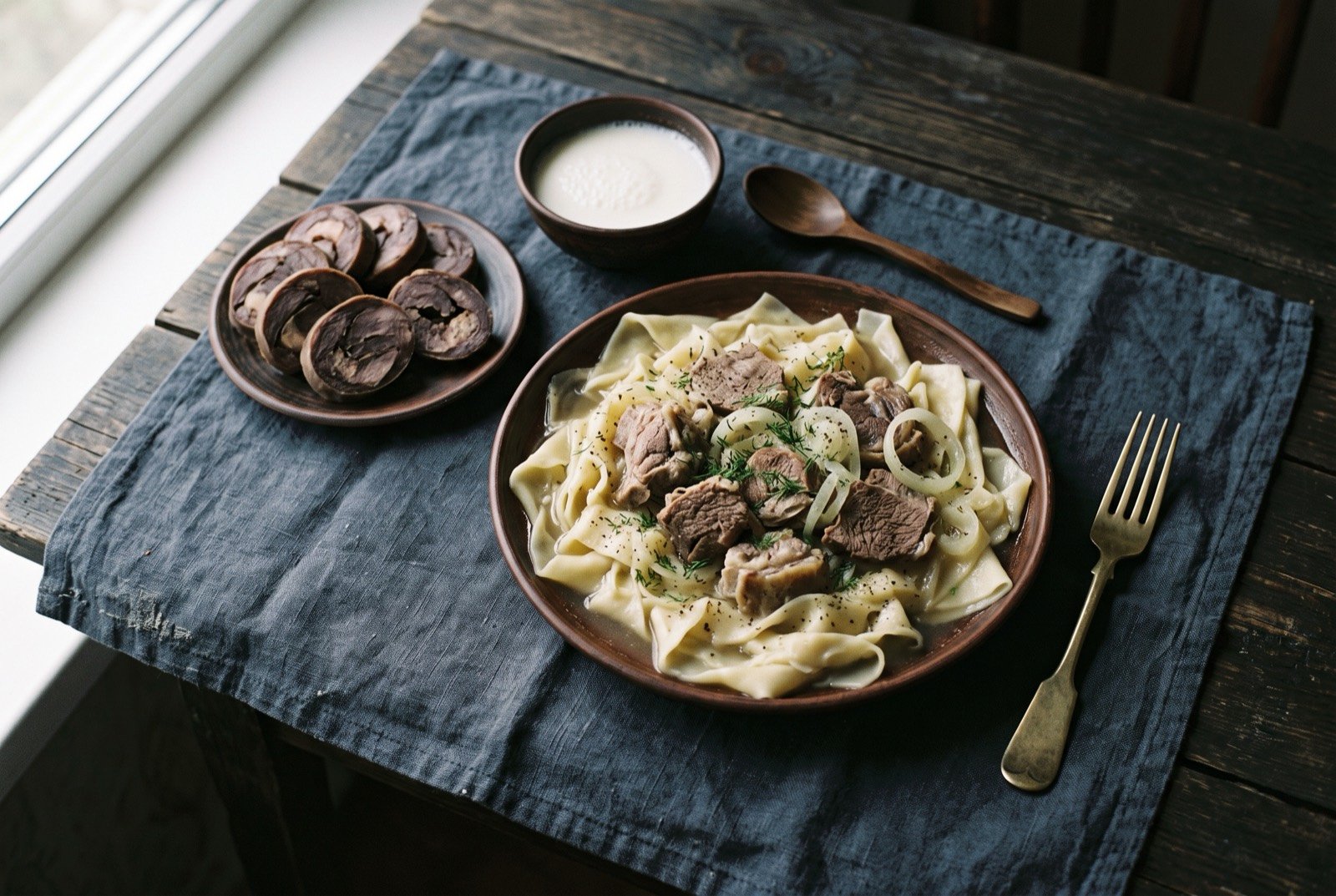
Three modern borders across one horse and sheep pastoralist world. Kazakhstan's horizontal steppe and Kyrgyzstan's vertical mountain pastures are close to one cuisine under two names; Turkmenistan sits here on the strength of its own tribal herding identity. Fermented milk, whole carcass boiling and dried curd answer a diet with almost no vegetables. Every dish as tradition built it, then what a modern chef would change.
Sources and review · What this chapter does not assert · How we research · Spotted something wrong?
A Sense of Place
Kazakhstan: the horizontal steppe and the animal that made it liveable
Kazakhstan is, by land area, mostly one thing: open, semi-arid grassland running for thousands of kilometres with almost nothing to stop the wind. That flatness decided the cuisine before anyone chose it. A herding economy on ground this open moves horizontally, not vertically, following grass and water across huge distances rather than climbing between fixed summer and winter altitudes, and the animal that made that kind of movement possible, the horse, sits at the structural centre of Kazakh food identity in a way no other steppe culture quite matches. Horsemeat and fermented mare's milk are not delicacies bolted onto a generic pastoral diet here; they are close to the whole of it, alongside mutton, and the Turkic horse cult that runs underneath both is treated by the sources behind this chapter as genuinely ancient, not folkloric colour. The fat is kurdyuk, sheep tail fat, and horse fat carried in cuts like zhal and zhaya; the thickener, where the kitchen wants one, is a hand rolled wheat noodle rather than a roux or a grain porridge; the aromatic is onion cooked directly into a broth, with black pepper, salt and dill doing what little else the dish asks for; the starch is wheat flour for noodles and baursak, with millet and barley reaching the table mostly as talkan, roasted grain ground to flour. Camel herding, and shubat, fermented camel's milk, belong to Kazakhstan's lower, drier regions specifically, not to the steppe as a whole and not, as later sections make plain, to Kyrgyzstan at all.
Kyrgyzstan: the same grammar, read vertically
Kyrgyzstan's ecology is Kazakhstan's near mirror image rather than its opposite. The Tian Shan and Alay ranges do not allow horizontal grazing at any scale; instead the whole year is organised around jailoo, the move to alpine summer pasture and back down again before the passes close. This is not simply logistics dressed up as culture: the move itself is still, today, treated as festival occasion, accompanied by prayer, feasting and horse racing rather than executed as a quiet chore. The material result is a diet with the same underlying grammar as Kazakhstan's, meat, milk, dough, restrained aromatics, but read through mountain rather than plain ecology: sheep and goat do more of the work on steep ground than horse can, and while kumis remains central to Kyrgyz dairy culture, the wider fermented milk repertoire leans harder on cow and yak than on camel. Kyrgyz and Kazakh cuisine are close enough in technique and vocabulary that a serious Russian language ethnographic source states plainly that most of their dishes are simply identical to one another; where this chapter draws a distinction between the two, it is usually ecological rather than technical.
Turkmenistan: a pastoral tribe's claim, and an oasis civilisation's counter-claim
Turkmenistan's presence in this volume rests on a specific argument rather than a comfortable fit, and the argument is worth stating plainly rather than assuming. Most of the country is the Karakum, the black sand desert, and the Turkmen tribal confederations, above all the Teke, Yomut and Ersari, built a pastoral sheep and horse economy across it closely related in spirit to the Kazakh and Kyrgyz world this chapter otherwise describes. But Turkmen society itself never pretended pastoral life was the whole picture: even within a single tribe, households split into charva, pastoral herders, and chomur, settled farmers, with the pastoral branch regarded as socially superior even as it depended on its farming relatives for grain, and the two exchanged produce every autumn. And Turkmenistan's oasis cities, above all Merv and, further north, Konye-Urgench, were genuinely major nodes on the historic Silk Road, Merv at points among the largest cities on earth, centuries before the Uzbek cities that carry that reputation in most Western writing today reached their own peak. This chapter places Turkmenistan here on the strength of the pastoral, horse and sheep half of that identity, which is well evidenced. It cannot, honestly, do the same for the oasis half: what survives in the record is that Merv and Konye-Urgench were rich trading cities, not what was actually cooked inside them, and that gap is named here rather than papered over with invented colour. What does survive well documented from the oasis side is produce, above all Turkmenistan's genuinely renowned melons, carried on the same caravan routes that made these cities rich, and a second, coastal register entirely: the Ogurjaly Turkmen of the Caspian shore, for whom fishing rather than herding was always the economic base, and whose fish plov is this chapter's clearest evidence that Turkmen cuisine was never purely pastoral even on its own terms.
The one deep, checkable difference: what happens to the horse
If a single fact should organise how a reader holds these three cuisines apart, it is this one, and it is unusually well sourced for a claim this specific. In Kazakh and Kyrgyz tradition the horse is the most prestigious food animal there is: its meat and its milk sit at the summit of hospitality and ceremony. In Turkmen tradition the horse, above all the Akhal-Teke breed the Teke tribe bred in the Akhal oasis and UNESCO recognised in 2023 for its own distinct culture of breeding and decoration, is not eaten at all. Multiple independent sources describe Turkmenistan as the one country in the Islamic world where horsemeat carries an outright cultural taboo, the animal given a formal funeral on death and eating it likened, in the strong idiom several sources report though none traces to a directly quoted Turkmen original, to cannibalism. No Turkmen recipe source consulted for this chapter mentions horsemeat as an ingredient anywhere, and UNESCO's own Akhal-Teke dossier discusses the horse only as transport, status symbol and wedding gift, never once as food. Turkmen fermented dairy tradition answers the gap this leaves with camel rather than horse: chal, from the one humped Arvana dromedary, is Turkmenistan's everyday fermented drink, and no evidence survives in this chapter's research of qymyz, fermented mare's milk, as a living Turkmen practice at all. One horse, understood two completely different ways, across a border that is otherwise porous in almost everything else: that is the real spine of what separates this volume's third country from its first two, more than any spice or any named dish.
The structural logic, at a glance
| Kazakhstan | Kyrgyzstan | Turkmenistan | |
|---|---|---|---|
| Landscape | Open horizontal steppe | Vertical mountain pasture, Tian Shan and Alay | Karakum desert, river oases |
| The prestige animal | Horse, eaten and drunk | Horse, eaten and drunk, though mutton does more everyday work on steep ground | Sheep and camel; the horse is not eaten |
| Fermented milk | Kumis (mare), shubat (camel, lowland) | Kumis (mare) central; shubat little documented | Chal (camel); no documented kumis tradition |
| Fat | Kurdyuk, horse fat (zhal, zhaya) | Kurdyuk, mutton fat predominates over horse fat | Kurdyuk, cottonseed oil in cotton growing regions |
| Aromatic | Onion, black pepper, salt, dill | Onion, black pepper, salt, dill | Salt and black pepper, close to no other seasoning |
| The seasonal answer | Household herding, kolkhoz dairy inheritance | Jailoo, the ritualised move to summer pasture | Charva and chomur, pastoral and settled branches of one family |
The History in Layers
A horse cult older than any of the three modern states
The reverence this chapter describes is not modern sentiment. Turkic peoples across the steppe treated the horse as close to sacred, and Russian and Kazakh sources agree that the animal's status reflects a plain material fact: nomadism at this scale was not possible without it. This inheritance is explicitly shared between Kazakh and Kyrgyz tradition rather than Kazakh alone, one of the clearest pieces of evidence in this chapter's research that the two cuisines really are one world read through two ecologies, not two neighbouring cuisines that happen to look similar.
A trading edge, not a trading centre
It would be convenient for this chapter's argument if the Silk Road had shaped the pastoral steppe kitchen as thoroughly as it shaped Turkmenistan's oasis cities, or the Uzbek and Tajik cities the atlas's neighbouring volume will properly treat. The honest position, on the sourcing available, is narrower: caravan trade touched the steppe world chiefly at its edges, at towns like Turkestan, Taraz and Osh, rather than reaching deep into the household diet of a herding family whose food came overwhelmingly from its own animals. This chapter does not assert a Silk Road spice or ingredient history for the Kazakh and Kyrgyz pastoral kitchen that the sources cannot support.
The famine that broke a household economy
Set against that comparative silence, one twentieth century event is documented with real precision, and it is the single most consequential thing that has happened to this cuisine in living memory. Soviet collectivisation from the late 1920s forced a nomadic, herd owning population into settled collective farms at speed, confiscating livestock as it went; historian Sarah Cameron's The Hungry Steppe, the standard scholarly account, argues the resulting catastrophe combined that policy with Slavic settler demographic pressure and drought rather than any single cause. The numbers, cross checked across Russian and Kazakh language sources, are stark: Kazakhstan's livestock herd collapsed from roughly 40.5 million head to 4.5 million, a fall of around 90 per cent, between the start of collectivisation and January 1933, and death toll estimates run as high as 1.5 million people, more than a third of the entire Kazakh population at the time and the highest death rate of any Soviet nationality during collectivisation. Kazakh historian Khaidar Aldazhumanov has argued the famine carries genocidal character, a position contested among historians and presented here as a live historiographical debate rather than a settled verdict. What matters for this chapter specifically is what the famine did to food: it broke, for a generation, the assumption that every household lived directly off its own herd, and the kolkhoz dairy economy that followed formalised qurt, kumis and shubat production at a scale a family unit had previously managed alone. That today's Russian language recipe sources describe qurt making as a set of "family secrets," varying house to house, reads as the household economy quietly reasserting itself since 1991 rather than an unbroken tradition that never noticed the interruption. No comparable famine or collectivisation history specific to Kyrgyzstan survives in this chapter's sources; that asymmetry is stated honestly rather than assumed away.
Cotton, and what a cash crop economy does to a kitchen
Turkmenistan's twentieth century runs on a different, equally documented track: not famine from forced pastoral settlement, but food insecurity from forced monoculture. Cotton cultivation in the Transcaspian region grew from 900 hectares in 1890 to 57,000 by 1915, and roughly tripled again between 1961 and 1975 under Soviet planning, land that could have grown food given over instead to a cash crop, with the shortfall made up by guaranteed wheat shipped in from other Soviet republics. When the Union dissolved in 1991 those shipments simply stopped, and food security across the region, Turkmenistan included, deteriorated sharply and fast. The new Turkmen government's answer was the Zerno, or Grain, programme, launched that same year to rebuild domestic wheat capacity, restructure farm administration and land and water use, and build large integrated milling and baking complexes as a deliberate break from cotton dependency. One specific, slightly unexpected trace of the whole episode survives directly in the kitchen: Turkmen recipe sources in cotton growing regions still specify cottonseed oil, not the clarified butter a reader might expect, as the routine cooking fat, a Soviet cash crop economy quietly still cooking dinner. Modern Turkmenistan remains one of the most closed and least documented states on earth, which is a research problem this chapter names honestly rather than compensating for with confidence the sources do not support; the one state sanctioned food celebration that survives well documented is Melon Day, a 1994 holiday established under President Niyazov that layers Soviet successor political theatre, a cultivar literally named for the president, on top of a genuinely older and independently attested tradition of Turkmen melon growing and trading.
Mongolia, and a question this volume does not need to settle
One structural note belongs here rather than nowhere. The atlas's own scoping documents flag Mongolia as ecologically close enough to this steppe world that it could plausibly belong in this volume, and note that it is simultaneously being weighed by the future Sinosphere region for its historic and administrative ties to China. This chapter takes no position on where Mongolia should ultimately sit; the question is real, contested between two future volumes rather than settled by either, and is named here so a reader encountering Mongolian food elsewhere in the atlas later understands why it was not folded into this one now.
The Flavour Arsenal
Qurt, the answer to a diet with no vegetables
Dried, salted curd is this cuisine's single most portable, most durable food, and its method is genuinely well documented rather than assumed. Milk is collected and left to ferment into whey in a saba, a traditional skin or wooden vessel; the fat that rises is skimmed and salted separately, and the whey itself is reduced by hours of boiling in a qazan, stirred continuously, then drained through cloth for several days before being shaped and dried, most reliably in shade rather than direct sun, over three to five days. Contemporary Kazakh press accounts describe boiling times of five to six hours and draining periods of four to five days, numbers that converge closely enough across independent household sources to be trusted as a real range rather than a single invented figure.
Kumis and shubat, fermentation as a genuinely serious craft
Kumis, fermented mare's milk, is not a folk curiosity but a documented double fermentation: Lactobacillus bulgaricus and Lactobacillus acidophilus working alongside natural yeasts convert lactose into lactic acid, ethanol, carbon dioxide and aromatic compounds together, typically reaching an alcohol content of 0.5 to 2.5 per cent and, in a strong natural brew, as much as 4.5 per cent. Fresh milk poured into a vessel with a starter of the previous batch, stirred repeatedly through the day to keep fermentation even, is ready in roughly two to three days at the right temperature. Shubat, camel's milk fermented the same broad way, carries markedly more fat than kumis, up to around 8 per cent, and is drunk chiefly in summer; the fermented cream that rises to its surface has its own name, agaran. Both belong squarely to Kazakhstan's lowland, camel keeping regions; neither is meaningfully documented as a living Kyrgyz practice, and Turkmenistan's parallel tradition, chal, is built on camel milk exclusively, soured from a starter over six to eight hours, with no surviving evidence in this chapter's research that fermented mare's milk was ever a Turkmen practice at all.
Kurdyuk, the fat that actually carries the flavour
Sheep tail fat is this cuisine's real seasoning, more than any herb or spice reaches. It renders through slow heat rather than melting off quickly, and it is what a Western attempt at these dishes most often leaves out, either through unfamiliarity or through the honest difficulty of buying it, and a bland result follows directly from that omission: the one detailed, unsentimental review of a London beshbarmak found in researching this chapter called the dish "hearty but pretty tasteless" despite well made noodles, exactly the failure a missing kurdyuk would produce.
Horsemeat, and its named delicacy cuts
Where Kazakh and Kyrgyz tradition eats horse, it does so with real internal hierarchy rather than treating the animal as one undifferentiated cut. Zhal, the fatty subcutaneous strip along the neck, and zhaya, salted, dried, smoked and then boiled loin meat, are together considered the single most valuable part of the horse, served smoked, boiled and sliced cold. Kazy, cured whole strips of rib meat and loin fat packed into natural casing, sits alongside them as the standard festive sausage; both belong to hospitality and status, not everyday eating.
Restraint, kept honest
None of this cuisine's identity comes from a complex spice cabinet, and this chapter does not invent one where the sources describe the opposite. Onion, black pepper, salt and dill do almost all of the aromatic work across Kazakhstan and Kyrgyzstan alike, with wild onion and garlic foraged where available; Turkmen tradition is, if anything, still plainer, several independent sources agreeing that salt and black pepper are close to the only seasoning Turkmen cooking uses at all, a genuinely useful, sourced point of contrast with the far more heavily spiced Uzbek and Tajik cooking of the Silk Road oasis volume next door.
The Technique Ladder
First, an honest problem
No restaurant in Kazakhstan, Kyrgyzstan or Turkmenistan holds a Michelin star, and none anywhere in the world serves this cuisine at that level either. Almaty's own food press hopes a first Michelin recognised restaurant will open there, but that is a stated ambition, not yet a fact. What does exist, and what this ladder leans on instead of a borrowed European kitchen, is a real, internationally noticed "neo-nomad" movement centred on two Almaty restaurants, Auyl and Tör, and Astana's Qazaq Gourmet, whose chefs cook over open flame, in a qazan, on a mangal and in a tandoor, reframing horsemeat tartare and hand pulled samsa with more precise technique rather than replacing steppe method with French or Nordic borrowings. No comparable movement exists for Kyrgyz or Turkmen cuisine specifically; that absence is named rather than smoothed over, and the rungs below are built from mechanism, not from a starred kitchen this cuisine does not have.
Rung 1. Dry radiant searing in the qazan
Kuurdak and its Turkmen cousin gowurdak both depend on the same physics: meat and offal fried hard in a heavy cast iron qazan over live fire sears fast enough to brown the surface through the Maillard reaction before the interior overcooks, and the fat that renders out in the process, kurdyuk above all, carries the dish's aromatic compounds far more effectively than a herb ever could. Sequence matters as much as heat: tougher cuts and organs go in first and get roughly ten minutes before liver, which toughens fast under high heat, follows for a shorter five, with onion, salt and pepper stirred through only in the final five minutes so it seasons rather than stews.
Rung 2. Long, slow simmering for gelatin, not just tenderness
Beshbarmak's broth is built the same way any serious stock is: hours of gentle simmering, two and a half to four depending on the cut, break down collagen into gelatin, which is what actually gives the finished broth body rather than the thin, watery result a rushed version produces. Salt goes in partway through, commonly around the two hour mark, once enough moisture has moved out of the meat that early salting would only toughen.
Rung 3. Salt curing and casing for horsemeat sausage
Kazy's method is a controlled dehydration, not simply seasoning: whole strips of rib meat and fat are cured in salt, garlic and pepper for six hours to a full day, during which osmosis draws moisture out and lets the cure's flavour move in, before the strips are packed into natural casing and boiled. Shuzhuk, the Kazakh minced variant, and chuchuk, the distinct Kyrgyz version built to its own ratios and its own casing length, both extend the same logic with a longer cold smoke and air dry for a firmer, keepable sausage rather than one meant for the same day.
Rung 4. Co-fermentation, lactic and alcoholic together
Kumis is not simple souring; it is two fermentations running at once, lactic acid bacteria and wild yeast working the same batch of milk simultaneously, the bacteria producing the sourness and the yeast producing the alcohol and carbon dioxide that give proper kumis its faint fizz. A UK kitchen cannot reproduce this with mare's milk, which does not exist here commercially, but the same double fermentation logic, applied to more available dairy with a live kefir culture as the yeast and bacteria source, is the honest, mechanism true way to approach the flavour family rather than a straight substitution that pretends nothing has changed.
Rung 5. Buried radiant baking, real sand oven physics translated
Ishlekli's traditional method, a filled dough parcel buried directly in hot sand and embers, works because sand holds and releases heat slowly and evenly from every side at once, cooking the raw filling by trapped internal steam while the crust crisps from steady radiant heat outside. The modern adaptation, sandwiching the pie between two heavy pans and burying that between them in hot ash inside a tandyr, keeps the same physics without literal sand. A Big Green Egg run for long, indirect heat with the pie set on a baking stone, or genuinely buried in a bed of hot lump charcoal ash the way the tradition itself already modernised toward, reproduces the mechanism closely rather than approximating it with an ordinary domestic oven's more even, less radiant heat.
The Ferment and Preserve Bench
1. Qurt
Dried, salted curd, this cuisine's most portable food and a direct descendant of the qurt making process described in the Flavour Arsenal above. At home: bring 2 litres of full fat yoghurt to a bare simmer in a heavy pan and reduce, stirring often to prevent catching, for about an hour, until thick and curdled. Strain through muslin for 24 hours, then work in salt to taste, roll into small balls, and dry on a rack in a dehydrator at 55°C for 6 to 8 hours, or in a warm, airy spot for 3 to 5 days if the weather allows, turning occasionally. The dehydrator route is the honest, realistic UK method; genuine sun and shade drying depends on a climate this kitchen cannot promise.
2. Kumis, a home approximation
True kumis needs mare's milk, which does not exist commercially in the UK, so this is named plainly as an approximation built on the same fermentation mechanism rather than a substitute recipe pretending to be the real thing. Warm 1 litre of whole cow's milk to 25°C, stir in 2 tablespoons of active kefir grains, and leave loosely covered at room temperature for 24 to 48 hours, stirring twice a day, until it has soured and developed a light natural fizz. Strain out the grains before drinking. The result shares kumis's double fermentation logic, lactic souring alongside a living yeast culture, without sharing its source milk, and this chapter says so rather than calling it kumis outright.
3. Gowurdak, meat preserved under its own fat
The pan Central Asian preservation extension of kuurdak and its Turkmen cousin gowurdak: meat is fried slowly in its own fat, or with added kurdyuk, until all the water has cooked off and the meat itself has taken real colour, then packed into a clean container and covered completely with a sealed layer of the rendered fat, which excludes air and keeps the meat edible for weeks stored cold. To use, warm gently until the fat layer softens enough to lift the meat free.
Sourcing in Britain
The one ingredient that actually decides the dish
Kurdyuk, sheep tail fat, is the single ranking priority on this list, and it is, genuinely and somewhat surprisingly, sourceable: halalo.co.uk and Anthap, a Turkish grocer in Enfield, both stock it under its own name, Liyah or Kurdyuk, and AM1NAH sells it already rendered as a jarred tallow if raw fat cannot be found. Buy this before anything else on this list; it will do more for these dishes than any other single purchase.
Kit: a genuine, well matched find
Cast iron Uzbek style kazan cauldrons are sold new in the UK by Amazon and The Range, and, better still for this reader specifically, Kamado Kings sells an 8 litre kazan with an aluminium handle engineered not to melt on a Big Green Egg, a real, well matched recommendation rather than a generic "use a wok" fallback. Where a dedicated kazan is not wanted, a large flat bottomed wok, a paella pan or a Dutch oven all serve.
Qurt and its honest substitute
Genuine qurt turns up on eBay and Etsy, most likely shipped from Central Asia or Germany rather than held as UK stock, and delivery timing could not be confirmed. Turkish kurut, sold through Turkish and Middle Eastern grocers, is a genuine close cousin worth treating as the practical UK stand in, alongside the dehydrator method given above.
Wild garlic, a real British crossover
Fine & Wild sells fresh foraged wild garlic online, in season February to June, a genuinely strong local ingredient standing in for the wild onion and garlic this cuisine forages for itself, not a stretch or a compromise.
Horsemeat and fermented mare's milk, named honestly as the hard limits
Horsemeat is legal to sell and eat in the UK, and Kezie Foods in the Scottish Borders is a real, checkable retailer that stocks it when in supply, currently out of stock at the time of writing. Fresh kumis and shubat have no verified UK source at all, commercial or otherwise; kefir, described in the ferment bench above, is the honest, mechanism based approximation, not a substitute that pretends to be the genuine article.
What is simply, easily available
Dried apricots, millet, barley and clarified butter need no special sourcing, available at any UK supermarket, wholefood shop or South Asian grocer. Tibetan and Himalayan tsampa, roasted barley flour, is the honest UK substitute for talkan, functionally the same product under a different regional name.
Central Asian grocers, a real gap
No dedicated Kazakh, Kyrgyz or Turkmen shop was found anywhere in the UK; Uzbek grocers and restaurants, London's OshPaz among them, are the closest adjacent retail footprint, useful for dried fruit and general Central Asian staples but not this volume's own cuisine specifically. Russian and Eastern European delis stock adjacent fermented dairy, kefir, tvorog, smetana, useful as the practical base for the kumis approximation above.
Ingredients that decide great from grim, ranked
- Kurdyuk, sheep tail fat, real and genuinely sourceable.
- A proper kazan, cheap, genuinely available, and Kamado compatible.
- Qurt or Turkish kurut, marginal UK availability, worth working around with a dehydrator.
- Fresh wild garlic, a genuinely strong seasonal British crossover.
- Fermented mare's or camel's milk, the honest bottom of the list, essentially unobtainable.
Voices and Sources
From inside the tradition
Aigerim Musugazhinova, credited as author and researcher behind Kazakh Cuisine: Taste and Traditions, published through the Kazakhstan cultural body qazaqgeography.kz, is the strongest named in-tradition lead this chapter found, though the book itself could not be independently obtained or its wider scholarly reception confirmed. Chef Ruslan Zakirov at Auyl in Almaty, and Ruslan Abduramanov at Tör, lead the closest thing this cuisine has to a documented modernist movement, cooking in qazan, mangal and tandoor rather than importing foreign method; Artem Kantsev at Astana's Qazaq Gourmet is credited with travelling the country studying regional variation before building his own menu. Turkmenkitchen.com, a genuine Turkmen run recipe site, supplied the exact, sourced quantities behind this chapter's ishlekli and gutap. In London, Nomadic Flavours on Hackney Road is the closest thing the UK has to a dedicated Kyrgyz restaurant, run by a husband and wife team and confirmed active through the Food Standards Agency's own register.
Scholarship
Sarah Cameron's The Hungry Steppe: Famine, Violence, and the Making of Soviet Kazakhstan (Cornell University Press, 2018) is the standard academic account of the collectivisation era famine this chapter draws on, and the single best sourced piece of history in this whole volume.
Things this chapter has deliberately not asserted
- That beshbarmak's meat boiling time has one canonical figure. Sources converge on a range, two and a half to four hours, not a single authoritative number, and none of the sources behind that range is an academic or ethnographic study, only aggregated household and media recipes.
- That the historical animal counts recorded for as, the Kazakh memorial feast, sixty three horses and two hundred sheep for one funeral, five thousand sheep and up to two hundred and fifty horses for another, are verified fact rather than Kazakhstan press retellings of oral tradition. They are reported here as attributed claims, not primary archival record.
- That Silk Road trade shaped the everyday pastoral Kazakh or Kyrgyz kitchen with any specific, dated ingredient transfer. The sourcing available supports contact at the steppe's trading edges, not inside the household diet, and this chapter does not claim more than that.
- That Merv or Konye-Urgench had a documented, distinct urban food culture separate from the general fact of Silk Road trade passing through them. What survives is evidence they were rich, cosmopolitan cities; what does not survive, in the sources available to this chapter, is what was actually cooked inside them.
- That the phrase reported by several sources comparing eating horsemeat in Turkmen culture to cannibalism is a direct quotation of an original Turkmen proverb. It is reported here as a repeated journalistic gloss on a genuinely well corroborated taboo, not as a sourced quotation.
- That dograma's origins lie in pre-Islamic sacrificial ritual, a claim found in only one general audience source and not corroborated by anything scholarly.
- That yarma is at least a thousand years old, a claim resting on a single uncorroborated citation.
- That etli nan and etli çörek are definitely the same dish, or definitely two different ones. The sources this chapter consulted are not consistent on the question, and it is left open rather than guessed at.
- That Turkmen wedding food carries any specific carpet related symbolism. No source found supports this, and it is named here specifically so a plausible sounding invention is not mistaken for a gap this chapter simply forgot to check.
Dry radiant searing in the qazan
Kuurdak and its Turkmen cousin gowurdak both depend on the same physics: meat and offal fried hard in a heavy cast iron qazan over live fire sears fast enough...
Long, slow simmering for gelatin, not just tenderness
Beshbarmak's broth is built the same way any serious stock is: hours of gentle simmering, two and a half to four depending on the cut, break down collagen into...
Salt curing and casing for horsemeat sausage
Kazy's method is a controlled dehydration, not simply seasoning: whole strips of rib meat and fat are cured in salt, garlic and pepper for six hours to a full...
Co-fermentation, lactic and alcoholic together
Kumis is not simple souring; it is two fermentations running at once, lactic acid bacteria and wild yeast working the same batch of milk simultaneously, the...
Buried radiant baking, real sand oven physics translated
Ishlekli's traditional method, a filled dough parcel buried directly in hot sand and embers, works because sand holds and releases heat slowly and evenly from...
The dishes
- Beshbarmak Kazakhstan and Kyrgyzstan
- Kazy Kazakhstan
- Kuurdak Kazakhstan and Kyrgyzstan
- Naryn Kazakhstan and Kyrgyzstan
- Kuiryk bauyr Kazakhstan
- Jent Kazakhstan
- Ishlekli Turkmenistan
- Gutap Turkmenistan
- Etli nan Turkmenistan
Sources and review
- Reviewed
- Not yet reviewed from inside the tradition
- Cooked
- Not yet cooked and reported
Where this volume comes from
3 research briefs on file for this volume, researched to the rules on How we research. Published 28 August 2026. Last changed 7 September 2026.
The brief's own account of its sources
Kazakhstan and Kyrgyzstan (Part One). Roughly 33 to 37 search queries were run. By rough language share: Russian language queries made up the clear majority, roughly two thirds; Kazakh language queries (Cyrillic Kazakh orthography) roughly 15 per cent; Kyrgyz language queries roughly 5 to 10 per cent; English language queries roughly 5 to 10 per cent, used specifically for academic and international cross verification of the famine and heritage listing claims rather than as a primary source base. Source mix skews toward Kazakhstan and Russia hosted recipe and press sites (Caravan.kz, 365info.