Asia · Volume 58
Uzbekistan & Tajikistan
The Silk Road Oases
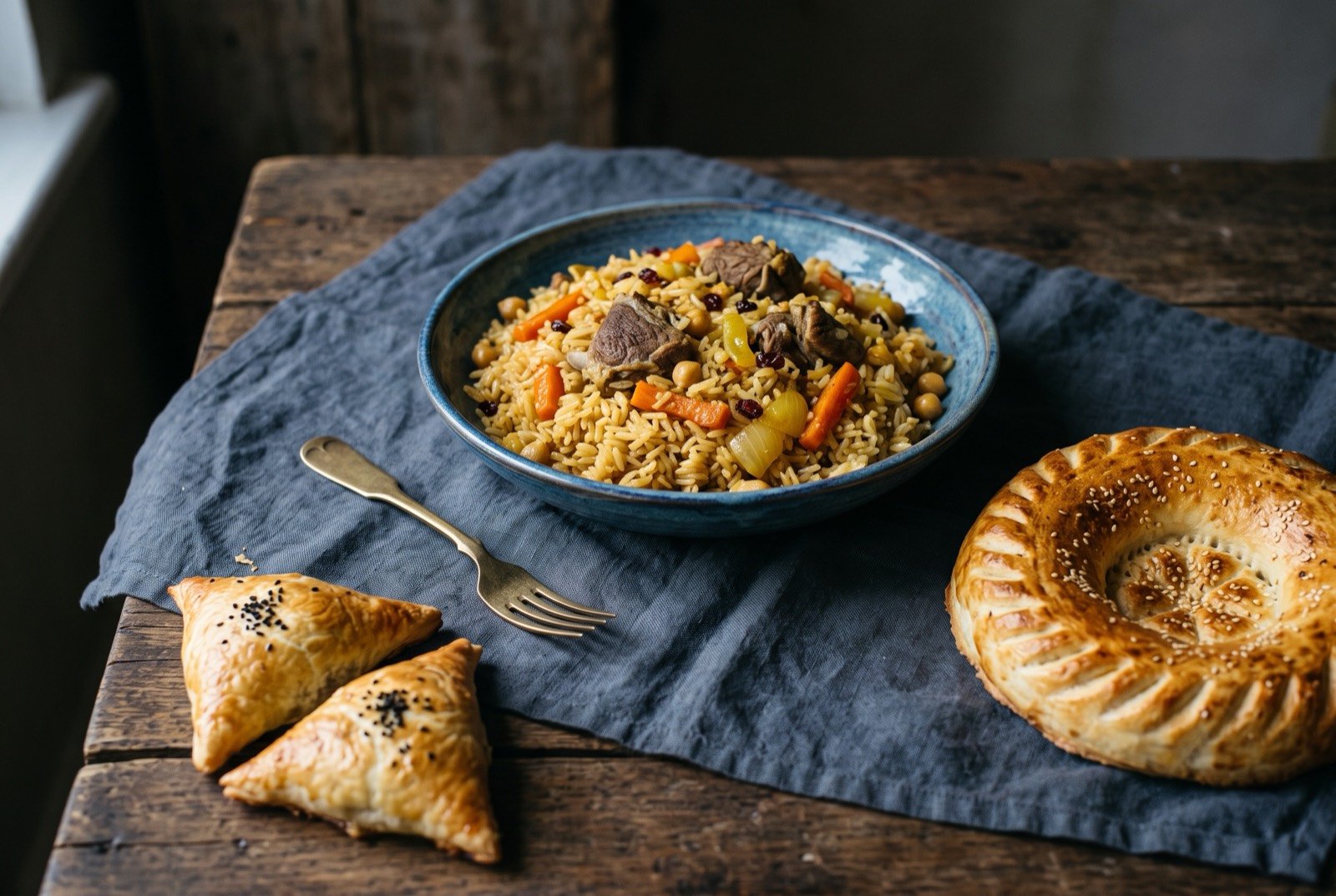
Two countries, one irrigated world. Uzbekistan and Tajikistan share almost none of their politics and only some of their language, but they share an answer to one question: how do you turn a desert into a plate, using rice, wheat, dried fruit and the animal fat a herding economy still supplies. Every dish as tradition built it, then what a modern chef would change.
Sources and review · What this chapter does not assert · How we research · Know this better? Tell us
A Sense of Place
Uzbekistan: three river valleys and two peoples in one set of borders
Uzbekistan's inhabited land is a set of irrigated oases set against the Kyzylkum desert, not a continuous plain: the Fergana valley, watered by the Syr Darya and its tributaries; the Zeravshan valley, home to Samarkand and Bukhara; and the Amu Darya's lower reaches around Khorezm. None of it is naturally farmable without engineered water. The Han Chinese envoy Zhang Qian, travelling through around 128 BC, already found the Fergana valley (which he called Dayuan) a settled, agriculturally developed country, not a nomad's steppe (Wikipedia, Ферганская долина; iskatel.com). Cities grow where water is controlled, which is why Samarkand and Bukhara, both Zeravshan valley oasis cities, became the region's great urban centres rather than any point on the open steppe.
The population inside these borders is not linguistically one thing. Alongside the Turkic-speaking Uzbek majority, Samarkand and Bukhara have been centres of Persian-speaking urban culture for a thousand years, and Persian remained the dominant language of Samarkand's educated classes through the Samanid, Qarakhanid and Timurid periods (centrum-air.com). Russian-language reference sources describe Uzbek cuisine itself as a synthesis, explicitly naming "assimilation of cultures, particularly Persian-Tajik," layered onto Uzbek nomadic and settled tradition (Wikipedia, Узбекская кухня). This bilingual, bicultural urban fact runs through the whole chapter, and section two treats its sharpest edge, who Samarkand and Bukhara really belong to, honestly rather than resolving it.
Tajikistan: the Persian tongue in the mountains
More than 90% of Tajikistan is mountainous, and its food geography runs along three valley systems squeezed between the Pamir, Alai and Gissar ranges: the Tajik portion of the Fergana valley in the north around Khujand; the Zeravshan valley, running from the Pamir-Alai west through Panjakent towards Samarkand and Bukhara; and the Vakhsh valley in the south, reshaped by Soviet-era cotton irrigation. What actually organises Tajik food culture is language, not ethnicity or border. Tajik is a Persian language, closely related to Iranian Farsi and Afghan Dari though written in Cyrillic rather than Arabic script, and Tajik cuisine is described in Russian-language reference material as having formed "on the basis of the traditions of the Persian-speaking world," explicitly distinguished from the cuisines of Turkic-speaking, nomadic neighbours such as the Kyrgyz, Kazakh and Turkmen (Wikipedia, Таджикская кухня). This is the load-bearing distinction for the whole volume: Tajikistan's food is close to Uzbekistan's because both are Persian-Turkic hybrid cultures built on the same oasis cities and the same trade, not because Tajiks and Uzbeks are the same people.
The structural logic, at a glance
| Uzbekistan | Tajikistan | |
|---|---|---|
| Staple starch | Rice (devzira and related varieties) and wheat non | Wheat, above all as fatir and non; rice for festival plov |
| Fat | Cottonseed oil, rendered sheep tail fat (dumba/kurdyuk) | Rendered tail fat, vegetable oil |
| The thickener | None in the French sense; reduction (zirvak) does the work | Reduction, and dairy (qurut/suzma) as a sauce in its own right |
| Aromatic | Zira (cumin), barberry, whole garlic head | Onion, fresh herb, dried fruit |
| The feast technology | The kazan (qazan), a wide, thin-walled cauldron | The shared tabakh/tavok bowl, eaten from communally by hand |
The History in Layers
Sogdian traders, a documented network with an undocumented kitchen
From the fourth century AD, Sogdian merchants based in Zeravshan valley cities including Samarkand ran trading colonies the length of the Silk Road, from Samarkand to Chang'an, dealing in metalwork, textiles, leather and fruit (europe-china.kz). This is genuinely well attested. What is not: no source found in researching this chapter describes a specific Sogdian-era dish or cooking technique. The trade network is documented in real depth; the kitchen behind it is not, and this chapter states that gap plainly rather than filling it with a plausible-sounding invention. The same honesty applies to the widely assumed idea that noodle and dumpling technology moved between China and this region along the same road: it is a reasonable inference from laghman and chuchvara's family resemblance to Chinese lamian and jiaozi, but no sourced account of the transmission route or period was found, so it is presented here as plausible, not proven.
Timurid Samarkand, and the refinement trade brings
Samarkand's political peak came under Timur, who made it his imperial capital in the 14th and 15th centuries. Uzbek and Russian-language sources treat this period as the one that gave the region's food culture its urban, refined register: elaborate patterned non, dozens of named plov variants, a confectionery and dried-fruit culture drawing directly on Silk Road trade goods (samarkandtour.com). No source found gives a specific dated Timurid court recipe. The connection made across the sources is broad, imperial wealth and trade attracting culinary refinement, not a single dish traced to a single decree, and the chapter follows that caution rather than inventing a court-kitchen anecdote.
The border that split a Persian world in two
The decisive break for the whole Uzbek-Tajik question came from Soviet national delimitation, not from any older ethnic line. In April 1924, the Bukharan and Khorezm People's Soviet Republics were divided along drawn national borders; in that division, Tajikistan received only the Khujand district, while Uzbekistan retained Samarkand, Bukhara and the Surkhandarya region, despite Tajik being the majority home language in Samarkand at the time and still widely spoken there today without official status (Refworld/EurasiaNet; Wikipedia, Таджикско-узбекская граница). Tajik nationalist and cultural writing regards Samarkand and Bukhara as historically Tajik-Persian cities administratively assigned away by Soviet fiat. Uzbekistan's own state framing, and the plain demographic fact that Turkic-speaking rule has been dominant across the region since at least the 16th century, is not the same position, though this chapter did not locate a comparable Uzbek-language source directly engaging the Tajik claim, itself a real sourcing asymmetry worth naming rather than hiding. This chapter states plainly that this is a genuine, live, actively felt dispute, names who claims what and from where they speak, and does not adjudicate it. The same tension runs directly through food: dishes described below as "Samarkand" or "Bukhara" tradition sit inside cities whose own linguistic and cultural character is itself contested.
Russian rule brings the potato, Soviet rule brings the cotton
Central Asia's incorporation into the Russian Empire in the 19th century brought new vegetables into Uzbek cooking that were not there before: potato, tomato, cabbage and radish (Wikipedia, Узбекская кухня). Soviet rule brought something far larger and harder. Cotton cultivation in Uzbekistan expanded to over two million hectares, close to 98% of the country's cultivated land at points, more than 60% of all Soviet cotton production. Soviet planners in the Fergana valley specifically redirected irrigation and investment to guarantee cotton for Soviet industry, at the expense of food-crop diversity (summarised from Russian-language academic material on Fergana valley water management under cotton monoculture, tadqiqot.uz, and a peer-reviewed history of postwar cotton monoculture policy 1945 to 1955, cyberleninka.ru, identified as a strong lead but not read in full text). The broad shape of this claim, that cotton monoculture crowded out food-crop diversity and imposed forced mass labour including children on the harvest, is well evidenced across multiple sources; the precise day-to-day dietary mechanism is not, and this chapter does not over-specify it. Tajikistan underwent the same reshaping in its own Vakhsh valley scheme, and by the USSR's collapse Tajikistan was the poorest of the Soviet republics, reportedly reliant on Moscow for as much as 60% of its budget, with cheese, sausage, butter and condensed milk regarded as luxuries even after genuine 1970s and 80s industrial investment (Current Time TV). Cottonseed oil, the fat most plov across this whole region is fried in, is the single clearest surviving link between this Soviet-era cotton economy and what actually ends up on the plate today; a widely cited but unattributed figure claims it remains a strategic food product consumed by roughly 80% of Uzbekistan's population, though this specific statistic could not be traced to a named primary source and should be read as indicative rather than confirmed.
A civil war, and a gap this chapter will not paper over
Tajikistan's 1992 to 1997 civil war, fought between the post-independence government and the United Tajik Opposition, killed close to 70,000 people from combat, artillery, starvation and typhus combined; the Aga Khan Development Network began emergency food deliveries of flour, oil, dried milk and pulses to the isolated Pamir region from 1993 (Wikipedia, Гражданская война в Таджикистане; CABAR.asia). No source found in researching this chapter connects the war to any specific, documented change in Tajik food culture or recipes, beyond the general humanitarian picture and the large labour diaspora, chiefly to Russia, that followed it. That is a real gap in what can currently be said, not a claim this chapter will manufacture to make the history feel more complete.
Plov, recognised twice on the same day, by two different countries
On 1 December 2016, at a UNESCO Intergovernmental Committee meeting in Addis Ababa, both Uzbek plov and Tajik oshi palav were separately inscribed on the Representative List of the Intangible Cultural Heritage of Humanity, two of twelve new elements added that session (Gazeta.uz; Lenta.ru). This was a genuine dual, parallel recognition on the same day, not a joint inscription and not one country's claim displacing the other's. Uzbekistan's own national press reported both without dispute. This is exactly the model this chapter follows for the dish itself: plov is treated below as a family of related but genuinely distinct national and regional traditions, not one dish with one true version and several impostors.
The Flavour Arsenal
Devzira, the pink rice that is running out
Devzira is a specific rice landrace, not a modern commercial variety, historically grown above all in the Fergana valley, with named centres of production in Piskent and Chinoz in Tashkent region and Bulungur and Jomboy in Samarkand region (uzpedia.uz). The grain is elongated, ridged, carrying reddish lines between the ridges from an iron-rich local soil and water; the intensity of that tint classifies it as "white" or "red" devzira. It is dense and hard, absorbs comparatively little oil while absorbing large amounts of liquid, and needs five to six washes plus a two to three hour warm, heavily salted soak before it will cook evenly (uzpedia.uz). This is worth stating plainly as a live agricultural concern rather than treating devzira as still grown at historic scale: modern cultivation has reportedly shifted mostly onto private farms and seed plots as newer high-yield varieties displace the old landrace from broad commercial production (uzpedia.uz).
Zira and barberry, the two non-negotiable spices
Cumin (zira) and barberry (barbaris) are treated across Russian-language sources as the two spices plov cannot do without, alongside red chilli and salt. Good zira is rubbed between the palms immediately before use to release its aroma properly, rather than added straight from a jar. Barberries carry the sourness a Western palate might reach for lemon to supply; here it is a dried fruit doing acid's job.
Yellow carrot, and the two-colour Samarkand exception
Uzbek plov traditionally calls for yellow carrot, cut into thick strips or julienne rather than grated, valued for texture and aroma retention over the deep orange colour a Western carrot supplies. Samarkand plov is the one regional exception worth flagging in the arsenal itself: it genuinely mixes yellow and orange carrot together, a real two-colour dish rather than yellow alone (povarenok.ru).
Suzma and qurt, the region's whole dairy-preserving discipline
Suzma, called chakka in Samarkand, is a thick strained fermented-milk curd: katyk (a regional cultured milk comparable to yoghurt) is gently heated until curds separate from whey, then strained through muslin for roughly 24 hours, the longer the drain the denser the result. Qurt (also qurut, korot, khurut) is suzma's onward, shelf-stable form: the drained curd is salted, sometimes with chilli, rolled into walnut-sized balls, and sun-dried over several days, historically central to food security on long pastoral migrations. This same base process, ferment, strain, salt, dry, runs underneath Uzbekistan's everyday qurt snack and Tajikistan's national dish alike, and is treated as its own ferment bench below.
Cottonseed oil, a fat with a political history
Described across sources as the most widely used cooking oil in Uzbek cuisine generally, requiring thorough pre-heating to burn off its raw smell before use. As noted in the history section above, cottonseed oil's dominance is not simply a matter of taste: cotton was, and largely remains, Uzbekistan's principal export crop, and the oil most plov is fried in is a direct downstream product of the same land-use decision that reshaped the Fergana valley for decades. Lighter, cottonseed, corn or sesame oil is sometimes swapped in for summer plov instead of animal fat. Uzbekistan's own market has itself been shifting toward sunflower oil in recent years (ukragroconsult.com), a genuinely live change rather than a settled tradition, and this chapter's own sourcing section below follows that same shift rather than insisting on an oil in decline even at home.
Saffron, honestly not a Tajik heritage crop
Saffron colours Tajikistan's festive oshi muzaffar rice, and popular sources claim that before the 1917 revolution, Tajiks and other Central Asian peoples used saffron generously in cooking, in the manner still seen in Iran and Azerbaijan today, implying a decline across the Soviet twentieth century (unattributed aggregated sourcing; plausible but not pinned to a strong primary citation). What is far better evidenced, and worth stating clearly rather than letting the golden rice imply an ancient domestic crop: Tajikistan's own saffron cultivation is a recent commercial pilot, not a heritage industry. Bulbs imported from Italy were planted experimentally in Panjakent and Rudaki district only from around 2021, aimed at export, with a single kilogram of the spice priced around $6,000 (East-Fruit; Fergana Agency). Historical saffron in Tajik cooking rests on imported spice, consistent with saffron's status everywhere as a high-value traded good rather than a local crop, until this very recent pilot.
The Technique Ladder
The argument, from inside
Almost everything in this chapter answers one of two questions. How do you build maximum flavour into rice, wheat and a limited amount of meat, using time and reduction rather than a long ingredient list? And how do you preserve dairy and fruit through a continental climate with a short growing season and a long winter? Neither question is decorative. A zirvak is reduced for an hour because that hour is where the whole dish's flavour is actually built, not the rice. A rice grain is never stirred once it is steaming because stirring breaks the very starch seal that is doing the cooking. A curd is dried in the sun, not the oven, because sun-drying at a low, slow temperature is what keeps the culture's living bacteria intact rather than cooking them dead.
Rung 1. Build the zirvak, then trust it
Plov's zirvak, the fried meat, onion, carrot and spice base under the rice, is where the entire dish's flavour is decided, and every credible source on the technique agrees that skipping or rushing it is the single most common cause of a flat plov. Fat is rendered first and heated until visibly shimmering, the traditional test that it is properly purified; meat is seared hard to build a real crust; onion is cooked until deeply coloured before carrot, cut into thick matchsticks rather than grated, goes in; the whole base is then simmered, loosely covered, for up to two hours in the Fergana style, reducing to a deep amber stock-sauce (corroborated across CraftnCulture, a Tashkent-based cultural-tourism source, craftnculture.uz, and multiple convergent Russian-language recipe sources). A sous vide bag holding a stock at a fixed, controlled temperature overnight is a genuinely defensible way to extend and stabilise this reduction for a home cook without a kazan's specific heat geometry, provided the initial hard sear still happens in a pan first; reduction by time and low steady heat is exactly what sous vide is built for.
Rung 2. Never stir the steam
Once rinsed rice is layered onto the zirvak, levelled, and enough water added to cook it through, the pot is left uncovered until the surface water is absorbed, then a few holes are pushed to the bottom to vent steam evenly, the pot is covered, and the heat is dropped right down for a final 20 to 30 minutes. The rice steams rather than boils in this final stage, and it is not opened or stirred. Stirring at this point breaks the starch seal on the grains and is the single most repeatedly cited cause of gluey plov across every technical source consulted, from Tashkent-based CraftnCulture to a two-year home-cook study on plov failure modes (silkroadchef.wordpress.com).
Rung 3. Ratio, not eye
The popular advice to add "a fingertip's depth of water above the rice" is precisely the mechanism that produces mushy plov, because that depth does not scale: the water lost to evaporation during the open-pot phase stays roughly constant regardless of how much rice is in the pot, so a smaller home batch cooked by the fingertip rule is systematically over-watered relative to its rice. The corrected approach is closer to a 1:1 water-to-rice ratio by volume, with a fixed evaporation allowance established once for your own pot and hob through testing, not read off a recipe (silkroadchef.wordpress.com). Devzira and its substitutes are also not soaked once this ratio approach is in play, since soaking makes the rice's own water uptake unpredictable and defeats the whole point of controlling the ratio precisely; a thorough rinse until the water runs clear, removing surface starch, replaces it. Devzira itself is the one specific exception worth naming: because it is unusually dense and hard, Uzbek sources specifically recommend a warm, heavily salted two to three hour soak before it goes anywhere near the ratio method, precisely because an unsoaked devzira grain will not cook through in plov's timeframe at all.
Rung 4. Ferment in the dark, dry in the sun
Qurt and suzma both depend on the same discipline as rakfisk or skyr elsewhere in this atlas: patience at a controlled, moderate temperature, not heat used to hurry things along. Katyk is fermented into a set curd, strained through cloth for around 24 hours to become suzma, then, for qurt specifically, salted and sun-dried over several days at ambient outdoor temperature. A dehydrator set to 40 to 45°C for 8 to 15 hours, depending on ball size, is a genuinely sound modern equivalent of that sun-drying step: going above roughly 50°C is understood to cook the live culture's proteins and kill the very bacteria the process depends on, which is exactly why the traditional method never used direct heat in the first place (this specific dehydrator protocol comes from a Western food blog without in-tradition authority behind it, glutenevasion.fr, but the mechanism, low-temperature dehydration mimicking sun-drying for a live-culture product, is sound and worth adopting on its logic rather than its source).
Rung 5. Steam, not boil, for the dumpling
Manti are defined by being steamed in a stacked, perforated mantovarka, not boiled; a boiled or fried version of the same dumpling shape is a different dish, pelmeni, in this region's own vocabulary. The distinction is mechanical as much as cultural: steaming cooks the thin dough gently from outside in without ever submerging or agitating it, which is what keeps a thin-walled dumpling holding its shape and its filling's own juices intact rather than washing them into the cooking water.
The Ferment and Preserve Bench
This whole region's answer to a short growing season and a long, dry-cold winter is dairy, fermented and then dried until it will keep indefinitely.
Suzma
Bring fresh whole milk to a gentle simmer, cool to blood heat, and stir through a small amount of live natural yoghurt as a starter culture; hold at a warm room temperature, covered, for 8 to 12 hours until set into katyk, a thick, set, cultured milk. Tip the set katyk into muslin and hang to strain over a bowl for around 24 hours; the longer it drains, the denser the resulting suzma.
Qurt
Take the drained suzma, work in salt to taste (traditionally with a little chilli), and roll into balls roughly the size of a walnut. Dry in full, direct sun over two to three days, turning regularly and covering loosely with muslin against flies and dust, until fully hard; a dehydrator at 40 to 45°C for 8 to 15 hours is the honest modern equivalent where reliable sun is not available, kept below roughly 50°C so as not to cook the live culture's proteins. Store the dried balls in cloth sacks in a cool, dry, ventilated place for up to a month. To use, break the balls and dissolve in warm water or milk with a little salt to recreate a tangy, salty sauce, the base of qurutob above and an everyday snack in its own right across both countries.
Sourcing in Britain
Verified August 2026.
Devzira rice. The real thing is genuinely findable, but only as a cross-border marketplace purchase rather than a UK high-street product: Barlos-brand devzira is listed on eBay UK, and Ubuy UK, a cross-border marketplace shipping from US-based Uzbek grocers, carries devzira, Laser and Alanga rice together. Expect a price premium and variable stock rather than a dependable single source. Where a reader will not order rice from a marketplace seller, golden sella (parboiled) basmati is the honestly-framed substitute, not plain basmati and not jasmine: the parboiling process pre-gelatinises the starch before milling, keeping grains separate through plov's steamed final stage the way devzira does. This is not an invented equivalence: Stalik Khankishiev, the most widely cited authority on the technique, is reported specifically recommending parboiled "sela" rice, alongside Turkish baldo rice and Spanish calasparra paella rice, all chosen for grain behaviour close to Fergana valley rice (Food Perestroika). Golden sella basmati is well stocked in the UK through Tropical Sun and Sadaf, a standard line at South Asian grocers nationwide.
Physical shops. Queensway, Bayswater, London, is currently the country's genuine centre of gravity. Kalinka (35 Queensway, trading since 1998, Companies House confirmed live) is a Russian and Eastern European deli likely to carry dried fruit, nuts, honey and preserved goods relevant to this chapter, though its own site does not confirm zira or barberries as named stock lines specifically. Uzbek Corner, a small family-run restaurant on the same street, is direct evidence of a working Uzbek kitchen and community anchor rather than a grocer. Uzbek Gourmet (uzbek-gourmet.co.uk) is the single most complete named UK source: a delivery-only online supermarket stocking Uzbek rice, cumin and other spices, oils, honey, ayran, and prepared or frozen qurt, lepyoshka, plov and manti. No dedicated Tajik shop exists anywhere in the UK found in this research; a British cook sources Tajik ingredients through the same Uzbek and Russian channels, since the two pantries overlap almost completely.
Restaurants, currently trading. Samarkand (Dalston, N16, halal certified) is the London restaurant to know, explicitly a different business from a 2016 Fitzrovia restaurant of the same name that no longer appears to trade at its old address; do not conflate the two. OshPaz (Regent Street), founded by Muzaffar Sadykov, who learned under his father and grandfather in Uzbekistan and describes plov as combining three separate cooking methods, frying the meat, boiling the carrots, steaming the rice, in one pot. Pasha (Camberwell) and Navruz (Cricklewood) both cover a wider pan-Central-Asian menu including Tajik dishes explicitly, the closest thing currently to dedicated Tajik dining in Britain, by naming Tajikistan among their cuisines rather than specialising in it. None of these hold or have held a Michelin star; this is honest diaspora and community dining, not an elevated tier, and the chapter states that plainly rather than overselling it.
Spices and dried fruit. Barberries and saffron are both genuinely well served in the UK, just under their Persian names, through Sous Chef, Steenbergs and several other named spice retailers; given Uzbekistan's own border with Afghanistan, Afghan saffron from Herat province is arguably the more geographically apt choice than generic Persian saffron for this volume specifically. Zira is, for practical purposes, ordinary cumin seed, toasted and ground fresh; no distinct "Uzbek zira" product was found as a separate UK line, and none is needed. Named Uzbek dried fruit varieties, kishmish raisins specifically, are harder to find as such; good-quality dried apricots and seedless raisins are the honest, minor substitute.
Qurut, suzma and cottonseed oil. Qurut is purchasable, listed by name, from Uzbek Gourmet. Suzma has no dedicated UK stockist, but this is barely a gap: it is the same technique family as Levantine labneh, widely available in UK Middle Eastern and Turkish grocers, or simply made at home by straining natural yoghurt overnight, arguably more authentic than any commercial product. Cottonseed oil has no UK retailer at all, but this is honestly framed rather than apologised for: Uzbekistan's own market has itself been shifting toward sunflower oil in recent years, so a UK cook reaching for sunflower oil follows the same substitution modern Uzbek cooks increasingly make themselves, not a compromise imposed by distance.
Kit. The qazan is a genuine no-caveat win: cast-iron qazans in 12 and 22 litre sizes are sold directly on Amazon UK with UK delivery, no marketplace workaround required. A wide, shallow cast-iron braiser or a paella pan is the honest fallback for a reader unwilling to buy a dedicated pot; a wok is closer in shape but usually too thin-gauge and round-bottomed for a UK hob or a Big Green Egg's flat grid. The chekich bread stamp, by contrast, is obtainable only via US marketplace sellers (Amazon.com, breadstamps.com), never a UK retailer; a fork or skewer pressed in a tight pattern is the honest zero-cost substitute. A Big Green Egg with a platesetter and pizza stone is a genuine, published, working approximation of a tandoor for non bread, closer than a domestic oven, though a real tandoor runs hotter still and bakes from a vertical clay wall rather than a flat stone; a dedicated home clay tandoor oven, sold in the UK by specialists including Baba Clay Oven and Tandoor Store, is the closer but more committed alternative for a reader serious enough to want to go further.
Ingredients that decide great from grim, ranked
- The rice, above every other ingredient: real devzira, or failing that golden sella basmati specifically rather than plain basmati, since this single choice decides whether the finished plov holds its grain or turns to paste.
- Rendered lamb tail fat over a neutral oil, wherever the recipe calls for it: the flavour it carries into samsa and manti pastry has no honest one-to-one substitute.
- Fresh zira, toasted and ground just before use, not a jar that has sat open for months.
- A real qazan or at minimum a wide, thin-walled, heavy pot: plov's whole cooking sequence depends on the vessel's geometry, not just its material.
- Genuine, currently active qurut or suzma, homemade or from Uzbek Gourmet, over any attempt to fake qurutob's sauce from plain shop yoghurt alone.
Voices and Sources
Books and named authorities. Samarkand: Recipes and Stories from Central Asia and the Caucasus (Caroline Eden and Eleanor Ford, 2016, Guild of Food Writers Food and Travel Award 2017) remains the standard English-language reference, though both authors write from outside the tradition as British food and travel writers. Stalik Khankishiev, raised in Fergana and the most widely read Russian-language authority on plov specifically, whose Bazaar, Cauldron, and Tablecloth won the 2012 Gourmand World Cookbook Award for best book about a national cuisine, is the closest thing to a named in-tradition voice this chapter draws on, though his primary books are Russian-language and were consulted here only through summary and secondary profile, not his own text directly. Anya von Bremzen writes on the region's shared Soviet-era food culture from a Russian-Jewish-American, diaspora-adjacent rather than Central Asian, perspective.
Restaurants and chefs. Muzaffar Sadykov of OshPaz, London, trained under his father and grandfather in Uzbekistan. Cheburechnaya, in Rego Park, Queens, the clearest documented example anywhere of serious, family-transmitted plov technique outside Central Asia, three hours of process, collagen-rich lamb, a whole baked garlic head, though this is specifically Bukharian Jewish practice and is named as such rather than generic "Uzbek" cooking. Chef Ruslan Italmazov at Lali by Novikov, Tashkent, is the clearest example found anywhere of a chef-led, self-consciously modern reinterpretation of Uzbek classics, though all available coverage of the restaurant is promotional rather than independently reviewed.
Institutional and press sources. Gazeta.uz, Uzbekistan's own national press, for the December 2016 UNESCO plov inscriptions; Khovar.tj, Tajikistan's state news agency, and Asia-Plus, its leading independent outlet, for Tajik regional cuisine and qurutob's status; mytashkent.uz, a long-running Tashkent culture and history blog, the single best source found on regional plov variation; CraftnCulture, a Tashkent-based cultural-tourism organisation, for plov's technical sequence; lechaim.ru, a Jewish cultural publication, for Bukharan Jewish cuisine specifically.
Things this chapter has deliberately not asserted
- That plov has one true origin. Two popular legends circulate, that Ibn Sina prescribed it as a cure for lovesickness, and that Alexander the Great brought it from Persia after conquering Sogdiana. Both are presented in the Russian-language sources themselves as legend, not history, and this chapter treats them exactly that way. What is genuinely documented is plov's appearance in Ibn Sina's own medical writings and in One Thousand and One Nights; a single point of origin, Persian, Central Asian or otherwise, is not asserted.
- Whether Samarkand and Bukhara "really" belong to Uzbek or Tajik cultural heritage. This chapter names the dispute, states who claims what and from where they speak, notes that the available sourcing on the Tajik side of the argument is stronger than anything found on the Uzbek side of it, and declines to adjudicate.
- That Tajikistan has a deep tradition of home-grown saffron. Its cultivation there is a 2021-onward commercial pilot using imported Italian bulbs, not a heritage crop, whatever saffron's older role as an imported spice in festive cooking.
- The precise spelling or provenance of qurutob's serving bowl, given as both "tabakh" and "tavok" in sources consulted, which could not be reconciled.
- That the chekich bread stamp or the hasip sausage belong distinctly to Tajikistan. Both were found sourced only as Uzbek, or as genuinely shared and unattributable between the two traditions, and neither is claimed here for Tajikistan alone.
- That qurutob's assembly method given above is definitive. No Tajik-authored source on the dish's technique was found anywhere in this research; the recipe above is built from the best converging evidence available, chiefly Western enthusiast sources, and that gap is real, not a rounding error.
- That a Central Asian restaurant scene comparable to Ottolenghi's Levantine reinterpretation, or Ikoyi and Chishuru's West African one, currently exists. It does not, at the time of this research, in London, New York or Tashkent, and this chapter treats that absence as a genuine finding rather than manufacturing a movement to fit the atlas's usual pattern.
- Any specific dated act of the Soviet state canonising plov as Uzbekistan's national dish. No such act was found; the dish's status reads as organic and long-building rather than the product of one campaign.
- A causal link between Tajikistan's 1992 to 1997 civil war and any specific change in its food culture. The war's humanitarian toll is well documented; its culinary consequences, if any beyond a general post-war labour diaspora, are not, in the sources this chapter could find.
Build the zirvak, then trust it
Plov's zirvak, the fried meat, onion, carrot and spice base under the rice, is where the entire dish's flavour is decided, and every credible source on the...
Never stir the steam
Once rinsed rice is layered onto the zirvak, levelled, and enough water added to cook it through, the pot is left uncovered until the surface water is...
Ratio, not eye
The popular advice to add "a fingertip's depth of water above the rice" is precisely the mechanism that produces mushy plov, because that depth does not scale...
Ferment in the dark, dry in the sun
Qurt and suzma both depend on the same discipline as rakfisk or skyr elsewhere in this atlas: patience at a controlled, moderate temperature, not heat used to...
Steam, not boil, for the dumpling
Manti are defined by being steamed in a stacked, perforated mantovarka, not boiled; a boiled or fried version of the same dumpling shape is a different dish...
The dishes
- Fergana Kovurma Palov Uzbekistan
- Obi Non (Samarkand Patyr) Uzbekistan
- Samsa Uzbekistan
- Laghman Uzbekistan, by way of a Uyghur and Dungan origin honestly named
- Manti Uzbekistan and Tajikistan, shared
- Dimlama Uzbekistan
- Bakhsh Bukhara, specifically the city's Jewish community
- Oshi Muzaffar Tajikistan
- Qurutob Tajikistan's national dish, eaten by hand from one shared bowl
- Sumalak Uzbekistan and Tajikistan, shared
Sources and review
- Researched
- 42 sources cited
Where this volume comes from
4 research briefs on file for this volume, researched to the rules on How we research. Published 28 August 2026. Last changed 20 September 2026.
The brief's own account of its sources
Roughly 20 web searches and a similar number of direct fetches were used for this section. Sourcing mix: genuinely local or in-tradition sources are a minority but real and load-bearing: CraftnCulture (Tashkent-based cultural-tourism organisation) for regional plov variation, restomenu.uz (Tashkent-based restaurant-industry publication) for laghman and manti background, the Bukharian Jewish diaspora press (The Knight News, Novastan, Gothamist) for the Queens restaurant scene, and Gazeta.uz for the UNESCO plov listing.