Central Asia and the steppe · Volume 58, The Silk Road Oases
Bakhsh
Bukhara, specifically the city's Jewish community
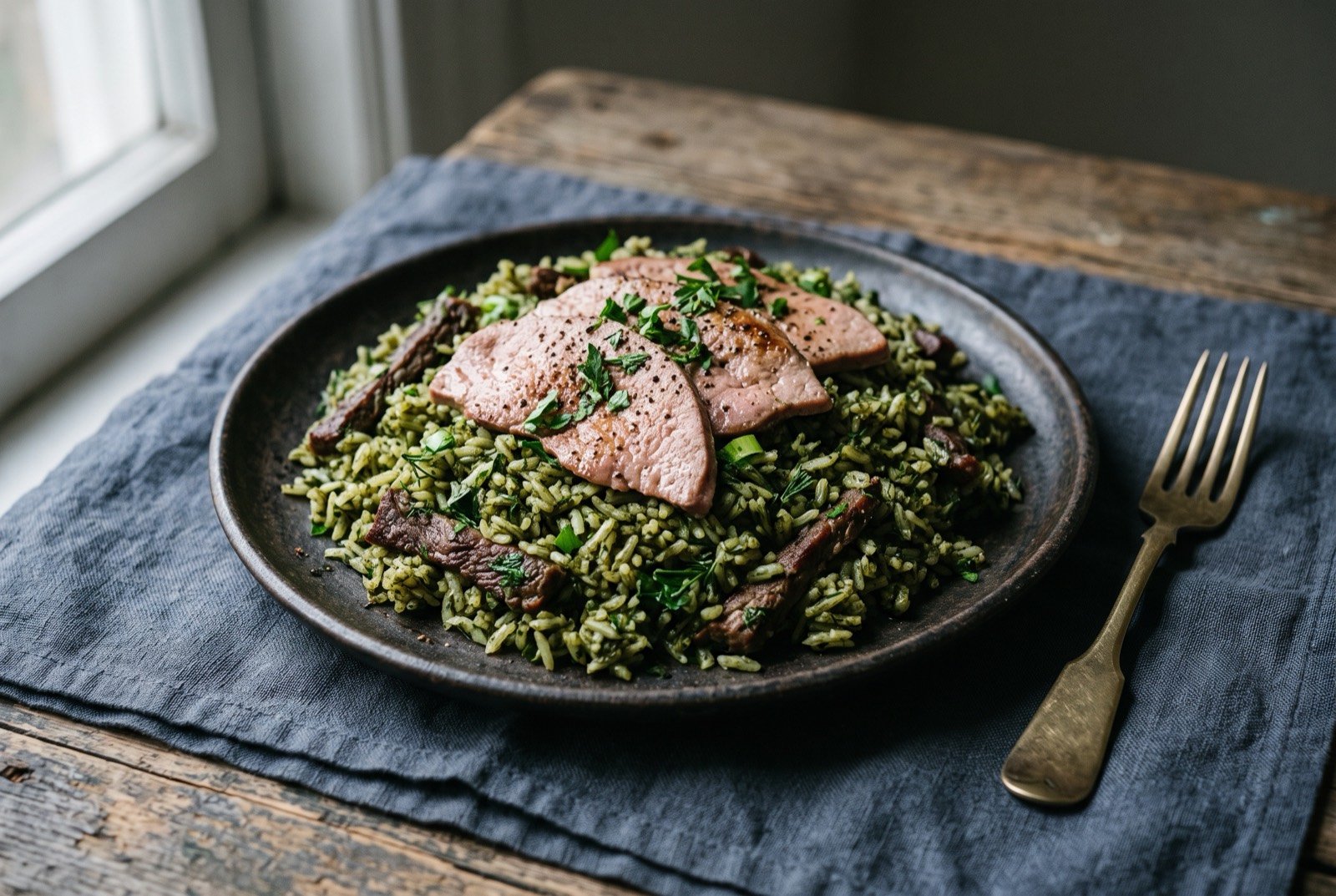
An illustration of the dish, not a photograph of it cooked.
- Time
- 2 hours
- Researched
- 42 sources cited
- Reviewed
- Not yet reviewed from inside the tradition
- Cooked
- Not yet cooked and reported
Bakhsh sits alongside, not inside, the wider Uzbek plov family described above, and this chapter names it as specifically Bukharan Jewish practice rather than folding it into generic "Uzbek" cuisine, following the house rule against letting one community's food speak for another's. Its defining difference from ordinary plov is the total absence of carrot and the inclusion of a large quantity of fresh coriander, which gives the dish both its green colour and its alternative name, "green plov." It is made from beef and beef liver, liver used in a smaller quantity than the meat itself, and both bakhsh and the related Bukharan dish osh-i-sofi use the same rice varieties, alanga or lazer, one of the few real points of overlap between the two (Wikipedia, Бахш (блюдо)); teletype.in; lechaim.ru). Bukharan Jewish cuisine as a whole is described by a specialist Jewish food writer as an ancient tradition grown at the intersection of kashrut law and Uzbek-Tajik culinary culture, a genuinely distinct third culinary current inside Bukhara's own food world (lechaim.ru).
As tradition built it
Serves 6. About 2 hours.
Ingredients
- 500 g alanga or lazer rice (or substitute long-grain rice, see sourcing)
- 500 g beef, cut into strips
- 250 g beef liver, cut into strips
- 2 large onions, finely sliced
- Large bunch fresh coriander, roughly chopped
- Small bunch fresh dill, roughly chopped
- 150 ml vegetable oil
- To taste zira, black pepper, salt
Method
- Heat the oil in a kazan and fry the onion until deeply softened.
- Add the beef and sear until browned, then add the liver, which needs only a few minutes, and remove before it overcooks and turns grainy.
- Return the beef to the pot with water to cover, season with zira, pepper and salt, and simmer for 30 to 40 minutes until tender.
- Stir the chopped coriander and dill through generously; this is what gives bakhsh its name and its colour, and a genuinely large quantity of herb, not a garnish's worth, is correct.
- Rinse the rice, layer it over the meat and herb base without stirring, add water to the correct ratio, and cook by the same method as the plov above: uncovered until the surface water is absorbed, vented, covered, and steamed on the lowest heat for 20 to 30 minutes, then rested before serving.
- Return the reserved liver to the dish just before serving so it stays tender rather than being cooked twice.
What a modern chef changes
A herb sauce and a pink-centred liver
Method
- The herb is processed two ways rather than one: half chopped and folded through as tradition dictates, half blitzed in a high-power blender with a little of the cooking liquid into a bright, smooth herb sauce, spooned over at plating to intensify the colour and flavour the chopped herb alone cannot fully deliver.
- The liver is seared separately at the very last moment and sliced thin over the top, rather than simmered into the pot at all, preserving a genuinely pink centre that liver simmered in stock for even a few minutes cannot achieve, a deliberate, named departure from tradition's fully-cooked liver.
- The beef is cooked sous vide at 58°C for 24 hours before a final sear, for the same reason as in the laghman recipe above: full tenderness with a real seared crust, rather than the compromise a single simmer gives a tougher cut.
- The rice water ratio is set by weight, as in the Fergana plov above, rather than by eye, for the same reasoning given in the technique ladder.