Central Asia and the steppe · Volume 58, The Silk Road Oases
Obi Non (Samarkand Patyr)
Uzbekistan
Illustration
- Time
- 2 hours
- Researched
- 42 sources cited
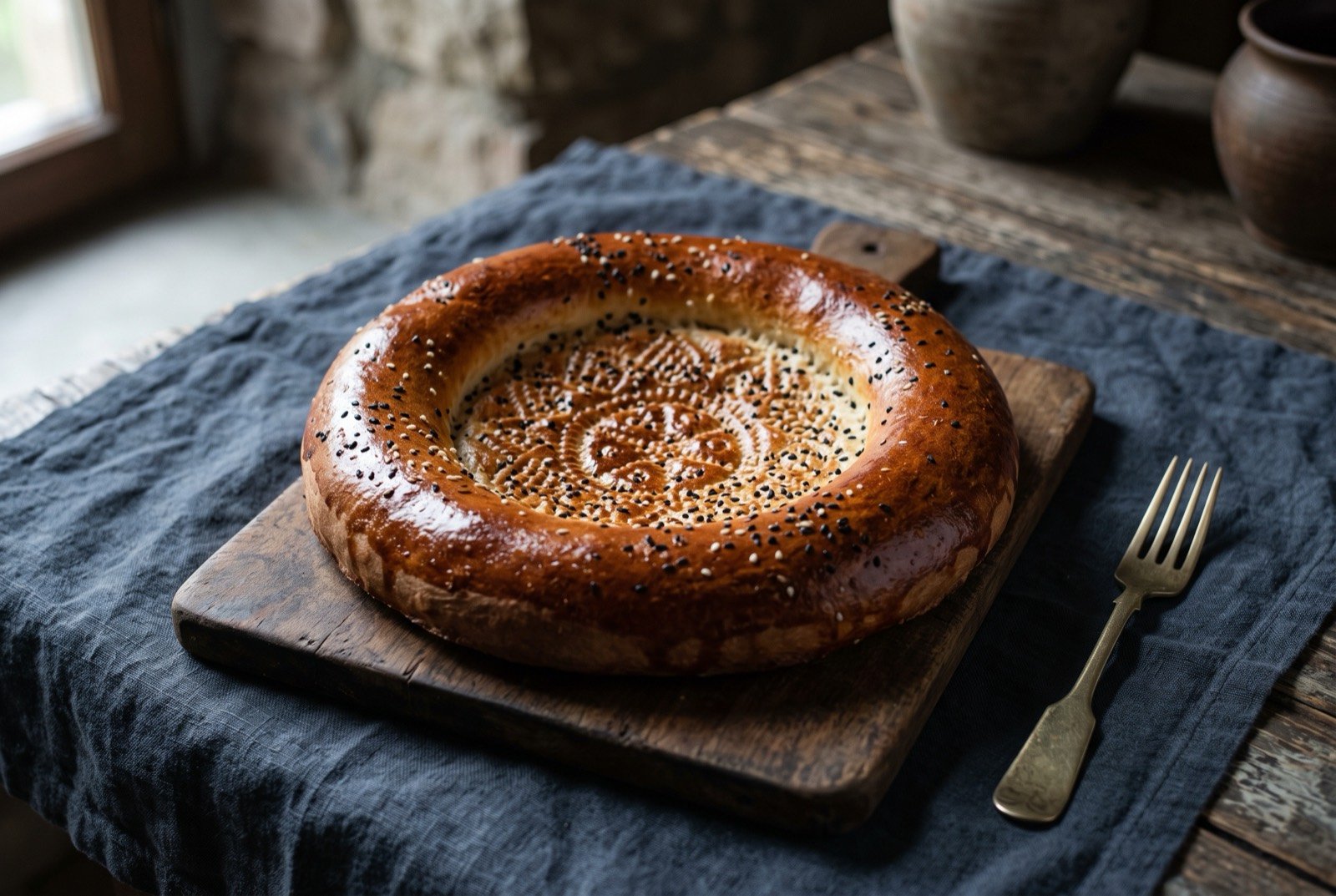
Tandyr-non is the shared Central Asian tandoor flatbread, baked by Uzbek, Kazakh, Kyrgyz, Uyghur and Tajik bakers alike, typically wheat flour, water, yeast, milk and butter or oil, sometimes finished with sesame or poppy seed (Wikipedia, Тандыр-нан). Samarkand's own version, patyr, is a medium, dense, heavy loaf with glossy russet-brown sides and a small central patch dusted with black sesame, specifically noted for its unusually long shelf life compared with other regional non (uzbekistangid.ru).
As tradition built it
Makes 4 loaves. About 2 hours, plus proving.
Ingredients
- 500 g strong white bread flour
- 300 ml warm water
- 7 g dried yeast
- 1 tsp sugar
- 1 tsp salt
- 2 tbsp melted butter or neutral oil
- A scatter black sesame seed, to finish
Method
- Dissolve the yeast and sugar in the warm water and leave until foaming, around 10 minutes.
- Mix into the flour and salt with the melted butter, and knead into a firm, smooth dough, around 10 minutes by hand.
- Prove, covered, until doubled, around an hour.
- Divide into four, shape each into a disc roughly 18cm across, thicker at the edge than the centre.
- Using a chekich, a wooden-handled, metal-studded stamp, or a fork pressed repeatedly in a tight pattern as an honest substitute, dock the centre firmly; this stops the middle puffing up in the tandoor's heat while the rim rises and colours, since the perforations let trapped steam escape from exactly the part of the dough that should stay flat.
- Brush the stamped centre with a little water and scatter with black sesame.
- In a traditional tandoor, the interior wall is sprayed with water and the discs slapped directly onto the vertical clay wall by hand, where they stick and bake on radiant heat once the initial flame has died to embers.
- Bake in a domestic setting on a preheated stone or steel at the highest oven temperature available, 8 to 10 minutes, until the rim is deeply coloured and the centre is fully set.
What a modern chef changes
The Big Green Egg as a tandoor
Rung 2
Method
- The Big Green Egg replaces the domestic oven, run with a platesetter and pizza stone for genuine radiant, dry ceramic heat (Rung 2, adapted for bread rather than rice, since a kamado is architecturally a direct cousin of the clay tandoor). Preheat with the stone in place for a full 15 minutes at maximum temperature, around 260°C; the dough goes directly onto the stone, dome closed, for around 6 minutes. This is closer to a tandoor's radiant-wall mechanism than any flat home-oven stone setup, though a real tandoor runs hotter still and cooks from a vertical wall rather than a flat stone, a genuine limitation this chapter states rather than smooths over.
- The dough is enriched with a small proportion, around 8%, of durum semolina in place of ordinary flour, giving a closer approximation of the dense, long-keeping crumb structure patyr is specifically prized for, rather than the softer, faster-staling crumb plain strong white flour alone produces.
- A poolish pre-ferment, built the night before from a third of the flour, replaces same-day yeast, extending fermentation time and building genuine depth of flavour into a bread whose traditional method already prizes keeping quality over speed.
- The chekich pattern is replaced with a laser-cut docking stamp of the reader's own design, milled from a food-safe hardwood block, restoring the decorative and functional precision of the traditional tool that a fork can only approximate.