Central Asia and the steppe · Volume 58, The Silk Road Oases
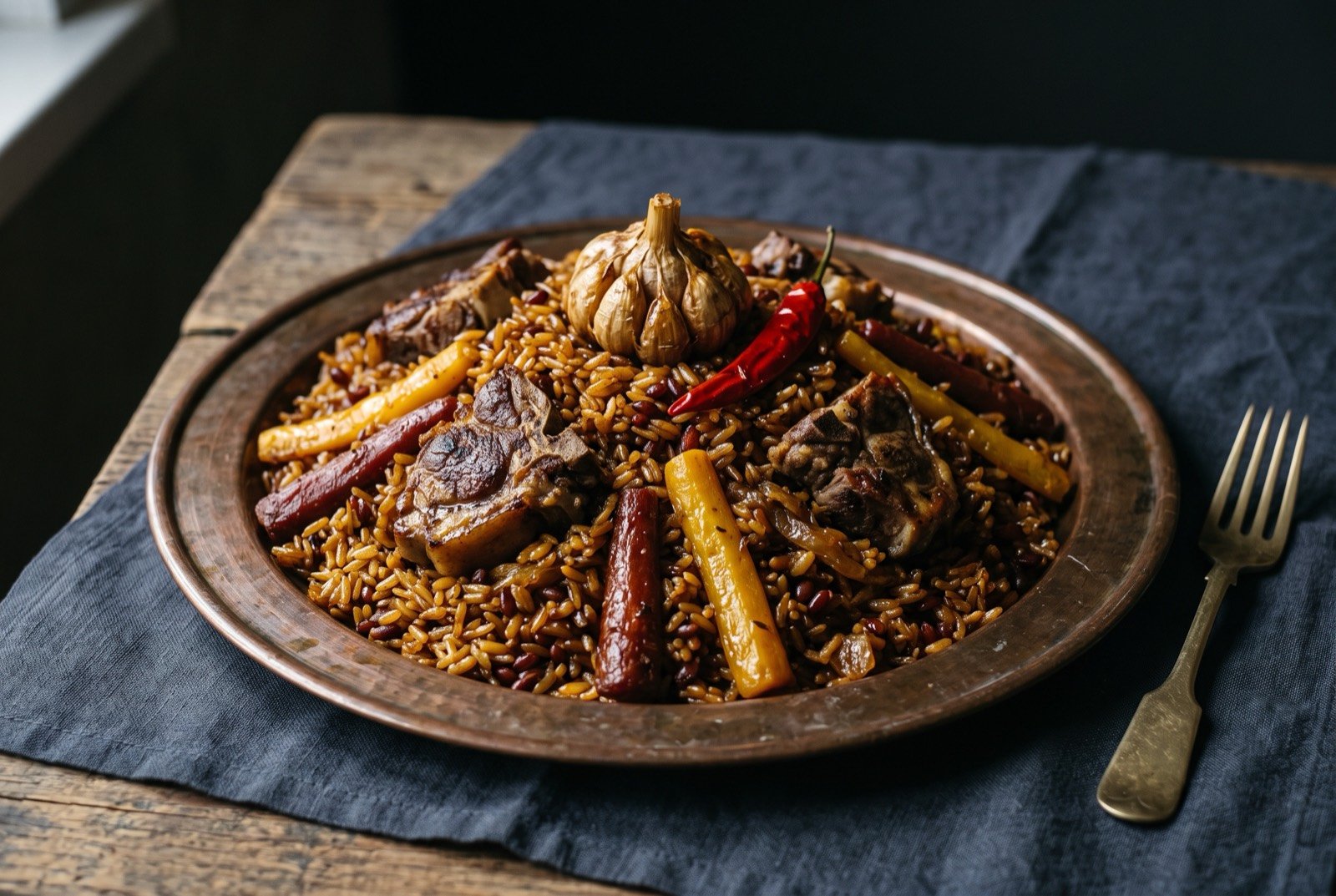
Fergana Kovurma Palov
Uzbekistan
Illustration
- Time
- 3 hours
- Researched
- 42 sources cited
Uzbeks recognise something like 150 regional and occasion-specific plov variants, according to a well-regarded Tashkent culture blog (mytashkent.uz), and this chapter has chosen the Fergana valley's kovurma (fried) style as its full tradition recipe precisely because it is devzira's own home ground and the version most other regional plovs are measured against. It explicitly rejects sweetness: no raisins, only garlic and hot pepper, occasionally chickpea and barberry, and every ingredient is fried hard before water goes in, which is what gives it its characteristic deep brown colour (mytashkent.uz).
As tradition built it
Serves 6 to 8. About 3 hours, including zirvak reduction.
Ingredients
- 1 kg devzira rice
- 1 kg lamb, bone-in shoulder or leg, cut into 4cm pieces
- 1 kg yellow carrot, cut into thick matchsticks, not grated
- 700 to 750 g onion, sliced into half-moons
- 250 to 300 ml cottonseed oil (or a neutral vegetable oil, see sourcing)
- 2 whole garlic heads, outer papery skin cleaned off, left whole
- 1 to 2 whole fresh hot chillies
- 2 tbsp zira (cumin seed), rubbed between the palms just before use
- 1 tbsp dried barberries
- to taste salt
Method
- Wash the devzira five to six times in cold water until it runs close to clear, then soak in warm, heavily salted water (around 60°C) for two to three hours; devzira's unusual density means it will not cook through in the time plov allows without this step.
- Heat the oil in a kazan or a wide, heavy, thin-walled pot until it visibly shimmers, close to smoking point.
- Sear the lamb hard in batches until deeply browned, then set aside.
- Fry the onion in the same fat until deeply coloured, then add the carrot and cook a further 5 to 10 minutes.
- Return the meat to the pot; this is the zirvak. Add water to cover, the zira and barberries, and simmer, loosely covered, for 40 to 50 minutes for lamb, until the liquid reduces to a deep amber and the meat is close to tender.
- Season the zirvak properly with salt now; it will not be adjusted again once the rice goes in.
- Drain the soaked rice and layer it evenly over the zirvak without stirring the two together.
- Add water to a level roughly a fingertip's width above the rice (this rule of thumb is specific to the batch size given here; see the technique ladder above on why it does not scale to smaller quantities). Bury the garlic heads and chillies into the rice.
- Cook uncovered on a fairly high heat until the surface water has been absorbed, then push five or six holes to the bottom of the pot with a spoon handle to vent steam evenly, cover, and drop the heat right down.
- Steam for 20 to 30 minutes without lifting the lid or stirring.
- Rest, covered, off the heat, for a further 15 to 30 minutes.
- Turn out onto a large shared platter, mixing rice, meat and carrot only at this final serving stage, with the whole garlic heads split for guests to squeeze out at the table.
What a modern chef changes
Sous vide zirvak, and the rice by weight
Rungs 1 and 3
Method
- The zirvak moves to sous vide (Rung 1). After the initial hard sear and onion-carrot fry are done conventionally in a pan, bag the meat, fried aromatics, zira and barberries with a measured stock rather than open water, and hold at 80°C for 10 to 12 hours. This extends the same slow reduction the Fergana kazan achieves over two hours into an overnight, unattended process with more even, controllable heat than an open flame, and the collagen in the bone-in cuts breaks down further than an open two-hour simmer typically achieves.
- The rice water goes by weight, not by fingertip (Rung 3). Weigh the rinsed, soaked devzira, then add exactly 1.05 times that weight in the reduced zirvak stock, established once by testing your own pot and hob's evaporation rate, rather than reading a depth off the side of the meat. This removes the single most commonly cited failure point in the whole dish.
- The barberries are rehydrated separately, in a light zirvak-stock reduction, and finished as a discrete garnish spooned over at plating, rather than simmered loose in the zirvak for two hours, which the technique research found tends to blow them out and lose their sharp acidity; this keeps their tartness as a genuine contrast rather than a background note.
- The whole garlic head is roasted separately at 180°C for 40 minutes until fully soft, rather than only steamed inside the rice for its final half hour, then nestled back into the dish at plating; this gives a genuinely sweet, spreadable garlic confit rather than a garlic head that is merely warmed through.