Central Asia and the steppe · Volume 58, The Silk Road Oases
Sumalak
Uzbekistan and Tajikistan, shared
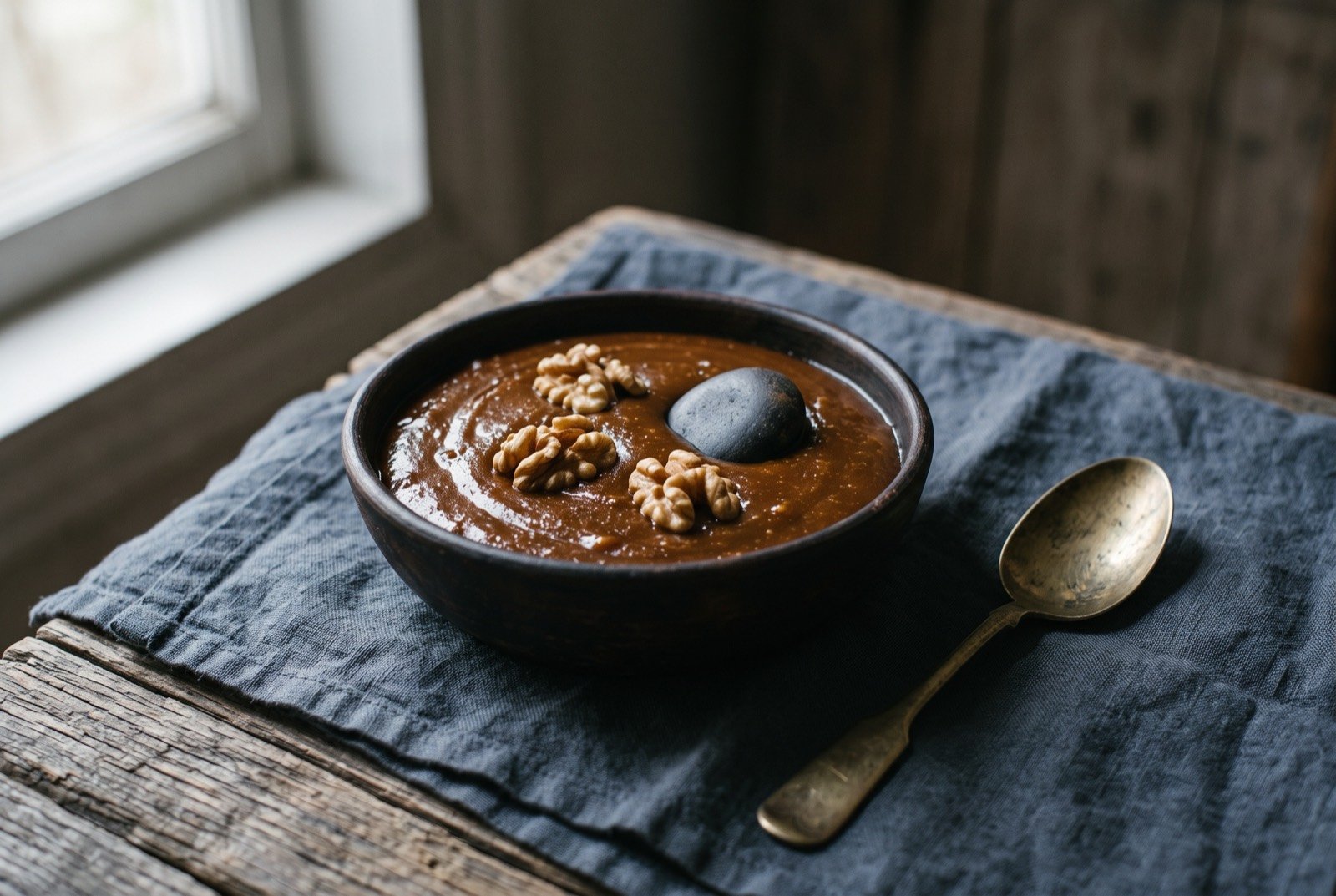
An illustration of the dish, not a photograph of it cooked.
- Time
- 12 hours
- Researched
- 42 sources cited
- Reviewed
- Not yet reviewed from inside the tradition
- Cooked
- Not yet cooked and reported
Sumalak (also sumalyak, sumanak) belongs to both countries' Nowruz table without belonging more to either, and this chapter treats it as a shared spring festival dish rather than assigning it to one side. Preparation begins around two weeks before Nowruz, when women gather communally to sort, wash and soak wheat grain; the whole process from soaking to finished pudding takes around a week. The actual cooking is exclusively women's work: 30 to 40 women stir the sprouted-grain paste continuously through an entire night, roughly 12 hours, in a large kazan over a fire that men are traditionally responsible for building and tending, though excluded from the stirring itself as a bad omen (converging Russian-language sources: centralasia-travel.com; kstrip.ru; your.tj). The finished dish is a thick, sweet, halva-like paste made purely from sprouted wheat with no added sugar; all its sweetness comes from the malted grain. Small clean stones are placed in the base of the kazan before cooking, both to stop the pudding catching and to regulate the heat reaching the pot; whoever finds a stone in their portion may make a wish and keep it as a talisman. This account is genuinely well corroborated, converging independently across multiple sources on the same specific details, the stone, the all-female cooking, the roughly week-long process, which raises confidence in it despite none of the individual sources being an academic citation.
As tradition built it
Makes enough for a communal gathering, roughly 20 to 30 portions. About 12 hours, plus around a week for sprouting.
Ingredients
An outline, not yet a recipe: the tradition's method with its ingredients named but not weighed. Quantities are being added from sources inside the tradition, lead dishes first.
- 2 kg wheat grain, for sprouting
- flour, added gradually during cooking to thicken
- A small handful a small handful of clean, smooth stones
- A little a little oil, to grease the kazan
- for garnish walnuts, for garnish
Method
- Sort and wash the wheat grain, then soak in warm water and leave to sprout in a warm, dark place for several days, rinsing regularly, until the shoots are around 1 to 2cm long.
- Grind the sprouted grain, retaining its liquid, then strain to extract a sweet, cloudy milk from the malted wheat.
- Grease the base of a large kazan with a little oil and scatter in the clean stones.
- Add the strained wheat milk and bring to a simmer, then begin adding flour gradually, stirring continuously, to build a thick paste over the course of the cook.
- Stir without pause, traditionally in shifts among the assembled women, for around 12 hours over a low, steady fire, until the paste has darkened to a deep caramel brown and reduced to a thick, spoonable consistency.
- Distribute into small bowls, walnuts scattered over, and share communally; anyone finding a stone in their portion keeps it and makes a wish.
What a modern chef changes
The sous vide bath replaces the all-night stir
Method
- A sous vide immersion circulator holds the wheat-milk mixture at a fixed, low simmering-equivalent temperature inside a large vacuum-sealed bag or a covered vessel with the circulator running in a water bath around it, rather than a continuously hand-stirred open kazan. This does not replicate the communal ritual, and this chapter says so plainly rather than pretending a machine can substitute for thirty women's labour and its social meaning; what it does replicate mechanically is the even, scorch-free heat the constant stirring exists to guarantee, since a sealed, circulated system cannot catch or separate the way an unstirred open pot would.
- A high-power blender purees the sprouted grain far more thoroughly and evenly than traditional hand-grinding, extracting a cleaner, more complete wheat milk and leaving less fibrous residue behind in the finished paste.
- The flour used to thicken is toasted dry in a pan first, adding a genuine nutty depth that plain raw flour, stirred in only for its starch, does not contribute.
- The stones are omitted from a version intended to be finished and served the same day rather than distributed at a communal gathering, since their function, heat regulation and prevention of scorching across many unwatched hours, is already handled by the sous vide bath's own precision; this is named as a genuine loss of the tradition's own ritual meaning, not merely a practical simplification, and a reader wanting the full dish should keep them in.