Central Asia and the steppe · Volume 58, The Silk Road Oases
Laghman
Uzbekistan, by way of a Uyghur and Dungan origin honestly named
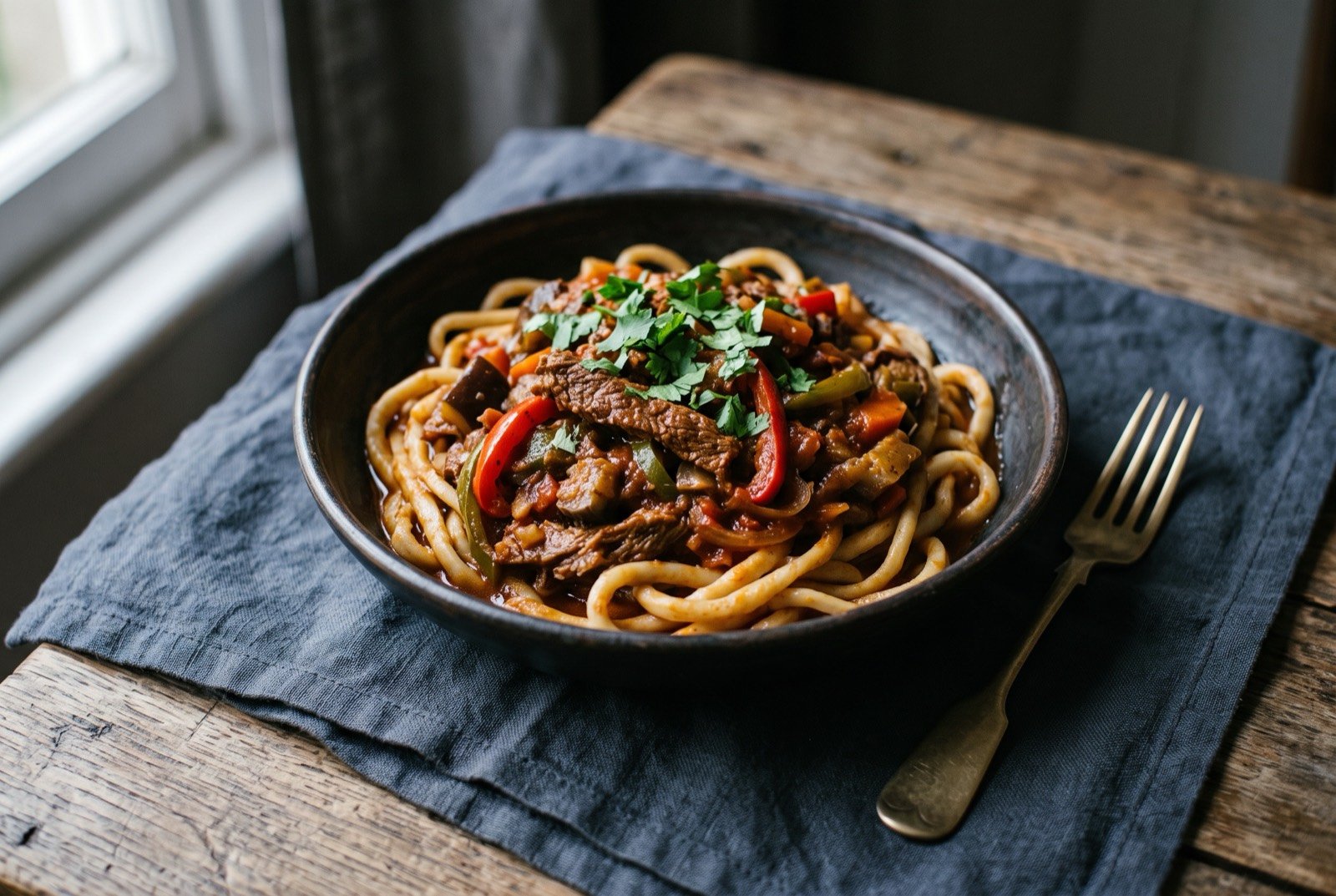
An illustration of the dish, not a photograph of it cooked.
- Time
- 1 hour 30
- Researched
- 42 sources cited
- Reviewed
- Not yet reviewed from inside the tradition
- Cooked
- Not yet cooked and reported
Laghman's roots trace to Eastern Turkestan and are widely attributed to the Dungan people, Hui Chinese Muslims, and the Uyghurs, who carried it into Central Asia as refugees from Qing-era reprisals; Uzbek, Kyrgyz, Kazakh and Tajik laghman are all later, localised derivatives of that original (aggregated Russian-language sourcing, consistent across every source found on the point; znanierussia.ru). This is stated here plainly rather than left implicit: laghman is not an indigenous Uzbek dish, whatever its current place at the Uzbek table, and this chapter does not claim otherwise. It is most strongly associated within Uzbekistan with Bukhara, Samarkand and the Fergana valley, and genuine, traditionally made laghman is cooked in a kazan over an open fire (uzbek-culinar.ru).
As tradition built it
Serves 4. About 1.5 hours, plus dough resting.
Ingredients
- 500 g strong white flour
- 250 ml water
- 1 tsp salt
- As needed vegetable oil, for coating
- 400 g beef, cut into strips
- 2 onions, sliced
- 3 garlic cloves, crushed
- 2 peppers, sliced
- 1 aubergine, diced
- 3 tomatoes, chopped, or 2 tbsp tomato paste
- 2 carrots, sliced
- 2 tbsp vegetable oil, for the sauce
- To taste zira, coriander seed, chilli flakes, salt
Method
- Mix the flour, water and salt into a firm dough, knead for 10 minutes until smooth, then rest, covered, for at least an hour.
- Divide into portions, roll into thick, well-oiled cylinders, the oil stopping the strands sticking to themselves, then pull each by hand into a long, thinning strand, slapping and stretching it repeatedly against the work surface before winding it around both hands to pull further; genuine irregularity in the finished noodle is read locally as a mark of skill rather than a flaw.
- Boil the pulled noodles briefly in salted water until just tender, then drain.
- For the sauce, sear the beef hard in oil, then add onion and garlic, cooking until softened.
- Add pepper, aubergine, carrot and tomato, and simmer with the zira, coriander seed and chilli flakes until the vegetables are tender and the sauce has reduced to a thick, clinging consistency, around 30 minutes.
- Toss the noodles through the sauce or ladle the sauce over a bowl of noodles, in the Uzbek soup-adjacent, wetter style rather than the drier, wok-fried Uyghur guyru laghman.
What a modern chef changes
Sous vide beef and a silkier sauce
Method
- The beef is cooked sous vide at 56°C for 24 hours before a final hard sear, delivering fully tender strips with a genuine seared crust, a texture the quick pan-sear of the tradition recipe cannot reliably achieve on a tougher cut.
- The vegetable sauce is finished through a high-power blender and passed through a chinois for a portion of its volume, then recombined with the remaining whole-cut vegetables, giving the sauce a silkier clinging body without losing the traditional dish's textural variety entirely.
- The noodle dough rests overnight under refrigeration rather than for a single hour, developing the gluten structure further and making the hand-pulling stage noticeably easier and the finished strand more elastic.
- A dehydrator is used to dry a portion of sliced aubergine and pepper to a leathery, semi-dried state before they go into the sauce, concentrating their flavour before cooking rather than relying on the sauce's own reduction time alone to do that work.