Central Asia and the steppe · Volume 58, The Silk Road Oases
Dimlama
Uzbekistan
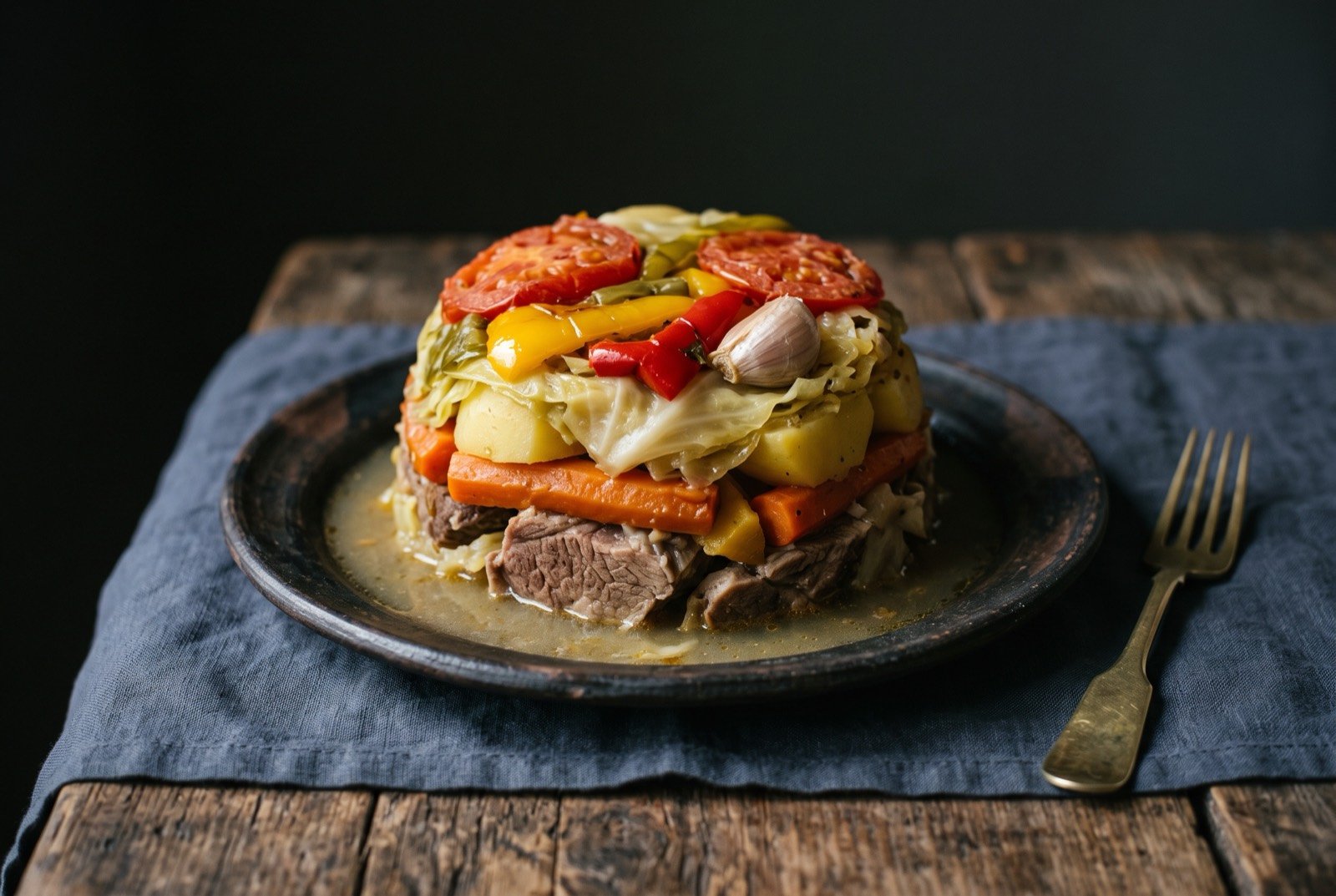
An illustration of the dish, not a photograph of it cooked.
- Time
- 2 hours 30
- Researched
- 42 sources cited
- Reviewed
- Not yet reviewed from inside the tradition
- Cooked
- Not yet cooked and reported
Dimlama (also damlama, dumlyama) stacks large-cut meat and a wide variety of vegetables in layers inside a single kazan and cooks them, essentially without added water or oil, over the lowest possible flame for at least two hours, relying entirely on the vegetables' own moisture. The name derives from Uzbek "dumlash," to steam or braise under cover. What separates it from an ordinary stew, per convergent Russian-language recipe sources, is precisely this absence of added liquid and the sheer number of vegetables layered in (iamcook.ru).
As tradition built it
Serves 6. About 2.5 hours.
Ingredients
- 1 kg lamb, large-cut, bone-in where possible
- 3 onions, thickly sliced
- 4 carrots, thickly sliced
- 4 potatoes, quartered
- 1 small cabbage, cut into wedges
- 2 peppers, sliced
- 3 tomatoes, sliced
- 1 whole garlic head, cloves separated but unpeeled
- To taste zira, bay leaf, black pepper, salt
Method
- Line the base of the kazan with the lamb.
- Layer the onion, then carrot, then potato, then cabbage, then pepper, then tomato on top, in that order, seasoning lightly between layers with zira, salt and pepper, and tuck the garlic cloves and a bay leaf or two into the upper layers.
- Cover tightly and cook over the lowest possible heat, without lifting the lid or stirring, for at least two hours, until everything is fully tender and has released enough of its own liquid to form a light broth at the base.
- Serve by turning the whole stack out onto a platter so the layers are visible, meat at the base, vegetables above.
What a modern chef changes
Sous vide lamb and a reduced broth
Method
- The lamb is cooked separately sous vide at 62°C for 18 hours before joining the stack, guaranteeing a fully tender result independent of how long the vegetable layers above it need, since the traditional single cooking time is a compromise between the meat's needs and the vegetables'.
- Each vegetable layer is blanched briefly and shocked before layering, evening out cooking times between vegetables that would otherwise finish at very different rates inside one sealed pot.
- A Big Green Egg, run at a steady low indirect heat with the kazan or a Dutch oven set on the platesetter, replaces the stovetop, giving a more even, all-round heat than a single stovetop burner under one side of a wide, thin-walled pot.
- The broth that collects at the base is drained off, reduced by half in a separate pan, and spooned back over at plating rather than left to soak passively back into the lowest layers, concentrating a flavour that would otherwise mostly be absorbed unevenly by the meat alone.