The Americas · Volume 10
Jamaica
Pimento Smoke, the Maroon Fire and the Ital Table
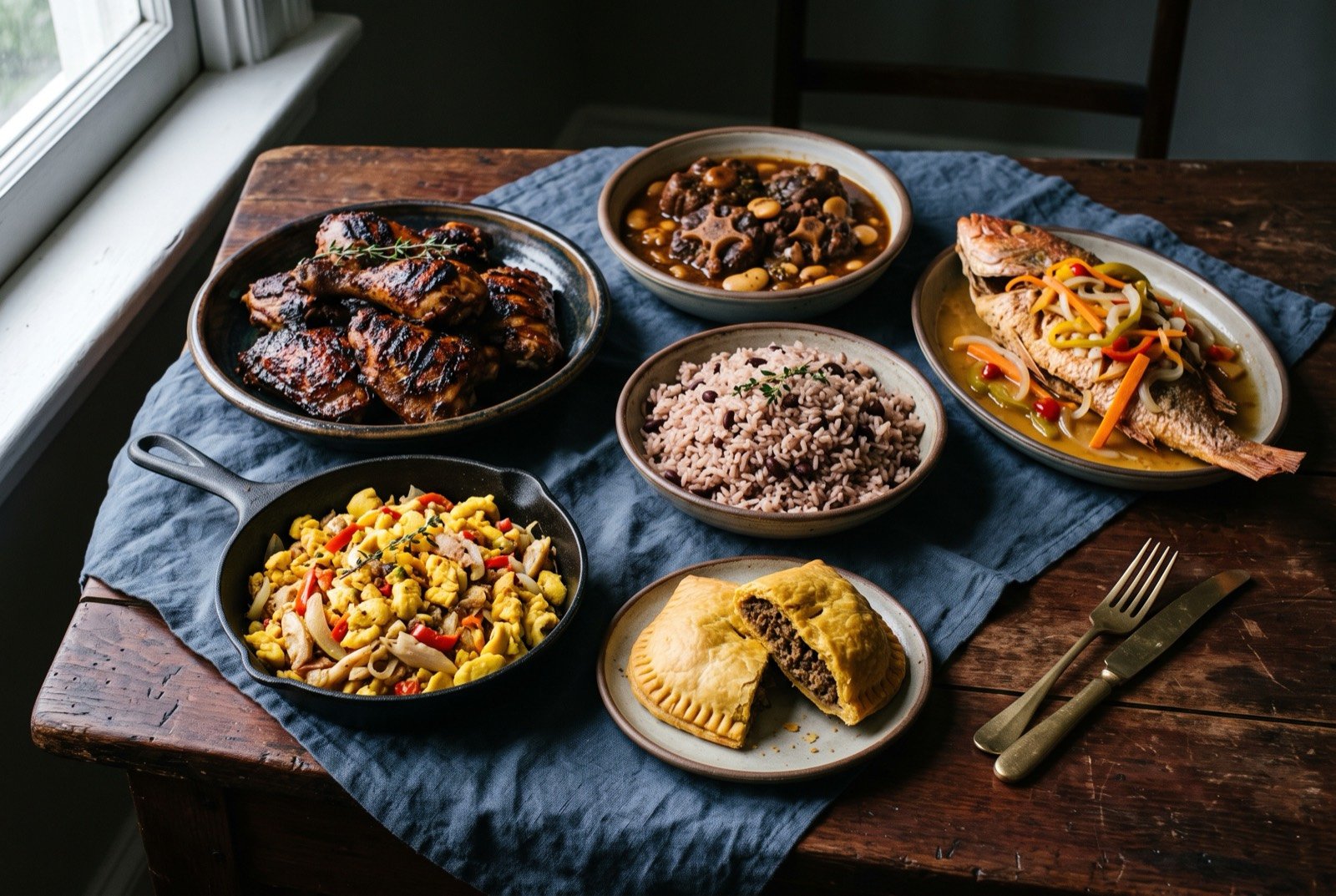
A small island with an outsized reach: jerk, ackee and saltfish and curry goat are known well past any reasonable measure of Jamaica's size, and Britain's own Jamaican diaspora, a community that has been cooking here since the Windrush generation of 1948, makes this one of the best-sourced volumes in the whole atlas rather than one of the thinnest. This chapter treats jerk as what it actually is, a Maroon resistance technology refined in hiding rather than a marinade, gives ackee's arrival its full slave-trade weight rather than folkloric colour, and gives Rastafari Ital cooking its own dedicated space rather than a footnote to the wider table, because it is a distinct, theologically grounded tradition in its own right, not a stricter version of Jamaican food generally. Every dish as tradition built it, then what a modern chef would change.
Sources and review · What this chapter does not assert · How we research · Know this better? Tell us
A Sense of Place
Jamaica packs a genuinely varied ecology into a small island. Mean temperatures run around 33 degrees Celsius at sea level and drop to around 12 degrees in the Blue Mountains; trade winds forced against the mountains deposit well over three metres of rain a year on the eastern parish of Portland, while the south and southwest run hot, dry savanna under a fraction of that rainfall. Fourteen parishes hold ecosystems from elfin forest on the highest peaks, through valley rainforest, to dry cactus-supporting scrub. The southern plains parishes, St Elizabeth, Clarendon and St Catherine, are the country's agricultural heartland, and 85 per cent of Jamaican agricultural holdings today are five hectares or under, a genuine smallholder economy rather than a plantation-scale one. A rough gradient runs through the food that follows from this: Portland, wet and mountainous, is jerk's home ground and the historic heart of Windward Maroon country; St Elizabeth, dry and given over to savanna, is informally but persistently called the island's breadbasket and is the historic heart of Leeward Maroon country and ground-provision farming. This chapter treats that gradient as a reasonable, widely repeated pattern rather than something pinned down by a single rigorous geographic source, because no such source turned up in the research behind it.
Jamaica's first people were the Taíno, whose Arawakan-speaking ancestors are believed to have moved into the islands from the Orinoco basin of what is now Venezuela. The Jamaican government's own Jamaica55 heritage portal, one of the strongest sources this chapter draws on throughout, credits the Taíno with cultivating chilli pepper, cassava, sweet potato, pumpkin, yampi and corn, and fishing more than forty species from grouper to conch. Cassava processing, grating the root on a wooden griddle called a burén, pressing the toxic juice out through a woven funnel basket, baking the dry pulp into a flatbread that kept for months, is the direct technical ancestor of bammy, and this bread's keeping quality is exactly why Spanish and later British colonists adopted it wholesale for provisioning ships and settlers rather than displacing it. The Taíno word barbacoa, the raised wooden grill-and-framework structure that gives English its word "barbecue," is the technical ancestor of jerk's own pit-and-grate logic, a thread this chapter follows in full below. By the time Maroon communities were consolidating in the seventeenth and eighteenth centuries, roughly nine in ten Taíno people had already been lost to Spanish colonisation and disease. The Jamaican scholar Carolyn Cooper's own account, that Maroons "settled among the Indigenous people who survived" and shared culinary tradition with them directly, is why this chapter treats jerk as a genuine three-way fusion rather than a single-origin invention.
Spain's presence in Jamaica runs from Columbus's 1494 landing to formal settlement from 1509, two dates that measure different things and both turn up across the sourcing; this chapter treats "sighted and claimed" and "settled" as distinct rather than picking one arbitrarily. Britain captured Jamaica from Spain in 1655 and held it until independence in 1962. Under British rule the whole food system organised itself around sugar plantation labour: enslaved Africans were issued rationed salt provisions, salt cod, cornmeal, and grew their own food on "provision grounds" in what little free time they had, generally Sunday, which is the direct ancestor both of the modern ground-provision-heavy table and of rice and peas as specifically a Sunday and Christmas dish. Post-Emancipation, full freedom arrived in 1838, the formerly enslaved moved into peasant smallholding and market-selling of ground provisions, and it is this shift, not romantic thrift, that underlies the continued centrality of yam, breadfruit and salted protein on the everyday table.
A table of the defining logic, read as fat, starch, aromatic and protein:
| Element | Everyday Jamaican table | The Rastafari Ital table |
|---|---|---|
| Fat | Coconut oil and milk, vegetable oil, pork lard | Coconut oil only; animal fat entirely absent |
| Starch | Rice, yam, green banana, breadfruit, cassava, cornmeal | The same ground provisions, the shared root of both tables |
| Aromatic base | Scotch bonnet, pimento, thyme, escallion, garlic, salt | The same aromatics with salt sharply reduced or absent, heat and herb doing salt's job instead |
| Everyday protein | Goat, oxtail, chicken, pork, salted or fresh fish | None; pulses, ground provisions and vegetables carry the whole plate |
The History in Layers
Enslaved Africans predominantly from the Gold Coast and Akan region, called Coromantee in period English, brought yam, coco and okra with them and combined these with rationed salted protein in one-pot cooking, using a three-legged iron pot, a grater, a mortar and pestle, and a wooden turn stick for working cornmeal porridge, a technique that survives today in Jamaica's "turned" dishes. Some very thick one-pot soups earned the nickname "jam an stan up," because a spoon would stand upright in them unaided. Enslaved Coromantee people heavily populated Jamaica's northeastern parishes, Portland specifically, the parish famous today for jerked pork, and this demographic thread is the reason this chapter treats jerk's African layer as a documented lineage rather than a spontaneous local invention.
Ackee is the clearest case of a dish arriving as slave-trade cargo rather than colonial policy. Native to tropical West Africa, its name traces to "Ankye" in Twi, the Akan language of Ghana, the same thread that runs through jerk. It travelled to Jamaica via the transatlantic slave trade and is documented on the island by the 1770s, with one vivid, specific claim that it was purchased directly from a slave ship's captain to feed the enslaved population. The botanical name honours Captain William Bligh, who carried ackee plants from Jamaica to Kew Gardens in 1793, on the same general voyage on which he transplanted breadfruit the other way. Breadfruit's own arrival makes a useful, deliberate contrast: it was a calculated colonial transplantation, not organic cargo. Sir Joseph Banks conceived moving Tahitian breadfruit to the Caribbean explicitly as a cheap, high-yield food source for enslaved plantation labourers; Bligh's first attempt on HMS Bounty ended in the 1789 mutiny before delivery, and his second voyage, on HMS Providence, succeeded, delivering 678 surviving seedlings of 2,126 collected in Tahiti, arriving in Jamaica in 1793. Despite the plant flourishing agriculturally, breadfruit reportedly did not become popular in local taste for more than forty years, a genuinely useful corrective to the assumption that a food's arrival and its adoption happen together.
The salt-cod trade is a transatlantic mechanism this chapter refuses to leave abstract. Saltfish was produced in Newfoundland and Nova Scotia and shipped to the British West Indies, Jamaica among them, specifically as cheap durable protein for enslaved plantation labourers; Canadian producers deliberately shifted toward lower-grade saltfish for exactly this market as the trade grew, in effect specialising part of their own economy around supplying slave-labour food. The Jamaica Observer states this plainly in its own words: this legacy comes from the transatlantic slave trade. Salted mackerel and herring travel the same route and the same mechanism, and salted or pickled mackerel specifically, not fresh, is what Jamaican cooks generally prefer for rundown.
After Emancipation, formerly enslaved people largely refused further plantation labour, and Britain answered with two separate waves of indentured migration whose dish-level legacy this chapter keeps distinct rather than blurring together. The first ship carrying Indian indentured labourers, the Maidstone, arrived at Old Harbour Bay on 10 May 1845; by the scheme's end in 1917 or 1921, over 36,000 Indian workers had arrived, most originally from Agra, Bihar and Oudh in what is now Uttar Pradesh, and from Nepal, with more from Madras and Punjab after 1900. Indentured workers were confined to the plantation without a pass, on pain of fines or imprisonment, and suffered yaws, hookworm and malaria at real rates. The direct dish-level legacy is curry goat and the whole Jamaican curry tradition: Indian indentured labourers are credited by Jamaica's own government heritage portal with introducing curry powder and curry technique, plus lettuce, cabbage, cucumber, green beans, roti, wheat flour, aubergine, ginger, and simple equipment, the cast-iron karahi and the flat tawa griddle. Ganja itself is also attributed by multiple sources to this same wave, a thread this chapter deliberately keeps connected to the Ital section below rather than treating as two coincidences.
Chinese indenture, predominantly Hakka migrants, arrived from the mid-nineteenth century, also after Emancipation, initially for sugar plantation labour. Chinese Jamaican cooking is credited with introducing stir-frying, deep-frying, steaming and sweet-and-sour technique to the wider repertoire, and Chinese-Jamaican dried-fish technique, scoring the flesh deeply, salting, sun-drying for weeks, is documented directly by the Jamaican government's own heritage material. Descendants of indentured Chinese labourers went on to establish most of Jamaica's grocery shops and bakeries, which is the documented reason Chinese-Jamaican bakeries remain major producers of the beef patty and coco bread today. A recurring claim that star anise in some Jamaican curry powder blends, and scallion in the beef patty, are Chinese-indenture legacies is presented even by its own sources as speculative rather than documented, and this chapter treats it as contested rather than settled.
Jamaica became independent in 1962. The 1973 oil shock and the trade pressure that followed are widely cited as contributing to a long-term decline in Jamaican agriculture and a heavier reliance on food imports that shapes the modern food landscape; this chapter states that claim cautiously, since the sourcing behind it in this research did not reach a strong Jamaican institutional citation. Jamaica's global culinary reach relative to its size, most visible through jerk, is a genuinely widely repeated claim; the one concrete figure this chapter found, Grace Foods reportedly selling around three million jars of jerk seasoning globally a year, is worth stating as an attributed commercial claim rather than a verified statistic.
Rastafari and the Ital Table
Ital deserves its own space in this chapter rather than a paragraph inside the wider one, because it is not simply Jamaican food with the salt and meat removed. It is a theologically grounded tradition with its own internal logic, its own history, and its own living practitioners, and treating it as a stricter diet rather than a distinct cuisine would misrepresent it.
The word Ital derives from "vital," with the initial letter dropped and re-emphasised as "I," part of Rastafari's wider practice of I-words, I-tal, I-man, I-dren, asserting a unity between the self and Jah. The animating concept behind it is livity: a life force conferred by Jah, present in and flowing through all living things, so that eating, speaking, working and living should raise rather than diminish that force. The strongest theological source this chapter draws on, Joseph Powell's 2021 peer-reviewed study "Ital Hermeneutics," grounded in a month spent living with Rastafari communities in Montego Bay plus further fieldwork in Britain, argues that Rastafari have developed a genuinely distinct method of scriptural interpretation that places the unity of creation at the centre of dietary practice. Ital, on this reading, is a theological method, not a rule list borrowed from vegetarianism and given a new name. It draws on Genesis's herb-bearing seed given as food, and on Levitical cleanliness law, reinterpreted as covenantal obedience rather than legal prohibition.
Salt is not flatly forbidden, and this chapter states the real nuance rather than a flattened version of it. Strict interpretations avoid rock or table salt but permit sea or kosher salt; some Rastafari reject salt entirely; Scotch bonnet and other herbs are frequently used as a salt substitute for heat and interest, in the words of the Kingston restaurateur Yvonne Hope's own published recipes. Meat and fish carry a comparable real range rather than one fixed rule. Strict, vegan Ital rejects all animal products, and the Bobo Ashanti mansion, based at Bull Bay near Kingston, one of the strictest, is consistently described as fully vegan in community settings, additionally avoiding mangoes and sugarcane. The Nyahbinghi mansion allows more individual latitude, vegan, vegetarian or raw-food, with some members eating fish. A widely repeated rule that some Ital-eating Rastafari accept fish only under roughly twelve inches and bearing scales, excluding shellfish and scaleless fish as scavengers, recurs constantly in lifestyle writing but was not traced to a named Rastafari voice or scholar in the research behind this chapter, and should be read as commonly repeated rather than verified.
The distinction worth carrying forward is Dr Jahlani Niaah's own, the coordinator of Rastafari Studies at the University of the West Indies, Mona, and the strongest in-tradition scholarly voice this chapter found: being vegan does not automatically mean being Ital. Ital requires clean, unpolluted nutrition carrying moral, philosophical and spiritual dimensions that reflect the mindset of the person who grew the food, not simply the absence of animal products. Niaah also makes an economic-access argument directly against the Western framing of plant-based eating as an expensive lifestyle choice: Rastafari, in his words, provides veganism as basic and cheap. Strictest interpretations avoid metal cookware in favour of clay, wood, earthenware and calabash, and avoid canned or dried food, an ethic one interviewed Rastafarian, Victor, ties explicitly to avoiding aluminium and plastic as well as tin.
Ital's origin runs through Leonard Howell (1898 to 1981), a street preacher who declared Haile Selassie the Living God in the early 1930s, fusing Marcus Garvey's Pan-Africanist message with a new religious claim. Imprisoned for sedition, on his release in 1940 Howell founded Pinnacle, a self-sufficient commune at Sligoville, St Catherine, where residents farmed communally and grew and traded ganja. The commune's exact size is genuinely contested across sources, anywhere from four hundred acres and over eight hundred people to five hundred acres and several thousand members, and this chapter gives the range rather than a false precision. Howell is also credited with promoting plant-based eating partly under the influence of Hindu dietary practice he observed among Indian indentured labourers, the same population credited elsewhere with bringing ganja to Jamaica in the nineteenth century, a genuinely underexplored Indian-Jamaican thread running through both Ital diet and ganja that this chapter names rather than flattens into a purely Afrocentric invention story. Marcus Garvey's own role was influence, not endorsement: his prophecy of a crowned Black king was the doctrinal seed Rastafari built on when Selassie was crowned in 1930, but Garvey himself, after Ethiopia's defeat by Italy and Selassie's acceptance of British help to regain his throne, came to regard Selassie as compromised.
Ganja functions as a sacrament in Rastafari practice, used in prayer and in reasoning, communal discussion, and is described by scholars as comparable in function, though not in doctrine, to the Christian Eucharist. Niaah describes it as a kind of food-medicine, something you need to understand your own hunger, framing its use through livity rather than as recreational, and it is drunk as tea and used in medicinal mixtures as well as smoked. This is the thinnest-sourced corner of Ital in the research behind this chapter: no named recipe, cook or in-tradition source giving quantities or method for a ganja-infused dish or tea turned up, and this chapter states that gap plainly rather than inventing detail to fill it.
The kitchen gardens and multi-acre plots common among Rasta communities are described, as a strong interpretive frame this chapter holds without treating it as a fully documented fact-chain, as direct descendants of the same provision grounds plantation owners once set aside for enslaved people, with Ital eating read as a deliberate return to that self-sufficiency. Pinnacle itself is repeatedly described as a full self-sufficiency experiment, communal farming, ganja cultivation and trade, and deliberate severance from the colonial cash economy. This thread continues in living voices today. David, owner of King David's Ital Restaurant in Half Way Tree, Kingston, who adopted Rastafari as a teenager, states plainly: "When you praise Haile Selassie your eating automatically has to change," and separately criticises Jamaica's continued dependence on imported, chemically treated produce. Shane Morgan, of Life Yard, a downtown Kingston community urban farm and cultural education enterprise growing ackee, plantain, tomatoes, callaloo, Scotch bonnet and green banana, frames the work explicitly as community self-reliance and cultural education together, not food production alone. Brenton "Johnny Ras" Campbell, a small, unbranded Ital cook in Gutters, St Catherine, cooks Ital stew, steamed callaloo and vegetable chunks over an open coal-stove flame, a useful counterweight to the restaurant framing above: Ital as everyday practice, not only a dining-out philosophy.
In London, Zionly Manna Vegan Rastarant on Rye Lane, Peckham, run by Jahson Peat, is the clearest and most directly self-identified Rastafari-run venue this chapter found. Peat states it in his own words: "I'm a Rastafarian and within Rastafarian teachings, there is a saying: 'Eat not flesh.' Long before we called it vegan, we said it was Ital." A university journalism piece makes the case that Ital, practised from the 1930s, can be read as predating the 1944 coinage of the word "vegan" by roughly a decade or more, and that Western veganism's usual pioneer narrative obscures older plant-based traditions, Ital among them; this chapter treats that as a reasonable, repeated interpretive claim rather than something independently verified against a primary historical source.
Rasta pasta is not a genuine Ital dish, and this chapter checked rather than assumed. It was invented in 1985 at Paradise Yard restaurant in Negril by chef Lorraine Washington, who was neither Jamaican-born nor Rastafarian, made as fettuccine with red sauce and ackee for a crew of construction workers; the red, green and gold colour association with the Rasta flag earned it the nickname from a worker present. It combines Jamaican jerk seasoning with Italian cream-pasta technique, an explicit fusion invention, not a traditional or theological dish, and this chapter states that plainly given how widely and wrongly it circulates as Rastafari food.
The Flavour Arsenal
Scotch bonnet traces via the Taíno and Carib route from the Orinoco valley into the Antilles and is now grown across all fourteen Jamaican parishes, a major agricultural export as well as a domestic staple.
Pimento, allspice, is Jamaica's other defining flavour and its own genuine claim on the world stage: the island is the world's primary allspice source, historically holding close to a monopoly and exporting around five thousand tons a year at its historic peak, and Jamaican pimento is credited with genuinely superior oil content compared with wild-harvested Central American fruit. The industry is under real, current strain worth naming plainly rather than treating pimento as an unchanging fact of the island: Jamaica imported pimento for the first time in its history in 2017, 2020 to 2022 brought severe drought followed by heavy rain, and Hurricane Beryl struck major pimento parishes in 2024.
Callaloo, the distinction this chapter has to get exactly right. In Jamaica callaloo means Amaranthus viridis, green amaranth, a true leafy amaranth steamed simply with garlic, onion, scallion, thyme, tomato, Scotch bonnet and pimento, with or without saltfish. This is botanically and structurally distinct from callaloo in the eastern Caribbean, Trinidad and Tobago, Grenada, St Lucia among them, where the same word names a thick soup built from dasheen or taro leaf with okra, coconut milk and often crab. A dedicated academic paper exists on exactly this distinction, "Jamaican Versions of Callaloo," confirming it as a real subject of scholarly attention rather than casual repetition.
Yam in Jamaica means several genuinely distinct cultivars, not one tuber: St Vincent, Lucea, Yampie, Renta, Sawf, Negro, White and Afu, or yellow yam. Yellow yam originates in Africa and reached the Caribbean via the slave trade; Negro yam, a cross between yellow and taw yam, whitish and firm raw but soft and delicately flavoured cooked, is specifically associated with Hanover parish and the town of Lucea, from which it was exported to Colón in Panama and to Cuba through the nineteenth and early twentieth century, a real, concrete data point for the peasant export economy this chapter describes above.
Sorrel, the hibiscus Hibiscus sabdariffa, used for Jamaica's ruby-red Christmas drink, is called bissap in West Africa and flor de Jamaica in Mexico; botanists are genuinely divided between a West African origin, with evidence for domestication in western Sudan as early as 4000 BCE, and an Asian one. It reached Jamaica via the slave trade, carried by enslaved Africans who already had cultivation knowledge, and was established on the island by around 1700. Each household is said to keep its own recipe, served over Christmas as a hospitality ritual.
Gungo peas, pigeon peas, native to India, were adopted by enslaved Africans as a substitute for cowpea, the traditional West African legume that was scarcer in Jamaica; they ripen around November and December, which is the documented reason gungo-pea rice and peas is specifically the Christmas dish, with kidney bean rice and peas as the everyday and Sunday standard.
Salted mackerel and herring are distinct from saltfish, salt cod, but trace to the same transatlantic mechanism of cheap durable preserved protein; red herring, historically eaten more often plain, survives mostly today as solomon gundy.
The Technique Ladder
The argument, from inside
Six techniques, each explained by why it works.
Rung 1. Jerk's smokeless pit, and its drum successor
Maroons developed jerk specifically as a smokeless or low-smoke underground pit method so that pursuing British forces could not see cooking smoke and locate their camps; wild boar was seasoned with pimento berries, salt and small hot peppers, wrapped in pepper elder leaves and cooked over dying embers, the meat sealed in by earth on every side but the vent. By the 1950s cooks adapted this same principle onto discarded oil drums, split lengthwise and hinged into a lidded cooker, with sheets of galvanised zinc laid over the grill trapping smoke so the meat steams as it smokes, the source of jerk's characteristically moist, tender result rather than the dry finish of Western barbecue smoking. Named modern practitioners burn out a new drum first specifically to eliminate oil and tar residue, then run pimento wood chips to cook, topping the drum with coal afterward to keep it heated through the day.
Rung 2. Escovitch pickling
Fried fish is covered in a hot vinegar sauce, bell pepper, onion, carrot or chayote, Scotch bonnet, pimento berries, thyme and sugar, simmered briefly then left to marinate overnight before serving, a genuine curing step rather than a garnish poured on at the table.
Rung 3. Dutch pot stewing
The semicircular, heavy cast-aluminium or cast-iron pot central to Jamaican home cooking distributes heat evenly and seals in moisture under its tight-fitting lid; in-community sources are consistent that the same dish cooked in a different pot is simply not the same, a genuinely load-bearing claim about kit rather than an aesthetic preference.
Rung 4. Jerk seasoning as wet marinade, not dry rub
In Jamaica, jerk seasoning properly means a fresh wet paste, scallion, thyme, Scotch bonnet and pimento blended together, traditionally by mortar, today often by processor, not a dry spice mix shaken from a jar. Fresh ingredients are consistently preferred over dried or powdered equivalents, and the balance principle worth carrying into any kitchen is this: if the dish tastes only hot, it is not authentic jerk. Heat has to sit inside sweetness and herbal freshness, not instead of them.
Rung 5. Toasting whole spice fresh before grinding
Reported, though not independently confirmed in exact wording, as Miss Lily's own technique in New York, and consistent with the wider, well-corroborated principle that fresh, whole spice consistently outperforms pre-ground in Jamaican cooking: toast pimento berries and curry spices briefly before grinding, rather than reaching for a jar of the pre-ground equivalent.
Rung 6. Cassava detoxification
Bitter cassava's toxic juice is pressed out through a woven basket after grating, a mechanical extraction rather than a cooking step, and this is the technology, inherited whole from the Taíno, that makes bammy possible at all: the root is genuinely dangerous raw, and the same pressing principle that makes bammy safe is what makes cassava a viable staple crop across the whole Caribbean and much of West Africa.
The Ferment and Preserve Bench
Two techniques, each a genuine preservation technology this island's history actually depended on.
Escovitch pickling. Covered in full above: fried fish held in a hot vinegar, pepper and pimento pickle, rested overnight, a real curing step that once meant the difference between a day's catch spoiling and a week's food holding through the heat.
Solomon gundy. A spicy pickled and salted fish pâté, traditionally made with smoked red herring and chilli, served with crackers. The name likely derives from the British "salmagundi," appearing in English recipe books from the seventeenth and eighteenth century; a popular but unverified tradition holds it began as a pirate-ship dish. Its Jamaican form is genuinely distinct from the plain pickled herring still called Solomon Gundy in Nova Scotia today, an interesting echo of the same transatlantic saltfish trade route this chapter follows throughout.
Sourcing in Britain
Britain's Jamaican diaspora, dating to the Windrush generation from 1948, is reflected in a genuinely deep sourcing infrastructure, confirmed directly rather than assumed thin. Brixton remains the anchor: Nour Cash & Carry, run by Saja Shareen and family for more than thirty years and recently moved to a larger unit in Granville Arcade, stocks cassava, yam, saltfish and ackee; Glory Afro Caribbean and the Latin & Caribbean Food Store trade alongside it in Brixton Village. Ridley Road Market in Dalston carries specialist Caribbean produce among over 150 stalls, with jerk chicken sold directly from street vendors. Outside London, B R B Supermarket in Bristol's St Pauls has traded since 1999, Home From Home Foods in Wolverhampton since 1976, and A A Afro Caribbean Foods runs branches in both Nottingham and Leeds. Notting Hill and Ladbroke Grove are now stronger on restaurants than on year-round grocers, a real gap this chapter names rather than papers over with an invented shop.
Grace Foods, founded 1922, is the dominant brand, confirmed at Tesco, Sainsbury's, Asda, Morrisons, Co-op and Waitrose: jerk seasonings, canned ackee, coconut products. Dunn's River and Walkerswood sit alongside it at the same mainstream shelf level. Betapac curry powder and Tropical Sun's dried sorrel and whole pimento remain specialist-shop and online territory rather than supermarket staples.
Pimento wood for smoking required real checking rather than assumption, and the finding is genuinely useful. It is not the hard gap a first guess might assume. FireFly Barbecue sells pimento wood chunks and leaves, imported by airmail directly from Jamaica under a Jamaican government heat-treatment export certificate, expensive and low-volume but real and currently buyable, alongside branded pimento wood chips on Amazon UK. A widely repeated claim that pimento wood is subject to international endangered-species export restrictions is not corroborated by the certificate-based process suppliers themselves describe, and this chapter does not repeat it. The honest verdict: real, named, genuinely buyable, a case of "yes, but expensive and airmailed" rather than either "freely available" or "impossible."
Saltfish: Cawoods and Sunshine brands, dry salted, skinless and boneless, recur across every UK Caribbean retailer, and Cawoods is stocked directly by Sainsbury's, so this is not solely a specialist-shop item. Ackee's legal status is worth stating clearly rather than apologetically: canned Grace or Dunn's River is fully legal and stocked in mainstream supermarkets without restriction; fresh, unprocessed ackee is the restricted item specifically because of the hypoglycin A risk described above, and no legitimate fresh-ackee import channel into the UK exists, a caution that follows directly from the toxin rather than an arbitrary customs rule. Callaloo in its true, fresh amaranth form is a genuine specialist-only item, Island Fresh among the very few confirmed UK importers; tinned is the realistic fallback, and spinach, though widely used, is a botanically different plant and should be presented as a compromise, not a like-for-like swap. Yam demands real specificity: UK Caribbean grocers stock several genuinely distinct tubers, and this chapter's own recipes above mean yellow yam specifically, not "a yam" and never sweet potato, which is an entirely different plant. Escallion, distinct from and, per Jamaican cooks themselves, more flavoursome than supermarket spring onion, needs a Caribbean grocer; spring onion is a workable but not equivalent stand-in. Goat is available through The Black Farmer's own farm shops in Brixton and White City with UK-wide chilled delivery, alongside halal butchers in areas with South Asian and Caribbean populations. Wray & Nephew White Overproof rum, 63 per cent, is stocked directly by both Sainsbury's and Tesco, a genuinely mainstream product rather than a specialist import.
Kit. Real cast-aluminium Dutch pots are available from Sous Chef UK, a legitimate specialist cookware retailer, and from Etsy UK listings made in Jamaica directly; a real practical caveat worth passing on is that cast aluminium is not suitable for induction hobs. AJC Metals has manufactured jerk pans in the UK for over nineteen years, from recycled oil drums in both a standard and a smaller "Baby" size, the most credible, long-established named supplier this chapter found for a genuine, if small, UK trade category.
The single decision that matters most. Real Jamaican pimento wood over hickory or any generic substitute, for exactly the same reason merkén over paprika mattered in Chile: it underpins jerk, and jerk, properly understood, is defined as much by fuel as by seasoning. A Scotch-bonnet-and-allspice chicken cooked without pimento wood is, by the tradition's own internal logic, not really jerk at all, however faithfully the marinade is built.
Voices and Sources
Jamaican institutional and press sources: the Jamaica55 government heritage portal, the strongest single source this chapter draws on throughout, for the Taíno substrate, the indenture waves and the flavour arsenal; the Jamaica Information Service and the National Library of Jamaica's own archival Indentureship Collection for the 1845 Maidstone arrival and the wider indenture record; the Jamaica Observer for the salt-cod trade's own direct framing as a slave-trade legacy; Portland's own municipal corporation for Maroon history.
Jamaican scholarly and in-tradition voices: Carolyn Cooper, University of the West Indies, on jerk's Taíno-Coromantee fusion and on the impossibility of packaging real jerk for mass consumption; Dr Jahlani Niaah, coordinator of Rastafari Studies at the University of the West Indies, Mona, the strongest scholarly voice this chapter found on Ital specifically; Joseph Powell's peer-reviewed "Ital Hermeneutics" (2021), grounded in real fieldwork in Montego Bay; named Jamaican Rastafari restaurateurs and farmers speaking in their own words, Yvonne Hope of Ashanti Oasis, David of King David's Ital Restaurant, Shane Morgan of Life Yard, and Brenton "Johnny Ras" Campbell.
Modern chefs: Gariel Ferguson of The Rib Kage Bar & Grill, Kingston, on jerk authenticity; Craig Wong of Patois, Toronto, whose classical French and Chinese training applied directly to Jamaican-Chinese food is the clearest documented technique bridge this chapter draws on; Nathaniel Mortley of 2210 by NattyCanCook in Herne Hill, the best-documented current London chef in this research, worth reading with the honest flag that his heritage is pan-Caribbean, Guyanese, Bajan and German-Jewish, rather than solely Jamaican, even as his menu draws heavily on Jamaican jerk technique; Tarell McIntosh of Paradise Cove, Battersea, whose menu carries a dedicated Ital section, a real bridge between this chapter's two halves.
On not conflating Caribbean with Jamaican: the British-Antiguan chef Andi Oliver's own frustration that British audiences habitually call all Caribbean food "Jamaican food" is worth carrying forward directly, since several of the London venues named in this chapter, Cottons among them, are explicitly pan-Caribbean rather than Jamaican specifically, and this chapter has tried not to claim London's Jamaican restaurant scene is more monolithic than it is.
On UK sourcing specifically: Riaz Phillips, author of Belly Full: Caribbean Food in the UK, and Melissa Thompson, author of Motherland: A Jamaican Cookbook, are named here as the strongest identified UK-Caribbean voices for exactly this subject; this chapter reached only descriptions of both books rather than their full text, and a future pass should read them directly rather than relying on secondary listings.
Things this chapter has deliberately not asserted
- That "godmother of Jamaican cuisine" is a formal, widely used honorific for Norma Shirley. The sourced quote behind it is personal and informal, "aunty Norma" among people close to her, not a culinary-world title.
- That the 1738 date for the Leeward Maroon treaty at Accompong is settled history. A Jamaican press headline found directly in this research appears to actively contest whether a formal treaty was signed there at all, and this chapter names that live disagreement rather than repeating the tourist-board version as fact.
- That any single numeric ratio for jerk marinade is "the" traditional formula. None survives in any source this chapter could locate; every ratio found traces to a named modern cookbook, chef or diaspora recipe site.
- That star anise in some Jamaican curry powder blends, or scallion in the beef patty, are confirmed Chinese-indenture legacies. Both claims are presented even by their own sources as speculative rather than documented.
- That the "fish under twelve inches with scales" rule for Ital fish-eating is a settled, sourced tenet. It recurs constantly in lifestyle writing and was not traced to a named Rastafari voice or scholar.
- That Rasta pasta is a traditional or theological Ital dish. It is a documented 1985 commercial invention by a non-Jamaican, non-Rastafarian chef.
- That the exact size of Leonard Howell's Pinnacle commune can be given as a single figure. Sources genuinely diverge between roughly four hundred and five hundred acres and between roughly eight hundred and several thousand residents.
- That any Michelin recognition, star, Bib Gourmand or recommended listing, exists for a Jamaican or Caribbean restaurant in London. None was found in this research, stated here as a finding this chapter treats as provisional rather than final, since a deeper search could yet reverse it.
- That any specific ganja-infused Ital dish or tea, beyond the general sacramental and medicinal framing, can be given with real detail. No named recipe or in-tradition source with quantities or method was found.
- That British mercantile presence in nineteenth-century Jamaica, or the post-1962 shift toward food-import dependency, can be stated with the same confidence as the rest of this chapter's economic history. Both rest on weaker sourcing than the claims around them and are stated cautiously rather than flatly.
Jerk's smokeless pit, and its drum successor
Maroons developed jerk specifically as a smokeless or low-smoke underground pit method so that pursuing British forces could not see cooking smoke and locate...
Escovitch pickling
Fried fish is covered in a hot vinegar sauce, bell pepper, onion, carrot or chayote, Scotch bonnet, pimento berries, thyme and sugar, simmered briefly then...
Dutch pot stewing
The semicircular, heavy cast-aluminium or cast-iron pot central to Jamaican home cooking distributes heat evenly and seals in moisture under its tight-fitting...
Jerk seasoning as wet marinade, not dry rub
In Jamaica, jerk seasoning properly means a fresh wet paste, scallion, thyme, Scotch bonnet and pimento blended together, traditionally by mortar, today often...
Toasting whole spice fresh before grinding
Reported, though not independently confirmed in exact wording, as Miss Lily's own technique in New York, and consistent with the wider, well-corroborated...
Cassava detoxification
Bitter cassava's toxic juice is pressed out through a woven basket after grating, a mechanical extraction rather than a cooking step, and this is the...
The dishes
- Jerk pork and chicken Portland, Jamaica
- Ackee and saltfish Jamaica
- Curry goat Jamaica
- Escovitch fish Jamaica
- Jamaican beef patty Jamaica
- Rice and peas Jamaica
- Oxtail Jamaica
- Rundown Jamaica
- Mannish water Jamaica
- Bammy Jamaica
- Ital stew Jamaica
Sources and review
Where this volume comes from
4 research briefs on file for this volume, researched to the rules on How we research. Published 3 September 2026. Last changed 8 September 2026.
The brief's own account of its sources
The general-tradition pass drew on a genuinely strong core of Jamaican institutional sourcing: the Jamaica55 government heritage portal was the single best source found across the whole brief, corroborated independently by the Jamaica Information Service, the National Library of Jamaica's own archival Indentureship Collection, and Portland's own municipal corporation on Maroon history.