The Americas · Volume 11
Trinidad and Tobago
Two Kitchens Built by Indenture
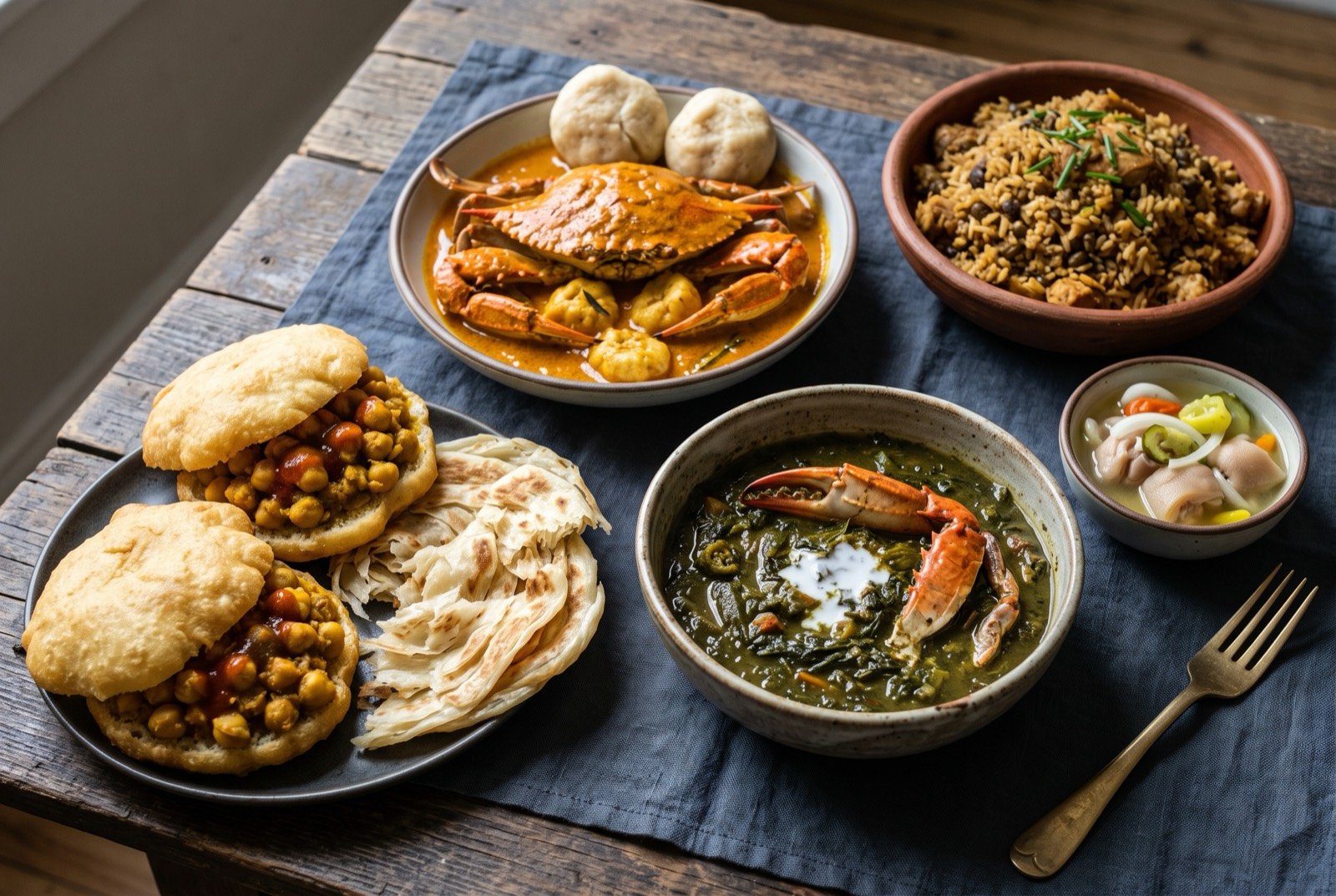
Two islands, two food histories that never fully merged. Trinidad's African-descended cooking, callaloo, souse, bake and shark, the whole Carnival street-food economy, sits beside a genuinely separate Indo-Trinidadian tradition, doubles, dhalpuri, curry built the Trinidad way, carried by indentured labourers from Bihar and eastern Uttar Pradesh from 1845 onward. This is the deepest Indian-indenture layering anywhere in the Caribbean, and this chapter gives both traditions real, separate weight rather than treating one as a footnote to the other. Every dish as tradition built it, then what a modern chef would change.
Sources and review · What this chapter does not assert · How we research · Spotted something wrong?
A Sense of Place
Trinidad and Tobago is one country and, culinarily, closer to two countries than one island's worth of regional variation. The distinction that matters here is not geography, the two islands sit eleven kilometres apart across the Bocas, it is which population built which repertoire, and how completely those two repertoires still stand apart on the same table.
Trinidad: the larger island, and the site of the deeper mixing
Trinidad was Spanish from 1498 to 1797, then British by capture, formalised by the Treaty of Amiens in 1802. Its plantation economy, unlike Barbados's or Jamaica's century-old sugar monocultures, was young and genuinely diversified: by 1796 the island had over 450 estates, 159 sugar, 60 cocoa, 130 coffee, 103 cotton. Britain imported over 25,000 enslaved Africans between 1797 and 1808 to work them. The 1813 slave registration, the earliest and most detailed of its kind in the British Caribbean, recorded the African-born population's origins in real ethnic detail: Igbo were the largest single group, 2,863 of 13,984, followed by Kongo, Ibibio and Malinke, with people from the Bight of Biafra making up roughly 39 per cent of the total. That register matters for this chapter because it lets a claim like callaloo's Kimbundu name, below, be traced to an actual documented population rather than a generic "West Africa."
Onto this, from 1845, Trinidad received the largest wave of Indian indentured labour anywhere in the Caribbean, discussed in full below. The result, on one island, is two food traditions that developed side by side for over a century without ever fully absorbing each other, a fact the 1957 fieldwork of the anthropologist Arthur Niehoff makes vivid: working in the Indo-Trinidadian town of Penal, he found Indian food had spread so far into general Creole cooking that when he asked Afro-Trinidadian communities where many of their dishes came from, "they had little idea they originated in Indian kitchens." Two traditions, thoroughly entangled in the pot, still separable at the root.
Tobago: the smaller island, the harder colonial history, the more purely African-descended table
Tobago's colonial history is markedly more fractured. The island changed hands repeatedly between the British, French, Dutch and Courlanders before being ceded to Britain for the last time by the Treaty of Paris in 1814, sugar planting under British control dating properly from 1763. Indian indentureship, concentrated almost entirely on Trinidad's sugar estates, appears to have reached Tobago only faintly, no source found for this chapter gives a Tobago-specific settlement figure, and the island's food today reads as considerably more purely African-descended than Trinidad's as a result. Historian Dr Rita Pemberton of the University of the West Indies, St Augustine, has written the fullest account of how that repertoire formed: after emancipation in 1838, self-sufficient household yards, banana and plantain stools, sweet potato beds, yam banks, cassava rows, produced what she calls "a flowering of food traditions", oil down, sancoche, pigeon peas soup, corn soup, cookup, curried pigeon peas, cassava cou-coo, tripe soup, sweet potato pone and souse among them. Where curry appears in Tobago's own repertoire, in curry crab and dumpling below, this chapter treats it as a real question rather than a settled one.
The defining logic, read by tradition rather than by island
| Element | African-descended (Trinidad and Tobago) | Indo-Trinidadian |
|---|---|---|
| Fat | Coconut oil and milk, salted pigtail rendered into the pot | Ghee historically, now vegetable oil; coconut milk in curries and pelau |
| Starch | Rice, cornmeal, ground provisions, cassava, dasheen | Wheat flour for every roti, imported rather than grown, plus rice and split peas |
| Aromatic base | Green seasoning, chive, celery, pimento, thyme, garlic | Curry powder pre-blended and roasted in oil, geera (cumin) roasted and ground separately, amchar masala |
| Everyday protein | Salted pigtail, pig trotter, crab, shark, blue crab (Tobago) | Chickpeas (channa), duck, goat, split peas as the vegetarian anchor |
| Signature herb | Thyme, chive, pimento pepper | Bandhania, chadon beni or shado beni, the culantro that stands in for coriander |
| Occasion | Carnival, Christmas hog-slaughter, the fete | Divali, Phagwa, Hosay, Eid |
The History in Layers
Enslavement, and a food economy built from what was withheld
Provisioning under slavery in Trinidad and Tobago followed the pattern documented right across the plantation Caribbean: the estate kept the animal's better cuts, and the enslaved were left the offal, trotters, tails, blood, and land marginal enough that a household could be trusted to feed itself on it without competing with the cash crop. Pemberton's account of Tobago's provision-ground system, mandated by the Tobago House of Assembly for every enslaved worker over fourteen, gives this a documented mechanism rather than a general impression: the land allocation was explicitly a food-security response to plantation-supply shortages linked to slave revolts elsewhere in the Americas. Souse and black pudding, both built from the trotter, the blood and the intestine, read straightforwardly against this history; this chapter states that reading rather than dressing it up.
A distinctly Trinidadian thread inside this history: the Merikins. Formerly enslaved African-Americans who had fought for the British in the Corps of Colonial Marines during the War of 1812 were settled in south Trinidad, around Moruga, in 1815 and 1816, 574 former soldiers and roughly 200 women and children, granted 16 acres each and organised into the "Company Villages" by former military company, several of which still exist. They are credited with bringing rice to Trinidad for the first time, a crop that later became, alongside Indian-indenture rice cultivation, one of the island's staple grains.
Carnival, and the food economy it built on its own terms
Canboulay, from the French cannes brûlées, "burnt cane", began as a Kongolese-inflected masking and procession tradition tied to cane harvesting and burning, practised by enslaved West and Central Africans, the word itself from Kikongo kambule. After emancipation it became a means of claiming public space and mocking former masters, incorporating stick-fighting, drumming and masked re-enactment. When the colonial authorities banned percussion instruments in the 1880s, the response was the steelpan; calypso developed alongside Canboulay as a vehicle for the same mockery and for covert communication among the enslaved. What Carnival became economically is now substantial and measurable: the 2023 festival generated roughly TT$420 million in visitor expenditure, with broader estimates of direct consumer spending above US$100 million a year and over a tenth of the population directly involved in producing it, though at least one source cautions that the larger share of that benefit may accrue to bigger operators rather than the street vendors this chapter is actually interested in.
Both traditions show up at Carnival, and neither absorbs the other there either. Doubles, entirely Indo-Trinidadian in origin, is Carnival's single most visible food, sold from Ariapita Avenue to the Savannah. Corn soup, the African-descended tradition's own anchor, does the same job through the night from carts around Independence Square and the panyards, thick with split peas and cornmeal dumplings, "Carnival fuel" for revellers with nowhere better sourced to trace the pairing to than that shared, unclaimed occasion.
Indian indentureship: the largest wave in the Caribbean, and what changed on the crossing
Indentured labour from India to Trinidad ran from 1845 to 1917, ended not by reform but by India's wartime Defence of India Act, which stopped recruitment and never restarted it. The total figure sits, depending on source, between roughly 143,000 and 148,000 arrivals, the largest such migration to any Caribbean territory. The first ship, the Fatel Razack, a teak merchant vessel owned by the Bombay merchant Ibrahim Bin Yussuf, left Calcutta on 16 February 1845 and landed 225 immigrants in the Gulf of Paria on 30 May, a date marked every year since as Indian Arrival Day. The great majority came from Bihar and eastern Uttar Pradesh, Bhojpuri-speaking country, and called each other jahaji and jahajin, ship-brother and ship-sister, a bond of the crossing itself that structured community independent of caste or village of origin. From 1866, new arrivals were processed through Nelson Island, quarantined against smallpox and measles and rationed on rice, pumpkin, mutton and chapatis while they recovered.
What travelled with them, tied into a cloth bundle on a stick, the jahaji bandal, is worth naming specifically rather than gesturally: religious texts, the Tulsi Ramayana or the Quran depending on the household, and seeds, mango, guava, pomegranate, tamarind, pumpkin, bitter gourd, turmeric, ginger, mustard, cinnamon, black pepper, fennel, cumin, cloves. By the 1880s, Indo-Trinidadians had become, in the words of the Trinidadian historian Angelo Bissessarsingh, "the primary source of vegetables, root crops and milk" on the island, grown from those seeds on provision grounds. This is worth stating plainly: Indo-Trinidadian food is not simply Indian food that arrived intact, it is the product of an agricultural transformation of Trinidad that the community itself carried out.
Three specific things changed in the transplanting, each of which this chapter treats as load-bearing rather than incidental. Wheat itself was not a crop of the Bhojpuri-belt home regions, so the first flour migrants found in Trinidad was imported white flour, never the atta used across the subcontinent, which is the actual reason Trinidad roti tastes and chews differently from Indian roti independent of any filling. Fresh coriander could not be found, so migrants substituted the indigenous herb culantro, bandhania or chadon beni, now the single herb that most distinguishes Indo-Trinidadian cooking from both Indian and Indo-Guyanese cooking, according to the Trinidadian folklorist Kumar Mahabir. And curry itself became a pre-blended, roasted product rather than the staged, ingredient-by-ingredient method of the subcontinent, coriander, cumin, turmeric, fenugreek, cloves and mustard seed ground together into one powder, fried hard in oil at the start of cooking rather than layered in through it, with roasted geera, cumin, added late and separately for aroma. Bissessarsingh's own account of the estate rations, drawn from Charles Kingsley's 1870 record, "a pound of rice, 4 oz of dholl... an oz of co-co-nut oil, or ghee, and 2 oz of sugar to each adult", shows this vegetarian, dhal-based cooking, talkari, was for decades enjoyed, in his words, "only within the Indo-Trinidadian community": a separate food world, not a shared one, for most of its first century on the island.
That separation had a hard edge. Indo-Trinidadian schoolchildren, per Bissessarsingh, "faced ridicule for their lunches," their food dismissed as "hog food" fit "only for the poorest classes," a stigma documented in Caribbean literature by V.S. Naipaul and Ismith Khan and persisting, by some accounts, into the 1930s. Doubles itself moved slowly from a rural, poverty-born household product, created, the best-attested version says, in 1936 in Princes Town by Emamool "Mamoodeen" Deen and his wife Rasulan, who cooked chickpeas with cumin, turmeric and green seasoning after selling their last goat, and served the mixture over a single fried bara until customers asked for it "doubled", into an urban and eventually national food. A rival version of the same origin, from another branch of the same family, credits Deen's brothers-in-law Asgar Ali and Choate Ali, who launched a competing "Ali's Doubles" business in 1938. This chapter states both, and settles neither: a real, sourced dispute inside one family, not a question this book has any standing to adjudicate. Kumar Mahabir, writing decades later with Mera Heeralal in Caribbean East Indian Recipes, is explicit that Indo-Trinidadian food's acceptance by "non-Indians, and particularly Africans," is a comparatively recent shift, not an old, settled fact of island life.
Two smaller, and equally real, layers
Trinidad's Chinese indentured migration, roughly 2,500 people between 1853 and 1866, left a linguistic mark this chapter did not expect to find sitting inside the African-descended dish list it was researching: "chow," the pickled green fruit condiment, most likely derives from Chinese Pidgin English ch'ao, "to fry or cook," via "chow-chow," a term many Chinese-Trinidadian grocers helped spread through the retail trade they came to dominate. Chow is treated in this chapter as a shared Creole dish sitting at the intersection of all three communities, not folded uncritically into either spine.
The Cocoa Panyols, Spanish and Venezuelan peon labourers of mixed Spanish-African-Amerindian descent, arrived after 1834 to work Trinidad's cocoa estates and settled districts including Santa Cruz, Lopinot and Brasso Seco. Pastelles, the Christmas cornmeal parcel below, is their clearest surviving culinary legacy, itself descended from the Venezuelan hallaca and, before that, from Amerindian corn-dough technique that predates European contact on either island entirely.
Callaloo or pelau: the argument the country still has with itself
Two dishes sit at the centre of an unresolved, and genuinely political, contest over which food represents the nation. An academic paper, "Callaloo or Pelau? Food, Identity and Politics in Trinidad and Tobago," reads the two dishes as competing metaphors for the country's African-descended and Indian-descended populations, each claiming to be the true national originator; this chapter could not obtain the paper's full text, only its framing, and states that limitation rather than the paper's argument in full. What this chapter can state with more confidence is Niehoff's 1957 finding, above: attribution across these two communities is often simply unknown to the people who cook the dishes, a more honest place to leave the question than a false resolution in either direction.
The Flavour Arsenal
Geera (cumin). A direct retention of Bhojpuri and Hindi jeera, and the spice this chapter keeps returning to as Indo-Trinidadian cooking's real signature. Sold and used dry-roasted before grinding, a genuinely different product from the raw ground cumin on an Indian or Pakistani grocer's shelf, and the late, separate addition of roasted geera to a finished curry, rather than folding all the cumin in at the start, is one of this cuisine's clearest technical fingerprints.
Amchar masala. A specific, named six-spice roasted blend, coriander seed, cumin seed, fenugreek seed, black peppercorns, fennel seed and mustard seed, ground together. Despite the name's echo of Hindi achar, pickle, it functions in Trinidad as much as a general curry finishing spice as a pickling one, and should not be confused with North Indian "amchur," dried mango powder, an entirely different product under a confusingly similar name.
Chadon beni, bandhania, shado beni. Eryngium foetidum, culantro, the herb that stood in for coriander when migrants could not find the real thing and has since become the single most identifiable Indo-Trinidadian seasoning. Its Trinidad name recurs across both communities' cooking, in the green seasoning that underlies African-descended stews as much as in Indo-Trinidadian curry and pickle, one of the clearest points where the two traditions actually do share ground rather than merely sit side by side.
Dasheen bush. Taro leaf, the base of callaloo, and the ingredient whose etymology ties the dish to a documented population rather than a vague "Africa": the scholarly source this chapter leans on, Hamilton and Hamilton's 2007 paper in the journal Callaloo, traces the word most plausibly to Kimbundu, an Angolan Bantu language, kalulú, an okra or okra-based dish, a lineage paralleled in Haitian Creole and São Tomean Portuguese. Freshness is tested by the stem: one that bends is fresh, one that snaps is old and will turn the finished pot bitter.
Split peas, and the pulse mix-up worth stating plainly. Trinidadian "split peas," in dhal, dhalpuri filling and pholourie batter, are yellow split peas, a split garden pea, not chana dal, split chickpea, and not toor dal, split pigeon pea, three botanically distinct pulses that share only their colour once split. Yellow split peas break down to a soft mush in 30 to 40 minutes; chana dal holds its shape and needs 40 to 60, with a nuttier flavour. Substituting one for another changes the texture of dhalpuri or pholourie noticeably, and this chapter's sourcing section below treats them as genuinely different ingredients rather than interchangeable.
Wiri wiri pepper and scotch bonnet. The small, round, intensely flavoured wiri wiri turns up specifically in callaloo and pigtail-based cooking; scotch bonnet is the more general island-wide heat, in curries, chow and green seasoning alike.
Cascadura. The hoplo catfish, Hoplosternum littorale, mud-dwelling and thick-scaled, most often served curried, and the fish this chapter treats as much for its folklore as its flavour: eat it, the legend says, associated with the Trinidadian novelist Samuel Selvon's short story "Johnson and the Cascadura," and you are bound to return to Trinidad, or, in a harder version told by a Trinidadian elder to a youth journalist in 2025, to "die in Trinidad or return here to die." Its global conservation status is Least Concern; a named Trinidad-based fisheries scientist, Dr Ryan Mohammed, separately reports the wild population under real local pressure from overfishing and climate-linked breeding disruption, two different claims from two different kinds of source that this chapter is careful not to conflate.
The Technique Ladder
The argument, from inside
Six techniques, each explained by why it works, drawn from one tradition or the other or, in two cases, shared by both.
Rung 1. Blooming curry powder, and roasting geera separately
Trinidad's pre-blended curry powder is fried hard in oil at the very start of cooking, not stirred raw into a simmering liquid, which is what actually releases its aromatics; cumin is dry-roasted and ground separately, added late, for a top note the bulk spice cannot carry once it has cooked through. Skipping either step, using raw powder or pre-ground shop cumin, is the single most cited reason a diaspora curry tastes flat against the real thing.
Rung 2. Dhalpuri's dry-grind-then-dry-toast
Boiled split peas are drained and properly dried before grinding, then the ground paste itself is dry-toasted in a hot pot until "light and airy." Skip either drying stage and the filling stays wet enough to tear the dough or seep straight through it once rolled; the two-stage moisture removal is the actual mechanism, not a fussy extra step.
Rung 3. Buss-up-shut's clapping
A cooked, layered paratha is beaten and shredded, traditionally between two wooden paddles, a dabla, or bare palms, while still hot off the tawa, so trapped steam between the dough's layers does the work of shattering them into the characteristic torn, flaky mass. Wait even a minute after it comes off the heat and the steam that would have done this work has already escaped, leaving a roti merely torn rather than genuinely laminated.
Rung 4. Pelau's burnt sugar
Brown sugar is melted alone in hot oil and carried deliberately past straightforward caramelisation to a near-burnt, deep mahogany stage before the meat goes in to brown directly in it, a step sources describe Trinidadians treating as non-negotiable. It supplies both the dish's colour and a specific smoky-sweet bitterness a dish simply seasoned and stewed cannot produce.
Rung 5. Souse's cold acid cure
Trotters are boiled to tenderness first, then the actual "cooking" is finished cold, in lime juice, cucumber, onion and hot pepper, the citrus denaturing the meat's surface protein the way heat would, but at a temperature that keeps the texture pickled rather than stewed. Serve it warm and the dish stops being souse.
Rung 6. Kuchela's sun-cure
Grated green mango has its liquid squeezed out, then is sun-dried, or low-oven-dried, for roughly a day before amchar masala, chilli, garlic and mustard oil are worked through it, a genuine dehydration-as-preservation technology rather than a fresh pickle, closer in mechanism to a cured sausage than a chutney.
The Ferment and Preserve Bench
Two preparations, one from each tradition, both genuine preservation technologies rather than modern flourishes.
Black pudding. Tied to the Christmas hog-slaughter: pig's blood is caught with salt added to stop it clotting, mixed with breadcrumbs, onion, celery, parsley and chive, "the main man in this recipe," cinnamon and pepper, stuffed into cleaned intestine, tied into sections, and boiled with straw laid across the pot's bottom to stop the gut bursting. A genuinely old, whole-animal technology, not a rustic flourish, tracing to the same enslaved provisioning history that gives this chapter souse.
Kuchela. Unripe green mango is peeled and grated, its liquid squeezed out, and the pulp sun-dried, or low-oven-dried, for roughly a day before amchar masala, fresh scotch bonnet or habanero, salt, sugar, garlic and mustard oil are worked through it. A genuine dehydration-and-cure technology for a fruit that would otherwise spoil within days, not a fresh pickle, and closer in mechanism to biltong than to a chutney.
Sourcing in Britain
Curry powder and geera. Chief brand, founded in Trinidad in 1957 and now the Caribbean's largest spice exporter, is the one to buy: its curry powder, coriander, turmeric, cumin, fenugreek, fennel and mustard seed based, is genuinely Trinidad-style rather than the allspice-forward Jamaican style of Betapac, which sits on the same shelves and should not be reached for by mistake. Confirmed in stock at Trini Roti Shack, My Trini Shop and Home From Home Foods, and on Amazon UK. Chief's own ground, roasted geera, confirmed at Amazon UK and My Trini Shop, is worth seeking out specifically over raw supermarket cumin: the roasting is done at source and is genuinely hard to replicate at home. Turban, Chief's historic rival, has folded as a manufacturer and has no confirmed UK stockist; name it for its history, not as something buyable.
Amchar masala and kuchela. Chief's own amchar masala, coriander, cumin, fenugreek, black pepper, fennel and mustard seed, roasted and ground, is confirmed at Amazon UK, and should not be confused with North Indian "amchur," dried mango powder, a different product under a similarly spelled name. For the finished kuchela relish itself, Matouk's is the reference brand, buyable via UK-shipping Etsy listings, with Puregro Mango Kuchela on Amazon UK as a cheaper, more reliably stocked alternative. Fresh green, unripe mango for making kuchela from scratch has no dedicated, confirmed UK retail route; the ready-made relish is the realistic option for most readers.
Shado beni. This is the one ingredient this chapter cannot solve with a simple retailer recommendation. Fresh culantro is not sold on any UK high street, and coriander is not a real substitute, in-tradition sources describe it as needing roughly double the volume to approximate a flavour it never fully reaches. The honest route is to grow it: Jekka's Herb Farm sells live plants, and Chiltern Seeds sells viable seed, both a serious option for a reader with a greenhouse or a warm windowsill and the patience for a season's wait. Golden Rootz dehydrated chadon beni, from My Trini Shop, is the fallback when fresh is out of the question, with real flavour loss acknowledged rather than papered over.
Split peas. Plain yellow split peas, the correct pulse for dhalpuri, pholourie and dhal, are ordinary stock at every UK supermarket, no specialist shop required, but they are not chana dal and not toor dal, and substituting either changes both the texture and the cooking time. For doubles' channa, any dried chickpea from any grocer does the job.
Pigtail, cassava and dasheen bush. Salted pigtail is confirmed at three or more UK retailers, Mr Riley's Tropical Food, Niyis, Alphanso, so there is no excuse to default to fresh pork instead; the salt cure is the point of the dish. Fresh cassava is well served by Niyis, Samisonline and Brixton Market's stalls. Fresh dasheen bush is confirmed at Home From Home Foods; tinned or frozen callaloo, Tropical Sun brand, is a reliable fallback via Fresh and Exotic.
Shops worth knowing. My Trini Shop, now with a physical premises in Romford as well as its long-standing online shop, is the single most credibly Trinidad-specific retailer found in this research. Trini Roti Shack (Waltham Abbey), Home From Home Foods, Niyis, Alphanso Afro-Caribbean Foods and Mr Riley's Tropical Food between them cover most of what this chapter's dishes need, and Harlesden's Craven Park Road, with Lloyd's Groceries and the Trinidad Roti Shop restaurant both on it, is the strongest single physical cluster this research could confirm. Claims for Trinidad-specific shops in Birmingham, Leeds, Slough, Tottenham and Willesden were found only in thin, unverifiable form and are not repeated here as confirmed.
Kit. A tawa and a wooden belna rolling pin are standard stock at any South Asian kitchenware retailer, identical to what chapati already uses. The buss-up-shut clapping technique needs no special tool at all, bare hands do the job the tradition actually specifies; the dabla paddle some Trinidadian cooks use has no confirmed UK stockist, and an ordinary flat wooden spatula or fish slice is the honest substitute.
The single decision that matters most. Real Chief curry powder and Chief's own roasted geera, over any generic curry powder and raw cumin. Between them they carry the dry-roasted, hard-bloomed character that this chapter's whole Technique Ladder identifies as the actual mechanism separating a real Trinidad curry from an approximate one.
Voices and Sources
Trinidadian and Tobagonian historians and journalists: Dr Rita Pemberton of UWI St Augustine, for Tobago's provision-ground and post-emancipation food history; the late Angelo Bissessarsingh, whose Trinidad Guardian column "Back in Time" is the strongest single source in this chapter for indentureship-era rations and the stigma Indo-Trinidadian food faced; Trinidad and Tobago Newsday, Trinidad Express and the Trinidad Guardian generally; NALIS, the National Library and Information System Authority; the UWI Museum of Anthropology's account of Arthur and Juanita Niehoff's 1957 fieldwork in Penal; Cari-Bois Environmental News Network, including a piece by the Trinidadian student journalist Jenissa Lawrence on the cascadura's conservation status.
Cookbook authors and food writers from inside the tradition: Wendy Rahamut, whose Curry, Callaloo and Calypso and decades of Trinidad Guardian columns anchor this chapter's curry technique; Kumar Mahabir and Mera Heeralal's Caribbean East Indian Recipes; Ramin Ganeshram's Sweet Hands: Island Cooking from Trinidad and Tobago; Chris De La Rosa of CaribbeanPot.com and Ria Mohammed-Roberts of CookingWithRia.com, both Trinidadian-born and both major sources for the dhalpuri, buss-up-shut and curry duck technique in this chapter; Natasha Laggan, "Trini Cooking with Natasha"; the Trinidadian recipe site Simply Trini Cooking, writing as "Felix," for the callaloo, souse and corn soup quantities given above.
Modern chefs: Brian Danclair of Fish, Wings and Tings and Danclair's Kitchen in Brixton, whose self-described "Nouvelle Caribbean," French technique learned under Jean-Louis Palladin applied back onto his own grandmother's Trinidadian home cooking, is this chapter's clearest real-world precedent for the whole idea that a restaurant technique already has an indigenous ancestor, even though his own documented dishes lean Venezuelan-Trinidadian rather than Indo-Trinidadian; Sham Mahabir of Limin' Southbank, London's one dedicated Trinidadian restaurant and the founder of International Doubles Day; Kwame Onwuachi, whose curried crab and roti at Tatiana in New York is the closest this research found to a genuinely modernist plate built from a Trinidadian dish, one course within a broader menu rather than a dedicated Trinidadian kitchen.
On the literature: Samuel Selvon, the Trinidadian novelist whose writing carries the cascadura legend into print, and whose Trinidad Guardian journalism this chapter could not fully trace to the specific column quoted above.
Things this chapter has deliberately not asserted
- That curry crab and dumpling represents a demonstrably separate African-descended lineage of curry technique in Tobago, predating or independent of Indian contact. The evidence found supports an on-island fusion assembled from the 1960s; a separate lineage could not be ruled out either, given the absence of any Tobago-specific figure for Indian settlement there, and this chapter leaves the question open rather than resolving it in either direction.
- That "chow" belongs to the African-descended tradition, as an earlier scoping document for this volume proposed. Its likeliest etymology, via Chinese Pidgin English "chow-chow," points to Trinidad's Chinese indentured community; this chapter treats it as a shared Creole dish rather than assigning it to either spine.
- That Turban curry powder, or a brand called "National," are currently buyable in the UK. Turban's manufacturer has folded and no UK stockist was found for its successor's products; "National" could not be confirmed to exist as a real Trinidad spice brand at all.
- That Trotters, in Port of Spain, is a fine-dining restaurant. It is a sports bar; this chapter does not repeat that error.
- That "the Cru" exists as a named Port of Spain restaurant, or that "Debbie Persaud" and "Vera Chan" are identifiable Trinidadian cookbook authors. No source confirmed any of the three under those names.
- That sous vide curry duck, or any comparably modernist treatment of curry duck, reflects a named chef's documented practice. No such precedent was found; the version given above is this chapter's own reasoned extrapolation from the dish's existing long, slow technique, offered for a reader to test, not presented as established.
- That the folk claim "souse cuts the alcohol" and prevents drunkenness has any medical or historical support. It is presented here, as everywhere it was found, as a piece of drinking-food folklore, nothing more.
- That geera pork's heavy cumin exists because planters gave enslaved or indentured labourers the pig's discarded offcuts to season and preserve. This appears only as an anonymous, unattributed claim online; no named historian or written primary source was found behind it.
- That the "seven curry" served at a Hindu jhandi puja is a documented, canonical Trinidadian tradition with a fixed dish list. The strongest sourcing for that specific practice and name found in this research was Guyanese, not Trinidadian, and this chapter does not borrow it across the border.
- That Tobago changed hands "31 times" during the colonial period, a figure that appears only in tourist-facing writing and could not be corroborated against an academic source.
- That sada roti's arrival in Trinidad dates to "the 1830s," as some recipe sources state. Indian indentureship to Trinidad began in 1845; this chapter uses that date throughout rather than the looser, incorrect rounding found elsewhere.
- That coconut bake's technique or ingredients can be traced specifically to African, rather than general Trinidadian Creole, culinary practice. No source found supports the more specific claim, and this chapter states the more general one instead.
- That any UK restaurant, or any restaurant in Trinidad and Tobago itself, currently holds Michelin recognition for Trinidadian food. Trinidad and Tobago has no Michelin Guide coverage at all, and London's Caribbean chefs are reported as actively working toward that recognition, not holding it.
Blooming curry powder, and roasting geera separately
Trinidad's pre-blended curry powder is fried hard in oil at the very start of cooking, not stirred raw into a simmering liquid, which is what actually releases...
Dhalpuri's dry-grind-then-dry-toast
Boiled split peas are drained and properly dried before grinding, then the ground paste itself is dry-toasted in a hot pot until "light and airy." Skip either...
Buss-up-shut's clapping
A cooked, layered paratha is beaten and shredded, traditionally between two wooden paddles, a dabla, or bare palms, while still hot off the tawa, so trapped...
Pelau's burnt sugar
Brown sugar is melted alone in hot oil and carried deliberately past straightforward caramelisation to a near-burnt, deep mahogany stage before the meat goes...
Souse's cold acid cure
Trotters are boiled to tenderness first, then the actual "cooking" is finished cold, in lime juice, cucumber, onion and hot pepper, the citrus denaturing the...
Kuchela's sun-cure
Grated green mango has its liquid squeezed out, then is sun-dried, or low-oven-dried, for roughly a day before amchar masala, chilli, garlic and mustard oil...
The dishes
- Doubles Trinidad, Trinidad and Tobago
- Dhalpuri roti Trinidad, Trinidad and Tobago
- Buss-up-shut roti Trinidad, Trinidad and Tobago
- Curry duck Trinidad, Trinidad and Tobago
- Pholourie Trinidad, Trinidad and Tobago
- Callaloo and crab Trinidad and Tobago
- Souse Trinidad and Tobago
- Bake and shark Maracas Bay, Trinidad
- Corn soup Trinidad, Trinidad and Tobago
- Curry crab and dumpling Store Bay, Tobago
- Pelau Trinidad and Tobago
Sources and review
- Reviewed
- Not yet reviewed from inside the tradition
- Cooked
- Not yet cooked and reported
Where this volume comes from
3 research briefs on file for this volume, researched to the rules on How we research. Published 3 September 2026. Last changed 8 September 2026.
The brief's own account of its sources
African-descended and Tobagonian tradition (Part One): of the sources used, roughly a third are strong in-tradition or local sources: Trinidad and Tobago Newsday (including two articles by named UWI historian Dr Rita Pemberton), Trinidad Guardian, Trinidad Express, Cari-Bois Environmental News Network (Trinidad-based, one piece by a Trinidadian secondary-school student journalist), NALIS, UWI's own repositories, and Trinidadian food writers publishing under their own names (Chris De La Rosa, Ria Mohammed-Pasha, Simply Trini Cooking).