The Americas · Volume 14
Haiti
The First Free Kitchen in the Americas
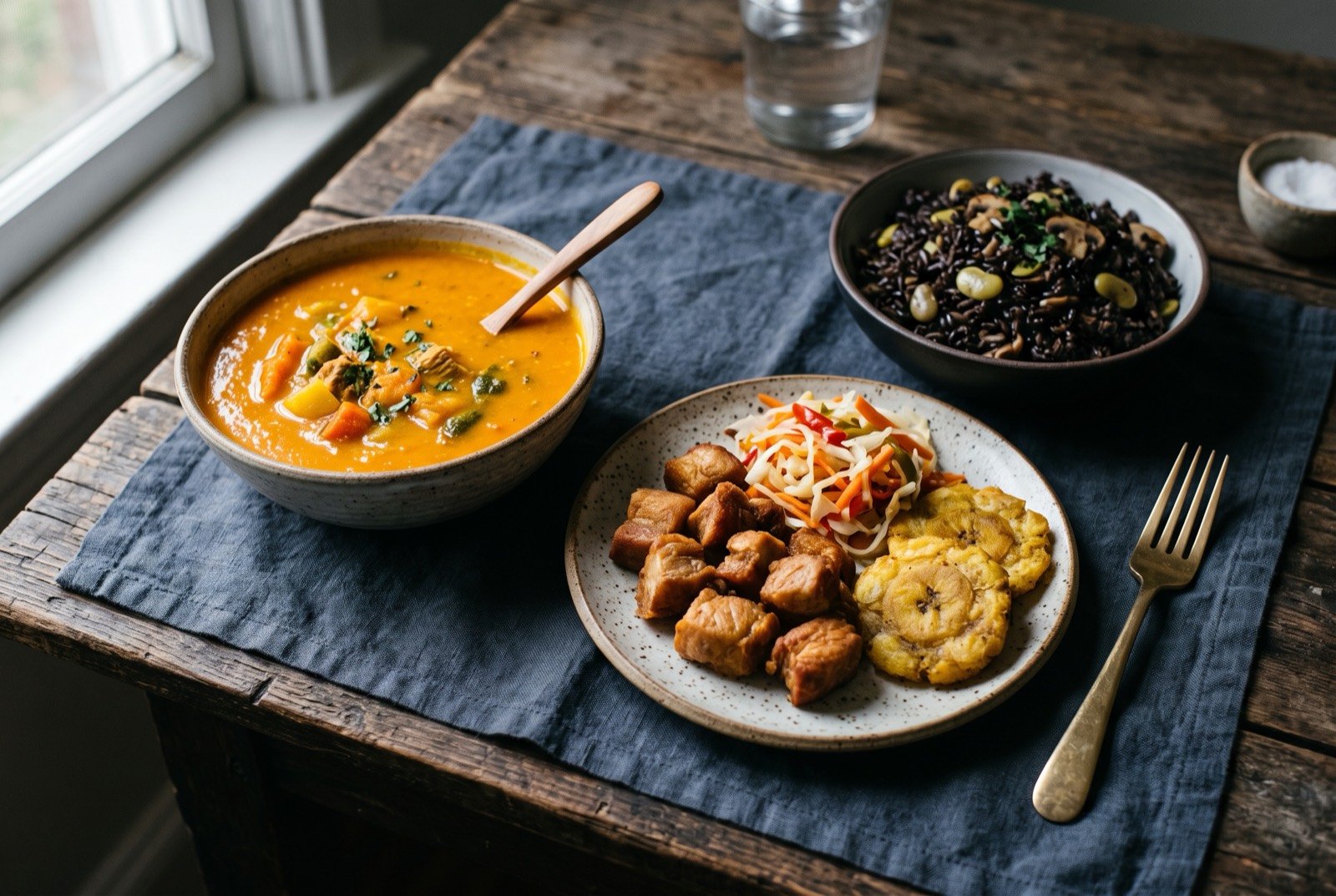
Haiti taken on its own terms, not as a footnote to the Dominican Republic it shares an island with, and not flattened into a general "Caribbean" idea that erases what actually makes it distinct. This is the only nation in the hemisphere founded by the people it enslaved rising up and winning, and that founding is not background colour here, it is the chapter's actual argument: a Kreyol-speaking, Vodou-practising, French-and-Spanish-neighboured country whose food carries the charge of 1804 more openly than any other cuisine in this atlas carries its own history. Soup joumou, the pumpkin soup eaten on Independence Day, is UNESCO-listed for exactly this reason. Every dish as tradition built it, then what a modern chef would change.
Sources and review · What this chapter does not assert · How we research · Spotted something wrong?
A Sense of Place
Haiti occupies the western third of Hispaniola, the island it shares with the Dominican Republic, and the border between the two is not administrative trivia here, it is one of the sharpest linguistic and religious frontiers in the Americas: a French-Kreyol-speaking, majority-Vodou-practising nation beside a Spanish-speaking, majority-Catholic one, on the same landmass, sharing the same mountains. The country is overwhelmingly mountainous, a fact baked into its own name: Ayiti, the Taíno word the island's indigenous inhabitants used, means roughly "land of high mountains." Deforestation, land pressure and a history of extractive agriculture have stripped much of that terrain of the forest cover it once carried, and food security in Haiti today cannot be separated from that ecological history: this chapter treats hunger and instability as part of the honest picture rather than something a food chapter can look past.
The kitchen's structural logic, once the individual dish names are stripped away, is remarkably legible:
| Structural role | What fills it | Notes |
|---|---|---|
| Starch | Rice, above all from the Artibonite Valley; plantain, cassava, breadfruit, cornmeal (mayi moulen); petit mil (sorghum) in rural and southern households | Rice's status as the aspirational everyday starch sits over an older, still-living root, tuber and grain base |
| Fat | Historically pork fat and vegetable oil | Griot and akra both depend on genuinely hot, well-managed frying |
| Aromatic base | Epis, a raw blended paste of garlic, onion or scallion, bell pepper, Scotch bonnet, parsley, thyme, citrus | Not a cooked sofrito, a raw marinade stirred in from the start of cooking, see the flavour arsenal below |
| Souring agent | Sour (Seville) orange, lime, vinegar | Used both to clean meat and fish before cooking and to season sauces and pickles |
| Heat | Scotch bonnet (piman bouk), left whole for aroma in a simmered dish, chopped or blended when real heat is wanted | |
| Protein | Pork, goat, turkey, chicken, beef, conch (lambi), dried and salted fish | Boiled-then-fried is the defining technique for pork and goat alike, see the technique ladder |
A table of peoples, in the sense the chapter spec asks for, is inseparable here from a table of forces, because Haiti's food culture was not built by several ethnic groups cooking side by side so much as by one population forging a single Kreyol-African-inflected kitchen out of catastrophe. The pre-contact Taíno population was all but destroyed within a few decades of Spanish arrival; what followed was French colonial Saint-Domingue, the single most profitable slave colony in the Americas, built on the forced labour of hundreds of thousands of enslaved Africans, overwhelmingly from West and Central Africa, whose descendants are effectively the nation. Kreyol, the language nearly every Haitian speaks and the language this kitchen is named and thought in, carries French vocabulary over African grammar and, in its food and ritual vocabulary specifically, direct Fon and Kikongo inheritance. Vodou, the religion practised by a large part of the population alongside or braided with Catholicism, is not a decorative detail on this cuisine, it structures a real category of food, manje lwa, food cooked specifically to feed the spirits, distinct from manje pòv, food prepared as charitable obligation, and manje ranvwa, food offered to repel a spiritual attack. That three-part vocabulary is itself evidence that ritual and domestic cooking in Haiti are not two separate systems, they share pots, verbs and spaces. Kannari, a cooking and storage vessel, is the same word used for the ceremonial act of "breaking the pot." Zen, another word for a cooking pot, traces to Fon. A kitchen word and a liturgical word are, here, often the same word.
Regional variation, named rather than flattened
Haiti's own food writing identifies real, named regional character rather than treating the country as culinarily uniform:
| Region | What it is known for |
|---|---|
| Nord (Cap-Haïtien) | A reputation for the country's best cooking generally; poul ak nwa, chicken with cashew, reflecting local cashew production; the traditional source of djon djon |
| Artibonite | The rice-growing heartland; lalo, a jute-leaf stew of African origin, made with fresh sea crab on the coast at Montrouis and without it inland |
| Grand'Anse (Jérémie) | Tonmtonm, pounded breadfruit served with an okra sauce, meat, fish or crab |
| Centre | Goat and turkey as the characteristic proteins |
| Ouest (Port-au-Prince region) | Griot with rice and peas, Haitian patties, Haitian spaghetti: the dishes most internationally identified as "Haitian food" are specifically Ouest dishes, not necessarily representative of the whole country |
| Sud-Est | Poisson gros sel, salt-crusted fish |
| Sud | Conch and fish; also where red beans and rice, chayote and cooked petit mil are most integrated into everyday cooking |
This chapter treats that list as real but incomplete: it comes from tourism-oriented Haitian sources and Wikipedia's citation of Le Nouvelliste rather than academic human geography, and no source consulted found detailed rural-versus-urban variation within the core everyday dishes this chapter treats, griot, legim, bouyon and pikliz, only the household variation any home cooking carries everywhere.
The History in Layers
Taíno foundations, all but erased
Before European contact, the island's Taíno population fished, grew cassava and cultivated conch and small game along a coastline that still, centuries later, supplies lambi to Haitian tables. Spanish colonisation from 1492 devastated that population within a few generations, through violence, forced labour and epidemic disease, so completely that Taíno culinary continuity survives mostly at the level of borrowed technique and vocabulary rather than a living, separate Taíno food culture: the word barbicu, the root of "barbecue," describes exactly the kind of open, unpeeled, wood-fire grilling that Haitian boukannen still practises today, alongside a parallel West and Central African grilling inheritance.
Saint-Domingue: the richest, and most lethal, colony in the Americas
French Saint-Domingue, established through the seventeenth century, became by the late eighteenth century the single most profitable colony in the world, producing roughly two-fifths of Europe's sugar and half its coffee on the backs of an enslaved population that colonial planters worked, quite deliberately, to death and replaced rather than sustained. The Code Noir nominally required weekly rations, three cassava breads and two pounds of salt beef or fish per person, but contemporary witnesses recorded routine starvation: the missionary Father Nicolson wrote in 1770 that enslaved people's food "ne se distingue pas de celle donnée aux animaux les plus immondes" (is not distinguished from that given to the filthiest animals), and the planter Charles Malenfant recorded, in 1814, enslaved sugar workers going without breakfast entirely. Subsistence depended on provision grounds, small distant or wooded plots masters allowed enslaved people to cultivate for themselves, the master often claiming a share of what grew there, the same task-garden system documented across the wider French Antilles. This is the starting condition this chapter's every subsequent claim about Haitian food sits on top of: a population fed by its own labour on the margins of the land that enslaved it, building a kitchen out of provision-ground crops, African seasoning memory and whatever the plantation did not want.
Bwa Kayiman, 14 August 1791, and a history worth reading carefully
The ceremony credited with launching the Haitian Revolution is one of the most consequential events in the hemisphere's history, and this chapter names its food element honestly rather than smoothing over a real historiographical dispute. The canonical account, a black pig ritually sacrificed and its blood drunk by participants swearing an oath of revolt, traces to a single written source: Antoine Dalmas, a French planter, writing in 1824, twenty three years after the event, claiming to draw on confessions extracted from captured rebels. The French scholar Léon-François Hoffmann argued in 1993 that the entire ceremony, pig sacrifice included, was best understood as a retrospective nationalist construction rather than a documented event, and that Dalmas's account in particular is unreliable and shaped by the racial assumptions of a slaveholder describing a slave uprising. This dispute is not settled either way, and Haitian writers have pushed back on the mythologisation from the other direction too. What is not in dispute is the revolution itself: enslaved Haitians rose, fought a war against France, Spain and Britain in turn, and won, and on 1 January 1804 declared the first free black republic in the world, the only nation in the Americas born of a successful slave revolt.
What the revolution actually did to the plate: land, not a single dish
The single most defensible claim this chapter can make about food and the revolution is structural, not culinary folklore. After 1804, the plantation export economy that had defined Saint-Domingue was dismantled. Land was redistributed to former slaves and soldiers, inheritance law gave every family member a veto over land sales, fragmenting large holdings into small peasant plots, and the new state constitutionally barred foreign land ownership. Haiti pivoted from a sugar monoculture worked by the enslaved to a peasant proprietorship built around coffee as cash crop alongside food crops grown for the family and the local market, precisely the transition the American food anthropologist Sidney Mintz spent fieldwork seasons in 1958 to 1959 and 1961 documenting in Haitian peasant markets. This is the revolution's real, lasting food-historical inheritance: who owns the land and what gets grown on it, not a single symbolic dish, however powerful that dish has since become.
Soup joumou: liberation, UNESCO, and a genuine, unresolved argument
Soup joumou, a squash soup thickened and coloured by puréed giraumon, is the dish most associated with Haitian Independence Day. UNESCO inscribed it on the Representative List of the Intangible Cultural Heritage of Humanity in December 2021, Haiti's first ever such listing, describing it as "originally reserved for slave owners," a soup Haitians "took ownership of... when they gained independence from France, turning it into a symbol of their newly acquired freedom and an expression of their dignity and resilience," eaten specifically on 1 January as the first meal of the year and, more broadly, as a traditional Sunday breakfast.
This chapter states the popular history plainly, because it is the dominant public and institutional position and is not itself disproven: enslaved people were forbidden the squash under French rule, and eating it after independence became an annual act of memory. But a specific, widely repeated embellishment of that story, that Dessalines's wife Marie-Claire Heureuse Félicité Bonheur personally distributed the soup to drums at every street corner on 1 January 1804, has been directly challenged by the Haitian linguist Robert Berrouët-Oriol, who argues in a lengthy published critique that no scientific or historical publication has ever verified the claim, that no trace of it appears in Haitian history books, school textbooks or literature of the period, and that the drums detail in particular is anachronistic. He names Bayyinah Bello, a professor at Haiti's state university, as a principal populariser of the story, and calls the UNESCO inscription built on it "une délétère contribution." He is not the only voice in this argument: the socio-ethnologist Kesler Bien-Aimé has defended the listing on different grounds, arguing that intangible cultural heritage status "transcends historical facts" and that the soup's power today, as a living symbol of resistance and belonging, does not depend on the precise accuracy of its 1804 origin story. This chapter reports both positions and adjudicates neither, in keeping with the pattern already visible at Bwa Kayiman above: Haiti's revolutionary food memory carries real institutional and popular weight, and at least two of its most famous stories rest on foundations a serious historian has publicly and specifically disputed. That is not a reason to distrust the food. It is a reason to tell its history honestly.
Occupation, dictatorship, and the present crisis
The twentieth century brought a US military occupation (1915 to 1934), decades of Duvalier-family dictatorship, and repeated cycles of political instability that this chapter does not have space to trace in full but that bear directly on any honest account of Haiti's food culture today. As of 2026, Port-au-Prince is substantially under the control of armed gangs outside a shrinking area around Pétion-Ville, roughly 1.5 million people have been displaced nationally, and over half the population is food-insecure. Haiti's paper of record, Le Nouvelliste, was vandalised and forced offline in 2024. This chapter cannot responsibly claim to document a thriving Port-au-Prince restaurant scene under these conditions, and says so directly in the sourcing section below, rather than pretending a picture exists that does not.
The Flavour Arsenal
The seasoning base
Epis. A raw, blended green paste, not a cooked sofrito: garlic, onion or scallion, bell pepper, Scotch bonnet, parsley, commonly also thyme, celery, cloves, black pepper, citrus juice and sometimes vinegar. Described with both Taíno and West African roots, traditionally hand-pounded in a wooden mortar and pestle, the pilon bwa, passed down through a family until the wood itself carries the household's own seasoning memory; now more often blended, which suits the reader's high-power blender well and matches, rather than compromises, how the paste has already evolved in diaspora kitchens making larger batches than a mortar allows. No two households make it identically, and epis is stirred raw into meat, rice, beans and sauces from the start of cooking, not added as a finishing touch. It keeps refrigerated for weeks and frozen, often in ice-cube portions, for months. Related to, but genuinely distinct from, Dominican sofrito: epis stays raw and leans on citrus and vinegar for acid and parsley and scallion for its herbal note, where sofrito is more often cooked down around onion, pepper and tomato.
Djon djon. A small, dark, foraged mushroom, not one settled species: an open-access academic study of the mushroom, published by the Presses de l'Université de Montréal, notes the name itself is "une déformation du mot champignon," a corruption of the French word for mushroom, and that the mushrooms sold under this name sit close to Psathyrella coprinoceps, first described in Cuba, though their exact identity "demeure floue," remains unclear. Other mycological sources give Psathyrella cf. hymenocephala as possibly the most common species actually sold commercially, with Cantharellus and Inocybe species sometimes mixed into dried product. This chapter treats djon djon as a folk category of small, dark, earthy mushrooms rather than asserting a single Latin name. Traditionally foraged in northern Haiti, with the Artibonite Valley also supplying the modern market. Soaked, blended and strained rather than eaten whole, for the near-black stock it gives rice, not itself the point of the dish. Only the stems, discarded for grit, not toxicity: recipe folklore claiming the cooked mushroom itself becomes toxic is not supported by the mycological sources consulted for this chapter and should not be repeated.
Scotch bonnet (piman bouk). Left whole in a simmered pot for aroma without overwhelming heat, or chopped and blended when real fire is wanted, as in pikliz.
Sour orange. The colonial-era souring agent, used to clean meat and fish before marinating and to season sauces directly.
Cloves. Named specifically, in more than one comparison, as a point of difference between Haitian epis and neighbouring Caribbean seasoning bases: Cuban sofrito and Puerto Rican sazón typically leave it out.
Starches and sweeteners
Rice, above all from the Artibonite. The valley is Haiti's rice-growing heartland and gives its name to the country's most prized domestic grain, though imported rice, contentiously, now makes up a large share of what Haitians actually eat.
Petit mil (sorghum). African in origin, introduced to Haiti in the sixteenth century alongside the enslaved population that grew it. A peer-reviewed CIRAD study of Haiti's sweet sorghum sector found that sweet sorghum cultivation, which yields both grain and a sugar-bearing stalk, can multiply a grower's income up to two and a half times over grain alone, once syrup, rapadou and clairin production are counted, framed explicitly as a strategy for keeping rural families on the land. Most associated today with the south, alongside chayote and red beans and rice.
Rapadou. Unrefined whole cane sugar, coagulated in moulds, produced in small rural units alongside clairin, cane spirit distilled from the same sugar.
Malanga. A starchy root, close kin to eddoe, cocoyam and taro, the base of akra fritters.
The Technique Ladder
The argument, from inside
Six rungs, each a real Haitian mechanism, explained by what it is actually doing.
Rung 1. Treat epis as a mother sauce, not a marinade you pour away
Epis is not seasoning added at the end, it is the base the whole pot is built from, stirred in raw at the start of cooking and again, in griot's case, reduced and reused as the base of the accompanying sòs ti-malis rather than discarded. What a cook does with this rung. Blend epis thoroughly in a high power blender rather than hand-chopping, which is how the paste is already made in diaspora kitchens working at scale, and make it in a batch large enough to both marinate and finish a dish, treating the reduced marinade liquid the way a French kitchen treats a jus, not the way a barbecue cook treats a discarded brine.
Rung 2. Boil then fry is a two-stage solution to a real problem, not a shortcut
Griot and tasso both marinate, then simmer gently, then fry hard. Every source consulted gives the same reasoning: simmering tenderises the meat fully before the fry ever touches it, so the fry's job narrows to building a genuinely crisp, dry crust rather than also trying to cook the meat through, which is exactly the failure mode of a single-stage fried pork that is either raw in the middle or leathery on the outside. What a cook does with this rung. Sous vide the marinated meat at a temperature and time suited to full, fall-apart tenderness rather than a pink medium, which is the register Haitian griot and tasso actually want, then finish in genuinely hot oil for the shortest time that builds real colour, or over live coals on the Big Green Egg for a smokier crust the traditional stovetop version does not get. This is not a foreign technique imported onto the dish, it is the same two-stage logic the tradition already uses, made more precise.
Rung 3. Djon djon extraction is a stock-clarification problem
The mushroom's value is entirely in the liquid it gives up, not in being eaten itself. What a cook does with this rung. Rehydrate dried djon djon in hot water, blend the soaked mushrooms briefly rather than leaving them whole, and pass the liquid through a chinois for a genuinely clean, grit-free black stock rather than the cloudier result a simple sieve gives. Where real djon djon cannot be sourced, a dehydrator lets a cook dry a shiitake-and-porcini blend from fresh, the diaspora-attested substitute, for a fresher, less musty result than most dried packets offer, though the honest limit of this substitution, a duller colour and a different, if still real, umami, should be stated to a reader rather than papered over.
Rung 4. Boukannen is live-fire cooking with a documented double ancestry, and a Big Green Egg is a direct continuation of it, not an import
Haitian boukannen grills unpeeled vegetables and meat directly over charcoal flame and smoke, a technique traced to both Taíno barabicu practice, the root of the English word barbecue, and a parallel West and Central African grilling inheritance carried by the enslaved population. What a cook does with this rung. A Big Green Egg's live charcoal, radiant heat and real smoke are functionally the same fire this technique has always used; the only real adaptation is fuel choice, since Haitian cooking does not reach for the resinous woods that would turn the smoke bitter, favouring instead whatever hardwood is locally available. This is worth a British cook stating to themselves plainly: cooking griot or corn on a Big Green Egg is not doing barbecue to Haitian food, it is the same fire the dish has always been cooked over.
Rung 5. Pikliz is a quick pickle, not a ferment, and the distinction changes how you make it
Pikliz, the cabbage, carrot and Scotch bonnet condiment served alongside almost every fried dish, is made by packing vegetables into a jar and covering them in vinegar, rested a minimum of twenty four to forty eight hours before use, the heat and acidity both intensifying the longer it sits. Haitian recipe writing itself sometimes calls this "fermentation," but there is no salt brine and no anaerobic culture at work, only acetic acid steadily penetrating raw vegetable, a macération rather than a true ferment. What a cook does with this rung. Because the vinegar, not a live culture, is doing all the work, the ratio and rest time can be controlled precisely rather than left to a jar-fill guess, and a spice grinder lets a cook work whole clove and black pepper into the vinegar itself for a more even seasoning through the batch than whole spices dropped in loose ever achieve.
Rung 6. Long, slow simmering is how you tenderise conch and a layered stew alike, and sous vide makes that timing exact
Lambi, conch simmered in a Creole sauce, is documented at two and a half to three hours precisely because conch toughens badly if it is flash-cooked hot and fast; bouyon and legim both run on the same long, patient logic, the pot building flavour and tenderness together rather than one after the other. What a cook does with this rung. Sous vide gives a cook the same long, gentle exposure a stovetop simmer provides, but at a fixed, repeatable temperature that removes the guesswork of watching a pot for hours, meaning the conch or the stew meat reaches exactly the tenderness the tradition is already aiming for, not a texture a British kitchen's less forgiving hob happens to land on.
The Ferment and Preserve Bench
1. Pikliz, correctly understood
As set out in Rung 5, pikliz is Haiti's everyday preserved condiment, and the honest chemistry, acetic quick-pickle rather than lacto-ferment, is worth restating here rather than only on the ladder: it is what lets a British cook make a reliable batch from vinegar alone, no starter culture, no salt-brine timing, just cabbage, carrot, onion, Scotch bonnet and enough vinegar to submerge everything, rested a minimum of a day.
2. Djon djon, dried before it is cooked
The mushroom itself is a preservation act as much as an ingredient: dried in the sun or by a dehydrator before it ever reaches a kitchen, which is what lets a foraged, seasonal mushroom from northern Haiti's forests turn up, months later, as the base of a festival rice anywhere in the country or its diaspora.
3. Clairin and rapadou, the same cane worked two ways
Rapadou, unrefined cane sugar coagulated in moulds, and clairin, a raw cane spirit distilled in small rural units, come from the same sugar economy, worked at the scale of a household or a village cooperative rather than an industrial refinery, a direct, still-living echo of the plantation crop the revolution broke apart and redistributed as smallholdings.
Sourcing in Britain
No dedicated Haitian, or wider Francophone Caribbean, grocer currently operates in the UK: every Haitian-specific retailer found in this research is US-based, and none showed confirmed UK shipping. What follows is built on the general Caribbean and West African grocery ecosystem a UK-based Haitian cook actually has to rely on, verified against live shop and delivery listings rather than assumed.
Epis components. Garlic, fresh thyme, parsley, green and red bell peppers, shallots and cloves are trivial, available at any UK supermarket. Scotch bonnet is now genuinely easy, fresh, from Afro-Caribbean grocers and increasingly mainstream shops: The Black Farmer stocks it at its Brixton Market Row farmshop, Afrobuy.co.uk delivers it UK-wide by the kilo, and Spice Mountain at Borough Market carries the dried form. Culantro, more central to Puerto Rican and Dominican sofrito than to most home Haitian epis, is a genuine gap, not stocked fresh anywhere confirmed in this research, only live plants and seed packets for growing your own, which matters less here than it would for a Puerto Rican or Dominican kitchen since most Haitian epis recipes lean on parsley and thyme rather than culantro regardless. Sour orange is available fresh but strictly seasonal, Seville oranges appearing in UK shops only in January and February; British Frozen Fruit sells organic frozen Seville oranges year-round, which solves the seasonality problem outright, and failing that, Caribbean cooks generally reach for a blend of two parts orange to one part lemon to one part lime as a workable substitute. No UK-stocked jarred commercial epis brand was found, which matters less than it might given how well suited the tradition's own raw, blended paste already is to a UK kitchen with a good blender.
Djon djon. Real, but precarious, availability: a handful of small Amazon.co.uk, eBay and Etsy UK listings exist, none a dependable month-to-month supply. Treat this specifically as an ingredient to order well ahead of a planned cook, with a backup ready. Where it cannot be sourced in time, dried shiitake, or shiitake blended with a little porcini, soaked in hot water, is the substitute Haitian home cooks themselves reach for, with the honest caveat that it gives real umami but a duller colour than the true mushroom.
Malanga. Available fresh via at least one UK-delivering online listing, and more reliably as eddoe or cocoyam, the closely related root UK African and Caribbean grocers (Wosiwosi, Ogbongeh, Afrobuy) stock under that name rather than "malanga." This substitution is not a UK compromise, malanga, eddoe, tannia and taro are already treated as siblings across Caribbean kitchens generally.
Rapadou. Not confirmed available under its Haitian name, but the identical product is sold across the UK as panela or rapadura, or approximated closely enough by a good dark muscovado sugar, both easy to find.
Petit mil. Sorghum flour is well stocked in the UK, though marketed as a gluten-free baking flour rather than the whole grain rural Haitian cooking actually uses; whole-grain petit mil itself was not confirmed available anywhere in the UK, and standard whole sorghum grain or millet, from South Asian and African grocers, is the honest substitute for a reader wanting to try it.
Named shops and areas. Brixton Market and Electric Avenue, Peckham, Tottenham, Hackney, Stratford, Woolwich and East Ham are the named high-street clusters for general Afro-Caribbean grocery in London; Ogbongeh, Wosiwosi and Afrobuy are confirmed, currently operating UK online retailers with real delivery, verified against live customer review pages rather than directory listings alone.
Ingredients that decide great from grim, ranked. First, epis, made fresh and properly rested, a minimum of four hours and preferably overnight, treated by every source consulted as the true foundation of the whole cuisine. Second, fresh rather than dried Scotch bonnet. Third, real sour orange, or a genuine citrus blend, for marinade acidity rather than heat alone. Fourth, real djon djon specifically where a dish is built around it, since no substitute gives the true black colour. Fifth, cloves within the epis itself, a genuine point of difference from neighbouring Caribbean seasoning bases.
Kit note. The reader's high-power blender is not a compromise here, it mirrors how diaspora cooks have already adapted epis-making away from the traditional pilon mortar specifically to work at a larger, more consistent scale. A Big Green Egg is, as the technique ladder sets out, a genuine continuation of boukannen's live-fire lineage rather than an imported barbecue aesthetic. Sous vide, the dehydrator and the chinois are not discussed in any Haitian source consulted for this chapter in connection with Haitian technique specifically, and their use throughout the modernist recipes above should be understood plainly as this chapter's own kitchen adaptation of a documented tradition, not a discovered practice.
Voices and Sources
Books. Gregory Gourdet, Everyone's Table (James Beard Award, Best General Cookbook, 2022). Nadege Fleurimond, Haiti Uncovered: A Regional Adventure into the Art of Haitian Cuisine. Karen McCarthy Brown, Mama Lola: A Vodou Priestess in Brooklyn, the standard academic ethnography of lived Vodou practice, recommended directly to any reader wanting properly sourced detail on lwa-specific food and ritual beyond what this chapter's own research could verify online. Sidney Mintz's fieldwork on Haitian peasant markets, which underlies this chapter's account of the post-revolutionary land economy.
Chefs and restaurants. Gregory Gourdet, Kann, Portland, Oregon, James Beard Award, Best New Restaurant, 2023; the clearest living example of the atlas's central claim, elevation as a deliberate return to tradition rather than an import of French method, in his own words: "I knew if I was going to bring Haitian food to the Beard House, it would have to be traditional so the story could start from an authentic place." Paul Toussaint, Kamúy and 3 Pierres 1 Feu, Montreal, whose own path from Toqué! back to Haiti and back to his own restaurants traces the same arc. Chris Viaud, Ansanm, Milford, New Hampshire, James Beard semifinalist. Sebastien Salomon, Itiyah, Washington DC, a forthcoming Haitian tasting-menu restaurant, not yet reviewed at time of writing. Annick Mégie, Tchakayiti, a Haitian-born food writer and the single most useful in-tradition source for this chapter's everyday cooking section, Saveur's Best Food Culture Blog, 2019.
Institutions and scholarship. UNESCO's Intangible Cultural Heritage listing for Joumou soup, file 01853, the chapter's primary source for the dish's official history. Robert Berrouët-Oriol's published critique of the soup joumou origin story, and Kesler Bien-Aimé's defence of the UNESCO listing on separate grounds, both cited above rather than adjudicated. Léon-François Hoffmann's historiographical challenge to the Bwa Kayiman narrative. The Presses de l'Université de Montréal's academic study of djon djon's uncertain taxonomy. The CIRAD/Cahiers Agricultures study of Haiti's sweet sorghum sector.
Things this chapter has deliberately not asserted
- That Dessalines's wife personally distributed soup joumou to drums at every street corner on 1 January 1804. This specific detail, though widely repeated, has been directly and publicly challenged by the Haitian linguist Robert Berrouët-Oriol, who found no primary documentary source for it; this chapter reports the popular story and the challenge to it, and adjudicates neither.
- That a black pig was ritually sacrificed at the Bwa Kayiman ceremony as settled historical fact. The canonical account rests on a single source written more than two decades after the event by a French planter, and has been argued by at least one serious historian to be a later nationalist construction rather than a documented event.
- That any colonial-era document specifically names soup joumou, as opposed to the squash generally, as forbidden to enslaved people. The prohibition is asserted by UNESCO and repeated widely, but this research located no primary archival record naming this specific dish.
- That "griyo" derives from West African griots, oral historians, or that the dish was historically an elite cut reserved for the wealthy before pig-raising was "democratised." This etymology and history is repeated across food-media secondary sources but was not found grounded in any academic linguistic or historical source.
- Specific food and colour associations for individual lwa beyond the general manje lwa, manje pòv and manje ranvwa framework. Granular detail of this kind circulates on Western esoteric websites this chapter's house rules exclude as sources; the properly sourced version almost certainly exists in Karen McCarthy Brown's academic ethnography, which this research could not substitute for online.
- That djon djon mushrooms become toxic once cooked. This claim recurs across recipe blogs but is directly contradicted by the mycological literature consulted, which states the mushrooms are edible, with only the stems discarded for texture.
- Any comparative claim that Haitian food receives more or less English-language media coverage than Jamaican or Dominican cuisine. No rigorous comparative study was found; the one ranking that surfaced in this research, TasteAtlas, is algorithmic and non-authoritative and is not used to support any claim here.
- A single settled Latin binomial for djon djon. The mycological sources consulted disagree on which Psathyrella species, or mixture of species, the name actually covers, and this chapter treats it as a folk category rather than a taxonomically resolved one.
- A functioning, currently documentable Port-au-Prince fine-dining scene. Haiti's ongoing security crisis makes this impossible to responsibly claim, and this chapter says so rather than relying on pre-crisis coverage as if it still described the present.
Treat epis as a mother sauce, not a marinade you pour away
Epis is not seasoning added at the end, it is the base the whole pot is built from, stirred in raw at the start of cooking and again, in griot's case, reduced...
Boil then fry is a two-stage solution to a real problem, not a shortcut
Griot and tasso both marinate, then simmer gently, then fry hard.
Djon djon extraction is a stock-clarification problem
The mushroom's value is entirely in the liquid it gives up, not in being eaten itself.
Boukannen is live-fire cooking with a documented double ancestry, and a Big Green Egg is a direct continuation of it, not an import
Haitian boukannen grills unpeeled vegetables and meat directly over charcoal flame and smoke, a technique traced to both Taíno barabicu practice, the root of...
Pikliz is a quick pickle, not a ferment, and the distinction changes how you make it
Pikliz, the cabbage, carrot and Scotch bonnet condiment served alongside almost every fried dish, is made by packing vegetables into a jar and covering them in...
Long, slow simmering is how you tenderise conch and a layered stew alike, and sous vide makes that timing exact
Lambi, conch simmered in a Creole sauce, is documented at two and a half to three hours precisely because conch toughens badly if it is flash-cooked hot and...
The dishes
- Soup joumou Ouest, Haiti
- Griot (Griyo) Ouest, Haiti
- Pikliz Haiti
- Diri djon djon Nord, Haiti
- Legim Haiti
- Bouyon Haiti
- Diri ak pwa (Diri kolé) Haiti
- Tasso (Tassot) Haiti
- Lambi Coastal Haiti
- Bannann peze Haiti
Sources and review
- Reviewed
- Not yet reviewed from inside the tradition
- Cooked
- Not yet cooked and reported
Where this volume comes from
3 research briefs on file for this volume, researched to the rules on How we research. Published 3 September 2026. Last changed 8 September 2026.
The brief's own account of its sources
The split. Of the sources actually used across both research passes feeding this brief, roughly 12 to 15 are genuinely Haitian, French-language-Haitian, or in-tradition: the UNESCO listing itself (official primary source, quoted directly); Le Nouvelliste; AyiboPost/AyiboLab (three pieces, though only retrieved via search summary, not full text , see below); Fondas Kréyol/Berrouët-Oriol; haitiinter.