The Americas · Volume 16
The Guianas
Guyana and Suriname
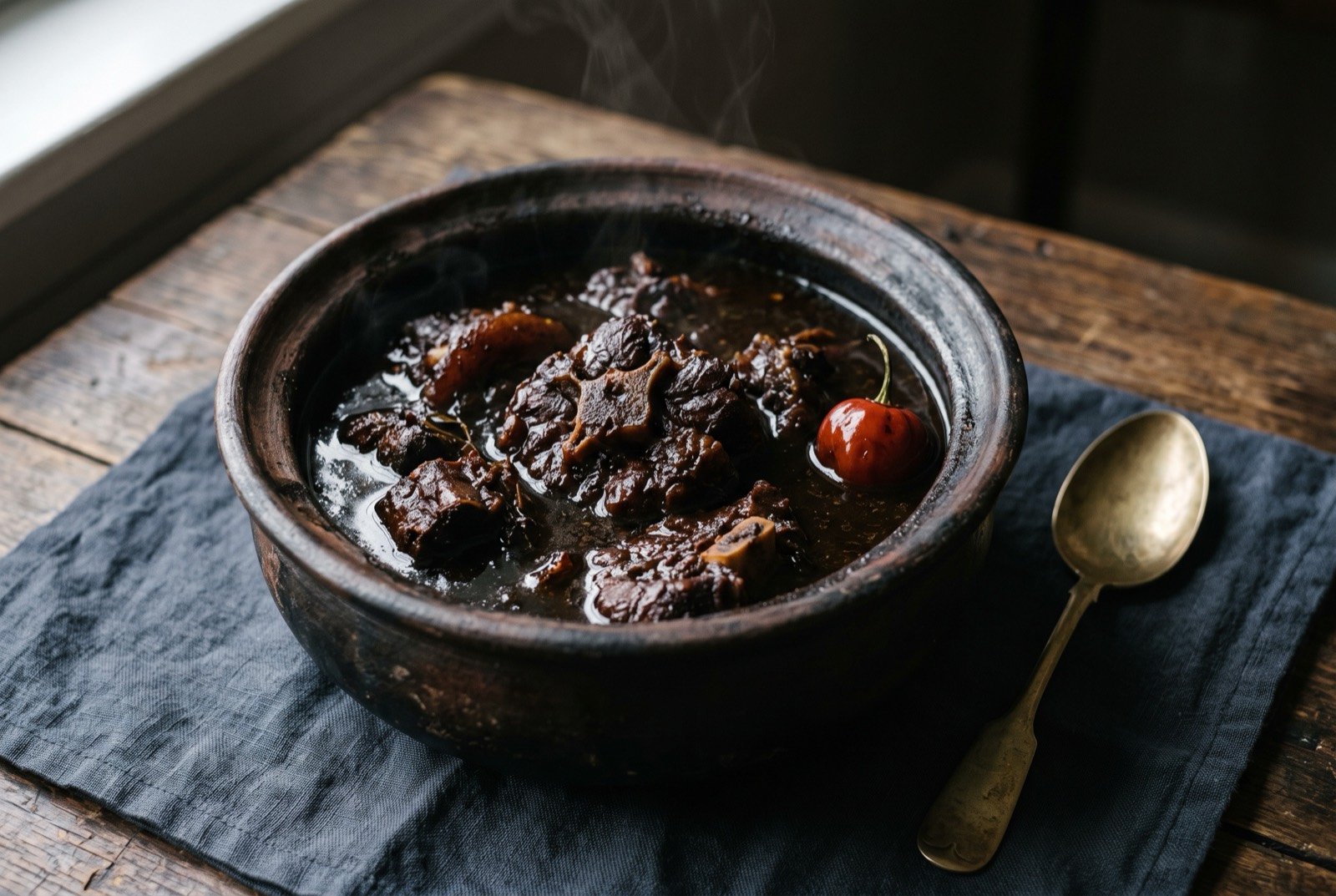
Two countries on the north-east shoulder of South America, built by the same plantation and indenture forces as the islands next door, joined not by border but by history: Dutch colonial engineering, African slavery, and, above all, a shared Indian indenture wave that neither country would recognise itself without. Then one difference that makes the pairing worth its own volume rather than a Caribbean footnote: Suriname alone received a second, Javanese indenture wave, carrying galangal, salam leaf and soto soup across an ocean that never touched Guyana next door. Every dish as tradition built it, then what a modern chef would change.
Sources and review · What this chapter does not assert · How we research · Spotted something wrong?
A Sense of Place
Guyana and Suriname sit on the same stretch of coast, share the same Amazon-fed mud shore and the same Guiana Shield beneath their feet, and were built out of the same three ingredients: sugar, slavery and indenture. Where they differ is worth naming before either country gets a paragraph of its own, because it is what makes this a two-country volume rather than one country with a Dutch-speaking neighbour thrown in for completeness.
The shared ecology: a mud coast, a shield, and a rainforest interior
Both countries run in the same bands, coast to interior. A narrow, low-lying, mangrove-fringed coastal plain carries the overwhelming majority of the population on a small fraction of the land: in Guyana the coastal plain is roughly 5% of national territory but holds more than 90% of the population, built from alluvial mud carried north from the Amazon and deposited below the high-tide line, protected by Dutch-built dikes, dams and kokers, sluice gates, an engineering inheritance that still governs how the coast is farmed. Suriname's coast is the same mud coast, fed by the same Amazon sediment migrating north-west along the shore. Behind that narrow strip, both countries are overwhelmingly rainforest: more than 75% of Guyana and roughly 80% of Suriname sit inside the Amazon biome, on the ancient Guiana Shield, one of the oldest exposed rock formations on earth. Guyana's largest interior grassland is the Rupununi Savannah, some 15,000 square kilometres in the south; Suriname's interior runs Amerindian in the lowland north and, further south, a smaller Amazonian zone shared with Trio and Wayana communities.
The peoples: six in Guyana, at least seven in Suriname
Guyana calls itself the land of six peoples: Amerindian, Afro-Guyanese, Indo-Guyanese, Portuguese, Chinese and mixed, the Portuguese counted separately from other Europeans because they arrived as indentured labourers rather than colonists. Guyana's Indigenous population itself comprises nine recognised nations by language: Lokono, Kalina, Warao, Wapishana, Makushi, Akawaio, Patamona, Pemon and Wai-Wai. Current demographics run roughly Indo-Guyanese 40%, Afro-Guyanese 26%, mixed 20%, Amerindian 11%.
Suriname's population, per the 2012 census, is more finely split again, and includes one group Guyana simply does not have. Hindustani, Indo-Surinamese, is the largest single group at 27.4%; Maroon, the descendants of enslaved Africans who escaped the plantations and built independent forest societies, roughly 21.7%; Creole, Afro-Surinamese, roughly 15.7%; Javanese 13.7%; mixed roughly 13.4%; the remainder Chinese, Indigenous and white. The Maroon and Javanese categories are Suriname's own, and neither has a real equivalent across the border: Guyana's enslaved Africans who escaped plantations did not build the same scale of enduring, semi-autonomous forest nations Suriname's Ndyuka, Saramaka, Aluku, Kwinti, Pamaka and Matawai peoples did, and Guyana, a British colony, never received Java-recruited indenture at all, because Java belonged to the Dutch East Indies, not to Britain.
The defining logic, by community, across both countries
| Element | Guyana: coast (Afro- and Indo-Guyanese) | Guyana: interior (Amerindian) | Suriname: Creole and Maroon | Suriname: Hindustani and Javanese |
|---|---|---|---|---|
| Fat | Coconut oil and milk, vegetable oil | Minimal, lean game | Palm and coconut oil | Ghee (Hindustani), coconut and palm oil (Javanese) |
| Starch | Rice, ground provisions, wheat roti | Cassava, especially bitter cassava | Cassava, plantain, rice | Rice, roti; Javanese-style rice specifically for nasi |
| Aromatic base | Green seasoning, bandhania, cassareep for Afro-Guyanese cookery; curry powder, geera, garam masala for Indo-Guyanese | Cassareep, wiri wiri pepper | Pepre watra spicing, allspice, celery | Masala and cumin (Hindustani); galangal, salam leaf, lemongrass (Javanese) |
| Everyday protein | Beef, chicken, salt fish, goat | Wild game: labba, agouti, peccary, deer, river fish | Salt fish, chicken, pork | Chicken, goat (Hindustani); chicken, fish (Javanese) |
The History in Layers
The two colonial economies, briefly stated and kept precise
The Dutch were the first European colonisers of both territories. In Guyana, Fort Kyk-Over-Al in Essequibo dates to 1616; the colony ran as three separate Dutch holdings, Essequibo, Demerara and Berbice, before Britain took control after the Napoleonic Wars in 1814, forming British Guiana. Suriname stayed Dutch throughout. Its founding moment is worth stating precisely rather than as the popular shorthand usually renders it: the Treaty of Breda, 31 July 1667, which ended the Second Anglo-Dutch War, did not contain an explicit swap clause. It established the principle of uti possidetis, what you have, you hold: the Dutch kept Suriname, which they had just seized from the English, and the English kept New Netherland, Manhattan and New Amsterdam, later divided into New York and its neighbouring colonies. The popular "Suriname was swapped for New York" story is a later simplification of a possession-based settlement, and several Dutch sources call it exactly that, a myth. This chapter uses the more precise framing throughout.
Both economies ran on sugar and enslaved African labour. Demerara had 206 plantations and 5,907 enslaved people by 1769; the enslaved population across the Guyanese colonies rose to roughly 75,000 by the 1820s. The 1823 Demerara Rebellion, some 10,000 enslaved people rising up, was suppressed within days, with executions. Britain's Abolition of Slavery Act passed 29 August 1833, effective 1 August 1834. Suriname's slavery lasted longer: abolition did not come until 1863, and even then was followed by a mandatory ten-year period of continued plantation labour, staatstoezicht, state supervision, a detail this chapter states with the caveat that it was not independently re-verified against a primary Surinamese source this time round.
Suriname's Sephardi Jewish planter community, and the two dishes it may or may not have shaped
From 1639 the colony, English then Dutch, admitted Sephardi Jews fleeing Europe and Brazil, a further wave arriving in 1652 under Francis Willoughby and settling at Jodensavanne, Jewish Savanna. By the late seventeenth century Jewish planters held around 40 plantations; by 1730, 115 of Suriname's roughly 400 plantations were Jewish-owned, an unusually large and semi-autonomous planter community with its own synagogue, cemeteries and legal privileges, in decline by 1765 to 1775 as residents drifted to the new capital, Paramaribo. This community sits at the root of two genuinely contested origin stories this chapter carries forward honestly rather than settling: pom, said by some to descend from a Sephardi Sabbath dish called sofrito, made with potato and reworked with pomtajer once in Suriname because potatoes grew poorly there; and pastei, whose pastry form is credited variously to Jewish-Portuguese, general Dutch and English inheritance, the last theory tracing specifically to England's brief occupation of Suriname, 1799 to 1816. None of the three theories for either dish rests on a primary source strong enough to settle the question, and this chapter does not pretend otherwise.
Guyana's indenture waves, in order
Portuguese, from Madeira, 1834 onward. The first group, recruited from the impoverished island of Madeira, arrived late in 1834; the ship Louisa Baillie docked in Demerara on 3 May 1835 with 40 Madeiran emigrants after a 78-day voyage, and 553 more arrived that same year, contracted as indentured labourers on sugar plantations. Migration is attributed to failing sugar and wine harvests and Portuguese political instability, 1823 to 1834. Madeiran indenture ran more broadly 1835 to 1882. Madeirans moved rapidly out of plantation labour into shopkeeping and commerce, becoming a distinct merchant class by the mid nineteenth century, the origin of their being counted as a separate "people" from other Europeans in Guyana's national self-description.
Indian, the largest wave, 1838 onward. The first Indian indentured labourers, 396 people, popularly the "Gladstone Coolies," landed in British Guiana from Calcutta on 5 May 1838. Over the following roughly 80 years, more than 230,000 indentured labourers arrived from India, the large majority from North India's Bhojpur and Awadh regions, present-day Uttar Pradesh, Bihar and Jharkhand, principal recruiting districts including Allahabad, Ghazipur, Benares, Faizabad and Gorakhpur. Most spoke Bhojpuri, with some Awadhi and Maithili, the direct linguistic ancestry of Guyana's Hindi-derived food vocabulary: dhalpuri, achar, masala, geera, kuchela.
Chinese, 1853 to 1879. The first Chinese labourers arrived on 12 January 1853 aboard the Glentanner, 105 assigned to Windsor Forest plantation, the first Chinese settlement in Guyana. Fourteen thousand Chinese arrived between 1853 and 1879 across 39 vessels from Hong Kong, filling the post-abolition labour shortage. Many later moved into retail and commerce; chowmein and fried rice are named directly as the enduring culinary legacy of this community in the national diet.
Suriname's parallel, but not identical, indenture waves
Chinese, 1853 to 1874, in fact arriving in Suriname the same year as in Guyana, and for the same anticipatory reason: planters, alarmed by what had happened to labour supply after French and British abolition elsewhere, wanted a replacement workforce contracted in advance of Suriname's own, later 1863 abolition. Between 1858 and 1874 over 2,500 Chinese workers were recruited, mostly via a Dutch consular arrangement in Macau and later a dedicated emigration office in Hong Kong.
Hindustani, 1873 to 1916. Over 34,000 people emigrated from British India as indentured contract workers in this window, the ship Lalla Rookh leaving Calcutta on 26 February 1873 carrying 410 immigrants on a 99-day voyage, 11 of whom died en route. This is Suriname's own, later and smaller counterpart to Guyana's much larger 1838 Indian wave, and it is the ancestry of Suriname's own roti, bara and achar tradition.
Javanese, 1890 to 1939, the layer with no Guyanese equivalent. After decades of Indian indenture and heavy lobbying from Surinamese planters, the colonial government permitted a first experiment with Javanese contract labour in 1890, initiated by the Dutch trading company Nederlandsche Handel-Maatschappij for its Mariënburg plantation. Recruitment was run by commercial emigration agencies paid per worker enlisted, agencies documented as having misrepresented the journey, claiming it would be short, the work easy, and migrants would return wealthy; some recruiters are recorded as having claimed to have "bewitched" people into signing. A first group of 94 people, mostly from Surakarta, departed 21 May 1890 aboard the Prins Willem II, arriving that August; a second, larger group of 612 followed in 1894, 48 dying in transit. From 1917 shipping moved to direct Java to Suriname routes; the final ship, the Kota Gede, delivered 990 people in 1939. Across the whole period, approximately 32,960 Javanese arrived, overwhelmingly from Central and East Java, roughly 90% ethnically Javanese with smaller Sundanese and Madurese minorities. Contracts ran five years; around a quarter exercised repatriation rights, and the remaining roughly 24,000 stayed permanently. This is the direct origin of saoto, nasi, bami, bakabana and the galangal-and-salam-leaf seasoning tradition that has no parallel anywhere else in this atlas so far, and it is the single fact that justifies pairing Guyana and Suriname in one volume rather than treating either as representative of the other.
Cassareep is Amerindian in origin, said plainly, on a first-person source
Cassareep's origin is not a folk claim dressed up as fact. The strongest source found for this chapter is a Stabroek News piece written from inside the Lokono, Arawak, community of Santa Rosa, Moruca, Region One, describing ha'chikupero, the hottest style of pepperpot made by the Lokono there, as a near-daily morning meal rather than solely a Christmas dish, and noting explicitly that the pepperpot eaten in Georgetown and along the coast, made with bottled, commercially prepared cassareep, differs from the Arawak home method built on freshly reduced cassareep and served with arasoka, a fresh thick cassava bread, rather than commercial bread. Guyana's own tourism material describes pepperpot more loosely as reflecting "African and Amerindian roots" together, and this chapter does not follow that framing without qualification: the strongest evidence supports Amerindian invention of the cassareep technique itself, with the coastal, cross-community pepperpot most Guyanese eat today a later adaptation, not a joint original invention. Cassava's use, and its bitter-variety detoxification technique, crosses the border freely: Suriname's Amerindian and Maroon communities process cassava by an essentially identical method, grating, pressing in a matapi, boiling off the toxin, and this chapter treats cassareep's reduction technique and Suriname's parallel cassava-bread technique as two expressions of the same underlying indigenous knowledge, not as two separate inventions.
Independence, on different clocks
Guyana became independent from Britain on 26 May 1966 and a cooperative republic within the Commonwealth on 23 February 1970, celebrated annually as Mashramani, a national festival framed explicitly as spanning all six peoples. Post-independence politics split largely along Afro-Guyanese and Indo-Guyanese party lines, a divide that persists in national life and is named here rather than smoothed over. Suriname's independence came later and more abruptly: from the Netherlands in 1975, followed by a 1980 military coup and a period of serious political instability through the 1980s. This chapter does not attempt Suriname's full post-independence political history; it is named as context, not as this chapter's subject.
The Flavour Arsenal
Cassareep, Guyana's defining reduction
A thick, near-black, molasses-consistency syrup, described by one Guyanese source as tasting "deep, tangy with a touch of bitterness." Bitter cassava is peeled and grated; the pulp is pressed through a matapee, a traditional woven cassava press, to extract the juice; the juice, which carries naturally occurring cyanogenic compounds, is boiled roughly two hours until translucent, by which point those compounds have volatilised off and it is safe; the liquid is then strained and reboiled a further two hours, roughly, until dark and thick, flavoured during this second stage with cloves, cinnamon, salt, sugar and cayenne. Yield is very low, one source giving roughly 20lb of fresh cassava to one 16oz jar, about six hours' total labour. It is still made as a small-batch, artisan process concentrated in Indigenous communities, the Pomeroon region named as a historic centre of supply.
Wiri wiri pepper
A small, roughly 1.2cm, round-to-bulb-shaped Guyanese chilli, taxonomically disputed between Capsicum chinense and Capsicum frutescens, ripening green to orange to red, 100,000 to 350,000 Scoville units, comparable to habanero and Scotch bonnet but tending toward the lower end of that band, and described as fruity and tangy rather than purely fierce. It is genuinely hard to find or grow outside Guyana and the immediate region, and this chapter's sourcing section below treats it accordingly.
Achar, kuchela and atjar, kept carefully apart
Guyana's achar and kuchela are the same Hindustani pickle family: mango kuchela is made by grating unripe mango, sun-drying it a day or two, then combining it with amchar masala, garlic, salt, sugar, a chosen chilli, and mustard oil, the garlic and chilli first briefly fried in the oil to bloom it. Suriname carries a genuinely different second word for a genuinely different dish, and this chapter keeps the two apart rather than letting the English transliteration blur them: Hindustani achar in Suriname is the same hot green mango pickle as Guyana's, but Javanese atjar, atjar tjampoer, is structurally an entirely different, Indonesian sweet-sour mixed vegetable pickle, cauliflower, carrot, cabbage, cucumber, in a turmeric and mustard-seed vinegar brine, served with nasi and bami rather than with roti. Two distinct pickle traditions from two distinct communities that happen to sound alike in one language, not one dish with two spellings.
Galangal, salam leaf and ketjap: Suriname's Javanese seasoning triangle
Galangal, laos, and salam leaf, daun salam, from Syzygium polyanthum, a myrtle-family tree rather than a true bay laurel, are both genuinely and heavily used in Surinamese-Javanese cooking today, carried directly from the 1890 to 1939 indenture wave and still core to saoto, nasi and bami. Ketjap manis, sweeter and thicker than ordinary soy sauce, built on palm sugar and spices such as star anise, is equally central. Masoesa, a ginger-family plant whose dried, powdered fruit colours rice yellow in moksi alesi, is described by Surinamese sources as comparable to saffron but cheaper; its precise botanical identity could not be confirmed with confidence in this chapter's research and is stated here as a functional description rather than a settled taxonomic fact.
Pomtajer, the one genuinely indigenous ingredient in Suriname's national dish
Pomtajer, also pongtaya, is the tuber of Xanthosoma sagittifolium, arum family, known elsewhere as tannia, yautia or malanga, growing wild and cultivated throughout Suriname's interior, tubers reaching up to 2kg, both root and leaves eaten. It is the single indigenous ingredient standing at the centre of pom, a dish otherwise built, on the contested evidence above, from a Sephardi-Jewish or general European template.
Green seasoning and bandhania
The herb central to Guyanese green seasoning is Eryngium foetidum, locally bandhania, from Hindi/Bhojpuri, elsewhere in the Caribbean chadon beni, shado beni or culantro, a stronger, more lingering relative of coriander, blended with scallion, garlic, thyme and hot pepper as the standard aromatic base for curries, cook-up rice and stewed dishes.
The Technique Ladder
The argument, from inside
Six techniques, each explained by why it works, not only what it does.
Rung 1. Cassareep's detoxifying reduction
Bitter cassava's juice carries acetone cyanohydrin, which breaks down to hydrogen cyanide on contact with water, genuinely poisonous raw. A first roughly two-hour boil volatilises that compound off entirely; only once the liquid runs translucent is it safe to strain and begin the second, spiced reduction. This is a controlled reduction sauce built on real technical trust in timing and heat, developed by Amerindian communities centuries before any French reduction sauce reached this coast, and it is the clearest single example in this volume of the atlas's own animating idea: that elevation is a matter of doing traditional things deliberately.
Rung 2. Matapi and matapee cassava pressing
A woven cylindrical press, squeezed by twisting or by hanging weight, forces the toxic juice out of grated bitter cassava pulp while leaving the starch behind, a mechanical dewatering step shared identically across Guyana's Amerindian communities and Suriname's Amerindian and Maroon communities, feeding cassareep on one side of the border and cassava bread, farine and kwaka on the other.
Rung 3. Roti's ghee-fold lamination
A flattened dough disc is brushed with ghee and folded back into a ball before final rolling, working the fat through the dough in layers rather than mixing it in. This single fold is what produces a flaky-but-pliable texture distinct from a plain chapati, and it is done identically, if to slightly different final effect, in both Guyana's dhalpuri and Suriname's roti.
Rung 4. Saoto's two-stage broth
A whole soup chicken is poached with laos, garlic, onion, lemongrass and salam leaf for a shorter first phase, just long enough to cook the fillet through for shredding; the fillet is removed, and the bony carcass continues simmering alone for a much longer second phase, up to an hour, to build real depth, garnishes assembled separately and the hot broth poured over only at the point of serving.
Rung 5. Garlic pork's vinegar brine-cure
Cubed pork is layered in a jar with a garlic, thyme and pepper paste and fully submerged in white vinegar, then left at room temperature three to four days until the meat visibly pales, a direct continuation of Madeira's carne de vinha d'alhos, adapted in Guyana from wine to vinegar, most likely reflecting what was actually available on a sugar-plantation coast rather than a deliberate change of method.
Rung 6. Pom's layered casserole bake
A cream of grated pomtajer, rice, butter and orange juice on the base, a spiced fried-chicken mixture on or through it, baked uncovered until the top browns hard and the edges caramelise dark, an oven technique from the outset rather than an adaptation of an older leaf-wrapped method, no such precursor having turned up in this chapter's research.
The Ferment and Preserve Bench
Three preparations, each a genuine indigenous or migrant preservation technology.
Cassareep. Covered in full above: peel, grate, press, boil off the cyanogenic compound, reduce a second time with spice. A genuine indefinite-keeping preservation technology in its original context, not a modern flourish, and the base of pepperpot's own daily-reboiling tradition.
Parakari and kasiri. Fermented, mildly alcoholic cassava drinks documented among Amerindian communities on both sides of this border, Pemon, Wapishana, Makushi and Patamona in Guyana, comparable groups in Suriname and Venezuela. Parakari specifically uses an unusual amylolytic-mould, Rhizopus species, fermentation, historically initiated by chewing the cassava to introduce saliva enzymes, a genuinely documented, peer-reviewed process running to roughly thirty distinct steps.
Guyanese garlic pork's vinegar brine. Three to four days at room temperature, fully submerged, a genuine preservation technology as much as a flavouring one, directly descended from Madeira's carne de vinha d'alhos and adapted from wine to vinegar on arrival in Guyana.
Sourcing in Britain
Cassareep. Confirmed buyable via Tropical Sun, 350ml, £5.99, at The Asian Cookshop, described on the retailer's own page as "made to a traditional Guyanese recipe," a mainstream Caribbean-food brand realistically found in UK Caribbean and African grocers rather than only online. Guyanese-specific brands, Dave's Pomeroon Cassareep and Guyana Pride Cassareep, appear on Etsy UK, but treat these as probably US-shipped parcels rather than same-day UK stock unless the individual listing's ship-from location is checked at purchase. If cassareep genuinely cannot be sourced, the best-credentialed substitute traces to a Guyanese food writer who sourced her own cassareep directly from Guyana's Ministry of Amerindian Affairs and recommends burnt sugar or coconut aminos for colour and sweetness, or soy sauce and brown sugar combined for depth, ahead of the generic Western molasses-and-browning formula several other sites converge on independently.
Wiri wiri pepper. Two real routes. For growing, Sea Spring Seeds' "Raj's Wiri Wiri," £2.00, names Guyana directly and gives 88,000 SHU; South Devon Chilli Farm and Red Dragon Seeds also stock it. For immediate cooking, Fine & Wild stocks Terre Exotique's whole dried wiri wiri chilli, £7.50 for 20g, next-day UK delivery, product copy stating plainly "native to Guyana, where it has been a cornerstone of local cooking for generations," the strongest single find in this whole sourcing section. Where neither suits, scotch bonnet is the closer cultural match and habanero the closer heat match, but neither replicates wiri wiri's real distinguishing habit: used whole, dropped into the pot and fished out, rather than diced through the dish.
Cassava, fresh and frozen. Genuinely easy. Confirmed at Tesco, fresh, sourced from Costa Rica, and Sainsbury's, fresh and frozen; also Niyis African Supermarket and Green Oranges online, and Brixton Village's Ali Store, worth naming specifically because staff there will cut the root open before sale to check for the dark spots a waxed supermarket root can conceal, a genuinely useful quality check for a dish where the root itself carries the dish rather than merely bulking it out.
Guyanese curry powder, and the brand the UK market actually stocks. State this honestly rather than implying otherwise: the UK Caribbean-curry market is dominated by Trinidadian branding, not Guyanese. Chief brand, Trinidadian, founded 1957, is genuinely easy to buy, via Trinipot, Home From Home Foods, Trini Roti Shack and My Trini Shop, and is the practical UK substitute for Caribbean-style curry powder generally. "Guyanese Pride" Madras Curry Powder, the genuinely Guyana-branded product, ships from a Canadian retailer with no confirmed UK delivery; do not assume it is available here.
Achar and amchoor. Ready-made Trinidadian mango kuchela is buyable on Etsy UK, likely transatlantic-shipped; the more realistic UK route to building achar from scratch is amchoor, dried green mango powder, genuinely and easily stocked by Sous Chef and Spice Mountain under its Indian name, paired with green mango where a South Asian grocer carries it seasonally.
Suriname's Javanese pantry, the strongest finding of this whole section. Galangal is genuinely easy, fresh, via Thai Food Direct, Longdan, and physical stores See Woo and Wing Yip. Daun salam, Indonesian bay leaf, does not need substituting at all: Toko Indonesia, a UK-based retailer, stocks it both dried and frozen, and it also appears on Amazon UK; a specialist order rather than a supermarket item, but genuinely obtainable, which makes it a better answer than any bay-leaf or curry-leaf substitute. Ketjap manis is stocked under two real, distinct brand identities worth naming separately: ABC, the genuine market-leading Indonesian brand, via Oriental Mart, £2.25 for 275ml, for a chapter wanting "authentic Indonesian"; and Conimex, the Dutch-Indonesian reformulation actually used historically by Surinamese-Javanese cooking in the Netherlands, via Amazon UK, for a chapter wanting the dish as Javanese-Surinamese cooks themselves would recognise it. Conimex's own boemboe spice pastes, rendang, nasi goreng, Javanese beans, are stocked through Holland Supermarket's UK-facing storefront at £2.53 to £2.75 per pouch.
Suriname's own grocery gap, and the honest fix for it. No dedicated Surinamese grocery shop exists in the UK; the country's diaspora settled overwhelmingly in the Netherlands, not Britain, and this chapter states that plainly rather than papering over it. Holland Supermarket, legally Netherlands-registered but running a genuine GBP-priced, UK-delivering storefront with a dedicated Surinamese category, is the real fix: Faja Lobi flatbread trafasie, £3.58 for 250g; Faja Lobi RotiChoti, £3.72 for 280g; Lekker Bekkie Javanese sambal, £3.76 for 145g; Verstegen's Surinamese spice mix for minced meat, £2.19 for 42g, all checked and priced directly, all carrying genuine Surinamese brand names rather than a generic substitute. For plain Javanese pantry basics beyond the branded Surinamese products specifically, a well-stocked UK Indonesian or Chinese grocer covers the need perfectly well without any Surinamese shop at all, since Suriname's Javanese cooking is, ingredient for ingredient, Indonesian cooking, and Indonesian ingredients are considerably better stocked in Britain.
Named physical shops. In Willesden/Harlesden, Brent, Blue Mountain Peak, family-owned since 1976, and Lloyd's Groceries, both on Craven Park Road, are worth asking at directly, though this chapter could not confirm either stocks Guyana-specific items by name rather than general Afro-Caribbean stock. In Croydon, the Caribbean Shopping Centre and Foodwise Croydon carry the same caveat. Present all four as the kind of shop worth asking for cassareep or wiri wiri, not as guaranteed stockists.
The single decision that matters most. Real cassareep, Tropical Sun at minimum, ideally a genuine Guyanese small-batch brand, over a molasses-and-soy substitute, underpins pepperpot, cook-up rice and chowmein's real Guyanese inflection, and is the one ingredient whose absence would leave the Guyanese half of this chapter tasting approximately, rather than actually, Guyanese. On the Surinamese side, the equivalent decision is daun salam and fresh laos properly sourced rather than substituted with bay leaf and ordinary ginger, since these two aromatics are what let saoto and bakabana read as genuinely Javanese-Surinamese rather than as a generic Asian-inflected stew.
Voices and Sources
Guyanese national and diaspora sources: Stabroek News, Guyana Chronicle, Kaieteur News and News Room Guyana for Guyana's colonial, indenture and contemporary restaurant history, several articles reached only via indexed summary rather than full text due to site access restrictions, flagged individually in this volume's research briefs and worth a reader's own direct follow-up; Althea Brown of Metemgee.com, Georgetown-born and raised, the single strongest source for real Guyanese recipes with real quantities in this chapter; Alica Senhouse of Alica's Pepperpot and Cynthia Nelson of Tastes Like Home, a 15-plus-year Stabroek News columnist, for cross-checking and the seven-curry material specifically; the Ameena Gafoor Institute, a Cambridge-affiliated Indo-Caribbean studies body directed by Professor David Dabydeen, for the Bhojpuri-Awadhi indenture linguistics.
Surinamese and Dutch-Surinamese sources: de Ware Tijd and Waterkant.net for Suriname's own national press coverage; the Nationaal Archief's own research guides for the Chinese, Hindustani and Javanese indenture waves in detail; Professor Chan E. S. Choenni, Surinamese-born historian and first holder of VU Amsterdam's Lalla Rookh Diaspora Chair in Hindustani migration studies, publishing regularly via Hindorama.com; Sandhia's Recepten/Faja Lobi and Surinamcooking.com for real Surinamese recipes with real quantities, the latter explicitly presenting its saoto recipe as taught by the author's own Javanese neighbours; Noni Kooiman, cookbook author of Switi Sranan and co-founder of the Amsterdam restaurant Kwie Kwie, whose own framing, "Surinamese cuisine is more than roti and nasi," is this chapter's clearest sourced statement on what diaspora commercial cooking tends to flatten out of the tradition.
Modern elevation, where it actually is. Soenil Bahadoer, Surinamese-Dutch chef, two Michelin stars at De Lindehof and again within months at his successor restaurant GEM. in Gemert, working in a self-described "Franco-Surinamese" idiom and speaking directly about pom as a dish in which "all the Surinamese cultures" sit together; Chef Coyd Jordan of The Skylark, Manhattan, raised in Guyana, on Guyanese food's place "usually in the background" of how Caribbean cuisine is popularly imagined; Hollis Barclay, whose "pepperpot croquette with tamarind glaze" is this chapter's clearest single example of a named, described elevation of a specific dish in this volume; Devan Rajkumar, Guyanese-Canadian, author of Mad Love.
On diaspora restaurants in Britain: Umana Yana, Herne Hill, and Kaieteur Kitchen, Enfield, are this chapter's two best-attested Guyanese restaurants in London, both long-running and both reviewed as genuinely close to home cooking; the UK's Surinamese restaurant scene, by contrast, does not extend meaningfully above a single fusion caterer and an informal market stall, a real and stated asymmetry with the Netherlands' Michelin-starred Surinamese cooking, not a gap in this chapter's research.
Things this chapter has deliberately not asserted
- That pepperpot was jointly invented by Amerindian and African communities. The strongest source found, a first-person Lokono account, supports Amerindian invention specifically, with later, coastal, cross-community adaptation; tourist-board framing describing joint African-Amerindian origin is not as well evidenced and this chapter does not repeat it as settled.
- That pom descends definitively from a Sephardi-Jewish sofrito dish, or, alternatively, that it has no Jewish-Portuguese connection at all. Both the specific-descent theory and the general-European-adaptation theory are genuinely current in Surinamese food writing, neither survives to a primary source strong enough to settle it, and this chapter states the dispute rather than choosing a side.
- That pastei's pastry form derives from the 1799 to 1816 English occupation of Suriname, as one source claims. This rests on a single book cited secondhand and not independently verified in this chapter's own research; it is named as one live theory among three, not as fact.
- That "wood ants" are a Guyanese culinary ingredient. No Guyanese source, in-tradition or otherwise, was found naming ants as a Guyanese ingredient in this chapter's research; if this belongs anywhere in the region's food culture, it has not been confirmed for Guyana specifically and is not asserted here.
- That Suriname's mandatory ten-year state-supervision period following 1863 abolition ran exactly as commonly described. This detail was not independently re-verified against a primary Surinamese source in this chapter's research and is stated with that caveat rather than as settled fact.
- That the "Suriname was swapped for New York" story is literally true. The 1667 Treaty of Breda settled on the principle of each side keeping what it already held, not an explicit exchange; this chapter uses that more precise framing and treats the popular swap story as a later simplification, not a falsehood invented for effect, but a shorthand this chapter declines to repeat uncritically.
- That masoesa's botanical identity is settled. Its culinary function and Javanese origin are well attested; its precise species was not confirmed with confidence and is stated here as a functional description only.
- That a Guyanese-branded curry powder or Guyanese-specific amchar masala is currently and reliably buyable in the UK. Neither was confirmed available from a UK retailer in this chapter's sourcing research; what is genuinely and easily buyable is Trinidad's Chief brand, a related but distinct tradition, and this chapter says so rather than implying otherwise.
- That any UK shop, named or otherwise, keeps confirmed, checked stock of tannia, eddo or dasheen by product and price. General availability at well-stocked Caribbean and African grocers is well established; no specific London retailer's current stock of these three roots by name was independently verified, and this chapter does not claim otherwise.
Cassareep's detoxifying reduction
Bitter cassava's juice carries acetone cyanohydrin, which breaks down to hydrogen cyanide on contact with water, genuinely poisonous raw.
Matapi and matapee cassava pressing
A woven cylindrical press, squeezed by twisting or by hanging weight, forces the toxic juice out of grated bitter cassava pulp while leaving the starch behind...
Roti's ghee-fold lamination
A flattened dough disc is brushed with ghee and folded back into a ball before final rolling, working the fat through the dough in layers rather than mixing it...
Saoto's two-stage broth
A whole soup chicken is poached with laos, garlic, onion, lemongrass and salam leaf for a shorter first phase, just long enough to cook the fillet through for...
Garlic pork's vinegar brine-cure
Cubed pork is layered in a jar with a garlic, thyme and pepper paste and fully submerged in white vinegar, then left at room temperature three to four days...
Pom's layered casserole bake
A cream of grated pomtajer, rice, butter and orange juice on the base, a spiced fried-chicken mixture on or through it, baked uncovered until the top browns...
The dishes
- Pepperpot Guyana
- Cook-up rice Guyana
- Garlic pork Guyana
- Dhal puri with curry Guyana
- Chowmein Guyana
- Pom Suriname
- Saoto soup Suriname
- Bakabana Suriname
- Heri heri Suriname
- Roti and bara Suriname
Sources and review
- Researched
- No outside sources linked
- Reviewed
- Not yet reviewed from inside the tradition
- Cooked
- Not yet cooked and reported
Where this volume comes from
3 research briefs on file for this volume, researched to the rules on How we research. Published 3 September 2026. Last changed 12 September 2026.
The brief's own account of its sources
Guyana. The strongest single source found was a first-person Arawak/Lokono account in Stabroek News, though it and most other Stabroek News and Guyana Chronicle articles cited above could only be reached via indexed search summary, not full text, since both domains blocked direct fetches; the chapter author should attempt manual access to these before finalising the chapter, particularly the Arawak pepperpot piece, the sugar-history essay, the Portuguese-history piece, the Indian-indentureship overview, and Cynthia Nelson's "Pudding" column.