The Americas · Volume 15
Barbados, the Eastern Caribbean and the Bahamas
Salt, Spice and the Limestone Coast
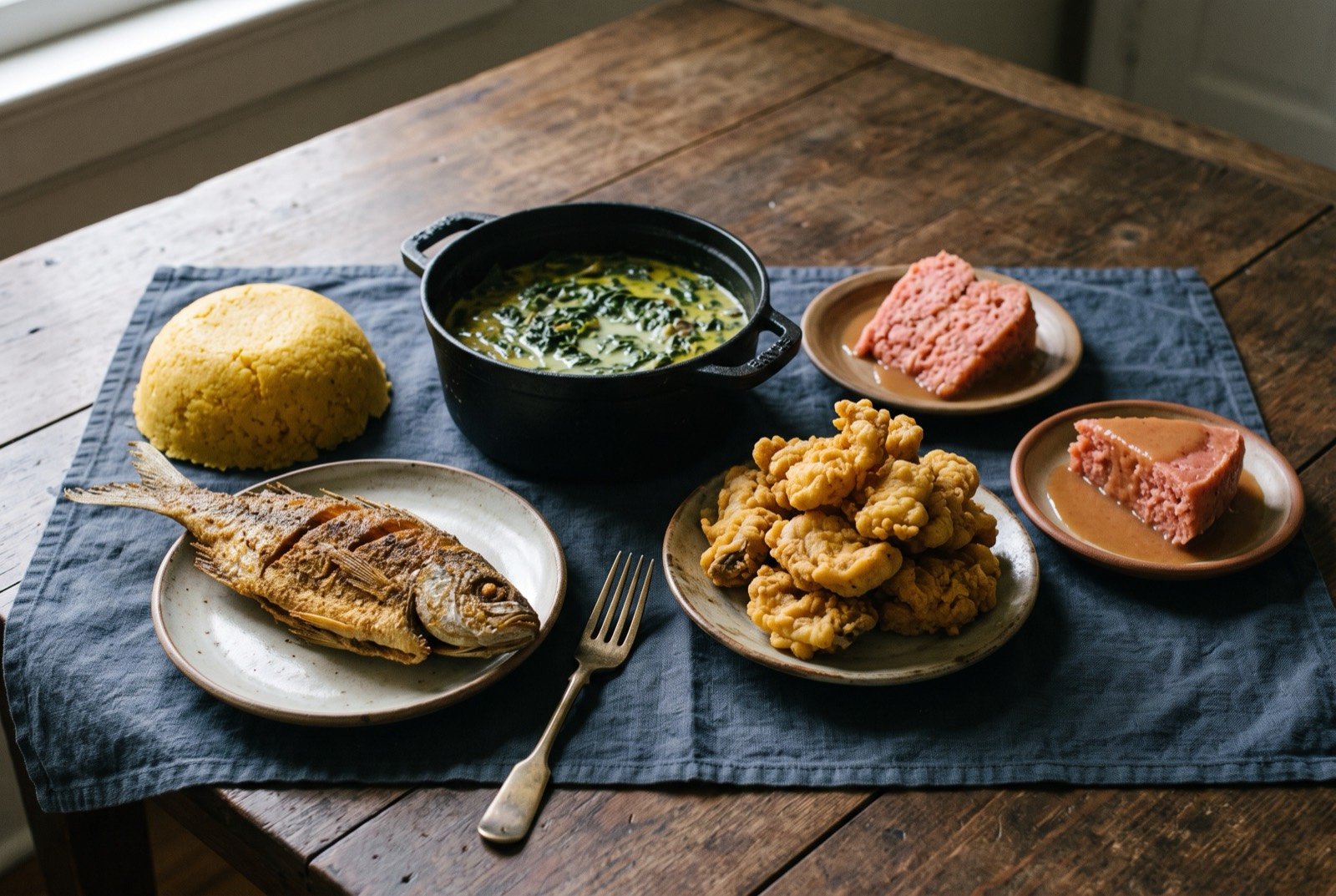
Barbados and the volcanic Eastern Caribbean, Grenada, Dominica, Antigua and Barbuda, share a colonial economy built on sugar, salt cod and the stirred cornmeal pot. The Bahamas shares none of that. Its limestone geology never sustained a plantation, so its table runs on the sea rather than on the root crop and the salted ration. This chapter treats the two as what they are, one book, two food worlds, joined by British administration and by not much else, and it keeps Grenada's spice island identity, Dominica's Kalinago inheritance and the Bahamas' conch economy as their own distinct things rather than one flattened Caribbean voice. Every dish as tradition built it, then what a modern chef would change.
Sources and review · What this chapter does not assert · How we research · Know this better? Tell us
A Sense of Place
This is a chapter about two food worlds that happen to share a coloniser, not one Caribbean cuisine with a Bahamian footnote.
The volcanic Eastern Caribbean: sugar's blueprint, and what it rationed
Barbados, Grenada, Dominica and Antigua and Barbuda sit on the arc of volcanic and coral islands running from the Virgin Islands to Trinidad. Their soil is real soil, deep enough and wet enough in most of them to have supported centuries of sugar monoculture, and it is that monoculture, not the ecology alone, that built the food. Barbados underwent what historians call the Sugar Revolution earlier and more completely than almost anywhere else in the English Atlantic, full commitment of land and labour to cane by the mid-1640s, and became by the late seventeenth century the wealthiest English colony in the hemisphere and its most socially polarised, a small planter elite over an impoverished enslaved majority, a model exported directly to the Carolina colony. Grenada's volcanic soil built a different economy from the 1840s, nutmeg and mace rather than cane, still on its national flag. Dominica's steep, wet, mountainous interior resisted full plantation conversion long enough that the island retains the only formally recognised Kalinago territory in the Eastern Caribbean today, a genuinely separate indigenous lineage running alongside, not folded into, the African descended majority tradition. Antigua's flatter, drier terrain suited cane fully, and its emancipation ran early and cleanly, full freedom from 1834 with no intermediate apprenticeship period at all, four years ahead of Barbados.
What this economy actually put on an enslaved cook's table was narrow by design. Sugar took the land, so protein came from outside it: salt cod, shipped south from the Newfoundland fishery in one of the Atlantic's great unglamorous trade routes, became the rationed backbone of the Eastern Caribbean plate, and it still is. Starch and thickener came largely from Africa, cornmeal and okra above all, worked into a stirred, communal pot that goes by cou-cou in Barbados and fungee in Antigua, Barbuda and Montserrat, two names for the same African stirring technique rather than two different dishes. What enslaved people grew for themselves, on the provision grounds estates were required to allow, filled in the rest: yam, sweet potato, cassava, dasheen, pumpkin, callaloo.
The Bahamas: limestone, and a plantation that failed on schedule
The Bahamas is not a quieter corner of the same story. It is a different ecology producing a different economy producing a different table, and the chapter treats it that way throughout. The roughly seven hundred islands and cays of the archipelago are low outcrops of oolitic limestone, not volcanic rock, and there is not one river or permanent stream anywhere in the country. Limestone is so porous that rain drains almost immediately underground rather than forming surface water; fresh water instead sits as a Ghyben-Herzberg lens, a shallow, convex layer of rainwater floating on denser saltwater within the rock itself, the same mechanism found on small coral atolls generally. Soil is thin, sandy, alkaline and low in nitrogen and potassium, sitting in scattered pockets rather than continuous arable land. A Bahamian heritage writer, publishing as the Bahamianologist, names three historically farmed soil types, black soil, the most plentiful and most farmed, white sand-dune soil, poor in nutrients, and red soil, wind-blown Saharan dust deposited over millennia, briefly fertile then quickly exhausted, and describes farmers clearing land by burning and typically getting one good year before several bad ones forced them to move on.
This is not a claim made from outside. It is demonstrated by an actual historical experiment that failed. American Loyalists, evacuating with British forces after the Revolutionary War from New York, Charleston, Savannah and British East Florida through the 1780s, brought roughly 1,600 white settlers and, with them, enslaved people whose numbers nearly tripled the colony's Black population to around two thirds of the total. They founded cotton plantations on what became known as the Cotton Islands, Cat Island, the Exumas, Long Island, Crooked Island, San Salvador, Rum Cay, on land that had barely been farmed before. Within roughly three decades, slash-and-burn clearing had exhausted the thin soil and the chenille bug had finished the job, and the plantation experiment was over. Where Barbadian sugar sustained a whole society for three centuries, Bahamian cotton could not sustain itself for thirty years. That failure, not a slave economy's long success, is what pushed the nineteenth century Bahamian economy toward subsistence farming on marginal soil, fishing, wrecking and, for three quarters of a century, sponging, and it is why the Bahamian table runs on the sea rather than on the root crop and tree fruit of its volcanic neighbours.
A table of the defining logic
| Element | Barbados and the Eastern Caribbean | The Bahamas |
|---|---|---|
| Fat | Coconut milk in Grenada's oil down; rendered pork and salt pork fat elsewhere | Rendered salt pork and bacon fat |
| Starch | Cornmeal in cou-cou and fungee; breadfruit; dasheen; provision ground root crops | Pigeon peas and rice; grits; cornmeal in johnnycake |
| Aromatic base | Onion, garlic, thyme, Scotch bonnet, Bajan seasoning paste; nutmeg and mace in Grenada specifically | Lime and sour orange acid, in souse and old sour; thyme, onion, goat pepper |
| Everyday protein, land | Salt cod; salt pork; pig offal in souse | Salt pork; chicken; land crab on Andros |
| Everyday protein, sea | Flying fish, specifically Barbadian; dasheen leaf callaloo with crab or saltfish | Conch above all; grouper and reef fish |
The History in Layers
Barbados: the earliest and most complete sugar economy in the English Atlantic
By the late seventeenth century Barbados was producing more sugar than any other Caribbean island, and its historians describe it plainly as the model later exported directly to Carolina, not a parallel case but the actual template. Barbadian planters, by the eighteenth century, "planted little food by volume other than sweet potatoes and yams" for the people they enslaved, relying instead on imports, chiefly salt cod, and that single fact is the direct line from the intensity of the monoculture to the salt-preserved backbone of Bajan cooking today. This chapter has not found a source directly comparing Barbados's sugar timeline against Martinique's or Guadeloupe's, so the claim that Barbados moved earlier and more completely than its French Creole neighbours rests on separate sources for each side rather than one scholarly comparison, and is presented with that caveat.
Full emancipation came on 1 August 1838. Before it, provision grounds, small plots enslaved people were required and permitted to farm, were worked on Saturday and Sunday afternoons in the earlier colonial period, compressed to lunch hours and night work as the estates intensified through the eighteenth century. After it, land ownership became the real measure of freedom rather than a legal formality: Rock Hall Freedom Village, established in 1841, only three years after emancipation, was the first freehold village in Barbados created by former slaves, followed through the 1850s by planter driven land sale schemes that set the pattern for the free villages that followed. This is the actual mechanism, not a vague sense that conditions improved, by which post-emancipation Bajan cooking gained a measure of independence from what the plantation had rationed.
Barbados had almost no indigenous population left by the time the English arrived in 1627. Amerindian occupation had ended in the early sixteenth century under Spanish slave raids, and the Kalinago afterward are documented only as occasional canoe visitors, never permanent settlers. Cassava processing and the barbacoa grilling technique, the root of the English word barbecue, both trace to earlier Arawak or Kalinago instruction, and cassava pone, cou-cou as a stirring concept, and jug-jug are named as dishes carrying that inheritance forward. But there is no genuine earth-oven or pit-cooking tradition documented for Barbados specifically, and this chapter has not invented one by analogy with dishes found elsewhere in this atlas.
The saltfish trade, the thread that actually unifies this volume
Salt cod's presence on every table in this chapter traces to one specific trade route: the Newfoundland cod fishery, salted lightly and air dried by a method English fishers developed into the export standard, shipped south through the Atlantic triangular trade to a British Caribbean that could not, and in Barbados's case would not, feed itself. Barbados was among the largest Caribbean markets for it; by the mid-twentieth century as much as forty per cent of Newfoundland's salt fish exports went to the Caribbean as a whole, Jamaica, Barbados and Puerto Rico the largest buyers. What enslaved people actually received is genuinely contested, and this chapter states both figures rather than choosing between them. A peer-reviewed analysis of Newton Plantation's own purchase records, 1805 to 1837, found workers received roughly a quarter pound of salt cod a week, considerably less than planters of the period claimed. A separate account from Barbados Community College gives a higher figure nearer a pound a week, alongside roughly a pint a day of cornmeal or rice. The two do not agree, and rather than resolve a genuine historiographical dispute this chapter leaves it open.
Grenada: nutmeg's real timeline, and the storm that is still being recovered from
Nutmeg reached Grenada in 1843, seed brought from Banda in the Dutch East Indies by the Honourable Frank Gurney and first planted at Belvidere Estate in St John's parish. That date marks introduction, not the start of production, which is worth keeping precise: commercial scale growing did not begin until after 1880, and exports only from 1881. Grenada's rise to major producer came about opportunistically rather than by design, a worm infestation devastated Indonesia's Banda crop around 1851 and Grenada filled the resulting gap. The Grenada Co-operative Nutmeg Association was founded on 27 March 1947 and remains the institution around which the industry organises.
Hurricane Ivan struck on 7 September 2004, a Category 3 storm that caused over nine hundred million US dollars of damage, more than twice Grenada's entire GDP, and destroyed roughly sixty per cent of the nutmeg crop. Because a replanted nutmeg tree takes at least seven years to bear fruit at all, and considerably longer to reach full yield, this was never a seasonal setback. Co-operative membership, over seven thousand farmers before Ivan, fell to roughly 3,375 afterward, and staff numbers from more than five hundred to around a hundred and fifty. Nutmeg had accounted for eighty per cent of Grenada's agricultural exports and supported over thirty thousand livelihoods before the storm. More than two decades on, the industry is still, by the measure of tree maturity, mid-recovery.
Whether the spice trade actually shapes how Grenadians cook, as distinct from what Grenada exports, deserves an honest answer rather than a flattering assumption, and the honest answer is both, unevenly. Nutmeg and mace are genuinely used at home, grated into cocoa tea, sprinkled over rum punch, baked into sweet bread, folded into oil down itself. But the overwhelming majority of what Grenada grows leaves the island, and the Spice Isle identity printed on the national flag is as much branding, Spicemas carnival, nutmeg tourism, the Gouyave processing station turned visitor attraction, as it is a description of the daily pot. This chapter has found nothing that quantifies domestic use against export volume, and does not overstate nutmeg's place at the everyday Grenadian table beyond what the evidence above actually shows.
Dominica: the mountain chicken, and why this chapter will not give it a recipe
Dominica's Leptodactylus fallax, the giant ditch frog known locally as mountain chicken, was once a genuinely popular local and tourist dish, and its current status has to be stated with complete precision rather than nostalgia. A chytrid fungus outbreak struck the island from 2002 and caused a population collapse of over eighty per cent within eighteen months; hunting was banned that same year in direct response, and the species is now listed Critically Endangered by the IUCN. A 2023 survey found only twenty one individuals alive in the wild anywhere in Dominica, the last place on earth the species survives outside captivity at all, with a total wild population across Dominica and Montserrat combined estimated at around a hundred. A captive breeding programme runs from Roseau's botanical gardens, with satellite populations held at London Zoo and in Sweden. This dish belongs in the chapter as culinary memory and as a genuine conservation warning, not as something a reader could seek out or cook, and it will not appear among the recipes below.
The Kalinago territory itself, formerly called the Carib Territory, was established by the British colonial administrator Henry Hesketh Bell between 1902 and 1903, formally declared on 4 July 1903, a piece of Victorian preservationist administration rather than an act of Kalinago self-determination at the time, renamed Kalinago Territory only in 2015 to reflect the community's own name for itself. It covers roughly 3,700 acres on Dominica's Atlantic coast and its population runs from 2,112 at the 2011 census to an estimated three thousand today. What survives there is a genuinely pre-Columbian food technology, not folklore dressed up as one: bitter cassava is peeled, grated, traditionally on a stone or metal sheet grater called a grage, then pressed in a matapie, a long woven sack hung and twisted to squeeze out the liquid that carries the root's toxic prussic acid, since grating is the step that exposes the compound linamarin to the enzyme that releases it as gas. The pressed pulp is toasted over a coal fire into farine, a coarse or fine cassava meal depending on how it is sieved. Whether any scheme of Indian indenture ever reached Dominica could not be confirmed in the course of this research; it is plausible given how far the island's plantation economy had already declined by the mid-nineteenth century relative to Barbados, but that is inference rather than a sourced fact, and this chapter leaves it as an open gap rather than a quiet assumption either way.
Antigua and Barbuda: freedom four years early, and a Portuguese layer
Antigua's most useful comparative fact against Barbados is that its emancipation ran clean and early, full freedom from 1834 with no apprenticeship period at all, four years ahead of Barbados's 1838, a genuinely useful corrective to treating British Caribbean emancipation as one uniform event with one uniform date. The resulting labour gap was filled in part by indentured Portuguese migrants from Madeira through the later nineteenth and early twentieth centuries, who on completing their contracts largely left plantation work to found businesses of their own, a documented layer distinct from the African-descended majority. A single weaker source claims South Asian indentured labourers also reached Antigua and brought curry with them; nothing stronger corroborates it, and Antigua's clearly documented indenture history is Portuguese, not South Asian, so this chapter does not repeat the second claim as fact.
Indenture across this whole volume, worth sizing correctly against Trinidad's much larger, better documented programme covered in a companion volume: Grenada received roughly 3,200 Indian indentured workers between 1857 and 1890, St Lucia roughly 4,500 across thirteen ships between 1859 and 1893, both legalised later than Trinidad's 1844 scheme and both struggling to attract labourers at all against larger, better resourced destinations, St Lucia at one point weighing Chinese labour instead when it could not secure Indian workers between 1881 and 1883. Indenture reached these small islands as a genuine but minor demographic layer, not the society-shaping wave it became in Trinidad.
British and French Creole, and the islands that changed hands
Dominica and St Lucia were fought over repeatedly by Britain and France, and the residue is still spoken, not just remembered: both retain French-lexicon Antillean Kwéyòl Creole alongside English, strongest among Dominica's older residents and spoken by a majority of St Lucia's population despite its English official status. Grenada shares the same Creole family despite earlier and more complete British consolidation, and scattered French-derived food vocabulary across all three islands is the direct, traceable result. One source consulted for St Lucia's history gives its final transfer to British control as 1914; every other, better source points to 1814, the Congress of Vienna settlement, and this chapter treats the 1914 figure as an error not to be repeated rather than a genuine second date.
The Bahamas: a Loyalist economy that failed, then a century of the sea
The population and colonial history sketched above under ecology deserves its own emphasis as history, not only as an explanation of soil. What arrived with the Loyalists was a late eighteenth century transplant of a plantation model that had worked elsewhere, attempted on land that had never held one before, and it failed inside thirty years. What filled the space afterward was not a slower version of the same economy but a genuinely different one, built around what the sea offered rather than what the land could no longer be made to give. Sponging became the clearest example: started almost by accident by a shipwrecked Frenchman, Gustave Renouard, exporting to Paris from 1841, the industry grew until, by 1935, the Bahamas ranked third in world sponge production, peaking in 1917 at over a million pounds exported. In November and December 1938 a fungal blight destroyed roughly ninety nine per cent of the Bahamian sponge beds in a matter of weeks, ending an industry that had underpinned the economy for three quarters of a century. Andros, and specifically the shoal known as the Mud off its west coast, was the premier ground, and a small revival survives today at Mangrove Cay and Red Bays.
What is known of Lucayan foodways, the Taino-related people who settled the northern Bahamas from roughly 800 to 900 AD, is genuinely thin, and this chapter would rather say so than invent a continuity that does not exist. Named academic archaeologists, working at Oxford, the Smithsonian and the Bahamas Maritime Museum, have documented that Lucayans grew manioc, maize, sweet potato and chilli peppers, hunted the hutia rodent and trapped birds, and drew over eighty per cent of their meat from marine fish taken by hand gathering, basket traps, weirs and hook and spear. Conch specifically appears in the archaeological record, eaten raw, steamed, boiled or roasted, and dried for storage up to six months, a real and specific claim rather than filler. What this chapter will not assert is any direct line of culinary transmission from Lucayan cooking to the modern Bahamian table. The Lucayan population was destroyed by Spanish enslavement and disease within decades of first contact, and there is no continuous chain of cooks comparable to the one that carried enslaved West African technique forward across the plantation centuries. A claim occasionally made by contemporary Bahamian chefs, that Lucayans specifically gave the Bahamas johnnycake, is a claim made in interview, not something this research found supported archaeologically or etymologically, and johnnycake's own origin is generally treated in wider food history as diffuse across the Atlantic world rather than traceable to one source.
What is better evidenced, and more useful to the chapter, is genuine internal variation between Nassau and what Bahamians call the Family Islands, the out islands beyond New Providence and Grand Bahama. Two named Bahamian chefs speak to it directly. Raquel Fox: "It really isn't a homogeneous food culture, very different from island to island, all rooted in being uniquely Bahamian." Simeon Hall Jr, on Nassau specifically: cooking there has had to be watered down under the pressure of roughly seven million annual tourist visits, chefs told not to use too much salt or certain ingredients, a direct, named account of exactly the flattening this chapter is trying not to do to the volume as a whole. Andros is named for its land crab, Eleuthera for pineapple and baked goods, Bimini for a distinctively sweet bread, Abaco for its rum cocktails, a real map of difference rather than one Bahamian voice standing in for all of them.
The Flavour Arsenal
Cornmeal and okra, cou-cou and fungee. Two names for one African stirring technique, not two dishes. Cou-cou in Barbados, fungee in Antigua, Barbuda and Montserrat, both trace to a pan-African family that also includes couscous, sadza, ugali and fufu: the word names the method, a starch stirred to a smooth, cohesive mass, not fixed ingredients. Fungee derives directly from the Angolan funge, a separate etymological line from cou-cou describing the same inherited technique, sometimes made without okra on Montserrat, where it is called fengi. A retired Barbadian diplomat and food writer, Dr Peter Laurie, has directly corrected a piece of popular folklore worth repeating here precisely because it corrects itself: the belief that cou-cou demands ritual conditions to stir is not supported, and the traditional cou-cou stick is, on his identification, a Scottish spurtle, an oatmeal-stirring tool with no African-specific origin at all.
Nutmeg and mace. Covered in full above. Sold internationally as West Indian nutmeg, distinguished in trade from the milder Indonesian East Indian nutmeg that supplies most of the world market, and stronger flavoured, roughly two thirds the quantity of a recipe written for standard nutmeg.
Callaloo, two plants sharing one name. This distinction matters more than almost any other in the chapter, because getting it wrong produces a different dish under the same name. Eastern Caribbean callaloo, Grenada's above all, is made from dasheen leaf, taro, cooked down with coconut milk, okra and saltfish or crab. Jamaican callaloo is a wholly different plant, a local amaranth, closer in the finished dish to a sautéed green than to a coconut soup. The two are not regional variants of one recipe. They are two different plants that happen to carry the same name across the Caribbean, and this chapter keeps them apart.
Salt cod. Covered in full above, the trade route that unifies this volume more than any single ingredient.
Conch. The Bahamas' signature protein, and its decline should not be softened. A 2011 survey of the Exuma Cays found adult conch density down roughly ninety one per cent over the preceding twenty years. A 2026 peer-reviewed reconstruction of Bahamian catches from 1950 to 2022 assesses the stock as severely overexploited, running at little over half the biomass that would sustain maximum yield, with recruitment failing across forty surveyed fishing grounds because conch need a minimum population density, roughly fifty adults per hectare, simply to find each other to mate. The United States listed queen conch as threatened under its Endangered Species Act in February 2024. The Bahamian government announced a phase-out of commercial conch exports by 2022, but the most recently dated official document this research could locate predates that announcement, and a 2025 secondary account describes the fishery as regulated rather than banned outright. This chapter states the regulatory picture as genuinely unresolved in the sources available to it, while being unambiguous that the underlying biology is one of serious, ongoing overexploitation.
Pigeon peas. The base of Bahamian peas and rice, an African legume, likely carried across the Atlantic during the slave trade in the seventeenth century, cooked down into a browned, tomato-based sauce with rendered salt pork, a genuinely different dish from Jamaican rice and peas, which uses kidney beans in coconut milk for a lighter, sweeter result.
Rum. Covered in the sourcing chapter below in the depth the subject deserves.
Sorrel and sea moss. Sorrel, made from roselle hibiscus, is planted in early summer and harvested around Christmas, the harvest timing itself the reason it is a Christmas drink rather than an arbitrary seasonal choice, simmered with cloves, ginger, allspice and cinnamon for around ten minutes then steeped overnight to two days, often fortified with rum. Sea moss, a red algae boiled to a gel and blended with milk, spice and condensed milk, is widely said to trace to Irish indentured servants who turned to the coastal algae as survival food after the Famine of the 1840s. This chapter has found that claim only in wellness and tourism sources rather than a historical one, and states it as widely repeated rather than verified.
Old sour. The Bahamian answer to an ecology that offers no reliable fresh produce out of season: Key lime juice, salt and bird pepper, sometimes sour orange, fermented and aged away from light. It travelled with Bahamian settlers, historically called Conchs, to Key West, and functions as a genuine preservation technology for citrus rather than a novelty condiment.
The Technique Ladder
The argument, from inside
Six techniques, each explained by why it works, not only what it does.
Rung 1. Cou-cou and fungee's continuous stirring
Okra's mucilage is what allows the cornmeal mass to bind and hold shape rather than remaining grainy; continuous stirring with a dedicated implement prevents scorching on the pot base and develops even starch gelatinisation throughout, which is why the traditional method insists on a specific motion rather than an occasional stir.
Rung 2. Oil down's unstirred one-pot layering
Ingredients are stacked in a fixed order, breadfruit at the base, protein at the centre, aromatics and coconut cream on top, and the pot is deliberately never stirred, so each layer steams in its own rising fat and juices rather than boiling into a single mush; the coconut fat concentrates as the liquid reduces, oiling down to the base, which is where the dish takes its name.
Rung 3. Conch cracking
Raw conch meat is pounded by hand with a mallet until roughly two to three millimetres thick and pliable, mechanically rupturing and shortening the dense, tightly packed muscle fibre of the animal's foot, the same principle as tenderising any tough cut, with a real festival at McLean's Town, Grand Bahama, that awards a trophy for the best conch cracker, evidence of how seriously the skill is held.
Rung 4. Black cake's long rum soak
Dried fruit is soaked in a roughly equal mix of rum and a fortified sweet wine for anywhere from a week to a year, then pulverised to a paste; both alcohol and sugar inhibit spoilage while slowly breaking down the fruit's cell walls, which is what keeps the finished cake's crumb moist for months rather than a few days.
Rung 5. Cassava grating and matapie pressing
Grating exposes the compound linamarin in bitter cassava to the enzyme that converts it to cyanide gas, and the matapie sack physically presses out the toxic liquid that carries it; this is what makes a genuinely toxic root safely edible, a real chemical process rather than a rustic affectation, and it predates European contact entirely.
Rung 6. Guava duff's steaming in cloth
A yeasted dough is rolled around a fruit filling and steamed inside a sealed cloth bag for at least an hour; the enclosed, moist heat cooks the dough through without a crust forming, the same principle behind any boiled or steamed pudding, and the technique itself, not the fruit, is the genuinely difficult part to get right.
The Ferment and Preserve Bench
Three preparations, each a genuine preservation technology this ecology or economy actually demanded, not a modern flourish.
Black cake's rum soak. Covered in full above. Dried fruit soaked for a week to a year or longer in rum and a fortified sweet wine, both alcohol and sugar working to inhibit spoilage while slowly breaking down the fruit's own structure, a genuine long preservation technique built directly on Barbados's centuries of continuous, trusted household rum.
Old sour. Key lime juice, salt and bird pepper, sometimes sour orange, fermented and aged away from light, a direct Bahamian answer to an ecology that offers no reliable fresh produce out of season, and a technology real enough to have travelled with Bahamian settlers to Key West.
Farine. Toasted, dried cassava meal, covered in full above, a way to turn a root that spoils quickly and carries real toxicity when raw into a meal that keeps for months and travels easily, exactly the kind of technology a subsistence economy on marginal land actually needs rather than one it adopts for taste alone.
Sourcing in Britain
Nutmeg and mace, the volume's best sourcing story. Genuine Grenada-origin nutmeg and mace is buyable in the UK from small specialist retailers rather than supermarkets. BoTree Farm's Grenada Gold Nutmeg, 50 grams for £5.95, whole or ground, states it is hand-picked at Belmont Estate on the island, a named, traceable source. Spices on the Web sells whole nutmegs from £1.99 and Grenada-origin mace blades from £3.81, and The Spice Shop sells whole Grenadan nutmegs from £0.75. Grenadian nutmeg is traded internationally as West Indian nutmeg, distinguished from the milder Indonesian East Indian nutmeg that supplies most supermarket stock, and is stronger flavoured, roughly two thirds the quantity a standard recipe calls for.
Salt cod. Straightforward. Cawoods' dry salted, skinless, boneless saltfish, around £3.25 for 200 grams, is available through ASDA and Caribbean grocers, and Island Sun carries a comparable line. A generic UK fishmonger's salt cod, the long-standing British and Iberian bacalhau trade item, is a genuine alternative, though it is typically cut thicker than the Caribbean-brand product prepared specifically for dishes like these.
Conch, and an honest word on why it is genuinely difficult. Bahamian conch specifically can no longer legally reach the UK as a commercial export, following the Bahamian government's announced phase-out of commercial conch exports from 2022. Other Caribbean nations still export queen conch under CITES permits, but no verified UK consumer retailer or specialist importer stocking conch meat was found in the research behind this chapter, and a single marketplace listing for frozen conch meat could not be confirmed for its shipping origin or CITES compliance and should not be relied on. The honest position for a UK reader is that conch is not realistically sourceable at present, a genuine limitation on what a Bahamas chapter can promise, stated plainly rather than papered over with an unverified listing.
Callaloo, and the plant that matters. UK supermarket and Caribbean-grocer callaloo, tinned or frozen, is almost always the Jamaican amaranth product, easy to find and the wrong plant for this volume's Grenadian dasheen leaf dishes. True fresh dasheen bush is genuinely scarce in Britain; one specialist importer is named in secondary sources as one of very few stocking the fresh leaf in bundles, but its current stock could not be independently verified. The honest recommendation is to seek out a specialist Caribbean grocer in person rather than rely on finding dasheen bush online, and to expect its availability to be inconsistent even there.
Farine and breadfruit, the two hardest items after conch. True toasted farine appears essentially unsourceable in the UK at present; cassava flour, a different, finer product, is easy to find but is not a substitute for it, and this chapter says so rather than implying otherwise. Fresh breadfruit turns up intermittently from a small number of UK exotic fruit importers, at anywhere from twenty to sixty pounds a fruit, frequently out of stock and rarely confirmed as Caribbean-grown rather than Pacific-sourced. A reader wanting to cook Grenadian oil down should expect to find breadfruit in person at a Caribbean greengrocer rather than order it online, and to budget for real scarcity.
Cornmeal. Island Sun's coarse cornmeal, around £2.95 for 1.5 kilograms, is available through Tesco and is the standard Caribbean-grocer-facing choice for cou-cou and fungee. The right grind is genuinely a matter of household preference across in-tradition sources, some favouring fine, some coarse, and this chapter does not assert one as correct.
Barbadian rum, the volume's sourcing success story. Mount Gay's Eclipse, around £19.50 to £25.50 for 70 centilitres, is widely stocked, including at Tesco and Tanners Wines. Foursquare, Doorly's and R.L. Seale's are confirmed available through The Whisky Exchange and Master of Malt, from around £28 up to £195 for limited releases, imported by Marussia Beverages UK. St Nicholas Abbey is available through Fortnum & Mason and several specialist spirits retailers, from a 5 Year Old up to a 25 Year Old expression. No UK importer specialises specifically in Eastern Caribbean or Bahamian rum as distinct from a general Caribbean range, worth stating plainly, but Barbadian rum itself is genuinely well served.
Kit. A genuine Caribbean Dutch pot, cast aluminium rather than cast iron despite how it is sometimes described, is sold in the UK from roughly £30 to £45. It is a thin, fast-heating pot built for an open flame, a genuinely different tool from a heavy enamelled Le Creuset-style casserole, which holds heat differently and is a workable substitute for a slow braise but the wrong tool for techniques that depend on fast heat response, such as browning sugar for a stew. No Caribbean-specific mortar and pestle retailer was found; a standard wooden or granite mortar from a general UK kitchenware supplier is the honest, undifferentiated recommendation.
The single decision that matters most. Getting the callaloo plant right, dasheen leaf rather than the Jamaican amaranth sold everywhere in Britain as "callaloo." Every other ingredient in this chapter can be approximated, substituted honestly, or in a few cases simply admitted as unavailable, but the wrong callaloo does not approximate Grenada's soup, it replaces it with a different dish that happens to share a name.
Voices and Sources
Barbadian and Eastern Caribbean press and institutions: Barbados Today, including a column by the retired diplomat Dr Peter Laurie correcting cou-cou's popular folklore directly; Nation News Barbados; Loop Barbados; Barbados Community College's own historical writing on enslaved provisioning; NOW Grenada; Caribbean Today; the Grenada National Trust's 1967 historical document on nutmeg; the University of the West Indies' Shridath Ramphal Centre, for its working paper on Hurricane Ivan's effect on the nutmeg supply chain; and a peer-reviewed paper in the Journal of Caribbean History directly analysing Newton Plantation's own salt cod purchase records.
Bahamian voices and institutions: the writer publishing as the Bahamianologist, whose two pieces, on the archipelago's soil ecology and on guava duff's actual British origin, anchor this chapter's most important corrections; the Nassau Guardian; the Mountain Chicken Recovery Programme, run jointly with Dominica's own government; a 2026 peer-reviewed paper in Frontiers in Marine Science on the queen conch fishery's decline; and named Bahamian cultural figures worth seeking out directly: Helen Burns Higgs, whose Bahamian Cook Book rests on forty five years of research into Bahamian home cooking; Rosamund Roberts, author of A Little Bahamian Cookbook; and Patricia Glinton-Meicholas, the leading documentarian of Bahamian folk culture generally.
Kalinago and Dominican sources: Dominica Gourmet, a Dominica-based food writer's own site, for the simplified modern cassava bread method used above; the Dominica High Commission's own material on the Kalinago Territory's founding and renaming.
Modern chefs: Paul Carmichael of Kabawa, New York, Barbados-born, whose restaurant received a rare three-star New York Times review and was named that paper's top New York restaurant in 2026, the strongest single reference point in this whole volume, and whose own stated resistance to the language of elevation, "I just think of it as now in its place," is worth carrying honestly rather than smoothed into this chapter's own framing; Jason Howard of Flava Pepper in London, who makes the explicit case that Bajan seasoning deserves the same standing as a named French regional ingredient; Antonio Williams of Mahogany Club in Nassau, drawing directly on his mother Melvina Rolle-Williams's Andros cooking; and Simeon Hall Jr, whose family carries a two-generation matrilineal line of pioneering Bahamian restaurateurs.
Things this chapter has deliberately not asserted
- That "Dutch pot" is a term or object native to Barbados, Grenada or the Bahamas. Every strong source found for it documents it specifically as Jamaican vocabulary, and this chapter has avoided using the term for this volume's own cast-iron and cast-aluminium pots rather than import it from a different island's food culture.
- That a genuine covered earth-oven or pit-cooking tradition exists anywhere in this volume's scope. Barbados had no permanent indigenous population at the time of English colonisation, ruling this out for that island specifically; Dominica's surviving Kalinago technique is grating and griddle work, not a covered pit method comparable to Chilean curanto or Hawaiian imu, and no source describing one was found.
- That jug-jug's popular Scottish-haggis origin story is settled history. It circulates with two mutually inconsistent dates, the 1685 Monmouth Rebellion or the 1745 Jacobite Rebellion, and neither was traced to a primary source in this research; it is treated here as folk etymology rather than verified fact.
- That sea moss's attribution to Irish indentured servants after the Famine is verified history rather than a widely repeated claim. It was found only in wellness and tourism sources, not a historical one.
- That mountain chicken is a dish a reader could cook. It is critically endangered, with only twenty one individuals confirmed alive in the wild in 2023, and hunting has been banned in Dominica since 2002; this chapter treats it as culinary memory and conservation warning only, and gives it no recipe.
- That the Bahamas' 2022 commercial conch export phase-out is confirmed as currently in force. This research found a clear 2020 ministerial announcement but no confirming, currently dated official document, and a 2025 secondary source describing the fishery as merely regulated; the regulatory status is stated as unresolved rather than settled either way.
- That Lucayan cooking survives in an unbroken line to the modern Bahamian table, or that Lucayans specifically gave the Bahamas johnnycake, a claim made by a contemporary chef in interview but not supported by the archaeological sources this chapter could find.
- That any named chef is doing serious technical elevation of St Lucian or Vincentian tradition specifically. This research found only outside interpreters for St Lucia and nothing at all for St Vincent beyond national-dish tourist copy, and treats this as a real gap in what could be found rather than a claim that no such work exists.
- That Indian indenture reached Dominica, or that it reached Antigua in any documented South Asian form. Neither could be confirmed; Antigua's clearly documented indenture layer is Portuguese, not South Asian, and Dominica's status is left as an open question.
- That Barbados's Sugar Revolution is directly, scholarly compared here against Martinique's or Guadeloupe's timeline. The claim that it moved earlier and more completely rests on separate sources for each side rather than one source making the comparison, and is stated with that caveat.
Cou-cou and fungee's continuous stirring
Okra's mucilage is what allows the cornmeal mass to bind and hold shape rather than remaining grainy; continuous stirring with a dedicated implement prevents...
Oil down's unstirred one-pot layering
Ingredients are stacked in a fixed order, breadfruit at the base, protein at the centre, aromatics and coconut cream on top, and the pot is deliberately never...
Conch cracking
Raw conch meat is pounded by hand with a mallet until roughly two to three millimetres thick and pliable, mechanically rupturing and shortening the dense...
Black cake's long rum soak
Dried fruit is soaked in a roughly equal mix of rum and a fortified sweet wine for anywhere from a week to a year, then pulverised to a paste; both alcohol and...
Cassava grating and matapie pressing
Grating exposes the compound linamarin in bitter cassava to the enzyme that converts it to cyanide gas, and the matapie sack physically presses out the toxic...
Guava duff's steaming in cloth
A yeasted dough is rolled around a fruit filling and steamed inside a sealed cloth bag for at least an hour; the enclosed, moist heat cooks the dough through...
The dishes
- Cou-cou and Flying Fish Barbados
- Pudding and Souse Barbados
- Bajan Black Cake Barbados
- Oil Down Grenada
- Callaloo Soup Grenada
- Farine and Cassava Bread Dominica
- Fungee and Pepperpot Antigua and Barbuda
- Cracked Conch The Bahamas
- Peas and Rice The Bahamas
- Guava Duff The Bahamas
Sources and review
Where this volume comes from
4 research briefs on file for this volume, researched to the rules on How we research. Published 3 September 2026. Last changed 8 September 2026.
The brief's own account of its sources
Roughly 15 to 18 of the sources behind the Barbados and Eastern Caribbean section are genuinely in-tradition, regional or academic: Barbados Today, including a column by a named Barbadian former diplomat directly correcting cou-cou folklore; Nation News Barbados; Loop Barbados; Barbados Community College; a peer-reviewed IJIH paper by Barbadian and UWI-linked academics; a peer-reviewed *Journal of Caribbean History* article on saltfish rationing; the Grenada National Trust's own 1967 historical document; a UWI Shridath Ramphal Centre working paper on Hurricane Ivan's impact on nutmeg; the