The Americas · Volume 13
Puerto Rico and the Dominican Republic
The Pilón, the Colony and the Frontier
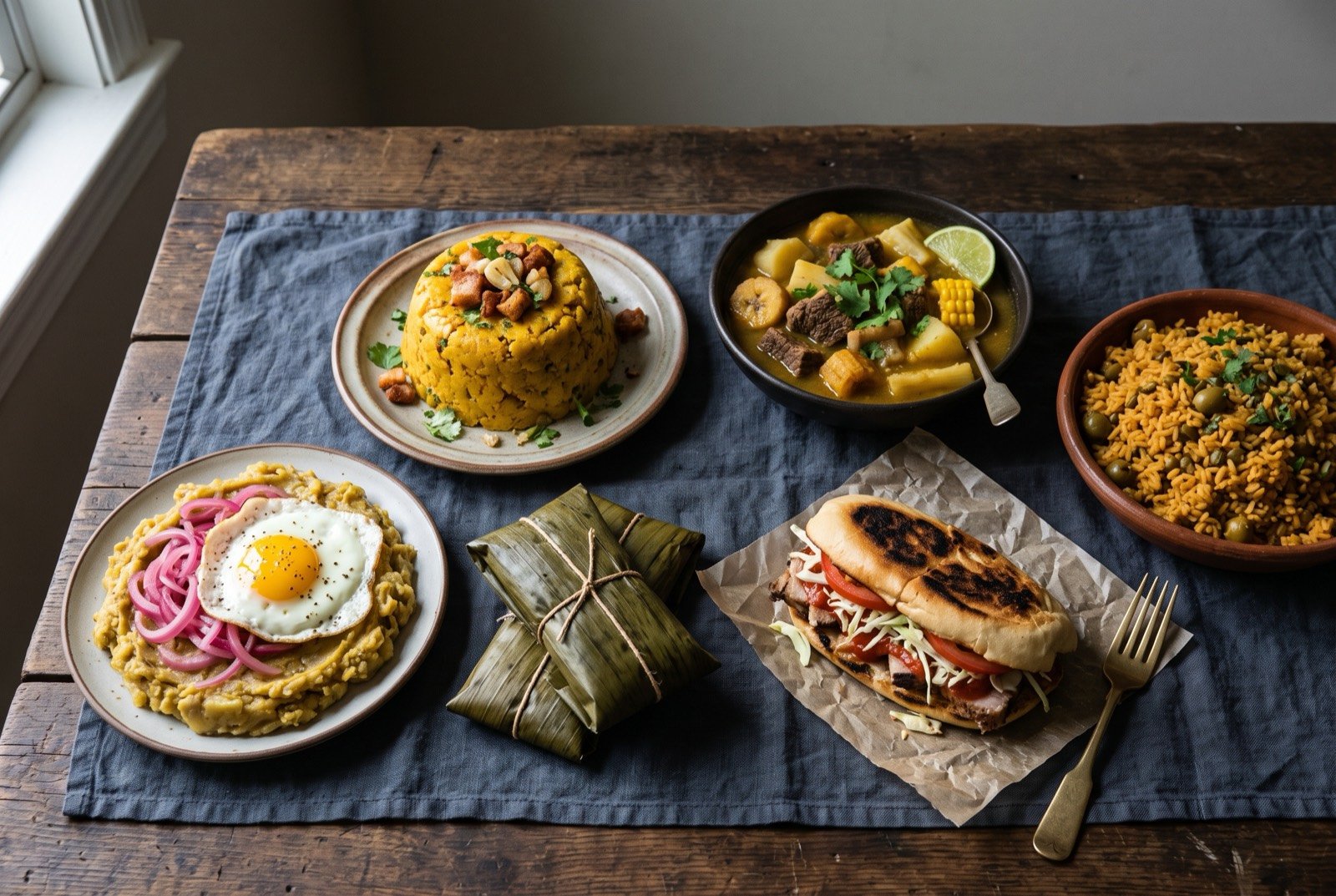
Two islands sharing one grammar, mashed and fried starch bound with a sofrito of garlic, onion and a peppery herb no supermarket in Britain reliably stocks, and one history that neither island tells the same way. Puerto Rico is a US commonwealth whose food politics run through shipping law and a hurricane, not just through a colonial kitchen. The Dominican Republic shares its island with Haiti, and that frontier, its labour, its violence, its market days, sits inside the food rather than beside it. Every dish as tradition built it, then what a modern chef would change.
Sources and review · What this chapter does not assert · How we research · Spotted something wrong?
A Sense of Place
Puerto Rico and the Dominican Republic are usually filed together as "Hispanic Caribbean" and left there, as though sharing a base grammar, mashed starch, sofrito, rice and beans, meant sharing a history. They do not. Puerto Rico has been a territory of the United States since 1898 and its food economy is still shaped today by an American shipping law and the debt crisis that followed it. The Dominican Republic shares the island of Hispaniola with Haiti, and that border, its sugar economy, its violence, its markets, is not background to Dominican food, it runs through the middle of it. This chapter keeps both facts in view rather than smoothing them into one generic "islands, plantains, rum" story.
The shared grammar
Both kitchens are built from the same three population layers, in something close to the same order, and it is worth setting out plainly before either island's own history diverges from the other's.
| Element | Puerto Rico | Dominican Republic |
|---|---|---|
| Fat | Manteca, lard, often infused with achiote seed; now often vegetable oil with achiote | Historically lard, now oil or butter, butter specifically for mangú |
| Aromatic base | Sofrito: recao (culantro), ajíes dulces, onion, garlic, green pepper, bound in achiote oil | Sazón: cilantro, culantro, red onion, ají cubanela, garlic, sometimes tomato and vinegar |
| Starch | Plantain, yautía, rice with gandules | Rice, plantain, yuca, the víveres (ñame, yautía, batata, auyama) |
| Everyday plate | Arroz, habichuelas (or gandules), a meat | La bandera: rice, stewed beans, a meat |
| Pounding tool | The pilón, for mofongo | The pilón or a wooden majador, for mangú |
The two islands' sofrito is not the same thing under a different name, and the difference matters more than the resemblance. Puerto Rican sofrito is culantro-forward and typically cooked down before storage; Dominican sazón is more often used fresh as a marinade, and leans on achiote for its characteristic orange cast in a way Puerto Rican sofrito does not. Neither is Cuban sofrito, which runs more toward cumin. A resort or pan-Latin kitchen that uses one jarred base across all three cuisines is not simplifying, it is erasing a real distinction, and this chapter comes back to exactly that erasure in the modernist section below.
Puerto Rico: the mountain and the coast
Puerto Rico is small, about a hundred miles by thirty five, but the Cordillera Central splits it into two working ecologies. The coast, San Juan, Loíza, Ponce, Piñones, runs on fishing, coconut palm and sugar-era flatland agriculture. The cooler mountainous interior, Utuado, Adjuntas, Lares, Maricao, Cayey, historically ran on coffee, tubers and small-scale subsistence farming, the world of the jíbaro. Viandas and coffee dominate the mountains; coconut, fish and fritters dominate the coast, and a great deal of the island's regional food identity still sorts along this one line rather than by province.
The Dominican Republic: Cibao, the capital, the south, and the sea
Four zones recur constantly in Dominican food writing. The Cibao valley, the fertile agricultural heartland around Santiago de los Caballeros, gives the country mangú and its own naming quirks, arepa is "torta" here. Santo Domingo, the capital and the site of first contact between Spanish, Taíno and African foodways, anchors the codified national plate, la bandera. The south and southwest, Barahona, Azua, Baní, San Juan de la Maguana, the border provinces, are described in Dominican sources as bearing the mark of African ancestors and sharing dishes with Haiti across the frontier, chenchén and chacá specifically. Samaná, geographically isolated on its own peninsula, carries two further Afro-diasporic layers found nowhere else on the island: free African-American settlers who arrived from Philadelphia in 1824, and a separate wave of free Black immigrants brought during the years of Haitian unification of the island, 1822 to 1825. Samaná's coconut-forward cooking and its own wheat-flour yaniqueque tradition both trace to these two later arrivals, not to the older Taíno-Spanish-African base.
The History in Layers
Taíno foundations, shared and specific
Both islands begin with the Taíno, and with the same crop: yuca, grated, pressed of its cyanogenic liquid in a woven bucán, sieved and baked on a hot ceramic griddle, the burén, a Taíno word still in use on both islands, into casabe. Casabe substituted for the wheat bread the tropical climate could not grow, and Spanish colonisers adopted it wholesale; it was also standard ship's provision out of the Antilles, light and effectively imperishable. Historian Bernardo Vega calls yuca and its industrialisation via casabe the single most important Taíno contribution to the Dominican diet, and the claim holds equally for Puerto Rico. Maize, batata, yautía, mapuey and ají rounded out the Taíno plant diet on both islands, grown on raised mounds called conucos, cleared by slash-and-burn.
The Spanish layer
Spain brought rice, which could not be grown locally at scale for centuries and was imported instead; pork husbandry; wheat, mostly unusable in the tropical climate, which is exactly why casabe persisted rather than being displaced; and onion, garlic, cilantro, chickpeas, olives and capers. Santo Domingo, founded in 1498, is repeatedly described in Dominican and Spanish-language sources as the first permanent European city in the Americas, the site of the Americas' first cathedral and first fortress, now a UNESCO World Heritage colonial zone. A 1577 document already records the pairing of rice and beans in Santo Domingo, per historian Hugo Tolentino Dipp, though for centuries afterward the ordinary diet on both islands remained root vegetables with a little meat, rice reserved for feast days rather than daily eating.
African labour, and technique as well as ingredient
Enslaved Africans, forcibly brought from the early sixteenth century, gave both islands more than new crops. Gandules, pigeon peas, are argued by Puerto Rican historian Berta Cabanillas to be an Angolan introduction via the slave trade; the plant is documented locally by 1795 in a Puerto Rican botanical survey recording the names "gandul" and "gandures." Okra, coconut cooking and deep-frying in quantity are widely attributed to the same layer on both islands. Puerto Rican chef Giovanna Huyke states the technique argument directly: "El sofrito, la columna vertebral de nuestra cocina puertorriqueña... viene directamente de las tradiciones africanas," sofrito, the backbone of Puerto Rican cooking, comes directly from African tradition. It is a strong, named, in-tradition claim, and it is one voice rather than a settled scholarly consensus, which this chapter states plainly rather than borrowing its certainty.
The clearest case of technique surviving intact is the pounding tradition itself. Mofongo, made by pounding hot fried plantain in a pilón, and mangú, made by pounding boiled plantain with a majador, are both explicitly likened by historians on both islands to West and Central African fufu. Puerto Rican historian Cruz Miguel Ortiz Cuadra traces the word "mofongo" itself to the Kikongo mfwenge-mfwenge, a great quantity of anything. But the two islands' own historians do not agree on the direction the dish travelled: Dominican historian Carlos Esteban Deive argues in Culturas afrocaribeñas that mofongo was imported into the Dominican Republic from Puerto Rico, which would make it a Puerto Rican dish carrying an African name and an African technique, rather than an unmediated African transplant to either island. This chapter states the disagreement rather than resolving it. Dominican sociologist Dagoberto Tejeda makes the same argument about words as objects: guandul, the Dominican word for pigeon pea, is traced by researchers Celsa Albert and Carlos Larrazábal Blanco to the Kikongo wandu, and concón, the crisped rice prized rather than discarded at the bottom of the pot, is traced by the same two researchers to Bantu naming practice, though this second etymology rests on secondary cultural commentary rather than a primary linguistics source and is offered here as plausible, not settled.
Puerto Rico's clearest living site of this layer is Loíza and Piñones, just east of San Juan, which sheltered escaped enslaved people from British colonies from the 1600s and today holds the island's highest concentration of Afro-Puerto Rican population, its fritter culture and its bomba music treated locally as the most direct surviving expression of the African layer. The Dominican Republic's equivalent later arrival is the cocolos, English-speaking Afro-Caribbean immigrants who came to San Pedro de Macorís from the late nineteenth century to work its sugar boom, bringing yaniqueque, calalú, fungí, mabí and domplín, a boiled wheat dumpling eaten with salami, salt cod, or stewed chicken. Their descendants created Los Guloyas, a carnival theatre tradition UNESCO recognised as Intangible Cultural Heritage in 2008.
Puerto Rico's distinct US-commonwealth food politics
This is the part of Puerto Rico's story a generic "Caribbean cuisine" chapter would leave out, and it needs naming directly rather than treated as background, because it decides what is actually on a Puerto Rican plate today.
The Treaty of Paris ceded Puerto Rico to the United States on 10 December 1898. The Foraker Act of 1900 established civil government and, critically, cabotage law: under the Jones Act regime that followed in 1917, all cargo shipped between US ports, and Puerto Rico is treated as a domestic point for this purpose, must travel on US-built, US-flagged, US-crewed vessels, among the most expensive shipping in the world. One Puerto Rican economic analysis, citing economist Rosario Rivera Negrón, sets US transfers to the island against US profits extracted from it and finds a $1.5 billion cabotage freight cost sitting inside that imbalance; a more recent estimate puts the added cost to a family of four at over $500 a year in food alone, describing a de facto 7.2 per cent "Jones Act tax" on imported food and drink. Since Puerto Rico imports the overwhelming majority of what it eats, this shipping law sits directly underneath the price of a plate of food on the island, not beside it.
That import dependency has its own cause. Operación Manos a la Obra, launched in 1947 under Governor Luis Muñoz Marín, deliberately shifted the economy from agriculture to manufacturing through tax exemptions for outside capital. Sugar, coffee and tobacco all declined sharply; seventeen sugar mills closed between 1951 and 1968 alone; agriculture fell from roughly 36 per cent of GDP in the 1950s to under 1 per cent today. That collapse is the direct historical root of the 85 per cent import dependency Puerto Rico carries now, not a natural condition of being an island.
The debt crisis and the storm arrived within a few years of each other. Public debt exceeded $70 billion; PROMESA, passed by the US Congress in 2016, installed a federally appointed Financial Oversight and Management Board with powers resembling municipal bankruptcy, and close to half of Puerto Ricans on the island, including 54 per cent of children under five, live below the poverty line. Hurricane María struck in September 2017 and destroyed roughly 80 per cent of the value of the island's crops, an estimated $780 million loss, individual farmers losing on average around $300,000 each; the coconut sector alone was projected to need at least a decade to recover, since replacement palms take that long to bear. Local agricultural production effectively dropped to near zero for roughly a year afterward.
Puerto Rico's food-assistance system is a further, quieter structural difference from the mainland, and one that rarely makes it into food writing about the island at all. Because Puerto Rico is not a state, residents do not receive SNAP. Instead they receive PAN, the Programa de Asistencia Nutricional, created in 1982 when Congress replaced the earlier coupon-based Food Stamp Program, which had run identically to the mainland scheme for its first eight years, with a fixed annual block grant. SNAP expands automatically when need rises, after a hurricane, in a recession; PAN cannot, whatever happens on the ground. A Puerto Rico PAN household receives 37.1 per cent less in maximum benefit than an equivalent mainland SNAP household, and roughly 40 per cent of the island's population relies on it. A proposed transition from PAN to SNAP has been repeatedly excluded from the current federal Farm Bill on cost grounds; this is live policy, not settled history, and the outcome was still undecided as this chapter was written.
What has grown out of María's wreckage is the most hopeful part of this story, and it has real institutional weight rather than being a slogan. Organización Boricuá de Agricultura Ecológica, founded in 1989, is the island's oldest farmer-to-farmer agroecology network; after María it organised Brigadas de Soberanía Alimentaria using a vehicle nicknamed the Guagua Solidaria to move tools, seed and people to damaged farms, distributing mostly root vegetables in the immediate aftermath, since viandas had survived 225 kilometre an hour winds underground where nothing above ground could. In 2018 Boricuá won the US Food Sovereignty Prize. El Josco Bravo in Toa Alta runs a twenty week Escuela de Agroecología across nine municipalities that had graduated roughly 1,800 students by its thirteenth cohort in 2026. The essay collection Pacto Ecosocial de Puerto Rico sets a public target of 65 per cent local food production by 2050 and documents a striking demographic contrast behind that ambition: agroecological producers average 40 years old, work 5 to 10 cuerdas, and are roughly gender-balanced, against a conventional farming population averaging 61 years old, working 59 cuerdas, and 89 per cent male. This is not nostalgia for a lost peasant economy. It is a younger, more evenly gendered generation deliberately rebuilding a food system that colonial policy dismantled inside living memory.
The Dominican Republic's frontier relationship with Haiti, named honestly
The Dominican Republic shares its island with Haiti, and this chapter keeps that fact visible rather than letting it dissolve into a footnote about "the other side of Hispaniola," because it shapes Dominican food history as directly as the Jones Act shapes Puerto Rico's.
The mechanism is sugar. A batey is the company settlement built around a sugar mill to house cane-cutting labour, barracones, boiling houses, storage, a term the Real Academia's own dictionary defines in exactly these terms. Bateyes began forming in the Dominican interior at the start of the nineteenth century as plantations expanded their reliance on itinerant Haitian labour; from 1933, seasonal Haitian migrants arrived specifically to work the Dominican sugar harvest under increasingly formal bilateral arrangements, and through the 1960s and 1970s the Dominican state itself built hundreds of barracones lacking running water, electricity or sanitation, a condition many still carry. There are 411 bateyes in the country today, 270 belonging to the state sugar council and 141 to the private consortiums Central Romana and Vicini; more than four thousand families of Haitian descent live in the bateyes of El Seibo province alone, cane cutters earning under $10 a day. In November 2022 the US Customs and Border Protection agency issued a Withhold Release Order against Central Romana, a supplier to Domino Sugar and Florida Crystals, after finding evidence of forced-labour indicators in its cane operations; that order was reportedly revoked in 2025, a detail resting on a single wire report and stated here with that caveat attached.
The violence in this history has a name and a date. In late September and early October 1937, on the direct order of dictator Rafael Trujillo, Dominican forces killed Haitian residents, overwhelmingly along the northern and western border provinces, in what is known as El Corte or the Parsley Massacre. Death toll estimates genuinely diverge and this chapter reports the range rather than settling on one: Haitian President Élie Lescot's contemporary count was 12,168; Haitian historian Jean Price-Mars counted 12,136 dead in 1953; Dominican politician and later president Joaquín Balaguer put the figure at 17,000 in 1975; Dominican historian Bernardo Vega's compiled estimates reach as high as 35,000; English-language reference sources give a commonly cited range of 9,000 to 30,000. The massacre's name comes from the field test used to identify Haitian Creole speakers, suspects were made to say "perejil," parsley, and the difficulty Creole speakers had rolling the Spanish r was treated as a death sentence. Trujillo denied ordering the killings and framed them as spontaneous peasant disputes. Historian Ernesto Sagás has argued across two books that Dominican elite ideology had constructed the nation as white and Catholic against an imagined Black Haitian other from the colonial period onward, and that 1937 was antihaitianismo's most violent expression rather than an aberration from it. One correction worth carrying precisely because the coincidence looks so loaded: the border river's name, Río Masacre in Spanish, appears in a 1929 boundary treaty eight years before the killings, and academic research traces the name to a much earlier massacre on the same river, dated to between 1660 and 1665. The popular belief that the river's name commemorates 1937 is, on this evidence, simply wrong.
The history is not only historical. On 23 September 2013 the Dominican Constitutional Court retroactively denationalised people of Haitian descent born in the country between 1929 and 2007, on the reasoning that undocumented parents should be considered to have been "in transit," and therefore never eligible to pass on citizenship regardless of how long the family had lived in the country. Human rights organisations put the number affected at over 200,000 people, many left functionally stateless, nationals of neither country. Protests marking the ruling's anniversary continued into 2025. Haitian press agencies reported roughly 32,000 people expelled to Haiti in January 2026 and over 30,500 the following month, in what AlterPresse's own reporting called conditions contrary to international human rights norms, a Haitian-press framing offered here as attributed reporting, not adjudicated fact.
Set against all of this, a real and substantial cross-border exchange exists and this chapter does not let the violence crowd it out. The Dajabón binational market, across the bridge from Ouanaminthe on the Haitian side, is one of the Caribbean's largest cross-border markets, trading Mondays and Fridays and moving, per Dajabón's own mayor, over 400 million Dominican pesos a week, functioning as Haiti's principal source of food and consumer goods given the instability on its own side of the border. Carrots, chayote, aubergine, cabbage, chilli, eggs and salami cross west for Haitian household tables. The clearest documented culinary crossover is chenchén, mashed dried corn, a signature dish of the border province of San Juan de la Maguana, which Dominican sources state plainly has an equivalent in Haitian cuisine, mais moulin, though Dominican scholarship does not even agree with itself on the direction of the exchange, sociologist Dagoberto Tejeda argues for a shared African origin on both sides rather than direct transmission either way. This chapter looked for a genuine Haitian voice on the food-culture side of this exchange, as distinct from the political and labour history, where Haitian press coverage is real and current, and found the gap real too: a 2013 piece in Le Nouvelliste, Haiti's leading daily, titled plainly "Haïtiens et dominicains se partagent la même cuisine," confirms a Haitian newspaper making exactly this argument, but sat behind a paywall that gave up no dish-level detail. What follows on Dominican food, in other words, is honestly told mostly from the Dominican side of the frontier, with the Haitian side of the political history present and the Haitian side of the food history still largely unheard.
The Flavour Arsenal
Sofrito (Puerto Rico) and sazón (Dominican Republic) are not two names for the same thing. Puerto Rican sofrito is built on recao, culantro, ajíes dulces, onion, garlic and green pepper, pulsed rather than fully blended to keep it from turning watery, and is typically cooked down before it goes into the fridge or freezer. Dominican sazón carries cilantro and culantro too, alongside red onion, ají cubanela and garlic, but is more often used fresh, as a raw marinade rather than a pre-cooked base, and leans harder on achiote for colour. Cuban sofrito, for comparison, runs more toward cumin. A menu that seasons Puerto Rican, Dominican and Cuban dishes from one shared jarred base is not simplifying between close cousins, it is erasing three distinct traditions that their own cooks would never treat as interchangeable.
Recao (culantro, Eryngium foetidum) is a serrated, longer-leaved, considerably more pungent relative of ordinary coriander, known on both islands by its own name rather than as a variety of anything else. It is not a substitute for coriander and coriander is not a substitute for it: professional guidance gives roughly double the volume of coriander to match the intensity of one part recao, and a cook using it one for one will get a noticeably thinner, flatter sofrito.
Ajíes dulces (Capsicum chinense) are small, wrinkled, essentially heatless, 500 to 1,000 Scoville units, related botanically to the habanero but bred generations away from its heat, tasting of green pepper without the bitterness. Ají caballero is the genuinely hot pepper of the same family, standing upright on the plant rather than hanging, and forms the base of pique, the Puerto Rican vinegar hot sauce.
Adobo is a dry, salt-forward rub, garlic powder, oregano, onion powder, black pepper, used where colour is not the point. Sazón is always built around ground achiote as its defining ingredient, responsible for the characteristic orange of rice and bean dishes on both islands, and is not interchangeable with adobo: swap one for the other and a dish either goes the wrong colour or loses the colour it should have.
Achiote (annatto, Bixa orellana) does double duty as sazón's colouring agent and, infused into fat as manteca or aceite con achiote, as a cooking medium in its own right, contributing a mild, faintly peppery, faintly smoky note alongside the colour.
Gandules, pigeon peas, carry their own history in their name: guandú in the Dominican Republic and gandul in Puerto Rico both trace, on the evidence above, to the Kikongo wandu, an African word for an African-introduced plant that is now simply Caribbean.
The Technique Ladder
The argument, from inside
Rung 1. The pilón
Taíno in origin, described by Spanish chroniclers seeing hollowed-log mortars in use before conquest was even complete, and still the correct tool for mofongo and for building sofrito by hand. Pounding, not blending, bruises and ruptures plant cell walls rather than shearing them, releasing an aromatic profile a blade genuinely cannot reach. A high-power blender approximates the texture at volume; it does not replace the technique, and this chapter treats the pilón as primary for exactly the reason the atlas treats every mortar-and-pestle tradition as primary elsewhere: elevate the indigenous method, do not import a French one over the top of it.
Rung 2. Frying, then mashing, hot
Mofongo's plantain is fried, then pounded while it is still releasing steam; mangú's is boiled, then mashed while hot with a majador. The heat is not incidental, it is what lets the starch bind properly with garlic and fat rather than setting into something gluey once it cools first.
Rung 3. Wood and charcoal fire
Carlos Portela's restaurant Orujo in San Juan runs no gas at all, cooking exclusively over wood; this is not a Nordic or Basque affectation borrowed for effect, it is a return to how food was cooked on the island before gas infrastructure existed. A Big Green Egg is the direct domestic equivalent of exactly this fire.
Rung 4. Slow render, hot crackling
Pernil and lechón both depend on a long, low render followed by a final blast of high heat for the skin. Sous vide can hold the meat at a precise, evenly tender temperature for as long as a wood-fired or buried whole-pig roast would take, without requiring either a whole animal or an all-day fire, before the Big Green Egg or a hot broiler finishes the crackling the traditional method was always built to deliver.
Rung 5. The rice crust
Pegao in Puerto Rico, concón in the Dominican Republic, is the crisped rice at the bottom of the pot, deliberately sought rather than scraped away, a genuine Maillard crust from direct pot contact. No named chef's precise modern treatment of it turned up in this research, so this rung is offered as the atlas's own reasoning rather than a sourced practice: a controlled, very hot, very brief finish, a cast-iron pan run hard, or a closed Big Green Egg at full heat for the last few minutes, should be able to build that crust deliberately rather than by chance.
The Ferment and Preserve Bench
Neither island runs a deep, codified fermentation tradition on the scale some of the atlas's African or Andean volumes carry, and this chapter says so rather than inventing one, but three preserving techniques recur constantly enough to be worth a bench of their own.
Guineitos en escabeche, green bananas pickled in a vinegar, onion, pepper and olive sauce, eaten across Puerto Rico especially from November to January, is the clearest true escabeche on either island, boiled green banana dressed hot in a vinegar and oil pickle and left to mature before serving cold. Pique, the Puerto Rican vinegar hot sauce built on ají caballero, is a working table condiment rather than a preserve with a long shelf life in most home kitchens, but it follows the same acid-and-chilli logic and belongs on the same bench. Cebolla encurtida, the quick-pickled red onion that sits on top of mangú, is barely a ferment at all, fifteen minutes in vinegar and salt, but it is so structurally essential to a correct plate of mangú, more than one Dominican source insists a mangú without it is not really mangú, that it earns its place here as the bench's simplest and most load-bearing member.
Sourcing in Britain
Genuine Puerto Rican and Dominican sourcing in the UK sits in an odd position: the shelf-stable seasoning brands are more available than the fresh herbs and peppers that actually decide whether a sofrito or sazón tastes right, and this chapter treats that imbalance as the starting point for sourcing advice rather than glossing over it.
Goya is the brand to look for, and its range is unevenly available. Adobo, both with and without pepper, is well stocked through DistriAndina (distriandina.co.uk), NineLife (ninelife.uk) and Amazon.co.uk. For sazón, look specifically for the label "Culantro y Achiote," the version made with real annatto extract rather than the artificial dyes Yellow 5 and Red 40 that several of Goya's other sazón variants rely on for colour, per aggregated ingredient-panel analysis rather than Goya's own disclosure; check the pack's own ingredient list, not just its front-of-pack name, before buying. Badia's equivalent range is available through americanfoodmart.co.uk. For a genuinely Dominican-brand seasoning rather than a Puerto Rican one worn by both islands, DistriAndina stocks Baldom Sazón Criollo Verde, the strongest single UK find of its kind. Gandules, both dried and tinned in coconut milk, the authentic preparation, are confirmed on Amazon.co.uk; the easier mainstream-supermarket alternative is Sainsbury's own Dunn's River Gungo Peas, tinned in water rather than coconut, the same bean under its Jamaican-English name, needing a splash of coconut milk added at home to match a genuine moro or arroz con gandules.
The harder gap is the fresh aromatic base itself. Recao/culantro has no confirmed fresh or frozen UK stockist at all. Given the reader's own inclination toward doing things properly, the more reliable route is growing a small pot from a live starter plant, available online from Plants Paradise UK (plantsparadise.co.uk), rather than hunting for it in a shop that does not carry it. If growing is not practical, coriander is a real but audibly inferior substitute, and the correct ratio is roughly double the volume of coriander to match the intensity of one part recao, not a straight swap. Ajíes dulces have no confirmed fresh UK stockist either; the closest genuine relative is what UK Caribbean grocers sell as "seasoning pepper," worth asking for by that specific name rather than Scotch bonnet, though which shops currently carry it fresh could not be confirmed here and is worth checking in person. Goya's Recaito, the green, culantro-forward cooking base closest to a true Puerto Rican sofrito in a jar, has no confirmed UK stockist at all, only its red, tomato-based Sofrito is findable, via UK sellers on eBay, which means for most UK readers making sofrito fresh is the default method, not a fallback from buying a jar that does not really exist here.
Banana leaf for pasteles is genuinely available, just not from Latin specialists: Oriental Mart and Tradewinds Oriental Shop both stock it frozen, sold for other cuisines entirely. Parchment paper cut to size and tied with butcher's twine is a legitimate, widely used fallback, losing the leaf's own aroma but not the technique. Bacalao is well served in the UK through specialist fish suppliers, Melbury & Appleton (sustainably line-caught off the Faroe Isles, fully traceable) and Basco Fine Foods (Spanish-imported); look for a piece with a pearly white, uniform colour, some flex rather than rigidity, and, in the best pieces, a gelatinous layer beneath the skin. Yautía and malanga are the hardest single ingredients on this list to source reliably fresh in Britain; no confirmed, currently trading UK shop stocks them fresh, and this chapter says so plainly rather than implying an easy source exists where one was not found.
A genuine wooden pilón is not sold by any UK retailer found in this research; a large, heavy wooden or granite mortar, molcajete scale rather than a small spice mortar, is the correct functional substitute, since it is the pilón's volume and stable base that matter for mofongo, not its specific carved shape.
Ranked, what decides great from grim: fresh recao, or a serious substitute strategy, first; genuine ajíes dulces or true Caribbean seasoning pepper, second; making sofrito or sazón fresh rather than relying on a jar that mostly does not exist here, third; a properly ripe plantain, judged by colour and a gentle press rather than bought blind, fourth; and quality bacalao, which is more a matter of buying from the right specialist than of any real scarcity, fifth.
Voices and Sources
Books. Carmen Aboy Valldejuli's Cocina Criolla (1954), now in its 68th printing, is the standard reference for Puerto Rican home cooking and the single most important text this chapter was unable to read directly; every recipe quantity above drawn from Puerto Rican sources rests on diaspora and generalist recipe writing cross-checked across several independent sources rather than on Valldejuli's own figures, a gap worth closing with a library copy before this chapter is treated as finished. Cruz Miguel Ortiz Cuadra's Puerto Rico en la olla (2006) is the leading academic food history of the island and is drawn on here entirely through press coverage quoting him, not through his own text, which could not be accessed in this research pass. Von Diaz's Islas: A Celebration of Tropical Cooking (Chronicle Books, 2024) makes, in its own comparative structure across tropical island cuisines, essentially the same argument this atlas makes about culinary regions defined by ecology rather than borders, and her earlier Coconuts and Collards connects her own Puerto Rican and Georgia upbringing directly. Illyanna Maisonet's Diasporican (Ten Speed Press), a James Beard Award winner with a foreword by Michael W. Twitty, carries over ninety recipes and a genuinely sourced grievance with how US food media has treated her cuisine, detailed below. Vanessa Mota's The Dominican Kitchen frames Dominican food as explicitly Taíno, African, European, Middle Eastern and Chinese in its influences, a multi-source account matching this chapter's own.
Chefs and restaurants. Natalia Vallejo, Cocina al Fondo in Santurce, won the James Beard Award for Best Chef: South in 2023, the first Puerto Rican chef of any gender to win a James Beard Award outright, built around what she calls a circular system tying the restaurant to local farmers, fishermen and its own garden, and stated directly in interview: "Food Sovereignty Is The Way Forward." Carlos Portela, Orujo Taller de Gastronomía, cooks entirely over wood fire with no gas in the kitchen at all, sources 100 per cent locally through dedicated weekly foragers, and serves up to 25 evolving courses he calls inspirations rather than fixed dishes, the clearest working demonstration in this whole chapter that the atlas's founding idea, every restaurant technique has an indigenous ancestor, is not a rhetorical flourish. Gabriel Hernández at Verde Mesa, Old San Juan, opened in 2009 as the island's first farm-to-table restaurant and still sources roughly 65 per cent of ingredients from Puerto Rico. In Santo Domingo, Javier Cabrera at Buche Perico carries the strongest individually verified technique pedigree found on the Dominican side, a 2012 Michelin star earned at Els Brancs in Spain, cooking in a working greenhouse restaurant that sources a signature soup's ingredients specifically from the Cibao region. Carmen González, trained in 1980s New York under Barry Wine at The Quilted Giraffe before opening Carmen the Restaurant in Coral Gables in 2003, shows that serious diaspora technique in Puerto Rican cooking is decades older than the current San Juan wave, not a recent development. La Fonda Boricua in East Harlem, cooking the same dishes properly for its own neighbourhood since 1996, is this chapter's honest anchor point against both resort mofongo and fine-dining reinvention alike.
On why the tourist version tastes bad. Remezcla's own reporting traces American disdain for Puerto Rican seasoning back to an 1898 New York Times correspondent who called the island's food "repulsive to Americans" for its treatment with "oil, onion, garlic and pepper," precisely the sofrito that is the cuisine's own flavour backbone, pathologised from the very start of the colonial relationship. In 2019, Bon Appétit's own San Juan coverage compared native malanga buñuelos to Italian arancini "to make them understandable," and Illyanna Maisonet has said on record that her own pitch to cover Afro-Boricua cuisine for the same outlet was rejected by its then editor-in-chief for not reflecting "right now." Whose right now, Remezcla asks, and this chapter thinks that is the right question to end on.
Things this chapter has deliberately not asserted
- A single settled origin for mofongo. Puerto Rican historian Ortiz Cuadra's Kikongo etymology and Dominican historian Deive's claim that the dish travelled from Puerto Rico to the Dominican Republic point in different directions, and both are given rather than one chosen.
- Juan José Cuevas's Michelin-starred status. Widely repeated in secondary press, not independently confirmed against an actual Michelin Guide listing for Puerto Rico in this research.
- A Santo Domingo chef with a Vallejo or Portela-level, internationally verified return-to-indigenous-technique philosophy. Not found in this research pass. This may reflect a genuine difference in international food-media attention between the two islands' fine-dining scenes, or a limit of this specific search, and the chapter states the gap rather than inventing a parity it did not find.
- A single named chef, on the record, criticising resort or tourist mofongo by name. The diagnosis given above is a reasoned synthesis of technique evidence and Remezcla's media criticism, not a direct sourced quote to that specific effect.
- The exact date coquito was invented. Food historian Cruz Miguel Ortiz Cuadra argues it likely could not predate the post-1898 commercial availability of tinned condensed milk, and did not become a widespread home tradition before household refrigeration in the 1950s, since it needs to be kept cold; he notes coquito recipes are absent from Puerto Rican cookbooks until the early 1970s. This chapter treats coquito as later and more American-inflected than its "ancient Christmas tradition" reputation suggests, without asserting a precise year.
- The Nigerian or Bantu etymology given for concón. Rests on Dominican cultural-commentary sites citing researchers secondhand; no primary linguistics source was reached to confirm it.
- Exact compensation figures for the 1937 massacre, and the precise 2025 circumstances of the Central Romana labour order's revocation. Both rest on single sources and are stated above with that caveat attached rather than as settled fact.
- A genuine Haitian food writer's own account of the Dominican-Haitian culinary crossover. This chapter found real Haitian press coverage of the political and labour history, but the food-culture side of the exchange is told here mostly from the Dominican side, a gap named rather than papered over with a source that was not actually found.
- A precise regional split between piñón and pastelón in Puerto Rico. Rests on a single generalist source not corroborated elsewhere in this research; both dishes are real, the regional attribution is not asserted.
The pilón
Taíno in origin, described by Spanish chroniclers seeing hollowed-log mortars in use before conquest was even complete, and still the correct tool for mofongo...
Frying, then mashing, hot
Mofongo's plantain is fried, then pounded while it is still releasing steam; mangú's is boiled, then mashed while hot with a majador.
Wood and charcoal fire
Carlos Portela's restaurant Orujo in San Juan runs no gas at all, cooking exclusively over wood; this is not a Nordic or Basque affectation borrowed for...
Slow render, hot crackling
Pernil and lechón both depend on a long, low render followed by a final blast of high heat for the skin.
The rice crust
Pegao in Puerto Rico, concón in the Dominican Republic, is the crisped rice at the bottom of the pot, deliberately sought rather than scraped away, a genuine...
The dishes
- Mofongo Puerto Rico
- Alcapurrias Puerto Rico
- Bacalaítos Puerto Rico
- Arroz con gandules Puerto Rico
- Pasteles Puerto Rico
- Mangú con los tres golpes Dominican Republic
- Sancocho Dominican Republic
- Locrio de pollo Dominican Republic
- Moro de guandules con coco Dominican Republic (Samaná)
- Pernil Puerto Rico and Dominican Republic
- Chimichurri dominicano Dominican Republic (Santo Domingo)
Sources and review
- Reviewed
- Not yet reviewed from inside the tradition
- Cooked
- Not yet cooked and reported
Where this volume comes from
3 research briefs on file for this volume, researched to the rules on How we research. Published 3 September 2026. Last changed 8 September 2026.
The brief's own account of its sources
Puerto Rico pass. Of the roughly 45 sources substantively used, approximately 15 to 18 are genuinely local or in-tradition: Puerto Rico-based press (El Nuevo Día, Primera Hora, Metro Puerto Rico, El Vocero, NotiCel, Claridad), EnciclopediaPR (a project of the Fundación Puertorriqueña de las Humanidades), the Universidad de Puerto Rico (dialogo.upr.