The Americas · Volume 25
Argentina & Uruguay
The Río de la Plata Table
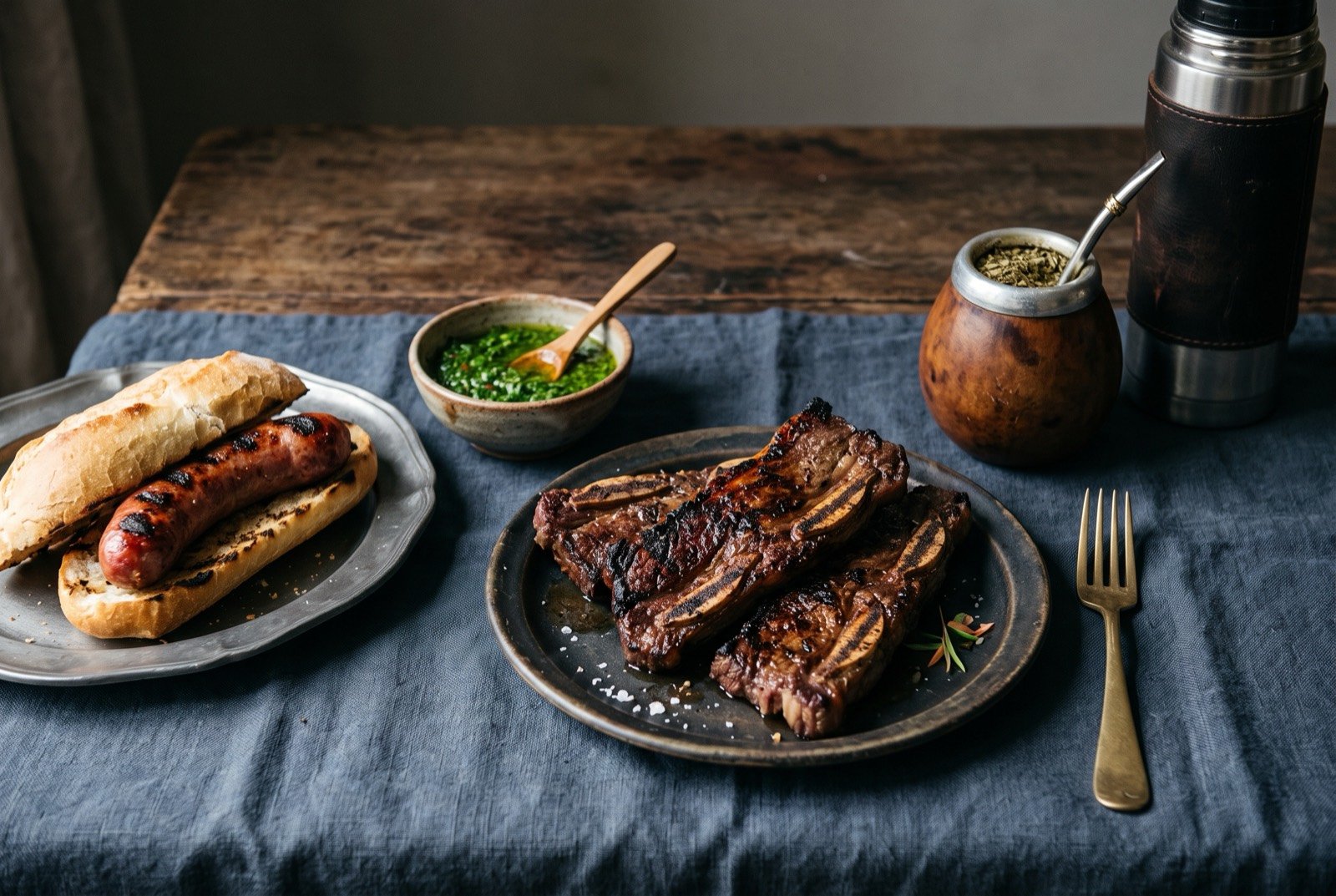
The Pampas, Buenos Aires, the Northwest, Patagonia and its Welsh valley, and across the river, Montevideo, the interior and Tannat country. Not two national cuisines filed under one river, but a single grazing economy split by a border that came later than the cattle did, and every dish as tradition built it, then what a modern chef would change.
Sources and review · What this chapter does not assert · How we research · Know this better? Tell us
A Sense of Place
The book level argument holds here as firmly as anywhere in this atlas: this is not one cuisine wearing two flags, and it is not two cuisines that happen to share a river either. It is one grazing world, the Pampas and the campo, that a nineteenth century border cut in two, plus two things the border cannot touch, an Andean food world in Argentina's northwest that has almost nothing to do with cattle, and a single nineteenth century Welsh settlement in Patagonia that belongs to neither national story.
The Pampas and the campo: one cattle economy, one border
Uruguay holds the highest cattle to human ratio on earth, something close to 3.4 to 3.8 head of cattle for every person in the country, ahead of New Zealand at 2.17 and Argentina itself at roughly 1.22. That is not a curiosity. It is the single fact that explains more about this volume's food than any other: a country and a neighbouring region where cattle have always, structurally, outnumbered the people eating them, on grassland too good for anything else to compete with beef for the land. Grass fed beef here is not a boutique claim bolted onto a marketing page. It is what direct grazing of natural pastureland on the Pampas and the campo has produced since cattle first went feral here in the sixteenth century, before ranchers began appropriating the wild herds into the estancia system.
Buenos Aires and Montevideo are the two urban poles of the same grazing hinterland, and both cities were transformed by the same wave arriving at almost the same moment: Italian and Spanish immigration between roughly 1870 and 1950, at its peak between 1900 and 1914 when Italians alone made up around half of all arrivals in some years. What that built is not a garnish on top of the cattle economy, it is now half the food culture: pasta, pizza, milanesa, the whole architecture of Sunday lunch. The other half is the fire.
The Northwest: an Andean food world that has nothing to do with cattle
Salta, Tucumán and Jujuy are where this volume's own logic breaks, in the same way Rome breaks the north-south logic of the Mediterranean volume, and it is worth saying so plainly rather than folding it in as a regional variant of the same story. This is Diaguita country, the Valles Calchaquíes, a settled agricultural civilisation from roughly the eighth to the sixteenth century built on maize, potato, beans, squash and quinoa, with llama and alpaca kept for cargo, meat, wool and hide in the high valleys where the ecology suits them and cattle do not. Before the Spanish arrived, the Pampas and Patagonia to the south were hunter-gatherer country. The Northwest was already growing its own food on terraces. That is not a small difference. It means this volume's spine, cattle and immigration, genuinely does not reach here, and this chapter treats the Northwest's dishes, the empanada salteña and locro especially, as carrying a separate, older logic rather than as a spicier regional cousin of the Buenos Aires table.
Patagonia: sheep, and one Welsh valley that answers to nobody else's story
Patagonia's ecology, in Santa Cruz and Chubut provinces especially, favours sheep over cattle, and cordero patagónico, Patagonian lamb, is the region's own protein, cooked by its own method, discussed below. But Chubut carries a second thread that belongs to nobody else in this atlas: 153 Welsh colonists sailed from Liverpool on the Mimosa on 25 May 1865 and landed at Golfo Nuevo, near modern Puerto Madryn, on 28 July that year, fleeing coal mining conditions and cultural and religious pressure at home, hoping to preserve their language and faith somewhere nobody would interfere with either. They found semi-arid steppe, not the green valleys they had pictured, relocated south to the lower Chubut river, and founded Rawson and Gaiman. Their food, torta galesa above all, survives there today as a living tea house tradition, not a museum piece, and it belongs in this volume as a footnote earns its place: small, real, and answering to nineteenth century Wales rather than to Rome, Madrid or the Pampas.
Montevideo, the interior, and Tannat's clay
Uruguay's interior splits along working lines rather than romantic ones. Tacuarembó, Salto, Paysandú and Río Negro carry the extensive beef ranching that covers over 70 per cent of Uruguay's land surface; San José carries the country's dairy pole; the rice belt sits further east in Treinta y Tres, Cerro Largo and Rocha. Canelones, twenty minutes from Montevideo, is the wine country, producing roughly two thirds of national output and, specifically, 67 per cent of the country's Tannat vines, on clay soils under Atlantic breezes, about as far ecologically from Mendoza's high, dry Malbec country as two grapes from the same continent can be. Montevideo itself absorbed a Basque immigration wave proportionally larger than anywhere else in the Americas, over 350,000 Uruguayans, roughly a tenth of the population, claiming Basque ancestry, alongside an Italian wave that ran in parallel with Argentina's own and left the same pasta, pizza and milanesa grammar behind it, so thoroughly folded into Uruguayan life that Uruguayan writers describe it as no longer registering as foreign at all.
The History in Layers
Before the cattle: two entirely different starting points
South of the Northwest, the story starts with hunting and gathering, not farming. The Pampas and Patagonia sustained their original inhabitants for millennia on wild game and gathered plant food, with no settled agriculture. During the eighteenth century, Araucanian groups from across the Andes, drawn by the feral livestock the Spanish had left running loose, particularly horses, moved onto the Pampas and gradually displaced the earlier population by the century's end, in a process Argentine historians call the araucanization of the Pampa. European livestock, the horse especially, transformed diet, transport and material culture among these populations before a single estancia had been fenced.
In the Northwest, by contrast, the Diaguita were already farming terraced maize, potato, beans, squash and quinoa centuries before contact, organising their calendar around the same two staples, maize and potato, that still anchor the region's dishes today. This chapter does not treat the Northwest's indigenous food world as a variant of the Pampas story. It is a separate starting point that the Spanish empire later folded into the same colonial administration, not the same ecology.
The Spanish layer, and what it actually changed
Cattle arrived with Spanish colonisation, the earliest documented antecedent dated 1556, and went feral on grassland with no natural predator and no competing land use. By the eighteenth century European travellers wrote home astonished that gauchos would eat only the choicest cuts of a slaughtered animal and simply discard the rest, in a country where meat was, for the only time in most of these travellers' experience, cheaper than the labour of preparing it.
Puchero is the clearest single case of what the Spanish layer actually did here, and it is worth stating precisely because the popular story, that puchero is simply Spanish cocido transplanted, is not quite right. In Spain, meat was the expensive ingredient and the dish leaned on legumes to stretch it. On the Pampas, where cattle multiplied faster than anyone could eat them, meat became the cheap, abundant ingredient, while maize, potato, sweet potato and squash, all American crops the Spanish dish had never known, were folded in, giving puchero criollo both its colour and a sweetness the Iberian original does not have. By the nineteenth century it was eaten by gauchos in the open country and by the Buenos Aires elite alike, before French culinary fashion arrived later in the century to complicate what counted as elite food.
The gaucho, from social margin to national symbol
The gaucho is a genuine historical figure before he is a national costume, and the two should not be confused. He emerged from mestizaje, indigenous, Spanish and criollo mixture, and in the colonial period was regarded as a marginal, semi-outlaw figure, living off hunting semi-wild cattle that belonged to nobody in particular. The independence wars of the early nineteenth century remade him, in the national imagination, into the man who knows the land, the animals and the weather better than anyone in the city ever could. His actual diet in this period was narrow and specific: beef from feral cattle, fresh roasted as asado or preserved as charqui, salted and dried, supplemented by maize, squash, legumes and yerba mate, hunted where necessary with boleadoras and the facón, the long gaucho knife, for rhea, guanaco and deer.
Wire fencing, introduced from 1846, ended this world within a generation. Vaquerías, the old organised wild-cattle hunts, had already been declining as ranchers appropriated semi-wild herds into the hacienda system called the estancia; fencing completed the process, and the free-roaming gaucho was reduced to a peón ganadero, a ranch hand working for an estanciero, the figure he has effectively remained ever since. This account of the fencing sequence rests on a secondary rather than academic source and should be read as a reasonable summary of the period rather than a fully verified chronology.
The immigration wave that built half the modern table
Between roughly 1870 and 1920, and again after an interruption through the 1930s global crisis, through to the mid 1950s, Argentina and Uruguay both absorbed one of the largest proportional European immigration waves anywhere in the Americas. Roughly 3.5 million Italians arrived in Argentina in this period, about half of all European arrivals; Spanish immigration ran to roughly 2.1 million between 1810 and the early twentieth century, with Spaniards making up 10 per cent of the national population by 1914. Uruguay's own Italian wave ran in close parallel and is described by the Uruguayan anthropologist Renzo Pi Hugarte as having sunk so deep into everyday life that Italian-derived food, pasta, polenta, milanesa, fainá, pizza, is now widely experienced as originally Uruguayan rather than as an import at all; Uruguayan pasta names still carry the trace, a la pomarola from the Neapolitan pummarola, tuco sauce from the Genoese tocco.
What this wave actually built, concretely, on both banks: the Sunday family pasta lunch; pizza, which in Buenos Aires began as pizza al molde, baked on trays in bakery ovens because Italian immigrants mostly lacked wood-fired pizza ovens, with pizza a la piedra, closer to the Italian original, only becoming popular from the mid 1970s, and the Genoese immigrant Juan Banchero credited with inventing the fugazzeta, an onion-topped, cheese-loaded focaccia relative, out of local dairy abundance; milanesa, a direct transplant of cotoletta alla milanese; and ñoquis del 29, the custom of eating gnocchi on the 29th of the month, widespread wherever Italian immigration was heaviest across the Southern Cone, carrying two competing origin stories, an eighth century legend attached to San Pantaleón and, more plausibly, a remembered act of quiet charity in which better-off immigrants left money under a poorer diner's plate.
Uruguay's Basque wave, the largest in proportion to population anywhere in the Americas, ran alongside this rather than instead of it; Montevideo's own founder, Bruno Mauricio de Zabala, came from Durango in the Basque Country, and Basque restaurant culture in Montevideo underwent a documented boom between 1988 and 2011, a thread this chapter has not been able to follow into its full academic detail, since the one paper found on it sits behind a paywall reaching only its abstract.
Argentina and Uruguay's own contested claims, named rather than settled
Two disputes recur constantly in the sourcing behind this chapter, and both are handled here the way the house style demands: named, not adjudicated. Dulce de leche's popular Argentine origin story places its invention on 24 June 1829 at the El Pino estancia in Cañuelas, when a servant preparing sweetened milk for mate left the pot unattended after discovering a political enemy asleep in her master's bed, and returned to find it thickened into something new. Uruguay's counter-claim is quieter and admits its own uncertainty: there are indications, per Uruguayan sources, that enslaved Africans in Uruguay were already making a milk and sugar preparation during the colonial period, offered without named dates or people. In 2003 both governments pursued UNESCO recognition, and the result was a deliberate non-exclusive joint submission, patrimonio gastronómico de la región del Río de la Plata, neither country's alone. This chapter treats it the same way: shared, contested, and not settled here.
Chimichurri carries a parallel, smaller dispute. Its geographic origin is placed generally in the Río de la Plata region, claimed by both countries, with the word's own etymology contested even within single sources, a folk story involving an Irish immigrant named James McCurry, mangled locally into Yimi Churri, sitting alongside a more linguistically serious theory tracing it to Basque tximitxurri, roughly jumble or mixture. Neither is resolved here either.
The Flavour Arsenal
The cuts that matter, and their real Argentine names
A British cook sourcing for this volume needs the Argentine terminology before the butcher's counter, since none of it maps cleanly onto standard British cuts.
| Cut | What it actually is | Worth knowing |
|---|---|---|
| Bife de chorizo | A sirloin or strip steak cut, from the tren de bife | Despite the name, has nothing to do with chorizo sausage |
| Vacío | The flank, cut with the fat cap and membrane left on | Name derives from the curved, hollow shape of the cut itself |
| Entraña | The diaphragm | Thin, fibrous, intensely flavoured from constant muscular work; dries out fast if overcooked |
| Asado de tira / tira de asado | Short ribs, cut crosswise across the bone into strips roughly 4cm wide, each containing 4 to 5 rib bones | Regional naming varies even within Argentina: tira de asado in Buenos Aires, asado con hueso in Mendoza, costilla in Córdoba |
| Ojo de bife | Ribeye, the boneless bife ancho | The most straightforwardly familiar cut to a British eye |
| Matambre | A thin, wide muscle from between the hide and the ribs | No standard British butchery term at all; must be described, not named, to a UK butcher |
Fire and fuel
Quebracho colorado, the wood of choice across both countries' parrillas, is prized specifically for being extremely dense: it burns slowly and evenly, produces long-lived stable coals, does not crackle or spit, generates comparatively little smoke, and holds a constant temperature well suited to cuts that need time and control rather than a fast sear. Algarrobo, espinillo and dried vine cuttings are chosen more for aroma than heat. Charcoal versus wood is itself a national marker: Argentine parrillas run more often on charcoal or a charcoal and wood mix, while Uruguayan asado leans toward wood as the standard fuel, credited locally with a smokier, more perfumed result against charcoal's comparatively more bitter note.
Beef, grass and feedlot, an honest complication
The single most important thing to know before sourcing beef for this volume is that grass-fed Pampas beef, while genuinely the historical and ecological basis of Argentine cattle ranching, is not straightforwardly what most Argentines eat today. Argentine sources themselves report that the majority of Argentine cattle is now raised intensively in feedlots on grain, protein supplement and vitamins, lighter in colour and flatter in flavour than grass-fed beef, and that a generation raised on it increasingly prefers it. Authentic Pampas beef marketing, as used by diaspora steakhouses abroad, is therefore doing real rhetorical work that does not necessarily reflect current domestic Argentine production. This chapter states that plainly rather than repeating the marketing claim uncritically; it does not change the case for sourcing genuine grass-fed beef in a British kitchen, since grass-fed is still the better and more traditional product, but it changes what "authentic" should be taken to mean.
Cheese, dairy and the provoleta invention
Provolone for provoleta is not an inherited Italian product used unchanged. It was specifically adapted in Argentina in 1940 by the Calabrian-Argentine cheesemaker Natalio Alba in Arroyo Algodón, Córdoba province, who applied the pasta filata, stretched-curd, technique to a hard Italian-style provolone specifically to produce a wheel firm enough to sit directly on a hot grill without collapsing or melting straight through, formally registered in Argentina's food code in 1955 as queso provolone hilado. This is a genuine, dated, named Argentine invention sitting inside an imported cheesemaking technique, exactly the kind of layered fact this atlas exists to surface rather than flatten into "Italian cheese, grilled."
Yerba mate
Yerba mate's origin belongs to the Guaraní, for whom caá, the word for the plant, means herb, jungle and plant at once; it was regarded as a gift from the gods, used as beverage, ritual object and trade currency long before Spanish contact, prepared in a calabash gourd, porongo, with a hollow tacuara bamboo reed as the original bombilla, filtered through the teeth before the metal straw existed. Modern practice fills the gourd roughly three quarters with yerba, tilted so the leaf settles to one side and leaves a dry space on the other for the water, with the bombilla placed and, crucially, never moved once drinking starts, so it does not clog and the dry side stays dry for later refills. Sharing the gourd, one vessel passed hand to hand and refilled by a cebador, a server, for each drinker in turn until the leaf loses flavour, is treated in the source material not as a quaint custom but as an act that genuinely requires care and generosity toward whoever you are sharing with.
Uruguay drinks more of it than anyone else on earth by a wide margin, roughly 10kg per person per year against Argentina's 7kg and Brazil's roughly 1kg, despite growing almost none of it domestically and importing the great majority from Brazil, a genuine complication of any simple picture of mate as rural self-sufficiency. Uruguayan practice is also more codified than Argentine practice: mate amargo, bitter, drunk hot, made with sin palo, destemmed, yerba, is described in Uruguayan sources as close to non-negotiable, against a more varied Argentine picture that includes sweetened mate in some regions. The specifically Uruguayan visual signature, the thermos carried under the arm in public at all hours, on the street, at the beach, in any plaza, is credited to the shift away from the older caldera, kettle, method, which liberated mate from home and workplace and let it be drunk anywhere, across every social class.
Wine: Malbec's altitude and Tannat's clay
Malbec arrived in Argentina in 1853, brought by the French agronomist Michel Aimé Pouget, and it was specifically Mendoza's high altitude, low humidity terroir that transformed a relatively austere, tannic French varietal into the full-bodied, dark-fruited, soft-tannined wine now inseparable from Argentine beef; it accounts for 71.9 per cent of the country's wine exports today, with the Valle de Uco producing its most elegant, spice and floral expression. Tannat's Uruguayan story runs on almost opposite ecology. Pascual Harriague, a Basque-French immigrant who arrived in Uruguay in 1840 and settled in Salto, identified Tannat around 1870 as suited to serious red wine production after trialling several varieties; his wine debuted publicly in 1887 and won acclaim at the Barcelona and Paris world expositions of 1888 and 1889. He died on 14 April 1894, and Uruguay has marked that date as Día del Tannat since 2016. Uruguay now grows Tannat on Canelones' clay soils under Atlantic humidity, the reverse of Mendoza's dry altitude, and is described by its own wine institute as the world's leading Tannat producer, ahead even of Madiran, the grape's French birthplace. Why the two countries converged on different grapes suited to genuinely opposite growing conditions is not settled by a single source in the research behind this chapter; the agro-climatic explanation offered here is this chapter's own reasonable synthesis, not a directly sourced claim, and should be read as such.
The Technique Ladder
The argument, from inside
This volume is not short of serious kitchens working from indigenous material rather than importing French technique over it, and naming the difference honestly matters as much here as it did for Bologna's Bottura in the Mediterranean volume. Pedro Bargero at Chila in Puerto Madero trained under Mauro Colagreco and David Toutain before returning to build a menu around native and seasonal Argentine ingredients, black hake, ñandú, native quinoas, foraged wild herbs, specifically working to recover ingredients like yacaratiá, a jungle tree bark from the north, that had genuinely fallen out of use. Fernando Rivarola and Gabriela Lafuente went further at El Baqueano: having built the restaurant in Buenos Aires around autochthonous ingredients gathered from across Argentina's biomes, yacaré, ñandú, llama, wild boar, deer, buffalo, they relocated the entire operation to Salta province specifically to sit closer to fresh, foraged, native sourcing rather than importing it to the capital. Neither is reinterpreting a foreign cuisine. Both are intensifying their own.
Francis Mallmann's Siete Fuegos, Seven Fires, framework deserves the same honest treatment this atlas gave Bottura, read carefully rather than as marketing. It codifies seven live-fire methods, parrilla, chapa (flat iron plate), infiernillo (a small enclosed fire cooking from above and below, like a portable hearth), horno de barro (clay oven), rescoldo (direct burial in hot ash and embers), asador (the vertical cross or spit, asado a la cruz), and caldero (cauldron cooking), presented as inherited from gaucho practice and, in the case of rescoldo specifically, from the Selk'nam people of Patagonia, said to have used the technique pre-contact to cook shellfish and rhea eggs directly in hot ash. This is the clearest and most specific indigenous-technique claim found anywhere in the research behind this chapter, and it is also the weakest sourced: it comes via Mallmann's own book and its secondary coverage rather than an independent ethnographic source, and could not be verified against academic anthropology in the time available. It is named here rather than smoothed over, because it sits closest to this whole series' central argument, that every restaurant technique has an indigenous ancestor, and that argument is only worth making if it is held to the same evidentiary standard everywhere else in this book.
Rung 1. Build and hold a genuine ember bed, metered by proximity and time, not a live flame
The single most consistently cited technical discipline behind a serious Argentine or Uruguayan asado is patience before the meat ever goes near the fire. Working parrilleros describe building the coal bed roughly 50 minutes ahead of cooking, until it reaches an even, well-aerated red glow with no active flame, then metering heat not by touch but by proximity and time: a hand held 15cm above the coals should not be able to stay there through a count of five before pulling away. Salt goes on the meat 10 to 15 minutes before it reaches the grill, and any cut over a kilogram is brought to room temperature 3 to 4 hours ahead so it cooks through evenly rather than staying cold at the centre while the outside chars. The single most cited amateur failure across every source consulted is impatience: flipping too often, which never lets the Maillard crust actually form. Four to five minutes undisturbed per side is the rule, not a guideline to be improved on by checking more often.
What a cook does with this rung. Build the fire earlier than instinct says, and judge it by eye and by the hand test, not by the clock alone. Resist turning the meat to check it. A Big Green Egg run indirect, with the coal bed established and settled before the grate goes on, and the vents used to hold a steady temperature rather than chased up and down, reproduces this discipline closely; the parrilla's real technology is time and restraint, not a particular grill design.
Rung 2. Match fire duration to the cut's own structure, not a single default sear
Argentine parrilla practice does not treat every cut the same way, and conflating them is the second most common technical failure after impatience. Tira de asado, short ribs cut across the bone, goes bone side down first and is only flipped once juice rises visibly to the surface, then finished roughly 25 minutes more on the boneless side; vacío, the flank, wants roughly 40 minutes a side over constant, unhurried medium heat, letting its connective tissue render slowly; entraña, the diaphragm, is thin, intensely worked muscle that dries out fast and wants the opposite treatment entirely, high heat, a single flip, 10 to 15 minutes a side depending on thickness, served the moment it comes off. The modern lever layered onto this, in the last decade or so at Argentina's most serious parrillas, Don Julio, La Cabrera, Corte Comedor among them, is genuine dry-ageing: held at roughly 2°C, low controlled humidity, with airflow to prevent mould, for anywhere from 7 to 75 days depending on the intensity wanted. This is still a minority practice even inside Argentina, not the historical norm, and a diaspora kitchen skipping it entirely, or badging simple wet-aged or vacuum-aged beef as dry-aged, is cutting a real, technically distinct step rather than a cosmetic one.
What a cook does with this rung. Choose the cut's treatment before lighting the fire, not while it is already on the grill. A collagen-rich cut like vacío or asado de tira rewards low, steady heat and real time; a worked, fibrous cut like entraña punishes it. At home, a dedicated fridge shelf held at 2 to 4°C with good airflow, wrapped loosely rather than sealed, will dry-age a well-butchered joint for a week to ten days safely, enough to notice a real concentration of flavour without the equipment a restaurant-scale ageing room needs.
Rung 3. Build a raw sauce cold, and let it rest before it ever meets the fire
Chimichurri's academy-recognised composition is parsley, garlic, ground chilli, ají molido, salt, oil and vinegar, with oregano an extremely common addition even though it sits outside the strictest list. Critically, it is never cooked: the ingredients are finely hand-chopped or mortar-pounded, mixed cold, and rested a minimum of a couple of hours, ideally a full day, before it goes anywhere near the meat, so the flavours genuinely integrate rather than sitting as separately identifiable chopped herbs in oil. This resting step is precisely what most diaspora versions skip, mixed and served within minutes, and it is a documented, named point of failure: at least one UK reviewer of a diaspora steakhouse singled out an underdeveloped chimichurri specifically while praising everything that had actually touched fire.
What a cook does with this rung. Make chimichurri the day before, not the hour before. Chop by hand or in short mortar strokes rather than blitzing to a purée, which bruises the herb cell walls too hard, too fast, and pushes the sauce toward a flat, uniformly green paste rather than a bright, textured, still-recognisable chop. If a high-power blender is genuinely necessary for volume, pulse in short bursts with a chilled jug, exactly as this atlas's Mediterranean volume advises for pesto, since the underlying failure, heat from a spinning blade dulling colour and flavour, is identical.
Rung 4. Seal a dough parcel to trap a genuinely wet filling, and treat the seal as a steam vessel
The empanada's defining technical discipline sits entirely in the fold. A properly made empanada salteña is deliberately jugoso, wet, its filling carrying enough of its own juice or broth that it drips slightly when the pastry is first bitten into, which is only possible if the repulgue, the crimped seal, is genuinely tight enough to hold that liquid in through the whole bake or fry without leaking or bursting. Regional practice differs on exactly how the seal is folded, and the sourcing behind this chapter found directly conflicting claims about fold counts by region, which this chapter states honestly below rather than inventing a settled answer for. What is consistent everywhere is the principle: the seal is not decoration, it is the difference between a jugoso filling that steams itself inside a closed parcel and a dry one that has simply been baked with meat inside it.
What a cook does with this rung. Rest the filling to a temperature where it will not blow the seal open with released steam the moment it hits real heat, but do not let it cool so far that the dough cannot crimp against a wet edge. Press the crimp with real pressure, working it along the whole seam rather than trusting a single decorative flourish at the end, and check for the smallest gap before it goes in the oven or the fryer, since a fine crack under pressure is where the whole dish's juice escapes.
Rung 5. Reduce dairy slowly under pH control, to concentrate without splitting or catching
Dulce de leche's genuine production method is milk and sugar, roughly a litre of whole milk to 250 to 300g of white sugar depending on desired sweetness, reduced together over a low, steady heat for around two hours, with a small addition of bicarbonate of soda, added once the milk is hot but before it reaches a rolling boil, acting as an acidity regulator that deepens colour and improves the final texture. It is never boiled hard, and it is stirred only occasionally rather than constantly, which would introduce too much air and disrupt the slow, even Maillard browning that gives real dulce de leche its depth. The everyday home shortcut, boiling an unopened tin of condensed milk for hours, produces something sweeter and flatter, without that depth, because it skips the bicarbonate's pH control and the milk's own proteins entirely.
What a cook does with this rung. Add the bicarbonate at the right moment, hot but not boiling, and resist the urge to stir constantly or to rush the reduction with higher heat, both of which risk catching the sugars and scorching rather than caramelising them. A sous vide bath is a genuine improvement here, not a gimmick: milk and sugar vacuum sealed and held at a steady 90°C for several hours reduces just as effectively as a watched pan, without the risk of a moment's inattention burning two hours of work, and a chinois will catch any skin that forms before the finished dulce de leche is passed through to a jar.
The Ferment and Preserve Bench
This is not a fermenting cuisine in the way some volumes in this atlas are; there is no long ferment tradition here comparable to West Africa's ogi or Ethiopia's injera. What it has instead is a preservation logic built for open grassland and long distances, and it is worth treating with the same seriousness.
1. Charqui
The gaucho's own preservation method for feral cattle meat that could not be eaten fresh: beef salted and dried, sustaining long cattle drives and periods away from any fixed base. Structurally the ancestor of every dried and cured beef product in this volume's tradition, and worth naming as such rather than treating dry-ageing as a purely modern, restaurant-invented technique.
2. Dulce de leche
Covered in full as a technique above; a reduction rather than a ferment, but a genuine preserve in its own right, its long, slow cook and sugar content giving it a shelf life far beyond fresh milk, exactly the kind of transformation that made it valuable on a cattle economy with milk to spare and no refrigeration.
3. Yerba mate, estacionada
Yerba mate intended for serious drinking is not sold and used fresh off the drying fire; it is rested, estacionada, aged for a period that mellows its raw green bitterness before it reaches a gourd. This ageing step is closer to tea's own curing practice than to a ferment proper, but it is a deliberate, named transformation this chapter's sourcing consistently distinguishes from unaged yerba, and a UK buyer choosing between brands should know to look for it.
4. Membrillo
Quince paste, eaten year round on both banks of the Río de la Plata rather than reserved for a single season the way it often is in Spain. Its cultivation and use in Uruguay is documented as far back as the country's first published book, Presbítero José Manuel Pérez Castellano's Observaciones sobre Agricultura, observations dating to 1773. It is the defining filling of pasta frola and of fried pastelitos, and paired with fresh cheese makes Martín Fierro, the region's most representative cheese-and-quince dessert.
Sourcing in Britain
Verified August 2026. Where a supplier could not be fully confirmed, that is said rather than smoothed over.
The ranked list: what decides great from grim
- Real Río de la Plata beef, cut the Argentine way, not just labelled Argentinian-style. The UK has genuine importers of Argentine and Uruguayan beef, so there is no need to fake this with generic British sirloin, but most UK butchers will not cut short ribs the Argentine way unless specifically asked, cut across the bone into 1.5 to 3cm strips rather than sawn into single-bone portions. Casa Argentina (argentinianbeef.co.uk) describes itself as the UK's leading Argentine beef supplier, trading since 1997, a 2025 Great Taste Award winner. La Pampa (lapampa.uk) is a specialist importer sourcing from Córdoba Province and air-freighting to the UK. Tom Hixson of Smithfield's Black Label Rioplatense range (tomhixson.co.uk) is genuinely imported Argentine Hereford and Angus beef, though stock appeared intermittent at the time of checking. For a UK grass-fed alternative cut to the correct thickness, The Dorset Meat Company already lists tira de asado by name, a useful reference point for briefing any other butcher.
- Dulce de leche made by slow reduction, not condensed milk boiled in the tin. The tinned shortcut is flatter and one-note; genuine dulce de leche, reduced from fresh milk over hours, has a roasted, faintly savoury depth. Casa Argentina's range carries Havanna, Argentina's best-known confectionery brand, made properly by slow reduction; Melbury & Appleton stock Havanna specifically. Casa Argentina is also explicit that some Argentine brands, Vacalin, La Serenísima, Cachafaz, cannot currently be imported into the UK or EU, a useful honesty check against retailers who imply everything is available.
- Yerba mate bought by type, not just by name. Con palo, with stems, milder and slower to steep, against sin palo, destemmed, stronger and dustier; Argentine, Uruguayan and Paraguayan yerba differ in toast level and bitterness. UruShop (urushop.co.uk) carries 28-plus brands filtered explicitly by country of origin and by con palo versus sin palo, the single best UK stop for choosing correctly rather than by brand alone.
- Uruguayan Tannat, genuinely the harder find. Malbec is everywhere in the UK; Tannat is not. Wines of Uruguay (winesofuruguay.co.uk) is the one UK site that reads as a real specialist importer, UK-registered, with four named artisanal producers and Tannat-specific bottlings; treat it as thin against Malbec rather than pretend it is easy to find.
- Ají molido, not chilli flakes and not paprika. A coarser, milder, fruitier crushed dried red pepper, closer to a mild Aleppo pepper, and what actually makes chimichurri and an empanada filling taste right rather than just hot. Melbury & Appleton stock it at 100g, Patagonia Online at 800g, The Argentino at 1kg.
- Argentine or Uruguayan chorizo, not Spanish cured chorizo, for choripán. A fresh, coarse pork and beef sausage meant to be split and grilled whole, a genuinely different product from cured, smoked Spanish eating chorizo. Primal Cut make a fresh Argentinian-style chorizo from British beef and Yorkshire pork with their own oak-smoked bacon, the clearest single UK source found.
- Lard or beef fat, not butter, for empanada dough. Genuine masa is traditionally made with grasa. UK grass-fed beef dripping and tallow from suppliers like Hunter & Gather, marketed explicitly for pastry use, is the correct, unglamorous fix.
- Mate gourd and bombilla, bought as a set with a curing pouch. A natural calabash gourd needs curing before first use, easy to miss if bought separately; Teapro's kit includes one, UruShop's stainless steel option avoids the issue entirely for a reader who does not want to cure and season a calabash.
- A parrilla grate cut for a British garden, not an improvised barbecue substitute. Parrilla Gaucha UK sells purpose-built Argentine-style grills with the traditional crank-and-chain height adjuster, and a Big Green Egg run indirect, with the vents used to hold temperature rather than chase it, reproduces the same discipline closely without specialist kit at all.
General importers and delis
Casa Argentina (casaargentina.com) is the broadest and best-established general importer found: beef, wine, yerba mate, dulce de leche, empanadas and more, next day delivery, a large and consistent Trustpilot review base, the equivalent of naming an established Italian deli for the Mediterranean volumes. UruShop (urushop.co.uk) deserves a second mention as the best single stop specifically for the Uruguayan side of this pairing, given its explicit country-of-origin filtering. Patagonia Online (patagoniaonline.co.uk) and The Argentino (theargentino.com) round out the wider Argentine grocery range available in the UK. Treat this as a starting list rather than an exhaustive one, since UK South American food retail is still comparatively young and changes regularly; check current shipping status directly before ordering rather than assuming a listing is current.
Voices and Sources
From inside the tradition
- Pedro Bargero, Chila, Puerto Madero, Buenos Aires. Trained under Mauro Colagreco and David Toutain, builds his menu around native and seasonal Argentine ingredients and has personally worked to recover forgotten ones, including yacaratiá, a jungle tree bark from the country's north.
- Fernando Rivarola and Gabriela Lafuente, El Baqueano, originally Buenos Aires, now Salta province. Relocated their entire restaurant closer to fresh, foraged, native ingredient sourcing rather than importing it to the capital, cooking with yacaré, ñandú, llama, wild boar and Patagonian rosehip.
- Francis Mallmann, Siete Fuegos, Mendoza, and Restaurante Garzón, Uruguay. His seven-fire framework codifies live-fire cookery as a genuine technical system rather than a rustic aesthetic, though the specific attribution of rescoldo to Selk'nam pre-contact practice, discussed in the Technique Ladder above, is the weakest sourced claim in this whole chapter and is named as such rather than repeated uncritically.
- Gastón Riveira, La Cabrera, Palermo, Buenos Aires. Runs a half charcoal, half wood-log fire, sources Hereford and Aberdeen Angus alongside newer dry-aged and Wagyu options, and built the restaurant's signature array of small side dishes, the cazuelitas, to sit alongside the meat as equals rather than garnishes.
- Lucía Soria, Jacinto, Montevideo. A Mallmann-trained chef who managed Hotel Garzón before opening her own author's-cuisine restaurant and adjoining bakery in Ciudad Vieja, direct evidence of a wider Uruguayan modernist scene beyond Garzón and La Huella alone.
- Don Julio, Palermo, Buenos Aires. Ranked number one in the World's 101 Best Steak Restaurants 2025, holding both a Michelin star and a Michelin green star, its beef dry-aged in-house from its own regenerative farm. Specific technical claims widely attributed to its ownership and sommelier team, on grill bar profile and heat calibration, could not be independently confirmed in this chapter's sourcing as their own words rather than press paraphrase, and are named in the Flavour Arsenal and Technique Ladder above with that caveat attached rather than presented as a direct quote.
The UK diaspora
- Diego Jacquet, Zoilo, Marylebone, London. Trained in Buenos Aires from 1993 as an apprentice directly under Francis Mallmann, then worked at El Bulli and Aquavit before opening Zoilo in 2012, a genuine technique lineage rather than a generic import, ranked 96th in the World's 101 Best Steak Restaurants.
- Gaucho, multiple UK locations, operating since 1994. Markets free-range Black Angus beef reared on Las Pampas grasses; reception among Argentine diners has been genuinely mixed, with at least one review singling out an underdeveloped chimichurri specifically while praising the meat itself, exactly the divergence this chapter's Technique Ladder addresses directly rather than glossing over.
The gaps, named
Neither La Cabrera's nor Parador La Huella's actual fire-management technique is documented in what is publicly available, despite both being genuinely serious, well-reputed kitchens; press coverage of each is heavy on reputation and atmosphere and light on verifiable detail, and this chapter would rather name that gap than invent technique to fill it. The IPCVA, Argentina's own national beef promotion institute, publishes a document, Carne, una pasión argentina, that is exactly the authoritative in-country institutional source this chapter's sourcing rules would prioritise, but it could not be read in this research pass, returning unreadable binary from the available fetch tools rather than text, and should be retried with a proper PDF reader before any future revision of this chapter. The academic literature on Basque restaurant culture in Montevideo between 1940 and 2020 sits behind a paywall reaching only its abstract, so the fuller scholarly account of that specifically Uruguayan thread remains untested here.
Things this chapter has deliberately not asserted
- That authentic Pampas grass-fed beef is what most Argentines, or most diaspora steakhouses abroad, are actually eating today. The sourcing behind this chapter suggests feedlot production now dominates even inside Argentina, complicating a simple grass-fed-versus-feedlot diaspora critique, and this chapter states that plainly in the Flavour Arsenal rather than repeating the marketing claim uncritically.
- That rescoldo, direct cooking in hot ash and embers, is a documented Selk'nam technique on the same evidentiary footing as this chapter's other historical claims. It is the specific attribution most central to this atlas's own argument, that every restaurant technique has an indigenous ancestor, and it is also the weakest sourced, resting on Francis Mallmann's own book and its secondary coverage rather than independent ethnography.
- That asado con cuero, or the parrilla format more generally, is a directly documented indigenous inheritance rather than a plausible but unverified claim repeated across secondary sources.
- Either origin story for the word chimichurri, an Irish immigrant's mangled name or a Basque root meaning jumble, as settled. Both are reported, neither confirmed.
- Either the Argentine Rosas-and-Lavalle legend or the Uruguayan colonial-kitchen counter-claim for dulce de leche's origin, as fact. Both are named above; the 2003 joint, non-exclusive UNESCO submission by both governments is itself evidence that neither country's own institutions consider the matter settled.
- That the chivito was invented in 1946 rather than 1944. Several otherwise reliable outlets use 1946; the stronger-sourced, more internally consistent accounts point to 1944, and both dates are named in this chapter's history section rather than one silently chosen.
- Any single, non-contradictory account of how many folds a repulgue should carry, or which region a specific fold count belongs to. Sources consulted for this chapter gave directly conflicting numbers and regional attributions, and this chapter has not picked a winner.
- Which of the empanada salteña or empanada tucumana carries the wetter filling. Sources consulted disagreed on this point directly, and this chapter presents the salteña's filling as jugoso, per its stronger single source, while noting the contradiction rather than resolving it.
- A fully quantified, gram-for-gram traditional recipe for locro, torta galesa or chajá. No source consulted for this chapter gave one; the recipes given above are workable, cookable versions built from documented composition and general practice, and this chapter has not invented false precision to disguise that gap.
- That Uruguay's converging on Tannat rather than Malbec, on the opposite ecology from Mendoza, has a single documented causal explanation. The agro-climatic account given in the Flavour Arsenal above is this chapter's own reasonable synthesis, not a claim traced to one named source.
- That the specific technical claims attributed to Don Julio's ownership team, on grill bar angle and the hand-heat test, are the restaurant's own confirmed words rather than press paraphrase repeated across secondary Argentine coverage.
- That gauchos historically collected rainwater specifically for torta frita dough. This circulates as a charming addition to the día de lluvia tradition across several sources but was not traced to a primary account, and belongs here rather than in the chapter's history section.
Build and hold a genuine ember bed, metered by proximity and time, not a live flame
The single most consistently cited technical discipline behind a serious Argentine or Uruguayan asado is patience before the meat ever goes near the fire.
Match fire duration to the cut's own structure, not a single default sear
Argentine parrilla practice does not treat every cut the same way, and conflating them is the second most common technical failure after impatience.
Build a raw sauce cold, and let it rest before it ever meets the fire
Chimichurri's academy-recognised composition is parsley, garlic, ground chilli, ají molido, salt, oil and vinegar, with oregano an extremely common addition...
Seal a dough parcel to trap a genuinely wet filling, and treat the seal as a steam vessel
The empanada's defining technical discipline sits entirely in the fold.
Reduce dairy slowly under pH control, to concentrate without splitting or catching
Dulce de leche's genuine production method is milk and sugar, roughly a litre of whole milk to 250 to 300g of white sugar depending on desired sweetness...
The dishes
- Asado a la parrilla The Pampas and the campo
- Choripán, with chimichurri The Pampas, shared with Uruguay
- Provoleta Córdoba province
- Empanada salteña Salta, the Northwest
- Locro The Northwest
- Milanesa a la napolitana Buenos Aires
- Torta galesa Gaiman, Chubut, Patagonia
- Chivito Punta del Este
- Torta frita Uruguay
- Alfajores, with dulce de leche The Río de la Plata
- Chajá Paysandú
Sources and review
- Researched
- Researched from 179 sources in the brief
Where this volume comes from
4 research briefs on file for this volume, researched to the rules on How we research. Published 28 August 2026. Last changed 8 September 2026.
The brief's own account of its sources
Argentina section. Of roughly 25 distinct search sweeps and 3 targeted page fetches, the strongest local citations landed consistently in La Nación, used repeatedly and the single most reliable outlet across this half of the brief, plus Infobae, El Cronista, Página/12, Canal26, and genuinely institutional local sources: Argentina.gob.ar (national tourism and culture ministries), Tucumán Turismo (a provincial tourism board, used only for factual detail, not marketing copy), and Infoalimentos, an Argentine food information NGO.