The Southern Cone · Volume 25, The Río de la Plata Table
Provoleta
Córdoba province
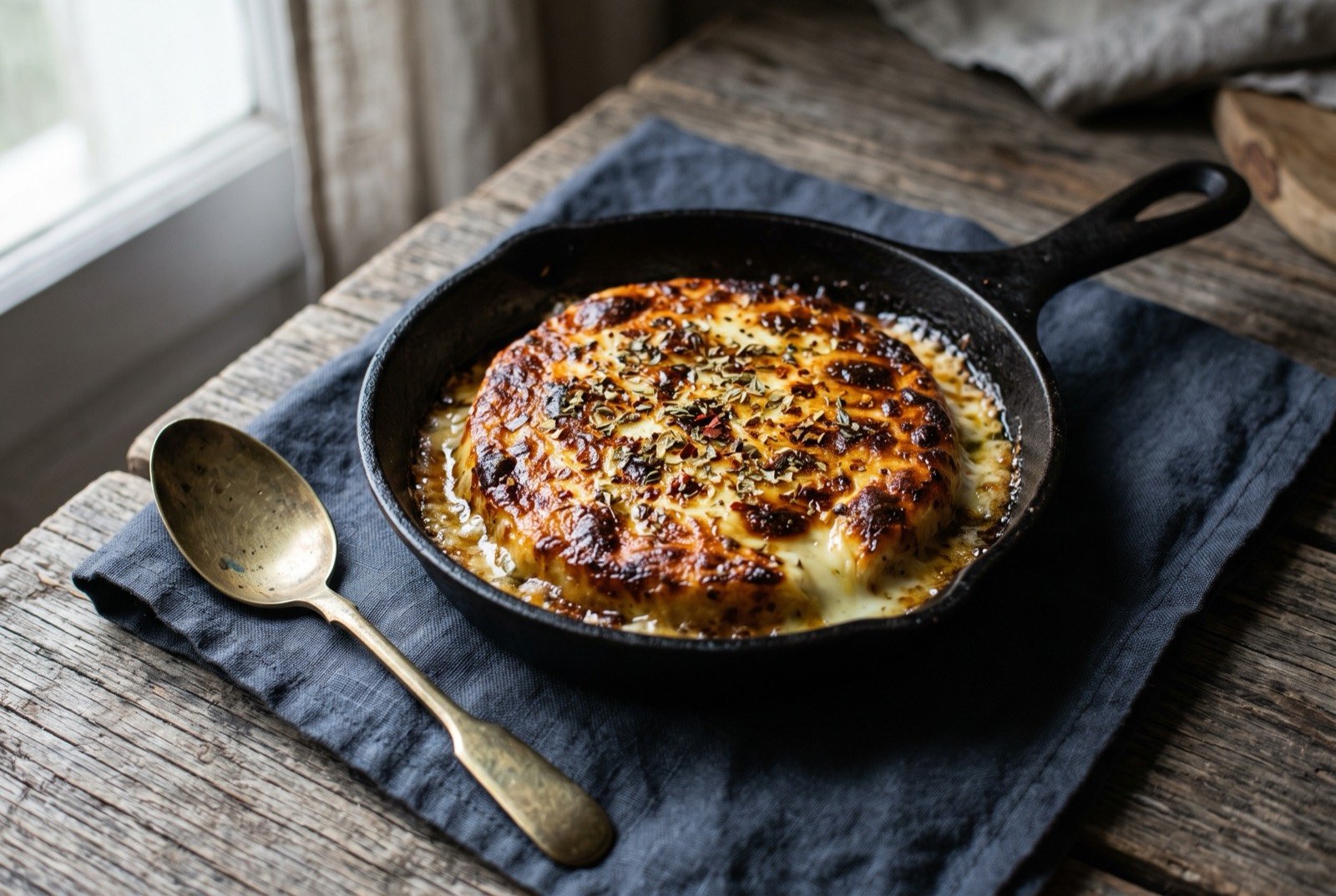
An illustration of the dish, not a photograph of it cooked.
- Time
- 10 minutes
- Reviewed
- Not yet reviewed from inside the tradition
- Cooked
- Not yet cooked and reported
Not an inherited Italian product used unchanged, but a specific, documented Argentine adaptation. Natalio Alba, a Calabrian-Argentine cheesemaker working in Arroyo Algodón, Córdoba province, applied the pasta filata, stretched curd, technique to a hard Italian-style provolone specifically to make a wheel firm enough to sit directly on a grill without collapsing or melting straight through, formally registered in Argentina's food code in 1955 as queso provolone hilado.
As tradition built it
Serves 2 to 4 as a starter. About 10 minutes, once the cheese has come to room temperature.
Ingredients
- 1 wheel of provoleta, or a firm provolone cut roughly 2cm thick
- to taste dried oregano, chilli flakes, olive oil, to finish
Method
- Rest the cheese at room temperature at least an hour before grilling, so it is not going onto a hot grate cold.
- Place it directly on the parrilla bars. Cook roughly 90 seconds, then lift one edge, rotate a quarter turn clockwise and press down.
- Repeat this rotation three more times, at roughly 90-second intervals, so the cheese cooks evenly on all sides.
- It is ready when the exterior is deeply browned and crisp and the interior has gone soft. Finish with oregano, chilli flakes and a little olive oil, and serve immediately with bread.
What a modern chef changes
A held, even heat rather than a single grill zone, and a controlled crust
Rung 2
Method
- Use a small cast iron disc or plancha set over the coals rather than the open bars, if the cheese threatens to weep through before the crust sets. This holds a more even heat across the whole base than bars alone, which matters more for a soft cheese than for meat.
- Rotate on the same 90-second discipline, but judge doneness by the crust's colour rather than the clock alone; provolone brands and thicknesses vary enough that the timing above is a strong starting point, not a fixed rule.
- Finish under a chinois-strained infused oil rather than a plain drizzle: warm olive oil gently with oregano and chilli flakes, strain, and spoon over at the pass for a cleaner, more concentrated finish than scattering the aromatics directly onto the hot cheese.