The Americas · Volume 27
Paraguay
Cassava, Maté and the Chaco's Second Kitchen
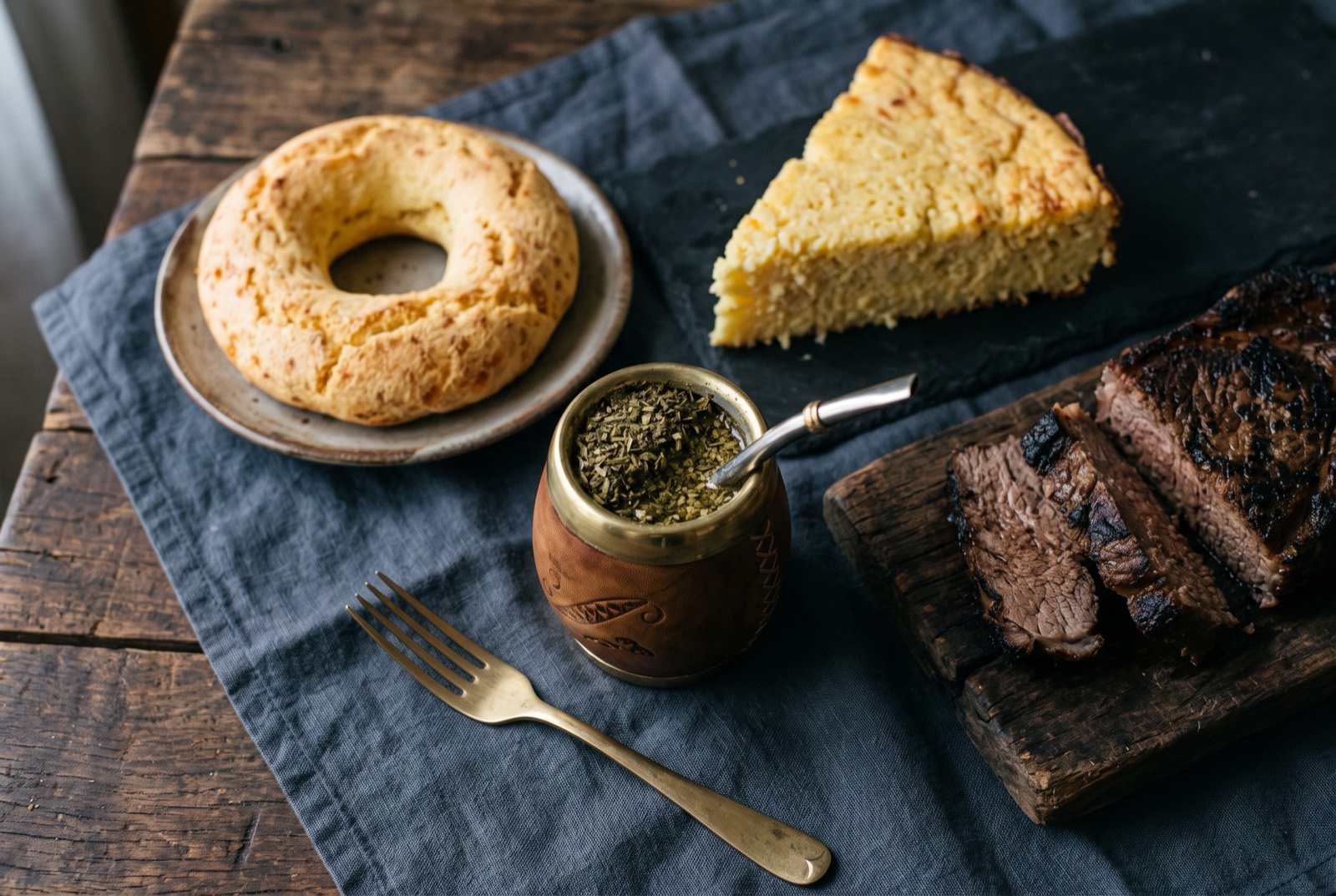
Paraguay taken on its own terms rather than as an appendix to Argentina: a country that runs on cassava starch and maize rather than wheat and beef, keeps Guaraní as a living kitchen language, and turns out to hold two food worlds rather than one, the mestizo heartland east of the river and a second kitchen out in the Chaco. Every dish as tradition built it, then what a modern chef would change.
Sources and review · What this chapter does not assert · How we research · Know this better? Tell us
A Sense of Place
Paraguay is landlocked, mediterranean in the geographic rather than culinary sense, and split down the middle by its own name-giving river in a way that matters more to its food than its politics. The Río Paraguay divides the country into the Región Oriental, the hilly, forested, well watered east where 97.3 per cent of the population lives on 39.3 per cent of the land, and the Región Occidental, the Chaco, a vast dry and semi-humid thorn-forest plain that most of the country's own food writing treats as a footnote. ABC Color, geografía This chapter treats it as the volume's actual argument rather than a footnote: Paraguay is not one cuisine, it is two, sharing a currency and very little else at the level of the plate.
The eastern heartland: a mestizo kitchen with a Guaraní grammar
Eastern Paraguay sits inside the Bosque Atlántico ecoregion, undulating, well watered, historically forested, now heavily pressured by soy monoculture and logging. Ecorregiones de Paraguay Paraguay is unusual among South American nations for the completeness of its mestizaje: there is no separate "indigenous cuisine" standing apart from a "national cuisine" here the way there is in, say, Bolivia or Guatemala, because the population itself is overwhelmingly of mixed Guaraní and Spanish descent, and the Guaraní language is not a minority survival but a majority spoken language, carried in daily speech as jopará, the Guaraní-Spanish blend most Paraguayans actually talk in. Jopará, BBC/Acento
The everyday kitchen's structural logic, once you strip away the individual dish names, is remarkably consistent:
| Structural role | What fills it | Notes |
|---|---|---|
| Starch | Mandioca (cassava), fresh or as almidón (extracted starch); maize (avati), fresh or dried and ground | Not wheat, and not rice; this is a root-and-maize kitchen, closer in its bones to the tropical Americas than to the wheat-and-beef Pampas next door |
| Fat | Historically pork fat and beef tallow; butter and vegetable oil in modern kitchens | |
| Dairy and binder | Queso Paraguay, a fresh cow's milk cheese, and eggs | Present in nearly every dish this chapter treats, and the clearest single mission-era addition to an older cassava-and-maize base |
| Aromatic | Onion, garlic, locote (the mild bell pepper, not a hot chile) | See the flavour arsenal below for why this matters more than it looks |
| Drink | Yerba mate, hot as mate or cold as tereré | Constant background presence, not an occasional beverage |
A table of peoples, in the sense the chapter spec asks for, is almost redundant here in the way it would not be for a country with several distinct ethnic tables: the point about eastern Paraguay is precisely that Guaraní and Spanish did not stay two tables side by side, they merged into one, so thoroughly that the debate over whether the word "chipa" itself is Guaraní or Quechua (see below) is a live argument rather than settled trivia, because the language the food is named in is itself a living, contested, everyday thing.
The Chaco: a second kitchen the rest of the country half-forgets
Cross the Río Paraguay westward and the ecology, the people and the kitchen all change at once. The Chaco is 60.7 per cent of Paraguay's territory and holds a tiny fraction of its population: dry thorn forest and scrub in the west and centre, more humid lowland nearer the river. Iniciativa Amotocodie It contains, distinctly and separately, two food worlds of its own.
The first is Indigenous: Nivaclé communities historically built around the Río Pilcomayo fishery, described in Paraguayan indigenous-peoples reference material as having "gran dominio y manejo del Río Pilcomayo, que constituye el centro vital del antiguo Territorio Nivaclé y es la fuente indispensable de su base alimentaria" (great command of the Pilcomayo, the vital centre of ancestral Nivaclé territory and the indispensable source of their food base), a diversified economy of net fishing, gathering, hunting and flood-recession maize cultivation. pueblosindigenas.es Enxet communities further east built a similar combination of small-plot horticulture, hunting and gathering, with the pod of the algarrobo tree, ground into flour or fermented into drink, as the single most important wild staple across the whole Gran Chaco, not only in Paraguay. Tierraviva, Enxet; Centro de Documentación y Estudios
The second is German-speaking and arrived by boat, ox cart and, in the last wave, refugee camp: three Mennonite colonies, Menno (1926 to 1927), Fernheim (1930 to 1932) and Neuland (1947), settled a semi-arid ecology nobody else had farmed at scale and built, from a standing start, one of Paraguay's most significant dairy industries. Paraguay, a country whose eastern kitchen is built on cassava and maize rather than dairy, has a serious cheese and milk industry today for one specific, geographically concentrated reason: three waves of persecuted German-speaking farmers needed somewhere to go, and the Chaco was where Paraguay's government, in 1921, agreed to let them go. ABC Color, 95 años Colonia Menno
These two Chaco worlds, Indigenous and Mennonite, sit close together geographically and have started, in one small but real enterprise, to actually meet on the plate (see below). Neither one is a footnote to eastern Paraguay's cassava-and-maize story, and this chapter gives both real space rather than the single paragraph most Paraguayan food writing allows them.
The History in Layers
Pre-Columbian Guaraní foodways
Before Spanish contact, Guaraní agriculture in what is now eastern Paraguay ran on maize (avatí), cassava (mandi'o), sweet potato (jety), squash, beans and cotton, supplemented by hunting and river fishing. The direct ancestor of this chapter's two most important dishes is already visible here: doughs of maize or cassava flour, wrapped in güembé or banana leaf, baked in hot ash. Historia de la chipa y de la sopa paraguaya, Meridiano 55 The Guaraní word for this bread, mbujape, simply means "pan," bread, and it is the word both chipa and sopa paraguaya trace back to before either had cheese, eggs or a built oven anywhere near them.
The Jesuit reductions, and what they actually added
The Society of Jesus arrived in the early 1600s and organised Guaraní communities into reducciones, mission towns built around a division of labour: three days a week worked on an individual family plot (abambaé), three days on communal land (tupambaé) whose produce supported the mission economy as a whole. Misiones jesuíticas guaraníes, Wikipedia What the missions layered onto the existing maize-cassava-fish base was cattle and poultry, and with them eggs, milk, meat and, decisively, cheese. Queso Paraguay, the fresh cow's milk cheese that appears in nearly every dish in this chapter, is repeatedly identified in Paraguayan sources as exactly this: a mission-era addition to an older indigenous base, not itself indigenous, but so thoroughly absorbed that Paraguayan cooking is now unimaginable without it. La importancia de la gastronomía en las misiones jesuíticas, El Debate
The Jesuits are also widely credited in Paraguayan sources with the decisive step in yerba mate's history: taking a wild forest plant into cultivation for the first time, after initially condemning the drink as demonically inspired and then, by the 1670s, reframing it as the "Hierba de San Bartolomé." La yerba mate en la cultura guaraní, Secretaría Nacional de Cultura Paraguay's status as yerba mate's actual ecological heartland, not merely a producer alongside Argentina and Brazil, both begins in wild forest that predates the missions and is organised into a crop because of them.
Sopa paraguaya's Jesuit claim, and the two stories this chapter does not adopt. Multiple Paraguayan sources describe sopa paraguaya as "producto alimenticio del sincretismo guaraní y español," a food product of Guaraní-Spanish syncretism, tracing a continuous line from Franciscan-era cooking through Jesuit-Guaraní mission cooking to the dish eaten today; its traditional artisanal preparation was declared Intangible Cultural Heritage by Paraguay's Secretaría Nacional de Cultura in 2017. INAN That much is solid. What is not solid is either popular story for how the dish got its name. The first, repeated across Paraguayan popular media, has Guaraní hosts, out of hunted meat to offer visiting Spaniards, serving a maize preparation instead and saying "so'o opa," the meat is finished, which Spanish ears supposedly misheard as "sopa." The second credits president Carlos Antonio López's cook with a happy accident, too much maize flour added to a thin soup, finished in a pan rather than thrown away. Neither has a primary source behind it in this research; both have the shape of a folk etymology built to be repeated rather than checked. This chapter names the real, documented layer, pre-Columbian ash-baked maize and cassava dough, Jesuit-era cheese, milk and eggs, and leaves the naming stories in "things this chapter has deliberately not asserted" below.
The War of the Triple Alliance, and how a language survives a war
The single most important rupture in eastern Paraguayan society, and in its food culture, is the War of the Triple Alliance (1864 to 1870), fought against the combined forces of Argentina, Brazil and Uruguay. Casualty estimates vary widely enough across sources that this chapter reports the range rather than a false-precision figure: some put Paraguay's total population loss between 50 and 85 per cent, with over 90 per cent of adult men dead; others describe a fall from roughly 500,000 to around 140,000 by the 1870 census, a loss of around two thirds, the overwhelming majority of survivors women, children, the elderly and the disabled. Bajas de la guerra de la Triple Alianza, Wikipedia Whichever figure is closest to correct, the scale of the demographic catastrophe is not in dispute, and it produced two food-relevant consequences worth naming directly rather than as background colour.
First, chipa became a documented wartime logistics food. The Paraguayan food historian Margarita Miró Ibars traced how "chipa abizcochada," a twice-baked, drier version, was calorie-dense, portable, kept without refrigeration, and was sent to soldiers by what she describes as a silent network of women and families, part of the wartime supply chain alongside cloth, grain and meat. Día de la Chipa, Última Hora Second, and more consequentially for this whole chapter, Guaraní survived the war's aftermath specifically because of women. Six days after the fighting ended, the provisional government banned Guaraní in schools. The language did not die, because the overwhelming majority of survivors were rural women, and they kept speaking it at home and teaching it to their children, in the one register the ban could not reach: the domestic and kitchen sphere. Guaraní became a constitutionally recognised national language only in 1967, and a co-official language only in 1992. El guaraní durante la Guerra contra la Triple Alianza, La Nación Paraguay This is why the vocabulary in the next section is not archaeology. It survived specifically in kitchens, spoken by women, through a period when speaking it anywhere more public was forbidden.
Stroessner, colonisation, and a quieter twentieth-century dispossession
Under Alfredo Stroessner (1954 to 1989), a state colonisation programme known as the "marcha hacia el este" pushed settlement into Alto Paraná, Caaguazú and Itapúa, covering over 400,000 hectares of state land, much of which was eventually transferred, often through irregular land grants, to Brazilian, Japanese and German-descended commercial farmers rather than Paraguayan smallholders. Academic and NGO sources frame the continued practice of traditional peasant foodways since then as an act of food sovereignty and cultural resistance against this dispossession and against agrochemical-driven soy monocropping. This political framing rests on NGO and academic sourcing rather than mainstream Paraguayan press, and is treated here as a live argument rather than settled consensus, though the underlying land transfers themselves are independently documented. Los invasores VIP del Paraguay, El Surtidor
The Chaco's parallel history: mission, dispossession and a different kind of colony
The Chaco's twentieth century runs on an almost entirely separate track, and this chapter treats it as one rather than folding it into the eastern narrative above.
Missionisation and land loss. The Anglican South American Missionary Society began work in the Paraguayan Chaco in 1886; the missionary Wilfrid Barbrooke Grubb worked among the Enxet, then called the "Lengua," from 1889 to 1921, publishing an account of his mission in 1904. Paraguayan academic sourcing frames Grubb plainly as a "misionero-antropólogo," an outside figure whose ethnographic authority arrived bundled with an evangelising and, later, a land-brokering role, not a neutral observer of Enxet life. CONICET, Wilfrid Barbrooke Grubb en Paraguay The war above emptied Paraguay's treasury and left its Chaco border with Bolivia undefined; an 1885 law authorised the sale of Chaco public lands that the state did not actually control and that was, in fact, indigenous land, to raise revenue. Successive generations of Indigenous families found themselves living, without documented tenure of their own, inside private estates sold out from under them; one source states the Enlhet people have lost 98 per cent of their territory over the last 90 years. SDCELAR/British Museum That dispossession continues today in the form of some of the most rapid deforestation on earth, driven by cattle-ranching land conversion, much of it, in the words of Paraguayan environmental NGOs, occurring "under a veil of legality." Iniciativa Amotocodie An estimated 150 or so Ayoreo remain uncontacted in Chaco forest along the Paraguay-Bolivia border today, still living by hunting, gathering and small seasonal plantings, their survival directly threatened by the same deforestation. IWGIA
Mennonite migration, in three waves. Mennonites are a German-speaking Anabaptist Christian group with roots in sixteenth-century Europe, who migrated to Russia under Catherine the Great from 1789, then, under further pressure and especially after the 1917 Russian Revolution, on to Canada. Colonia Menno, the founding Paraguayan colony, was settled in 1926 to 1927 by roughly 1,743 Plautdietsch-speaking Mennonites from Manitoba and Saskatchewan, who left Canada specifically because its provinces had begun requiring English-language public schooling, which conflicted with their determination to keep German-language religious schooling. Colonia Fernheim followed in 1930 to 1932, roughly 1,570 Mennonites fleeing the Soviet Union directly, their route into the Chaco itself an ordeal: steamboat up the Paraguay River, then some 150 kilometres inland by narrow-gauge railway, then several more days by ox cart. Conditions were harsh enough that around a third of Fernheim's population left for eastern Paraguay in 1937. Colonia Neuland came last, in 1947, some 2,474 mostly German Mennonites displaced from Ukraine and Poland during and after the Second World War, reaching Paraguay after time in displaced-persons camps in Germany. ABC Color, 95 años Colonia Menno; Paraguay-Info, Kolonie Fernheim Paraguay's 1921 agreement with the Mennonites guaranteed land, freedom of religion and exemption from military service, the standard package these communities have negotiated wherever they have resettled.
A dairy industry built from nothing, in the least likely place in the country. Artisanal butter-making for the Asunción market began around 1948; a proper dairy processing building opened in Loma Plata in 1954, selling cheese and butter simply as "queso menonita" before the brand name Trébol was adopted. The cooperative behind it, Cooperativa Chortitzer Ltda., today produces roughly 500,000 litres of milk daily and holds somewhere between a quarter and a third of Paraguay's national dairy market, figures that vary by source and should be read as approximate rather than audited. Wochenblatt The point that matters more than any single figure is qualitative: nobody had farmed this semi-arid thorn-forest ecology at this scale before the Mennonites arrived, and that is the entire reason Paraguay, a country whose national cuisine is built on cassava and maize rather than dairy, has a serious cheese industry at all, concentrated almost entirely in one unlikely region its own capital rarely thinks about.
Guaraní as a Living Kitchen Language
This deserves its own section rather than a paragraph inside the flavour arsenal, because it is one of the strongest, best evidenced things this chapter can say: Guaraní food vocabulary in Paraguay is not reconstructed or archaic, it is spoken daily, in jopará, over the stove, today.
| Term | Literal Guaraní meaning | Notes |
|---|---|---|
| mbujape | "pan" (bread) | The direct pre-colonial ancestor of chipa and sopa paraguaya alike |
| chipa | disputed | See below: a Paraguayan historian argues for Quechua rather than Guaraní origin |
| mbeju / mbejú | "pan de almidón" (starch bread) | Pre-colonial cassava starch flatbread, no egg or leavening |
| chipa guasu | "big bread/roll" | Fresh corn and cheese cake, no dough as such |
| tatakua | tata (fire) + kua (hole) | The clay dome oven, literally "fire hole" |
| so'o | "carne" (meat) | Root of several dish names |
| so'o josopy / soyo | meat + "crushed/pounded" | A thick soup of meat pounded in a mortar |
| pira / pira caldo | "pescado" (fish) | Fish soup or broth |
| mbaipy | corn porridge | Described in Paraguayan sources as one of the most refined preparations from maize |
| ka'a / kaay | "hierba/planta" (herb/plant) | The old Guaraní name for yerba mate |
| hy'a / hy'a guasu | decorated gourd/vessel | Used for mate and tereré |
| pohã ñana | "remedio" + "hierba/planta" | The yuyos, medicinal herbs added to tereré |
| avati | maize | Root of the named maize races below |
| kivevé | "colorado/rojizo" (reddish) | Named for the colour of the andaí squash used |
| kesu | cheese | A Guaraní-Spanish loanword from "queso" |
Sources: Chipa, Vikipetã (Guaraní Wikipedia); La yerba mate en la cultura guaraní
Is "chipa" itself a Guaraní word? Contested, and this chapter does not adjudicate it. The Paraguayan historian Fabián Chamorro argues, in an interview with the outlet Venus Media, that "chipa" is actually Quechua in origin, meaning something like "apelmazado," packed or gummy, rather than Guaraní, even though the food and its Paraguayan form are unambiguously a Guaraní-mestizo inheritance. He offers no documentary citation, only assertion, so his claim is not adopted as fact here; but it directly contradicts the popular framing that "chipa is a Guaraní word," repeated widely enough, including in this atlas's own early planning notes, that it is worth correcting in print. La chipá es una palabra Quechua, Venus Media What both sides of that dispute agree on is that the Guaraní ancestor dish is unambiguously called mbujape, and mbujape unambiguously means bread.
One genuine Guaraní-language source anchors this section: the Guaraní Wikipedia's own article on chipa, read directly rather than via translation, which confirms the ingredient list, a baking temperature of 250°C, a dough thickness of roughly seven centimetres for meat-filled chipa so'o, and attributes the widely repeated figure of some seventy documented regional variants of chipa to Miró Ibars's own research. Chipa, Vikipetã
The Flavour Arsenal
Starches
Mandioca (cassava). Paraguay grows roughly 400 named varieties; the traditional preferred varieties for starch extraction are Canó, Pyta and Pyta'i, valued for high dry matter and starch content. Processing for almidón (starch) is washing, grating and decanting the root; a separate, older method produces fermented starch through spontaneous anaerobic fermentation followed by sun-drying. Paraguay is the world's fourth-largest exporter of cassava starch. 5Días; CIFCA/Universidad Nacional de Asunción
The starch itself is worth understanding chemically before it is worth cooking with, because the chemistry is what makes chipa chipa rather than a stretchy failure of a wheat bread. Cassava starch runs roughly 17 per cent amylose to 83 per cent amylopectin, gelatinises at a comparatively low temperature (sources give a range of 51 to 73°C depending on how the starch has been processed), and, when cooked, forms long, clear, elastic filaments rather than the short, crumbly set a wheat-flour dough gives. Amylopectin's heavily branched structure holds more bound water and forms fewer of the rigid, ordered zones that make a gluten system crisp and shatter; it forms an extensible, elastic gel network instead. This is general starch food science rather than a Paraguayan food-culture finding as such, but a Paraguayan source independently confirms the underlying fécula-versus-almidón distinction and cassava's central role, and the mechanism is the honest explanation for why chipa and mbeju are chewy and stretchy in a way no wheat bread ever is. ABC Color, fécula y almidón
Crucially, cassava starch is not one product. Paraguayan producers sell both almidón dulce, sweet, unfermented, and almidón agrio, sour, fermented by spontaneous anaerobic fermentation and sun-drying, a mildly acidic starch associated with elasticity in a related but distinct family of baked goods, pan de queso and pan de bono in the wider region. Chipa, sopa paraguaya, chipa guasu and mbeju all want the dulce variety; reaching for the wrong bag, which is genuinely easy to do given how similarly both are labelled, is one of the most consequential single mistakes a cook outside Paraguay can make with this cuisine. Codipsa
Avati (maize). Paraguay's flour-making maize is classified into four named races: Avati Guapy, Avati Tî, Avati Morotî and Avati Mitâ. Avati Morotî is by far the most widespread, found on nearly every farm nationally, described as "the maize par excellence" for flour, a primitive race already selected and sown by the Guaraní and still in everyday use; Avati Guapy and Avati Tî survive today mainly among indigenous farming communities rather than the modern commercial farmer. Variabilidad en la raza de maíz harinoso Avati Moroti de Paraguay, DIGITAL.CSIC
Dairy
Queso Paraguay. A fresh-curd, semi-hard cow's milk cheese, coagulated with rennet, drained, pressed and moulded, with no long ageing and a shelf life of around 45 days. The best artisanal versions are still made with raw milk pasteurised over a wood fire, traditionally espinillo wood, credited locally with a richer, more golden character than the industrial product. Paraguayan sources frame it as originating in rural estancia and campesino practice, a way of preserving surplus daily milk, and it is repeatedly identified as the mission-era addition described above rather than an indigenous product in its own right. Agencia IP
Queso menonita and Trébol. The Chaco's dairy layer, described in the history section above, produces a different family of cheeses under Cooperativa Chortitzer's Trébol brand, a European-style cheesemaking tradition transplanted wholesale into a semi-arid ecology rather than an adaptation of anything already local. This is genuinely a second dairy tradition inside one country, not a regional variant of the first.
Sweeteners and wild trees
Algarrobo (Prosopis alba / P. nigra). The single most important wild food resource across the whole Gran Chaco, not only in Paraguay: dried pods are ground into flour, used for flatbreads and a dense bread or cake called patay, or formed into balls and hung in net bags to dry for storage. Centro de Documentación y Estudios A ceremonial fermented drink, aloja, is made across the wider Gran Chaco by grinding fresh pods and fermenting for 24 to 48 hours; the best documented account of this comes from the Wichí people on the Argentine side of the same river system rather than from Paraguayan fieldwork directly, so this chapter treats aloja as a well established Gran Chaco practice and only a plausible, not independently confirmed, one for Paraguay's own Nivaclé specifically. Journal of Ethnic Foods
Aromatics, and a negative finding worth stating plainly
Locote, in Paraguayan usage, is the mild bell pepper, Capsicum annuum, not a hot chile; the fiery locoto or rocoto of Bolivia and Peru is a distinct Andean pepper that this research found no evidence of in Paraguayan cooking. No source consulted for this chapter supports a strong hot-chile tradition in eastern Paraguayan food, in real contrast to its Andean neighbours. Where chile appears at all, it is typically an optional table condiment, ají chopped with garlic and steeped in oil or vinegar, offered on the side rather than built into the base of a dish. This chapter states it plainly rather than importing an Andean chile tradition into a country whose aromatic base is actually onion, garlic and mild pepper.
The drink itself
Yerba mate (Ilex paraguariensis). Native specifically to eastern Paraguay's Región Oriental, both sides of the Sierra del Amambay and Mbaracayú ranges, inside the Bosque Atlántico ecosystem: this is genuinely the plant's ecological heartland, not merely a growing region shared equally with Argentina and Brazil, whatever the balance of UK shelf space might suggest. La yerba mate en la cultura guaraní
Yuyos (pohã ñana). The fresh herbs infused into cold tereré. A Paraguayan yuyero interviewed by ABC Color recommends a maximum of three yuyos per preparation, mixing roots and leaves, each with a distinct function: cooling combinations named include kapi'i katĩ, menta, Santa Lucía and agrial. This directly contradicts a separately sourced claim that a good tereré carries seven herbs; the two cannot both be the standard, and this chapter presents the number of yuyos as a matter of real local variation rather than a fixed rule. ABC Color
The Technique Ladder
Six rungs, each a real Paraguayan or Guaraní mechanism, explained by what it is actually doing rather than asserted by reputation.
Rung 1. Treat cassava starch as a starch chemistry problem, not a flour substitute
As set out in the flavour arsenal above, cassava starch's high amylopectin content is what gives chipa and mbeju their characteristic chew and stretch, and the sweet-versus-sour distinction is not a technicality, it decides whether a dough behaves at all. What a cook does with this rung. Buy dulce, not agrio, unless a recipe specifically wants the fermented product's tang and aeration. Hydrate the starch fully before working fat and cheese through it, since an unevenly hydrated starch dough bakes patchy, dense in some places and hollow in others. A high power blender lets a cook emulsify fat and fresh cheese into the starch far more evenly than hand-mixing manages, which is precisely where most home chipa goes wrong: greasy in patches, dry in others, from fat that never properly dispersed.
Rung 2. Build queso Paraguay at home, because nobody else will sell it to you
This is the volume's clearest case of a technique forced into existence by a sourcing gap rather than chosen for its own sake, and it earns its place on the ladder because of that, not despite it. Queso Paraguay is not imported into Britain in any form this research could find (see Sourcing below), and no Western cheese, halloumi least of all, reproduces its combination of high moisture, mild acidity and gentle partial melt. What a cook does with this rung. Make a simple fresh curd cheese at home: warm whole milk, coagulate with rennet or a food-grade acid, drain and lightly press, working toward queso Paraguay's own moist, mild, only lightly salted profile rather than a drier, saltier cheese. A dehydrator, run at a low, controlled temperature, dries the finished curd faster and more evenly than open-air drying ever manages in a British kitchen, addressing directly the substitution problem that every serious diaspora cook this research found has gone to real lengths to avoid, importing starch, importing pork fat, even building a clay oven from scratch, rather than reach for the wrong cheese.
Rung 3. Cure a tatakua's thermal mass properly, and treat a Big Green Egg the same way
The single most rigorously documented mechanism in this whole chapter. A tatakua is a mud-and-brick dome oven, built on a stone base, traditionally rendered with red earth and, by some builders, molasses on the interior to help the mass hold heat. The clay behaves, in the words of one Paraguayan food writer, like a microscopic sponge: sudden, intense heat flashes internal moisture to steam faster than it can migrate out, and the resulting pressure is what cracks the dome. Correct curing is progressive, gentle heating that lets moisture escape gradually, building thermal inertia so the mass absorbs and re-radiates heat evenly rather than spiking. Resinous woods, pine or green eucalyptus, are explicitly wrong, since they impart a bitter smoke. Once cured, coals are typically raked out before chipa or sopa paraguaya go in, so the food bakes from stored heat, not live flame. ABC Color, tatakuá curing
What a cook does with this rung. A Big Green Egg's ceramic body is functionally the same idea as a tatakua's mud dome: thick thermal mass that stores heat and releases it evenly. The tatakua's documented failure modes map directly onto Egg mistakes, loading food before the ceramic and deflector plate have fully stabilised at temperature, and using resinous, high-sap wood for smoke rather than a fruit or oak wood that will not turn bitter.
Rung 4. Cook meat the way the fire was built before the parrilla existed
Modern Paraguayan asado runs on the standing metal parrilla, but its indigenous ancestor is mbichy, also called asado a la estaca: meat skewered upright around a fire built beside it, not under it, in a shallow dug pit, cooking by radiant and convective heat over three to five hours rather than direct flame contact. Difusión Empresarial This is directly reproducible on a Big Green Egg configured for indirect heat, deflector plate in, fire banked to one side or the dome held at a low, stable temperature, and it is worth stating plainly: this is not doing American barbecue to Paraguayan beef, it is returning to a documented Guaraní method that predates the parrilla by centuries.
Rung 5. Extract tereré cold, deliberately, and understand why that changes the cup
Tereré is prepared with the same gestures as hot mate, a guampa filled roughly half to two thirds with yerba, but with iced water, typically 1 to 5°C, often infused with citrus and yuyos. The mechanism worth knowing: cold water extracts less caffeine and fewer bitter compounds than hot water, which is why tereré reads as smoother and less astringent than hot mate even at a similar yerba-to-water ratio, and why the same yerba can be re-infused eight to twelve times cold before it is spent. What a cook does with this rung, and an honest flag about it. A high power blender and a chinois let a cook blitz fresh yuyos briefly with a little of the iced water and strain out a clean, controllable infused base, rather than floating whole sprigs and hoping for even extraction. No Paraguayan or Argentine source documents anyone actually doing this; it is this chapter's own extrapolation from the sourced cold-extraction mechanism, offered as a version of the technique the reader's kit makes possible, not as a discovered tradition.
Rung 6. Engineer sopa paraguaya's crust and crumb as two separate problems
Sopa paraguaya is explicitly not a soup; it behaves as a savoury cornbread that sets custard-like inside while crisping on top, "esponjosa por dentro, ligeramente húmeda y con una costra dorada y crujiente en la superficie." No Paraguayan source found in this research explains that outcome mechanistically; every source describes the result without the chemistry behind it. This chapter states plainly that what follows is general food science applied to the dish, not sourced Paraguayan food writing: the interior sets from egg protein coagulation working alongside starch gelatinisation from the maize flour, while the crust's colour and crunch come from surface Maillard browning and moisture loss, two processes that happen at different rates and can be deliberately separated rather than left to chance. Sautéing the onion before it goes into the batter, universal across every tradition-facing recipe found though none frame it as a named technique, removes raw onion's excess moisture and sulphur compounds before they can interfere with the batter's set.
The Ferment and Preserve Bench
1. Almidón agrio, cassava starch's fermented cousin
Produced by wet-extracting starch from cassava root, then leaving it to ferment spontaneously and anaerobically before sun-drying, giving a mildly acidic starch associated, in the family of related breads (pan de queso, pan de bono) across the wider region, with a more elastic, more aerated crumb. The specific claim that fermentation is what causes this aeration is sourced only to a Paraguayan starch producer's own technical description, not to an independent food-science source, and is presented here as worth testing rather than settled. Codipsa
2. Kaguijy, the real pre-colonial Guaraní fermentation
If this chapter names one genuine ancestor fermentation, it is kaguijy, a ceremonial fermented maize drink still made today by the Mbyá Guaraní and drunk at the Arete Guasú festival that coincides with the corn harvest. The traditional activation method for the corn version is mastication: women chew the corn and spit it into the mix, because human saliva's amylase enzyme is what starts breaking maize starch down into fermentable sugars, since the corn will not ferment on its own. Cocina Rica This chapter names the real mechanism honestly rather than either sanitising it or asking a reader to replicate it: the modern kitchen equivalent of the mastication step is a controlled amylase source, malted corn, or a koji-style enzymatic conversion, substituted for saliva while keeping the same underlying fermentation logic. No source found documents any Paraguayan chef actually making this substitution; it is offered here as the chapter's own idea, not as a discovered technique.
3. Queso Paraguay itself, as a preservation act before it is a cheese
Worth naming here as well as in the flavour arsenal: the entire reason queso Paraguay exists is preservation, a way for a rural household to keep the useful part of a day's surplus milk before it turned. That logic, curdle and press rather than let it spoil, is the same logic behind every fresh cheese anywhere, and it is worth a British cook attempting the home version above remembering that the goal is not a fancy cheese, it is a working solution to exactly that problem.
Sourcing in Britain
Verified August 2026. Where a supplier could not be fully confirmed, that is said rather than smoothed over.
The ranked list: what decides great from grim
- Sweet cassava starch, not sour. Chipa, sopa paraguaya, chipa guasu and mbeju all depend on unfermented, dulce, cassava starch. The fermented Brazilian type sold as polvilho azedo, or "sour cassava starch," is a different product made for pão de queijo, not chipa, and both sit on UK shelves under confusingly similar names. Tesco's "Zaeli Sour Cassava Starch" is the wrong product for this chapter's dishes; Bob's Red Mill Tapioca Flour, sold at Holland & Barrett, is a safe, widely stocked sweet default, as is Suma Tapioca Starch Flour via Infusions4Chefs.
- Queso fresco in place of queso Paraguay. Queso Paraguay itself is not imported to Britain in any form this research could find. Halloumi and feta are both wrong: halloumi does not melt when heated, and feta is crumbly and sharply saline rather than soft and mildly acidic. A fresh curd cheese in the queso fresco family is the honest substitute: Mexi Dairy Co and Yorkshire Dama Cheese both make a UK-produced queso fresco that sidesteps the import gap entirely.
- Genuinely Paraguayan yerba mate, if the reader wants tereré to taste as Paraguayans drink it rather than as a Río de la Plata approximation. The UK yerba mate market is dominated by Argentine brands, Taragui and Rosamonte chief among them, sold everywhere from Casa Argentina to MateMundo. Genuinely Paraguayan brands are buyable, but only from one reliable specialist: UruShop, UK-based with a strong review record, stocks Pajarito and Kurupi, both confirmed Paraguayan on their own product pages.
- The finest cornmeal available, for sopa paraguaya. Paraguayan sources are explicit that the dish needs a fine, pale cornmeal, not coarse polenta. No UK retailer stocks a "sopa paraguaya" branded product specifically; the honest substitute is the finest-ground yellow cornmeal or American-style "corn flour" available, sieved if needed, named here as a genuine compromise rather than a like-for-like match.
- Fresh cassava root, for whole-root preparations, bought fresh rather than the frozen, pre-peeled, often par-cooked chunks sold in UK Afro-Caribbean shops for fufu-style dishes, which are a different texture once boiled. Niyis African Supermarket sells fresh cassava in bulk with UK delivery.
Cassava starch and root
The sweet-versus-sour distinction above is the single easiest way to get this cuisine wrong from a UK kitchen. Sweet cassava starch, correctly labelled as polvilho doce, is available via Amazon UK and Brazilian brands (Yoki, Matuto, Amafil) through UK-facing importers such as Latimex Market. Fresh cassava root itself is widely available through African and Caribbean grocers: Niyis African Supermarket, Afrimartuk and Samis Online all stock it, and Latin and Caribbean grocers around Brixton Village, London, are a reliable in-person source.
Dairy
Queso fresco from Mexi Dairy Co or Yorkshire Dama Cheese is the recommended substitute for queso Paraguay throughout this chapter. Halloumi and feta are named and explicitly ruled out above rather than offered as fallbacks, since using either would misrepresent the dish's texture and flavour balance.
Yerba mate
UruShop is this chapter's recommended retailer: UK-based, free delivery over £50, a strong, consistent review record, and a maintained Paraguay category stocking Pajarito and Kurupi by name. MateMundo also lists Pajarito, but at least one customer reports an unexpected customs charge suggesting orders may ship from outside the UK; treat it as a secondary option.
Achiote, chile, and what this cuisine genuinely does not need
Achiote does grow in Paraguay, locally called oro cu or urucu, but no source consulted for this chapter found it used in any of the dishes above; presenting it as an essential Paraguayan pantry item would be misleading, and this chapter does not do so. Equally, this is not a cuisine that needs a UK cook to hunt down a specific hot chile: the aromatic base throughout is mild onion, garlic and bell pepper, and where heat appears at all it is an optional table condiment rather than a built-in ingredient.
Kit: the tatakua question
No dedicated Paraguayan grocer or UK equipment supplier sells anything resembling a tatakua, unsurprisingly, since it is a built masonry structure rather than a purchasable item. A Big Green Egg run in indirect, ceramic-oven mode, per the Technique Ladder above, is the closest match among kit a reader is likely to own, its thick ceramic wall behaving similarly to a tatakua's mud-and-brick mass; a wood or pellet pizza oven, for a reader who has one, is arguably the single closest domestic analogue available in a British garden. A conventional domestic oven remains the reliable fallback, and this chapter says plainly that none of the three fully replicates a tatakua's specific thermal mass and smoke profile.
General Latin American grocers
No shop trading specifically as Paraguayan was found anywhere in the UK, a genuine reflection of how small Paraguay's diaspora is here relative to Colombian, Ecuadorian, Peruvian and Bolivian communities. The general Latin American retail clusters at Elephant and Castle, London, and Seven Sisters Market, Tottenham, are worth a visit and worth asking shopkeepers directly whether they carry Paraguayan brands specifically, but neither should be presented as a confirmed Paraguayan supply chain.
Voices and Sources
From inside the tradition, in Asunción
- Rodolfo Angenscheidt ("el Chapori"), Tierra Colorada Gastro, the only Paraguayan restaurant to reach Latin America's 50 Best Restaurants list, position 47 in 2016. His stated project is to mix local producers with the ancestral recipes of the Guaraní, Payaguá and Toba peoples, bringing food that previously stayed home-style or bar food onto a table that could sit beside good wine.
- Sofía Pfannl and José Miguel Burga, Pakuri, conceived while working in New York, cooking meats in a traditional tatakuá and building menus around local river fish and seasonal herbs.
- Romina Roura, Óga, whose crisped chipa guasu with confit cherries is this chapter's clearest documented example of an Asunción kitchen reworking a traditional accompaniment on its own terms.
- Leticia Villalba Pomata, Central Market, Alma Cocina con Fuego and Sello 33, whose dry-ageing programme for Paraguayan beef is explicitly framed as intensifying flavour rather than changing it, and whose stated ambition is to make Paraguay a reference point for aged beef the way Argentina owns grilling.
- Ez Estragó, a Paraguayan chef based in Copenhagen, whose stated ambition is to "rescatar recetas ancestrales" and build a genuinely historical Paraguayan culinary practice. No documented body of work following through on that ambition was found in this research; his philosophy is real, his practice of it is not yet on the record.
The diaspora
- Nancy Ojeda, I Love Paraguay, Queens, New York, trained under named Paraguayan teachers before emigrating, her restaurant described in coverage as functioning as an informal Paraguayan embassy for the community there.
- Silvio Frutos, also New York, documented preparing 700 chipas at scale for the community's Easter, insisting on homemade queso Paraguay, pork fat sourced from Brazilian grocers, and cassava starch shipped in by boat rather than substituted, the clearest single illustration of this chapter's finding that the gap between good and bad diaspora Paraguayan food is almost entirely about refusing to substitute the load-bearing ingredients.
- A Paraguayan family in Spain has built a full traditional tatakuá on their own property specifically to keep authentic Easter chipa-baking technique alive, and a home producer in Asturias makes and sells queso Paraguay to the local diaspora.
The ethnographers, named honestly for what they are
- Margarita Miró Ibars, Paraguayan food historian, whose 2001 study of chipa is the best specialist source this research identified. Her book itself was not accessed directly in this research, only through press summaries of its findings, and obtaining it would materially strengthen any future edition of this chapter.
- Miguel Chase-Sardi, Paraguayan anthropologist, began fieldwork with Nivaclé communities in 1965 and worked with them periodically over several decades, the closest thing this research found to a long-embedded, Paraguay-based, in-tradition-adjacent primary source on Nivaclé life, though not Nivaclé himself.
- Marcelo Bogado, Sorbonne-trained Paraguayan anthropologist, published a 2025 study of the Nivaclé intended as a reference for Nivaclé students themselves, reportedly including first-person testimony. The book's actual text was not accessible in this research.
- Tierraviva, the Paraguayan indigenous rights NGO working with Enxet, Enlhet, Sanapaná, Angaité, Qom and Ishir communities since 1994, the most Paraguay-specific, non-tourist source this research found on Chaco Indigenous subsistence.
The gap, named plainly
No Nivaclé- or Enxet-authored source on food was located anywhere in this research. Every substantive ethnographic voice on the Chaco's Indigenous layer is an outside anthropologist, however long embedded and however respectfully engaged, or an advocacy NGO working alongside these communities rather than a text written by a Nivaclé or Enxet person about their own food culture. This chapter states that candidly rather than smoothing it into false parity with the eastern Paraguayan material, which does rest on strong government, press and academic sourcing, and on one genuine Guaraní-language source read directly. GAMEO, the standard Mennonite historical encyclopedia, could not be accessed in this research (both relevant colony pages returned an access error) and would likely sharpen the Mennonite dairy history's precise dates if consulted directly before any future edition. The one small, real crossover found between the Chaco's Indigenous and Mennonite worlds, Tucos Factory in Filadelfia, is worth naming for what it actually is: a Mennonite-led enterprise employing Indigenous ecological knowledge and wild-harvest labour across five ethnic groups, not yet a jointly authored food project with equal voice on the record. That asymmetry is real, and this chapter names it rather than presenting the crossover as more equal than the sources show it to be.
Things this chapter has deliberately not asserted
- That "so'o opa" is the documented origin of the word "sopa" in sopa paraguaya. A widely repeated folk etymology with no primary source found behind it anywhere in this research.
- That the Carlos Antonio López kitchen-accident story for sopa paraguaya is documented history rather than oral tradition. Undocumented beyond repetition in popular media.
- That "chipa" is definitively a Guaraní word. A named Paraguayan historian argues for Quechua origin; the point is contested, and neither side offers documentary proof. What is not contested is that the ancestor dish, mbujape, is unambiguously Guaraní for bread.
- Precise gram quantities or timings for sopa paraguaya, chipa guasu, mbeju or kivevé as standard home recipes. No source consulted gave them, and this chapter has not invented figures to fill the gap; where a recipe above lacks a full quantities table, that is the reason.
- That eastern Paraguayan cuisine carries a strong hot-chile tradition. The evidence points the other way: locote is a mild bell pepper, and the genuinely fiery Andean locoto is a distinct plant this research found no trace of in Paraguayan cooking.
- Precise casualty percentages for the War of the Triple Alliance as settled fact. The range across sources, from roughly half to over four fifths of the total population, and over ninety per cent of adult men, is wide enough that only the fact and scale of catastrophic loss is asserted here, not a specific figure.
- That the Stroessner-era "food sovereignty" framing of peasant food culture is uncontested. It rests on NGO and academic sourcing rather than mainstream Paraguayan press, and reflects a particular political reading of a documented land-transfer history rather than settled consensus.
- That the aloja fermentation and chaguar fibre-processing detail in this chapter applies confirmed to Paraguayan Nivaclé communities specifically, rather than to the wider Gran Chaco. The strongest sourcing found for both comes from academic work on the Wichí people on the Argentine side of the same river system; extended to the Nivaclé by ecological and linguistic proximity, not by direct Paraguayan fieldwork.
- That Mennonite dairy cooperatives produce exactly ninety per cent of Paraguay's national dairy output, or the various land-area percentages cited for Mennonite territorial control. These figures trace to a single opinion-inflected source and could not be cross-checked against an industry or government statistic; treat as approximate.
- That the physical chemistry explaining sopa paraguaya's custard-like interior and crisp crust is itself a Paraguayan or in-tradition finding. It is general food science, applied to the dish by this chapter, not something any Paraguayan source explains at that level of mechanism.
- That the tereré yuyo-blending technique and the kaguijy-to-modern-fermentation substitution offered in the technique ladder and ferment bench are documented Paraguayan or chef practice. Both are this chapter's own extrapolations from a real, sourced underlying mechanism, offered as ideas the reader's kit makes possible, not as discovered tradition.
Treat cassava starch as a starch chemistry problem, not a flour substitute
As set out in the flavour arsenal above, cassava starch's high amylopectin content is what gives chipa and mbeju their characteristic chew and stretch, and the...
Build queso Paraguay at home, because nobody else will sell it to you
This is the volume's clearest case of a technique forced into existence by a sourcing gap rather than chosen for its own sake, and it earns its place on the...
Cure a tatakua's thermal mass properly, and treat a Big Green Egg the same way
The single most rigorously documented mechanism in this whole chapter.
Cook meat the way the fire was built before the parrilla existed
Modern Paraguayan asado runs on the standing metal parrilla, but its indigenous ancestor is mbichy, also called asado a la estaca: meat skewered upright around...
Extract tereré cold, deliberately, and understand why that changes the cup
Tereré is prepared with the same gestures as hot mate, a guampa filled roughly half to two thirds with yerba, but with iced water, typically 1 to 5°C, often...
Engineer sopa paraguaya's crust and crumb as two separate problems
Sopa paraguaya is explicitly not a soup; it behaves as a savoury cornbread that sets custard-like inside while crisping on top, "esponjosa por dentro...
The dishes
- Chipa Eastern Paraguay
- Sopa paraguaya Eastern Paraguay
- Chipa guasu Eastern Paraguay
- Mbeju Eastern Paraguay
- Kivevé Eastern Paraguay
- Vori vori (bori bori) Eastern Paraguay
- Mbaipy so'o Eastern Paraguay
- Reviro Eastern Paraguay, particularly Alto Paraná
- Asado paraguayo Eastern Paraguay
- Tereré Eastern Paraguay
Sources and review
- Researched
- 49 sources cited
Where this volume comes from
4 research briefs on file for this volume, researched to the rules on How we research. Published 28 August 2026. Last changed 20 September 2026.
One time here is our estimate, from comparable dishes in this atlas.