Asia · Volume 06
Najd, Kuwait, Qatar, Bahrain & the UAE
The Khaleeji Pearling and Bedouin Coast
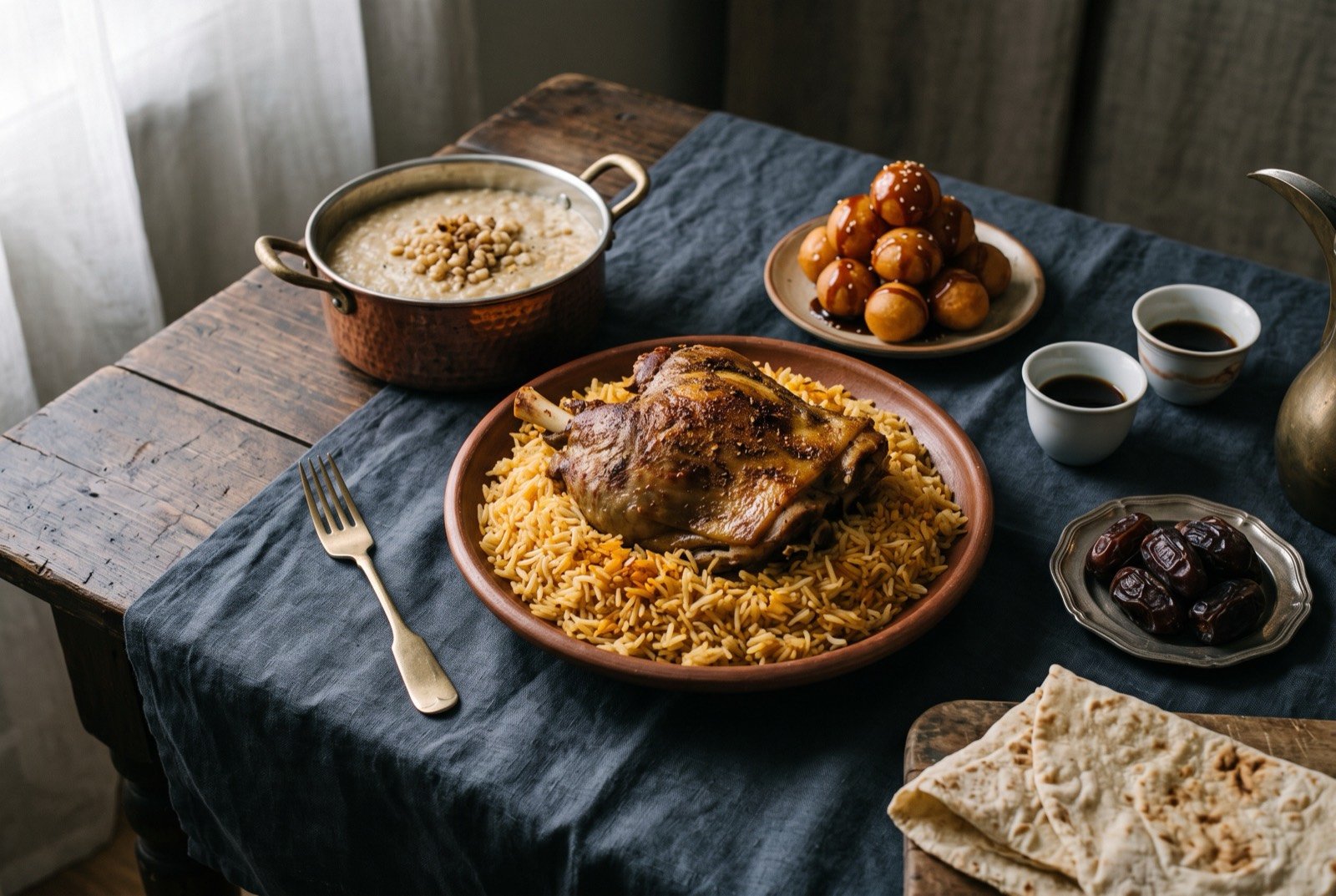
Two food economies inside one shared code of hospitality. Inland, Najd's high desert plateau: date palms and dry-farmed wheat, a Bedouin pastoral world overlaid on fortified oasis towns, coffee and dates arriving with the guest and never leaving the table until the guest does. On the coast, four small monarchies, Kuwait, Qatar, Bahrain and the UAE, built for centuries on one thing: the pearl. Until the 1930s collapse of that trade, these coastal towns lived from the sea and the dhow routes it opened to India, Persia and East Africa; the interior lived from the herd and the well. Both halves share a hospitality grammar so completely that Kuwaiti, Bahraini, Qatari and Emirati writers describe their own food as one continuous, coast-facing tradition, closer to each other than either is to Najd, and Najd's own food writers argue, unresolved, among themselves about how old their most famous dish actually is. Every dish as tradition built it, then what a modern chef would change.
Sources and review · What this chapter does not assert · How we research · Spotted something wrong?
A Sense of Place
Draw the region as two economies rather than one desert, because that is what the research behind this chapter actually found. Inland, Najd: the high central plateau of the Arabian Peninsula, arid steppe and desert bounded by the Nafud to the north and the edge of the Rub' al-Khali to the south, broken wherever groundwater reaches the surface into date-palm oases. Qassim, the historic heart of Najd, is now Saudi Arabia's second-largest date-growing region by tree count, more than 6.9 million palms, 24.4 percent of the national total, some of them 150 to 200 years old and over 35 metres tall, its position straddling the caravan route between Syria, Iraq and the Hijaz making it both a farming region and a trade waypoint. Unaizah and Buraidah, Qassim's historic twin towns, anchor this world: Unaizah's Souq al-Musawkaf is described in Saudi sources as the oldest market in Najd, standing until its removal in 1394H, 1974, and Buraidah today hosts one of the kingdom's largest date markets.
On the coast, a different economy entirely. The Gulf's shallow, warm waters, rarely more than 20 fathoms deep, created ideal pearl-oyster beds along what are now the coasts of Kuwait, Bahrain, Qatar and the UAE, and Bahrain sat at the centre of the pearl banks as the trade's historic marketing hub, buyers converging there from India and beyond. Coastal towns, Kuwait City, Manama, Doha, the Trucial towns that became the UAE, lived from pearling, dhow trade and fishing; inland and desert populations lived the Bedouin pastoral economy of camels, sheep and dates that Najd shares. The two populations were linked by kinship, trade and a shared hospitality code, but their food economies differed structurally: the coast ate fish, rice and dates, the interior ate meat, milk and dates, and the classic Najdi dishes named repeatedly in Saudi sources, jareesh, marqouq, qursan, haniny, are wheat-and-dairy oasis-town dishes rather than purely nomadic ones, a distinction worth holding onto rather than flattening every desert dish into one undifferentiated "Bedouin food."
Trade across the Gulf. Long before oil, these coasts were nodes in Indian Ocean trade. The large ocean-going dhow, the boom, was associated above all with Kuwait, whose sailors and merchants used it to reach southern Arabia, East Africa and western India, and as far as Sarandib, Sri Lanka. This is the route by which rice from India, spices transiting or originating from Zanzibar's clove plantations, and dried-lime technique entered Gulf cooking and became structural rather than decorative: rice is the base of the region's two great festive dishes, and the black dried lime is close to the single most distinctive Gulf flavour, present in Gulf-coast cooking in a concentration Najdi cooking does not share.
A table of peoples, logic and dishes
| Region | Defining logic | The dishes that carry it |
|---|---|---|
| Najd interior (Riyadh, Qassim, ad-Dir'iyyah) | oasis dates, dry-farmed wheat, a Bedouin pastoral overlay | jareesh, haniny, marqouq, qursan |
| Kuwait | pearling and dhow-trade capital, the boom's home port | majboos, gers ogaily |
| Bahrain | the historic pearl market and clearing house | harees, the communal Ramadan pot |
| Qatar | pearling coast, Ramadan's thareed-and-harees table | thareed, majboos |
| The UAE (the former Trucial towns) | the coastal-Bedouin double economy | luqaimat, chebab, khameer, ghuzi |
The History in Layers
First and Second Saudi State: Najd's political spine
The First Saudi State was founded in 1139H, 1727, by Imam Muhammad bin Saud, with ad-Dir'iyyah as its capital, following his pact with Sheikh Muhammad bin Abd al-Wahhab; Saudi sources describe ad-Dir'iyyah as having been a genuine centre of learning, culture and trade under that alliance until Ibrahim Pasha's Ottoman-Egyptian force took the city in 1233H, 1818. This chapter could not find a Gulf-Arabic source directly linking Wahhabi religious doctrine to specific food practices, table austerity or majlis gender norms, beyond generic and unsourced assumption; that causal link is real background to the region's social history, but is not asserted here as a food fact, only named as a gap.
Famine, plague and a king's mudheef
A rich, named piece of Najdi oral history published by the Riyadh newspaper al-Riyadh in 2010, journalist Saud al-Mutairi reporting from al-Asyah in Qassim, documents the old practice of naming years after disasters: the year of the locusts, the year of red sorghum, the year of smallpox, and worst of all, 1337H, "the year of mercy," combining famine and plague so severe that funeral processions ran out of coffins and used house doors instead. People in extreme famine years reportedly ground date pits and bones for food and dug into ant burrows for stored grain. One detail in that same article does not survive checking: it attributes the 1337H plague partly to "the Hiroshima bomb," which is chronologically impossible, since Hiroshima fell in 1365H, 1945, more than a quarter century later; a reader's correction in the article's own comment thread makes exactly this point, and this chapter follows that correction rather than repeating the original claim.
King Abdulaziz's own response to this hardship is independently corroborated and genuinely striking. He bought the Thulaim farm in 1355H, 1935, as a waqf for his father, and in 1359H, 1940, ordered a mudheef, a guesthouse-kitchen, built there to feed travellers approaching Riyadh, prisoners and students. Reported daily throughput at its peak: 30 to 50 sheep, five camels, 50 traditional pottery vessels of dates, 35 tin cans of samn and 80 sacks of rice, served across two daily meals to tens of thousands of people. It is the same coffee-dates-and-rice hospitality vocabulary as the domestic majlis, run at the scale of a state.
The pearl, the dive and its collapse
The pearling coast's history in layers is a different story, and a shorter one in calendar time even though it shaped these four states more completely than any single ruler did. The main pearling season, al-ghaws al-kabir, ran from roughly May or June to September or October, divers away from home for "four months and ten days" as one Bahraini folk-culture account puts it, with a harsher winter dive and a short "small season" alongside it. Provisions loaded before departure were rice, dates, water and firewood, and the diet at sea was reported as bread, dates and fish, with almost nothing else. Divers reportedly restricted their own food deliberately, fearing weight gain would slow them underwater, a practice at least one Arabic source links to the spread of scurvy among crews; a Kuwaiti diver's season involved roughly 3,000 dives and on the order of 40 hours a week spent underwater without breathing apparatus.
The dhow itself was a strict working hierarchy that shaped Gulf food-as-social-obligation customs long after the dive ended: the nakhoda, captain and ship's owner; the ghais, the diver; the sib, who hauled the diver back up by rope; the radeef, an apprentice diver; independent divers called azal; boat assistants, tabab; and the nahham, the ship's singer, whose work songs coordinated collective labour and sustained morale across four months' absence. Ship types ranged from the large ocean-going boom and baghlah down to the smaller jalbut, sunbuk, baqarah and battil.
The industry that had defined these coasts for centuries, Gulf heritage sources repeat a figure of 7,000 to 8,000 years for the antiquity of Gulf pearl diving, though that specific figure rests on a widely repeated heritage claim rather than a cited archaeological study and should be read that way, collapsed abruptly in the 1930s. Muhammad Al-Suleis, a diver and field researcher at Bahrain's Institute for Pearls and Gemstones, states it plainly: the industry peaked in the early twentieth century, then collapsed catastrophically in the 1930s when Japan's cultured-pearl industry, Mikimoto among others, flooded the world market with cheaper, indistinguishable stock, compounded by the global Depression. Oil wealth, in most of these states, arrived a decade or more later, filling the vacuum the pearl trade's collapse had already created rather than displacing pearling directly.
Harees and the women left behind. One of the strongest pieces of research behind this chapter is Aisha Khansaheb's oral history of Emirati cuisine, built from structured interviews with more than nineteen Emirati women aged sixty and above and presented at academic conferences abroad. She singles out harees specifically because its preparation was communal rather than domestic: wealthy households prepared it while neighbours sent their own grain to be ground and cooked together in shared pots, an entire domestic food economy run by women during the months men were away diving. She pushes back directly on the idea that younger Emirati women neglect this inheritance, pointing to contemporary fusions such as "brownie balaleet" as evidence of a living, adapting cuisine rather than a museum piece.
Forty years, oil to plenty
Gulf Arabic sources describe the postwar shift as compressed and total: in scarcely forty years, the region moved from Bedouin hardship and scarcity to considerable prosperity. On food specifically, from the 1970s onward, after the United States floated the idea of a food embargo on OPEC states, Gulf Cooperation Council governments adopted deliberate food-security policy, subsidising and expanding domestic food production and imports. This is the exact period in which refrigeration, imported rice and meat at scale, and eventually supermarkets, transformed what had been a subsistence coastal and pearling diet into the rich, meat-and-rice-abundant festive cuisine visitors encounter today. It is worth stating plainly rather than letting it pass unremarked: much of what reads today as "traditional Gulf abundance," whole roasted lambs, generous nut and raisin garnishes, several meat dishes at one sitting, reflects this postwar prosperity, not the pearling-era diet of rice, dates and salted fish described above.
The kabsa question
This is the single most contested factual point this chapter's research encountered, and it is contested by Saudis themselves, not by outsiders. A 2026 Al Jazeera Arabic feature on what it calls the Saudi culinary trilogy, kabsa, jareesh and haniny, frames kabsa as a nineteenth-century Gulf port phenomenon, arising in places such as Uqair and Jeddah once rice arrived as a prestige import traded for pearls and dates, and explicitly contrasts a simpler, more austere Najdi kabsa against a richer Hijazi kabsa, built on Hajj-route spice trade and cooked in copper marajil, and Gulf coastal machboos variants such as Kuwaiti chicken majboos with its caramelised-onion-and-raisin stuffing. Separately, a 2007 opinion piece in al-Riyadh by columnist Abdulaziz al-Muhammad al-Dhakir goes further and argues kabsa is not an old, rooted Saudi dish at all, calling it a quick meal historically cooked by travellers and truck drivers, and naming what he considers the genuinely old Najdi dishes instead: marqouq, qursan, haniny, aseed. That same piece repeats a folk etymology linking kabsa to Spanish paella by way of "bayla," Andalusian palace leftovers, a claim the article's own comment thread disputes hard, one reader arguing that the name kabsa itself, from al-kabs, compression, or the drowsy fullness the dish produces, is evidence enough of Saudi authorship on its own.
Most Arabic sources this chapter reached simply do not draw a clean line between an inland Najdi kabsa and a coastal machboos, using the two terms close to interchangeably outside expert food writing. This chapter follows that finding rather than inventing a tidier distinction the sources do not support: the recipe below is given under both names, sourced to a Kuwaiti coastal version because that is where real quantities survive, with the dispute over its Najdi credentials reported as a live, unresolved local argument rather than settled either way.
The contemporary moment: an institution, a UNESCO city and an honest question about confidence
Saudi Arabia's Culinary Arts Commission, established in February 2020 under the Ministry of Culture, launched its "Roayat al-Atbaq al-Wataniyah," National Dishes Narratives, initiative across all thirteen Saudi regions in January 2023, and designated jareesh the kingdom's official national dish, selected by regional committees against heritage value, historical importance, geographic representativeness and economic potential. Buraidah, Qassim's twin city to Unaizah, was separately inscribed in 2021 into the UNESCO Creative Cities Network as a Creative City of Gastronomy, the first Gulf city and second Arab city in that category. Michelin followed the money and the moment: Dubai from 2022, Abu Dhabi from 2022, Doha, and Saudi Arabia's own first guide, Riyadh, Jeddah and AlUla, in 2026, that last one run in direct partnership with the Culinary Arts Commission.
What this institutional moment is actually responding to is worth stating honestly, because the sourced evidence points somewhere more specific than a simple story of tourist misrepresentation. Eloísa Martín, a sociologist at UAE University who has led a research project on Emirati food and culture since January 2019, argues in a peer-reviewed 2021 paper that Emirati cuisine "still is in the process of being created," that there is no agreement, "not among citizens, chefs or even the government," on which dish should represent the nation, and, most pointedly, that there is "almost an insinuation that the food is not good enough, that their own food is not good enough to become a national cuisine yet." Chef Khulood Atiq, the UAE's first female national chef, independently describes the same absence twenty years earlier in her own career: "in 2006, I noticed that there was almost no Emirati food available in the tourism industry." Chef Nabhan Al Ali, opening ATHAR in Dubai in 2026, describes finding the identical gap on arrival: "there was a gap, you would find every cuisine, but very little Emirati food." Three Gulf-national voices, twenty years apart, independently naming the same absence is a genuinely strong finding, and this chapter treats it as the honest diagnosis rather than the more commonly assumed story that tourist "Arabian Nights" restaurants actively misrepresent the cuisine; that specific tourist-venue critique was searched for directly and not found stated by a named Gulf food writer or chef, and is not asserted here as fact.
The Flavour Arsenal
| Ingredient | What it is, and why it matters |
|---|---|
| Loomi (dried black lime) | A whole lime, dried until the shell hardens and darkens, close to the single most distinctive Gulf flavour and the ingredient that separates this cuisine's sourness from a Levantine lemon or a Persian sour-orange note. Used whole, pierced, or ground; a genuine one is dark and hard, never spongy or pale. |
| Baharat / bizar | The region's warming mixed-spice blend, built around cardamom, cinnamon, cloves and black pepper, with Kuwaiti bizar carrying its own household-specific ratio. This chapter's research did not find a Gulf-specific commercial baharat sold in the UK; what is sold under that name is almost always Levantine or Turkish, a real sourcing gap addressed below. |
| Saffron and rosewater | Named by Chef Khulood Atiq, alongside loomi, cardamom and bzar, as one of the five defining flavours of Emirati cuisine; both colour and scent the festive rice dishes and the sweet vermicelli and pancake dishes below. |
| Dates, named varieties | Sukkari, repeatedly called "the master of dates" in Qassim sources and the region's flagship variety, with named local sub-varieties; khalas and saqai as Qassim's other major cultivars. Ajwa is a Madinah and Hijaz variety, not a native Najdi one, and should not be presented, as most English-language sources present it, as an undifferentiated third member of a Najdi trio alongside khalas and sukkari. |
| Samn (ghee) | The finishing fat poured hot over harees and jareesh at the table; no dedicated UK Gulf-samn importer was found in this chapter's research, and South Asian ghee is the honest, workable substitute. |
| Hamour (grouper) | The Gulf's most consistently available and prized food fish, caught year-round, from under a kilogram up to twenty, with specimens recorded to fifty; fried whole, stuffed, or paired with sweetened rice in muhammar below. |
| Samid al-harees (whole wheat groats) | Whole hulled wheat, soaked and simmered for hours until it collapses into harees's single unified porridge; a genuinely different starch treatment from jareesh's coarser cracked wheat. |
Part Two
The Technique Ladder
Rung 1. Fry, brown, then steam the rice apart from its garnish
Kabsa and machboos share one mechanical logic across every regional variant this chapter's research reached: the meat is browned first in its own spiced fat, the rice is separately sautéed briefly then steamed on the reserved, strained cooking stock, and only at the very end are the fried onion, nuts and dried fruit scattered over the top rather than cooked through the rice itself. What a cook does with this rung. Strain the meat's cooking liquid through a chinois before it ever touches the rice, so the rice steams on a genuinely clear, unclouded stock rather than one carrying spent aromatics and scum; a precise digital thermometer during the steaming stage holds the lowest possible simmer, protecting the rice's structure the way a wood fire's uneven heat never reliably could.
Rung 2. Add the sour last, and off the boil
Loomi and soured yoghurt are this cuisine's two great souring agents, and both punish being added too early. Loomi, boiled hard for too long, turns bitter rather than bright; yoghurt, added to a fast-boiling pot, splits into visible curds rather than binding into a silken sauce. Jareesh's own defining Najdi innovation, per Al Jazeera's sourced account, was adding soured yoghurt to the wheat during cooking specifically to soften its fibres while keeping distinct grain texture, a sourness added with the cook's control, not an accident of fermentation. What a cook does with this rung. Pierce loomi and add it partway through a simmer rather than at the start, giving it time to release its sourness without the hours of boiling that turn it bitter; temper yoghurt by whisking a ladle of the hot cooking liquid into it first, off the direct heat, before folding the warmed yoghurt back into the pot, the same insurance a béchamel cook uses against a curdled sauce.
Rung 3. Cook it long, then unify it by force
Harees's own name comes from the Arabic verb harasa, to mash or pound: whole wheat and meat are simmered for hours until indistinguishable, then physically beaten with a wooden beater into one dense, uniform porridge, enriched with samn at the end. This is not a shortcut a food processor should simply replace; it is a real textural argument, that a dish becomes something else entirely once its components are forced into one substance rather than left as recognisable parts. What a cook does with this rung. A high-power blender reaches the same textural endpoint in minutes rather than the traditional beating's considerable arm labour, and passing the blended porridge through a chinois afterwards removes any remaining fibre a wooden beater's patience would eventually have worked out by hand, giving a home cook a genuinely silken result without pretending the mechanical method is the traditional one.
Rung 4. Seal the heat underground, and let it baste itself
Ghuzi, and its near-identical regional cousins, Iraq's stuffed whole lamb, Saudi and Yemeni madfoon wrapped in foil over direct heat, Oman and the UAE's shawaa wrapped in palm fronds and submerged in water, and Jordan and Syria's zarb, are all, on the evidence this chapter's research reached, the same underlying technique under different regional names: a whole animal, sealed against the air, cooking slowly in its own released fat and steam. Dubai's Gerbou restaurant runs an underground pit as its own signature method today, billed explicitly by the restaurant and the press covering it as inspired by age-old Emirati practice, real evidence this is a working restaurant technique rather than only a folkloric memory. What a cook does with this rung. A Big Green Egg, set up for a long, low, indirect cook with the meat wrapped tightly in foil or banana leaf to trap its own steam, reaches for the same self-basting, oxygen-starved result a sand pit gave without ever asking a home cook to dig one; a finishing blast of direct, high heat at the very end, lid off, crisps the outside the way pulling a whole animal from hot embers always did.
Rung 5. Griddle it thin, hot and fast
Khubz raqaq, chebab and khameer are all, in their different registers, saj-griddle breads: thin batters or hand-stretched dough cooked directly on a hot, dry, flat metal surface rather than baked in an enclosed oven. What a cook does with this rung. A well-seasoned cast-iron plancha, run as hot as a Big Green Egg's open lid setup allows, gets a home cook closer to a saj's fierce, direct, dry heat than any domestic oven will, and a pasta roller, run down through its settings in stages, opens a hand-stretched dough to an even thinness few home cooks manage by hand on a first attempt.
Part Three
The Preserve Bench
1. Malih (dried, salted fish)
Documented on the Bahraini coast as a genuine pre-refrigeration preservation practice: fish, salted and sun-dried, extending its life well past what fresh catch alone allowed through a season with no reliable refrigeration.
2. Tarih (fermented small-fish sauce)
Named alongside malih in Bahraini sourcing, and compared directly there to Egypt's fesikh, a fermented small-fish sauce that has largely vanished from the modern coastal table but is documented as a genuine historic preparation.
3. Loomi (dried lime)
Covered in full in the Flavour Arsenal above as the region's defining sour note. This chapter's research did not surface a detailed, sourced account of loomi's own production method; boiling in salted water followed by sun-drying is the commonly repeated description in secondary sources, but it was not independently verified against a named in-tradition source in this chapter's Arabic-language research, and is named here rather than asserted as a confirmed process.
Sourcing in Britain
The honest headline finding: several of this cuisine's most distinctive ingredients are genuinely well served in the UK, and one of its most important, a Gulf-specific baharat blend, is not sold here at all.
The ranked list: what decides great from grim
- Loomi, dark and hard, never spongy or pale. No other cuisine's pantry carries this exact sour depth, and it is genuinely well stocked: Melbury & Appleton, Food Bazaar, Valvona & Crolla, Aytac Wholesale and Steenbergs all carry it, alongside ordinary Amazon UK listings.
- Dates by named variety, not just "Medjool." Kawthar Dates, verified via its own About and Contact pages and a stated Saudi sourcing claim, and MyJam Food both sell khalas and sukkari specifically, the two varieties this chapter's research found most repeatedly named as Najd's own rather than a generic Gulf-wide date.
- A genuine Gulf-style baharat, sourced rather than substituted. No UK retailer was found selling a Gulf-specific, saffron-and-turmeric-leaning baharat; everything on offer under that name, including from Steenbergs, is built to a Levantine or Turkish spice profile, confirmed directly from the retailers' own ingredient lists. Blending one's own, from separately sourced cardamom, cinnamon, cloves and black pepper, is the honest route rather than trusting a shop-bought jar's name.
Ingredients, shop by shop
Rice, vermicelli and wheat present no real difficulty: standard aged basmati and South Asian vermicelli and bulgur cover balaleet, harees and jareesh's needs without any Gulf-specific branding required. Samn has no dedicated UK Gulf importer; South Asian ghee is the honest substitute. Samak safi (rabbitfish) is not sold as food anywhere in the UK found in this research; the only UK listing for the fish is an aquarium retailer selling it live as an ornamental species, a false positive worth naming so nobody chases it as a market fish. True hamour is similarly unconfirmed as available; Red Sea-sourced grouper from Reading Quality Fish or Mediterranean-sourced grouper from Adam's Seafood, both verified via Companies House, are the closest honest substitutes, presented as substitutes rather than the article itself.
Physical shops. Edgware Road, London, holds the country's densest concentration of Middle Eastern grocers, and Green Valley and Noor Supermarket there are both real and well stocked, but the street's character is pan-Arab and Levantine rather than Gulf-specific, worth naming honestly rather than implying a dedicated Khaleeji grocery scene that does not exist. Manchester's LuLu Market carries a genuine connection to LuLu Group International, the UAE-founded hypermarket chain, though its own website's SSL certificate had expired at the time of this research.
Kit. A dallah, the long-spouted Gulf coffee pot, and a mihbaj, the mortar used for roasting and grinding coffee and cardamom together, have no dedicated new-retail UK source found in this research; secondhand and antique listings on Etsy and eBay, and specialist antique dealers such as Lloyd Ellis, are the honest route to a real one.
A note on UK voices. No UK-based Gulf Arab food blogger, home cook or small producer with a verifiable public profile was found in this chapter's research; a small number of candidates surfaced but turned out to be Gulf-based rather than UK-based, or, in one case, a Levantine or Persian food writer working in a Gulf city rather than a Khaleeji one. This is named as a real gap rather than filled with a weaker substitute.
Voices and Sources
From inside the tradition
- Chef Khulood Atiq, also transliterated Khuloud Ateek, the UAE's first female national chef and a culinary development specialist with Abu Dhabi's Department of Culture and Tourism, author of Sarareed, over 80 bilingual recipes, and the source of this chapter's five defining Emirati ingredients: cardamom, saffron, rosewater, loomi and bzar.
- Aisha Khansaheb, independent Emirati researcher whose structured interviews with more than nineteen Emirati women aged sixty and above are the strongest primary social history behind this chapter's account of harees and the pearling-era domestic economy.
- Aisha Al-Tamimi, Qatari chef and cookbook author, Popular Qatari Tables, part of an eight-book "Tables" series in Arabic and English.
- Suad Radhi, Kuwaiti author of Kuwaiti Cuisine: Heritage and the History of Peoples.
- Dr Saad al-Sowayan, Saudi academic folklorist at King Saud University, whose 1983 to 1990 oral-history project with elderly Bedouin narrators underlies any serious treatment of Najdi social and hospitality culture, named the Ministry of Culture's Cultural Personality of the Year in 1446H, 2024.
- Abdulaziz Mohammad and Fayez al-Shammari, the named authors of the Al-Manwar study on Saudi welcome traditions that anchors this chapter's account of the majlis and the gahwa-and-dates ritual, including the specifically Najdi detail of a quarter-full coffee cup.
- Chef Tala Bashmi, Bahraini, the first winner of the Middle East and North Africa's Best Female Chef award, describing her own project as "reclaiming her identity and telling the Gulf's untold food stories," and naming palm pollen as her favourite native Bahraini ingredient.
- Chef Nabhan Al Ali, Emirati chef at ATHAR, Dubai: "the recipes don't change... what changes is the presentation."
The critical voice
- Eloísa Martín, sociologist, UAE University, whose peer-reviewed 2021 paper is the strongest single academic source in this chapter's research, and the source of its honest diagnosis: Emirati cuisine as a still-forming, under-confident national project, not a cuisine actively misrepresented by tourist venues.
The UK diaspora
- Roaya Saleh, founder of Villa Mamas, Chelsea, a former investment banker whose Bahraini-Persian food, Tahchin Chicken among its signatures, is the strongest single UK finding of this chapter's research.
- Hashem Al Marzouqi, founder of Al Fanar, South Kensington, deliberately recreating 1960s pre-oil Dubai rather than reinterpreting it.
Restaurants named as reference points
- Erth, Abu Dhabi, the first Emirati-inspired restaurant anywhere to hold a Michelin star, retained through 2024, 2025 and 2026, worth naming honestly alongside the fact that its head chef is Indian, not Emirati.
- Gerbou, Dubai, whose underground pit cooking is the clearest working evidence in this whole chapter that an indigenous technique can be a restaurant's own signature method rather than a garnish over imported technique.
- NOMAS, Riyadh, an all-female kitchen whose camel tenderloin glazed with Saudi coffee is the clearest indigenous-ingredient-to-modernist-technique story this chapter's research found.
- Jiwan, Doha, named here specifically as a contrast case: a French three-star chef's name attached to a reworking of Bedouin technique, the inverse of this atlas's own founding argument.
- Aseeb and al-Qarya al-Najdiya, ad-Dir'iyyah and Riyadh, the strongest verified Najdi-cuisine restaurant reference points this chapter's research reached, both Michelin-covered.
The gap, named
No Kuwaiti, Qatari or Bahraini chef with international recognition comparable to Erth, NOMAS or Tala Bashmi specifically for Gulf-coast heritage cuisine was found in this chapter's research. This is a genuine gap in the available English and Gulf-press coverage this chapter reached, not an oversight, and a dedicated further pass in Kuwaiti, Qatari and Bahraini Arabic-language press would likely close at least part of it.
Things this chapter has deliberately not asserted
- Whether kabsa is a genuinely old Najdi dish, or a nineteenth or twentieth century Gulf-port and travellers'-food invention Saudis have since claimed as their own. Saudi sources themselves disagree, sometimes within the same newspaper's own comment thread, and this chapter reports that disagreement as live rather than settling it.
- Whether a clean Najdi-interior kabsa is reliably distinguished from Gulf coastal machboos anywhere outside one Al Jazeera feature. Most sources use the two terms close to interchangeably.
- The Spanish paella, "bayla," folk etymology for kabsa. A repeated claim in Saudi opinion journalism, explicitly disputed by other Saudi commentators in the same sources, and not presented here as fact.
- Any causal link between Wahhabi religious doctrine and Najdi table manners, food austerity, or majlis gender norms. No source reached in this chapter's research supports such a link with evidence.
- The precise date or mechanism of Najd's shift from wheat to imported rice as the staple grain of the main meal. The general direction is corroborated by multiple sources; no specific, checkable date or import figure was found.
- Whether haniny or maqshoush is the Culinary Arts Commission's officially designated national sweet. Sources genuinely conflict, and this chapter does not choose between them.
- A named-cookbook, Najd-specific recipe for saloona. No source reached in this chapter's research gave one; the dish is real and named, but not treated here with a full recipe.
- The "Arabian Nights tourist restaurant" critique as something a named Gulf food writer or chef has attacked in print. Searched for directly and not found; the honest diagnosis this chapter uses instead, an under-confident, still-forming national cuisine, rests on stronger, named sourcing.
- The 7,000 to 8,000 year figure for the antiquity of Gulf pearl diving, as a precisely dated archaeological fact rather than a widely repeated heritage claim.
- Samak safi's specific preparation, beyond naming it as a common Gulf market fish; no dedicated sourced account of its cooking was found.
- Dried shrimp as a defined historic Gulf-India trade commodity. Modern shrimp import statistics exist; no historic trade-good claim comparable to pearls or dates was found to support it.
- Sheikha Ahmed Al Meer's full biography, and the original Arabic publication details of The Art of Qatari Cooking. Found only via restaurant-derived mentions, and named here as under-verified rather than as settled fact.
- That Ariana Bundy or Arva Ahmed are Khaleeji food voices. Both were considered during this chapter's research and both are, on the evidence found, something else, Persian cuisine and Dubai's broader multicultural food scene respectively, and neither is cited here as a Khaleeji source.
Fry, brown, then steam the rice apart from its garnish
Kabsa and machboos share one mechanical logic across every regional variant this chapter's research reached: the meat is browned first in its own spiced fat...
Add the sour last, and off the boil
Loomi and soured yoghurt are this cuisine's two great souring agents, and both punish being added too early.
Cook it long, then unify it by force
Harees's own name comes from the Arabic verb harasa, to mash or pound: whole wheat and meat are simmered for hours until indistinguishable, then physically...
Seal the heat underground, and let it baste itself
Ghuzi, and its near-identical regional cousins, Iraq's stuffed whole lamb, Saudi and Yemeni madfoon wrapped in foil over direct heat, Oman and the UAE's shawaa...
Griddle it thin, hot and fast
Khubz raqaq, chebab and khameer are all, in their different registers, saj-griddle breads: thin batters or hand-stretched dough cooked directly on a hot, dry...
The dishes
- Kabsa / Machboos The Gulf coast and Najd (contested)
- Harees Bahrain and Qatar
- Jareesh Najd (Qassim)
- Thareed Qatar (Hijazi in origin)
- Luqaimat The UAE
- Haniny Najd (Qassim)
- Muhammar, with Fried Hamour The Gulf coast
- Chebab The UAE
- Ghuzi (Qoozi) Kuwait and the UAE
Sources and review
- Researched
- 3 sources cited
- Reviewed
- Not yet reviewed from inside the tradition
- Cooked
- Not yet cooked and reported
Where this volume comes from
3 research briefs on file for this volume, researched to the rules on How we research. Published 3 September 2026. Last changed 8 September 2026.
The brief's own account of its sources
Rough split: Of the roughly 30 to 35 distinct sources consulted for this section, the substantial majority were Arabic-language: national and regional press (al-Khaleej, Al Bayan, Al Jazeera Arabic, Al Jazeera Net, Al-Anba Kuwait, Al-Sharq Qatar, Sayidaty, QNA), Arabic Wikipedia (used as a secondary aggregator pointing to further named sources, not as a primary source in itself, and flagged inline where Arabic Wikipedia's own citations were thin), a Bahraini folk-culture academic journal (folkculturebh.