Asia · Volume 08
Oman
The Sultanate the Desert Never Fully Closed
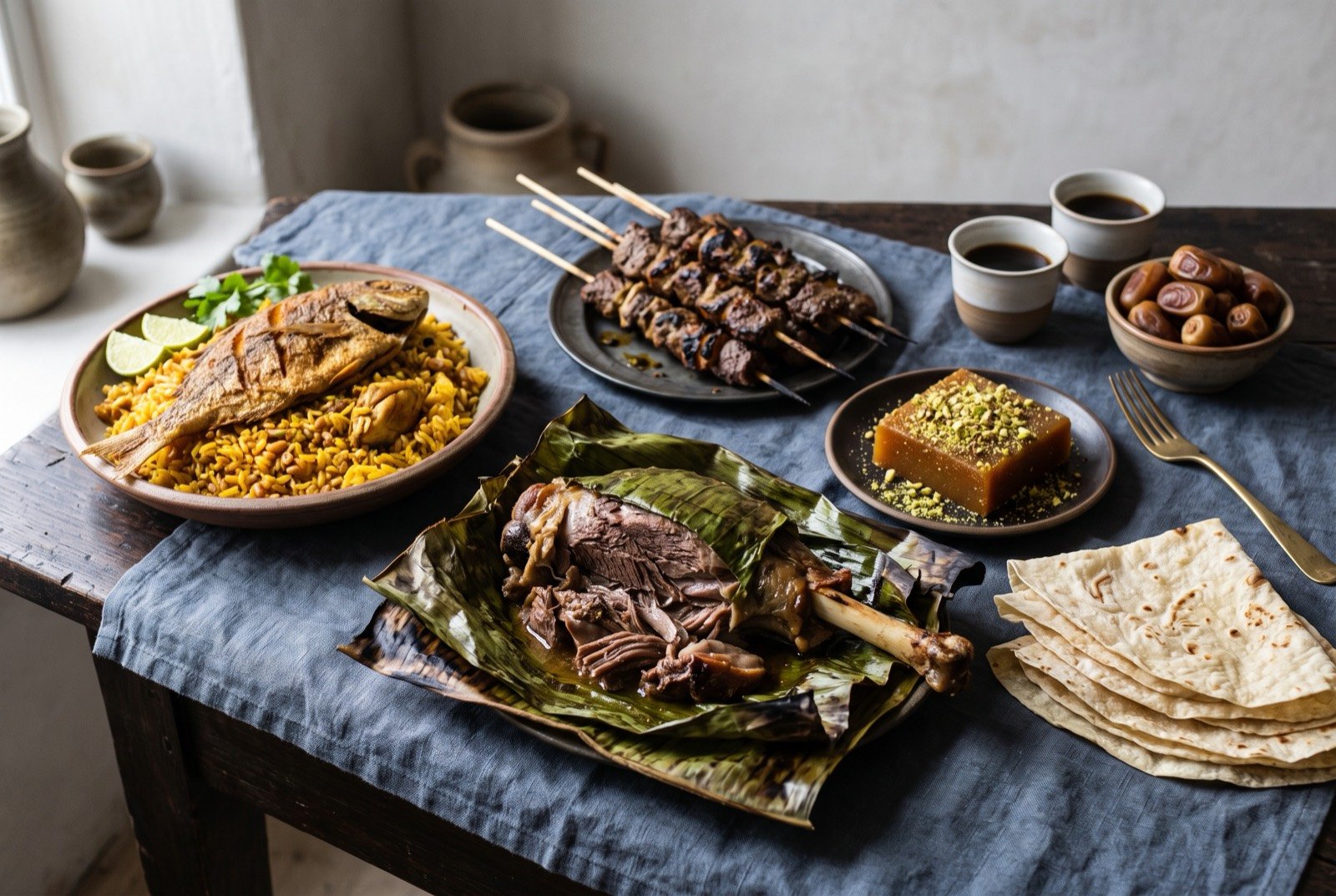
A mountain and desert cuisine that is also, uniquely on this peninsula, an Indian Ocean one: Oman ruled Zanzibar and the East African coast for the better part of two centuries, and that empire left a genuine, checkable mark on Omani food, cloves in the shuwa spice mix, a skewer that travelled to Zanzibar and back to London as mishkaki, a whole Zanzibari cuisine still cooked inside Oman by the families who came home. Every dish as tradition built it, then what a modern chef would change.
Sources and review · What this chapter does not assert · How we research · Spotted something wrong?
A Sense of Place
Oman does not fit the kabsa-and-Bedouin-hospitality grammar the rest of the peninsula shares. It has that grammar too, dates and coffee, a Bedouin desert interior, a Najdi-adjacent rice-and-meat table, but it also has three things none of its neighbours have in the same combination: a mountain range high and wet enough to grow roses and pomegranates on stone terraces fed by a 4,500-year-old gravity irrigation system; a resin, harvested from a tree that grows wild in one southern province and nowhere else worth mentioning, that was worth more than gold to the Egyptians, the Babylonians and the Romans; and a maritime empire that, for two centuries, ran the other way, out across open water to Zanzibar and the Swahili coast, rather than only inland along the peninsula's own trade roads.
The interior and the mountains. Nizwa, Bahla and Rustaq, Oman's historic interior capitals, sit high in the Hajar mountains or on easily defensible terrain, a direct settlement response to geography. Jebel Akhdar, the Green Mountain, rises to over 3,000 metres and carries a temperate microclimate found nowhere else on the peninsula: apricots, peaches, walnuts, pomegranates and roses grow on hand-built stone terraces, watered by the falaj system, over 4,100 recorded gravity-fed irrigation channels, a third of them still flowing, engineering that predates Islam in the region by three thousand years. This is not simply "irrigation." It is the mechanism that makes an alpine fruit garden possible at 2,000 metres in the middle of the Arabian desert, and it is why Jebel Akhdar pomegranates and Jebel Akhdar rosewater carry real weight across the whole Gulf rather than being a local curiosity.
Ibadi Islam, Oman's majority school, distinct from both Sunni and Shia Islam, took root specifically in this mountain-protected interior, and Oman's own political and cultural commentary credits the terrain with fostering the country's historically independent, self-governing character. This research found no specific Ibadi dietary law or custom distinct from general Islamic practice, and none should be implied; what the mountains clearly did shape is settlement pattern, trade posture and a real cultural distance from the rest of the peninsula's political mainstream.
Dhofar, the southern province around Salalah, is close to a separate country by climate. It alone on the whole Arabian peninsula catches the Indian Ocean's southwest monsoon, the khareef, roughly 21 June to 21 September, turning its hills green with low cloud and drizzle while the rest of Arabia bakes. Dhofar sows its own rain-fed crops in that window, cowpea, maize, cucumber, rather than relying on falaj irrigation, and its livestock graze on khareef pasture that is said to change the milk itself: samn kharfi, khareef-season ghee, is the most prized grade going. Dhofar is also where the frankincense tree, Boswellia sacra, grows wild, nowhere else in Oman, and where its resin has been harvested, traded and taxed for at least five thousand years.
The coast runs from the Musandam peninsula in the north down through Muscat, Sohar and the Batinah plain, Sur (the historic dhow-building port whose ships reached India, East Africa and reportedly China), to Mirbat and Salalah's own Dhofari coastline in the south. This is where Oman's other identity lives: a seafaring, trading nation whose merchant fleet, at its height in the nineteenth century, ran an empire stretching to Zanzibar, not a nation that merely received traders at its ports.
The empire, and what it changed. Omani forces expelled the Portuguese from the Swahili coast through the seventeenth century, taking Fort Jesus in Mombasa in 1698, and by the 1840s Sultan Said bin Sultan had moved his own seat of government from Muscat to Zanzibar, judging, correctly, that his East African revenues now exceeded his Arabian ones. Zanzibar's clove economy, discussed in full below, made this the wealthier half of a single realm for two decades, until Britain split the sultanates permanently in 1861. What matters for the kitchen is what came back: cloves folded into the Omani spice vocabulary, a skewered-meat tradition, mishkak, carried out to Zanzibar and now thriving as mishkaki on London street-food stalls, and, after the 1964 Zanzibar Revolution sent tens of thousands of Arab families fleeing home to Oman, a living, separately-named Zanzibari cuisine now cooked inside Oman itself by the families who returned.
A table of peoples, logic and dishes
| Region | Defining logic | The dishes that carry it |
|---|---|---|
| Jebel Akhdar and the interior mountains | falaj-fed terrace agriculture, roses, pomegranates | rosewater, Omani halwa, mountain fruit |
| The Bedouin desert interior | camel, date, minimal seasoning, hospitality ritual | qahwa and dates, maqdeed |
| Dhofar, the mountains and khareef | monsoon-fed farming, frankincense, a distinct southern table | ruz al mudhroub, maqdeed/mu'ajjan, frankincense halwa |
| Muscat, Sohar and the Batinah coast | trade, dhow-building, spice-blended grilling | mishkak, rukhal bread, shuwa |
| Sur | historic dhow construction, the Indian Ocean reach | the mishkak/mishkaki route out to Zanzibar |
| Zanzibar, inside Oman | coconut, citrus, a distinct returnee cuisine, not fused | fish curry with coconut milk, kept Zanzibari, not Omani |
The History in Layers
An interior that faced two ways at once
Oman's food culture was shaped by two forces that are usually described as opposites and were, here, working in tension at the same time: genuine geographic isolation, mountains and desert cutting the interior off from the rest of the Arabian peninsula's cultural mainstream, and simultaneous position at the centre of one of the world's oldest maritime trade routes, the Gulf-to-Indian-Ocean crossing, plus overland caravan roads reaching deep into Arabia. Oman's historic trading contact with India, East Africa and Persia was, on the evidence, closer and more consequential than its contact with its own Arabian hinterland. This is the key that unlocks the whole chapter: an interior that turned inward, and a coast that turned outward, sharing one flag.
Frankincense: five thousand years before oil
Dhofar's frankincense trade is dated to at least the third millennium BCE, moving by sea and camel caravan to Sumer, Babylon, Assyria, Pharaonic Egypt, Rome and ancient Israel, and later to Ming-dynasty China via fifteenth-century diplomatic exchange. Queen Hatshepsut's own expedition in the early second millennium BCE is credited with returning from the frankincense lands loaded with resin, perfumes, animals and wood. UNESCO's "Land of Frankincense" World Heritage listing covers four Dhofar sites: Wadi Dawkah, the port of Khor Rori (ancient Samharam), the ruins of Al Baleed, and Shisr, identified by some with the legendary lost city of Ubar. An Omani source describes frankincense's historic economic weight to Dhofar in exactly the terms this atlas would use of oil today, and the comparison is not rhetorical: this was, for millennia, the single most valuable export the Arabian peninsula produced.
Portugal, briefly, then an empire that ran the other way
Muscat itself was held by Portugal from 1507 to 1650, a fact the chapter returns to below because it is precisely the history Dina Macki draws on for her forthcoming Muscat restaurant, Mesa. Omani forces expelled the Portuguese from their remaining East African forts through the 1650s, taking Fort Jesus, Mombasa, in 1698 and consolidating Omani rule over the Swahili coast.
What travelled to Zanzibar, and what actually made it valuable, checked rather than assumed. Cloves are not native to Zanzibar. They are native to the Moluccas, the Spice Islands of modern Indonesia. The Dutch monopoly on Moluccan clove cultivation was broken in the 1770s when the French smuggled seedlings to their own Indian Ocean colonies, Mauritius and Réunion, and from Réunion cloves reached Zanzibar around 1812, introduced on a small scale by a Zanzibari Arab trader, Saleh bin Haramil al-Abray. Sultan Said bin Sultan, seeing al-Abray as a political rival, confiscated his early plantations and redistributed the land as concessions to loyal Arab, Omani and Indian investors, driving a fifteenfold increase in clove exports between roughly 1820 and 1850, worked by Baloch and East African slave labour. This is a more specific, and more honest, story than "Oman brought cloves from the East": the crop's own journey ran through French colonial horticulture, and Oman's role, real and structurally central, was the second act, turning a smuggled seedling into a plantation economy through capital, land seizure and enslaved labour.
By 1840, Said's East African revenues had overtaken his Arabian ones, and he moved his own capital from Muscat to Zanzibar, an Arabian sultan becoming, in the words of the English-language secondary literature, "an east African ruler with Arabian possessions." Arabic-language sources are less unanimous on the exact date than that summary implies, some placing the process as early as 1832, formal sultanate status arriving only on Said's death in 1856, and this chapter treats 1840 as the conventional anchor while naming the uncertainty rather than hiding it. Said died at sea in 1856, sailing between his two capitals, and a succession dispute between his sons split the realm for good: Britain's Viceroy of India, John Charles Canning, arbitrated the 1861 Canning Award, giving Zanzibar to Majid and Oman to Thuwaini, Zanzibar paying Muscat an annual subsidy from then until Zanzibar's own 1964 revolution. English-language historians call this "the deathblow to the Omani Empire," the end of two centuries of Omani hegemony across the western Indian Ocean.
1964, and what came home
The Zanzibar Revolution of January 1964 violently overthrew the Arab-led sultanate. Estimates of Arabs killed range from an academic figure of 5,000 to a BBC estimate of "as many as 17,000" Arabs and South Asians combined. Oman itself, under the isolationist Sultan Said bin Taimur, one of the most closed states in the world at that date, initially restricted the return of Zanzibar's fleeing Arab families. It was only after the 1970 palace coup brought Sultan Qaboos to power that East Africa-born Omanis were formally invited back and granted citizenship, arriving with skills, medicine, teaching, engineering, that an Oman with almost no modern infrastructure badly needed. An estimated hundred thousand or more Omanis today were either born in East Africa or carry direct family roots there, no formal census exists, colloquially called "Zinjibaris," and by some accounts still navigating friction with Oman-born citizens over perceived economic advantage and being seen as culturally too cosmopolitan.
What this means for the kitchen, stated as precisely as the evidence allows. The clean, romantic version of this history says Omani and Zanzibari cooking fused into one coastal cuisine. The more accurate version, per the British-Omani-Zanzibari food writer Dina Macki, whose forthcoming cookbook Bahari is the first Omani-authored cookbook in English, is that they did not fuse. Omani-Zanzibari households in Oman and in the diaspora cook and name Zanzibari dishes as Zanzibari, coconut-milk fish stews, citrus-bright, Swahili-inflected, alongside Omani dishes as Omani, dried-lime-and-date-based, sitting in the same kitchen and the same identity without becoming one hybrid cuisine. A dedicated Zanzibari restaurant, The Coconut House, operates in Seeb, near Muscat, serving coconut-braised fish and octopus stews under its own name, not as "Omani coastal food." Where the empire's food legacy genuinely has crossed all the way into dishes Omanis themselves call Omani, cloves in the shuwa spice mix, and one specific, well-documented dish family, mishkak, that crossing is real, checkable and covered fully below and in the dishes section. Where it has not, coconut-milk cooking most of all, this chapter says so rather than flattening two food worlds into one for the sake of a tidier story.
The Flavour Arsenal
Loomi (dried black lime). The single most load-bearing flavour in Omani savoury cooking, a whole lime boiled or sun-dried until it hardens and darkens, then cracked or ground and simmered into stews and rice for a sour, faintly smoky, fermented depth no fresh citrus gives. A good one is black or very dark brown right through; a still-yellow or grey-green lime was under-dried and tastes flat and dusty rather than tart. Buy whole and crack as needed, pre-ground loomi loses its aromatic top notes within weeks.
Baharat. A pan-Gulf warming blend, not a single fixed recipe, built around black pepper with cumin, coriander, cinnamon, clove and cardamom in support. A blend that leans hard on paprika and chilli is a different thing, closer to a Levantine shawarma spice, and worth naming as such rather than treating any tin marked "baharat" as interchangeable.
Dried lime's counterpart at the sweet end: rosewater, saffron and cardamom, Omani halwa's three defining aromatics, sourced traditionally from Jebel Akhdar specifically for the rosewater. Jebel Akhdar's own distillation, a wood fire heating clay vessels of rose petals and water, a copper condensing disc above, run for about four hours a batch, settled for one to forty days and stored three months in a clay jar, produces a rosewater genuinely different from the clear Lebanese and Iranian product familiar in Britain: red-brown in colour and smoky in aroma, a direct result of the clay-pot method rather than a marketing distinction.
Cloves, the clearest edible trace of the Zanzibar empire inside food Omanis call their own, part of the standard shuwa spice mix alongside black pepper, dried chillies, dried lime, cardamom and cinnamon.
Dates, roughly 250 native Omani varieties, khalas the best-documented, concentrated around Samail and Bahla, some Nizwa palms yielding over 100kg a season. Ripe fresh dates, rutab, are the everyday eating form; dried dates and date syrup are pantry staples and, in the tabreera cure below, a base for meat marinade.
Frankincense, Boswellia sacra resin from Dhofar, graded from incense-only up to the highest, treatment grade, hawjari, traditionally soaked in cold water overnight and drunk on an empty stomach. Its clearest culinary use is as a flavouring in halwa in Dhofar specifically, and, per specialist retailer description rather than an Omani technique source, occasionally ground into food and drink for flavour. This chapter could not verify frankincense as an ingredient in Omani coffee or in halwa generally, both widely assumed pairings, and does not assert either (see "deliberately not asserted" below).
Samr wood, a desert acacia burned down to embers for shuwa, prized specifically for charcoal that burns hot and slow rather than for any smoke flavour it imparts directly, since the meat is sealed away from it in leaves.
Camel milk and meat, the historic staple of the Bedouin interior, served to guests as sabuha in the morning and ghabuqa in the evening, higher in vitamin C and iron than cow's milk and less fatty. Camel colour is even said to vary regionally, darker in Dhofar, red, tan, yellow and white further north, evidence camel husbandry remains a living occupation rather than a folkloric relic.
The Technique Ladder
The argument, from inside
Two named voices anchor this ladder. Isa Al Lamki, president of the Omani Chefs Association, argues plainly that "Omani cuisine is rich, but it is wronged," neglected outside Eid and passed over by hotels defaulting to international menus even inside Oman itself; his own answer has been to rework harees with caramelised onions and raisins rather than leave it as a plain wheat-and-meat porridge, cooking, in his words, with "no restrictions or laws," global technique in service of Omani flavour. Dina Macki, the Omani-Zanzibari author of Bahari, gives the sharpest, most specific answer this research found anywhere to why elevated versions of home food often taste worse, not missing spice, but missing time: "there's more love going into it... the food tastes so much better because there's probably sweat in it." Every rung below is an attempt to buy back, with modern equipment, exactly the hours a home or street cook would otherwise spend by hand.
Rung 1. Seal the pit, not the dish
Shuwa's real mechanism is not a marinade or a spice mix, it is the pit itself: a hole up to two metres deep, fired with samr acacia charcoal, the meat wrapped in banana leaves and palm fronds, laid on the embers, covered with more fronds, then sealed completely under earth for roughly twenty four hours, sometimes longer. This is a sealed, humid, self-regulating, very low heat, the same physics as sous vide or a slow braise under a cartouche: collagen breaks down without the meat losing moisture, at a temperature the earth itself holds steady. This atlas's whole argument, that every restaurant technique in these cuisines has an indigenous ancestor, is nowhere clearer than here: the ancestor of a thirty-six-hour sous-vide lamb shoulder is not French confit, it is this pit.
What a cook does with this rung. A sous vide bath at 68 to 72°C for 24 to 30 hours reproduces the pit's actual thermal logic more faithfully than any oven roast could; wrapping the joint in banana leaf inside the bag, or finishing it wrapped in banana leaf over embers on a Big Green Egg at very low, indirect heat for the final hour, carries across the aromatic and textural cue of the leaf without needing to dig a hole in the garden.
Rung 2. Clarify the syrup before you colour it
Omani halwa's technique, cooked in a copper cauldron called a mirjal with a wooden paddle called a bistan, is already a genuine three-stage restaurant process, it has simply never been broken apart and served as one. First, a sugar-and-starch syrup is boiled, and egg white is whisked in specifically to clarify it, the resulting foam skimmed off with a tool called a mishkhal, precisely the mechanism a clarified consommé uses. Separately, sugar is dry-cooked to a judged, watched golden-then-reddish-brown, a controlled caramelisation, not "add sugar and stir." Butter or ghee is worked in, the clarified starch syrup is folded through and stirred continuously over direct heat until it thickens and comes together, and rosewater, saffron and cardamom go in last. The whole process runs a couple of hours of continuous, physically demanding stirring, historically male-dominated and passed down inside families.
What a cook does with this rung. Treat the three stages as three separate, controllable operations rather than one long stir: clarify the starch syrup properly with egg white and a fine chinois rather than skimming by eye; hold the dry caramel at a precise, thermometer-checked stage rather than judging by colour alone; finish the emulsion in a stand mixer on low rather than by hand, since what a mirjal and years of practice achieve by feel, even, unbroken heat and constant motion, a heavy pan and a stand mixer achieve by instrumentation.
Rung 3. Slap thin dough onto a blistering surface
Rukhal, Oman's everyday thin flatbread, is baked directly on a hot saj, a domed metal griddle, the dough stretched thin and cooked in seconds on contact with a surface far hotter than a domestic oven reaches.
What a cook does with this rung. An unglazed pizza stone or steel, preheated on a Big Green Egg run as hot as it will go, 300°C plus, reproduces the saj's near-instant contact cooking better than any conventional oven; the dough should be rolled paper-thin and cooked a matter of seconds per side, watched rather than timed.
Rung 4. Salt, press, dry, use sparingly
Maqdeed, Dhofar's dried spiced meat (called mu'ajjan in some sources, likely a regional name for the same underlying technique as the Bedouin interior's qadeed), is meat salted and air-dried for long-term keeping without refrigeration, historically stored in a woven palm-frond vessel to stay dry and ventilated, a preservation technique rather than a flavouring one, meant to be reconstituted or eaten sparingly rather than as a fresh-meat substitute.
What a cook does with this rung. A dehydrator gives precise, repeatable control over exactly the variables, temperature, airflow, time, that traditional sun and wind drying manage by season and instinct; salt the meat firmly, dry at a controlled low temperature until it is firm and dark rather than brittle, and treat the result as a concentrated seasoning ingredient stirred through rice or stew, not a cut of meat in its own right.
Rung 5. Skewer small, fire hot, baste as you go
Mishkak, small cubes of marinated meat threaded onto skewers and grilled fast over charcoal, is the volume's single best-documented crossover dish, the same tradition that travelled to Zanzibar under Omani rule and now thrives, largely unchanged in form, as mishkaki on East African diaspora stalls across London.
What a cook does with this rung. Cut meat small and even, marinate briefly rather than for hours, since the point is a fast, hot sear rather than a slow tenderising cure, and grill directly over a Big Green Egg's coals at close range, turning and basting frequently, exactly the technique the dish has always used, elevation here means sourcing and knife work, not new method.
The Ferment and Preserve Bench
Oman's preserving tradition runs on drying and curing rather than active fermentation, but it is real and worth its own bench.
1. Loomi, dried lime
Whole limes are boiled briefly in salted water, then sun-dried for one to two weeks, turning daily, until they harden and darken from green to near-black, a slow oxidation and moisture loss rather than a true ferment, though the flavour that results, sour, faintly funky, deeply savoury, reads as fermented to a Western palate used to fresh citrus. A dehydrator at 60°C for 24 to 36 hours, following a brief salted blanch, reproduces the process reliably in a British kitchen.
2. Tabreera, the date-vinegar shuwa cure
Covered in full in the shuwa recipe: fermented date vinegar as the acidic base of a week-long dry cure, doing real preservation and tenderising work before the meat ever reaches a pit or a sous vide bath.
3. Maqdeed
Covered in full above: salted, air or dehydrator-dried meat strips, a genuine long-keeping preserve rather than a same-day preparation.
4. Jebel Akhdar rosewater
Not a ferment, but a genuine distillation craft worth naming here for readers with the equipment: a home cook with access to a simple copper alembic or a benchtop essential-oil still can approximate the clay-pot method, rose petals and water heated gently, the condensate collected and rested. Without a still, buy Lebanese rosewater (see Sourcing) and accept the difference honestly rather than attempting to fake the smoky note with anything else.
Sourcing in Britain
Verified September 2026. Where a supplier could not be fully confirmed, that is said rather than smoothed over.
Loomi (dried black lime), genuinely well stocked, including products explicitly marketed as Omani: Melbury and Appleton sell dried black limes under the name "Limu Omani." Steenbergs' own lumi is Lebanese-sourced, not Omani, worth knowing since the fruit itself is the same species used across the Gulf either way. Buy whole and black right through; a grey-green or yellow-tinged lime was under-dried.
Baharat, widely available from Steenbergs, Bart Ingredients, Spice Kitchen and Spice Mountain, but none Omani-specific, since baharat itself is a pan-Gulf family of blends rather than one fixed recipe. Choose one that leads with black pepper and warm spice rather than paprika and chilli.
Rosewater. True Jebel Akhdar rosewater is not realistically buyable in the UK. Use Mymouné or Cortas, both good Lebanese rosewaters, and know honestly that the Omani original would be smoky and amber-brown where these are clear and purely floral, a real difference in the finished dish, worth naming to the reader rather than hiding.
Saffron and cardamom, no difficulty at all. Buy whole threads and whole pods from a shop with real turnover, an Iranian grocer on Edgware Road serves saffron better than a supermarket jar, and grind cardamom fresh.
Dates. No UK retailer sells dates actually grown in Oman; a UK bag marked "Khalas" is near-certainly Saudi or Emirati fruit, since the variety is grown across the Gulf. A good Medjool, honestly labelled as not Omani, is the realistic choice.
Fish for ruz al mudhroub. Seafood Xpress sells fresh grouper listed by its Gulf name, "Grouper, Hamour," directly. Reading Quality Fish and Ocean Catch Fishmongers both list grouper too. Sea bass or halibut are reasonable, clearly-flagged compromises where grouper cannot be sourced in time.
Frankincense. Temple of Incense and Revive Sunnah both sell Omani Hojari-grade resin, sourced from Dhofar, though sold as incense rather than a labelled food product, treat any culinary use as the cook's own careful judgement. Honoor's Omani frankincense-blossom honey, from South Dhofar, is the one genuinely food-labelled route into the flavour, and a legitimate way to bring it into halwa or coffee without handling incense-grade resin at all.
Copper pot for halwa. No UK retailer sells a purpose-made mirjal. A heavy-bottomed pan or a wide, thick-based wok is the honest substitute, the mechanism that matters, fast, even heat so the sugar doesn't catch during a long stir, is about mass and conductivity, which a good heavy pan gives reasonably well even without copper's efficiency. Stir a little more attentively than a traditional recipe implies.
Shops. Green Valley, on Upper Berkeley Street near Edgware Road, is a genuine Middle Eastern food hall for fresh produce and halal meat; Asal and Sinbad Supermarkets nearby are strong for Persian staples including saffron. Sous Chef, Steenbergs, Spice Mountain, Spice Kitchen and Melbury and Appleton between them cover rosewater, baharat, saffron, dried lime and cardamom online with UK delivery.
Eating it before cooking it. Al Wali, in Cardiff, is the UK's first and, as far as this research could establish, only dedicated Omani restaurant, serving shuwa, kingfish curry, Arabic coffee and Omani halwa, and worth a special trip rather than a passing visit, some directory sites mislabel it "Lebanese," which is exactly the flattening this chapter has argued against throughout. London has no fixed Omani restaurant, but Dina Macki, the Omani-Zanzibari author of Bahari: Recipes from an Omani Kitchen and Beyond (DK, 2024, winner of the 2023 Jane Grigson Trust Award), runs periodic pop-ups and supper clubs there and in Muscat, and her book is the strongest single English-language source available for anyone wanting to go deeper than this chapter has room for.
Ranked, the ingredients that decide great from grim: loomi, properly black through; a baharat blend that leads with pepper, not paprika; rosewater, honestly substituted rather than faked; fresh grouper or hamour when the dish calls for it; a genuinely heavy pan for halwa; saffron and cardamom bought whole and fresh; frankincense sourced from a retailer naming Dhofar and Hojari grade specifically, if the reader wants the real thing rather than an unverified listing.
Voices and Sources
From inside the tradition, and the sources behind this chapter
- Dina Macki, Bahari: Recipes from an Omani Kitchen and Beyond (DK/Penguin Random House, 2024), the first Omani-authored cookbook in English, winner of the 2023 Jane Grigson Trust Award, the single strongest available voice on Omani-Zanzibari food and its real, un-fused relationship, drawn on throughout this chapter via her press interviews (National Geographic, Muscat Daily, The New Arab, Sous Chef UK). Her own restaurant project, Mesa, in Muttrah, is named here as in progress rather than confirmed open.
- Isa Al Lamki, president of the Omani Chefs Association, whose reworked harees anchors this chapter's technique ladder, interviewed by Al Khaleej.
- Abdul Sheriff, Slaves, Spices and Ivory in Zanzibar: Integration of an East African Commercial Empire into the World Economy, 1770 to 1873 (James Currey, 1987), the definitive academic history of the clove economy, reached in this chapter's research only via review and index, not full text, and named here as a genuine gap worth closing before any future edition of this chapter.
- Fahad Ahmad Bishara, A Sea of Debt: Law and Economic Life in the Western Indian Ocean, 1780 to 1950 (Cambridge University Press, 2017), on the Indian merchant networks trading between Muscat, Zanzibar and India, likewise reached only in summary.
- Oman's own Ministry of Heritage and Tourism, with Sultan Qaboos University, on "Documenting Omani Cuisine," a government-backed project recording 110 traditional dishes, cited here as existing rather than quoted directly, since its own text could not be located online.
- Hyphen's reporting on London's East African mishkaki scene, and Middle East Eye's feature on the Omani-Zanzibari community, both serious, editorially independent digital publications, gave this chapter its clearest present-tense evidence that the empire's food legacy is still moving. Named restaurants: Ubhar and Bait Al Luban in Muscat, The Coconut House in Seeb, Al Wali in Cardiff.
Things this chapter has deliberately not asserted
- Exact traditional quantities or ratios for the shuwa marinade. No credible Omani source gave real numbers, only an ingredient list; the quantities given here are this chapter's own practical scaling for a home kitchen, not a claim of recovered authenticity.
- A single agreed sealing time for the shuwa pit. Sources range from a self-flagged-unreliable 12 to 72 hours to a more specific, more trustworthy Omani state-press figure of roughly 24 hours, which this chapter has used as its working figure.
- Frankincense as an ingredient in Omani coffee, or in Omani halwa generally (as opposed to a specifically Dhofari halwa variant). Both are widely assumed pairings this chapter's research could not verify in any credible source.
- Frankincense smoke applied directly to cooked food, as opposed to its well-attested role scenting rooms, clothing and people.
- Mashuai and marak samak's exact spicing, and their specific association with the port of Sur. Both dish names are plausible and repeated across several sources, but every one of those sources is Western tourist-blog tier; this chapter has not built any factual claim on them.
- "Dhofari Manshab" as a named dish at all. It surfaced only via travel-blog aggregation and an AI-generated encyclopedia, which this atlas never treats as a source, and is not used here.
- The precise date of Sultan Said bin Sultan's move to Zanzibar. This chapter uses 1840 as the conventional anchor, but Arabic-language sources put the process anywhere from 1832 to 1840, with formal separate sultanate status only in 1856.
- Omani coastal cuisine as having generally "absorbed" coconut-milk cooking. The more accurate picture, per Dina Macki directly, is a distinct, separately-named Zanzibari cuisine practised alongside Omani cuisine inside Omani-Zanzibari households, not a merged coastal hybrid, and this chapter has kept that distinction rather than flattening it.
- Any specific link between Ibadi Islam and a distinct Omani food practice or dietary custom, beyond general Islamic dietary law.
- A properly sourced account of Oman's pre-oil food economy. General research returned only post-oil, post-1970 economic commentary; this remains a real and acknowledged gap.
- A clean distinction between Dhofar's mu'ajjan and the Bedouin interior's maqdeed as dried meats. They appear closely related, quite possibly regional names for the same technique, but no source directly compared them.
- Any coherent, named "New Omani Cuisine" restaurant movement. What exists in Muscat today is real but small: a handful of chefs and restaurants working in this direction, not yet a documented movement, and this chapter has not overstated it into one.
Seal the pit, not the dish
Shuwa's real mechanism is not a marinade or a spice mix, it is the pit itself: a hole up to two metres deep, fired with samr acacia charcoal, the meat wrapped...
Clarify the syrup before you colour it
Omani halwa's technique, cooked in a copper cauldron called a mirjal with a wooden paddle called a bistan, is already a genuine three-stage restaurant process...
Slap thin dough onto a blistering surface
Rukhal, Oman's everyday thin flatbread, is baked directly on a hot saj, a domed metal griddle, the dough stretched thin and cooked in seconds on contact with a...
Salt, press, dry, use sparingly
Maqdeed, Dhofar's dried spiced meat (called mu'ajjan in some sources, likely a regional name for the same underlying technique as the Bedouin interior's...
Skewer small, fire hot, baste as you go
Mishkak, small cubes of marinated meat threaded onto skewers and grilled fast over charcoal, is the volume's single best-documented crossover dish, the same...
The dishes
- Shuwa Muscat and the Batinah coast, cooked nationwide
- Omani halwa Jebel Akhdar and the interior, Oman's national sweet
- Harees Oman, nationwide
- Rukhal bread Muscat and the Batinah coast, eaten nationwide
- Maqdeed Dhofar, and the Bedouin interior as qadeed
- Ruz al mudhroub Dhofar
- Mishkak Dhofar and the Omani coast, carried to Zanzibar as mishkaki
- Qahwa and dates The Bedouin interior, nationwide arrival ritual
Sources and review
- Researched
- No outside sources linked
- Reviewed
- Not yet reviewed from inside the tradition
- Cooked
- Not yet cooked and reported
Where this volume comes from
3 research briefs on file for this volume, researched to the rules on How we research. Published 3 September 2026. Last changed 8 September 2026.
The brief's own account of its sources
Interior and mountains pass. Roughly 13 Omani national press or state-linked articles cited or fetched (Jaridat Oman/Oman Daily, Al Roya, Atheer, Al Watan Oman, Al Sahwa, Oman News Agency, Shabiba), 6 Arabic Wikipedia articles (treated as a secondary aggregator, its own gaps self-flagged where present), roughly 9 pan-Gulf Arabic press articles (Al Ittihad, Al Bayan, Al Khaleej, Al Jazeera Net, Qatar Digital Library, Anadolu Agency Arabic), 2 commercial Omani sources (a Dhofar frankincense retailer, used only for grade and preparation claims), and a small number of weak/generalist sources (a