Asia · Volume 09
Yemen
The Terrace, the Wadi and a Kitchen Carried Out
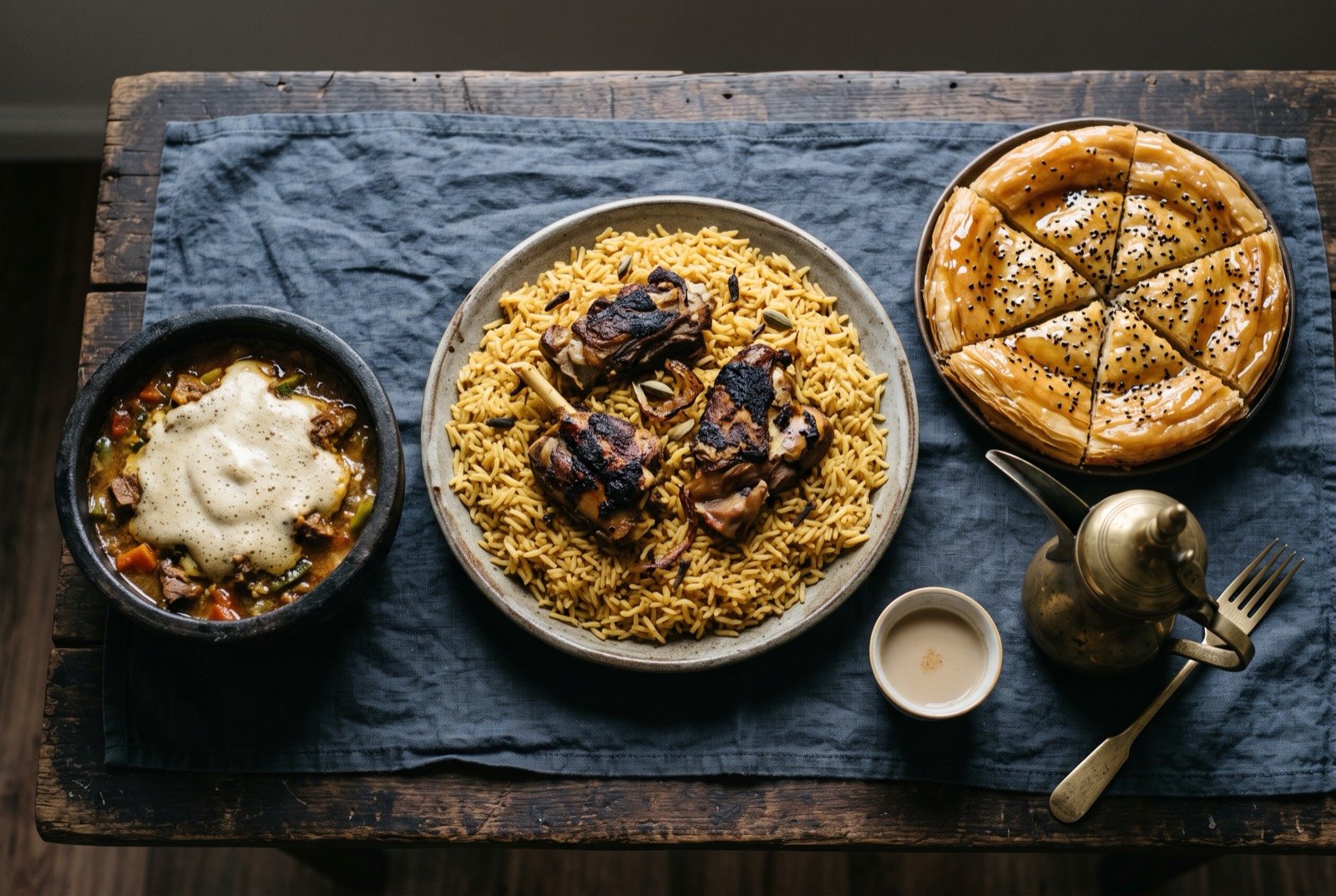
A highland kitchen built on hand-cut stone terraces that also happen to be the plant coffee left the world from, a Red Sea and Hadhrami coast shaped by a thousand years of Indian Ocean trade rather than by desert alone, and a country now in its second decade of war, whose cuisine is at this moment better documented, in several real senses, outside Yemen than inside it. Every dish as tradition built it, then what a modern chef would change. This chapter tries to do that honestly rather than either flinching from the war or writing around it, and to credit the diaspora properly rather than treating it as a lesser substitute for fieldwork that is not currently possible to do.
Sources and review · What this chapter does not assert · How we research · Spotted something wrong?
A Sense of Place
Yemen is not one ecology wearing one flag. It is at least three: a terraced highland spine running roughly 2,000 to 3,000 metres through Sana'a, Ibb, Taiz, Al-Mahwit, Hajjah and Raymah, cool enough and wet enough, just, to grow coffee, qat, wheat and sorghum on hand-built stone terraces that are themselves close to 3,000 years old; a hot, humid Red Sea coastal plain, the Tihama, running sorghum, millet, dates and sea fish rather than coffee; and, entirely separately, the Hadhramaut valley and the port of Aden in the south and east, a wadi-and-coast world shaped less by what grows locally than by thirteen centuries of dhow traffic across the Indian Ocean. A reader used to thinking of Yemen as simply "Arabia's poor, dry corner" should drop that image immediately: more than half the country is genuinely too arid to farm, and almost everything in this chapter comes from the narrow, intensively worked exception to that rule.
The highlands: terraces, qishr and the qat hour
Sana'a itself sits at roughly 2,200 metres in a mountain valley, continuously inhabited for more than 2,500 years and a major centre for the spread of Islam from the 7th and 8th centuries CE. The Old City, on the UNESCO World Heritage List and added to the List of World Heritage in Danger in 2015 because of the war, preserves 106 mosques, 21 hammams and roughly 6,500 houses predating the 11th century, tower houses in a distinctive multi-storey style with gypsum-fretwork window surrounds called qamariyah. Its markets, Al-Meleh, Al-Hab and a dedicated spice market, are unusual even within Yemen for trading daily rather than the once- or twice-weekly rhythm of rural markets elsewhere in Sana'a governorate.
The terraces themselves are the highlands' actual technology, not a scenic backdrop. Each is a horizontal cultivated layer held by a hand-built stone retaining wall, half a metre to two metres thick depending on the slope, engineered so rainwater percolates slowly down through the terraces rather than sheeting off the mountainside. Yemen's per-capita water availability, 140 cubic metres a year, is the lowest of any country on earth, and that single fact explains almost everything else in this section: why the terraces exist at all, why coffee's yield is so poor by world standards, and why qat, a thirsty, wildly profitable stimulant crop, keeps winning the fight for both land and water against the coffee tree that shares the same hillside.
Coffee is grown in 15 of Yemen's 21 governorates, concentrated in Haraz, Bani Matar, the Hayma highlands, Bura'a and Dhamar, at elevations up to roughly 3,000 metres. There is no formal scientific classification of Yemeni coffee cultivars; farmers and traders instead recognise around 15 named local types, Mattari, Hiamy, Udainy and a dozen others, named for the village or district that grows them and the flavour that place's particular soil and altitude produce, not for any documented genetic difference. "Khawlani," the name more familiar in English-language specialty coffee, refers to the broader family grown across the Khawlan mountain range straddling the Yemen-Saudi border; UNESCO inscribed Khawlani coffee cultivation as intangible heritage in 2022, but the submission and the listing are Saudi Arabia's alone and cover only the Saudi side of that shared range, a distinction worth being precise about rather than letting Yemen borrow a recognition it was not actually given.
Coffee cherries are picked by hand as they redden, a family task run across the whole household because the fruit on one tree ripens unevenly over two to three months, October to December, sometimes into January. The picked cherries go straight up to the household roof to dry whole, husk and all, for 12 to 21 days, turned periodically, rather than being pulped and washed the way most of the world's coffee now is: this is natural, dry processing, done because there is no water to spare for the washed alternative, and it is the single biggest reason Yemeni coffee tastes the way it does, wine-like, spice-forward, closer to fermented fruit than to a clean, bright washed coffee. A farmer then either banks the dried cherries as savings against future cash needs or carries them, commonly by donkey, to a weekly rural market; hulling, grading and roasting happen downstream, in town, at dedicated coffee-and-spice shops. Alongside roasted coffee, those same shops sell qishr, a tisane brewed from the dried husk itself with ginger and sometimes cinnamon rather than from the bean, described in early twentieth-century travel accounts as "the universal drink" of Yemen and the customary thing offered to a guest before anything else. Qishr is Yemen's own daily coffee, drunk far more widely than roasted coffee ever was at home; almost all of the actual coffee bean crop has always been grown for export.
Coffee's economics are genuinely lopsided against it. Yemen's own Ministry of Agriculture puts coffee's cultivated area at 32,984 hectares against qat's 166,745, roughly one hectare of coffee for every five of qat, and independent researchers think government figures understate qat's real extent further still. Qat draws an estimated 40 per cent of the water pulled from the Sana'a basin each year and, nationally, close to 40 per cent of all water used for irrigation, while occupying only around 15 per cent of agricultural land; coffee, by contrast, needs an estimated 35 times less water per kilogram of output. None of that stops qat winning: it is dramatically more profitable per hectare and per cubic metre of water than coffee, and highland land that once grew some of the world's most valuable coffee, the Sarawat region specifically, has documented cases of conversion to qat. More than seven in ten Yemeni households have at least one qat user, and the afternoon and evening qat-chewing session, takhzin, "storing," for the way the chewed leaf is held in the cheek, is a genuine social institution rather than a private habit: after a substantial midday meal, family and guests move to the mafraj, the light-filled room crowning the top floor of a traditional Sana'ani tower house, windows deliberately set low for the view and topped with a coloured-glass qamariyah arch, and settle in on cushions for an afternoon and evening of conversation, politics, poetry and business that can run past midnight. This chapter treats the qat hour as load-bearing social infrastructure, the frame most highland meals and most highland hospitality actually sit inside, while being equally plain that qat itself is what is squeezing the water and land a hungry country needs for food and for the coffee crop the world actually prizes.
The Tihama and the Red Sea coast
West of the highland escarpment, the Tihama runs hot, humid and flat down to the Red Sea, growing sorghum, millet and dates rather than coffee, and fishing the Red Sea's own waters rather than the Gulf of Aden's. This is lahoh and sorghum country, closer in staple logic to the Horn of Africa across the water than to Sana'a up the mountain, a kinship this chapter returns to below.
Hadhramaut and Aden: a wadi and a port, not a desert
Hadhramaut is not the empty desert its name suggests to an outsider. Wadi Hadhramaut itself, and the separate coastal Wadi Hajr, nicknamed "Wadi al-Milyun Nakhla," the valley of a million palms, are real, long-farmed date-growing valleys; inland towns, Tarim, Say'un, Shibam, are old, wealthy trading and scholarly centres, not oases in the romantic sense. What actually defines Hadhramaut and Aden as a food world is not their ecology so much as their address on the map: for two thousand years and more this coast sat on the sailing route between the Red Sea, the Gulf and India, and its cooking was built by that traffic as much as by anything grown locally. Yemeni sailors are credited with working out how to use the Indian Ocean's monsoon winds to sail directly across open water to India rather than hugging the coast, a discovery that reached Greek sailors under the Ptolemies in the second century BCE; regular voyages then ran Aden and Mocha to Barygaza on India's west coast for the better part of five centuries. Aden's British colonial century, from 1839 to 1967, is the connection that shows up most directly on the plate: Aden was administered, for roughly its first hundred years, from Bombay, as part of British India, on the Indian rupee, and it was the ordinary Indian soldiers, clerks and traders who came with that administration, not the small British officer class, whose own varied diet actually took root locally. That is why Aden eats roti and paratha as everyday bread, drinks milky spiced tea, and seasons its meat with a blend called hawaij al-shirka, "the company's hawaij," a name that names its own colonial administrative origin plainly. Hadhramaut's own trading diaspora ran the other way and further still, into East Africa, the Gulf, India's Hyderabad and, most surprisingly, maritime Southeast Asia, a thread this chapter takes up properly in The History in Layers.
A table of peoples, logic and dishes
| Region | Defining logic | The dishes that carry it |
|---|---|---|
| Sana'a and the highland terraces | wheat, sorghum, coffee and qat sharing scarce terraced land and water | saltah, hilbeh, bint al-sahn, qishr |
| Taiz, Ibb and the southern highland fringe | the same highland grammar, its own dish reputations | fahsa, asida |
| The Tihama, Red Sea coast | sorghum, dates, dried fish, a fermented flatbread shared across the strait | lahoh, shafoot |
| Hadhramaut's wadi towns | date palms, old trading wealth, a documented Southeast Asian kitchen influence | Hadhrami mandi, masoob |
| Aden | a British-Indian colonial port grafted onto an Arab coastal town | zurbian, sayadiya, hawaij al-shirka |
The History in Layers
Indigenous core. Yemen's highland terracing is old, Arabic heritage sources describe roughly thirty centuries of continuous practice, with origins placed in the Sabaean period, the same pre-Islamic South Arabian civilisation credited with building the great Marib dam. This is a genuinely ancient agricultural technology, not a medieval or Ottoman-era improvement, and it is still, largely, the same stone-walled system in use today.
Coffee's own origin story sits inside this layer, and it is worth being precise about what is actually established. Coffee arabica is indigenous to Ethiopia's highlands, not Yemen's; what Yemen did, from at least the 15th century, was become the first place coffee was deliberately cultivated as a crop and traded as a commodity, rather than simply gathered wild, and the port of al-Mukha, Mocha, became the word's own gateway to the rest of the world. Sufi monasteries are widely credited with an early role in cultivating and drinking coffee to stay awake through night prayer, a claim repeated often enough across sources that it is worth stating as the tradition's own account of itself, while noting plainly that the deeper mechanics of exactly when and by whom cultivation began in Yemen specifically are not settled with the precision popular coffee writing implies.
Trade layers. Two separate trade histories run through this one small country, and conflating them is the single most common English-language error about Yemeni food and drink. Mocha's trade was specifically about coffee: from the sixteenth century, highland-grown coffee was carried down to this one Red Sea port and shipped on to India, East Africa, the Ottoman lands and, from the seventeenth century, Europe, the Dutch making their first commercial coffee purchase there in 1628. Mocha's population collapsed from around 20,000 in the 1800s to about 1,000 by the 1930s once Dutch Java and then Brazil broke Yemen's coffee monopoly and British Aden and Ottoman Hodeida drew the wider trade away. Aden's trade, by contrast, long predates and long outlasts coffee specifically: it was, and remained, a general Indian Ocean entrepot, frankincense, myrrh, textiles, livestock, later coal and shipping, continuously important from antiquity and given its decisive modern shape by Britain's 1839 seizure of the port and Aden's rise as a free port drawing merchants from across the ocean. "Mocha" as an English word for a coffee flavour belongs to the small port town specifically; Aden earned its own separate reputation as a cosmopolitan trading city, not as a coffee town.
Hadhramaut's own diaspora ran outward from this same trading world, and for far longer than the war-driven emigration of the last decade. Hadhrami merchants, religious scholars and labourers built communities right around the Indian Ocean rim from at least the eighteenth century: on the Swahili Coast, where Hadhrami sayyids helped consolidate Islam and intermarried freely with local families; in the Gulf; in Hyderabad, where the Hadhrami-descended Chaush community, originally brought in as soldiers for the Nizams, still runs mandi and qahwa restaurants along Barkas's main streets, and where the city's own festival dish, haleem, is credited to Arab-diaspora introduction under the Nizams' rule; and, least expected of all, in maritime Southeast Asia. A 1931 travel account of the wadi towns Tarim and Say'un describes households whose wealth, and whose kitchens, were "deeply marked by Singapore and Java," wealthy families employing Javanese cooks, and Indonesian and Malay words for food, sayur, sambal, goreng, sate, entering everyday Hadhrami Arabic, a level of borrowing that only happens with sustained lived contact rather than casual trade. This is not a story this chapter can resolve into one tidy claim about who influenced whom; it genuinely ran both ways, Hadhramis carrying their own cooking east and carrying Southeast Asian dishes and cooks home again.
The religious and ritual layer is Sunni Shafi'i in most of the country and Zaydi Shia in much of the northern highlands, a division whose modern political weight is discussed below rather than here. Ramadan and Eid shape a real share of the dish calendar directly: shafoot is specifically an iftar dish, qatayef-style sweets and bint al-sahn appear at Eid and at weddings, and asida, cheap, oil-free and filling, has its own documented status as food for the poor eaten across the whole social range regardless of season.
The colonial economy. North Yemen, broadly the highlands and Tihama, passed from Ottoman rule to a Zaydi imamate that governed in relative isolation until a 1962 revolution; South Yemen, broadly Aden and Hadhramaut, was British colonial and protectorate territory from 1839 until 1967, when it became the People's Republic of South Yemen, briefly the Arab world's only Marxist state. These were, in effect, two separate countries with two separately administered food cultures for well over a century, which is the real reason Aden's Indian-inflected, curry-and-biryani-adjacent cooking and the highlands' fenugreek-and-hilbeh cooking read as genuinely different food worlds rather than regional variants of one national cuisine. Unification in 1990 put both halves under one flag; it did not erase the culinary difference, and this chapter has not tried to pretend otherwise.
The modern moment, stated plainly. Yemen's civil war, now more than a decade old since the Houthi takeover of Sana'a in 2014 and the Saudi-led coalition intervention in 2015, has produced one of the world's most severe humanitarian crises. As of 2026, an estimated 18.3 million people face Crisis-or-worse acute food insecurity, including 5.5 million in outright Emergency conditions; in the areas the internationally recognised government controls, close to half the population faces Crisis-or-worse conditions, and Yemen's own humanitarian response plan for the year remains funded at under 15 per cent. Agriculture has contracted by roughly a fifth during the conflict years, driven by market disruption, unavailable inputs and displacement rather than only by fighting itself. It would be dishonest to write around any of this, and it would be equally dishonest to let it be the whole story: a coffee export renaissance, discussed in full in The Modernist Elevation below, is genuinely rebuilding around Yemen's own highland smallholders even as the water and land those same farmers depend on remain under real pressure from qat, from the war, and from a shrinking humanitarian aid pipeline. Both things are true at once, and this chapter has tried to hold them together rather than choosing the more comfortable one.
The Flavour Arsenal
Seeds and pods. Fenugreek, hilbeh, is the highland kitchen's single most distinctive ingredient: whipped, not just cooked, into an aerated, faintly bitter froth that tops saltah and much else, in a technique covered in full in the Technique Ladder below. Black cumin or nigella, habbat al-baraka, finishes bint al-sahn and much festive baking. Cardamom, ginger and cinnamon spice the coffee-husk tisane qishr, a genuinely daily drink rather than an occasional treat, and appear again, in a savoury register, in hawaij, of which there are properly two distinct blends, a savoury one for soup and stew (black pepper, cumin, cloves, allspice, coriander, nutmeg, cardamom, cinnamon) and a separate, more cardamom-forward one used specifically to spice coffee itself. Coffee cherry, of course, is this volume's own named-for ingredient, discussed at length above and again below.
Leaves. Qat, chewed fresh daily by a large majority of the adult population, is this chapter's one flavour-arsenal entry that is deliberately not a flavouring at all: it shapes when and how the whole highland day eats, and its thirst for land and water shapes what can grow alongside it, without itself contributing a single dish to this chapter's list. Fresh coriander, garlic and green chilli, ground raw rather than cooked, are the backbone of sahawiq, the salsa-like relish that sits alongside saltah and much else, the highland cousin of Aden's own besbas chilli condiment and of zhoug further south still.
Ferments and preserved staples. Samn, clarified butter, is the highland kitchen's keystone fat, finishing asida, fatta and much bread. Lahoh's own fermented batter, discussed in full at Dish 5, is this chapter's clearest live ferment: a wheat and semolina batter, given time and warmth to sour and bubble before it ever meets a griddle. Dried small fish and dried, salted meat both appear across the Tihama and Hadhrami coast as ways of carrying protein through a hot, humid climate without refrigeration, though this chapter could not source precise traditional methods with the same confidence it found for lahoh's ferment or samn's clarification, and says so plainly rather than inventing detail.
Chillies. Sahawiq and its Adeni cousin besbas both put fresh, ground green or red chilli at the centre of the table rather than treating it as a background heat. Zhoug, Yemen's own fresh chilli-and-herb relish, deserves a direct note here: it is Yemeni in origin, carried by Yemenite Jewish emigrants into Israeli food culture after most of Yemen's Jewish population left in Operation Magic Carpet, 1949 to 1950, and this atlas has already given zhoug, along with hilbeh's Yemenite Jewish life, jachnun and kubaneh, full tradition-and-elevation treatment in AS-05 (Israel). Credit for all four belongs here, at their point of origin; the recipes themselves live there, and this chapter cross-links rather than repeating them.
Starches and staples. Sorghum and millet carry the Tihama coast; wheat carries the highlands, ground for lahoh, asida and bread; basmati rice, imported rather than grown, carries Hadhramaut and Aden's mandi and zurbian, itself a direct, edible trace of the Indian Ocean trade this whole southern and eastern half of the country was built on.
The Technique Ladder
The argument, from inside
Nearly everything that separates a serious version of this food from a bad diaspora or takeaway version comes down to two things a written recipe alone cannot easily convey: what a mechanical process is actually doing, and how much a piece of equipment matters. London's Ola Pinch of Yemen stall, run by Abeer Yahya Mohammed, made this argument with her feet rather than her words: rather than substitute a domestic oven for the tandoor-family oven mandi genuinely needs, she shipped one from Yemen by a three-month sea journey. That single decision is the clearest evidence this chapter's research found that the oven itself, not just the marinade, is where the real work of this cuisine happens.
Rung 1. Whip the hilbeh into a true froth, not a paste
Fenugreek seeds are soaked in water for several hours upward, which softens the seed's raw bitterness and lets its natural mucilage swell, then drained and whipped, traditionally by hand, until the colour turns from a dull, bitter brown to a pale, foamy near-white and the texture goes from wet and pasty to genuinely light and aerated. Under-whipping is the single most common failure: if the colour has not turned and the texture has not lightened, nothing has actually happened chemically or physically, it is just wet ground fenugreek sitting in a bowl. What breaks a froth once it is made is stirring it into a hot liquid, saltah's own broth, rather than serving it as a distinct dolloped layer on top, which collapses the aeration and dumps the raw bitterness straight back in.
What a cook does with this rung. This is an emulsion built by mechanical aeration, not a flavour trick, so a stand mixer's whisk attachment, run for several minutes, will succeed reliably where a food processor's blade, which chops rather than aerates, generally will not. A high-power blender's whisk function does the same job. This single piece of equipment closes most of the gap between a takeaway saltah, where the hilbeh often arrives thin, dark and separated, and a properly made one.
Rung 2. Read the smoke and the drip, not just the marinade
Mandi is cooked in a tanoor, or a related regional oven, mofa, mas'ud, tabun, a beehive-shaped pit, traditionally clay-lined and dug into the ground. Dry wood is burned down to charcoal; the meat, usually whole chicken or lamb, is suspended on a rack or hook so it never touches the coals, and the rice cooks in a pot suspended below or alongside it, never resting on the fire itself. The pit is sealed, with a small vent to bleed excess smoke, and the whole thing cooks low and slow on trapped residual heat and rising steam, fat and spice-laden drippings from the suspended meat falling onto the rice below and basting it as it steams. A version that simply roasts meat and steams rice separately, then combines the two afterwards, produces soft, fragrant rice, but it has skipped the exact mechanism, meat rendering directly above rice, that makes mandi taste like mandi rather than like spiced chicken and plain rice served together.
What a cook does with this rung. No UK kitchen has a dug earth pit, and no Yemeni or diaspora source this chapter's research reached recommends a Big Green Egg specifically for mandi; that suggestion below is this atlas's own extrapolation from general kamado technique, offered honestly as a plausible high-end adaptation rather than as sourced tradition. A kamado's sealed ceramic body and dome genuinely does replicate a tanoor's enclosed, radiant, smoke-retaining heat better than a standard oven does: run indirect, with a drip pan under a raised rack and the lid closed to trap smoke, it comes reasonably close to the sealed-pit, drip-basting mechanism. The more modestly equipped, and better attested, home substitute is a "coal dum" finish: a piece of fully lit charcoal set in a small foil cup on top of the cooked rice, given a few drops of oil to make it smoke, the pot then sealed tightly for ten to fifteen minutes before serving, trapping smoke against rice that has already cooked rather than replicating the drip itself.
Rung 3. Stretch the dough hand to hand until it is nearly gone
Bint al-sahn's whole technical difficulty sits in its lamination, not its ingredient list. Each portion of a yeasted, egg-and-ghee-enriched dough is rolled to roughly 25 centimetres, then stretched further by passing it from hand to hand until it is close to translucent, laid onto an oiled tray, brushed with melted ghee, and topped with another paper-thin layer, repeated to build real height before baking. This is precisely why the dish is more often made at home for a wedding or an Eid than found properly executed on a restaurant menu: restaurants under time pressure visibly skip the full lamination and serve a flatter, less convincing approximation.
What a cook does with this rung. This is a strudel-dough problem, not a baking problem. The gluten needs to relax enough, with rest time and a little worked-in fat, that the dough stretches without tearing, exactly the skill set strudel or Moroccan warqa demand. A chinois has no role here; a dedicated pastry brush and patience do.
Rung 4. Layer meat under rice, then seal the pot
Zurbian's construction, called tadmees, is a wet, layered, sealed pot method genuinely distinct from mandi's dry pit-roasting: meat marinated in yoghurt, garlic, ginger and heavily fried onion is layered with parboiled rice, finished with saffron dissolved in rosewater or milk, then sealed and cooked gently so the rice finishes by absorbing the meat's own rising vapour rather than by direct additional liquid. The dish is Aden's own adaptation of an Indian technique, carried in by sailors roughly two centuries ago, not a variant of Hadhramaut's own much older mandi, and treating the two as the same dish with different spicing misses what each is actually doing.
What a cook does with this rung. A heavy, well-sealing lidded pot, or a Dutch oven with a damp cloth under the lid to improve the seal, replicates the trapped-vapour finish reliably. This is a genuinely low-equipment-barrier technique compared with mandi's smoke; what it actually demands is restraint at the marinating and layering stage rather than any specialist kit.
Rung 5. Ferment the batter properly, and judge it by its eyes
Lahoh's batter, wheat flour, semolina and water, is given real time to ferment before it ever meets a griddle, wild yeast and lactic acid bacteria in the batter dropping its pH and weakening its gluten network, the same mechanism this atlas has already documented in detail for Somalia's structurally related canjeero and laxoox in AF-11, a bread that is, by name and by construction, directly descended from this one. The tell of a properly fermented, properly cooked lahoh is its surface, covered in small, even "eyes," bubble holes formed as the batter sets on a hot griddle, rather than a smooth, pancake-like face: eyes are the surface a sauce actually clings to, in shafoot and elsewhere, not decoration.
What a cook does with this rung. A live batter needs warmth and time, not haste: a warm spot, several hours to overnight, and a wetter batter than instinct suggests, produce more eyes than a stiff, quickly cooked one. A domed lid over the griddle while the top sets, rather than flipping, is standard practice and keeps the top surface soft enough to tear rather than crack.
Rung 6. Dry the whole cherry on the roof, and do not rush it
Coffee processing at Yemeni origin is natural, or dry, processing: the whole ripe cherry, husk and all, is dried in the sun, on the household roof, for 12 to 21 days, turned periodically, rather than being pulped and washed the way most of the world's coffee now is. This single choice, made from necessity, since there is no water to spare for washing, is the actual mechanism behind Yemeni coffee's distinctive, wine-like, fermented-fruit cup profile: sugars and acids from the drying fruit continue interacting with the bean inside for the whole of that two-to-three-week period, in a way a quickly washed bean never experiences.
What a cook, or a coffee drinker, does with this rung. A home cook cannot replicate this at the roasting stage; what this rung actually changes is how a reader should buy and taste Yemeni coffee, seeking out and naming natural-process, single-origin lots rather than a generic "Mocha-style" blend, and expecting, and valuing, exactly the fermented, spice-forward character a washed coffee is usually bred and processed to avoid.
The Ferment and Preserve Bench
1. Lahoh's live batter
Covered in full at Dish 5 and Rung 5 above: a genuine, judged-by-eye fermentation, not a quick chemical leaven.
2. Samn
Clarified butter, the highland kitchen's keystone finishing and cooking fat, functioning as much as a flavour carrier and a preservation medium as an everyday cooking fat, though this chapter could not source a precise traditional clarification method specific to Yemen with the same confidence it found for lahoh's ferment.
3. Qishr and the roof-dried coffee cherry
The natural, dry-processed coffee cherry, dried whole on the household roof for 12 to 21 days before its husk is ever removed, is itself a preservation technique as much as a processing step, covered in full at Rung 6, and the husk that comes off it is brewed as qishr rather than discarded, Yemen's own genuinely daily drink.
Sourcing in Britain
Verified this research pass. Britain's Yemeni communities, among the oldest settled Arab and Muslim communities in the country, mean this volume's sourcing is genuinely better served than a typical new-diaspora chapter would expect: actual Yemeni-run shops and restaurants on British high streets, not only generic Middle Eastern grocer substitution.
The ranked list: what decides great from grim
- Yemeni-origin green coffee, correctly roasted, over any "Mocha-style" blend. Genuinely buyable in the UK at three tiers: mid-priced named-region single origin, for instance Quantum Roasters' Sana'a-region lot; and true microlot direct trade at a premium, Ozone Coffee Roasters' "Yemen: Ali Kabeer" nanolot and Qima Coffee's own farmer-series lots, sold both through Qima Café's two London shops and through third-party specialists Sigma Coffee UK and Colonna Coffee. Availability at the cheaper end fluctuates because raw bean import from Yemen is genuinely difficult during the war; Algerian Coffee Stores, Soho, the UK's oldest coffee shop and a long-time Yemeni Matari stockist, was out of stock at the time of this research, citing sourcing difficulty directly.
- Hilbeh made from real whole fenugreek seed, soaked and whipped, not a jarred approximation. The seed itself is cheap and stocked by essentially every South Asian and Middle Eastern grocer; no pre-made UK hilbeh product exists, and none should be sought, since the technique is the entire point.
- Sidr honey, if used at all, treated as a genuine fraud risk rather than assumed genuine. A 2015 report from inside Yemen, quoting named beekeepers and a consumer-protection official, documents cutting, sugar-syrup adulteration and outright substitution with Pakistani honey as established practices; several UK retailers, The Suuk, Balqees, Prophetic Blends, claim independent lab testing, none independently verified here. Price far below $100 to $150 per kilogram equivalent, no stated growing region, and honey that pours too easily for a product prized for viscosity are the practical red flags; a good raw UK wildflower, heather or Manuka honey is an honest substitute for Sidr's role rather than its specific flavour.
- Whole, not powdered, dried lime (loomi) for saltah and maraq. Widely available; whole cracked loomi simmered in the pot gives a cleaner sourness than the powder, which suits spice blends better than a simmering stew.
- Hawaij, correctly identified as one of two distinct blends. The savoury blend, for soup and stew, and the separate, cardamom-forward coffee-spicing blend are frequently conflated in UK retail listings; Ottolenghi, The Spice Shop and Spice Professors all sell a dedicated "Yemeni Hawaij," and a reader should check which is meant before buying the first result.
- Zhoug, made fresh rather than bought. UK jarred versions, Waitrose's own-brand paste, Belazu's wet zhoug, skew towards the Israeli-deli register the dish took on after Yemenite Jewish emigration, rather than a Yemeni-specific one; the components, coriander, chilli, garlic, cumin, cardamom, oil, are all separately easy to source, and a high-power blender makes the fresh version genuinely quick.
Physical shops and restaurants, by city
Sheffield's Yemeni community, one of Britain's oldest and largest, is centred on Spital Hill, Burngreave, where Saleh's Mini-Market, trading since 1996, is a genuine grocer rather than only a restaurant, alongside working restaurants including Zurbiany and Al-Diyafa. Cardiff, historically the largest Yemeni settlement outside Yemen relative to city size, has verified current restaurants, Yemeni Crown, Bab Al-Yemen and Hadramowt, though no Yemeni-specific grocer could be verified there. London's scene is newer and restaurant-led rather than grocer-led, concentrated around Edgware Road and Paddington; for grocery ingredients specifically, the relevant shops are general Middle Eastern grocers, Green Valley and Damas Gate, which stock loomi, hawaij, samn and fenugreek as standard rather than specialist stock. No Yemeni-specific grocer could be verified in Birmingham or South Shields, Britain's single oldest continuously settled Yemeni community, despite active searching; this chapter states that as a real gap rather than inventing one.
The atlas's own extrapolation, named plainly
No Yemeni or diaspora source recommends a Big Green Egg or kamado specifically for home mandi; the suggestion at Rung 2 and Dish 7 above is this atlas's own adaptation from general kamado technique, offered as a plausible high-end substitute rather than as tradition itself. The actually attested home substitute, from cooks writing specifically about this technique for a home kitchen, is the simpler coal-dum finish described there.
Voices and Sources
From inside the tradition, in Yemen
- Ibrahim Alhasbani, an eighth-generation coffee farmer from the mountains around Sana'a, founder of Qahwah House, whose own account of family farming and export logistics runs through the coffee renaissance material above.
- Khalid Khan and Abdul Gabbar Al-Kirshi, the Yemeni lead authors of UNDP's 2022 "Qat and Coffee" value chain analysis, a genuine field survey of 30 informants across seven governorates conducted despite serious wartime access constraints, the single strongest research document behind this chapter's agricultural sections.
- Fathi Abu Al-Nasr, the Yemeni poet quoted on asida's own philosophy of sufficiency, one of the few named in-tradition voices this chapter's research found speaking directly about a specific dish rather than about Yemeni food in general.
The diaspora, credited properly rather than treated as a lesser substitute
- Faris Sheibani, British-Yemeni founder of Qima Coffee, and Mokhtar Alkhanshali, the Yemeni-American founder of Port of Mokha whose escape from Sana'a across the Red Sea by fishing boat, in 2015, with two suitcases of coffee samples, became the spine of Dave Eggers's "The Monk of Mokha," the most widely known single narrative in Yemeni food and drink culture in the anglophone world.
- Hamzah Nasser and the brothers Hatem Al-Eidaroos and Munif Maweri, founders respectively of Haraz Coffee House and Qamaria Yemeni Coffee Co., whose Dearborn-based chains, alongside Qahwah House, now run 121 locations across 14 states between them, a boom Sally Howell, of the University of Michigan-Dearborn, documents academically as a deliberately mixed-gender, alcohol-free "third space," distinct from the Lebanese and Syrian coffeehouses of a century earlier.
- Fatma Al-Baiti, running the "Meet Me at Fatma's" supper club in London specifically, in her own words, because "all they hear about is the negative things, like the war," having been unable to return to Yemen herself since 2015.
- Amjaad Al-Hussain, whose 2018 self-published cookbook "Sifratna" is the clearest single example of book-length documentation of Yemeni home cooking in English, notable precisely because she wrote it from family recipes and diaspora memory, having never herself been to Yemen.
- Abeer Yahya Mohammed, of Ola Pinch of Yemen, London, whose decision to ship a real tandoor from Yemen by sea rather than substitute a domestic oven anchors this chapter's whole argument about equipment.
- Mohammed Al-Hamadi, Yemen Chef, Oakland: "Saltah is Yemen on a plate, resilient, complex, and nourishing to the core... When we make saltah, we're not just cooking; we're performing an act of cultural preservation."
The gap, named plainly
This atlas has already documented, in AS-05, a dedicated, well-funded institutional effort, the Jewish Food Society, to rescue Yemenite Jewish cooking technique from a genuine, specific transmission gap: recipes and hand-skills that existed only in the memory of people displaced from Yemen in 1949 and 1950, filmed and archived before that knowledge was lost entirely. No equivalent organisation exists for the far larger Yemeni Muslim diaspora. Documentation of that larger community's home cooking is real, but scattered and individual-led, a self-published cookbook here, a supper club there, rather than institutional. This is a genuine, notable absence, and this chapter names it rather than smoothing it into a false equivalence between the two communities' preservation efforts.
Things this chapter has deliberately not asserted
- That saltah was formally adopted as Yemen's national dish after 1990's unification, or that it began as Ottoman-era charity food. Both claims trace to a single Western food blog and nowhere else.
- That fahsa is an Aden speciality. The stronger sourcing this chapter found places its heartland in Sana'a and Ta'izz.
- That mandi originated provably and specifically in Hadhramaut, as opposed to being Hadhramaut's own development of a broader, older Arabian pit-roasting tradition attested as far back as thirteenth-century Aleppo. The best support found, a Gulf heritage feature's technical distinction between mandi and madhbi, is presented above as attributed argument, not settled history.
- Any single figure for qat's profitability multiple over coffee or other crops. Two different, non-comparable figures exist in the sourcing behind this chapter, and neither is repeated here as a clean statistic.
- What specifically breaks hilbeh's foam once it has properly formed, beyond reheating or premature mixing into a hot liquid, and any district-by-district variation in saltah between Sana'a, Taiz and Ibb. Both were specifically sought and neither was found.
- That the 2022 UNESCO inscription for Khawlani coffee cultivation covers Yemen. It is a Saudi Arabia-only submission and covers only the Saudi side of the shared Khawlan range.
- Any specific, sourced claim of terrace-by-terrace physical war damage, as opposed to the general, well-documented agricultural sector decline of roughly a fifth during the conflict years.
- That any UK Yemeni restaurant currently holds Michelin recognition or comparable British critical acclaim, unlike the American scene's Michelin Bib Gourmand for Yemenat in Brooklyn. Actively searched for, not found, and named here as a real, current gap rather than an oversight.
- That a Big Green Egg or kamado is a traditional or Yemeni-sourced recommendation for home mandi. It is this atlas's own extrapolation from general kamado technique, named as such at Rung 2 and again in Sourcing in Britain.
- Recent, post-2015 in-region reporting on the scale of Yemeni honey fraud, or independent verification of any single UK retailer's Sidr honey lab certificates. The strongest source found on the fraud itself is now over a decade old.
Whip the hilbeh into a true froth, not a paste
Fenugreek seeds are soaked in water for several hours upward, which softens the seed's raw bitterness and lets its natural mucilage swell, then drained and...
Read the smoke and the drip, not just the marinade
Mandi is cooked in a tanoor, or a related regional oven, mofa, mas'ud, tabun, a beehive-shaped pit, traditionally clay-lined and dug into the ground.
Stretch the dough hand to hand until it is nearly gone
Bint al-sahn's whole technical difficulty sits in its lamination, not its ingredient list.
Layer meat under rice, then seal the pot
Zurbian's construction, called tadmees, is a wet, layered, sealed pot method genuinely distinct from mandi's dry pit-roasting: meat marinated in yoghurt...
Ferment the batter properly, and judge it by its eyes
Lahoh's batter, wheat flour, semolina and water, is given real time to ferment before it ever meets a griddle, wild yeast and lactic acid bacteria in the...
Dry the whole cherry on the roof, and do not rush it
Coffee processing at Yemeni origin is natural, or dry, processing: the whole ripe cherry, husk and all, is dried in the sun, on the household roof, for 12 to...
The dishes
- Saltah The highlands
- Bint al-sahn The highlands, Old Sana'a
- Asida The highlands, Taiz especially
- Fahsa The highlands, Sana'a and Ta'izz
- Lahoh The Tihama and the highland fringe
- Shafoot The highlands, Ramadan especially
- Hadhrami mandi Hadhramaut
- Zurbian Aden
- Masoob Hadhramaut
Sources and review
- Reviewed
- Not yet reviewed from inside the tradition
- Cooked
- Not yet cooked and reported
Where this volume comes from
3 research briefs on file for this volume, researched to the rules on How we research. Published 3 September 2026. Last changed 8 September 2026.
The brief's own account of its sources
Highlands thread, roughly 30 sources: 15 to 16 Yemeni or Arabic-language, in-tradition or local press/NGO sources (Holm Akhdar, Reef Yemen, Al-Masdar Online, jawak.com, Al-Araby Al-Jadeed, Al Jazeera Arabic, Al-Quds Al-Arabi, Alpheratz, UN News Arabic, Al-Hal Net, a Bahraini academic folk-culture journal, Arabic Wikipedia used cautiously); one strong primary field-research document, the UNDP 2022 value chain analysis, Yemeni-led, carrying most of the weight in the coffee and agriculture sections; Western secondary sources used and flagged (English Wikipedia, the Washington Institute, WFP