The Gulf and Arabia · Volume 09, The Terrace, the Wadi and a Kitchen Carried Out
Fahsa
The highlands, Sana'a and Ta'izz
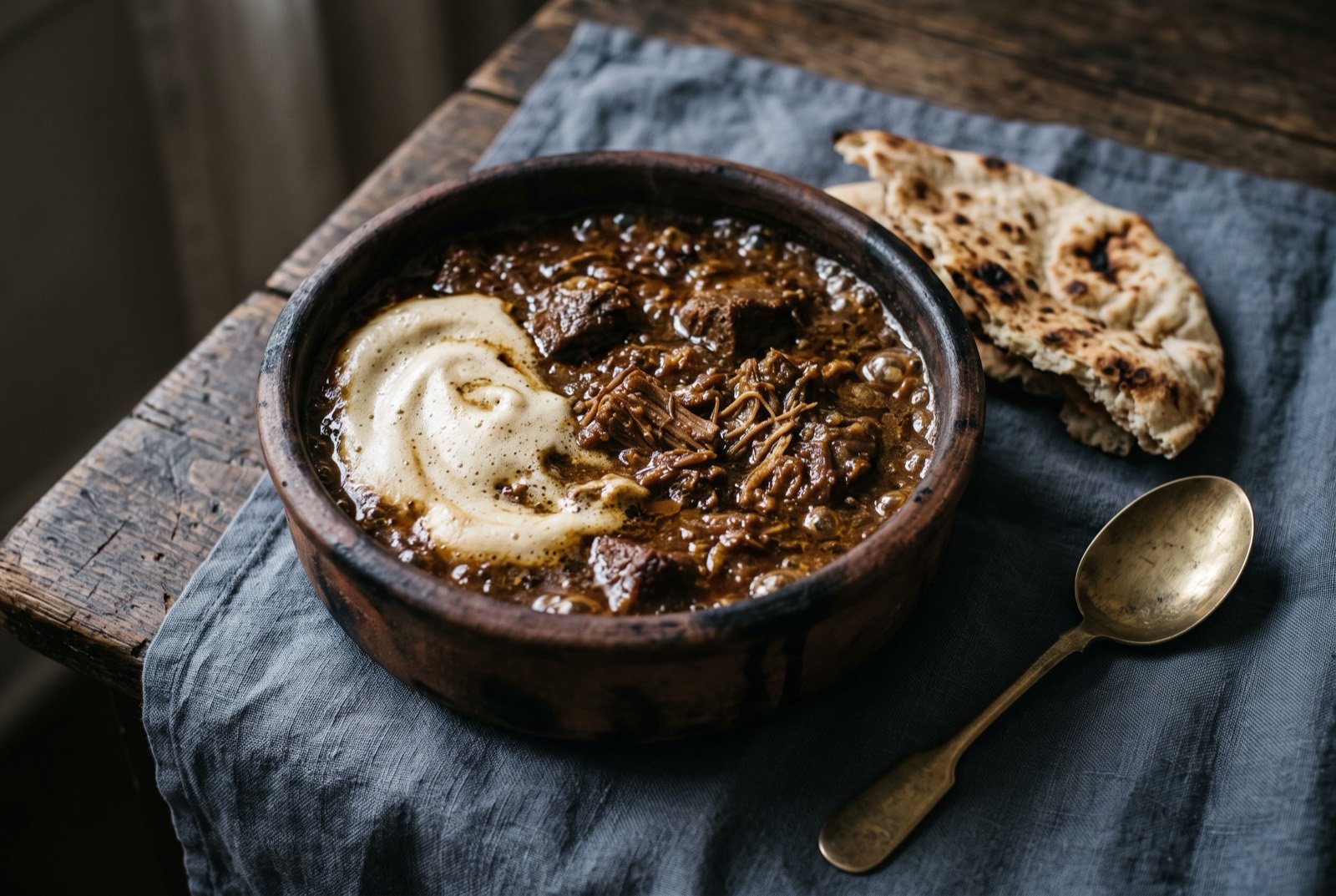
An illustration of the dish, not a photograph of it cooked.
- Time
- 1 hour
- Reviewed
- Not yet reviewed from inside the tradition
- Cooked
- Not yet cooked and reported
Chunks of veal, mutton or chicken, browned hard in ghee or oil, then cooked down with onion, tomato, garlic and a Yemeni spice mix, cumin, cardamom, coriander, black pepper, in stock until very tender. Served bubbling in a stone or clay vessel that holds its heat, eaten with bread; hilbah is stirred in after cooking, not during, unlike saltah's dolloped finish. Fahsa is popularly, and wrongly, described in some English-language writing as an Aden speciality; the strongest sourcing this chapter found places its heartland firmly in Sana'a and its surrounding governorate and in Ta'izz, and this chapter follows that sourcing rather than the more commonly repeated claim.
As tradition built it
Serves 4. About 1 hour.
Ingredients
- 600g veal or mutton, cubed
- 2 tbsp ghee
- 1 onion, chopped
- 2 tomatoes, chopped
- 4 cloves garlic, chopped
- 1 tsp cumin
- 0.5 tsp ground cardamom
- 0.5 tsp ground coriander
- 0.5 tsp black pepper
- 500ml stock
- 3 to 4 tbsp hilbeh (see Dish 1), whipped
Method
- Brown the meat hard, in batches, in the ghee, over high heat.
- Add the onion and garlic, softening a few minutes, then the tomato, cumin, ground cardamom, ground coriander and black pepper.
- Add the stock, bring to a simmer, cover and cook gently 45 minutes to 1 hour, until the meat is very tender and the sauce has reduced and thickened.
- Off the heat, stir the whipped hilbeh through, rather than serving it dolloped on top as in saltah.
- Serve bubbling hot, with bread.
Notes
No precise quantities for fahsa were found in this chapter's research; the recipe above is an indicative reconstruction from a consistent technique description and should be adjusted to taste.
What a modern chef changes
Slower heat, the same finish
Rung 1, adapted
Method
- Braise at a stable 140°C in a covered pot in the oven, rather than on the hob, for a more even, hands-off tenderising over the same hour.
- Reduce the braising liquid separately once the meat is tender, then reunite the two, for a sauce with real body rather than one thinned by the meat's own released liquid.
- Whip the hilbeh to the fuller Rung 1 standard before stirring it in off the heat, since fahsa's hilbeh gets folded through rather than judged as a standalone dollop, and a properly aerated froth still lightens the finished dish even once mixed in.