The Gulf and Arabia · Volume 09, The Terrace, the Wadi and a Kitchen Carried Out
Bint al-sahn
The highlands, Old Sana'a
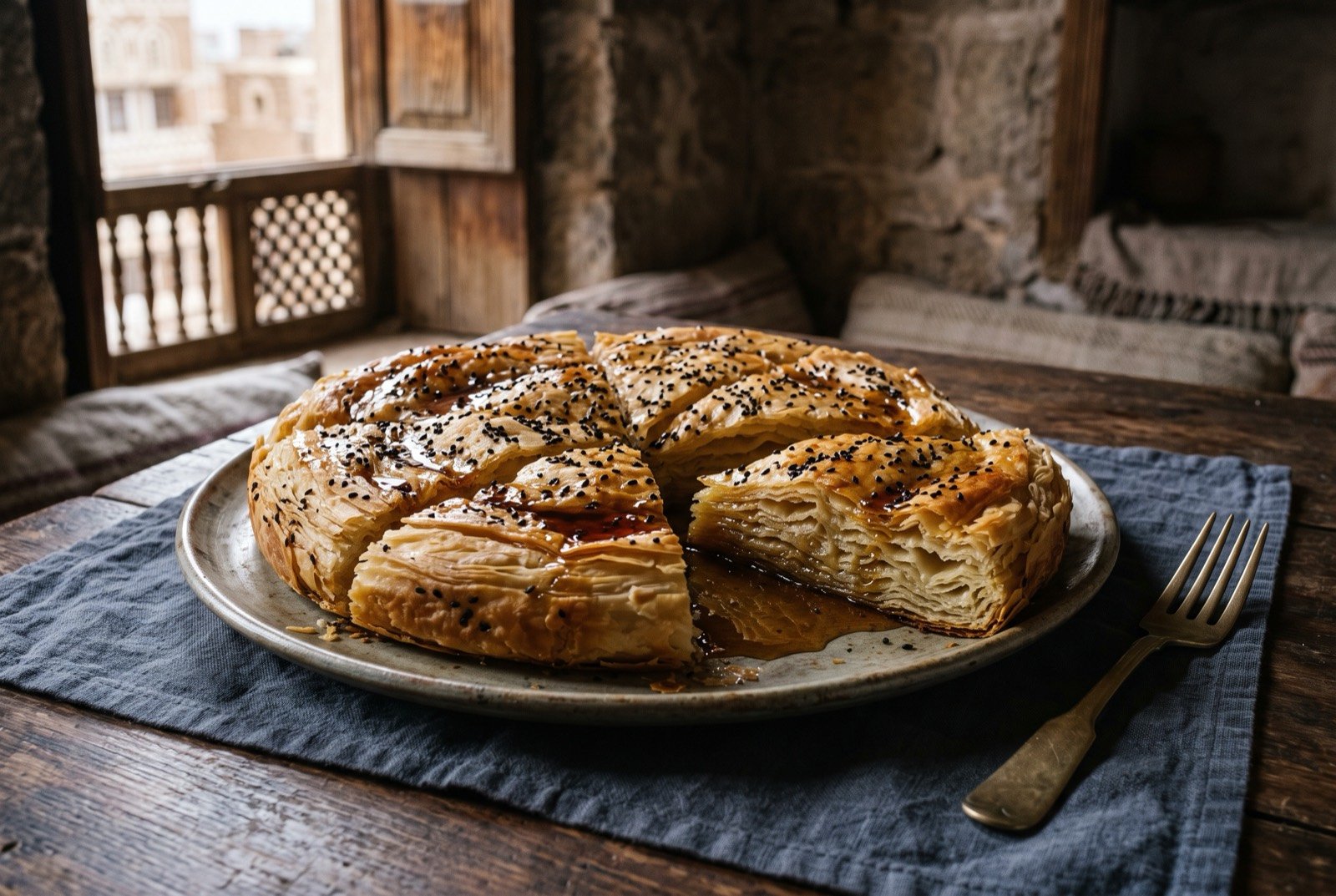
An illustration of the dish, not a photograph of it cooked.
- Time
- 2 hours
- Reviewed
- Not yet reviewed from inside the tradition
- Cooked
- Not yet cooked and reported
A large, round, crisp-golden layered pastry, its thin sheets brushed with liquid ghee between layers for a shiny gold colour, finished with a scatter of black cumin, and often a final drizzle of honey. Served at engagements, weddings and Eid. A syndicated Chinese state-media feature is the only source this chapter's research found naming the Old City of Sana'a specifically as its origin point, from a non-Yemeni broadcaster, and this chapter treats that as a widely repeated claim rather than a settled fact.
As tradition built it
Makes one 25cm pastry. About 2 hours, including proving and stretching.
Ingredients
- 400g strong white flour
- 1 egg
- 7g fast-action yeast
- 1 tsp sugar
- 0.5 tsp salt
- 220ml warm water
- 150g ghee, melted, plus more for finishing
- a scatter black cumin (nigella) seed, to finish
- a drizzle honey, warmed, to serve
Method
- Combine the flour, egg, yeast, sugar, salt and water into a soft, elastic dough. Knead well and rest, covered, 1 hour, until doubled.
- Divide into 6 to 8 portions. Working with one at a time, roll to roughly 25cm, then stretch further by passing it from hand to hand until it is close to translucent.
- Lay the first sheet on a well-oiled tray, brush generously with melted ghee, lay the next sheet on top, and repeat, building height rather than width.
- Bake at 200°C for 20 to 25 minutes, until deep golden.
- While still hot, brush generously again with ghee, scatter with black cumin, and serve with warmed honey poured over at the table.
Notes
No single in-tradition source consulted for this chapter gave quantities for bint al-sahn with the precision the saltah and mandi recipes above have; the ratios here are built from a consistent description of the dough's yeasted, egg-and-ghee-enriched character across several sources and should be treated as indicative rather than a tested traditional standard.
What a modern chef changes
The lamination judged as a strudel, not a shortcut
Rung 3
Method
- Rest the dough fully before the first stretch, a genuine 20 minutes uncovered after kneading, so the gluten has relaxed enough to stretch without tearing, the exact discipline a strudel dough demands.
- Work over a lightly floured cloth, not a bare worktop, lifting the stretched sheet by the cloth underneath rather than by hand, to avoid the small tears that force a restaurant kitchen to give up on lamination under time pressure.
- Finish with a fat brush, never a spoon, for the ghee: an even, thin coat between every layer, not pooled patches, is what lets steam force the layers apart into distinct sheets rather than fusing them into one dense cake.