The Gulf and Arabia · Volume 06, The Khaleeji Pearling and Bedouin Coast
Ghuzi (Qoozi)
Kuwait and the UAE
Illustration
- Time
- 4 hours
- Researched
- 3 sources cited
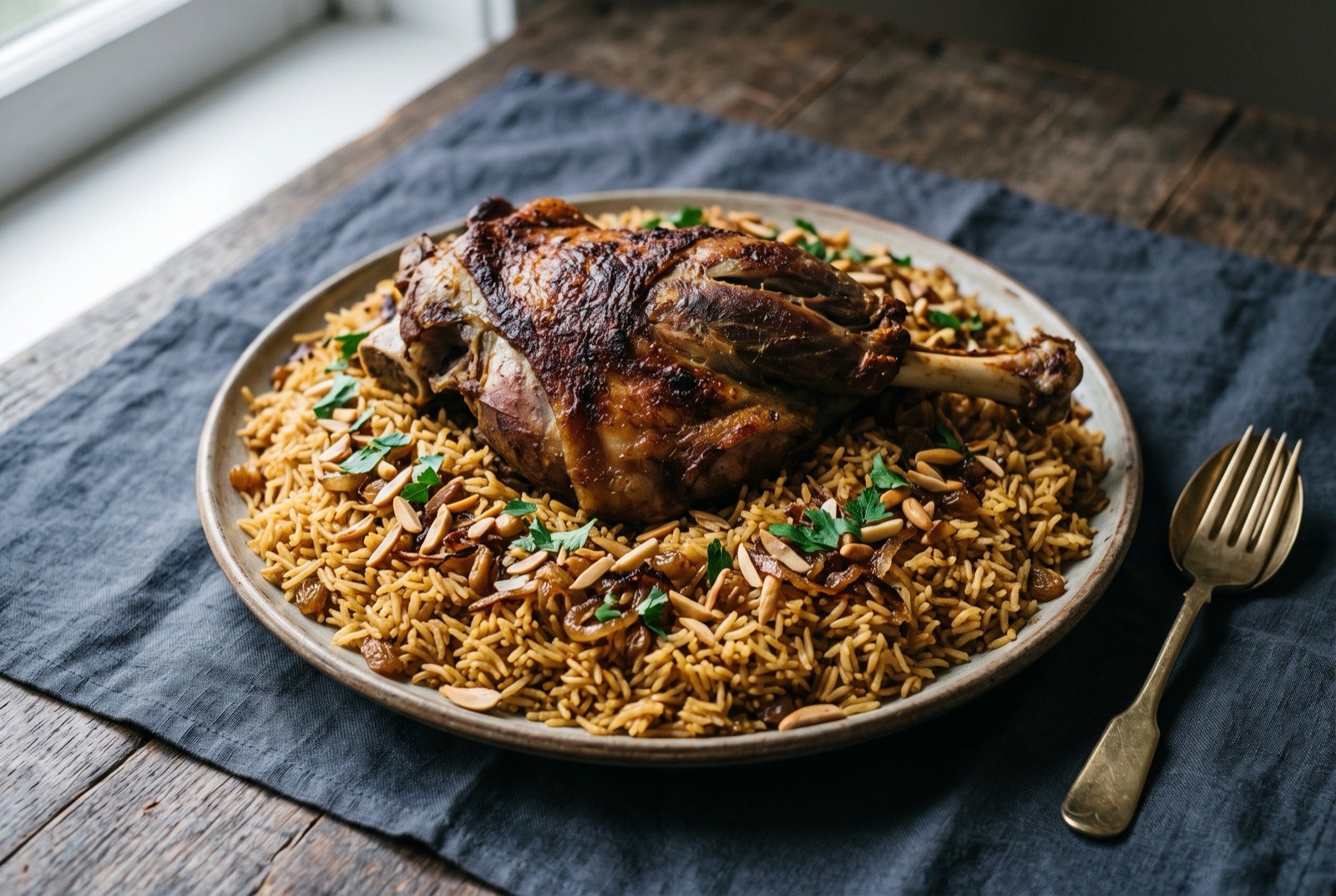
A whole roasted lamb over spiced rice, the region's great festive centrepiece, and, on the evidence this chapter's research reached, one dish under several regional names rather than several distinct inventions.
As tradition built it
Serves 8 to 10. Around 4 hours, home-scaled from a whole-animal method.
Ingredients
- 1 whole lamb shoulder, bone in
- to taste salt, baharat, and whole cardamom, cloves and cinnamon
- 500 g basmati rice
- 1 onion, ¼ cup raisins, ½ cup toasted almonds and pine nuts a stuffing of fried onion, raisins, toasted almonds and pine nuts
- a generous knob samn
Method
- Rub the lamb shoulder generously with salt and baharat, and press the whole spices into the fat.
- Seal the meat tightly, traditionally in a sand pit or a sealed clay oven, wrapped so no steam escapes.
- Cook low and slow for several hours, until the meat is fully tender and pulls easily from the bone.
- Cook the rice separately with samn and the same whole spices, then fold the fried onion, raisin and nut stuffing through it.
- Serve the whole shoulder over the spiced rice, traditionally at the centre of the table for a large gathering.
Notes
This chapter's sourced material covers the dish's history, etymology and cross-regional naming in real depth, but did not yield a named in-tradition recipe with exact stuffing proportions. The quantities below are this chapter's own reasonable, home-kitchen scaling of the documented method onto a lamb shoulder rather than a whole animal, flagged as an interpolation rather than a sourced ratio.
The etymology here is genuinely well sourced. Qoozi derives from Ottoman Turkish kuzu, lamb, documented in James Redhouse's 1890 Ottoman Turkish dictionary, and the dish itself spans the region under different regional names for what appears to be the same technique: in Iraq a whole lamb stuffed with rice, vegetables, spices and nuts, slow-cooked in a sealed oven or in water; in Saudi Arabia and Yemen, madfoon, wrapped in foil over direct heat; in Oman and the UAE, shawaa, wrapped in palm fronds and submerged in water; in Jordan and Syria, zarb. This chapter treats the Kuwaiti and Emirati ghuzi named in its own remit and Oman's shawaa as the same underlying technique under different regional names, rather than as a discrete Gulf-coast invention.
What a modern chef changes
A sand pit, replaced by a sealed grill
Rung 4
Method
- Wrap the lamb shoulder tightly in foil, sealing every edge, and cook on a Big Green Egg set up for a long, low, indirect burn, mimicking the sand pit's sealed, self-basting, oxygen-starved environment.
- Finish with the lid off and the coals raked to direct heat, crisping the exterior the way pulling a whole animal from hot embers always did.
- Reference Dubai's Gerbou restaurant directly as evidence this is a working, current technique: its own underground pit, billed by the restaurant and the press covering it as inspired by age-old Emirati method, is real proof this rung is a live restaurant practice, not only a folkloric memory.