Europe · Volume 27
Ukraine and Belarus
Steppe, Forest and the Reclaimed Kitchen
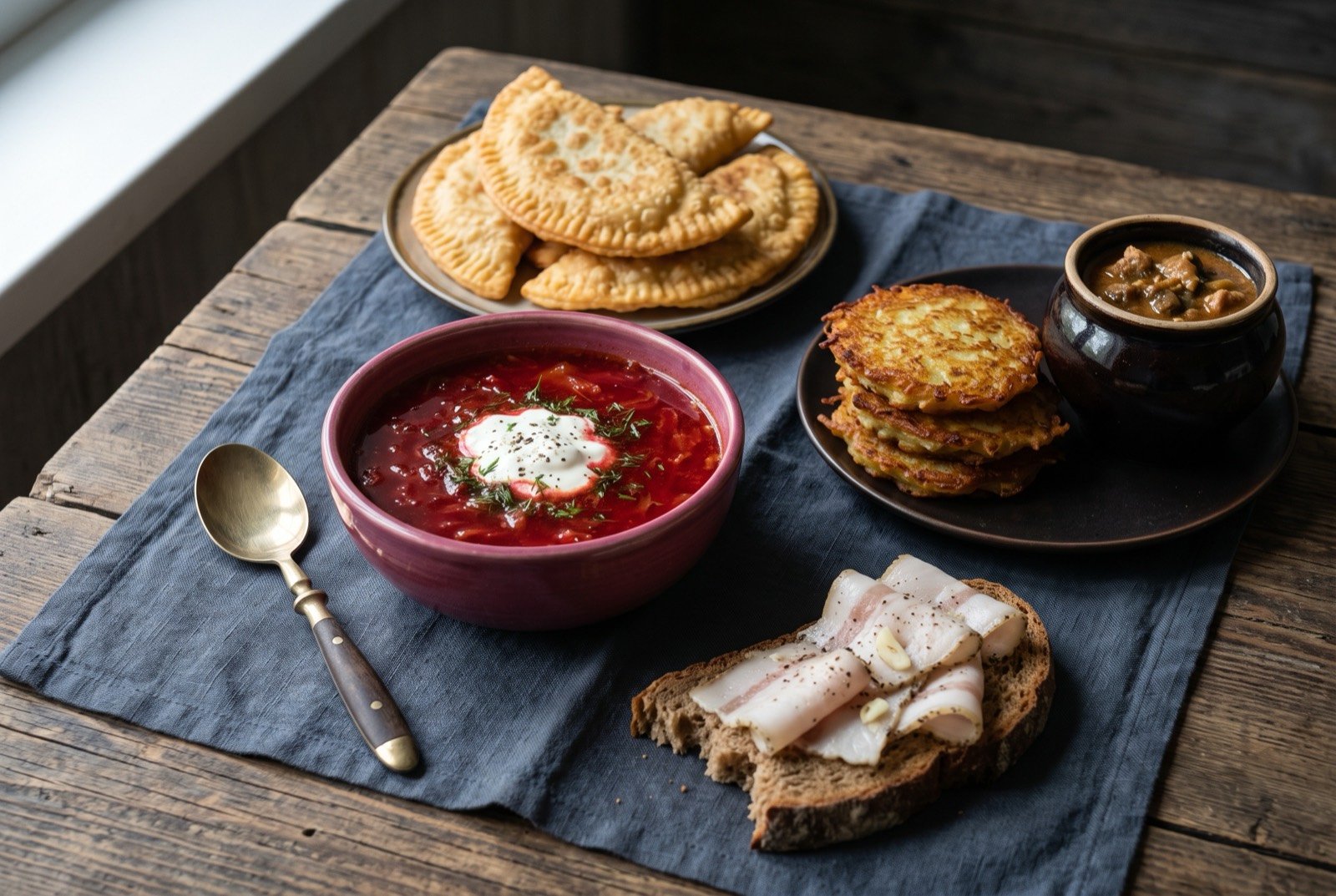
Two Slavic nations either side of one long, mostly flat border, and two different ecologies underneath the food: Ukraine's chernozem wheat and sunflower plain against Belarus's forest, rye and a genuinely working culture of mushroom and cranberry foraging. The Crimean Tatars, a Turkic, historically Muslim people deported wholesale in 1944 and now living under occupation, are treated as their own tradition rather than folded silently into "Ukrainian food." Both nations are doing the visible, ongoing work of reasserting a food culture as their own, one loudly and at war, the other quietly, and every dish as tradition built it, then what a modern chef would change.
Sources and review · What this chapter does not assert · How we research · Spotted something wrong?
A Sense of Place
Start with the soil, because Ukraine's whole reputation as a food-producing nation is built on a specific, measurable fact rather than a national myth: chernozem, black earth, deep, humus-rich and extraordinarily fertile, and Ukraine holds roughly 30 per cent of the world's known reserve of it. Ukrainian agricultural writing treats this as the real, load-bearing basis of the country's grain economy, not a slogan. But the phrase that usually rides alongside it, "the breadbasket of Europe," is worth correcting before it is repeated. A piece of Ukrainian data journalism argues directly against the cliché: before the full-scale invasion, Ukraine was the world's fourth-largest grain exporter by volume, and its exports fed Africa and Asia far more than they fed Europe. "Breadbasket," in the honest, global sense, holds. "Of Europe" specifically does not, and a Ukrainian trade-press piece makes the same point from the other direction, noting that before the war few people considered Ukraine breadbasket to Europe, Africa and Asia all at once, not Europe alone.
Sunflower, the crop that now defines Ukraine as visibly as wheat does, is a genuinely modern arrival rather than an ancient one. It reached Ukrainian territory only in the eighteenth century and became agriculturally significant once oil extraction industrialised in the following one: the standard Ukrainian account credits a serf named Danylo Bokariov with pioneering sunflower-oil pressing in 1829. Ukraine is today the world's largest exporter of sunflower oil, war notwithstanding, and unrefined sunflower oil, called simply oliya, is the country's default cooking fat, used cold on salads and drizzled raw over kasha and varenyky rather than for frying. That is a nineteenth- and twentieth-century layer sitting on top of a much older cuisine actually built on lard.
That lard is salo, cured pork back fat, and it is the ingredient this chapter treats as closest to a national keystone: a Cossack-era field food, still eaten today thinly sliced on black bread with garlic, and the one dish that makes the country's whole preservation culture, salting, drying, pickling, fermenting, legible in a single bite. It sits alongside the fact that shapes everything else about how Ukrainians relate to keeping food through hard times, discussed properly below: the Holodomor, the 1932 to 1933 famine, which sits close under the surface of domestic cooking even now, whether or not a given cook could name it as the reason.
Ukraine is not one food region and this chapter will not flatten it into one. Galicia, centred on Lviv, spent centuries inside the Austro-Hungarian Kingdom of Galicia and Lodomeria and then interwar Poland, and its food culture shows it directly: Ukrainian reference sources describe Galician cooking as a mixture of Polish and Ukrainian technique with strong Austrian, Hungarian and Jewish influence, and a Ukrainian regional-press feature on old Lviv cuisine calls it, more evocatively, "a strange mixture of Ukrainian, Polish, Jewish and Armenian traditions" that "meticulous Austrians seasoned with the dizzying aromas of the Mediterranean, and tidied and classified." Inside Galicia sits a further, genuinely separate sub-tradition: the Carpathian highlands, home to the Hutsul people, whose cornmeal-and-dairy mountain cookery, discussed below under banosh, belongs to an entirely different ecological logic, sheep pasture rather than grain field, than the lowland cuisine around it. Central and eastern Ukraine, Poltava, Chernihiv, the Dnipro basin, is the wheat-and-beetroot heartland proper, the historic seat of the Cossack Hetmanate and, later, the region hit hardest by the Holodomor. The south and the Black Sea coast, Odesa above all, carry a maritime, multi-ethnic port culture, Greek, Jewish, Bulgarian, Moldovan, Italian by trade, that this chapter has not researched to the same depth as the rest of the country and names here as a real gap rather than a settled account. Crimea, treated fully in its own right below, is a different world again, closer to Anatolia than to the steppe.
Belarus starts from the opposite premise. Forest covers roughly 36 to 40 per cent of the country, rising to nearly half in Gomel province in the south, and the underlying soils are podzolic, poor, acidic and often waterlogged, exactly the conditions that make wheat a poor bet and rye, buckwheat and eventually potato the sensible ones. Deciduous swamp forest alone covers 13 per cent of Belarus's forested land, and lowland bog covers over a fifth of its wetland area, concentrated in the Polesian marshes in the south, much of it drained across the twentieth century. Mushroom foraging here is not a hobby laid over the food economy, it is a working part of it: Belarusian writing calls it "the silent hunt" and states plainly that in Belarusian villages, mushrooms served as a genuine meat substitute for their protein content, not a foraged extra. Cranberries, marsh-picked from the Polesian bogs around Hantsavichy, Lyakhavichy, Drahichyn and Pinsk each September, are the other defining forest crop, gathered by ordinary households specifically to build the winter store. Internal regional variation within Belarus is real, Belarusian heritage bodies catalogue province-level differences in the grated-potato dish family alone, Mogilev, Vitebsk and Gomel each with their own documented dossier, but this chapter could not find sourcing strong enough to map a fuller regional table with confidence, and says so rather than inventing one.
| Region | Defining logic | Dishes and staples that carry it |
|---|---|---|
| Central and eastern Ukraine (Poltava, Chernihiv, the Dnipro basin) | Chernozem wheat and beetroot heartland, the Cossack Hetmanate's old ground, the Holodomor's epicentre | Borscht in its Kyivan and Poltava forms, varenyky, salo, kulesh |
| Galicia (Halychyna), west Ukraine | Centuries under Austro-Hungarian and then Polish rule, a genuinely Central European layer over a Ukrainian base | Lviv-style borscht with kovbasa, deruny, a wider soup culture shared with Poland |
| The Carpathian highlands, Hutsul country | Sheep pasture and cornmeal, not grain field; its own mountain economy inside Galicia | Banosh, brynza, shkvarky |
| Southern Ukraine and the Black Sea coast, Odesa | Maritime, multi-ethnic port trade; under-researched here and named as a gap | Not treated in depth in this chapter |
| Crimea | Turkic, historically Muslim, Ottoman-facing; a different culinary world under Russian occupation since 2014 | Chebureki, yantyk, sarburma, plov, kubete |
| Belarus generally | Forest, podzolic soil, rye, buckwheat and potato over wheat; foraging as working economy, not hobby | Draniki, machanka, kolduny, dried and salted mushrooms, cranberry preserves |
The History in Layers
What predates every empire that later ruled here
Underneath every later layer sits the same basic ecology on both sides of the border: grain, chiefly rye further north and wheat on the chernozem steppe, forest and steppe game, freshwater and Black Sea fish, and, in Belarus specifically, forest foraging old enough that it reads less as a supplement to farming than as a parallel economy running alongside it. Neither country's food starts with the empire that happens to appear first in a given history book, and this chapter treats that ecological base as the real foundation the rest is layered onto.
Kyivan Rus', the Cossacks, and how far back borscht actually goes
Kyivan Rus' left a diet already broader than the peasant stereotype suggests: domestic meats and fowl, pulses, and, in the ninth-century Kyivan chronicles, some of the earliest recorded regional mentions of cucumbers. Cooking became a distinct trade only in the eleventh century, though the Laurentian Chronicle of 1074 already describes a full staff of monk-cooks at the Kyiv Cave Monastery, suggesting professionalised food production earlier than that formal date implies. Popular Ukrainian food writing constantly reaches back to Kyivan Rus' for borscht's own origin, and this chapter will not repeat that claim as fact. The earliest hard textual evidence for borscht, recognisably, is a 1584 diary entry by the German merchant Martin Gruneweg, describing the dish in Kyiv. That is sixteenth century, not tenth, and the difference matters for how confidently a chapter like this one can speak.
What the historical record supports with more confidence is Cossack foodways specifically, though even there the sourcing leans on later ethnographic reconstruction rather than surviving Sich-era recipes. Zaporozhian Cossack cuisine ran on portability and a martial rhythm of life: freshwater and Black Sea fish, sturgeon, beluga, sterlet, catfish, carp, bream and herring, as the main protein, and millet and buckwheat cooked into porridge. Kulesh, a thick millet porridge enriched with lard and onion and sometimes meat or fish, cooked in a cauldron over an open fire, is described in Ukrainian sources as close to sacred among the Cossacks, a plain field dish carrying real symbolic weight.
The Holodomor, and why preservation carries more weight here than its ingredients alone explain
The Holodomor, the famine of 1932 to 1933, was engineered by Soviet policy, chiefly grain requisition quotas set and enforced against a starving rural Ukrainian population, and is recognised by Ukraine's parliament and numerous other states as genocide. This chapter states a range rather than a single number, because the range is where the real, current scholarly work actually sits. Current demographic reconstructions from archival data, reported by the Ukrainian service of Radio Free Europe/Radio Liberty as converging findings rather than a single settled figure, put excess deaths across 1932 to 1934 at roughly 3.9 to 4.5 million, around 3.6 million of that rural. Ella Libanova, director of Ukraine's own state Institute for Demography and Social Studies, has said publicly that the frequently repeated figure of seven million or more is a substantial overstatement the demographic evidence does not support. This chapter uses the lower, better-evidenced range, names the higher figures as coming from older or advocacy sources, and treats the scholarly convergence itself as recent and still being argued over, not settled decades ago. It matters here specifically because it explains something about the food rather than sitting apart from it: a cuisine this dependent on salting, drying, pickling and fermenting, salo, sauerkraut, dried fruit for uzvar, is not simply thrifty by habit, it carries the memory of a state that could, and once did, take the harvest away.
Chernobyl fell on Ukrainian soil and landed hardest on Belarus
The reactor stood in Ukraine. The fallout did not stay there. Belarus's own Ministry of Natural Resources states the country received approximately 35 per cent of total European Chernobyl fallout, roughly three times what Ukraine itself retained, and this is not a historical footnote for Belarus's food chapter, it is a live, present-tense fact: about 25,500 square kilometres, roughly 12 per cent of the country, remains classified as contaminated today, strict agricultural limits still apply in the affected resettlement and evacuation zones, food from that ground is still radiation-screened, and schoolchildren living on contaminated territory still receive free meals funded through Chernobyl remediation budgets. International radiological bodies confirm what this means specifically for the forest economy described above: caesium-137 continues to cycle through forest ecosystems for decades after it clears from arable soil, so wild mushrooms, berries and game carry a longer-lived contamination risk than a farmed potato does. Lingonberry, bilberry, cranberry and blueberry are named as strong accumulators of the isotope; strawberry and rowan moderate; cloudberry, viburnum and raspberry weak. This chapter names that risk directly rather than presenting Belarusian foraging as unproblematic pastoral good, because forty years on it genuinely is not, in the specific places it is not.
Draniki, and the dish this chapter will not let stand as ancient
If this volume has one debunk worth carrying with real force, on the Belarusian side it is this one. Draniki, Belarus's own national dish by wide popular consent, is not an old peasant invention. It entered Belarusian cooking only in the first half of the nineteenth century, and it arrived from German cuisine by way of Yiddish-speaking intermediaries, where the dish is known as latkes. The first written recipe, called blinki kartoflane, appears in Jan Szyttler's 1830 cookbook, published during the Polish-Lithuanian Commonwealth's long afterlife under the Russian Empire. Draniki only received formal status as an intangible historico-cultural value of the Republic of Belarus in 2022, a striking gap between how central the dish feels to Belarusian identity today and how recently that identity was formally attached to it. Babka, the savoury baked grated-potato dish discussed below, follows the same pattern: a late nineteenth-century dish, arriving only once potato itself became the dominant field crop, shared in near-identical form across Belarusian, Lithuanian and Ukrainian tables of the same period rather than invented separately by any one of them. None of this makes either dish less worth cooking well. It does mean this chapter will not call either one ancient.
Deruny and draniki, one idea either side of a border that is real but thinner than it looks
Ukraine's own regional naming map complicates the Ukraine-versus-Belarus story before it even reaches the border. Ukrainian sources state plainly that the grated-potato pancake itself arrived in Ukraine from Belarus, where it is called draniki, and that Ukrainian regional naming reflects exactly that route: areas closest to Belarus, in Zhytomyr and Rivne oblasts, and the south and east more broadly, still use "draniki" for the same dish; areas nearer the centre of the country call it "bataliany" or "bulbanyky"; the standard modern Ukrainian term is deruny. So within Ukraine, the difference is mostly dialect, a naming question tracking trade and settlement routes, not a technical one. Between Ukraine and Belarus proper, though, there is at least one real technical difference worth keeping: Belarusian draniki are frequently made with a raw meat layer sandwiched between two grated-potato pancakes before frying, a construction Ukrainian deruny do not typically use. This chapter treats deruny and draniki together below, for exactly that reason, one working idea, genuinely shared, with one genuinely distinct regional variant.
The Grand Duchy of Lithuania, and the crossover EU-25 already opened
Belarus was the demographic and territorial core of the medieval Grand Duchy of Lithuania, not a peripheral province of it, and this is the historical hinge that connects this chapter directly to EU-25's Baltic volume rather than leaving the connection implied. A Belarusian cultural outlet argues that the culinary foundations of modern Lithuanian, Belarusian and Ukrainian cuisine began taking shape at roughly the same time, in the Grand Duchy's own first century, naming borscht specifically as shared through that common root. Kolduny, the filled potato dumpling discussed below, carries this history directly in its own name: its Lithuanian cognate koldūnai has a genuinely unsettled etymology, with Old French, medieval Latin, Middle High German, Polish and Tatar roots all proposed by different scholars, and a documented association with the Lipka Tatar community that settled in Lithuania under Grand Duke Vytautas. This chapter reports that as unresolved etymology, which it is, rather than picking a winner.
Two claims of national reassertion, one wartime and urgent, one quiet and largely unheard
Ukraine's food identity has been actively, publicly reclaimed since 2014, and especially since 2022, and the two clearest markers of that reassertion are genuinely documented, not just widely believed. Chef Ievgen Klopotenko, after studying in France and realising by his own account how little he actually knew of Ukraine's own regional food, spent years travelling the country, his team filming borscht traditions across fourteen regions, and led the campaign that put Ukrainian borscht culture forward for UNESCO recognition. Verified directly against UNESCO's own register rather than taken on trust from secondary reporting: "Culture of Ukrainian borscht cooking" was inscribed on 1 July 2022, during the Intergovernmental Committee's fifth extraordinary session, on the List of Intangible Cultural Heritage in Need of Urgent Safeguarding, the emergency list, not the main Representative List, and the nomination jumped the normal cycle for the first time in the Convention's history under its "extreme urgency" provision, invoked because the war was actively disrupting the tradition itself: displaced people could not grow the local vegetables, cook, or gather to practise it together, which UNESCO's own committee decision names as undermining communities' social and cultural well-being. Get the causal order right, because most retellings do not: this was primarily a wartime emergency-safeguarding listing, and UNESCO's own text states plainly that inscription "does not imply exclusivity, nor ownership, of the heritage concerned," even though the timing, one year into a Russian invasion whose foreign ministry had in 2019 called borscht "a symbol of traditional Russian cuisine," was read by nearly everyone as a move in that dispute too. Ukraine had already placed borscht on its own National List of Intangible Cultural Heritage Elements in October 2020, well before the full-scale invasion, and that domestic groundwork is what made the UNESCO nomination possible when the moment came. The international relabelling this campaign helped drive is itself concretely documented: Sainsbury's announced in March 2022 it would rename "Chicken Kiev" to "Chicken Kyiv" across its own packaging, other UK retailers and restaurants followed, and the stated reasoning was that "Kiev" is the Russian-derived transliteration while "Kyiv" is Ukraine's own spelling. Note honestly that even the Associated Press style guide kept "chicken Kiev" for the dish name specifically while adopting "Kyiv" for the city, so the renaming was real but never total.
Belarus's own reassertion is quieter, and this chapter reports that honestly rather than dressing it up to match Ukraine's. Since the fraudulent August 2020 election and the crackdown that followed it, an estimated 300,000 to 600,000 people have left Belarus, the EU and US imposed sweeping sanctions, and independent media and civil society inside the country have been substantially dismantled, an environment that works directly against the kind of internationally networked, food-writer-visible chef culture that has driven Ukraine's profile since 2019. A small number of self-described "modern Belarusian cuisine" restaurants exist in Minsk, named below in Voices and Sources, but this chapter could not find sourcing strong enough to describe a genuine modernist restaurant movement comparable to Ukraine's, and says so rather than inventing one to balance the chapter symmetrically. What Belarusian identity reassertion the sources here could actually verify sits instead in its diaspora, discussed below, and in the quieter, better-documented fact of what Soviet standardisation removed from ordinary Belarusian tables in the first place: root vegetables, legumes, buckwheat-flour products, traditional spices, smoked products and regional cheeses, named directly as having disappeared from regular consumption once Soviet-era menus standardised across the whole union.
The reclaimed kitchen at war, and the diaspora it has produced
The full-scale invasion of 24 February 2022 hit Kyiv's restaurant scene within days, and what happened next is worth telling with the same plainness the sources themselves use, not as a human-interest aside but as a real, sourced account of what a cuisine does under bombardment. Restaurateur Dmytro Borysov, who owned more than fifty outlets across Ukraine including Kanapa, shuttered all of them and, on receiving requests for hot meals from the military, opened the first volunteer kitchen. A seafood restaurant, Chernomorka, stopped serving blinis with trout caviar and champagne and switched, without alcohol under wartime restriction, to free rice and chicken dishes for elderly residents; its manager put the shift in four words: "This is what we can do." Kiev Food Market, founded by restaurateur Alex Cooper, coordinated free distribution and reported roughly six thousand meals prepared for the military within the invasion's first weeks. Within about a year, a dozen central Kyiv restaurants were together producing around twenty thousand meals a day for soldiers, territorial defence, hospitals and the elderly, sharing groceries and volunteer delivery drivers between them. One volunteer cook, Pavlo Khrobust, described the switch plainly: "Instead of a machine gun I grabbed a ladle and a knife," because "good food keeps the spirit high." Musafir, a Crimean Tatar restaurant that had opened after Russia's 2014 annexation of Crimea, converted just as immediately to supplying the army and emergency-service workers, a detail worth keeping precisely because it shows the same wartime kitchen-to-frontline pivot extending to Ukraine's Crimean Tatar minority tradition too, not only to ethnically Ukrainian cooking. When the Russian campaign of strikes on the power grid began in earnest from late 2022, restaurants across the country installed voltage stabilisers to protect professional equipment, ran reduced menus, some down to as few as four dishes on generator power, and served candlelit dinners of cold starters, salads, oysters, when hot cooking simply was not possible; pastry kitchens suffered worst of all, since dough proving depends on the overnight warmth a rolling blackout removes.
Displacement on this scale has produced a genuine, if genuinely new, restaurant diaspora, and Alex Cooper's own path through it is the clearest single thread this chapter found: the same restaurateur who coordinated wartime meal production from Kiev Food Market in March 2022 opened Tatar Bunar in Shoreditch in early 2025, named for his own hometown of Tatarbunary in southern Ukraine, with Anna Andriienko. That is not two coincidentally similar stories, it is the same named person, documented independently three years apart, and this chapter treats it as exactly what it is: a wartime volunteer cook who later opened a London restaurant, not a metaphor. Mriya, opened in central London in August 2022 by chef Yurii Kovryzhenko and Olha Tsybytovska, staffed almost entirely by Ukrainian refugees with little or no prior restaurant experience, one former accountant retraining into pastry work, put the point in the owner's own words: "We want people to... want Ukrainian food... not just come because they want to help Ukraine." Sino, opened in Notting Hill in 2025, carries the sharpest single biography in this chapter: chef Eugene Korolev had opened his own restaurant in Dnipro just before the full-scale invasion, then served eighteen months in Ukrainian special forces including frontline combat near Kharkiv, before opening Sino with restaurateur Polina Sychova. Told the way the source itself tells it, as technique origin rather than trauma display, Korolev sketched dish ideas during deployments, and once built a dish from wild chervil he ate while sheltering from drones in a field. This chapter treats that as what it is: a chef's working notebook, kept under conditions no cookery school would ever set, not a story about suffering.
The scale behind all of this is worth stating precisely rather than gesturing at. Since March 2022, 131,000 Ukrainians have arrived in the UK specifically through the Homes for Ukraine scheme, and, combined with the now-closed Ukraine Family Scheme, around 234,000 people in total, the great majority in 2022 itself. Across Europe as a whole, UNHCR recorded a peak of roughly 6.17 to 6.35 million registered Ukrainian refugees in 2024 to early 2025, easing to around 5.2 to 5.75 million by September 2025, a figure that has genuinely moved rather than one fixed number worth repeating as settled. Belarus's own, smaller exile wave, following the 2020 crackdown, sent the largest single share, more than 140,000 people, to Poland, where a Belarusian bakery in Warsaw now fills with the scent of ciasta, syrniki and pelmeni, functioning as a genuine gathering point rather than only a shop.
The Flavour Arsenal
- Chernozem wheat. The physical basis of Ukraine's grain reputation, roughly 30 per cent of the world's known black-earth reserve inside the country's borders; treat "breadbasket" honestly as a global claim, not specifically a European one.
- Sunflower oil (oliya). Ukraine's default cooking fat since industrial pressing began in 1829, unrefined and cold-pressed for finishing and cold dishes, refined for heat; a nineteenth-century arrival, not an ancient one, sitting on top of an older lard-based cuisine.
- Salo. Cured pork back fat, dry-salted with garlic, black pepper and bay leaf and rested several days in a non-metal container since metal reacts with the salt; very hard to over-salt, since the fat only takes up what it needs.
- Beetroot. The structural vegetable of borscht in every regional form; whether it is boiled whole in its skin then julienned, or stewed raw and grated, is one of the real technical variables that actually distinguishes one region's borscht from another's.
- Buckwheat. A Cossack-era staple alongside millet, the base grain of kulesh and of Belarusian kasha and blini alike, shared across both countries' forest and steppe economies.
- Rye. Belarus's true bread grain, the caloric anchor of a diet built on poor, podzolic soil; nineteenth-century ethnographic figures put an adult man's daily rye-bread intake at around 1.2 kilograms, a scale worth keeping in mind against how modestly this chapter can otherwise speak of Belarusian dairy.
- Potato. A late arrival on both sides of the border, present on Belarusian magnates' tables as a curiosity from the 1680s but not the true dietary foundation until the end of the nineteenth century; hold it loosely as "ancient," on both sides of the border, for exactly the reason the draniki debunk above sets out.
- Smetana. Cultured soured cream, at real dairy-fat strength, 20 to 30 per cent, not the 12 to 15 per cent product a British supermarket sells under the same translated name; the base of borsch garnish, syrniki and the finish on draniki and kolduny alike.
- Wild mushrooms. A working, not decorative, part of the Belarusian forest economy, dried, salted and pickled for winter; in the caesium-137-affected regions this chapter names the accumulation risk directly rather than treating foraging as unproblematic, since mushrooms and berries carry Chernobyl fallout longer than farmed produce does.
- Cranberries. Marsh-foraged from the Polesian bogs each September, Belarus's clearest forest-to-larder export crop.
- Honey. Structural in kutia and uzvar and the traditional sweetener of medivnyk, where buckwheat honey specifically is the named choice.
- Crimean lamb, dried fruit and rice. The Black Sea and Anatolia-facing pantry behind chebureki, plov and kubete, genuinely apart from the mainland's steppe and forest economies, and, under occupation since 2014, genuinely hard to source information about at all.
The Technique Ladder
Rung 1. Judge smetana and kefir by fat and culture, not by the word on the label
A UK "soured cream" at 12 to 15 per cent fat and a genuine smetana at 20 to 30 per cent are not interchangeable, and this chapter's cold dishes and garnishes depend on knowing the difference: smetana should hold a spoon upright, taste properly cultured rather than merely tangy, and carry real body. Reach for the highest-fat, most actively live-cultured product reachable, per the sourcing section below, and treat a thin standard soured cream as a last resort, not a direct substitute.
Rung 2. Dry-cure salo by touch and time, not by a fixed weight
Salo is genuinely difficult to over-salt, since the fat only absorbs what it needs rather than taking up salt indefinitely the way lean meat does; three to four days in a non-metal container, salt packed under and over the fat with garlic, black pepper and bay leaf, is the working method this chapter's sourcing supports, and a cook should trust the fat's own resistance to salt rather than a printed number.
Rung 3. Keep raw-grated potato dough bound with its own starch, not a shortcut
Every raw-grated-potato dish in this chapter, draniki above all, depends on the same mechanism: the liquid pressed from grated raw potato is left to stand until its starch settles, poured off, and folded back into the batter as the actual binder, not discarded as waste. Skip that step and the pancake falls apart in the pan rather than holding together.
Rung 4. Cold-smoke kovbasa and fish as a distinct, multi-day discipline
Kovbasa and preserved fish both depend on smoking run low and slow, not fast and hot: a controlled cold smoke, held well below the temperature that would actually cook the meat, over beech or oak, run across many hours or days rather than one session, is what UK butchers making genuine Ukrainian-style kovbasa actually use, and it is squarely what a Big Green Egg held at a true, low, controlled dome temperature is built to do at home.
Rung 5. Read a filled dumpling's dough by its job, not by one master recipe
Varenyky, kolduny and kubete are three different construction problems wearing a similar shape: varenyky's dough needs to seal and boil without splitting, kolduny's needs to hold a raw-potato-and-meat filling through a longer cook, kubete's needs to encase a whole pie's worth of lamb, potato and onion and bake through evenly. Treat each dough on its own terms, thickness, hydration, resting time, rather than reaching for one dumpling-dough formula and hoping it fits all three.
The Ferment and Preserve Bench
1. Salo, dry-cured and cold-smoked
The chapter's own keystone preserve, three to four days dry-salted with garlic, black pepper and bay leaf per rung two, and, where the reader wants to go further than tradition strictly requires, finished with a cold smoke on the Big Green Egg per rung four. Genuinely hard to over-salt, and worth trusting the fat's own resistance to salt over a printed timing.
2. Sauerkraut and pickled beetroot
The base of kapusniak and of the fermented-leaf holubtsi above, and, unsalted and undiluted, close to the working principle behind every winter souring larder on both sides of the border: salt, time, and a vegetable that would otherwise not keep.
3. Dried and salted wild mushrooms
Belarus's forest larder, boiled then salted under a weighted board and brine, or simply dried, the working method behind the season's whole mushroom harvest being carried into winter; this chapter repeats, deliberately, that mushrooms and berries from Chernobyl-affected ground carry a longer radiological risk than farmed produce, and a British cook working from home-dried or shop-bought dried porcini, rather than anything foraged on affected Belarusian ground, avoids that risk entirely.
4. Uzvar and kutia's soaked fruit and grain
Dried apple and pear as the essential base, apricot, quince, cherry, raisin, cranberry, fig, rosehip, viburnum and raspberry as regional or seasonal additions, each soaked separately by type for 15 to 20 minutes before simmering and sweetening with honey rather than sugar, the ritual drink and the ritual dish sharing one preserving logic between them.
Sourcing in Britain
Verified August 2026. Where a supplier could not be fully confirmed, that is said rather than smoothed over.
What decides great from grim. Fat content and live culture on the dairy, a thin, gum-stabilised UK "soured cream" is not smetana; whether the sunflower oil is genuinely cold-pressed and unrefined rather than deodorised neutral cooking oil; whether the rye flour is a proper dark grade rather than a light rye blend; whether the kovbasa is actually smoked and cured rather than a boiled "Continental sausage" wearing the name. None of it is exotic. It is mostly a matter of finding the Eastern European specialist shelf rather than the mainstream one, and of naming businesses that genuinely exist and currently trade rather than repeating a stale listicle, of which this chapter found at least one live example: Mriya Neo Bistro in Earl's Court, widely praised and GQ-recognised, closed permanently in June 2026 after just under three years trading, and still appears in several circulating "best Ukrainian restaurants in London" pieces that have not been updated.
Grain and fat
Shipton Mill's Organic Dark Rye Flour, Type 1350, is a proper dark, wholemeal-adjacent rye suited to Belarusian and Ukrainian black bread; its buckwheat product, though, is a gluten-free flour for pancakes, not roasted groats, and the reader wanting real grechka for kasha, blini batter or kutia should buy the darkest-roasted whole groats from an Eastern European specialist shelf rather than a British mill. Dykanka, a genuine Ukrainian brand of cold-pressed, unrefined sunflower oil, is independently stocked by two verified retailers, Babushka Deli and MAK, Eastern European Delicatessen, a family-run Ukrainian-specialist shop with stores in Edinburgh and Stirling; use it raw, on cold dishes and drizzled over kasha or varenyky, and keep ordinary refined supermarket sunflower oil for frying.
Cured meat
Swaledale Butchers and Stansted Park Farm Shop both sell a genuinely named Ukrainian kovbasa, coarser-cut and more heavily garlicked and allspice-forward than a Polish kielbasa; Swaledale's own beechwood cold-smoking is exactly the method rung four asks a Big Green Egg to reproduce at home. Ready-made salo is harder to find than to cure it yourself; where a verified UK source cannot be reached in time, home-curing per rung two, one to two weeks in a fridge or cool larder, is genuinely closer to the tradition than most commercial "Continental" fat products.
Dairy
Babushka Deli's "Native Village" Smetana, at 24 per cent fat, is a genuine match for real smetana and should be used wherever the dish calls for it, borsch garnish, syrniki, the finish on draniki and kolduny, over a standard UK soured cream at 12 to 15 per cent. Lowicz Full Fat Twarog Curd Cheese, stocked at Tesco, Ocado and Asda, is a genuine, no-compromise match for tvorog and needs no specialist trip at all.
Fresh produce
Beetroot, cabbage, dill and garlic are supermarket and greengrocer staples; buy fresh rather than pre-cooked vac-packed beetroot, dulled by its packing vinegar and wrong for borsch. Fresh whole horseradish root, needed for the salo elevation above, is a genuine specialist item, sold online by Fine Food Specialist, Real Foods and Nearly Naked Veg, and best processed in the reader's own spice grinder or high-power blender rather than grated by hand. Dried porcini sold under Polish branding is the same forest fungus this chapter's Belarusian dishes use; treat the Polish label as trade-route provenance, not evidence of the wrong ingredient, and reach for the reader's own dehydrator instead wherever fresh wild or cultivated mushrooms are in season.
Delis, bakeries and restaurants, verified currently trading
MAK (Edinburgh and Stirling, UK-wide online) and Babushka Deli (Mansfield, UK-wide online) for the grocery items above; Payava in Newham and Cream Dream in Covent Garden, both genuine Ukrainian-owned businesses opened after 2022, the first a bakery, the second a plant-based café and patisserie; Dnister in Forest Gate, run by Lana Zoubata since 2005, the genuine old guard rather than a post-2022 opening; Tatar Bunar in Shoreditch, opened 2025 by Alex Cooper and Anna Andriienko, drawing on southern Ukrainian and Crimean Tatar-adjacent cooking. No dedicated Belarusian grocery or deli currently trading in the UK could be found despite a deliberate search; Belarusian staples ride on the same Eastern European specialist shelf as the Ukrainian items above. No UK retailer stocking specifically Crimean Tatar ingredients, as distinct from generic Turkish or Central Asian stock, could be found either; a Turkish or Central Asian grocer, widely available in most UK cities, is the honest nearest substitute source for the dried fruit and rice varieties chebureki, plov and kubete depend on, and any UK halal or standard butcher supplies the lamb.
Kit already in this reader's kitchen that suits this cuisine specifically
Cold smoking, on the Big Green Egg or a dedicated attachment, for kovbasa, salo and preserved fish alike. The dehydrator for home-foraged or fresh cultivated wild mushrooms, genuinely superior to most shop-bought dried product. The high-power blender and dedicated spice grinder for fresh horseradish and for grinding roasted buckwheat or poppy seed rather than buying either pre-ground. Sous vide for the slow, low, fat-rendering cooks salo, kovbasa and machanka's pork trimmings all depend on when building a home cure or confit.
Voices and Sources
This chapter rests on chef Ievgen Klopotenko's own site and public record, the single strongest in-tradition culinary source used throughout, for regional borscht variants, varenyky, holubtsi, kapusniak, kutia and pampushky; on Ukraine's national and public-broadcast press, Suspilne, Radio Svoboda, LB.ua, Espreso.tv and ZN.ua, for the Holodomor's demographic reconstruction, the UNESCO campaign and Crimean Tatar history; on UNESCO's own Intangible Cultural Heritage register, fetched directly rather than taken from secondary reporting, for the precise date and stated rationale of the borscht listing; on Ukraine's Institute of National Remembrance and the Verkhovna Rada's own recognition of the Sürgün as genocide; on the Kyiv Independent, a Ukrainian, English-language outlet staffed by Ukrainian journalists, for the wartime restaurant economy and the UK diaspora restaurant scene; on Belarusian and Belarusian-Taraškievica reference sources and Belarus's own Ministry of Natural Resources for the Chernobyl fallout data; on independent Belarusian-language press operating from exile or with editorial independence, Radio Svaboda, euroradio.fm, naviny.belsat.eu, for draniki's real history, the 1930s collectivisation crisis and the post-2020 exile wave; on two Turkish-language sources, a documented Ottoman-heritage culinary project and a peer-reviewed study of Crimean Tatar pastry, for the Crimean Tatar section specifically, given how hard direct Crimean sourcing is under occupation; and on UK trade press, Restaurant Online chief among it, for the named London restaurants and their current trading status, checked rather than assumed.
Things this chapter has deliberately not asserted
- That borscht is a dish of Kyivan Rus'. The earliest solid textual evidence found is a 1584 diary entry describing the soup in Kyiv, sixteenth century, not ninth or tenth, and the deeper claim is repeated constantly in popular Ukrainian food writing without documentary support this chapter could verify.
- A single figure for the Holodomor's death toll. Current demographic reconstruction converges on roughly 3.9 to 4.5 million excess deaths; the widely repeated figure of seven million or more is explicitly disputed by the director of Ukraine's own state demography institute, and this chapter uses the lower, better-evidenced range rather than the higher, more commonly cited one.
- That draniki, kolduny or babka are ancient Belarusian dishes. Draniki is a nineteenth-century German dish carried in via Yiddish-speaking intermediaries, first written down in 1830, and only formally recognised as Belarusian intangible heritage in 2022; babka follows the same late-arrival pattern once potato became the dominant field crop.
- That the UNESCO borscht listing settled a Russia-versus-Ukraine ownership dispute. UNESCO's own text states inscription confers no exclusivity or ownership; the listing's own stated purpose was wartime emergency safeguarding of a living tradition the war was actively disrupting, even though its timing was widely, understandably read as a move in the dispute too.
- Kolduny's etymology as settled. Its Lithuanian cognate has genuinely disputed roots across at least four candidate source languages, and this chapter reports that as an open question, not a solved one.
- A confirmed causal link between Belarus's post-1994 russification policy and any specific suppression of Belarusian food heritage. Russification itself is well documented; a direct link to food-heritage documentation or promotion specifically was searched for and not found.
- A precise scholarly account of the 1930s Belarusian famine or its relationship to Ukraine's Holodomor. What sourcing exists here rests on a single, uncorroborated popular-history source, and this chapter names that as a real, structural gap in how thinly this period of Belarusian history is documented, not a settled parallel event.
- That a serious, internationally documented modernist Belarusian restaurant movement currently exists. It does not, on the sourcing this chapter could reach; a small number of self-described modern-Belarusian-cuisine restaurants trade in Minsk with very thin documentation behind them, and this chapter states that gap plainly rather than inventing a movement to match Ukraine's.
- That "Bulbash," Belarus's popular potato-nation nickname, is an innocent piece of national self-description. It is documented as a nickname applied mainly by Russians and Ukrainians, with at least one Belarusian historian arguing its origin is unrelated to potato at all.
- A confirmed technical account of Yurii Kovryzhenko's "molecular borscht." It is a real, photographed and Michelin-credited dish; no source this chapter reached describes the actual method behind it in enough detail to state with confidence.
- Any UK retailer stocking ingredients specific to Crimean Tatar cooking, as distinct from generic Turkish or Central Asian stock. None was found, and this chapter says so rather than implying a specialist supply chain that does not currently exist in Britain.
Judge smetana and kefir by fat and culture, not by the word on the label
A UK "soured cream" at 12 to 15 per cent fat and a genuine smetana at 20 to 30 per cent are not interchangeable, and this chapter's cold dishes and garnishes...
Dry-cure salo by touch and time, not by a fixed weight
Salo is genuinely difficult to over-salt, since the fat only absorbs what it needs rather than taking up salt indefinitely the way lean meat does; three to...
Keep raw-grated potato dough bound with its own starch, not a shortcut
Every raw-grated-potato dish in this chapter, draniki above all, depends on the same mechanism: the liquid pressed from grated raw potato is left to stand...
Cold-smoke kovbasa and fish as a distinct, multi-day discipline
Kovbasa and preserved fish both depend on smoking run low and slow, not fast and hot: a controlled cold smoke, held well below the temperature that would...
Read a filled dumpling's dough by its job, not by one master recipe
Varenyky, kolduny and kubete are three different construction problems wearing a similar shape: varenyky's dough needs to seal and boil without splitting...
The dishes
- Borscht Ukraine
- Varenyky Ukraine
- Salo Ukraine
- Holubtsi Ukraine
- Banosh Ukraine
- Deruny and Draniki, with Machanka Ukraine and Belarus
- Kolduny Belarus
- Kutia Ukraine and Belarus
- Chebureki Crimean Tatar
- Kubete Crimean Tatar
Sources and review
- Reviewed
- Not yet reviewed from inside the tradition
- Cooked
- Not yet cooked and reported
Where this volume comes from
3 research briefs on file for this volume, researched to the rules on How we research. Published 28 August 2026. Last changed 8 September 2026.
The brief's own account of its sources
Ukraine and Crimean Tatar pass. Of roughly 25 searches, the large majority were genuine Ukrainian-language queries returning Ukrainian-domain results: national media and the public broadcaster (Suspilne, Radio Svoboda, LB.ua, Espreso.tv, ZN.