Europe · Volume 28
The Western Balkans
Grill, Pepper and the Ottoman-Habsburg Line
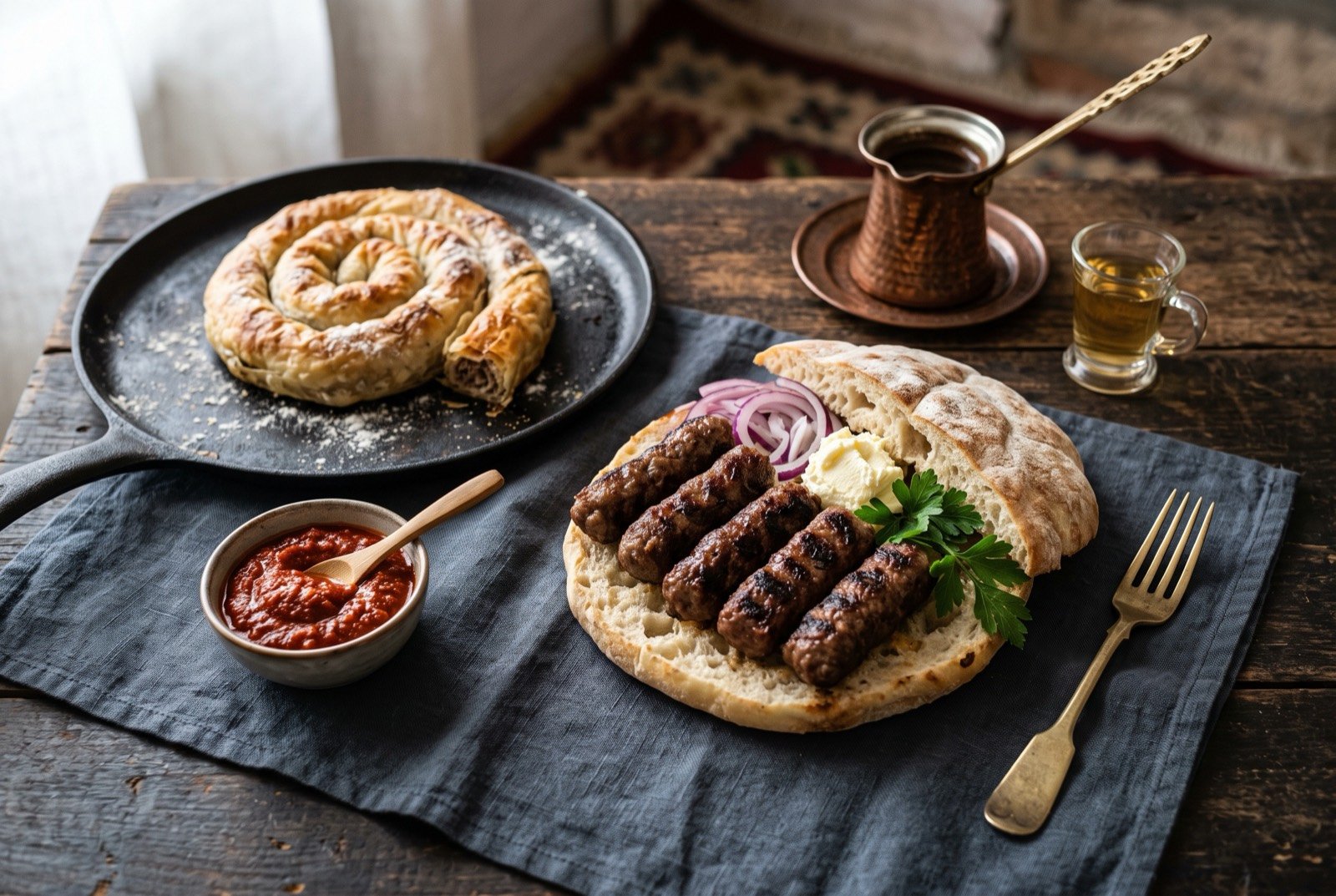
Serbia, Bosnia and Herzegovina, continental Croatia, North Macedonia and Kosovo, five territories that spent five centuries under one empire and the last hundred and fifty years under three or four different ones, cooked by three religions who mostly agree on how to grill meat and mostly disagree on who invented the relish to put beside it. This is not one national cuisine wearing five flags. It is a single, coherent food world built by the same forces that build every culinary region in this atlas: a hot, dry, pepper-growing summer and a hard winter that demands a smokehouse; five hundred years of Ottoman rule laying grill, filo, coffee and syrup pastry over a Slavic base; a shorter, later Habsburg layer running through Vojvodina and Slavonia that swapped the Ottoman pepper for a milled, Hungarian-mediated one; and a twentieth century, Yugoslav, then violently not Yugoslav, that both spread these dishes further than any empire had and then made arguing over who owns them a matter of real, recent grief rather than idle pub debate. Every dish as tradition built it, then what a modern chef would change.
Sources and review · What this chapter does not assert · How we research · Spotted something wrong?
A Sense of Place
The grammar the whole volume shares
Before the borders, before the Ottoman and Habsburg layers even, this is one climate doing one thing to five kitchens. Hot, dry summers ripen peppers and plums with real intensity; a continental winter, sharp enough to demand serious preservation, built the smokehouse, the dried sausage and the whole-head fermented cabbage that Britain would call sauerkraut and gets it structurally wrong by shredding it. The fat is pork lard everywhere the calendar allows it, and only there: Bosniak Muslim households keep halal butchery, and the everyday grilled-meat-and-bread repertoire, ćevapi, somun, kajmak, sits outside religious identity even where the fat used to render a stew does not. The aromatic is paprika, sweet or hot, milled from the region's own peppers, arriving surprisingly late for how foundational it now feels: Serbian sources are direct that it entered wide use only in the nineteenth century, a detail this chapter takes seriously rather than assuming paprika has always sat in this cupboard. The starch runs cornmeal in the historically poorer south and interior against wheat in the flat, arable Pannonian north. The thickener, where a dish wants one, is a paprika-and-flour roux, fried in fat and worked back into the pot.
Serbia: three geographies under one paprika sky
Serbia itself divides into Šumadija, the wooded, hilly heartland; Vojvodina, the flat Pannonian plain to the north; and a more mountainous south and southwest running toward Kosovo and the Sandžak. Peer-reviewed Serbian ethnography on rural Šumadija, from the Bulletin of the Institute of Ethnography at the Serbian Academy of Sciences and Arts, is worth taking as seriously as it deserves: it records women's autonomous control of the mlekar, a dedicated wooden dairy structure, through which household and children's access to milk and cream was independently regulated, a detail that says something real about who actually ran a rural Serbian kitchen's economy, not just who cooked in it.
Vojvodina is a different story, told below in its own right. Novi Pazar and Leskovac, in the south, are the two cities most associated with Serbia's grill tradition, Leskovac already grill-famous by the early nineteenth century, and Novi Pazar's Old Čaršija bazaar quarter is one of the very few places left in Europe still brewing coffee the pre-electric way, a džezva set into a tray of continuously hot sand rather than onto direct heat.
Bosnia and Herzegovina: the sofra and the three communities
Sarajevo's food culture is built, in its own language, around sofra, the shared low table, and ćeif, a word that resists a tidy English gloss and covers unhurried pleasure, sociability and the specific enjoyment of slow eating and drinking together. One Bosnian source calls it "the art of slow, meraklijsko [connoisseur's] enjoyment of food with conversation and drink," and that phrase does more honest work describing Sarajevo's café and aščinica culture, houses serving slow-cooked stews prepared each morning and eaten through the day, than any list of dish names could.
Bosnia's three communities, Bosniak Muslim, Serb Orthodox and Croat Catholic, diverge in food practice at specific, identifiable points, not across the whole cuisine. Halal butchery governs meat for Bosniak households. Krsna slava, the Serbian Orthodox family patron-saint feast, is built around a ritual bread and boiled wheat with walnuts and honey, and Orthodox Great Lent runs a genuinely longer, stricter forty-eight days against Catholic Lent's forty. Ramadan and the iftar table shape a Bosniak Muslim month each year, and begova čorba, a rich okra soup treated in full below, is specifically tied to Sarajevo's Ramadan table. Outside those calendar-specific practices, the everyday grilled-meat-and-bread repertoire belongs to all three communities equally. The genuine contest in this cuisine is regional, Sarajevo against Banja Luka against Serbia, not communal.
North Macedonia: named towns, one claimed relish
Macedonian regional identity runs through named towns as much as through any larger geography: Skopje's simit pogača, Ohrid's gjomleze, and Štip's pastrmajlija, an oval flatbread topped with cured meat and egg that one Macedonian source calls the town's actual civic brand across the whole Balkans. Macedonia's claim to ajvar, treated at length below, is now a formal one: of fifty-three registered Macedonian geographical indications, "Makedonski ajvar" is the only one carrying the word "Macedonian" itself, and one of only four Macedonian products to reach international-level registration. Strumica, in the country's southeast, is the named heartland for the red peppers that make it.
Kosovo, named honestly and lightly
Kosovo sits inside this volume for a real reason: its everyday grilled-meat-and-pepper table, and its Ottoman-inherited coffee and pastry culture, belong to the same continental Balkan world as Serbia, Bosnia and North Macedonia, sharing dishes and disputing others across the same lines. But Kosovo's Albanian-majority population also means a genuine second inheritance, the wider Albanian-speaking food world of flija, byrek and Adriatic-facing technique that properly belongs, in full, to a future volume of this atlas covering Albania and the Adriatic coast, not yet written. This chapter names that connection honestly rather than either ignoring Kosovo or treating it as fully covered here. Kosovo's own sourcing, in both research passes behind this chapter, came back thinner than any other territory in this volume, and that thinness is stated rather than smoothed over throughout.
Continental Croatia and Slavonia, named alongside Vojvodina
Slavonia, eastern continental Croatia, sits ecologically and historically alongside Vojvodina rather than alongside coastal, Mediterranean Dalmatia and Istria, which belong instead to a future Adriatic volume. Slavonia shares Vojvodina's flat, paprika-fed Pannonian ecology and its own former place inside Austria-Hungary, and its kulen, the region's own paprika-cured, air-dried pork sausage, is treated below alongside Vojvodina's. This chapter's research reached Slavonia mainly through that shared Pannonian and kulen thread rather than through dedicated Croatian-language research of its own, and that is a real limit of this chapter's sourcing, named here rather than papered over.
The structural logic, at a glance
| Serbia (Šumadija) | Vojvodina and Slavonia | Bosnia | North Macedonia and Kosovo | |
|---|---|---|---|---|
| Fat | Pork lard | Pork lard | Pork lard, halal-observant where needed | Pork lard, halal-observant where needed |
| Starch | Cornmeal, wheat | Wheat | Wheat | Cornmeal (kačamak), wheat |
| Thickener | Paprika-flour roux | Paprika-flour roux | Paprika-flour roux | Paprika-flour roux |
| Aromatic | Paprika, garlic | Paprika (Hungarian-mediated) | Paprika, garlic | Paprika, garlic |
| The Ottoman inheritance | Grill, coffee, filo | Lighter; Habsburg dominates | Grill, coffee, filo, at its strongest | Grill, coffee, filo, at its strongest |
| The Habsburg inheritance | Light | At its strongest | Light | Absent |
The History in Layers
Five centuries, named plainly
Serbian sources are consistent and unembarrassed about this: "spices, meat cooking techniques like grilling, and dishes such as ćevapi, sarma, and baklava entered Serbian cuisine" during Ottoman rule, and the same is true, more strongly still, of Bosnia, North Macedonia and Kosovo, which sat closer to the empire's administrative and cultural centre for longer. Coffee reached the Ottoman Empire from Yemen in the sixteenth century, under Suleiman the Magnificent, and the first public coffeehouse opened in Istanbul in 1555; from there the whole Balkan coffeehouse culture, the kafana, the kahvehane, follows directly. Grilling's deeper route, per Serbian sources who state the point with real honesty about how thin the evidence gets this far back, "is believed" to run from the Caucasus through Turkey, Greece and Macedonia into Serbia, shedding lamb for pork as it moved north. Baklava's own documented Ottoman court history is comparatively solid: the earliest record of its preparation in the Topkapi Palace kitchens dates to 1473, and by the eighteenth century only specially trained palace cooks were permitted to make it. This atlas's fullest treatment of that Ottoman filo, syrup-pastry and coffeehouse inheritance sits already in EU-03, Greece and Cyprus, and this chapter cross-links to it rather than re-deriving baklava's or Turkish coffee's deep history from nothing: what belongs here instead is what is genuinely distinct in this volume's own territory, Bosnian coffee's specific procedural difference from Turkish coffee, and jufka's own regional handling, both treated below.
Somun, Sarajevo's flatbread, carries two competing Ottoman-linked origin stories worth naming rather than adjudicating: one ties it to Timur's fourteenth or fifteenth-century Indian campaign; the more Sarajevo-specific version holds that Gazi Husrev-beg's intendant, after Gazi Husrev-beg arrived in Sarajevo in 1521 and ordered the building of the city's public kitchen, created the bread for it, taking the bread's name from his own surname, "Somun." Regional cousins carry different names again, pitice in Sandžak, ramazanske lepine elsewhere in Bosnia, a reminder that this whole volume's dish family is genuinely one thing wearing several regional names rather than several separate inventions.
Under Ottoman rule, the same pastry technology diverged differently in different hands, a detail worth carrying because it bears directly on the Kosovo question: Arab cooks added rosewater and cardamom to their baklava, Armenians clove and cinnamon, Persians a diamond cut with a jasmine-scented filling, and Albanians, distinctively, traditionally made theirs without any nut filling at all.
The Habsburg north, arriving later and differently
Where the Ottoman layer runs through the whole volume, the Habsburg layer belongs specifically, almost exclusively, to Vojvodina and Slavonia, and this chapter picks up a thread that this atlas's own account of Vienna, EU-19, deliberately left dangling. That chapter's treatment of Gulasch states plainly that paprika arrived in Hungary via Ottoman and Balkan trade in the sixteenth century, and that "the full weight of Hungary's paprika kitchen belongs to a future Balkans volume of this atlas, not yet written," declining to re-derive it there. This is that volume, and the thread runs like this. Paprika entered Vojvodina's own kitchen specifically in the late eighteenth century, brought by Hungarian traders, becoming genuinely dominant through the nineteenth, and the debt shows up directly in language: perklet, gulaš and paprikaš are all Hungarian loanwords still used as Serbian dish names in Vojvodina today. Vojvodina's food culture more broadly is a documented mixture built by centuries of coexistence among Hungarians, Slovaks, Romanians, Rusyns, Roma, Croats and Czechs, with Hungarian influence credited for the goulash and paprikaš family, Slovaks for dumpling dishes, Romanians for a sweeter grape-leaf sarma, and Rusyns for pie traditions. Sremski kulen, Vojvodina's cured, paprika-rubbed pork sausage, carries a name traced through Greek kolon, for its casing, first attested in writing in Vuk Stefanović Karadžić's 1852 Serbian dictionary published in Vienna, and it received formal geographic-origin protection in 1992.
The Yugoslav twentieth century, and what this chapter could not source about it
This chapter would like to be able to say precisely how ćevapi and burek, genuinely regional dishes at their root, became a shared national repertoire across the whole former Yugoslavia: army postings, worker migration and state tourism promotion are all plausible mechanisms. No source behind this chapter, in either Serbian, Bosnian or Macedonian, was found actually documenting that spread with any specificity, and this chapter says so rather than asserting a tidy mechanism it cannot back up.
The 1990s wars, named without flinching and without lecturing
Sarajevo's siege ran from 5 April 1992 to 29 February 1996, one thousand four hundred and twenty five days, one of the longest sieges of a capital city in modern warfare, cutting the city off from water, electricity, gas and food. One documented aid-ration figure gives a genuine sense of what actually reached the city during it: four hundred grams of beans, three hundred grams of peas, two hundred grams of rice, two decilitres of oil and a kilogram of flour, alongside whatever was smuggled through the tunnel dug under the city's airport. Civilians were killed queuing for bread and water on multiple occasions during the siege. This chapter did not find a source connecting the siege directly to any lasting change in Sarajevo's modern restaurant or home-cooking repertoire, a war-era substitution dish surviving into today's table, say, and it will not invent one. What the siege changed is the ground this chapter's later, contested claims stand on: when Belgrade businesses in the 1990s reportedly hesitated over whether "sarajevski ćevap" on a menu meant the version from Pale, held by Bosnian Serb forces during the war, or from the rest of the city, and some began marketing "banjalučki" ćevapi instead as an unambiguous alternative, that is not simply culinary rivalry. It is the war sitting inside a menu decision, and this chapter names it as such rather than treating every regional dish dispute in this volume as equally old or equally innocent.
Contested claims, named honestly, adjudicated by no one
This is the volume where the atlas's own rule, attribute rather than adjudicate, gets its heaviest workout, and it is worth stating the rule again here because three separate disputes below depend on it: where two or more communities each claim a dish, this chapter names who claims what and from where they speak, and does not decide a winner.
Ćevapi, first. Sarajevo, Banja Luka and Leskovac each make a genuinely different thing under a shared name, and the differences are specific rather than vague. Sarajevo's version contains no garlic in the finished patty by the clearest comparative source this chapter found, formed as separate small cylinders, canonically served as "deset u pola," ten pieces in a halved somun with raw onion; Banja Luka's, a distinct Bosnian city tradition rather than a Serbian import, does contain garlic and is formed in joined rows of four; Leskovac's, Serbian, also carries garlic plus the city's own ground pepper, and runs noticeably longer than either Bosnian version. Sarajevo's own sourcing states the mixture rests forty eight hours before grilling, a specific and checkable claim, though this chapter also found a real, unresolved tension in its own research between "no garlic" as the defining Sarajevo feature and a separately cited "garlic in the mixture" as a stated ingredient; the official Bosnian product specification that would settle this returned only a dead link during this chapter's research, so the discrepancy is named here rather than silently resolved one way. "Sarajevski ćevapi" now carries national-level protected geographical status in Bosnia, restricted to Sarajevo Canton, with an application toward EU-level registration submitted. Bosnian sources uniformly claim the longest documented history of ćevap-making among the successor states; this chapter's Serbian-language research did not surface an equivalent Serbian counter-claim of invention priority, which may say more about where this chapter's searches landed than about the dispute's actual balance, and is named as a limit rather than evidence either way.
Ajvar, second, and now a genuinely three-cornered live dispute rather than a settled historical one. North Macedonia's claim is formal, as above. Serbia's claim runs through a specific place rather than the whole nation: "Leskovački domaći ajvar" carries protected geographical status from Serbia's own Intellectual Property Office plus international WIPO certification valid across twenty eight countries. One Serbian source states the underlying legal position plainly: no country, not Serbia, not Macedonia, not Bulgaria, has protected the generic word "ajvar" itself, only the specific named regional variants. That has not stopped the argument running hot in public: in 2026, on the American talk show "Hot Ones," the Kosovo-British singer Dua Lipa called ajvar "an Albanian specialty everyone should try before they die" while a jar visibly labelled "Leskovac ajvar," a specifically Serbian-registered product, sat on screen behind her; the city of Leskovac announced legal action, and Macedonian press covered a related row over her calling pljeskavica a "Kosovo sandwich." Named separately from that fight, and genuinely a different preparation rather than a regional name variant of the same one: pindžur, which adds tomato and is chopped rather than ground to a smooth paste, giving a coarser, milder, more acidic relish, and ljutenica, which combines pepper and tomato without the aubergine some ajvar recipes include. One further, quieter honesty this chapter carries rather than smooths over: Macedonian sourcing states its own tradition of ajvar-making dates only to around the Second World War, complicating any instinct to treat the relish as ancient in either of its claimant countries.
Burek's actual naming logic, third, is the single most commonly garbled fact about this cuisine in Western writing, and Bosnian sourcing is unusually precise about correcting it. In Bosnia, "burek" is reserved exclusively for the meat-filled pastry; other fillings carry their own dedicated names, sirnica for cheese, zeljanica for spinach and cheese, krompiruša for potato and onion, with "pita" serving as the umbrella term for the whole family. One Bosnian source puts it memorably: "Bosnia cares about pastry classification the way Italy cares about pasta shapes." Outside Bosnia, the logic inverts: "burek" itself becomes the generic umbrella term that "pita" serves in Bosnia, so a menu elsewhere in the region says "burek with meat" or "burek with cheese," using burek as the category label rather than the meat-specific name. This chapter's research reached that precise distinction for Bosnia; it did not reach the same granularity for North Macedonian and Kosovan naming conventions, and says so rather than guessing at a parallel logic that was not independently confirmed.
The Flavour Arsenal
Paprika, the aromatic that arrived twice
Paprika reaches this volume by two separate historical routes that happen to end up in the same spice jar, and the chapter's honesty depends on keeping them apart. The Ottoman route runs old and slow, part of the general Ottoman-era pepper and spice trade into the Balkan interior. The Habsburg route runs later, faster and better documented: paprika reached Hungary via Ottoman and Balkan trade in the sixteenth century, but its arrival specifically in Vojvodina's kitchen, milled, Hungarian-mediated, dominant by the nineteenth century, is a distinct, later event from its earlier presence further south. Serbia's own spice-paprika belt sits in two places, northern Vojvodina around Horgoš, Martonoš and Novi Kneževac, and the south around Leskovac and Levač; the Horgoška slatka cultivar, officially recognised from 1972, is the standard sweet variety grown commercially at scale, roughly three and a half thousand hectares nationally.
Kajmak, a clotted dairy fat that rewards patience alone
Kajmak is milk, slow-boiled fifteen to thirty minutes with stirring, then cooled gradually over roughly two hours down toward eighty degrees Celsius, poured into shallow, non-corrosive vessels and left completely undisturbed for twelve to twenty four hours while the fat layer rises, then skimmed, salted and packed in layers. Young kajmak is eaten within days; mature kajmak needs a genuine minimum of two months' ageing, properly stored keeping up to a year, and its casein and proteases concentrate at the surface as it ages, the flavour shifting, in the words of a Serbian food-technology source, "from butter toward cheese character." The named heartland regions are the Western Morava valley, the Zlatibor and Tara mountains, and specifically the Sjenica and Pešter plateau, where a still-operating dairy has made it to the traditional recipe since 1991. Serbia's own Committee for Intangible Cultural Heritage has formally listed traditional kajmak production, protecting the hand method specifically.
Sour cabbage, the whole head, never shredded
Whole fermented cabbage heads, not shredded sauerkraut, are what sarma actually needs, the leaves peeled off whole and rolled around a filling rather than mixed through it. This is the single most easily botched substitution a British kitchen makes with this cuisine, reaching for a jar of shredded German-style sauerkraut because it is what a British supermarket stocks, and it simply cannot be rolled.
Kačkavalj, a name that travelled by rope
Kačkavalj's own name is a small piece of trade history in miniature: it derives from Italian caciocavallo, "horse cheese," from Latin caseus plus cavallo, thought to describe the traditional method of tying paired wheels together and draping them over a pole or a rope to age, resembling saddlebags slung over a horse's back. Serbian sourcing links the word's Balkan transmission to Vlach, Aromanian shepherd communities specifically, though this chapter treats that transmission route as plausible rather than settled, since the sourcing behind it is thin.
Rakija and šljivovica, the plum spirit and its craft logic
Plums, fermented and distilled, give this volume's defining spirit, and the craft that separates a good one from a rough one is worth understanding even by a reader who will never legally distil it themselves in Britain, covered in Sourcing below. Fermented plum mash goes into a copper still, traditionally filled to only around sixty per cent capacity; a first distillation yields a soft spirit of roughly twenty five to thirty per cent alcohol by volume, and a second concentrates it further, with the distiller cutting the run into a discarded head, containing unwanted volatile compounds, a kept heart, and a discarded tail of heavier alcohols. Quality distillers target a finished strength around fifty to fifty five per cent. That head, heart and tail cut is the actual technical reason a rough homemade rakija gives a headache and a proper one does not, and it is worth explaining to a reader for exactly that reason, whatever the law says about them making one themselves.
Filo, jufka, and the hand that stretches it
This volume's own hand-stretched pastry, jufka, is built the same way this atlas's fullest treatment of hand-stretched filo, in EU-03, already explains the mechanism: a flour, salt and water dough, kneaded to a smooth elastic mass, oiled and rested a genuine minimum of thirty minutes so the gluten relaxes enough to stretch rather than tear, then rolled as far as a pin will take it and finished entirely by hand, pulled from the centre outward until it is nearly transparent, large enough to cover a whole table. The thick outer edge the hand cannot thin further is traditionally torn off and discarded rather than used. A shop-bought sheet, machine-extruded to a uniform, thicker gauge, is a genuinely different product from this, not a shortcut version of it.
The Technique Ladder
The argument, from inside
Every rung below is a version of the same discipline this atlas keeps rediscovering in every region it treats seriously: the dishes that read as rustic are, without exception, the ones a working kitchen has quietly refined over centuries, and the shortcut that a bad diaspora restaurant takes is never a simplification, it is the removal of the one step that was doing the actual work.
Rung 1. The coals do the work, not the meat
The Leskovac grilling tradition states its own principle more bluntly than this chapter could improve on: "Roštilj nije meso, roštilj je žar," grilling isn't the meat, grilling is the coals. Beech charcoal, burning evenly with a real, identifiable smoke character, is the named standard, and a gas grill's even, flameless heat is not a lesser version of this technique, it is the absence of it. A hot fire, close, fast cooking, and pulling the meat the moment it is done rather than holding it for a set number of minutes, are the whole of the method.
Rung 2. Rest the meat before you shape it, and understand what the rest actually does
Sarajevo's own account of ćevapi preparation calls for the diced meat to be salted and mixed with water in which garlic has been boiled, then left overnight in the fridge before it is minced, the claim being that the salt and garlic water begin a light, controlled tenderising of the meat before it ever reaches a grinder. This chapter treats that specific mechanism honestly: it reads, in the sources behind it, as a plausible working-kitchen explanation rather than a laboratory-verified one, and is presented here as such. What is much better attested, and worth taking as the more load-bearing fact for a home cook, is the meat itself: fatty, correctly chosen cuts, neck and shoulder over lean rump, at roughly twenty to twenty five per cent fat, rested before shaping rather than mixed and grilled the same hour.
Rung 3. Bind with chemistry, not with filler, and know that this is a genuine argument, not a settled fact
Serbian sourcing describes bicarbonate of soda, at roughly half to one per cent of the meat's weight, dissolved in a little water before mixing in, as the actual working professional's binding trick, raising the meat's pH so its proteins stay springy rather than overtightening and squeezing out moisture, then breaking down into gas during cooking to keep the finished ćevap from shrinking dense. This chapter states plainly that this is a genuinely disputed technique inside the tradition itself, not a quiet consensus: purist sources hold that authentic ćevapi use no addition at all beyond meat, salt and fat, and regard bicarbonate as exactly the kind of shortcut breadcrumb or egg represents. Both positions are named here rather than one being asserted as correct.
Rung 4. Roast, peel, and reduce slowly, and trust the two hours
Ajvar's whole character comes from a single, unhurried process: peppers roasted directly over open flame until the skin blackens and the flesh softens near the stem, rested covered so the trapped steam loosens the skin, peeled, deseeded, then simmered slowly, stirred constantly, for roughly two hours before oil is worked in at the end. A jarred version, built for shelf stability rather than depth, cannot reasonably be expected to replicate that reduction, and this chapter says so as reasoned inference from the method itself rather than as a directly sourced comparison, since no source behind this chapter ran that specific taste test.
Rung 5. Seal the dome, and stop opening it
The sač, a domed metal or earthenware lid holding embers over a pan of food beneath it, depends on staying sealed. Fire preparation starts a genuine ninety minutes ahead using a high-calorie hardwood, beech or hornbeam, building embers rather than open flame, and once the dome goes on and is buried in ash, it stays closed for a minimum of two to two and a half hours for meat, the trapped moisture and aromatics doing in that sealed time what an open oven cannot. This maps almost directly onto a Big Green Egg run low and closed, the clearest, most directly transferable technique in this whole chapter for a reader's own kit.
The Ferment and Preserve Bench
1. Kajmak, Slow Dairy Culturing
Covered in full above. The bench entry worth repeating here because it is the one most likely to be skipped: this is not a quick clotted cream, it is a genuine multi-week culturing process, and a British kitchen without access to real unpasteurised milk is realistically building an approximation, not the thing itself, see Sourcing below.
2. Rakija, Double Distillation
Not a home technique in Britain, since home distillation is illegal here without a licence, see Sourcing below. Worth understanding for what it changes about how a bottle should be judged: the head, heart and tail cut, discarding the first and last fractions of each distillation pass, is the actual mechanism separating a clean, aromatic rakija from a rough, headache-inducing one, and a reader buying rather than making should look for that discipline named or implied on a bottle's own story.
3. Sour Cabbage, Whole-Head Fermentation
The single most consequential preserve in this chapter's dish list, since sarma depends entirely on it. A whole cabbage head, salted and submerged, ferments over weeks into leaves sour and pliable enough to peel whole and roll; the shredded, quick-fermented sauerkraut a British kitchen defaults to is a different product entirely, built for a different dish.
4. Kulen, Winter Sausage Curing
Made traditionally during the household winter pig slaughter, svinjokolja, historically the primary meat-preservation route for Vojvodina and Slavonian families, each household's recipe treated as a closely held secret. Not a realistic home project without proper curing facilities and time, but worth understanding as the origin of the cured pork that appears sliced into sarma and eaten alongside kajmak and rakija throughout this volume.
Sourcing in Britain
Verified August 2026. Where a supplier could not be fully confirmed, that is said rather than smoothed over.
Two genuine gaps, stated plainly first. No verified UK source sells real, fresh, unpasteurised kajmak; what is sold under that name in Britain is a commercially produced, pasteurised, shelf-stable spread that sources themselves describe as "nowhere near" the real thing. And home distillation of rakija is illegal in the UK without a licence, under the Alcoholic Liquor Duties Act 1979, regardless of spirit type or intended use; this chapter will not present it as a legal home project. What is legal, and a genuine, honestly different alternative: macerating fruit in an already-distilled, duty-paid spirit for a plum liqueur, or fermenting a plum wine with no distillation at all.
The ranked list: what decides great from grim
- The meat grind and fat ratio for ćevapi, above everything else. Ask a UK butcher specifically for a double grind on the finest plate, beef from chuck or flank, lamb from neck or breast if blending, and fat left at around 20 to 30 per cent; supermarket standard mince, once-ground and trimmed lean, will not give this dish its texture.
- Fresh-roasted, slow-reduced ajvar over a jarred one, achievable at home with real open-flame char and two hours of patience, see the dish entry above.
- A cultured clotted-cream approximation for kajmak, built properly, not a plain sweet clotted cream from a tub.
- Whole fermented sour cabbage over shredded sauerkraut, Best Grocery stocks Skanderbeg brand whole vacuum-packed heads, UK-wide delivery, a genuinely specific and useful find.
- Graded, fresh paprika over a supermarket tin. No UK retailer specifically importing Serbian or Macedonian paprika as a distinct product was confirmed; Best of Hungary, sourcing from the Rubin Paprika family company in the Szeged region, is the practical, genuinely graded UK-available choice.
- Vegeta, or an equivalent seasoning base, taken seriously rather than dismissed. Widely stocked, confirmed at Tesco; genuinely load-bearing across home Balkan cooking, not a shortcut to be embarrassed about.
Shops and specific brands
- Magaza Online, originally an Acton, London shop, now trading primarily online; stocks ajvar, kačkavalj (Yotovi brand, 400g), deli meats, dairy and pastries. Its physical London premises' current status could not be confirmed beyond conflicting reports, but the online arm is definitely active.
- Vardar Balkan Shop, 69 Askew Road, Shepherd's Bush, London, a dedicated Balkan grocer importing directly from the region, stocking Podravka ajvar among other lines; its current physical trading status was not independently confirmed beyond its own site and a business directory.
- Taste Croatia, Borough Market, London, a Croatian specialist rather than pan-Balkan, and the one confirmed UK stockist of genuine kulen (Slavonian, 100g packs), plus Croatian rakija and fruit brandies.
- Hampstead Food & Drinks, online, stocks Podravka ajvar, bottled rakija and šljivovica (Stara Sokolova, Djedova brands) and kačkavalj under the Bulgarian Mandra label.
- Balkans Finest and Balkans Taste, both online, stock Klas brand jufka/filo pastry and Mezza brand somun/lepinja.
- MezeHub, stocks EM brand wood-fired lepinja specifically marketed for ćevapi and ajvar pairing.
Outside London, coverage is genuinely thin. No dedicated Balkan grocer was confirmed in Manchester or Birmingham; a "Bosna Store" that surfaced in search is in Manchester, New Hampshire, in the United States, not the United Kingdom, named here specifically so that false positive is not repeated elsewhere. The realistic route for most readers outside London is the online specialists above, all shipping UK-wide.
Kit notes for this volume
A Big Green Egg, run low, closed and ember-fed, is the closest realistic domestic analogue to a sač, and genuinely earns its place both there and, run hot and open, for real charcoal-roasted peppers for ajvar. A dehydrator has no clearly sourced traditional application anywhere in this cuisine's core dishes, and this chapter has not invented one for it. A sous vide has a plausible but genuinely unsourced role in kajmak's slow initial heating stage, named honestly above as extrapolation rather than tradition.
Voices and Sources
From inside the tradition
- David Šimunić, Salon 1905, Belgrade. First Serbian member of Jeunes Restaurateurs, reworking Serbian heritage dishes, including a deconstructed sarma, as contemporary tasting-menu food.
- The chefs at Enso, Belgrade, Michelin Guide recommended continuously since 2022, describing their own kitchen as modern French technique "strongly influenced by Serbian, Italian and Oriental culinary traditions."
- Bruno Vokal, Noel, Zagreb. Zagreb's first and only Michelin-starred restaurant, pairing Croatian ingredients with technical, nouvelle method guided by tradition.
- Danijela Velimirović, whose peer-reviewed ethnography on food and gender in rural Šumadija, published by the Serbian Academy of Sciences and Arts, is the strongest single academic source behind this chapter.
- Beni Komerc, the Sjenica dairy still producing traditional Sjenički kajmak commercially since 1991.
The UK diaspora, honestly named
Burnt Umber, Hackney Wick, London, cevapi, pljeskavica and ražnjici made from scratch on a live grill, a genuine craft operation rather than a takeaway counter. No named UK Balkan restaurant found in this chapter's research has been verified against serious food-press or trade coverage; the UK diaspora restaurant scene for this cuisine is real but thinly documented, and this chapter says so rather than inflating a handful of promising leads into settled fact.
Things this chapter has deliberately not asserted
- A resolution to any of this chapter's three central disputes, ćevapi's true home city, ajvar's true origin, or burek's naming logic outside Bosnia specifically. Each is presented by attribution, who claims what and from where, and none is adjudicated.
- The Sarajevo ćevapi "fermentation" mechanism, the claim that an overnight garlic-water rest lightly ferments the meat before mincing. This reads, in the sourcing behind it, as a working-kitchen folk explanation rather than a laboratory-verified fact, and is presented as such.
- Whether Sarajevo ćevapi genuinely contain no garlic at all. This chapter's own research found a real, unresolved tension between sources on this exact point, and does not pick one.
- Ajvar as an ancient dish in either of its two main claimant countries. Macedonian sourcing specifically dates its own tradition there only to around the Second World War; this complicates any instinct to treat the relish as timeless, and this chapter will not repeat that instinct.
- A specific historical mechanism by which ćevapi and burek spread from their home regions across the whole former Yugoslavia. Army postings, worker migration and state tourism are all plausible; none was found documented with any specificity in the sourcing behind this chapter.
- Any direct, sourced connection between the 1990s Sarajevo siege and a specific surviving dish or technique in the city's food culture today. The siege is named plainly in its own right; a culinary through-line from it was not found and is not invented here.
- Zaharije Orfelin as an early Vojvodina cookbook author. A tourism source makes this claim; a direct check of his own documented biography lists no cookbook among his works, and this chapter treats the claim as likely incorrect rather than repeating it.
- A named, verifiable modernist chef working with local technique in either Skopje or Pristina. This chapter's research found only generic, unattributable "fine dining" listings for both cities and says so rather than inventing a scene to match Belgrade's and Zagreb's.
- A UK restaurant in this cuisine verified against serious food press. Every UK diaspora finding in this chapter rests on Tripadvisor, Time Out or listicle-tier sourcing, named honestly in Voices and Sources above.
- Any dedicated Balkan grocer outside London. None was confirmed in Manchester or Birmingham despite searching; a same-named US shop was found and excluded rather than mistakenly presented as British.
- Continental Croatia, specifically Slavonia, as independently researched to the same depth as Serbia, Bosnia and North Macedonia. This chapter reaches Slavonia mainly through its shared Vojvodina thread and its kulen tradition, not through dedicated Croatian-language research, and that is this chapter's clearest single gap.
- Kosovo's own food culture beyond flija and the shared Ottoman-Albanian repertoire named and cross-linked here. Kosovo's sourcing came back thinner than any other territory in this volume; its fuller treatment belongs to a future Adriatic and Albania volume of this atlas, not yet written, and this chapter does not attempt to fill that gap with guesswork in the meantime.
The coals do the work, not the meat
The Leskovac grilling tradition states its own principle more bluntly than this chapter could improve on: "Roštilj nije meso, roštilj je žar," grilling isn't...
Rest the meat before you shape it, and understand what the rest actually does
Sarajevo's own account of ćevapi preparation calls for the diced meat to be salted and mixed with water in which garlic has been boiled, then left overnight in...
Bind with chemistry, not with filler, and know that this is a genuine argument, not a settled fact
Serbian sourcing describes bicarbonate of soda, at roughly half to one per cent of the meat's weight, dissolved in a little water before mixing in, as the...
Roast, peel, and reduce slowly, and trust the two hours
Ajvar's whole character comes from a single, unhurried process: peppers roasted directly over open flame until the skin blackens and the flesh softens near the...
Seal the dome, and stop opening it
The sač, a domed metal or earthenware lid holding embers over a pan of food beneath it, depends on staying sealed.
The dishes
- Leskovački Ćevapi Leskovac, Serbia
- Sarajevski Ćevapi Sarajevo, Bosnia and Herzegovina
- Burek, Sirnica and Zeljanica Bosnia
- Ajvar Serbia, North Macedonia
- Sarma Serbia, and genuinely shared across this whole volume
- Bosanski Lonac Bosnia
- Karađorđeva Šnicla Belgrade, 1956
- Tavče Gravče North Macedonia
- Tufahija Bosnia and Herzegovina
- Fiš Paprikaš Vojvodina, Serbia
Sources and review
- Researched
- 10 sources cited
- Reviewed
- Not yet reviewed from inside the tradition
- Cooked
- Not yet cooked and reported
Where this volume comes from
3 research briefs on file for this volume, researched to the rules on How we research. Published 28 August 2026. Last changed 8 September 2026.
The brief's own account of its sources
Language and origin mix. Across both passes, the substantial majority of sources are local-language, published by outlets and institutions in the countries concerned: Danas, N1 Info, B92, Politika, Telegraf, Espreso, Agromedia, Agroklub, Vojvodina Go!, Srbijuvolimo.rs, Bašta Balkana and one Croatian-hosted peer-reviewed dairy-science paper for Serbia; bihamk.ba, federalna.ba, radiosarajevo.ba, n1info.ba, klix.ba, historija.info, halal.ba and Macedonian-language sources (mojafarma.mk, skopjeinfo.mk, mkvesti.mk, mk.