Europe · Volume 30
Bulgaria and Romania
The Living Culture, the Roman Vein and the Rose Valley
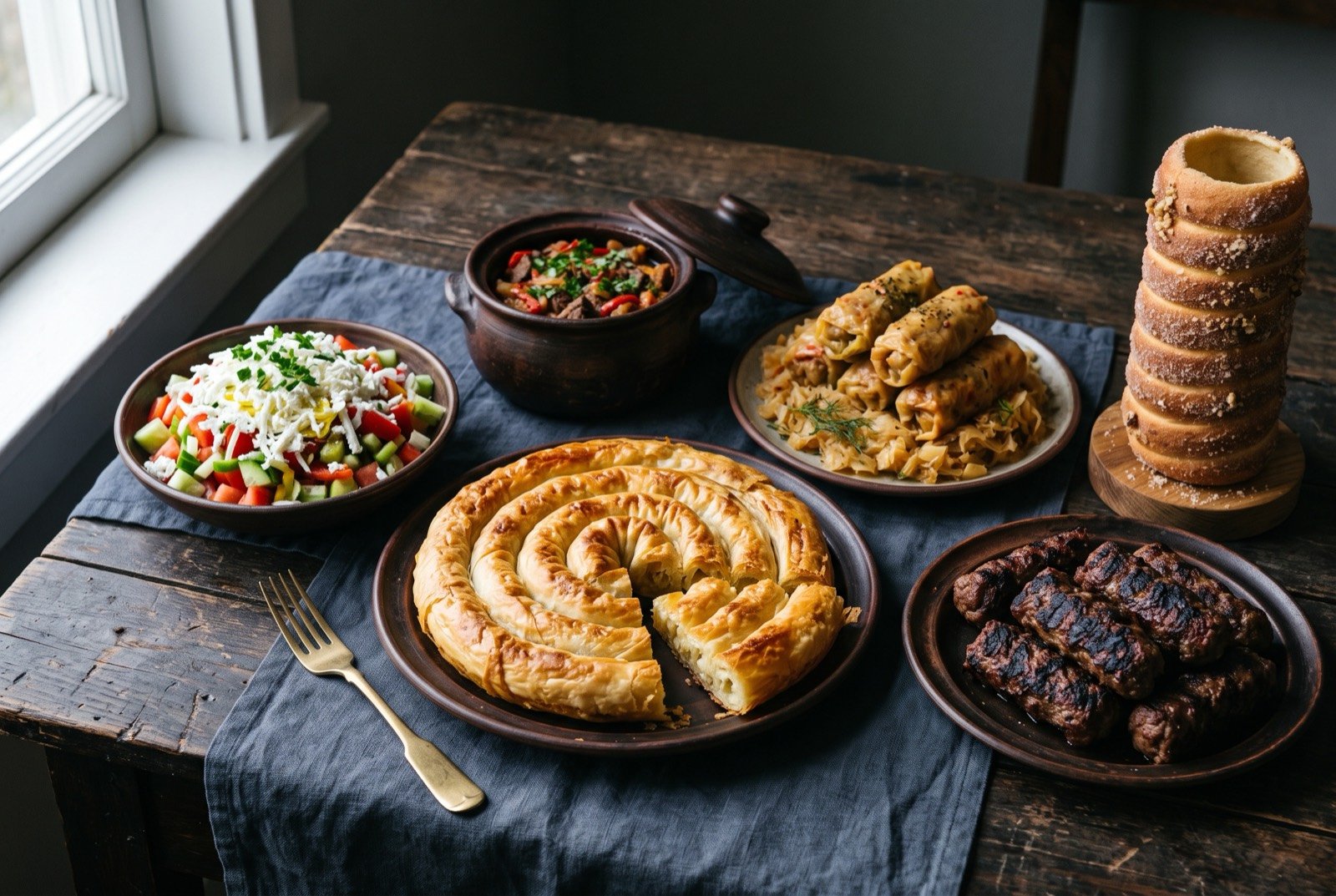
Two nations either side of the Danube's lower reach and the same Black Sea, each shaped by roughly five centuries of Ottoman entanglement, and each holding one fact the other cannot claim. Bulgaria holds the founding organism: the bacterium that makes yoghurt yoghurt, Lactobacillus bulgaricus, was isolated from a Bulgarian sample and named for the country in 1905, and kiselo mlyako's living culture sits underneath more of this book's tarator, banitsa filling and everyday table than any other single ingredient. Romania holds the language: alone among its neighbours, its Romance tongue descends in an unbroken documented line from the Latin of Roman Dacia, and Romanian food writers themselves are honest that the deeper Roman inheritance is real but thin, a matter of a few words and one baking technique, not a national cuisine handed down whole from antiquity. Both truths are worth taking seriously and neither should be allowed to flatten the other. Every dish as tradition built it, then what a modern chef would change.
Sources and review · What this chapter does not assert · How we research · Spotted something wrong?
A Sense of Place
Start with the fact that decides more of this table than any other: Bulgaria was ruled directly as Ottoman territory for roughly five centuries, organised into provinces under a resident pasha and subject to the devshirme, the child levy. Romania, or rather the two medieval principalities that became it, Wallachia and Moldavia, was not. Both paid tribute and both sat inside the Ottoman world's gravitational pull, but Wallachia and Moldavia held a treaty status called dar al-ahd, ruled throughout by their own native princes, keeping their own political, judicial and religious institutions intact, never converted, never levied for the Sultan's household troops. That is not a small distinction and this chapter will not let it collapse into the lazy shorthand of "the Ottoman Balkans" covering both countries identically. It is the single best explanation for why Romania's food reads as genuinely its own thing standing beside the shared Ottoman grammar of pepper, filo and grill, rather than simply another regional variant of it.
Bulgaria's own internal map runs from the Danubian plain in the north, catfish and carp country, tied to the Orthodox fish feast of St Nicholas Day on 6 December, down across the Thracian plain and up into the Rhodope mountains, a mixed farming and pastoral world that has lost more than it has kept: the ethnographer Petar Gruev's 1994 study names specific local cheeses, kurtmach, ahchak, tulumsko sirene, strombotiri, bitata brunza, that survive now mostly on the page rather than the table. The Black Sea coast runs its own fish economy and its own small named species. Set apart from all of it, the Kazanlak, Karlovo and Streltcha valley grows the Damascus rose that gives this book its most fragrant, least straightforward ingredient, real in the kitchen but genuinely narrower there than its perfume-industry fame suggests, a point this chapter returns to below. Two communities deserve a more honest note than most accounts give them: the Turkish minority concentrated around Kardzhali and Razgrad, tracing to Ottoman-era Anatolian settlement, and the Bulgarian-speaking Muslim Pomak communities of the Rhodopes, whose food history this research could not document with any confidence and will not invent to fill the gap.
Romania's own map is at least as internally various. Wallachia, south of the Southern Carpathians and north of the Danube, splits along the Olt river into Muntenia in the east, Bucharest's hinterland, plainer lamb cookery, mămăligă with cheese and the Pitești sausage tradition, and Oltenia in the west, more heavily spiced, built on leeks, and home to oaie la groapă, a whole sheep pit-roasted in a sealed jar. Moldavia, and this needs stating plainly because the ambiguity genuinely misleads, means the Romanian region of Iași, Suceava and southern Bucovina, not the separate sovereign Republic of Moldova next door; the historical principality's territory now splits three ways across Romania, Moldova and Ukraine, and this chapter's Moldavia is the Romanian third. Transylvania, ringed by the Carpathian arc, is genuinely a different food world again, closer to Central Europe than to the Balkans, its table built by four centuries of Romanian, Hungarian and Székely, German Saxon, and Armenian and Jewish coexistence, each community, as Romanian food writers themselves put it, "preserving its own identity" rather than dissolving into one. And Dobrogea, the Black Sea province, is different again, a genuinely Ottoman-Tatar-Greek-Lipovan Russian coastal world running on grey mullet, turbot and June-to-October anchovy, closer in spirit to Bulgaria's own coast than to inland Romania.
| Region | Defining logic | Dishes and products that carry it |
|---|---|---|
| Danubian north, Bulgaria | Catfish and carp, tied to the Orthodox winter fish-feast calendar | St Nicholas Day fish dishes, river fish stews |
| Thracian plain and the Rhodope mountains, Bulgaria | Mixed pastoral farming, a real and ongoing loss of named local cheeses | Kavarma, gyuvech, sirene, and Gruev's 1994 list of already-fading Rhodope cheeses |
| Bulgarian Black Sea coast | A fish economy running on named local species | Coastal fish soups and grills |
| Kazanlak, Karlovo and Streltcha, the Rose Valley | Rosa damascena distillation since the seventeenth century, genuine but narrow culinary use underneath a much larger perfume trade | Rose water, rose petal jam, crystallised rose petal |
| Wallachia: Muntenia and Oltenia | Plainer, Danube-facing cooking in the east; more heavily spiced, leek-and-lamb cooking in the west | Mămăligă with cheese, Pitești sausages, oaie la groapă |
| Moldavia, the Romanian region | Garlic, black pepper and paprika as base seasoning; mujdei as the signature condiment | Sarmale, mujdei, dill and leek-forward dishes |
| Transylvania (Ardeal) | Four centuries of Romanian, Hungarian and Székely, and German Saxon coexistence; smoked pork runs through the whole table | Tochitură, kürtőskalács, Baumstriezel, gulaș naturalised as tocăniță |
| Dobrogea, the Romanian Black Sea coast | Ottoman, Tatar, Greek and Lipovan Russian layers on a genuinely coastal economy | Grey mullet, turbot, șuberecul, garlic-free Lipovan haladeț |
The History in Layers
What predates the Ottomans, on both sides of the Danube
Bulgaria's deepest layer is proto-Bulgar and Slav laid over a Thracian base: Virgil himself, in classical-history sources discussing the Bizaltae, a Thracian tribe, describes sour milk mixed with horse blood, and the proto-Bulgars are credited with kumis, fermented mare's milk, the Slavic groups around it with sura, an early fermented drink. Romania's deepest layer is Roman: Trajan's legions conquered Dacia in 106 CE, and Romanian is the only Romance language native to south-eastern Europe, the sole survivor in the region of a Latin that everywhere else gave way to Slavic, Hungarian or Turkic tongues. Romanian historiography frames the country's own ethnogenesis in two stages, a Daco-Roman fusion running from the second and first centuries BCE through the fifth century CE, then the Romanian people crystallising properly across the sixth to eighth centuries, with "Romanitatea," Roman-ness, and Christianity named as the two decisive forces.
That claim deserves to be taken seriously and also held to real scrutiny rather than simply repeated, because it is genuinely contested and this chapter will not pretend otherwise. The rival account, formulated by the Austrian historian Robert Roesler in 1871 and still cited in Hungarian historiography today, argues the Romanian people formed south of the Danube and migrated north only after the Magyars had already arrived in Transylvania around 895 CE, meaning no continuous Daco-Roman population was there to greet them. Romanian historians themselves note, correctly, that Roesler's theory surfaced within four years of Transylvania's 1867 annexation into the Hungarian half of Austria-Hungary, a timing that is not coincidence. No neutral third-party scholarly consensus resolves this, both national historiographies remain shaped by real nineteenth and twentieth century territorial stakes over Transylvania, and the honest position for a food book to take is that it is contested, not that either side has won.
What actually survives from Roman Dacia into today's kitchen is real but narrower than the grand claim suggests, and Romanian food writers are candid about this too: the word plăcintă, for a filled pastry, descends directly from Latin placenta and survives in this form in no other Romance language, a genuine linguistic fossil; the clay baking dome still used in some rural areas, called a țest, descends from Latin testum; and a mainstream Romanian newspaper piece is bluntly titled, in translation, "the truth about the authenticity of Romanian cuisine: how we Romanianised Oriental, Russian and Greek recipes and turned them into a national brand." A word and a baking technique are real inheritances. A continuously cooked national cuisine handed down whole from the Roman legions is not what the evidence supports, and this chapter will not claim it.
Five centuries under one empire, two entirely different administrative facts
Bulgaria's Ottoman period, roughly the late fourteenth century to 1878, was direct rule: Ottoman pashaliks, later vilayets, governed by an appointed sanjakbey or pasha, subject to the devshirme. Wallachia accepted tributary vassal status in 1420, reaffirmed 1462, Moldavia in 1456, reaffirmed 1486, and neither ever became an administered province. Under the dar al-ahd treaty status, native princes, elected by the boyars and confirmed by the Sultan, kept ruling; political, judicial and ecclesiastical institutions stayed in Romanian hands; there was no forced conversion and no devshirme. One Romanian historical source states the distinction plainly: unlike Bulgaria, the Romanian principalities were never directly incorporated as provinces, but continued as vassal states throughout. This is the structural fact underneath this chapter's whole argument that Romania's food is not simply Bulgaria's food with a different flag, even though both share pepper, filo and grill technique with the wider Ottoman-shaped Balkans.
Where the two countries' history does converge again is in a specific later chapter: from 1711 to 1821, the Ottomans installed Greek nobles from Constantinople's Phanar district as princes of both Wallachia and Moldavia, replacing native boyar rule during a period when the Porte wanted more directly loyal administrators. Romanian sources frame this Phanariote period as the deepest single channel of Ottoman-Greek cultural penetration into Romanian elite life, court custom, schooling in Greek, and by clear implication cuisine, though this research could not pin down a single specific dish or technique to that exact channel with real confidence, and this chapter will not invent one to complete a tidy narrative.
Direct evidence for what the Ottoman centuries specifically changed at the level of technique, as opposed to the fact of rule itself, proved genuinely hard to source on the Bulgarian side; most searches returned political rather than culinary history, and this is named here as a real gap rather than papered over with plausible-sounding generalisation. What can be traced with confidence is dish by dish rather than period by period. Boza, the fermented cereal drink both countries still drink, traces to ancient Mesopotamia and was popularised across the whole Ottoman Balkans; the seventeenth-century Ottoman travel writer Evliya Çelebi recorded roughly a thousand boza-sellers working Istanbul's streets alone. Kozunak, Bulgaria's sweet Easter bread, by contrast, is not ancient and not Ottoman at all: its documented root is seventeenth-century France, a genuine correction against the reflex assumption that anything wearing a plait and a sugar glaze must be old.
The twentieth century, socialism, and what each country's own record actually shows
Bulgaria's own most useful correction on this whole subject comes from the writer and historian Albena Shkodova, whose work on the state tourism authority Balkantourist documents how a codified, exportable "Bulgarian cuisine" was deliberately constructed for foreign and domestic tourists during the socialist decades, a manufactured national table in exactly the sense this atlas has already met in the Baltic and Estonian chapters. Shopska salad is this chapter's own clearest example of the mechanism at work, treated in full below.
Romania's socialist record is more brutal and considerably better documented in named, dated detail. From 19 December 1980, "Legea 13" put bread, sugar and oil on ration cards distributed county by county. Nicolae Ceaușescu personally justified the shrinking rations through a 1982 "Programul de alimentație științifică a populației," a scientific-sounding name for pure austerity, aimed at repaying foreign debt fast; his officials judged a daily intake of 3,300 calories to be overfed. An 1981 decree made storing food at home a criminal offence, punishable by six months to five years in prison, and travel outside one's own county to buy food was restricted. The programme was among the very first decrees abolished after the December 1989 revolution. What came back afterward is well documented only in general terms, a rapid influx of previously unavailable imported goods, frozen American chicken and imported butter named specifically, and a shift toward meat, dairy and cheese taking a larger everyday share of the diet; this research could not find a source cataloguing which specific traditional dishes were suppressed and then specifically revived, as distinct from this general scarcity-then-abundance pattern, and this chapter will not manufacture that sharper narrative where the sourcing does not support it.
Transylvania's own layered table, and the pastry this chapter has to correct
Transylvania's Saxon community, invited by the Hungarian king Géza II and arriving mainly between 1141 and 1242 from the Rhine and Moselle regions, despite the name "Saxon," built a household cuisine Romanian sources describe as consistent and practical: thick soups, rich stews, smoked meat, slow-cooked vegetables, balanced sweet, salty and sour. Named surviving dishes, Hanklish, a spiced curd cheese, Ischler, a filled shortbread, and Saxon honey gingerbread, are, in one Romanian source's own words, no longer the property of the Saxon community alone but simply part of Transylvania's culinary identity now. The Hungarian and specifically Székely community's own contribution runs alongside it, goulash naturalised into Romanian as tocăniță, and a genuine Székely variant of cozonac.
It also runs into the working assumption this project's own scoping brief made about kürtőskalács, the spit-baked, sugar-crusted pastry claimed by Prague's tourist trade as trdelník, and this research had to correct that assumption rather than confirm it. The earliest documented recipe, dated 1784, sits in the manuscript cookbook of Countess Mária Mikes of Zabola, a Székely Hungarian noblewoman, and contains no sugar at all, the sweet crust arriving later. The spit-roasting technique itself most likely did arrive via German, Austrian or Saxon transmission, related to Baumkuchen and the Transylvanian Saxon Baumstriezel, whose very name is a literal mirror-translation of "chimney cake," and a Transylvanian Hungarian noble writing in 1736 pointedly did not list kürtőskalács among traditional Hungarian foods, evidence read by Hungarian scholarship itself as confirming the dish began as a German import that Hungarian and Székely kitchens then took up and elaborated. The honest account, then, is neither "purely Hungarian" nor "a Transylvanian Saxon invention" as this project first assumed going in, but a Transylvanian dish born of both communities together, first written down by a Székely Hungarian hand. It belongs to this volume because Transylvania belongs to Romania, and Prague's trdelník, carrying its own Slovak protected-origin status at Skalica, is a separate, later story this chapter leaves for whichever volume eventually treats the Czech lands properly.
The Flavour Arsenal
Kiselo mlyako. Bulgaria's living yoghurt culture, and the reason this whole volume opens on it: cultured from two bacterial strains only, Lactobacillus delbrueckii subsp. bulgaricus and Streptococcus thermophilus, at roughly 42 to 45°C for three to four hours, undisturbed, and never strained, which is the structural difference from Greek-style yoghurt rather than a matter of taste.
Sirene and kashkaval. Sirene is Bulgaria's brined white cheese, holding Protected Designation of Origin status from Bulgaria's own Ministry of Agriculture, and unlike authentic Greek feta it is legally permitted to be made from cow's milk as well as sheep's or goat's, a real and useful distinction. Kashkaval is the firm yellow cheese behind it, traditionally sheep's milk, made by a boil-and-salt technique.
Telemea. Romania's own brined white cheese, its name descending from Turkish teleme, a linguistic fossil of the Ottoman layer sitting inside an otherwise Latin vocabulary. Distinguished technically from feta and sirene by a two-stage salting process, both dry-salted and then brine-cured, which is specifically credited with its longer shelf life. Telemeaua de Ibănești, made from native-cattle milk in three delimited Mureș communes, became Romania's first EU Protected Designation of Origin product.
Smântână. Not simply "sour cream": genuinely fermented, cultured at room temperature for twelve to twenty four hours, traditionally ten to fifteen per cent fat, and Romanian cooks distinguish it sharply from both crème fraîche and plain cooking cream. This single distinction is the clearest reason a diaspora sarmale or ciorbă can taste subtly wrong even when every other ingredient is right.
Kapia peppers and paprika. The long, sweet-pointed pepper behind lyutenitsa, kyopolu and zacuscă alike, roasted and skinned rather than used raw. Bulgarian paprika itself is typically sun-dried and unsmoked, a genuinely different product from the Spanish or Hungarian smoked paprika that dominates the UK spice aisle, and this chapter names that gap plainly in the sourcing section below rather than letting a reader assume one paprika does the job of the other.
Mujdei. Romania's raw garlic sauce, pounded with salt and thinned with water or oil, the Moldavian region's signature condiment and the plainest possible expression of how much weight garlic carries across this whole table.
Rakia, țuică and pălincă. Bulgaria's rakia and Romania's țuică and pălincă are cousins, not the same drink under different names. The Romanian distinction is by fruit, not strength: țuică only ever means plum brandy, pălincă means brandy from anything else, apple, pear, cherry, quince. Transylvania specifically favours a genuine double distillation, a second full pass through a fractionating still that removes methanol and lifts the spirit to around fifty per cent ABV, called pălincă, horincă or horencă depending on the sub-region. The word "pălincă" itself is first attested in 1630 in what is now Slovakia, reaching Romanian by way of Hungarian, a Central European loanword sitting inside the Latin vocabulary and worth naming as a small, honest counterweight to this chapter's own Roman-vein argument.
Danube and Black Sea fish. Carp, pike and bream are the everyday catch of the Danube Delta, a UNESCO World Heritage site since 1990 hosting over a hundred and ten fish species; sturgeon is under a total fishing ban as a live conservation measure, not a historical footnote, and this chapter recommends no wild-caught sturgeon or its roe in any form. Dobrogea's coastal calendar runs on grey mullet, turbot at its best reputation among local eating fish, and anchovy specifically from June to October.
Rose. From the Kazanlak, Karlovo and Streltcha valley, whose distillation technique for attar of roses most likely arrived by way of seventeenth-century Persian and Indian precedent. Genuinely used in Bulgarian home cooking as rose water and rose petal jam and in crystallised petal work, but this chapter is honest that the evidence for it running through savoury cooking, rather than sweets and preserves specifically, is thin, and does not overstate a perfume industry's fame into a wider culinary claim than the sources actually support.
The Technique Ladder
Rung 1. Culture kiselo mlyako by feel, not by a printed clock
The finished yoghurt should be undisturbed for the full three to four hours at 42 to 45°C and judged by nose and set, not by a stopwatch borrowed from a different country's dairy tradition. A domestic yoghurt maker or a very low, thermostatically stable oven with the light left on holds this temperature more reliably than most stovetops, and the two-strain culture, never a Greek-style strained product, is what actually gives tarator and banitsa filling their correct looseness and tang.
Rung 2. Cook a gyuvech or a kavarma low, slow and nearly dry, in real unglazed clay
The pot itself, not the liquid inside it, is doing the work: little or no added stock, the meat and vegetables' own moisture and fat carrying the whole dish, in an unglazed or lightly glazed clay vessel that holds heat evenly and lets flavour concentrate rather than boil away. A Big Green Egg run low, around 150 to 160°C, with a genuine clay gyuvech set on the plate setter, lid down, gives the same low, even, radiant heat with a faint smoke note a wood-fired hearth would once have left, something a sealed domestic oven cannot replicate.
Rung 3. Match the souring agent to the soup, because a ciorbă is not defined by its vegetables but by how it is soured
What actually separates a ciorbă from a plain supă is the souring step itself, and Romanian kitchens reach for four genuinely different agents depending on the dish: vinegar, cabbage brine, unripe plum juice, or borș, a fermented liquid made from wheat bran and cornmeal that has nothing to do with Slavic beetroot borscht despite the near-identical name, brewed over two to three days from bran, cornmeal, sugar and hot water, sealed and kept warm, sometimes accelerated with a spoonful of an older batch exactly the way a sourdough starter works. Reaching for the wrong one, or for plain vinegar every time out of convenience, is one of the most common ways a diaspora ciorbă goes flat.
Rung 4. Rest a bicarbonate-treated mince overnight, because mici hold their shape through chemistry, not casing
Mici and mititei are grilled with no casing at all, and what actually holds them together on the grill is baking soda, traditionally slaked first in lemon juice, worked through the minced meat and rested under refrigeration for twelve to twenty four hours, sometimes two to three days for the best texture. The bicarbonate relaxes the meat's own protein structure over that resting time, giving the characteristic springy bite and helping the surface brown properly without a casing to hold the shape. Skip the rest, or skip the bicarbonate, and the mixture simply falls apart on a hot grill.
Rung 5. Buy or build a genuinely hand-stretched dough for banitsa, because mechanically rolled filo behaves like a different material
Hand-stretched yufka, thicker per sheet than supermarket filo but far more elastic, is what actually holds together when layered wet with butter, egg and yoghurt-softened sirene and baked into banitsa's characteristic spiral or stack; mechanically extruded filo is thinner, drier and shatters under the same treatment. A UK cook chasing the real texture should look to a Turkish specialist for genuine hand-stretched yufka rather than the supermarket filo aisle, a substitution this chapter's sourcing section below sets out properly.
Ferment or Preserve Bench
1. Kiselo Mlyako Starter
The living two-strain culture behind this whole chapter's cold soups and pastry fillings, judged by nose and set rather than a printed clock, per rung one; a genuine Bulgarian starter culture, cultured at home, is the honest route for a UK cook, since no mainstream UK dairy brand markets a yoghurt carrying the specific Lactobacillus bulgaricus strain by name.
2. Lyutenitsa and Kyopolu
Roasted red pepper relish and roasted aubergine relish respectively, both built by charring, skinning and reducing the vegetable down with garlic and a little oil until thick and spreadable, the everyday Bulgarian preserve shelf's two anchors.
3. Borș
Romania's fermented souring agent, wheat bran and cornmeal combined with hot water and a little sugar, sealed and kept warm for two to three days, sometimes accelerated with a spoonful of an older batch, a direct sourdough-starter analogue and, despite the name's similarity, technically unrelated to Slavic beetroot borscht.
4. Zacuscă
Romania's own roasted aubergine and pepper preserve, simmered with tomato paste, onion and bay leaf for forty five to sixty minutes then jarred hot for the winter pantry, a genuine home-canning tradition rather than a purely restaurant condiment.
5. Varză Murată
Whole-head soured cabbage, the wrapper for sarmale rather than fresh cabbage leaves. This chapter could not find a reliably sourced brine ratio or fermentation timing for the technique itself, only the finished dish that depends on it, and states that gap honestly rather than inventing a precise number to fill it.
Sourcing in Britain
Verified August 2026.
Kiselo mlyako and Bulgarian dairy. No mainstream UK dairy brand markets a yoghurt carrying the named Lactobacillus bulgaricus culture specifically; the honest route is a genuine starter culture, Freshly Fermented's Organic Bulgarian Yoghurt Starter, cultivated in the UK to organic certification, cultured at home per rung one. Sirene and kashkaval are both stocked by weight through Find BG Food Marketplace and Malincho, though both sites returned errors on direct verification and should be given a final live check before relying on them.
Romanian dairy and cheese. A&S Market, trading from physical shops in Woking, Basingstoke and London with next-day UK delivery, is the single strongest verified source in this whole chapter: telemea from Dodo, Dobrolact, Hochland, Helios and Stana across cow, sheep, buffalo and goat milk, and a genuinely rich, thirty two per cent, fermented smântână from Five Continents. Alimente.co.uk, based in Smethwick, independently stocks goat telemea, smântână and zacuscă.
Filo and yufka for banitsa. Genuine hand-stretched yufka, per rung five, comes from Turkish specialists rather than the supermarket filo aisle: The Turkish Shop and Turkish Porter both stock it, thicker and far more elastic than mechanically rolled filo, a real and worthwhile substitution for banitsa specifically.
Cornmeal for mămăligă. Harry Harvey's medium-grind cornmeal is the right texture; a fine grind, sold by some UK retailers as cornmeal or polenta interchangeably, gives a pasty rather than a properly grainy result and should be avoided for this dish specifically.
Mici and Romanian meat. ValahiaUK, "the first factory of traditional Romanian dishes... in the UK," based in Birmingham, sells ready-made mici in the correct beef, pork and lamb blend with UK-wide delivery, the single most reliable route to the real thing without building the blend from scratch. A UK butcher substitute, coarse-ground beef shin or chuck, shoulder of lamb and belly or shoulder pork fat, mixed with bicarbonate and rested per rung four, is a reasonable fallback.
Peppers, paprika and jarred relishes. This is the chapter's clearest sourcing gap: UK "smoked paprika," from Bart Ingredients to Spice Mountain, is overwhelmingly Spanish or Hungarian in character, a materially different, smoked and darker product from Bulgaria's own sun-dried, unsmoked style, which has essentially no stocked UK retail presence beyond a single small Etsy listing. Jarred lyutenitsa and kyopolu, by contrast, are genuinely well stocked: Ned Buy Foods carries Olinesa, Seltse, Horceto and Veselina by name, all worth reaching for directly. Kapia peppers for roasting come from Ned Buy Foods fresh or Parthenon Foods jarred; zacuscă itself from Alimente.co.uk or foodsklep.com.
Rose from the Kazanlak valley. Alteya Organics, grown and processed in the village of Yagoda, Bulgaria, UK-distributed through Bio-Nature Ltd, is genuinely organic-certified Rosa damascena rose water, the real product rather than a generic Middle Eastern substitute. Rose syrup and genuinely Bulgarian crystallised rose petal are both weaker finds: no confirmed live UK stockist exists for either at the time of writing, and a UK cook is better served making a rose sugar or glaze from Alteya's verified rose water directly, as this chapter's own kozunak and kürtőskalács elevations do, than chasing an unverified import.
Rakia, țuică and pălincă. Ned Buy Foods stocks named Bulgarian rakia brands including Burgas 63 and Kehlibar; Romanian Drinks, a dedicated UK importer, carries Distileria Ionescu's țuică de prune and pălincă de prune directly from Romanian producers.
Delis, city by city. In London, Bulgarian Food Shop "Kasmetcheto" in Acton and Prahova Romanian Shop, with branches in Colindale and Harrow, are both well corroborated as currently trading. ValahiaUK and Alimente.co.uk ship UK-wide from Birmingham and Smethwick respectively, and Ned Buy Foods and Continental Food Store both carry genuinely distinct Bulgarian and Romanian ranges rather than a single undifferentiated "Eastern European" shelf.
What Decides Great From Grim, Ranked
- Genuine unsmoked Bulgarian paprika over the ubiquitous Spanish or Hungarian smoked substitute, the single widest gap this chapter found.
- A real home-cultured kiselo mlyako over any UK "live yoghurt," since no UK dairy brand carries the named strain.
- Hand-stretched Turkish yufka over supermarket filo for banitsa specifically, a structural rather than cosmetic difference.
- Genuinely Bulgarian rose product over a French confectionery or generic Middle Eastern substitute, accepting that the crystallised petal specifically has no verified UK source at all.
Voices and Sources
This chapter rests on Bulgaria's own Ministry of Agriculture for sirene's protected status; on the bacteriologist Stamen Grigorov's own 1905 publication in the Revue Médicale de la Suisse Romande, working in Professor Léon Massol's laboratory at the University of Geneva; on the ethnographer Petar Gruev's 1994 study of vanishing Rhodope cheeses; on the writer and historian Albena Shkodova's work on Balkantourist's construction of a codified national cuisine; and on national Bulgarian press, Capital.bg, Novinite, Plovdiv24, Marica.bg, covering the country's own current restaurant scene honestly, including its 2025 Michelin rejection. On the Romanian side, on Historia.ro's own history journalism; on the documentation project comunismulinromania.ro for Ceaușescu-era rationing; on Romania's own Ministry of Agriculture and EU documentation for Telemeaua de Ibănești's protected status; on Hungarian-language sources, kurtoskalacsinfo.hu and kurtosfeszt.ro among them, for the kürtőskalács correction that a Bulgarian or Romanian source alone could not have supplied; and on Adevărul's own honest reckoning with how much of "traditional" Romanian cuisine is a nineteenth and twentieth century national synthesis rather than ancient practice.
For the working chef's voice, on Radu Ionescu of Kaiamo, Bucharest, Vladislav Penov of Cosmos, Sofia, Sevda Dimitrova of The Gallery, Sofia, and Tsvetomir Nikolov of Niko'las, Sofia, all named and quoted directly in the sources above; and on Irina Georgescu, a Romanian-British food writer whose book Carpathia: Food from the Heart of Romania is the strongest genuinely in-tradition, English-language voice available to a British reader on this cuisine specifically.
Things this chapter has deliberately not asserted
- That kürtőskalács is "a Transylvanian Saxon invention," as this project's own working scoping document first assumed. The earliest documented recipe, 1784, was written by a Székely Hungarian noblewoman; the spit-roasting technique most likely arrived by way of German or Austrian Saxon transmission. It is a dish born of both communities together, and this chapter has corrected the original assumption rather than repeated it.
- That a specific "thirty six country centenarian survey" links Bulgarian yoghurt consumption to a named longevity statistic. No primary source for this frequently repeated figure could be found, and it does not appear in this chapter as fact.
- That kiselo mlyako's founding-organism claim proves Metchnikoff's original longevity hypothesis. His hypothesis was real, taken seriously in its day, oversold by contemporary press, and only partially, not simply, rehabilitated by later microbiome research.
- That any restaurant in Bucharest currently holds a Michelin star, including the specific claim that "La Brasserie, Bucharest" holds one. This claim surfaced twice in this chapter's own research process as an evident AI-generated fabrication with no primary source behind it anywhere, and does not appear here. Whether Bucharest holds any Michelin-recognised restaurant at all, as distinct from Romania's confirmed November 2025 hotel Keys, remains genuinely unresolved in the sources reached and is not settled either way.
- That Bulgarian rose water and rose oil run broadly through savoury cooking. The evidence found is real but narrow: rose petal jam and crystallised petal work in home confectionery, and no named Bulgarian fine-dining chef using rose in a signature savoury dish.
- That the Pomak communities of the Rhodopes have a distinctly documented cuisine of their own. Their identity and geography are well established; no credible source on their specific food practice was reached in this research, and this chapter does not invent one.
- That sarmale's soured cabbage wrapper follows one fixed brine ratio or fermentation timing. The finished dish is well sourced; the pickling technique behind it, in this research, was not, and no precise figure is given here that the sourcing does not actually support.
- That specific traditional Romanian dishes were suppressed under Ceaușescu and then specifically revived after 1989, beyond the well-documented general pattern of scarcity followed by abundance. No source traced that sharper, dish-by-dish suppression-and-revival narrative with real confidence.
- That the Daco-Roman continuity thesis is scholarly settled fact. It is Romania's own historiographical position, genuinely contested by Hungarian historiography on real evidentiary grounds, and both national accounts are shaped by nineteenth and twentieth century territorial politics over Transylvania that this chapter has named rather than adjudicated.
Culture kiselo mlyako by feel, not by a printed clock
The finished yoghurt should be undisturbed for the full three to four hours at 42 to 45°C and judged by nose and set, not by a stopwatch borrowed from a...
Cook a gyuvech or a kavarma low, slow and nearly dry, in real unglazed clay
The pot itself, not the liquid inside it, is doing the work: little or no added stock, the meat and vegetables' own moisture and fat carrying the whole dish...
Match the souring agent to the soup, because a ciorbă is not defined by its vegetables but by how it is soured
What actually separates a ciorbă from a plain supă is the souring step itself, and Romanian kitchens reach for four genuinely different agents depending on the...
Rest a bicarbonate-treated mince overnight, because mici hold their shape through chemistry, not casing
Mici and mititei are grilled with no casing at all, and what actually holds them together on the grill is baking soda, traditionally slaked first in lemon...
Buy or build a genuinely hand-stretched dough for banitsa, because mechanically rolled filo behaves like a different material
Hand-stretched yufka, thicker per sheet than supermarket filo but far more elastic, is what actually holds together when layered wet with butter, egg and...
The dishes
- Banitsa Bulgaria
- Shopska Salad Bulgaria
- Tarator Bulgaria
- Kavarma Bulgaria
- Kozunak Bulgaria
- Sarmale Romania
- Tochitură Transylvania, Romania
- Mici Romania
- Ciorbă Rădăuțeană Northern Moldavia, Romania
- Kürtőskalács Transylvania, Romania
- Papanași Romania
Sources and review
- Researched
- No outside sources linked
- Reviewed
- Not yet reviewed from inside the tradition
- Cooked
- Not yet cooked and reported
Where this volume comes from
3 research briefs on file for this volume, researched to the rules on How we research. Published 28 August 2026. Last changed 8 September 2026.
The brief's own account of its sources
Bulgaria (Part One): of roughly 30 distinct searches, an estimated 24 to 26 were genuinely Bulgarian-language sources, reached via real Bulgarian-language queries as instructed (national and regional press, dairy-industry technical material, Balkantourist/socialist-era food history via named historian Albena Shkodova, Professor Petar Gruev's 1994 study on Rhodope cheeses, Bulgaria's own Ministry of Agriculture for sirene's PDO status). A handful of sources were necessarily English-language, chiefly for the international Metchnikoff/probiotics science strand.