Europe · Volume 29
The Adriatic and Albania
Bura, Smoke and the Ottoman Line
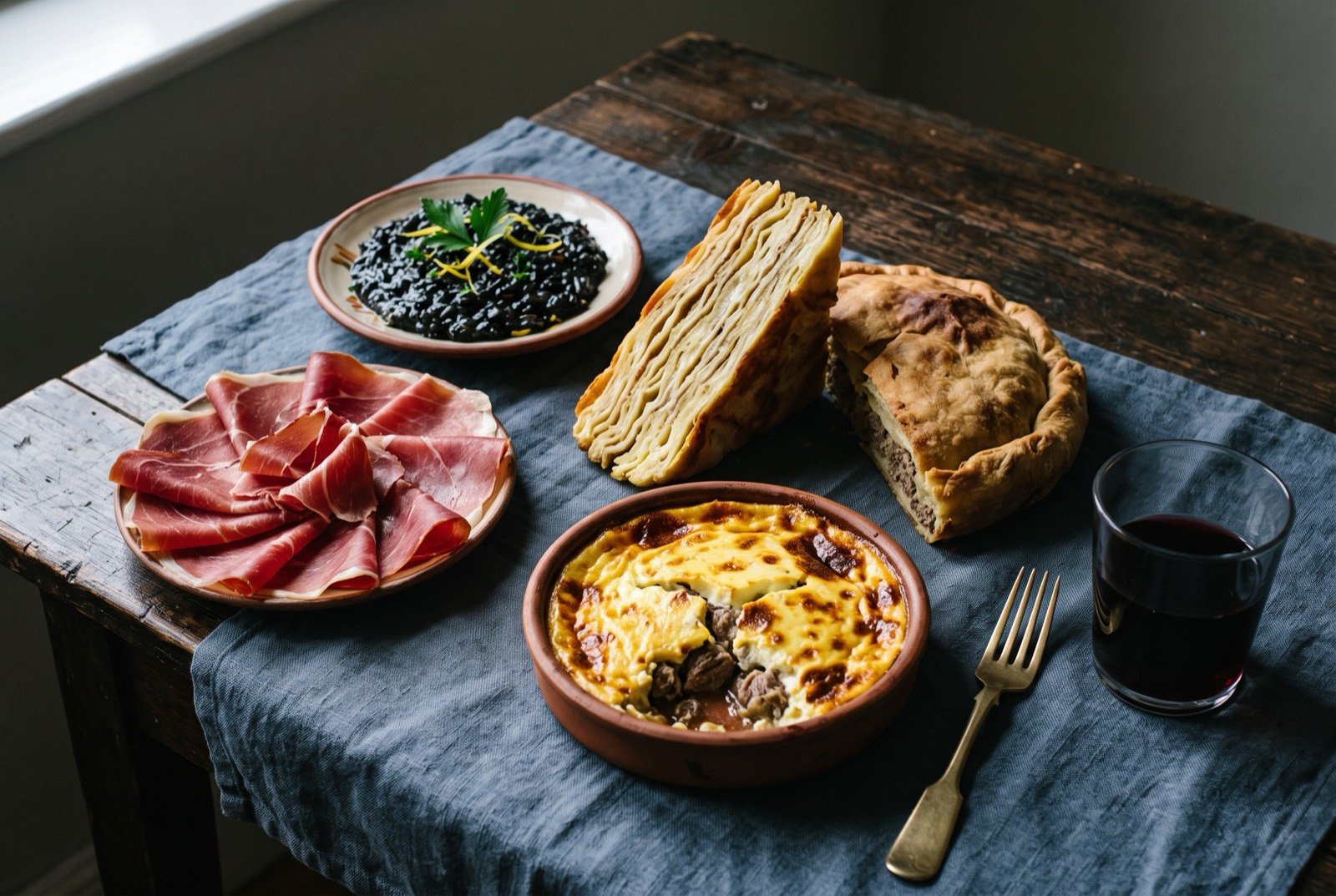
Three coastlines and two empires, not one. Dalmatia and Istria, the Croatian Adriatic, sit under four centuries of Venetian rule that left olive oil, wind-cured ham and a rice-and-stock technique as its clearest legacy. Montenegro splits down the middle: a short Venetian-facing coast around the Bay of Kotor, and a highland interior around Njeguši and Cetinje that the Ottomans never fully absorbed and that cures its own ham with smoke rather than wind alone. Albania took the opposite dose entirely: five centuries of direct Ottoman rule, administratively total, religiously transformative, that made yoghurt, filo pastry and grilled meat the unmarked default of its kitchen rather than a garnish on something older. The result is a volume built on a single, falsifiable technical distinction worth stating before anything else: there is no one way to cure a ham on this coast. Istrian pršut is wind-dried alone. Dalmatian pršut is wind-dried and smoked. Njeguški pršut is smoked first and matured on mountain wind second. Flatten those three into "Balkan ham" and the whole argument of this chapter, and of this atlas, is lost before the first bite. Every dish as tradition built it, then what a modern chef would change.
Sources and review · What this chapter does not assert · How we research · Know this better? Tell us
A Sense of Place
Coastal Croatia: olive oil where continental Croatia runs on pig fat
Dalmatia and Istria are Mediterranean ecology laid onto karst limestone: thin soil, erratic summer rain, and a coastline broken into hundreds of islands that made small-boat fishing and terraced vines and olives the only reliable farming. The fat here is olive oil, everywhere, in sharp contrast to the pig fat and dairy fat of continental Croatia and the wider Balkan interior this atlas treats separately, in EU-28. The aromatic base is garlic, wild Mediterranean herbs, rosemary, bay, sage, marjoram, and, on the islands, the low scrubland the Croats call makija, which yields capers, wild fennel and the everlasting flower smilje. Istria, wetter and greener than Dalmatia, with a forested interior around the Mirna valley that grows white truffles, carries more pork and pasta than the bare karst south of it; Dalmatia is drier and starker, its hinterland pastoral, its islands each carrying a genuine micro-speciality, capers on Vis, wine on Korčula, sheep's cheese on Pag, shaped by nothing more complicated than what a small boat could carry to market.
Montenegro: a country cut in half by one mountain massif
Montenegro's food geography splits along the line the Lovćen massif draws between sea and highland, and the two halves did not eat the same way until quite recently. The coast, Herceg Novi through the Bay of Kotor to Bar and Ulcinj, sat under Venetian control, on and off, from 1420 to 1797, closely related in its cooking to Dalmatia across the water. The interior is a different world entirely: the Njeguši and Lovćen highlands, valued since the medieval period for stočarstvo, mountain livestock farming, and never absorbed into Ottoman provincial administration the way Elbasan or Berat further south were. Njeguši village itself sits at the physical hinge, on the old road linking highland Cetinje to coastal Kotor, which is exactly why its cured ham and cheese could reach a Mediterranean-facing market despite being cured to a mountain, not a coastal, method.
Albania: the same split, cut across far more deeply by Ottoman rule
Albania carries its own coast-versus-highland divide, from the fertile lowlands and coast around Shkodra, the Myzeqe plain and Vlora, up into the northern malësi highlands, Kukës, Tropoja, Dukagjin, Malësia e Madhe. What makes Albania structurally different from Montenegro is that both halves, coast and highland alike, sat inside roughly five centuries of direct Ottoman administration, a depth of rule Montenegro's highland core never experienced. The malësi is where flija, cooked under a domed saç over embers, and the pastoral dairy economy of kos, gjizë and djathë are strongest; the plains and coastal towns produced the richer, urban, Ottoman-inflected cookery, byrek, tavë, fërgesë, that made Elbasan, Tirana, Shkodra and Gjirokastër into named culinary centres in their own right.
The structural logic, at a glance
| Coastal Croatia | Montenegro | Albania | |
|---|---|---|---|
| Fat | Olive oil | Olive oil (coast), kajmak and cheese (highland) | Olive oil (coast), yoghurt and butter (highland) |
| The imperial layer | Venetian, roughly four centuries | Venetian on the coast, largely untouched by direct Ottoman rule on the Lovćen highland | Ottoman, direct, roughly five centuries, coast and highland alike |
| The signature cure | Pršut, wind-dried (Istria) or wind-dried and smoked (Dalmatia) | Njeguški pršut, cold-smoked over beech, then matured on mountain wind | Suxhuk, cured beef sausage; no comparable air-dried whole-muscle ham tradition |
| The structural dairy | Pag cheese, salt-and-herb grazed | Njeguški sir, and sir iz ulja, cheese preserved in oil | Kos, yoghurt used as a cooking medium, not just a food |
| The bread-and-pastry answer | Fuži pasta (Istria), soparnik's hearth-baked chard pie (Dalmatia) | Kačamak, cornmeal stretched with potato | Byrek's hand-rolled filo, flija's saç-baked layers |
The History in Layers
Illyrian claims, made honestly and not adjudicated
Both modern Albanians and modern Montenegrins claim descent from this coast's pre-Roman Illyrian population, and the claims are not symmetrical. The Albanian case is a claim of linguistic and genetic continuity: that modern Albanian descends from ancient Illyrian speech, a position Albanian-language sources increasingly present as settled. International scholarship is considerably more cautious, noting that surviving fragments of Illyrian and Albanian share almost nothing directly comparable, and that the Komani-Kruja archaeological culture Albanian scholars cite as continuity evidence is read by most outside scholars as Romanized Illyrians speaking a Romance language, not proto-Albanian speakers. Montenegro's claim is a different shape entirely: not linguistic descent but cultural absorption, the argument that the Slavic-speaking population arriving in the sixth and seventh centuries CE absorbed a pre-existing Illyrian population, the Docleati, whose name gave Duklja, the first Montenegrin medieval state, its own name. This chapter states both claims as made from inside the nations concerned, in service of national identity, and adjudicates neither.
Venice, and a name worth knowing: Albania Veneta
Venice's imprint runs down both the Croatian and Montenegrin coast as one continuous zone. Venice took Dalmatian towns and islands piecemeal from around 1000 CE and held effective control until the Republic's fall in 1797; in Istria it expanded from the 13th to 15th centuries until it held roughly two-thirds of the peninsula. Kotor and the Bay were administered, on and off, within that same system from 1420, under Venice's own official label for its remaining eastern Adriatic holdings: Albania Veneta, a term covering coast that is now both Montenegrin and northern Albanian, and a useful reminder that Venice itself saw this whole littoral as one administrative and culinary zone rather than the several nations it is read as today. Istrapedia, the regional Croatian encyclopedia, states plainly that Venetian cuisine left the greatest single trace on Istrian gastronomy of any outside influence, importing cod from the Baltic and spices from Asia while building its cooking around Istria's own produce. Concretely, this layer gave the coast the rice-and-stock technique that becomes crni rižot, the pasta tradition behind fuži, the Malvazija grape family, and, on the dessert side, both fritule and Dubrovnik's rozata, whose oldest documented form is a 14th-century Venetian "friar's pudding" before it becomes Dubrovnik's own. The "Italian" gloss commonly put on Adriatic cooking is itself several centuries of local adaptation of one specific empire's foodways, not a recent import.
Ottoman rule, and why the mechanism differs so sharply here
Ottoman conquest of Albania proceeds through the fifteenth century, and Albania remained under direct Ottoman administration into the twentieth, until independence in 1912. Albanian-language sources state the depth of this plainly: Ottoman influence on Albania is described as greater than any other outside influence, given five hundred years inside an Ottoman cultural mosaic. This was never merely political suzerainty. It included substantial conversion to Islam across large parts of the population, a demographic and religious change the Montenegrin or Croatian coast never underwent at scale; direct absorption into Ottoman administrative structure, the timar system and local beys; and full participation in Ottoman urban economy, Elbasan and Berat each supporting professional guild bakers by the seventeenth century. Ottoman technique, filo and byrek pastry, yoghurt culture, grilled and skewered meat, coffee, was absorbed here as the ambient, default cooking idiom, not layered onto something older, which is exactly why tavë kosi and byrek read today as unmarked, everyday Albanian food rather than as "Ottoman dishes" the way a Western menu might file them.
Montenegro's Ottoman layer sits at a genuinely different depth. Control over Montenegrin territory was real but geographically partial and administratively contested for the whole period it lasted, 1496 to 1878; Kotor and Herceg Novi remained under Venice even during periods of Ottoman rule elsewhere in the region. Crucially, the Cetinje highland core, seat of the vladike, the prince-bishops who ruled Montenegro's political and spiritual life, maintained real practical autonomy from Ottoman provincial administration for most of this period. Njeguši and the Lovćen massif were never absorbed the way Elbasan or Berat were. The Ottoman layer here sits alongside the Venetian one on a coast that changed hands repeatedly, rather than replacing an older layer outright, which is exactly why Njeguški pršut, kačamak and Njeguši sir read as indigenous highland pastoral food with no visible Ottoman fingerprint at all, no yoghurt custard, no filo, no grilled kebab as the base technique, while Turkish coffee and some grilled meat forms travelled into Montenegrin food culture later and more lightly, through trade rather than total absorption. This is the actual argument this atlas keeps making region by region: empire's culinary force is a function of depth and duration, not mere proximity, and this volume happens to sit at the exact point where you can watch that difference play out across three neighbouring coastlines within a few hundred kilometres of each other.
The Habsburg gap, and Yugoslavia's tourist century
After Venice's fall, Dalmatia and Istria passed briefly through French administration before becoming, from 1815, Habsburg territory, and from 1867 part of the Austrian half of the Dual Monarchy. Dalmatia specifically was the least-developed province of that empire's Austrian half, still carrying feudal-era land tenancy into the twentieth century, never connected to the interior by rail, and marked from the 1880s by heavy transatlantic emigration. No credible source behind this chapter found a specific culinary legacy from this period on the coast comparable to what exists for Zagreb or continental Croatia; that is stated here as a genuine research gap, not an assumption that no influence existed. The twentieth century's major event on this coast was touristic rather than political: socialist Yugoslavia built the Adriatic into a mass tourism destination, peaking at 68.2 million overnight stays in 1986, a figure independent Croatia did not surpass until 2015, standardising coastal restaurant food for a mass audience even as home kitchens kept older, more localised dishes alive. Albania's twentieth century ran in the opposite direction entirely: Enver Hoxha's regime, especially after Albania's 1978 break with China, pursued an isolation so total that this chapter's own research could not establish, to the standard the rest of it holds, exactly what that isolation did to the country's diet and ingredient supply beyond the well-documented general facts of rationing and collectivised agriculture. That asymmetry, one country building a tourist economy around its coast, the other closing itself almost entirely, is a real part of why coastal Montenegrin and Albanian food, similar enough in the nineteenth century, diverged further still by the century's end.
Independence, EU accession, and a note on the neighbours
Since Croatia's 2013 EU accession, a wave of PDO and PGI registrations has formalised much of what follows in this chapter: Dalmatinski pršut, Istarski pršut (PDO, 2015), Paška janjetina (2015), Paški sir (PDO, 2019), Poljički soparnik (PGI). Two boundaries are worth naming rather than quietly stepping over. This volume's continental neighbour, the grill-and-paprika Balkans of Serbia, Bosnia and Herzegovina, continental Croatia, North Macedonia and Kosovo, sits in this atlas's own EU-28, and that is where ćevapi, burek and the fuller Ottoman-Habsburg grill tradition belong; nothing in that repertoire is re-derived here. Slovenia's own Adriatic coast is a genuine sliver, the Primorska strip around Piran, and it touches this volume lightly and honestly: Slovenia as a whole reads as Alpine and Austrian in its potica and štruklji, not Balkan, and belongs in this atlas's Central Europe grouping, but the reader walking the coast road south from Trieste will find Piran's own pršut and olive oil sitting in exactly the same technical family this chapter describes for Istria, one bay further north than this chapter's own remit runs.
The Flavour Arsenal
Olive oil, the coast's one true fat
Istrian oil in particular now carries real international standing: in a recent edition of the Flos Olei guide, sometimes called the industry's bible, 69 of Croatia's 71 listed oils were Istrian, and a Savudrija producer has twice taken the guide's Hall of Fame 100/100 score. The dominant cultivars differ by zone: Oblica, roughly 60% of all Croatian plantings, across Dalmatia; Cres, at the northern edge of Adriatic olive cultivation, growing Plominka and Slivnjača and holding Croatia's first protected designation of origin for oil; Istria's own Buža and Istarska bjelica, typically more bitter and pungent, in the Tuscan register rather than the softer southern Italian one.
Pag lamb and Pag cheese, one flavour explained by one mechanism
The island of Pag's pastures are regularly sprayed with sea salt by the bura wind, and the aromatic plants that survive that salting, sage, smilje, thorny broom, wild fennel, concentrate the compounds the island's sheep graze directly. That is a genuinely well-evidenced causal chain, salt shapes flora, flora shapes animal, animal shapes flavour, not a marketing flourish, and it is why both Paška janjetina (2015) and Paški sir (PDO, 2019) carry EU protection on the same underlying logic.
Malvazija, Teran, Pošip and Vranac, four grapes doing four different jobs
Malvazija istarska, Istria's dominant white, is genuinely of uncertain origin, DNA analysis finding no relationship to any other grape called Malvasia elsewhere; first written mention traces to 1641, and it did not overtake Istria's black varieties until the interwar period. Teran, Istria's principal black grape, covered over 90% of the peninsula's vineyard two centuries ago and remains its leading black variety today despite falling to under 12% by 1980 as Malvazija rose. Pošip, native specifically to Korčula, was officially recognised as a premium Croatian white variety only in 1967. Vranac, Montenegro's own signature red, has been planted in its mountainous districts since the medieval period, with seventeen recorded biotypes pointing to genuinely long local cultivation, and makes up more than half of all Montenegrin vineyard area; it was recognised at the 1905 London exhibition, and its name translates roughly as "strong black," descriptive of both colour and character.
Kos, Albania's structural ingredient, not its condiment
Yoghurt in Albania functions as a cooking medium as much as an eaten food, baked into tavë kosi's custard, thinned into tarator's cold soup base, with a strong, living home-production tradition running alongside commercial dairies. This is the single clearest ingredient-level marker of how deep the Ottoman dairy inheritance runs here, against coastal Montenegro, where yoghurt plays a far smaller structural role and kajmak and cheese do the work instead.
Smilje, capers and the makija
Vis specifically carries a real production tradition in both: capers harvested wild off island walls and rock faces in May and June, only the smallest unopened buds picked, preserved in vinegar or, for the prized version, dry-salted; and smilje, the everlasting flower, distilled for its essential oil within 24 hours of picking or the yield and quality drop, one tonne of fresh flowers yielding roughly one litre of oil. Both are genuinely foraged rather than farmed, the makija's own working larder.
Raki, and the difference between a grape and a plum
Albanian raki is principally grape-based, raki rrushi, traditionally distilled in copper stills over oak-fired heat; the south, Skrapar, Berat, Përmet, is named as producing the most highly regarded grape raki, with the northern highlands favouring plum instead. Montenegrin rakija follows the wider Balkan fruit-brandy tradition, generally grape or plum, present at births, weddings and funerals alike. The distinction matters for anyone sourcing or substituting: most rakija reaching the UK is plum-based, structurally a different drink from Albanian grape raki, and this chapter does not conflate the two.
Wild herbs and greens, a necessity food before it was ever a flavour
Montenegrin zeljanica is made from foraged zelje, wild greens gathered from pasture; Albanian sources name wild asparagus, wild sorrel varieties and çaj mali, mountain tea, Sideritis syriaca, used both medicinally and as an infusion. Nettle is documented on both sides of the border, historically valued for its iron content in poor mountain districts where meat was scarce.
The Technique Ladder
The argument, from inside
Every technique in this chapter answers a version of the same question this whole atlas keeps asking: what does a kitchen with no refrigeration and, in the mountains, no reliable oven, actually do to keep protein safe and flavour worth having. Bura wind, cold smoke, an open hearth and a domed lid are none of them decorative. Each is the answer this specific coast and this specific highland gave to that question, and a technically capable home cook with real kit can reproduce the logic properly, provided the logic, not merely the appearance, is what gets copied.
Rung 1. Match salt, wood and wind to the microclimate, not to a single recipe
The whole point of this coast's charcuterie is that there is no one cure. Istrian pršut is salted with sea salt and spices, then air-dried on bura wind alone for five to seven months, unsmoked. Dalmatian and Drniš pršut are salted to a higher 5 to 6% (against roughly 3% in industrial Italian prosciutto), smoked over hornbeam, beech and oak for 30 to 60 days, then bura-dried to a year or more. Njeguški pršut, in a mountain climate with no bura of its own, is cold-smoked over dry beech for five to eight weeks at 13 to 21°C and matured a further eight to ten months in the Lovćen massif's own mix of Mediterranean and continental air. The technique that actually transfers to a modern kitchen is not "cure a ham" but the discipline of reading a specific microclimate stage by stage and choosing salt, wood and time to match it, which is directly what a controlled charcuterie cabinet or cold smoker is doing today, just with instruments instead of a wind ledger.
Rung 2. Shake, don't stir
The rule governing brudet, buzara and gregada alike, repeated almost verbatim across every Croatian source behind this chapter's tradition brief. Fish and shellfish flesh is delicate enough that a spoon breaks it into a formless stew; shaking the covered pot distributes heat and liquid without mechanical damage, while still stopping the base from catching.
Rung 3. Cook the ink with the flesh, not with the rice
Crni rižot's real technique is that cuttlefish is cooked down in its own liquid for a good fifteen minutes before wine and ink go in, so its natural gelatine and moisture are already in the pan before the ink, which both thickens and colours, and the rice, which needs an already-flavoured liquid to absorb by the standard gradual-stock risotto method, arrive. Add the ink to a separately cooked base instead and the result is coloured rice, not this dish.
Rung 4. Bake without an oven, under embers or a domed lid
Soparnik is baked directly under hot embers and ash on an open hearth, a pre-domestic-oven technique specified in its own EU protection document as part of what makes the product genuine. Flija is built the same way in spirit but a different way in form: a domed metal lid, the saç, set on a low iron tripod over embers, each very thin layer of batter set for a minute or two before the next is poured directly on top, the lid lifted and the setting layer brushed with butter between pours, over two to three hours total. Both are answers to the same constraint, no oven, and both are why a Big Green Egg, closed and steady, is the single most useful piece of kit a UK cook brings to this chapter.
Rung 5. Warm the custard gently before it meets real heat
Tavë kosi's yoghurt-egg topping is not a béchamel, whatever it resembles once baked. Yoghurt is whisked with egg, a little flour and some of the meat's own roasting liquid, then given two to three minutes of gentle stovetop heat, just enough to begin binding it, before it meets the oven's full heat. Fërgesë's cheese-and-egg finish runs on the same logic in miniature, low heat, continuous stirring, just enough to melt the cheese and softly set the egg without scrambling it. Skip the gentle first stage on either dish and the result splits or weeps rather than setting into the custard both are built to become.
The Cure and Preserve Bench
1. Pršut, Three Ways
Covered in full above, in the Dalmatinski and Njeguški entries. The chapter's clearest example of one word, pršut, covering three genuinely different curing philosophies, and worth reading as a single argument rather than two unrelated recipes.
2. Sir iz Ulja, Cheese Preserved in Oil
A preservation method, not a separate cheese: born of necessity rather than culinary whimsy, cheese sold before it had fully aged was packed into jars, covered in olive oil, sometimes with garlic, basil and rosemary layered through, sealed and matured in a cool place for around sixty days. Genuinely reproducible at home with a proper aged sheep's cheese, a clean jar and real patience, and a natural use for a cheese bought slightly underripe rather than a flaw to work around.
3. Kos, a Living Culture Worth Keeping Going
Albania's own yoghurt tradition runs on genuine home culturing, not a supermarket tub bought fresh for each dish. A starter culture kept and refreshed, the way this atlas's other volumes treat a live sourdough or a living skyr culture, develops a depth and tartness a one-off shop-bought yoghurt cannot match, and is worth maintaining if this chapter's Albanian dishes become a regular part of a reader's kitchen.
Sourcing in Britain
Verified August 2026. Where a supplier could not be fully confirmed, that is said rather than smoothed over.
The genuine gaps, stated plainly first. Drniški pršut specifically has no confirmed currently-trading UK direct-to-consumer retailer; the producers found sell into continental Europe or UK foodservice, not direct-to-home retail. Post-Brexit, high-risk animal products including cured meats require health certificates and pre-notification to import commercially into Great Britain, and as of December 2025 there is an active safeguard suspension on some Croatian ovine and caprine raw-milk products following a livestock disease outbreak, so genuine PDO pršut may be harder to source commercially than assumed; check current import status before relying on it. Albanian kos with UK retail distribution was not found. Outside London, no specifically named, currently-trading Albanian or Balkan grocer was verified with confidence, despite Birmingham's confirmed Albanian population; mail order from London-based shops is the honest fallback.
The ranked list: what decides great from grim
- Genuine Istrian olive oil, used generously and finished raw. Sous Chef UK and Taste Croatia both currently stock single-estate Istrian oil. Look for a harvest date, not merely a best-before date.
- A properly aged pršut, genuine or honestly substituted. Taste Croatia, Borough Market, stocks Dalmatian prosciutto aged 36 months, the single most credible UK source; failing that, a genuine 24 to 36 month Parma or San Daniele is a far better substitute than Spanish jamón serrano.
- Cuttlefish ink, sachet or fresh. Sous Chef UK, The Cornish Fishmonger and The Upper Scale all stock sachets currently; Hamiltons Fish supplies whole wild cuttlefish with the ink sac intact for the traditional route.
- The wine, chosen by grape rather than by generic "white." VINVM and Taste Croatia stock Malvazija and Pošip; The Wine Society, a mainstream, reputable merchant, stocks Montenegrin Vranac, real proof this is genuinely available rather than a niche curiosity.
- Paški sir, or an honest substitute. Taste Croatia sells it directly; failing that, Berkswell or Spenwood, both genuine hard aged ewe's milk cheeses stocked at good UK cheesemongers and, for Spenwood, Neal's Yard Dairy.
- Full-fat strained yoghurt for tavë kosi. FAGE Total 5% is the practical, widely stocked UK standard, structurally close to what the dish needs, honestly presented as a Greek stand-in rather than misrepresented as Albanian.
- Grape raki, not plum rakija, when the dish specifically wants Albanian raki. UK stocking of Albanian grape raki specifically was not confirmed in this research; an unaged Italian grappa is a genuinely closer substitute than any plum-based rakija.
- Albanian and Balkan groceries. Taste Croatia and Magaza Balkan Fine Food, both trading physically in London with UK-wide delivery, plus Vardar Balkan Shop, Goni's Store and Fresh AlbMarket for Albanian-specific stock.
Kit notes for this volume
A Big Green Egg is the single most useful piece of kit in this chapter, the closest UK equivalent to both the peka bell and the Albanian saç, genuinely useful for soparnik, flija and a home-scale pršut smoke alike. A sous vide setup earns its place for tavë kosi's custard and for a more controlled pašticada braise. A dehydrator is honestly useful only for a smaller-scale, quicker home-cured ham project, not as an equivalent to months of bura-wind or beech-smoke curing, and this chapter says so rather than overselling it. A high-power blender is a genuine but modest help, for a smooth cuttlefish-ink finish or a silkier fërgesë base. A chinois is worth using to finish pašticada's sauce to a restaurant-grade smoothness. A spice grinder earns real, if modest, use grinding cumin and allspice fresh for Albanian and Montenegrin meat dishes, a genuine flavour improvement consistent with this atlas's whole argument: doing traditional things deliberately, not importing method that was never native here.
Voices and Sources
From inside the tradition
- Danijel Đekić, Monte, Rovinj, the first Croatian restaurant to hold a Michelin star and now holding two. On record framing his cooking around "the aromas of my mother's and grandmother's kitchens," reworking Istrian fritaja and fuži rather than importing generic tasting-menu language.
- Rudolf Štefan, Pelegrini, Šibenik, Gault&Millau Croatia Chef of the Year 2025. Notable for explicitly naming Turkish and Austro-Hungarian influence on Dalmatian cuisine as part of his own menu's intellectual frame, a rare instance of a working chef stating this chapter's own layered-empire argument in his own words.
- Bledar Kola, Mullixhiu, Tirana, trained in Copenhagen including at Noma. The clearest case found anywhere in this volume of a chef elevating through native technique rather than imported French method, foraging genuinely local flora and reworking Albania's Ottoman-Italian-Greek layered tradition as raw material rather than an obstacle.
- Udruga Dalmatinski pršut and the Istarski pršut producers' association, whose geographical-indication specifications are the primary source behind this chapter's curing ratios and timings.
- RTCG, Montenegro's national public broadcaster, the source behind kačamak's documented eighteenth-century origin.
- Albania's National Register of Intangible Cultural Heritage, a government heritage body, the strongest source found for flija's real technique.
The UK diaspora, honestly assessed rather than assumed
There is currently no UK restaurant doing serious, technique-forward Dalmatian, Istrian, Montenegrin or Albanian cooking, and this chapter states that plainly rather than inventing one. What exists in London is heritage and comfort format: Illyrian Grill House, opened 2020 specifically to fill a gap its own founder describes, on Green Lanes, alongside Vardar Balkan Shop and a small cluster of Balkan cafés and delis serving the expat community well without attempting the kind of technique-led elevation Mullixhiu is doing in Tirana or Monte in Rovinj. This absence is worth naming honestly: this cuisine currently has no UK kitchen doing for it what Ikoyi does for West African technique, and a reader taking this chapter seriously is, for now, working somewhat ahead of what London's restaurant scene offers.
Things this chapter has deliberately not asserted
- That "Balkan ham" is one thing. Istrian pršut is wind-dried, unsmoked. Dalmatian pršut is wind-dried and smoked. Njeguški pršut is cold-smoked first and wind-matured second. These are three distinct curing philosophies tied to three distinct microclimates, not regional variations on a single method.
- Pašticada's multi-day marinade. The strongest source behind this chapter gives 24 hours, and this chapter follows that rather than a longer figure sometimes assumed without a source.
- Tavë kosi's custard as a béchamel. It is a yoghurt-egg-flour custard, warmed gently before baking, not a butter-and-flour roux cooked into milk, despite a superficial resemblance once baked.
- The Illyrian-Albanian continuity theory as settled. Albanian-language sources present it with more certainty than the international scholarship does; this chapter states both positions and adjudicates neither.
- A specific culinary consequence of Enver Hoxha's isolationist rule. The general historical fact of extreme post-1978 isolation and rationing is well documented; this chapter could not source its specific effect on diet and ingredient availability to the same standard as the rest of the material here, and says so rather than filling the gap with plausible invention.
- Any Austro-Hungarian culinary legacy on the Dalmatian and Istrian coast comparable to what exists for continental Croatia. No credible source behind this chapter supports one, and this chapter does not assert an influence it cannot show.
- That Montenegro has a fine-dining scene translating its highland tradition. It does not, as of this writing. No Michelin-recognised restaurant exists in the country, and no chef doing for Njeguši charcuterie and kačamak what Bledar Kola is doing for Albanian food in Tirana was found.
- That any UK restaurant is currently doing serious, technique-forward Dalmatian, Istrian, Montenegrin or Albanian cooking. None was found. What exists is heritage and comfort dining, valuable in its own right but not what this chapter means by elevation.
- Fritule's "14th-century Rome museum" recipe, or rozata's 1570 Cvijeta Zuzorić wedding origin. Both are repeated across Croatian tourism and lifestyle sources without an identifiable archival citation, and this chapter treats them as repeated folk history rather than confirmed fact.
- That gregada is definitively Hvar's own invention rather than a shared island form. The attribution rests on general coastal and fishing press, not ethnographic sourcing, and is presented here as commonly claimed rather than settled.
- The legal status of importing genuine PDO Croatian pršut into the UK commercially at any given moment. Regulatory friction is real and current, including a December 2025 safeguard suspension on some Croatian raw-milk products; this chapter recommends checking current import status directly rather than assuming either free availability or a flat ban.
Match salt, wood and wind to the microclimate, not to a single recipe
The whole point of this coast's charcuterie is that there is no one cure.
Shake, don't stir
The rule governing brudet, buzara and gregada alike, repeated almost verbatim across every Croatian source behind this chapter's tradition brief.
Cook the ink with the flesh, not with the rice
Crni rižot's real technique is that cuttlefish is cooked down in its own liquid for a good fifteen minutes before wine and ink go in, so its natural gelatine...
Bake without an oven, under embers or a domed lid
Soparnik is baked directly under hot embers and ash on an open hearth, a pre-domestic-oven technique specified in its own EU protection document as part of...
Warm the custard gently before it meets real heat
Tavë kosi's yoghurt-egg topping is not a béchamel, whatever it resembles once baked.
The dishes
- Dalmatinski Pršut Coastal Croatia
- Brudet Coastal Croatia
- Crni Rižot Coastal Croatia
- Pašticada Coastal Croatia
- Soparnik Coastal Croatia
- Njeguški Pršut Montenegro
- Kačamak Montenegro
- Tavë Kosi Albania
- Flija Albania
- Fërgesë Albania
Sources and review
- Researched
- 14 sources cited
Where this volume comes from
4 research briefs on file for this volume, researched to the rules on How we research. Published 28 August 2026. Last changed 20 September 2026.
The brief's own account of its sources
Coastal Croatia (Part One): essentially all searches were run in Croatian, per house rule. The large majority of citable sources are Croatian-language, Croatia-published: government ministry documents (poljoprivreda.gov.hr), producer-association geographical-indication specifications (primary documents for pršut curing ratios), regional encyclopedias (Istrapedia), a serious food-culture magazine (Iće & Piće), Croatian national and regional press, and Croatian recipe/lifestyle sites.