Europe · Volume 26
Russia, the East Slavic Heartland
Rye, the Samovar and the Sturgeon’s Retreat
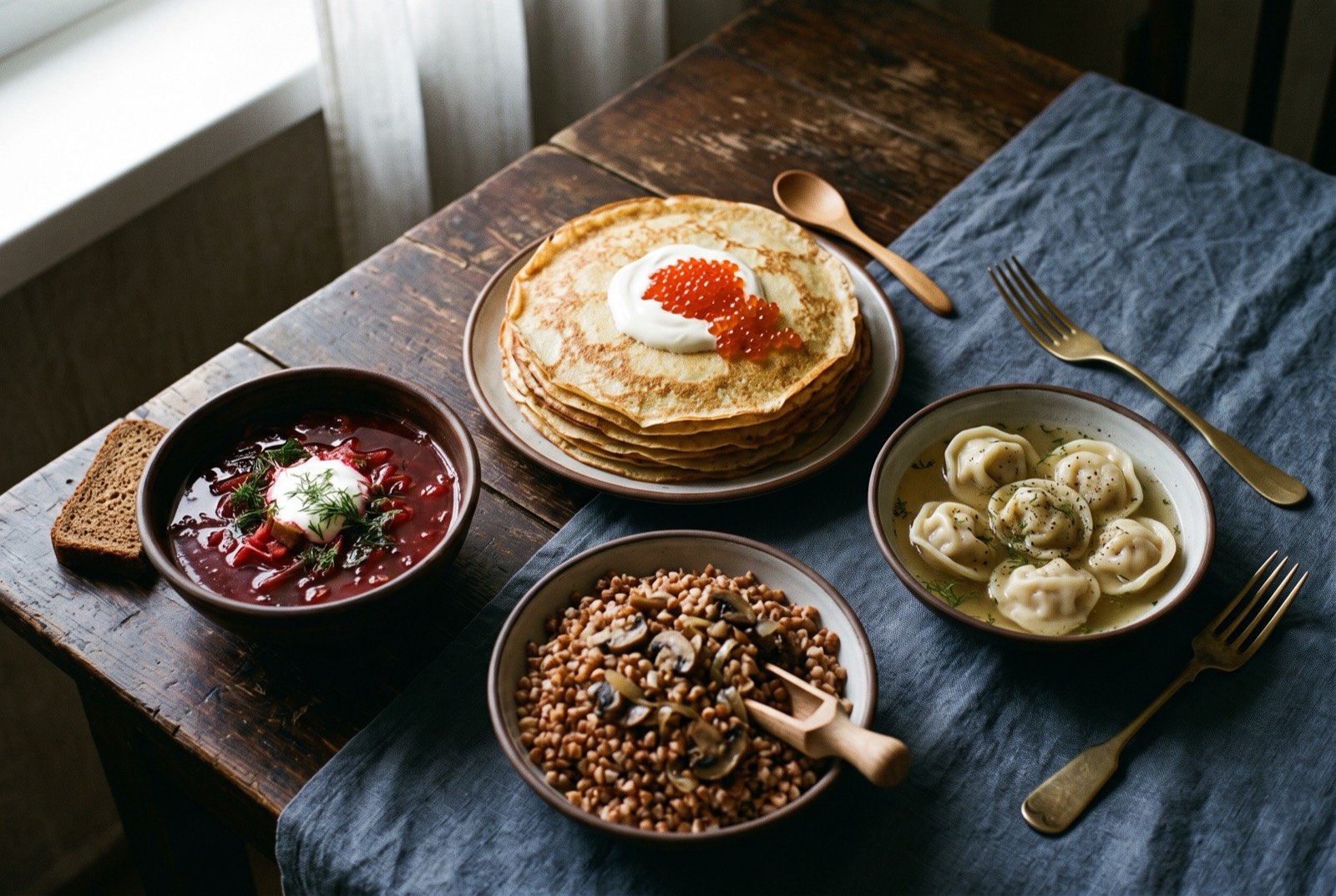
A cold, short growing season pressed into a single working grammar: rye and buckwheat as the starch, lacto-fermented dairy and cabbage as the everyday preserve, a stove built to cook on its own falling heat rather than a fixed flame. Above that sits a luxury layer that very nearly did not survive its own success, Volga sturgeon and Caspian caviar, hunted to the edge of extinction within living memory and now almost entirely farmed. Running underneath all of it, for a large share of the calendar year, is a second, parallel kitchen: the Orthodox fasting table, meat-free and often dairy-free by rule rather than by fashion, built on mushrooms, grain and preserved fish centuries before any modern vegan movement claimed the same territory. Every dish as tradition built it, then what a modern chef would change.
Sources and review · What this chapter does not assert · How we research · Know this better? Tell us
A Sense of Place
Borscht belongs here too, and this chapter names the argument honestly rather than settle it. Russia and Ukraine both claim the dish; Ukraine holds UNESCO recognition for its version, and a mainstream Russian food publication consulted for this chapter states plainly, in its own words, that Ukrainians have, in their own view, the strongest claim to the dish's birthplace. This chapter reports that asymmetry rather than smoothing it over, and treats Russian regional borscht, Moscow's own version among them, as real, separately worth cooking dishes rather than a rival claim to be defended.
Three tiers sit on top of one another here, and the chapter treats them as genuinely distinct rather than flattening them into one undifferentiated "Russian food." The first is the European Russian heartland: Moscow and the forest belt running north and east of it, rye and buckwheat agriculture, lacto-fermented dairy, a cooking culture built around a masonry stove that holds heat for hours after its fire has gone out. The second is the Volga and Caspian luxury layer, sturgeon and caviar specifically, a fishery with a documented history running back to Greek writers in the second century BCE and a collapse recent enough that the current legal position, essentially no wild-caught caviar reaches any market today, including Russia's own, is a fact of the present rather than a footnote to the past. The third is Siberia, which this chapter refuses to treat as simply cold Russia: it is layered from at least three genuinely distinct sources, the indigenous peoples of the taiga and tundra (Evenki, Buryat, Khanty, Mansi, Yakut and others, each themselves distinct), the Finno-Ugric peoples of the Urals and Prikamye who sit at Siberia's western gateway, and Russian settler cuisine, which arrived from the sixteenth century onward and absorbed elements of both without ever quite becoming either.
Running underneath and across all three tiers is a fourth structural fact that a British reader is least likely to know and most needs to understand: the Orthodox fasting calendar. Between Great Lent, the Nativity fast, the variable Apostles' fast, the Dormition fast and the weekly Wednesday and Friday fasts observed for most of the rest of the year, a very large share of the calendar falls under some tier of restriction, from complete dry fasting (bread, water, fruit, vegetables, no oil, meat, dairy, egg or fish) down to hot food with vegetable oil permitted. This is not a minor seasoning on the cuisine. It is the reason a genuinely developed, satisfying meat-free and often dairy-free repertoire exists here at all, built on mushrooms, grain, dried and salted fish and kvass-based dishes, centuries before any modern framing of plant-based eating claimed the same ground.
| Layer | Defining logic | Dishes and products that carry it |
|---|---|---|
| The heartland: Moscow and the forest belt | Rye and buckwheat as staple, lacto-fermented dairy, the Russian stove's falling-heat cookery | Shchi, kasha, blini, pelmeni, kholodets, kvass |
| The Volga and Caspian luxury layer | Sturgeon, caviar, a state-controlled trade that collapsed and is now almost entirely farmed | Caviar in its three historical styles, ukha, balyk |
| The samovar and tea-and-preserving culture | Tea arriving overland from China via Siberia, a concentrate-and-dilute drinking method, staged fruit preserving | Zavarka and kipyatok, varenye, pryaniki, sushki and baranki |
| Tatarstan and the Volga Tatar table | A genuinely distinct Turkic, Muslim tradition bordering this volume's Volga geography, not a Russian regional variant | Chak-chak, echpochmak, gubadiya, zur-belesh, tokmach |
| Siberia, Russian settler layer | Transplanted central Russian cooking adapted to extreme cold, plus adopted Finno-Ugric technique | Pelmeni's real route into Russian use, tea via the Great Tea Road |
| Siberia, indigenous peoples | Reindeer, wild game and fish, freezing as an active preparation technique rather than mere storage | Stroganina, kukura, sirne, khuliktè, buyurun |
| The Orthodox fasting calendar, cutting across all of the above | A parallel lenten cuisine, meat and often dairy excluded for a large share of the year | Kutya, mushroom-based lenten dishes, kvass-based cold soups, dried and salted fish |
The History in Layers
What is genuinely indigenous, before any of the layers above it
Rye and buckwheat agriculture sit at the base of this chapter, and they arrived by two entirely different routes worth keeping separate. Rye is homegrown to the climate, attested as a staple from at least the ninth century and, by the late nineteenth century, occupying 30 to 60 per cent of sown land in Russia's forest zone against under 1 per cent for wheat. Buckwheat is not a grass at all, botanically unrelated to rye or wheat, a fast-maturing pseudocereal that reaches harvest in around a hundred days and tolerates poor, acidic soil. Its route into Russia is unusually well documented for a foodstuff this old: it arrived via Byzantine contact with the Muscovite state, which is exactly why its Russian name, гречка, literally means "the Greek grain," even though its ultimate botanical origin traces, per Nikolai Vavilov's research, to central and eastern China. Despite that deep history, buckwheat was never grown at rye's scale: 1913 harvest figures put it at roughly a twenty-fifth of rye's tonnage, because it needs more warmth and better soil and its straw is worthless as fodder, unlike rye's. Nineteenth-century sources describe it becoming fashionable among landowners specifically because it was comparatively scarce and demanding, the reverse of its later reputation as the archetypal humble grain.
Alongside the grain sits lacto-fermented dairy, and this chapter draws a real distinction the English word "sour cream" flattens. Smetana and tvorog are both simple, low-technology products of souring milk or cream with lactic bacteria, indigenous techniques in the plainest sense. Kefir is not: its grain culture, a symbiotic mix of bacteria and yeast, is documented to the northern Caucasus specifically, Karachay-Cherkessia and Kabardino-Balkaria around Elbrus, where nineteenth-century highlanders called the grains "the Prophet's millet" and would neither sell nor give them away, treating them as a sacred gift. One early researcher proposed the kefir culture itself descended from koumiss, the fermented mare's milk of steppe nomadic peoples, which would place its ultimate ancestry with Turkic pastoralists rather than Slavic dairying. Kefir is Russian in the sense that it is drunk everywhere in Russia today. It is not Russian in the sense that smetana and tvorog are, and this chapter keeps that distinction rather than folding all three cultured products into one undifferentiated "Russian dairy" story.
The Russian stove itself, русская печь, is attested from the eighth or ninth century in its earliest boulder-built form and remained the dominant hearth technology across the Russian, Belarusian, Ukrainian, Romanian and Moldovan lands until the early twentieth century, heating the home, drying laundry and, in some builds, providing a bathing space as well as cooking. Its cooking logic, томление, slow cookery in gradually falling heat as the fired stove's masonry cools rather than at any single fixed temperature, is not folklore dressing. It is a real, specific technology with a real chemical effect, and it is the direct ancestor of this chapter's own technique ladder.
Byzantium, and what it actually left behind
The clearest, best-attested channel of Byzantine influence here is not a set of borrowed dishes but the fasting calendar itself, inherited wholesale with Orthodox Christianity and structurally central to Byzantine cooking for the same religious reason before it ever reached Rus. Buckwheat's naming and arrival is the other concrete Byzantine-contact thread. What this chapter has not found, and will not manufacture, is evidence tracing specific lenten cooking techniques, as against the calendar's structure and logic, directly from Byzantine to Russian practice; that more granular claim stays unverified rather than asserted.
The Mongol and Tatar era, narrower than popular claims suggest
This layer is real, and it is also thinner and more contested than the popular version usually allows, and this chapter treats both facts honestly. Tatars are credited in Russian sources with introducing tea-drinking and teaching the baking of kalachi, a specific wheat bread shape, and linguists have identified around two thousand Tatar loanwords in Russian, food and clothing vocabulary the largest categories, evidence of real everyday contact even where it resists dish-by-dish tracing. Pelmeni sit at the centre of the genuinely contested part of this story, and this chapter refuses the flattened "Siberian invention" version repeated confidently in English. The strongest, best-corroborated thread is etymological and Finno-Ugric, not Mongol: "pelmeni" derives from the Komi and Udmurt Permian compound пельнянь, пель meaning ear and нянь meaning bread, describing the dumpling's shape exactly. The Soviet food historian V. V. Pokhlyobkin dated pelmeni's entry into Russian cuisine to the late fourteenth or early fifteenth century and pointed to Ural settlement surnames derived from "pelmeni," Pelmenev, Pelnenev, Pelmennikov, appearing in written records from 1679 onward. A competing, more circumstantial theory holds that pelmeni are a westward adaptation of Chinese jiaozi carried by Mongol trade routes in the thirteenth century; it is repeated confidently in popular Russian food writing, but rests on comparative reasoning, a shared shape, the use of black pepper, rather than direct documentary evidence, and this chapter treats it as the weaker of the two claims rather than the settled origin story. What is not in dispute is that pelmeni's deepest roots sit with the Finno-Ugric peoples of the Urals and Prikamye specifically, not with the indigenous peoples of Siberia proper further east, who have their own distinct food traditions built on reindeer and fish and are not, in fact, the people who gave the world pelmeni at all.
The tea question carries its own honest tangle worth naming rather than resolving falsely into one clean date. Russia's own most-repeated origin story is specific and well documented: on 20 September 1638, the envoy Vasily Starkov returned from a mission to the Mongol Altyn Khan bearing some 64 kilograms of dried tea leaves, which he initially tried to decline in favour of more sable furs before the gift was accepted, tried at court, and gradually taken up among the wealthy. Separately, Tatar cultural sources state that tea reached the Tatars via the Mongols in the thirteenth century, several centuries earlier, and that the samovar was a treasured Tatar household item by the nineteenth century too, which would make Volga-region tea culture a genuinely older, partially separate root rather than a straightforward Moscow-outward diffusion. That claim rests on a single source found in this chapter's research and is offered as a real possibility worth naming, not a settled correction to the more famous 1638 story.
The Volga trade, from tribute to near-collapse
Sturgeon and caviar's documented history runs further back than most British readers will expect. Greek historians Polybius and Strabo recorded large sturgeon exports from the Caspian and Azov regions in the second and first centuries BCE, and caviar reached Novgorod by trade route in the thirteenth century. Russian control of the lower Volga, following Ivan the Terrible's capture of Kazan and then Astrakhan in the 1550s, turned the fishery into a direct state resource: the 1554 tribute settlement with the Astrakhan khanate required some four to six hundred tonnes of sturgeon delivered to Moscow annually, and by 1669 the annual Volga catch is put at around fifty thousand tonnes. By the 1970s Soviet output had reached roughly two to two and a half thousand tonnes of black caviar a year, close to ninety per cent of the entire world supply at the time, the real backdrop to caviar's reputation as the Russian luxury food above all others.
That scale is exactly why the collapse matters so much to how this chapter treats the ingredient today. Damming, principally the mid-twentieth-century hydroelectric cascade, destroyed nearly all natural beluga spawning grounds and around seventy per cent of Russian sturgeon spawning grounds. Sturgeon were listed under CITES from 1998, and after years of failed coordinated quotas and confirmed illegal fishing at multiples of the legal catch, all five Caspian states progressively banned commercial sturgeon fishing between 2011 and 2014. The settled position today, cross-checked across international conservation and trade sources, is stark and worth stating plainly: essentially no legal wild-caught Caspian caviar reaches any market at all, including Russia's own domestic market. What is sold as caviar anywhere in the world today, including in Russia, is farmed. This chapter treats that not as an incidental regulatory footnote but as one of the central facts a reader needs to understand this ingredient at all.
French chefs, Gallomania, and the mythologised dishes it left behind
Russian noble-table cooking of the eighteenth and nineteenth centuries was deliberately eclectic: French dishes for formal, public dining, "Russian" dishes reserved for private, everyday household eating, the balance shifting toward France the more formal the occasion. A French chef on staff was a matter of household prestige, and these chefs brought technique as much as recipes, browning, flambéing, the construction of composed sauces that had no real precedent in the existing Russian repertoire. Napoleon's 1812 invasion, rather than dampening this influence, is recorded as having accelerated Gallomania among the Russian elite in its aftermath, and St Petersburg's first restaurant, Pierre Talon's, opened in 1814. One genuinely Russian contribution moved the other way across this same channel: eighteenth-century service à la française, dozens of dishes set out simultaneously, gave way in the nineteenth century to service à la russe, dishes brought to table in sequence, which then spread back outward across Europe under that Russian name and remains the standard restaurant service pattern today.
Two of this chapter's dishes carry real mythology worth checking rather than repeating uncritically, and both survive the check with a genuine, verifiable core underneath the legend. Beef Stroganoff's earliest verifiable printed recipe dates to 1871, in Elena Molokhovets' household manual Подарок молодым хозяйкам, and the dish is reliably named for Count Alexander Grigoryevich Stroganov, governor-general of Novorossiya. Everything past that is contested rather than documented: the "toothless count" story, in which an elderly Stroganov's chef sliced the meat thin because the count could no longer chew properly, is flagged as legend, "якобы," supposedly, by the Russian source itself. Pozharsky cutlet's fame is real and specifically dateable: Pushkin wrote to a friend on 9 November 1826 recommending "Pozharsky's fried cutlets" at the coaching inn in Torzhok, and that endorsement, not the popular story of an emperor's veal order improvised into chicken, is what actually carried the dish into wider cultural memory.
What the Soviet period did, and what New Russian Cuisine says it is recovering from
The 1939 Book of Tasty and Healthy Food, commissioned directly by Anastas Mikoyan and produced with a hundred-thousand-copy first print run, is treated by Russian cultural historians as a genuine hinge point: it marks the deliberate end of what is called the "all-Russian national cuisine" period and the start of a distinct Soviet one, projecting a façade of abundance, photographs of sturgeon and elaborate pastry, that presupposed access to a private cook and special-distributor ingredients ordinary households simply did not have. What followed, per the serious Russian humanities publisher Arzamas Academy, was cooking shaped by planned-economy scarcity rather than by season or region, working from what one source calls "a constructor with a dozen details," the narrow, unpredictable set of staples reliably available in shops. Borscht is the clearest concrete casualty named in Russian sources: the Soviet food historian Pokhlyobkin is credited with cataloguing and standardising named regional variants, Moscow, fleet, that now sit as parallel, coexisting versions inside the Russian tradition rather than derivatives of one original, even as the deeper national-origin question stays genuinely unresolved between Russia and Ukraine.
This is precisely the target contemporary Russian fine dining names when it speaks of recovery. Vladimir Mukhin of White Rabbit, the movement's most visible figure, has repeated across several interviews that pre-Soviet Russian food "had colour" and that the Soviet period specifically "killed" that variety and turned it "grey," and Russian trade and popular press are consistent that the movement, associated also with Anatoly Komm's Varvary, the Berezutsky twins' agriculture-led Twins Garden, Anatoly Kazakov's Selfie and Roman Chistov's work at Beluga, positions itself against Soviet standardisation specifically, not against the pre-revolutionary or peasant table it claims to be recovering. Chistov's own framing, given in a Russian food-platform interview, is worth stating directly because it matches this atlas's own house argument almost exactly: Russian cuisine, in his words, is "an interweaving of many peoples' cooking," shaped by climate, available ingredient, religion and custom rather than by any single unified national tradition.
That movement now operates inside a genuinely altered landscape that this chapter will not pretend around. Michelin suspended all Russia activity in March 2022 and has not updated its Moscow selection since, so every star named above is frozen at its October 2021 award rather than currently, actively reassessed. The Berezutsky twins left Twins Garden in March 2023. And the historian doing the most serious, source-grounded work on Russian food history today, Pavel Sutkin, who with his wife Olga spent roughly two decades documenting Russian peasant cooking honestly as, in the framing this chapter found praised, "food of survival" rather than nationalist myth, was detained by Moscow authorities in October 2025 and remanded on charges of spreading "fakes" about the military, having consistently and publicly opposed the invasion of Ukraine. This chapter names that fact plainly rather than treating New Russian Cuisine as a purely celebratory story with no cost attached to telling it honestly.
The Flavour Arsenal
Rye. The historic staple grain of the forest belt, base of every sour bread and the whole tradition of kvass; northern populations preferred it wherever the climate allowed, giving way to barley only at the true polar limit of cultivation.
Buckwheat (гречка). A Byzantine-era import whose Russian name means "the Greek grain," never grown at rye's scale historically but adopted into the everyday table more completely here than in any other European cuisine; sold in Britain in two genuinely different forms, raw pale groats and toasted, reddish-brown kasha, and the traditional porridge wants the latter.
Smetana. Cultured soured cream, the working fat and finishing agent across shchi, blini and stroganoff alike, made by inoculating cream with lactic bacteria at roughly 38 to 42°C; genuinely distinct from a supermarket "soured cream," with real body and a tendency to melt slowly through hot liquid rather than dissolve on contact.
Tvorog. Fresh curd cheese, made by souring milk with a pure lactic starter and draining the curd; closer in character to quark than to cottage cheese but not identical to either.
Kefir. Fermented with a living grain culture of bacteria and yeast, documented specifically to the northern Caucasus rather than to Slavic dairying proper, and treated by nineteenth-century highlanders as a gift too sacred to sell.
Wild mushrooms, especially белый гриб (Boletus edulis). The forest larder's central protein and umami source, gathered from at least the tenth century, dried and salted for winter, and carrying real structural weight on the strictest Orthodox fasting days when meat, dairy, egg and sometimes fish are all excluded at once.
Salted cucumbers, lacto-fermented. Not vinegar pickles; a brine of 3 to 10 per cent salt at room temperature over several days is the real technique here, and the distinction matters to a British reader used to "pickled" meaning vinegar.
Kvass. The mildly alcoholic, lightly carbonated fermented rye-bread drink that also forms the base of the classic cold summer soups, okroshka and botvinya.
Sturgeon and caviar. The Volga luxury layer, three historical styles worth knowing: зернистая (zernistaya), granular and individually salted, the familiar premium form; паюсная (payusnaya), pressed from lower-grade roe under heat and salt, now prized for a scarcity born of frugality; and ястычная (yastychnaya), still bound in its membrane sac and salted whole. Malossol, "little salt," under about 5 per cent, is the mark of proper grainy caviar.
Dill, bay, black pepper, horseradish, garlic. The working aromatics of the everyday table, none of them exotic or costly, all of them structural rather than decorative.
Honey. Central to sbiten (spiced honey infusion, drunk hot, sold historically by street vendors from insulated copper flasks), medovukha (fermented honey), varenye and the whole tea table's sweets.
The Technique Ladder
Rung 1. Томление: cook in falling heat, not fixed heat
The Russian stove's real technical gift is not "low and slow" in the abstract but a genuinely falling temperature curve: fired hot, loaded, then left to cook for hours as the masonry itself loses heat. This is explicitly different from a modern oven held at one setting, and it is why kasha cooked this way, oven-tomlёная at 110°C for three to three and a half hours, or a faster boil-then-drop version, brought to the boil at 160°C then held near 100°C for thirty to forty minutes, tastes and holds together differently from a fast stovetop simmer. A Big Green Egg run hot and allowed to drift down naturally over hours, rather than actively regulated to a fixed temperature by its vents, is the closest mechanical analogue this chapter can offer, a reasoned extrapolation from shared thermal-mass behaviour rather than a documented Russian technique, and it should be understood as such. Sous vide, by contrast, is a genuinely good analogue for a different traditional effect, fixed-temperature, moisture-sealed cooking, but not for this falling curve specifically; the two are not interchangeable substitutes for the same thing.
Rung 2. Judge a lacto-ferment by its numbers, then by its nose
Salted cucumbers ferment properly at room temperature, roughly 22 to 24°C, for two to four days, by which point lactic acid concentration reaches about 0.3 to 0.4 per cent; at a cooler 20°C the same ferment runs ten to twelve days, and in a cold cellar it can extend to sixty. Brine strength for proper fermentation sits at 3 to 10 per cent salt. Kvass fermenting must is typically held at 25 to 30°C industrially, with home fermentation at room temperature typically taking two to three days rather than the fourteen to sixteen hours an industrial pitch achieves. Grey shchi's own crumb ferment, крошево, coarse outer cabbage leaves salted, sometimes with rye flour worked through, and left under weight to properly ferment before use, follows the same family of parameters, though no single confirmed time or temperature survives for it specifically, and this chapter extrapolates from the cucumber and kvass numbers above rather than inventing a false precision.
Rung 3. Culture real smetana at home, and trust the result over an imported clock
Smetana is achievable in an ordinary warm kitchen with no special equipment: cream warmed to roughly 38 to 42°C for inoculation with lactic cultures, with a working starter capable of culturing a full batch in ten to twelve hours at 35°C. A temperature-controlled proving drawer or a sous vide bath both work perfectly well for this, and the result, judged by body and a clean, properly sour smell rather than a fixed printed time, will consistently outperform a standard UK supermarket soured cream in every dish this chapter calls for it.
Rung 4. Smoke fish as two genuinely different techniques, not one at two speeds
Hot smoking runs at 70 to 100°C for roughly one and a half to two hours, cooking the fish through as it smokes. Cold smoking runs at 20 to 30°C for anywhere from twelve hours to several days, and in this range the protein never coagulates, the fish stays, in the plain words of the Russian source behind this rung, "practically raw" but permeated with smoke, which is exactly what historically gave it a shelf life of up to two months in a pre-refrigeration economy. A Big Green Egg held at a genuinely controlled low dome temperature is well suited to the cold-smoke range specifically, and this chapter treats the two methods as distinct disciplines rather than one technique run faster or slower.
Rung 5. Treat freezing as an active preparation, not mere storage
Stroganina inverts the usual Western logic of freezing entirely: fish or meat is frozen solid, held at -18 to -20°C for at least two to three days for a full-depth freeze, specifically so that it can be shaved into thin curls with a very sharp knife and eaten raw, never cooked, never refrozen once thawed. A blunt knife produces thick, broken pieces rather than proper curls, and that failure is the practical test of whether the technique has been done right. This is a genuinely indigenous Siberian technique, documented among the Evenki for reindeer meat as well as fish, not a settler adaptation, and it belongs in this chapter's ladder as its own distinct discipline rather than a curiosity.
The Ferment and Preserve Bench
Kvass. Dried, lightly toasted rye bread crusts, roughly 300 to 500g per 3-litre batch, steeped in hot, not boiling, water for several hours; sugar, and often raisins, added; strained and fermented at room temperature, with added yeast, 24 to 40 hours depending on ambient warmth, or left to ferment spontaneously on wild yeasts for around a day. A secondary bottle-conditioning stage, a few raisins added to each bottle before sealing and left a further five hours or so in a warm dark place, builds the characteristic light carbonation.
Salted cucumbers. True lacto-fermentation via a cold brine, per rung two: room temperature, roughly 22 to 24°C, for 2 to 4 days, brine strength 3 to 10 per cent salt, the finished, fermented cucumbers then held at 0°C for storage. The crucial distinction for a British reader used to vinegar pickling.
Grey shchi's own крошево ferment. Coarse-chopped outer cabbage leaves, salted, sometimes with a little rye flour worked through, left under weight to properly ferment before use rather than eaten as fresh sauerkraut would be. Treated in this chapter as a real, distinctive, if under-documented, technique rather than folklore.
Varenye. Genuinely distinct in method from British jam. Fruit or berries kept whole or in large pieces, simmered gently in sugar syrup, and not stirred with a spoon during cooking, the pot shaken or turned instead to keep the fruit intact. Delicate fruit is cooked not in one continuous boil but in two or three separate passes with rest periods of 8 to 12 hours between them, brought to a boil in syrup, cooled and left to steep, then reheated and briefly boiled again. A quick single-boil version, pyatiminutka, "five-minute jam," cooks for only 3 to 5 minutes after coming to the boil.
Home-cultured smetana and kefir. Smetana: cream warmed to roughly 38 to 42°C for inoculation with lactic cultures, a working starter capable of culturing a full batch in 10 to 12 hours at 35°C, achievable in an ordinary warm kitchen with no special equipment. Kefir, its own separate Caucasian lineage, needs a living kefir grain rather than a simple starter culture, and is worth sourcing as a genuine living culture rather than approximated from a commercial starter.
Dried and salted wild mushrooms and fish. The forest larder's and the fasting table's shared bench: mushrooms salted, marinated or dried for winter store, fish salted and air-dried or smoked, both active seasonal household tasks rather than industrial processes, and both directly what makes a genuinely satisfying meat-free Orthodox fasting table possible at all.
Sourcing in Britain
Verified August 2026. The UK response to the invasion of Ukraine has hit Russian grocery retail, drinks and the restaurant trade in three distinct, uneven ways, and none of them map onto a simple "everything closed" or "nothing changed" story. Small, long-established specialist grocers have mostly survived; the drinks trade has been reshaped by tariffs and voluntary boycott rather than an outright ban; and the restaurant scene has thinned and, in at least one case, carried real personal tragedy.
Rye flour and Borodinsky bread. Hambleton Bakery in Rutland bakes a wholemeal Russian rye with coriander seed, rye malt and sea salt, though only on Fridays and Saturdays; Boatyard Bakery, The Organic Farm Shop Online, Hunnypot Cottage Bakery and Amber Bakery all sell a Russian-style dark rye with coriander and black treacle. None of these were verified in this research as using a true sour rye starter and malt exactly as the traditional recipe demands, so treat them as credible approximations rather than certified traditional-method loaves. For baking at home, Shipton Mill and Bacheldre Watermill both stock proper dark rye flour, generic UK millers rather than Russian specialists, which is worth being honest about.
Smetana, kefir, tvorog and ryazhenka. Kalinka, 35 Queensway, London, trading since 1998, and Babushka Deli, online with a physical shop in Mansfield, Nottinghamshire, both stock genuine smetana, kefir and buckwheat honey with UK-wide delivery from the latter. Dacha, in Queensway and Notting Hill Gate, carries the same range but with genuinely mixed recent reviews, worth presenting as a real but inconsistent option rather than an uncritical recommendation. Rodyna, in Manchester, trading name of Karpathia Ltd, stocks rye breads, kefir and Russian-style soft cheese. For tvorog specifically, there is no clean British supermarket equivalent; Polish twaróg, widely available through Britain's much larger Polish deli network, is the more practical honest substitute than quark. Ryazhenka ready-made is genuinely hard to find in the UK; starter cultures for making it at home are the realistic route.
Pickles. Babushka Deli sells ready-made lacto-fermented salted cucumbers; Crooked Pickle Co, a British maker using the correct brine method rather than vinegar, is a genuine non-Russian alternative. For sauerkraut, Biona's raw, unpasteurised "Fresh Sauerkraut Classic" line is genuinely live-fermented; its standard organic sauerkraut is heat-treated and not the same product.
Buckwheat. Waitrose and Sainsbury's own-label buckwheat is the plain, pale, raw groat. For the toasted kasha the traditional porridge actually wants, Forest Whole Foods, Real Foods and Buy Whole Foods Online all sell it specifically as roasted kasha; specify it by name, since default supermarket buckwheat is the wrong product for this dish.
Dried wild mushrooms. Mainstream British dried porcini, from Merryhill Mushrooms or similar specialists, is honestly equivalent to Russian белый гриб; it is the same species, foraged and dried by broadly the same method, and there is no real reason to insist on a Russian-branded product.
Caviar. State this clearly, because it is one of the most misunderstood facts about the ingredient: wild-caught Caspian caviar has been effectively illegal in international trade since CITES controls formalised from 1998, and there is no legal wild caviar sold in the UK at all. All UK caviar is farmed, and by law every tin must carry a CITES label since 1 July 2007; a private traveller may carry up to 125g without a separate permit. The UK banned imports of Russian caviar specifically in April 2022, alongside the EU's own parallel ban, so any caviar bought legally in Britain today is not Russian in origin regardless of species or style. King's Fine Food, a Royal Warrant holder, sources chiefly from Belgium and China; Caspian Caviar and Lemberg are both established, verified suppliers, the latter sourcing from certified German farms; Imperial Caviar Limited is a genuine, Companies House-verified business dating to 1991. Britain also has its own small domestic producer, Exmoor Caviar in Devon, Siberian sturgeon farmed since 2010 and cured in Cornish sea salt.
Vodka. The UK never banned Russian vodka outright; it imposed a 35 per cent tariff from March 2022, alongside several supermarkets voluntarily pulling Russian-branded stock, though Tesco kept Russian Standard on its shelves. Beluga is now Latvian-distilled and Montenegro-bottled since a 2022 ownership change; Stoli, formerly Stolichnaya, rebranded specifically to distance itself from Russia and has been Latvian-made for years regardless of the old name. Smirnoff, despite its nineteenth-century Moscow origin, is a British-owned, largely American-made product and has not been meaningfully Russian for sourcing purposes for decades. A reader should treat brand names as an unreliable guide to current origin and check the specific bottle rather than assume.
Pelmeni, kit and honey. Kalinka, Dacha and Rodyna all stock frozen pelmeni; a proper aluminium pelmennitsa mould is genuinely and cheaply available on Etsy UK and eBay UK. Babushka Deli's buckwheat honey, sold under its own "PASEKA" label, is the most concretely verified UK source for the real product. A functional, food-safe modern samovar is not realistically sourceable in Britain; what is available is decorative and antique, worth knowing as material culture rather than buying as kitchen equipment.
The restaurant scene. London carries a small, real, but genuinely thinned Russian dining scene rather than either a flourishing or a vanished one. Zima in Soho, plus a Notting Hill site opened February 2025, and Mari Vanna and Borshtch n Tears, both in Knightsbridge, remain open and trading. Potemkin, in Clerkenwell, has closed. Zima's founder, Alexei Zimin, an outspoken public critic of the invasion, was found dead in Belgrade in November 2024 in circumstances Serbian authorities said were not suspicious; this chapter states that fact plainly and attributes it, rather than smoothing over what it means for how this food is currently experienced in Britain. Since his death, Zima has explicitly repositioned itself from a "Russian restaurant" to a self-described "Slavic restaurant" whose menu now spans Central and Eastern Europe, a direct, dated, verifiable example of the war reshaping how this cuisine presents itself in London. Bob Bob Ricard, London's best-known "Russian" restaurant by reputation, is worth a caveat of its own: Anglo-Russian eccentric dining built around British comfort food and Orient Express styling, not the place to point a reader looking for the tradition this chapter has actually described.
What decides great from grim, ranked. First, real cultured smetana and kefir rather than a thin commercial soured cream, since it is the working fat and finishing agent across most of this chapter's dishes. Second, genuinely toasted kasha rather than raw buckwheat groats sold under the same name. Third, real lacto-fermented salted cucumbers rather than a vinegar pickle, since the whole flavour logic of this table depends on the distinction.
Voices and Sources
This chapter rests on Russia's own national and regional press, searched and read in Russian throughout: Kommersant, Rossiyskaya Gazeta and its history offshoot Родина, Gazeta.ru, Literaturnaya Gazeta, and the respected humanities publisher Arzamas Academy, whose lectures by Galina Kabakova on noble-table cuisine and on Soviet cuisine specifically underpin this chapter's history section. It draws on Russian Orthodox reference publications, Azbyka Very and Foma, for the fasting calendar; on the food historian V. V. Pokhlyobkin's own catalogued technique and regional-variant work, reached through multiple current Russian sources rather than his original texts directly; and, above all, on Pavel and Olga Sutkin, whose two decades of source-grounded popular history, The Real History of Russian Cuisine and Russian Cuisine: From Myth to Science, is the strongest in-tradition scholarship this research found, and whose author was jailed in October 2025 for opposing the war, a fact this chapter has chosen to state rather than quietly omit.
On the modernist side, this chapter draws on the working chefs Vladimir Mukhin (White Rabbit), the Berezutsky twins (Twins Garden, until their March 2023 departure), Anatoly Kazakov (Selfie), Anatoly Komm (Varvary) and Roman Chistov (Beluga), on Michelin's own, now-frozen October 2021 Moscow selection, and on the American food historian Anya von Bremzen, author of Mastering the Art of Soviet Cooking, for the Soviet-cuisine-as-ideology argument. For the diaspora picture, this chapter draws on Bonnie Frumkin Morales of Kachka in Portland, a genuine positive counter-example of this food cooked properly abroad, and on the honest, sometimes hard, British reporting of Zima's Alexei Zimin and his death in Belgrade.
Things this chapter has deliberately not asserted
- That borscht is Russian in origin, or that this question is settled at all. The Russian sources this chapter found do not themselves claim primacy; the strongest and most specific among them explicitly favours the Ukrainian claim as stronger "in their own view," while treating Russian regional variants as real, legitimate, separately worth cooking dishes. This chapter has reported that asymmetry rather than smoothed it over, and defers the Ukrainian claim in full to EU-27.
- That pelmeni are a Siberian invention. Their strongest documented root is Finno-Ugric, specifically Komi-Permyak and Udmurt, from the Urals and Prikamye, not from Siberia's own indigenous peoples further east, who have entirely distinct food traditions of their own. The competing Mongol/jiaozi theory is real but weaker and more circumstantial, and this chapter has kept the two clearly ranked rather than blended.
- That the specific corner-cutting diagnosis for bad diaspora Russian food, vinegar shortcuts instead of real lacto-fermentation, vodka used as gimmick, over-boiled cabbage, is a documented finding rather than a plausible, unverified hypothesis. No source located in this research made that exact diagnosis by name; the chapter has kept it as informed synthesis, not sourced fact.
- That balyk's popularisation traces to a merchant named Ivan Lazarev or a Soviet technologist named Mikhail Kaznov. Both names appeared in only one unverifiable search result and could not be corroborated anywhere else; this chapter has not used them.
- That "bublik" carries the well-known 1683 Vienna stirrup-roll legend often attached to it in Russian food writing. On inspection that story is the contested bagel origin legend, apparently transplanted onto bublik by at least two Russian sources, and this chapter treats it as a likely conflation rather than independent history.
- That Moscow has a broad, coherent regional cuisine of its own comparable to a genuinely distinct Russian region. The strongest source this chapter found argues the opposite: that Moscow functioned chiefly as a place where the wider Russian and Soviet repertoire concentrated, plus a short, real list of dishes actually invented in the city, mostly in the Soviet and late-Soviet period.
- That the Michelin stars named in this chapter for White Rabbit, Twins Garden, Selfie and Beluga are currently, actively held. Michelin has not updated its Moscow selection since suspending all Russia activity in March 2022, and every star here is frozen at that date, not reconfirmed since.
- That Twins Garden today carries the same creative vision that earned it those stars. Its founding chefs, the Berezutsky twins, left in March 2023, and this chapter has not assumed continuity it cannot verify.
- That any caviar sold legally in the UK is, or could be, of Russian origin. It cannot be, under the April 2022 import ban, and none of the verified UK suppliers this chapter checked name Russia as a current source.
- That borax was historically used specifically in Soviet or Russian caviar production, as distinct from caviar production generally, which is well documented and remains legally exceptional within the EU today. The specific Soviet-industry link is a plausible, commonly asserted claim this chapter could not independently confirm.
- That Volga Tatar tea culture definitely predates and runs independent of the 1638 Muscovite court introduction via Vasily Starkov. That claim rests on a single source found in this research and is offered here as a genuine possibility, not a settled correction.
Томление: cook in falling heat, not fixed heat
The Russian stove's real technical gift is not "low and slow" in the abstract but a genuinely falling temperature curve: fired hot, loaded, then left to cook...
Judge a lacto-ferment by its numbers, then by its nose
Salted cucumbers ferment properly at room temperature, roughly 22 to 24°C, for two to four days, by which point lactic acid concentration reaches about 0.3 to...
Culture real smetana at home, and trust the result over an imported clock
Smetana is achievable in an ordinary warm kitchen with no special equipment: cream warmed to roughly 38 to 42°C for inoculation with lactic cultures, with a...
Smoke fish as two genuinely different techniques, not one at two speeds
Hot smoking runs at 70 to 100°C for roughly one and a half to two hours, cooking the fish through as it smokes.
Treat freezing as an active preparation, not mere storage
Stroganina inverts the usual Western logic of freezing entirely: fish or meat is frozen solid, held at -18 to -20°C for at least two to three days for a...
The dishes
- Grey shchi (серые щи) Vologda region
- Moscow-style borscht Moscow
- Blini Russia
- Pelmeni Urals and Prikamye (Komi-Permyak and Udmurt)
- Buckwheat kasha Russia
- Kholodets Northern Russia
- Kulebyaka Russia
- Beef Stroganoff Russia
- Stroganina Siberia
- Kutya Russia (Orthodox fasting table)
Sources and review
- Researched
- Researched from 62 sources in the brief
Where this volume comes from
4 research briefs on file for this volume, researched to the rules on How we research. Published 28 August 2026. Last changed 20 September 2026.
The brief's own account of its sources
Overall balance. This brief combines two research passes covering roughly 90 distinct sources between them. The heartland pass (Part One) is overwhelmingly Russian-language and Russian-published: Russian Wikipedia, Russian state and cultural-institution sources (Kizhi open-air museum, culture.ru), serious Russian journalism (Kommersant, Rossiyskaya Gazeta and its history offshoot Родина, Gazeta.