The Slavic east and the Balkans · Volume 26, Rye, the Samovar and the Sturgeon’s Retreat
Pelmeni
Urals and Prikamye (Komi-Permyak and Udmurt)
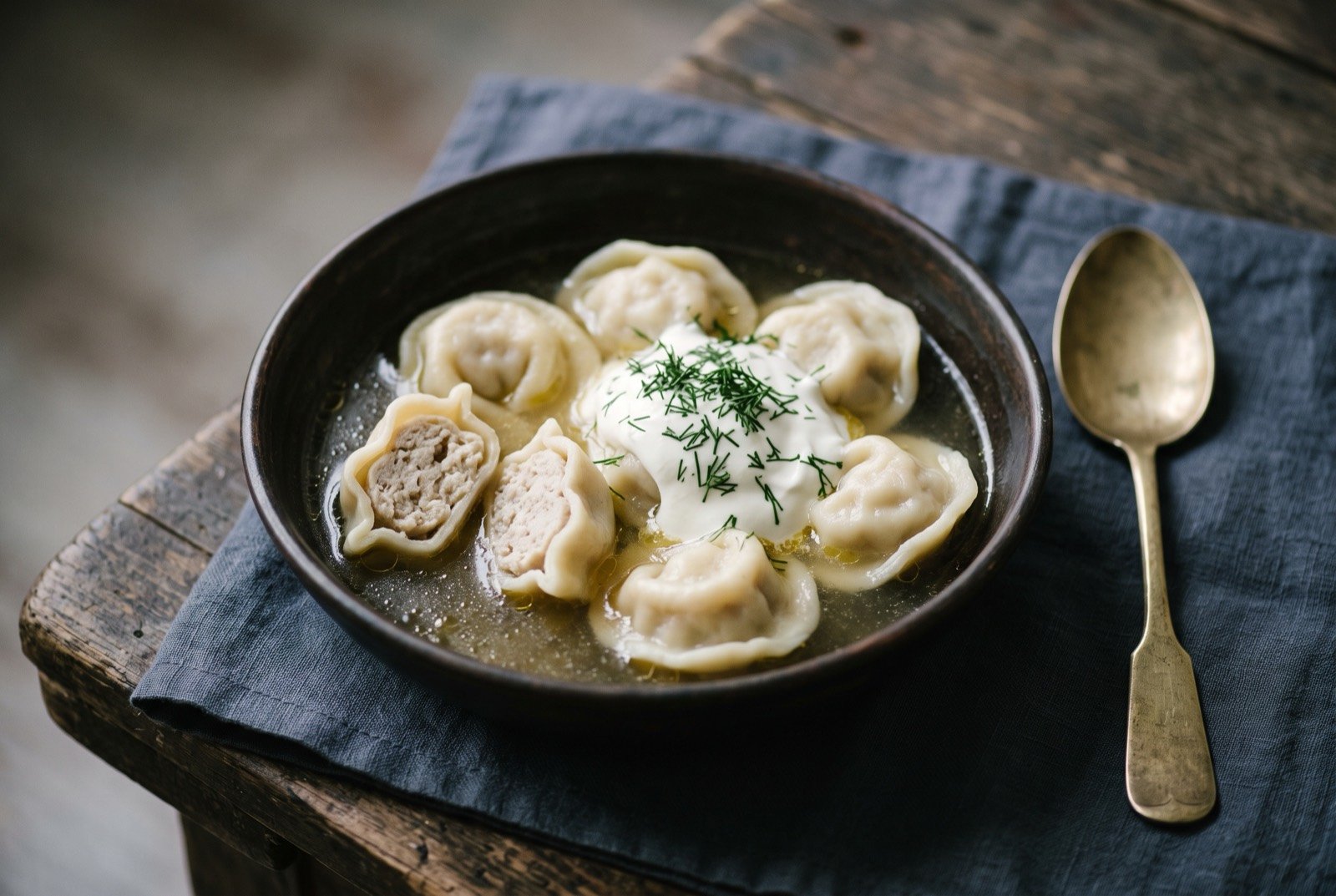
An illustration of the dish, not a photograph of it cooked.
- Time
- Not statedNo source states a time and the atlas has too few comparable dishes to estimate one.
- Reviewed
- Not yet reviewed from inside the tradition
- Cooked
- Not yet cooked and reported
Russian trade press is unambiguous that hand-shaping, not machine production, is the real dividing line between a good pelmeni and a poor one.
As tradition built it
Dough rests 20 to 30 minutes; boil the pelmeni 5 to 10 minutes once they float.
Ingredients
Dough, egg-and-water enrichment
- 1 cup plain wheat flour
- 1 egg
- 2 tbsp water
Dough, hot-water alternative
- 500 g plain wheat flour
- 250 ml water, at 70 to 75°C
- to taste salt
Filling
- 500 g minced meat
- 1 onion
- 1 egg yolk
- to taste salt and pepper
- about 70 ml stock or water
Method
Make the dough
- For the egg-and-water dough: combine plain wheat flour with egg and water, roughly a cup of flour to one egg and two tablespoons of water.
- For the hot-water dough: combine 500g flour with 250ml water at 70 to 75°C, unenriched, well salted.
- Knead either dough by hand around 15 minutes, then rest 20 to 30 minutes. Work it quickly once rolled, since its low water content dries fast.
Make the filling
- Combine the minced meat, onion, egg yolk, salt and pepper, working in around 70ml of stock or water to loosen the mix to a pipeable consistency.
Shape
- Shape by hand rather than by machine: Russian trade press is unambiguous that hand-shaping is the real dividing line between a good pelmeni and a poor one, since thinner, more evenly worked dough seals in juice more effectively, which is precisely the corner a bad diaspora kitchen cuts first.
What a modern chef changes
A confit filling, a barely-simmering poach, and a reduction built from the poaching water
Method
- Confit the filling gently before wrapping it, rather than working it raw into the dough, for a more evenly cooked, more consistently seasoned centre than a raw mince filling that cooks only as fast as the surrounding dough allows.
- Hold the finished dumplings at a barely-simmering, precisely controlled water temperature rather than a rolling boil, protecting the thin hand-worked dough from the splitting a hard boil risks.
- Serve with a reduction built from the poaching water and a spoon of home-cultured smetana, rather than smetana alone, so nothing of the filling's own flavour that leaches into the water goes to waste.