The Slavic east and the Balkans · Volume 26, Rye, the Samovar and the Sturgeon’s Retreat
Kholodets
Northern Russia
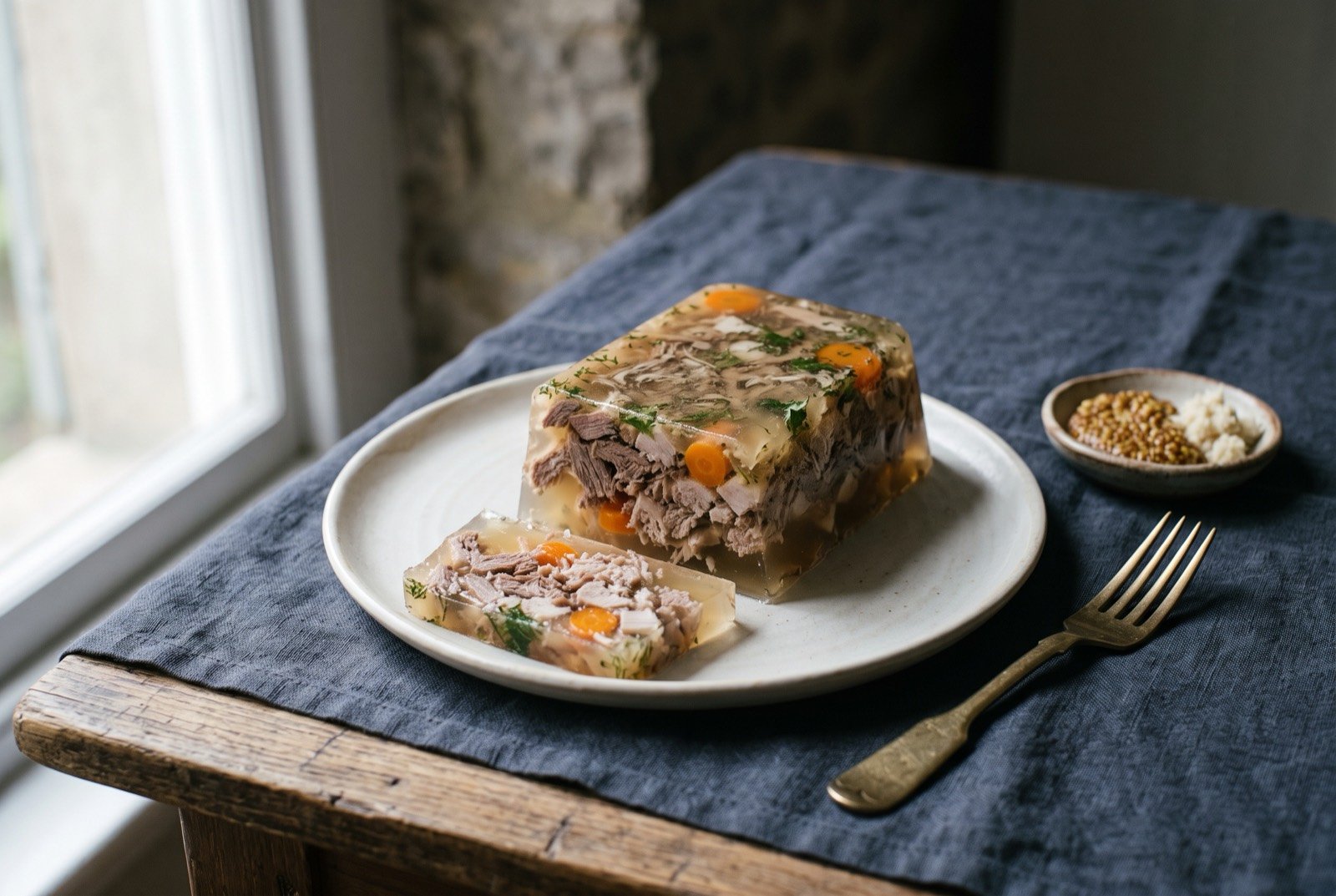
An illustration of the dish, not a photograph of it cooked.
- Time
- Not statedNo source states a time and the atlas has too few comparable dishes to estimate one.
- Reviewed
- Not yet reviewed from inside the tradition
- Cooked
- Not yet cooked and reported
Built from a mix of gelatine-rich cuts simmered at the barest possible simmer until the collagen has fully rendered out.
As tradition built it
About 8 hours to simmer, then set overnight.
Ingredients
- 3 kg gelatine-rich cuts, classically a beef head, feet and tail, or with pork, ears, tails and trotters
- about 4 litres water
- to taste onion
- to taste carrot
- to taste bay
- to taste black peppercorns
Method
- Combine the gelatine-rich cuts with water in a roughly 1:2 meat to water ratio, for example 3kg meat to around 4 litres liquid.
- Simmer at the barest possible simmer, never a rolling boil, which clouds the stock, for 5 to 8 hours, skimming regularly, until the collagen has fully rendered out.
- Add the aromatics, onion, carrot, bay and peppercorns, about an hour before the end.
- Strain and pour into moulds. If the ratio of gelatine-rich cuts to water is right, no added gelatine is needed for the finished dish to set; it sets in 6 to 7 hours, with overnight setting standard practice.
What a modern chef changes
A sous vide, clarified kholodets, plated in individual portions
Method
- Clarify the finished stock properly with an egg-white raft, for a genuinely clear, glass-like set rather than the traditionally cloudy version.
- Cook the individual gelatine-rich cuts separately under sous vide at a controlled low temperature, to extract collagen more cleanly and evenly than a single mixed pot allows, then combine the strained, clarified liquors before setting.
- Portion into individual moulds rather than one large dish, and finish with a fine dice of the meat arranged deliberately within each portion: a plating discipline that echoes New Russian Cuisine's own habit of taking an unglamorous peasant dish and giving it a considered, restaurant-register presentation without changing what the dish actually is.