West Africa · Volume 01, The Wolof-Mandinka World
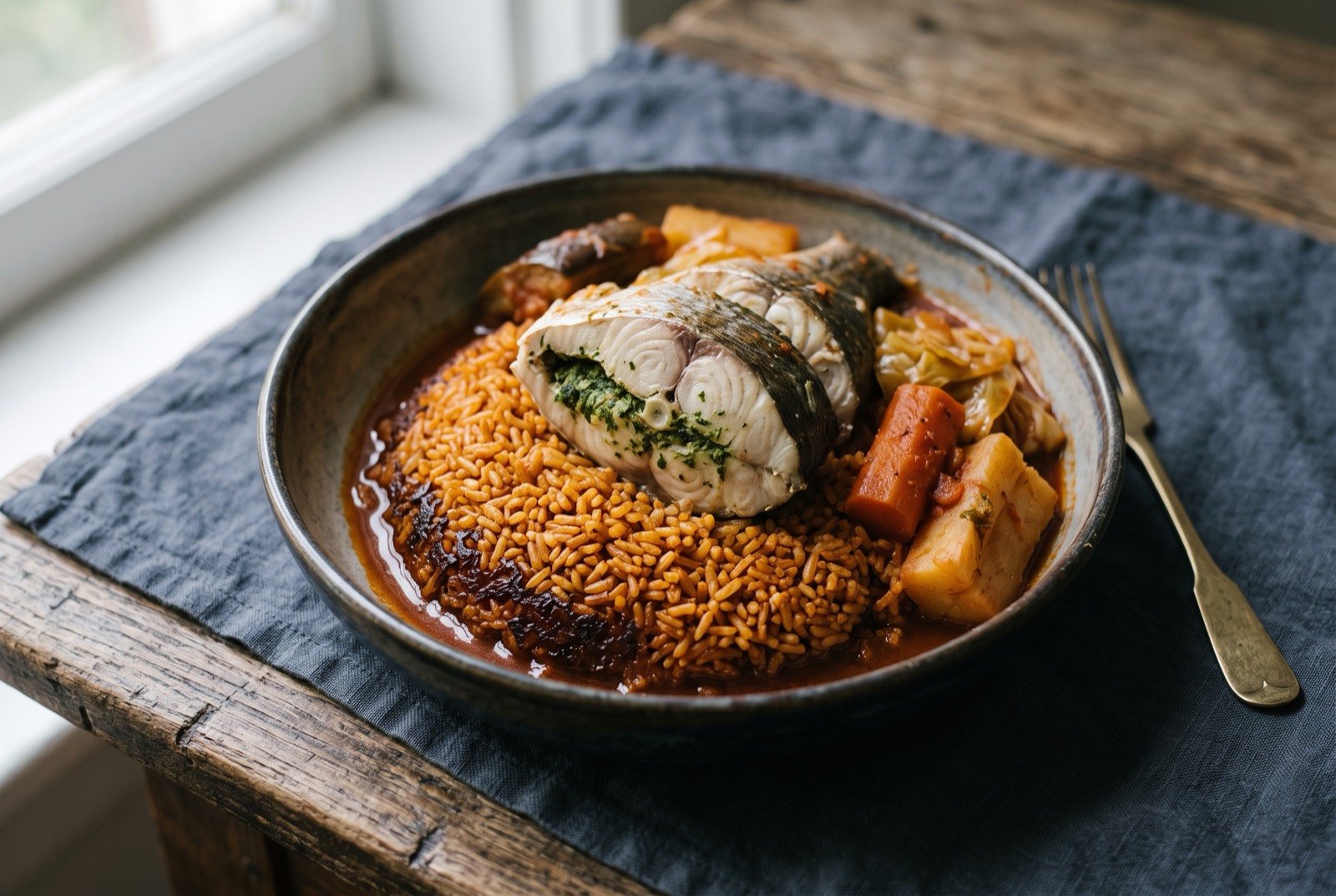
Ceebu jën
Wolof heartland
Illustration
- Time
- 2 hours
- Researched
- Researched from 160 sources in the brief
- Reviewed
- Awaiting a reader from inside the tradition
- Cooked
- Awaiting a cook report
The direct ancestor from which the whole West African jollof family descends by name, and the volume's spine.
As tradition built it
Serves 6. About 2 hours.
Ingredients
- 6 small whole white fish, gutted and scaled
- 1 bunch parsley
- 3 bird's eye chillies
- 6 garlic cloves
- to taste salt
- 2 onions, chopped
- 400 g tomatoes, crushed, plus 2 tbsp concentrate
- 30 g guedj
- 15 g yeet
- 1 aubergine
- 1 cassava
- 1 carrot
- 1 sweet potato
- a wedge cabbage
- 6 okra
- 800 g broken rice
Method
- Pound the parsley, chillies, garlic and salt to a coarse, bright green, wet paste. Do not over-blend it: a blender weeps water out of the leaf and thins the paste. This is rof.
- Cut a pocket into each fish and pack it with rof, or score deep incisions and fill them directly.
- Soften the onion in oil, add the tomato and concentrate, and cook down hard until the raw smell is gone and the fat begins to separate.
- Add the guedj and yeet, pounded, then water, then the harder vegetables: aubergine, cassava, carrot and sweet potato. Simmer.
- Add the fish gently, cook through, then lift out and set aside. Add the softer vegetables, cabbage and okra, to finish in the same broth.
- Add the broken rice to that same coloured, fat-enriched liquid. It cooks by absorbing the liquid entirely, not by boiling in separate water.
- In the last ten minutes, do not stir. Let the base form the xoon.
- Return the fish and vegetables on top to serve.
What a modern chef changes
The xoon engineered, the two ferments separated and dosed, and the fish chosen for structure
Rungs 1, 2 and 6
Method
- Use genuinely broken rice and a genuinely flat, heavy pot. Rung 1. This is not negotiable if you want the crust.
- Build a concentrated guedj and yeet stock separately, then dose it. Steep both, gently, off the boil, strain, and add back in a controlled quantity rather than pounding whole pieces into the pot and hoping. You get the same double fermentation system with a repeatable result.
- Choose your fish for the job. Rung 6. A sustainably sourced hake or coley, firm enough to stuff and hold through a long simmer, does the dish's actual job better than a wild grouper bought on the strength of its name.
- Listen for the xoon rather than timing it. The sound changes from a wet simmer to something drier just before the crust sets. That sound, not a clock, is the cue to stop stirring.