Iberia · Volume 05, The Rías, the Feira and the Road to Santiago
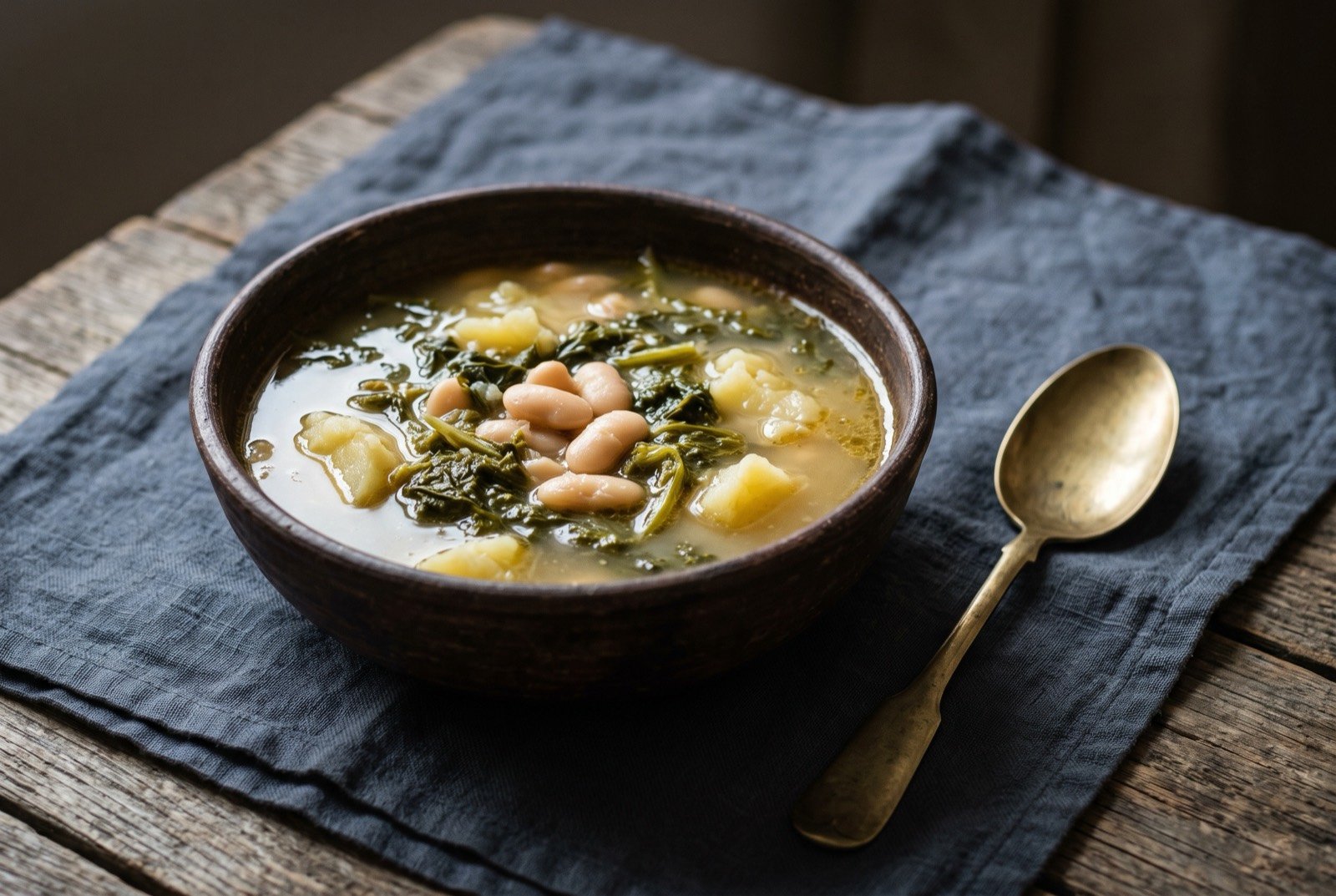
Caldo Gallego
Interior and everyday Galicia
Illustration
- Time
- Hands on 1 hour 15 · Waiting 8 hours
House style requires precision that a great deal of Spanish-language food writing skips past: caldo gallego, pote gallego and cocido gallego are three genuinely different pots, not one dish under three names. Caldo is the lightest, a broth of white beans and greens. Pote sits in the middle, beans and vegetables with some pork. Cocido is the most substantial, chickpeas and a full range of pork cuts, traditionally served in separate courses. This recipe is caldo, the everyday version.
As tradition built it
Serves 4, adapted from Karlos Arguiñano's own published recipe. About 1 hour 15 minutes, plus overnight soaking and a separate desalting soak.
Ingredients
- 200g dried white beans
- 50g unto
- 250g salted bacon
- 300g salted pork rib
- 200g pork spine
- 1kg potatoes, broken into rough pieces with a knife rather than cleanly cut
- 1 large bunch grelos, roughly chopped
Method
- Soak the dried white beans overnight.
- Separately soak the unto, salted bacon, salted pork rib and pork spine to draw out excess salt.
- Simmer the desalted meats together for 40 minutes, then add the drained beans and cook a further 15 minutes.
- Add the potatoes, broken into rough pieces with a knife rather than cleanly cut, so they release starch into the broth, and cook 10 minutes.
- Add the grelos and cook a final 10 minutes until just tender.
- Taste before adding any extra salt: the cured meats and unto usually carry enough already.
What a modern chef changes
A monitored simmer, a tasted desalt, and a reduced glaze finish
Rungs 5 and 6
Method
- Hold the whole pot at a genuinely low, monitored simmer throughout rather than trusting a stovetop dial, preventing the beans splitting and clouding the broth (Rung 6).
- Desalt the cured pork on a proper, tasted schedule rather than a fixed clock (Rung 5).
- Pass a small portion of the finished broth through a chinois and reduce it separately to a light glaze, brushed back over the plated meats and potatoes for a concentrated hit of the pot's own flavour without diluting the main broth's clarity.