Europe · Volume 05
Galicia
The Rías, the Feira and the Road to Santiago
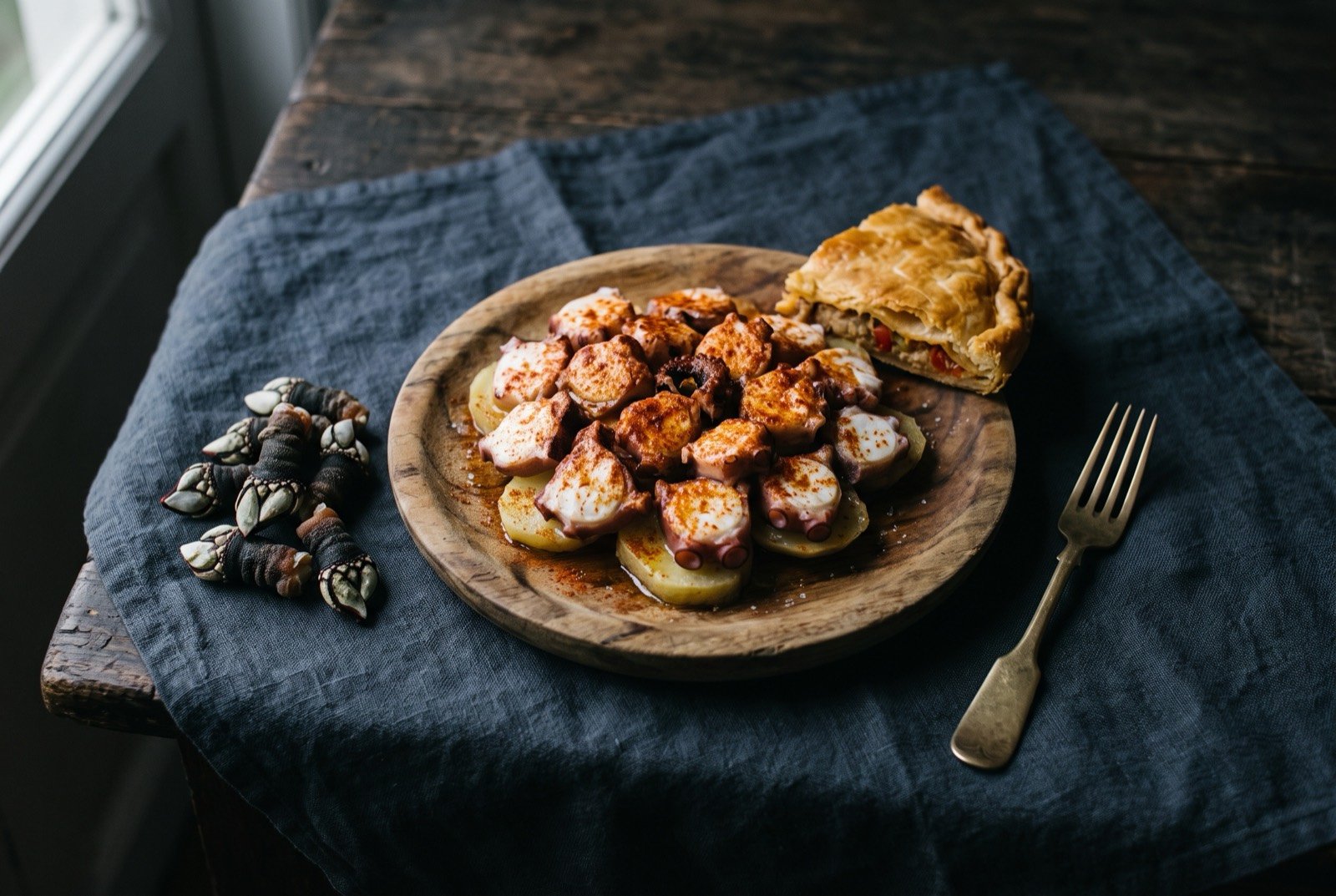
Spain's rain-soaked, Celtic-tinged northwest corner, where drowned river valleys pull cold Atlantic water into some of the richest shellfish grounds in Europe, and a thousand years of pilgrims have walked in from the east expecting to be fed. Coastal Albariño and shellfish, an inland pork and chestnut economy, one roof over two tables, and every dish as tradition built it, then what a modern chef would change.
Sources and review · What this chapter does not assert · How we research · Spotted something wrong?
A Sense of Place
Galicia sits at the corner where Spain runs out and the Atlantic takes over, and almost everything about its food follows from that single fact of geography. It rains here more than almost anywhere else in Spain, roughly 1,600 to 2,000mm a year on the coast, more inland against the mountains, and the coastline itself does not run in a clean line but folds back on itself in a series of drowned river valleys, the rías, that let the sea reach thirty or forty kilometres inland in sheltered, current-scoured inlets. That single piece of coastal geometry is the reason Galicia has a shellfish culture unlike anywhere else in Spain, and the reason this chapter has to spend real time on oceanography before it gets anywhere near a recipe.
The mechanism is called upwelling, afloramento costeiro. From roughly March to October, northerly winds blowing along the Galician coast push the surface water offshore, and the ocean replaces it with cold, nutrient-rich water drawn from two hundred metres down or more. Most coastlines let that upwelled water disperse across an open shelf. Galicia's rías instead funnel it into narrow, semi-enclosed basins, concentrating rather than diluting the nutrient pulse, and the peer-reviewed literature on this is direct: the ría's own circulation channels "the 3-dimensional variability of the open ocean into a 2-dimensional system," producing a "massive response" in plankton productivity even during comparatively weak upwelling on the open coast outside. The Rías Baixas alone carry over 3,300 mussel rafts producing roughly 250,000 tonnes of raw mussel a year, more than anywhere else in Europe, on a stretch of coastline you could drive along in an afternoon. This is not folk wisdom about clean Atlantic water. It is a specific, named, measured physical mechanism, and it is worth understanding because the same mechanism has a dark side that belongs in the same paragraph, not a caveat two pages later: the nutrient load that makes the rías so productive also drives the harmful algal blooms that periodically close the shellfish beds, and Galician and Spanish marine scientists are still actively working out why those blooms start when they do.
But Galicia is not only its coast, and a chapter that stopped at the rías would miss half the country. Inland, past the belt of shellfish towns, the land climbs into a genuinely different world: the river canyons of the Sil and the Miño, where terraced vineyards cling to slopes so steep that some of the grape harvest still comes out by boat, and a pork-and-turnip-tops economy built on curing, smoking and the annual matanza, the pig slaughter that has structured the rural year here for centuries. Coastal Galicia runs on Albariño, olive oil and quick, protective cooking of fragile shellfish. Interior Galicia runs on Mencía, cured pork fat and long, patient pots. Both are Galicia, and the difference between them is ecology doing exactly what this atlas's whole argument says it does: shaping two genuinely distinct tables under one linguistic and political roof.
Threaded through both halves is a third force that is neither ecology nor empire in the usual sense: the Camino de Santiago, the pilgrim road that has been carrying strangers into Galicia on foot for over a thousand years, all of them arriving hungry and expecting the country to feed them. That expectation built an entire pilgrim food economy, monastery kitchens, hospital broths, roadside fairs, that still shapes what Galicia serves a visitor today, right down to the scallop shell stamped in icing sugar on its most famous cake.
And underneath the coast and the interior both sits a genuine linguistic and cultural kinship this chapter has to name rather than skip past: Galician and Portuguese share a documented common medieval ancestor, Galician-Portuguese, and the food connection is real, not sentimental, caldo verde and caldo gallego are close cousins built on the same cabbage grown along the same river. Portugal's own volume, EU-10, has not been written yet, and this chapter will not pretend to write it in advance. But the connection is real, it runs both directions across a border that is younger than the cuisines on either side of it, and it deserves naming here rather than a silent omission.
The History in Layers
Pulpo á feira and the monastery it may have started in
The best documented, most consistently repeated origin story for Galicia's single most famous dish begins, of all places, in a monastery accounts ledger. Diego Arias, a Galician nobleman who had served as a captain under Queen Urraca, received the coto, the seigneurial jurisdiction, of Marín, a fishing settlement near what is now Pontevedra, as a reward for service. Widowed in his seventies, he entered the newly founded Cistercian monastery of Santa María la Real de Oseira and, on 12 May 1151, donated his possessions, including Marín's rents, houses and lands, to the monks. Oseira sits more than sixty kilometres inland, with no way to keep fish fresh, so octopus, which dries and preserves well, became the practical tribute good sent up from Marín's fishing households. A later step, dated by several sources to around 1583, has the monks fixing lower prices for octopus sold at Marín's port during Advent and Lent and distributing the surplus to parishioners, which is where the lay trade of cooking octopus and carrying it to market is said to actually begin.
This should be told carefully rather than as settled fact. The 1151 donation and the 1583 pricing detail both come from journalism and from the festival's own promotional history, not from an independently checked academic source. The underlying shape, a monastery's dried-octopus tribute economy feeding an inland lay cooking trade, is plausible and consistently repeated across separate accounts, and Oseira genuinely did exist from 1137 and genuinely did sit inland from a genuine fishing port. But it should be presented here as the strongest available account, not as nine centuries of unbroken documented practice. What is much better documented is the modern festival: O Carballiño's Festa do Pulpo was first staged specifically as such on 20 September 1964, on the banks of the Arenteiro river, credited to three named local figures, and now runs annually on the second Sunday of August. The Galician cultural chronicler Felipe Senén calls "o pulpo, Aurora Baranda e o Carballiño," Aurora Baranda being a historic pulpeira, a "santa trindade galega," a Galician holy trinity, and that is a genuinely local, in-Galician voice worth more than any tourist board's version of the same claim.
The scallop shell, the best documented thread in this whole chapter
If pulpo's origin is plausible but imperfectly sourced, the scallop shell's history as the Camino's emblem is the opposite: unusually solid, thanks to a specialist Camino reference literature built on close reading of the Codex Calixtinus itself. That mid-twelfth-century manuscript references the vieira shell three times, naming it, alongside the pilgrim's staff and pouch, as one of three spiritual attributes of anyone walking to Santiago, and its Book V separately documents an already-flourishing commercial trade in shells in the city. That trade was not an incidental souvenir business. By 1200 around a hundred shell-sellers, uices concharium, were working in Compostela; activity continues documented through 1230; and in 1272 Pope Gregory X formally recognised shell production and sale as legitimate pilgrimage commerce. Sales outside the city were suppressed as a protected local monopoly, according to one source under threat of excommunication, and shells were fashioned in everything from cheap lead alloy to jet and precious metal depending on what the pilgrim could afford. The Codex's own theological reading, preserved by that same specialist literature, held that the shell's ribbed, fanning structure "signifies good works," charity read as radiating outward the way the shell's ridges do. Pilgrims sewed real shells into their clothes and burial shrouds, placed them on home altars, built them into foundations, and the whole devotional practice was gradually suppressed as superstitious from the sixteenth century onward, replaced by medals and the newly formalised Compostela certificate. The shell's shift into a purely secular tourist object is dated specifically to the period following the 1879 rediscovery of Santiago's own relics. It is a genuinely rare thing in food history writing, a symbol whose story can be told almost entirely from primary and near-primary sources rather than repeated assertion, and this chapter leans on it accordingly.
What the Camino actually fed people, and the word that survives from it
The pilgrim food economy behind that symbol was real and organised, not incidental charity. Benedictine monasteries took on feeding pilgrims as part of their Rule from the earliest organised Camino period, and a wider network of hospitals, kings, bishops and nobles as sponsors grew up especially along the Camino Francés. The base pilgrim meal had a name, caldo de peregrinos, also called sopa boba, hot water poured over stale bread with vinegar and salt, enriched when the house could afford it with rancid bacon fat and vegetables, described in the specialist Camino literature as the direct ancestor of the regional stew traditions found along the route today. A specific word survives from this economy into modern Spanish with its original charitable meaning inverted: gallofa, from medieval Latin galli offa, a morsel for the pilgrim, named the food given to poor pilgrims from France, and then, from the sixteenth century as pilgrimage itself declined, took on a pejorative sense, describing vagrants, gallofos, who kept working the old charity circuit after the religious reason for it had faded. Inland, O Cebreiro offers the single most concrete surviving case of this economy: its pilgrim hospital dates to 835, growing in importance from 1072 under French Benedictine monks sent from the Cluniac abbey of Saint-Pierre d'Aurillac specifically to run it, a presence that lasted until Spain's mid-nineteenth-century disentailment laws finally ended it. Local tradition credits that same French monastic presence with leaving behind Queixo do Cebreiro, the cheese still made there. That attribution is repeated everywhere and traced to no written record connecting the monks to the cheese's invention, so this chapter states it as accepted local tradition, not documented fact, the same distinction it will keep making throughout.
The interior's own timeline: chestnuts, then maize, then the potato
Before either maize or the potato reached Galicia, chestnuts were the staple carbohydrate, present in the region for an estimated twelve thousand years and cultivated seriously from Roman times onward. Surviving Benedictine and Cistercian monastic documents record chestnut cultivation as the second most profitable crop after vineyards, and foral land contracts specifically required tenants to plant a chestnut grove and accepted rent paid in dried chestnuts. Maize, an American crop, arrived in the early seventeenth century, spreading first from the Mondoñedo area against initial popular resistance before reaching the whole of Galicia by the eighteenth century, and reaching roughly a third of coastal cereal production within decades of its 1630s to 1640s uptake there. It is tempting to say Galicia adopted maize faster than the rest of Spain, and this chapter will not say that: no source behind it makes that specific comparative claim, only Galicia's own, genuinely early and genuinely thorough timeline.
What maize did do, once established, was displace rye and wheat as the everyday bread grain for the rural poor from the eighteenth century, giving Galicia broa, its dense, mixed-flour maize bread, and giving filloas, the thin Galician griddle cake, a starch base distinct from a purely wheat batter. One claim about filloas circulates constantly and does not survive checking: that the dish descends from a Roman legionary preparation called phyllon. It appears unsourced even within the single encyclopaedia article that carries it, and no independent source corroborates a Roman ancestor for the technique. It belongs in this chapter's deliberately-not-asserted list, not in its history.
Ribeira Sacra: sacred riverbank, or sacred oak grove
Inland, the terraced vineyards of the Sil and Miño canyons carry a name, Ribeira Sacra, whose usual gloss, sacred riverbank, rests on a 1124 charter in which Queen Teresa of Portugal used the Latin phrase Rivoyra Sacrata. That reading has a genuine scholarly challenger this chapter is not going to smooth away. In 1987 the Galician philologist Manuel Vidán Torreira argued that a seventeenth-century transcription by the chronicler Fray Antonio de Yepes contained an error, that the Galician evolution of Latin roboreta, oak grove, is riboira or reboira, and that the phrase should actually be read as Reboira Sacra, sacred oak grove, pointing to a pre-Christian sacred grove underneath the later monastic name rather than the monasteries themselves. Both readings are attributed and argued by real scholars; neither is folklore against fact, and this chapter gives both rather than picking a side. What is not disputed is the age of the viticulture itself: Roman-era terracing shaped the canyon slopes in the first place, monks took over and refined the terraces from at least the tenth century, and a documented 876 donation gave vineyards in Sober to the monastery of Santa Cristina de Ribas de Sil specifically to fund the saying of masses. The terraces themselves are worked by hand to this day, in places on slopes reaching an 80 percent gradient with a five hundred metre drop to the river, the harvest brought out in the steepest stretches by small boat rather than any vehicle. Spain submitted Ribeira Sacra as its sole nominee for UNESCO World Heritage status in January 2025, a decision expected in July 2026, and this chapter states that as a live, pending process rather than an achieved status, since as of writing it has not yet been decided.
The Flavour Arsenal
From the sea
| Pulpo | Octopus, Octopus vulgaris specifically, traditionally frozen for 24 to 72 hours before cooking to break down its collagen structure, a genuine tenderising mechanism rather than a compromise on freshness |
| Percebes | Goose barnacles, hand-harvested from wave-battered intertidal rock by percebeiros and percebeiras working a two-hour window either side of low tide, among the most dangerous and expensive shellfish in Galician cooking |
| Centollo | Spider crab, protected by a closed summer season coinciding with its offshore spawning migration, sexed at the fishmonger's by the broadening of a mature female's abdomen |
| Mexillón | Mussel, farmed on suspended rope rafts, bateas, in the rías since the 1940s, Galicia producing more mussel than anywhere else in Europe |
| Vieira / zamburiña | The great scallop and its smaller, single-eared cousin, the vieira carrying the Camino's own pilgrim symbolism |
| Ostra | Oyster, historically centred on Arcade on the Ría de Vigo, its native flat-oyster population now the subject of an active Xunta restocking programme rather than a settled heritage stock |
| Bacalao | Salt cod, less structurally central here than in the Basque Country and Asturias to the north but still a working ingredient, particularly in empanada |
From the land
| Grelos | Turnip tops, harvested only once the plant flowers from January to Easter; the earlier vegetative leaf, harvested October to December, is a genuinely different thing, nabizas, and the two words should not be used interchangeably |
| Unto | Cured pork leaf fat, "the soul of Galician broth," the flavouring base of caldo gallego and pote gallego with no straightforward substitute |
| Lacón | Cured, salted pig's foreleg, distinct from chorizo's smoking, requiring a long soak to desalt before cooking |
| Chorizo gallego / androlla | The interior's smoked charcuterie, chorizo built from lean pork, fat, garlic and pimentón smoked over oak or chestnut; androlla the pork-rib sausage specific to eastern Lugo and Ourense, the Galician cousin of León's botillo |
| Castaña de Galicia | Chestnut, IGP-protected since 2009, the genuine pre-maize, pre-potato staple carbohydrate |
| Pimentos de Padrón | Small green peppers whose heat varies genuinely by season, water stress and heat driving capsaicin production upward, hotter in dry August than in wet June |
Cheese, wine and pimentón
| Queixo de tetilla | Soft, mild, conically shaped cow's milk cheese, DOP since 1996, first documented in writing in 1753 |
| San Simón da Costa | Smoked, pear-shaped cow's milk cheese, DOP since 1999, smoked specifically over birch, a choice originally driven by what woodworking offcuts were locally available rather than a deliberately chosen flavour |
| Albariño | The coast's defining white grape, Rías Baixas DO, high acid and a saline character that makes it Galicia's default shellfish pairing |
| Mencía | Ribeira Sacra's dominant red, lighter in colour and body than a Rioja-style red, herbaceous and peppery, built for the interior's pork and chestnut cooking rather than for fish |
| Pimentón | Sweet paprika, arriving in Galician cooking via the wider Spanish pantry from Extremadura's Vera valley rather than any Galician-grown source, and the single ingredient most responsible for whether pulpo á feira tastes of anything at all |
The Technique Ladder
The argument, from inside
Marcelo Tejedor, at Casa Marcelo in Santiago, treats pulpo á feira at three ingredients, octopus, oil and pimentón, as an ideal outcome rather than something waiting to be improved by addition, and his own kitchen's octopus technique proves the point without adding a single foreign idea to it: a slow simmer for tenderness, then a finish over hot embers for the smoke, char and crisped skin that boiling alone cannot give. That double cook, gentle first, fierce second, is the same logic Aitor Arregi applies to turbot at Elkano in the neighbouring Basque Country, and Iván Domínguez, at Nado in A Coruña, states the underlying principle almost as a manifesto: technique should "always complement the product," sometimes improving it, sometimes simply accompanying it, "but never relegating it to a secondary role." Nothing in this ladder imports a foreign method. Every rung is something a pulpeira, a percebeiro or a rural Galician cook already knew, made precise and repeatable.
Rung 1. Freeze the octopus, and understand why that is method, not compromise
Octopus flesh is unusually rich in collagen, structurally closer to meat collagen than to fish collagen, and unless that fibrous structure is broken down before cooking, the result is rubbery rather than tender. Freezing works because water inside the muscle cells expands into ice crystals that physically rupture cell walls and collagen fibres; once that structure is weakened, the collagen hydrolyses far more readily under heat into soft, unctuous gelatine. A peer-reviewed Latin American food-science study on Octopus vulgaris confirms the mechanism directly: frozen-then-cooked octopus came out measurably more tender than fresh-then-cooked, with tenderness increasing further with cooking time. This replaces the older method, apaleado, physically beating the octopus against rocks to the same mechanical end. A minimum of 24 hours' freezing is standard; 48 to 72 hours is better.
What a cook does with this rung. Buy frozen octopus without embarrassment, or freeze fresh octopus deliberately rather than cooking it straight away. A dedicated freezer or a blast chiller run to around minus 18°C for an hour, the modernist route used by Galician chefs working sous vide, achieves the same collagen disruption in a controlled, repeatable way.
Rung 2. Asustar, the three-plunge shock, before the long simmer
The octopus is held by the head and plunged in and pulled out of vigorously boiling water three times, three to four seconds submerged each time, before being left to cook through at a gentler simmer. This makes the tentacles contract evenly rather than curling or toughening unevenly, and keeps the skin adhered to the flesh through the whole cook rather than sloughing off into the water. Daniel Espasandín, a Galician chef running Los Montes de Galicia in Madrid, states the technique directly: "Debemos 'asustar' el pulpo tres veces y aprovechar el agua en la que se cuece para un resultado perfecto," we should scare the octopus three times and use its own cooking water for a perfect result.
What a cook does with this rung. A sous vide bath, held at a steady 77°C for around five hours after the initial freeze and three-plunge shock, reproduces this more precisely than a hob ever could, finishing with thirty seconds of hard heat, a hot plancha or a Big Green Egg run direct, to colour the skin. This is not a French import; it is the pulpeira's own freeze-and-shock logic made exact.
Rung 3. Treat the wooden serving plate as technique, not presentation
The traditional prato de pau, the wooden serving plate the octopus is cut and dressed on, is functional rather than decorative. Wood retains heat far longer than ceramic or metal, and the board is moistened with a little of the octopus's own cooking water before the sliced meat goes onto it, so the olive oil and pimentón emulsify slightly with the residual cooking liquid directly on the wood's surface rather than pooling and separating the way they would on a dry ceramic plate.
What a cook does with this rung. A well-scrubbed, untreated wooden chopping board, warmed slightly and dampened with a spoonful of the cooking water before the octopus goes on, reproduces this at home. Dress generously and without caution, coarse salt, pimentón dulce and picante mixed rather than one alone, and Galician olive oil poured "sin miedo," without fear, rather than measured.
Rung 4. Cook percebes for seconds, not minutes
Percebes are boiled for 30 seconds to one minute, the count starting only once the water returns to a full rolling boil after they go in, in water salted to roughly 70 grams of coarse salt per litre, deliberately simulating seawater. The single most common and most damaging failure in cooking this shellfish anywhere outside Galicia is overcooking, which turns the flesh gummy and rubbery in exactly the way a badly cooked octopus does, the opposite of the fast, briny bite the barnacle is prized for. Percebes should never be cooked ahead and reheated, and should always be eaten warm, never cold.
What a cook does with this rung. Have the pot at a genuine rolling boil before the percebes go in, use a timer rather than judgement, and serve within minutes. This is one rung where the correct modernist tool is simply discipline: resisting the urge to leave a delicate protein in the water a moment longer than it needs.
Rung 5. Desalt cured pork on a schedule, not by guesswork
Lacón and other salt-cured Galician pork require a proper soak before cooking, traditionally 24 to 48 hours in cold water changed every eight hours, to draw the curing salt back out before the meat goes into caldo gallego, pote or lacón con grelos. Skipping or rushing this step, the same failure this atlas's Basque and Cantabrian chapter flags for bacalao, leaves the finished dish inedibly salty rather than seasoned.
What a cook does with this rung. Weigh the cut and judge the soaking time against its thickness rather than a fixed clock, tasting the soaking water itself partway through: if it still tastes strongly of salt, it needs longer.
Rung 6. Scare the pot, don't boil it
The same low, patient simmer this atlas's Cider and Cod Coast chapter documents for fabada and cocido montañés applies equally here, to caldo gallego and pote gallego both: a hard, rolling boil agitates the beans against each other and against the pot violently enough to split their skins, clouding the broth and releasing starch unevenly, where a bare simmer lets them soften from the inside without that mechanical damage.
What a cook does with this rung. Hold the pot at a genuinely low simmer, checked rather than left to run, and let a pote or caldo gallego rest and improve overnight before it is eaten a second time, which every source behind this chapter agrees it does.
The Ferment and Preserve Bench
Galicia's preserving tradition runs through cured pork and salted fish rather than dedicated fermentation, and the two traditions worth keeping on a British bench are lacón and unto.
Lacón galego, the cured pig's foreleg carrying Indicación Xeográfica Protexida status since 1997, is salted, washed, rested and matured over roughly 35 days before it is ready, then needs its own 24 to 48 hour desalting soak before cooking, exactly as Rung 5 above describes. Unto, the fat surrounding the pig's intestines, distinct from tocino, the plainer back or belly fat, is washed thoroughly, traditionally in running water, then cured in salt for roughly a fortnight before being cleaned and wrapped for use as the flavouring base of Galician broths. Neither of these has a straightforward UK substitute, and this chapter says so honestly in the sourcing section below rather than inventing one.
Chorizo gallego and androlla, the interior's smoked sausages, both depend on smoking over oak or chestnut wood for their character, chorizo built from lean pork, back fat, garlic and pimentón, androlla, the eastern Lugo and Ourense speciality, built instead from chopped, seasoned pork rib meat and skin, garlic, oregano, white wine and pimentón, smoked over oak for around two months. One plausible-sounding product does not survive checking and belongs here as a correction rather than a recommendation: "Chosco de Vilalba" is not an IGP-protected Galician product. The IGP-protected chosco found in research is Chosco de Tineo, from neighbouring Asturias; Vilalba's own protected product is Capón de Vilalba, a castrated cockerel, an entirely different foodstuff.
Sourcing in Britain
Verified August 2026, against retailers' own current listings, matching the standard set by this atlas's Basque, Cantabrian and Asturian volume. Where a genuine gap exists, it is stated as a gap rather than papered over.
Octopus
Buy frozen without embarrassment: freezing is the tenderising method itself, not a compromise on freshness. If buying fresh, check the species. The Cornish Fishmonger (thecornishfishmonger.co.uk) sells Cornish-caught octopus explicitly labelled Octopus vulgaris, confirmed by its double sucker rows, the diagnostic feature separating it from the more commonly landed curled octopus, Eledone cirrhosa, a real, edible but genuinely different species and texture; Wing of St Mawes is the same company under its wholesale name, not a second independent source. Failing that, Asian and Mediterranean grocers such as Wing Yip and SeeWoo reliably stock frozen whole octopus as a category staple.
Pimentón
La Chinata and Santo Domingo, both genuine DOP pimentón de la Vera, stocked in all three grades, dulce, agridulce and picante, by Brindisa and Melbury & Appleton. This is the single ingredient most worth getting right: the common UK mistake is buying a supermarket own-brand jar labelled simply "smoked paprika," carrying no DOP mark and no named producer, which is often a cruder, barely smoked product. Check for the words "Pimentón de la Vera DOP" on the tin.
Albariño and Mencía
Mar de Frades, a genuine DO-stamped Rías Baixas Albariño, is stocked at Tesco itself, no specialist merchant required for a genuinely correct bottle. Majestic Wine runs dedicated Rías Baixas and Ribeira Sacra categories; the latter is real but thinner on the ground than the coastal wine, findable rather than a household name.
Percebes, zamburiñas and centollo: an honest account
Fresh percebes are essentially unobtainable in the UK; this chapter does not pretend otherwise, and treats their absence as something to name rather than solve. Tinned percebes from a genuine Galician cannery are the realistic route where they can be found through a Spanish deli importer. Zamburiñas are thinly available frozen. Centollo inverts the expected direction of travel entirely: the great majority of UK-caught spider crab is exported to France and Spain rather than sold at home, so a British cook is better served by a good Cornish fishmonger, sometimes marketing the same animal as "Cornish king crab," than by hunting a Spanish import of a British-caught species.
Queso de tetilla and San Simón da Costa
Both are genuinely well represented in UK specialist retail. Brindisa stocks Tetilla and runs a physical Cheese Rooms counter in London; Basco Fine Foods and Lunya both stock San Simón da Costa under the named Prestes brand. Check for the DOP mark against a generic "Spanish cheese" substitute either way.
Lacón, chorizo gallego and unto
Here the honest gaps outweigh the finds. No UK retailer with a confirmed, currently listed Lacón Gallego product was found across the major Spanish specialists; R Garcia and Sons, a genuine, long-running Portobello Road delicatessen established in 1957, is worth a phone call before assuming it does not exist in physical stock. Genuine unto has no UK retailer at all; a good butcher's leaf lard or back fat, salted and rendered slowly into the broth, is the nearest workable substitute, with pancetta or guanciale, used sparingly, as a flavour analogue rather than a true one.
Tinned Galician conservas
The best-served category in this chapter. The Tinned Fish Market and Brindisa both stock genuinely Galician mussels and cockles from named canneries, Real Conservera Española, Los Peperetes and La Brújula among them. The tell for a generic substitute is the absence of "Galicia," "Rías" or a named Spanish cannery on the label.
Kit note
No UK stockist was found for a dedicated copper octopus pota or a Galician wooden serving plate; a heavy stainless or enamelled cast-iron stockpot, and a well-scrubbed, warmed wooden chopping board, do the same jobs adequately at home. A sous vide bath, held at the low, steady temperatures pulpo and lacón both traditionally depend on, is a genuinely more precise version of what a pulpeira already does by hand and eye, not an imported shortcut.
Ranked: what decides great from grim
- Correct octopus species and the freezing step, understood as method. The single biggest lever on this chapter's signature dish.
- Genuine DOP pimentón de la Vera, by name. Decides whether pulpo á feira tastes of anything at all.
- A named Rías Baixas DO Albariño. Mar de Frades at Tesco proves the real thing needs no specialist hunt.
- Real Galician tinned mussels and cockles over a generic tin.
- DOP-checked Tetilla or San Simón da Costa, not "Spanish cheese."
- Accepting the honest gaps rather than faking them. Percebes, unto and Lacón Gallego are all genuinely hard to find fresh in Britain.
- Centollo: buy British, not Spanish. The counter-intuitive one, and worth remembering.
Voices and Sources
This chapter draws on Galician regional press, principally La Región, El Correo Gallego, Diario de Pontevedra and El Progreso; national Spanish outlets running dedicated Galicia desks, particularly El Español's Quincemil vertical; the official regulatory bodies for Galicia's protected foods, Agacal, the DOP Mexillón de Galicia, the DOP Tarta de Santiago and the Consello Regulador da Ribeira Sacra; Xacopedia, a specialist Camino de Santiago reference encyclopaedia, for the pilgrim food economy and the scallop shell's documented history; and named quotes from Galician chefs and percebeiros themselves, Marcelo Tejedor, Iván Domínguez, Daniel Espasandín, Amador Vilela and José Manuel Sánchez among them. Two independent peer-reviewed food-science papers anchor the octopus-freezing mechanism. A consistent, honestly flagged gap runs through the research behind this chapter: La Voz de Galicia and Faro de Vigo, Galicia's two largest regional papers, could not be reached directly as primary sources, and no Galician-language-only outlet, Sermos Galiza or Nós Diario among them, was reached as a primary source for a historical claim. Full citation detail and the complete source provenance sit in the research briefs behind this chapter, `briefs/EU-05-tradition.md` and `briefs/EU-05-modernist-sourcing.md`.
Things this chapter has deliberately not asserted
- A single, confidently dated origin for pulpo á feira resting on independent academic history. The 1151 monastic donation and 1583 pricing detail come from journalism and the festival's own promotional material, presented here as the strongest available account, not settled fact.
- Who actually built the first Galician mussel raft, the batea. Three separately named claims exist alongside one documented, tragic failed 1932 attempt; this chapter presents the dispute rather than adjudicating it.
- That "Ribeira Sacra" definitively means "sacred riverbank." A genuine, unresolved philological disagreement exists between that reading and a scholarly "sacred oak grove" argument; both are given, attributed, neither settled.
- That Galicia adopted maize meaningfully faster than the rest of Spain. Galicia's own early, thorough timeline is well supported; the comparative claim against the rest of the country is not, and is not made here.
- That filloas descend from a Roman legionary dish called phyllon. Unsourced even in the single article that repeats it.
- That "Chosco de Vilalba" is a real, IGP-protected Galician product. It is not; Vilalba's actual protected product, Capón de Vilalba, is an entirely different foodstuff.
- A first documented attestation for lacón con grelos as a named dish. The antiquity of curing pork and eating grelos separately is well documented; the specific combination's own first written record was not found.
- That queixo do Cebreiro was documentarily created by the French Aurillac monks, as opposed to being a well-established but undocumented local attribution to their presence.
- A 1577 origin for Tarta de Santiago under a named cleric. Not found on the DOP's own official history, and treated here as unconfirmed.
- A specific genetic study tying Padrón peppers' variable heat to a named gene mechanism. The general Capsicum genetics are real and published; no source ties them specifically to the Padrón cultivar.
- That fresh percebes, unto or Lacón Gallego are readily available in the UK. All three are named as genuine gaps in the sourcing section rather than smoothed over.
- Any content properly belonging to Portugal's own volume. The galego-português kinship is real and named here, caldo verde and caldo galego's shared lineage the one concrete thread this chapter draws, but Portugal's cuisine itself waits for EU-10.
Freeze the octopus, and understand why that is method, not compromise
Octopus flesh is unusually rich in collagen, structurally closer to meat collagen than to fish collagen, and unless that fibrous structure is broken down...
Asustar, the three-plunge shock, before the long simmer
The octopus is held by the head and plunged in and pulled out of vigorously boiling water three times, three to four seconds submerged each time, before being...
Treat the wooden serving plate as technique, not presentation
The traditional prato de pau, the wooden serving plate the octopus is cut and dressed on, is functional rather than decorative.
Cook percebes for seconds, not minutes
Percebes are boiled for 30 seconds to one minute, the count starting only once the water returns to a full rolling boil after they go in, in water salted to...
Desalt cured pork on a schedule, not by guesswork
Lacón and other salt-cured Galician pork require a proper soak before cooking, traditionally 24 to 48 hours in cold water changed every eight hours, to draw...
Scare the pot, don't boil it
The same low, patient simmer this atlas's Cider and Cod Coast chapter documents for fabada and cocido montañés applies equally here, to caldo gallego and pote...
The dishes
- Pulpo á Feira Coastal Galicia
- Empanada Gallega de Berberechos Coastal Galicia
- Percebes Coastal Galicia
- Centollo Coastal Galicia
- Caldo Gallego Interior and everyday Galicia
- Mejillones a la Gallega Coastal Galicia
- Lacón con Grelos Interior Galicia
- Filloas Both coast and interior
- Tarta de Santiago Compostela
Sources and review
- Researched
- No outside sources linked
- Reviewed
- Not yet reviewed from inside the tradition
- Cooked
- Not yet cooked and reported
Where this volume comes from
3 research briefs on file for this volume, researched to the rules on How we research. Published 28 August 2026. Last changed 7 September 2026.