Europe · Volume 09
The Canary Islands
Gofio, the Guanche Grain Beneath a Castilian Table
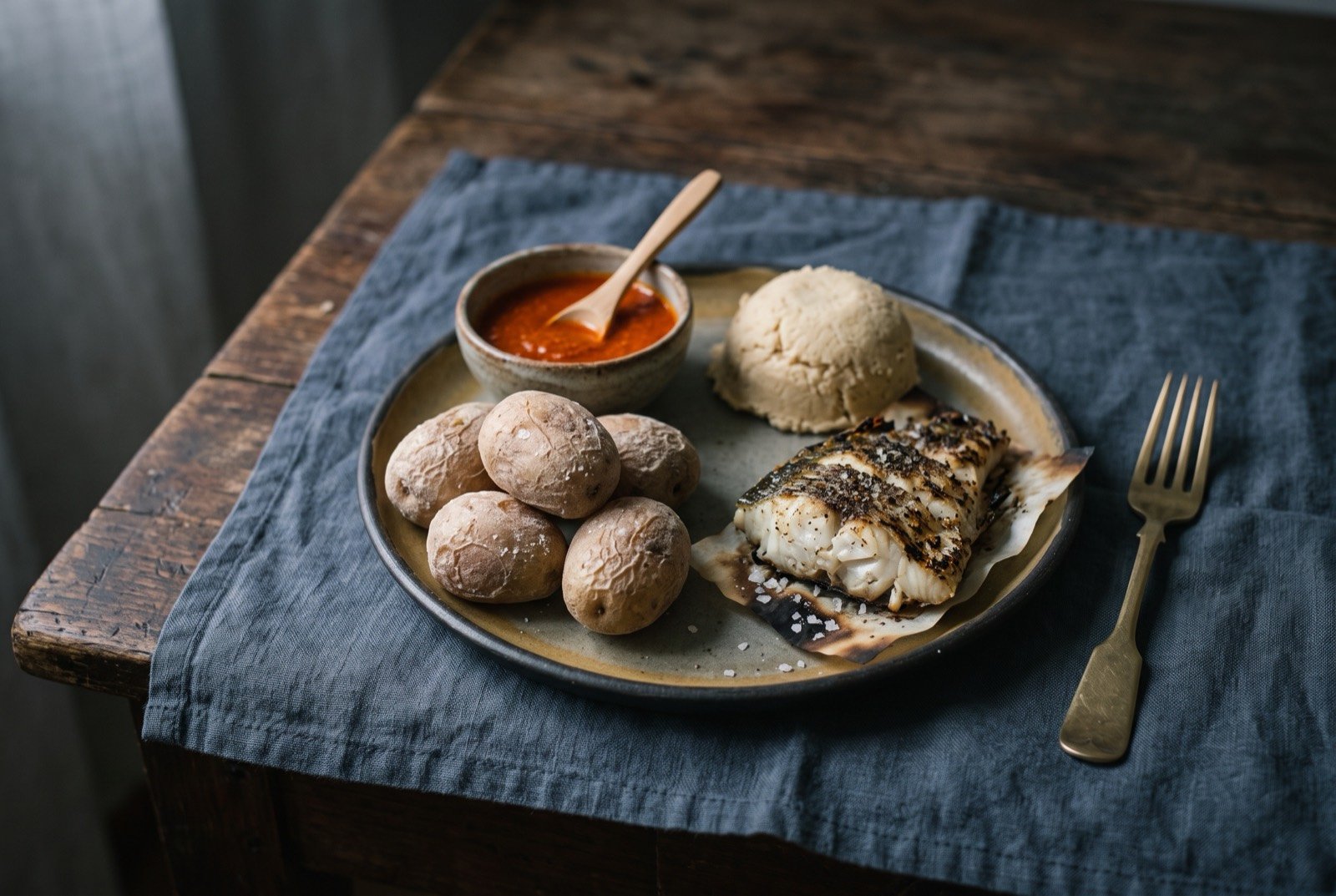
Seven volcanic islands off Western Sahara, ruled by Castile since the fifteenth century: African-adjacent Atlantic territory administered as European soil, its food carrying both facts honestly. Beneath what Castile brought sits a genuine pre-Hispanic foodway: gofio, the Guanche toasted-grain flour, still the islands' most-eaten starch. Every dish as tradition built it, then what a modern chef would change.
Sources and review · What this chapter does not assert · How we research · Spotted something wrong?
A Sense of Place
Seven islands, and no single one of them “the Canaries”
The archipelago runs from Lanzarote and Fuerteventura in the east, flat, arid and geologically the oldest of the group, close enough to the Sahara that Saharan dust storms, calima, regularly cross the strait, through Gran Canaria and Tenerife at the centre, the two largest, most populous and most agriculturally varied islands, Tenerife home to Mount Teide, Spain's highest peak, to La Gomera, La Palma and El Hierro in the west, the wettest, steepest and most isolated of the seven, closer in feel to a fragment of cloud forest than to a Spanish holiday island. A cuisine built for one of these islands does not automatically describe another: Fuerteventura's semi-desert goat economy and Lanzarote's ash-buried vineyards have almost nothing ecologically in common with La Gomera's laurel-forest ravines or La Palma's chestnut woodland. What holds the seven together as one culinary region is not shared terrain but a shared history: a pre-Hispanic foodway common to all of them before conquest, and a single Castilian and then Atlantic-trade layer imposed on all of them afterward.
The Guanche and the Canarii, named precisely
Popular usage now calls every pre-Hispanic Canarian a “Guanche,” and this chapter uses the term precisely instead, because the conflation would be visible and irritating to a Canarian reader. Guanche properly names only the aborigines of Tenerife, organised into nine kingdoms, or menceyatos, Daute, Abona, Taoro, Adeje, Anaga, Icod, Güímar, Tegueste and Tacoronte, each ruled by a mencey, with island tradition holding that all nine descended from a single mencey of Adeje named Gran Tinerfe, who divided the island among his sons. The aborigines of Gran Canaria are correctly called canarios or, in the Latin chronicles, canarii, organised into guanartematos that had consolidated by the conquest into two, Gáldar and Telde, each under a guanarteme. Each of the other islands carried its own aboriginal population and name again. This chapter follows Canarian usage and reserves “Guanche” for Tenerife specifically, using “aboriginal Canarian” or naming the island's own people where the broader archipelago is meant.
An unusually well-evidenced pre-Hispanic diet
What the aboriginal Canarians actually ate is better documented than most pre-literate societies anywhere, not through folklore but through real archaeological method: isotope analysis, archaeobotany and radiocarbon dating applied to hundreds of aboriginal remains, cross-checked against the earliest Castilian chronicles. The picture that emerges is a diet built overwhelmingly on meat and dairy, goat and pig above all, with barley-milled gofio as the carbohydrate staple, and a real, measurable class gradient: isotope analysis of mummified elite remains against ordinary burials shows the elite ate meaningfully more meat and dairy than commoners did. Tenerife's own archaeological record shows real internal variation too, the island's damper north, from Tacoronte to La Orotava, leaning more on foraged and wild plant food, its drier south more purely pastoral. Archipelago-wide comparison tells the same story at a larger scale: Gran Canaria and Tenerife, the two islands richest in arable land, show the most agriculturally stable diets and the lowest isotopic variance of the whole group, while the western islands, La Palma, La Gomera and El Hierro, leaned harder on wild plants, fern-root flour and shellfish in years of scarcity, and the arid eastern islands, Lanzarote and Fuerteventura, show diets adapted specifically to drought.
The structural logic, at a glance
| Tenerife and Gran Canaria | La Gomera, La Palma and El Hierro | Lanzarote and Fuerteventura | |
|---|---|---|---|
| Staple grain | Gofio, barley and wheat, later maize | Gofio, and La Palma's chestnuts as a real secondary starch | Gofio, leaning more toward wheat and barley than maize |
| Fat | Olive oil, pork fat | Goat's cheese fat, palm honey as a sweetening fat-substitute | Goat's cheese, olive oil |
| The preserving discipline | Salt-drying fish, cheese ageing | Palm sap reduction, hard-cheese ageing | Salt-drying fish (jareas), enarenado dry farming |
| Aromatic | Coriander, garlic, cumin | Garlic, local dried pepper | Garlic, cumin |
| The defining answer | Papas arrugadas and the mojo family | Isolation-built specialities: almogrote, miel de palma | Volcanic-ash agriculture and Malvasía wine |
The History in Layers
A grain toasted before it is ground
Gofio's own name is pure Guanche vocabulary, confirmed by the Real Academia Española's historical dictionary as a word with no Castilian root, naming flour milled from grain that has first been toasted. Before the conquest it was made from barley and wheat only, both already present on the islands, with lentils and other legumes and seeds eaten in leaner periods, and, on the driest and most isolated western islands specifically, fern-root flour used as genuine emergency food. Maize did not exist on the islands before contact with the Americas; it arrived only after 1492 and was folded into the older grain repertoire rather than replacing it, so that a bag of gofio today is as likely to be maize as the wheat and barley the aboriginal islanders actually milled. The toasting itself was done on a flat, half-moon shaped clay dish, and the toasted grain then ground on hand querns turned with a small goat bone as a handle, a piece of everyday technology that differed by island: Tenerife's Guanche used loose basalt blocks taken from volcanic cones, worked with stone picks and a wooden mallet, while Gran Canaria's canarii instead carved their querns directly into the walls of tuff, compacted volcanic ash, quarries, using a harder basalt pick alone. Both methods left grit in the finished flour, and the aboriginal skulls held in Gran Canaria's own archaeological museum, El Museo Canario, show severe dental wear from exactly that grit, premolars worn down to the pulp cavity from a lifetime of gofio eaten daily. A single sixteenth-century Castilian chronicle line, “esta harina llamaban gofio, la cual cernida era su ordinaria comida,” they called this flour gofio, which, sifted, was their ordinary food, is as close as the written record comes to hearing the aboriginal islanders describe their own staple in their own words.
A conquest documented as a rehearsal for America
Castile's conquest of the archipelago ran across most of the fifteenth century, beginning with Lanzarote in the early 1400s under Norman and French lords acting for the Castilian crown, and ending with Tenerife and Gran Canaria falling later in the century after longer, harder resistance from the island kingdoms. Spanish historiography treats this conquest as a documented dress rehearsal for what followed in America: the same capitulación, a royal contract granting a named individual the right to conquer and govern territory on the crown's behalf in exchange for a share of the proceeds, used here first and then again, almost unchanged, across the Atlantic. What the conquest actually put on the Canarian table was wheat proper, alongside the barley and wheat gofio the islands already grew, new livestock breeds, sugar cultivation, wine culture, and, once contact with the Americas opened in 1492, the potato, the tomato, maize and the sweet potato, crops that did not merely add to the old Guanche pantry but became structurally central to island cooking within a few generations. The Canary Islands' position, the last European soil before the Atlantic crossing, meant American crops often arrived here before they reached the Spanish mainland, and papas antiguas, the heritage potato varieties still grown on Tenerife today, are Andean landraces from the Peru and Bolivia highlands around Lake Titicaca, preserved on the islands essentially unchanged since shortly after 1492, distinct from the varieties that continued on to mainland Europe and were bred differently there.
A dish that entered the Spanish dictionary, and the fast day behind it
Sancocho canario is specific enough to Canarian identity that the Real Academia Española added it to the Spanish dictionary only in 2022, one of over three thousand new entries that year, defined there as the islands' own stew of potatoes, sweet potato, desalted salt fish and spicy mojo. The dish's fixed place on the Canarian calendar, eaten specifically on Good Friday, is the clearest surviving trace of the Catholic fasting calendar layered onto an older subsistence habit of salting fish for keeping: a dish built to satisfy a fast day's ban on meat used exactly the preserved protein an island economy without refrigeration already depended on for the rest of the year.
Ash farming as a documented answer to catastrophe
The single best-dated agricultural turning point in this chapter belongs to Lanzarote. Between 1730 and 1736, the longest continuously recorded volcanic eruption sequence in the archipelago's history buried the island's most fertile farmland under a thick layer of black volcanic ash and lapilli, locally rofe or picón, forming the Timanfaya massif. Rather than abandon the land, farmers dug down through the ash to reach the buried, still-fertile paleosoil beneath, planting directly into each exposed pocket while leaving the surrounding ash layer largely undisturbed, since the porous volcanic material itself turned out to trap overnight dew and atmospheric humidity and release it slowly into the soil beneath, functioning as a genuine passive irrigation system in an environment that receives very little rain. This technique, enarenado, and its most famous expression, La Geria's hand-dug hoyos, is a Lanzarote story specifically, later adopted more thinly elsewhere in the archipelago, and this chapter treats it as such rather than folding it into a general Canarian farming method it does not equally describe.
A named producer economy that collapsed within a generation
The Canary Islands' nineteenth-century cochineal economy is worth naming honestly because it explains why prickly pear cactus, otherwise a marginal ingredient in this chapter, covers so much of the archipelago's land today. The cactus was introduced in real agricultural scale from the mid-1800s specifically to farm cochineal, the scale insect Dactylopius coccus, which lives on it and yields carminic acid, a valuable natural red dye. That entire export economy collapsed within a few decades once synthetic aniline dyes reached the market from 1856 onward, and more decisively through the 1870s and 1880s, leaving the cactus itself, prickly pear, behind as rural food, forage and smoking material rather than as the industrial crop it was actually planted to be.
An honey that is not honey, and a status still unresolved
Miel de palma, La Gomera's palm honey, is not honey in the apicultural sense at all: it is a syrup made by boiling down guarapo, the sap of the Canary palm, a process documented since at least the eighteenth century and, by every account, essentially unchanged since. What is genuinely live and unresolved, rather than settled, is its legal status: La Gomera's producers have actively sought Denominación de Origen or Indicación Geográfica Protegida protection in recent years, complicated by the fact that EU honey-labelling law reserves the word “miel” for bee honey, putting the product's own name in tension with the protection it is seeking. The Real Academia Española added “miel de palma” to the Spanish dictionary in December 2021, defined explicitly as this specific La Gomera syrup, a genuine linguistic recognition, but distinct from and no substitute for the DO or IGP status the product does not yet hold. This chapter states that status as pending, not settled, because that is what the evidence actually shows.
The Flavour Arsenal
Gofio, toasted before it is milled
Covered in full above. What belongs here as a working ingredient note: gofio has carried EU Indicación Geográfica Protegida status archipelago-wide since February 2014, and shops sell it in several distinct grains, pure wheat, pure maize (millo), pure barley, and blends of several grains sometimes cut with vegetables or soya, each with a genuinely different flavour and grind, not interchangeable versions of one product.
The pepper family behind mojo, named properly rather than lumped as one
Two named local pepper landraces do real work in this chapter rather than sitting as generic “chilli”: pimienta picona, associated above all with Tenerife, medium to high heat with earthy, fruity notes, and pimienta palmera, La Palma's own small, thick-fleshed cultivar, used dried, its documented use extending even into La Gomera's almogrote, evidence of real inter-island exchange of this one pepper. Folk names collected for these local peppers, Puta la Madre, Rabiosa, Palmera, Picona, are worth naming once as texture rather than treated as a real taxonomy.
Three cheeses, three protected origins, three different coagulants
Queso de flor de Guía, from three named Gran Canaria municipalities, Santa María de Guía, Gáldar and Moya, holds EU DOP status since September 2010 and is coagulated not with animal rennet but with dried thistle flower, cut in April and May and dosed carefully into a blend of Canarian sheep's and cow's milk, giving a thin yellowish rind over a creamy, fatty, faintly bitter paste. Queso Palmero, La Palma's own DOP since September 2001, is made exclusively from the island's own Palmera goat breed, coagulated instead with natural rennet from suckling kid goats over roughly forty-five minutes, and where it is smoked at all, over almond shell, prickly pear pad or Canary pine. Queso Majorero, from Fuerteventura's native Majorera goat, was in 1996 the first Denominación de Origen goat cheese granted anywhere in Spain, and its regulation permits up to fifteen per cent sheep's milk in the version destined for long ageing, a real, sanctioned accommodation of mixed herding rather than an insistence on cheese purity for its own sake.
Cochino negro canario, an endangered heritage pig
The archipelago's only native pig breed, present since the aboriginal islanders themselves, oldest remains found on La Palma, and descended from Mediterranean pig stock. Before other breeds arrived it functioned, in the phrase used by the breed's own recovery programme, as the household's natural recycler. It is now genuinely endangered, roughly three thousand animals and around six hundred breeding sows, and is the subject of an active joint recovery programme run by the Cabildo de Tenerife and a dedicated breeders' association working toward Spain's official autochthonous-breed seal. Its chops are named specifically as the cut most prized for juiciness and intramuscular fat.
Malvasía Volcánica, a grape that barely exists anywhere else
Lanzarote's signature grape, grown almost entirely within the enarenado system described above, accounts for roughly seventy per cent of the region's production and is described by wine specialists as functionally endemic to the island's volcanic terrain, found nowhere else in meaningful quantity. It is made across a genuine dry-to-sweet range, and its mineral, saline character is attributed directly to the volcanic soil and the vineyards' coastal exposure.
Vieja, the fish islanders themselves rate above all others
Parrotfish, up to fifty centimetres, taken from rocky, algae-rich seabeds and consistently named across sources as the most prized fish in island cooking, ahead of anything imported or farmed. The pre-Hispanic fishing method for catching it in shallow rock pools, embarbascar, stunning fish using sap pressed from endemic Canarian plants, is real ethnographic record, not folklore, and belongs beside gofio as one of this chapter's clearest surviving pre-Hispanic techniques.
The Technique Ladder
The argument, from inside
Every technique in this chapter answers to one of two forces: an island with too little fresh water and no refrigeration, or a colonial and Atlantic-trade layer that brought new ingredients without displacing the older methods built to handle scarcity. Salt draws water from fish because that water is what spoils it. A grain is toasted before it is ground because toasting builds flavour a raw grind cannot reach on its own, and because a toasted grain keeps far longer than a raw one in a hot climate. A marinade runs a full day because a full day is what wine, vinegar and garlic actually need to work all the way into a lean, farmed rabbit. None of it is decorative, and a technically capable home cook can reproduce most of it properly by respecting exactly what constraint it was built to answer.
Rung 1. Boil in near-seawater salinity, then dry the pot down hard
Papas arrugadas depend on a specific two-stage process: potatoes boiled unpeeled in water salted closer to seawater than to any ordinary cooking liquid, until tender, then most of that water poured away and the empty-looking pot returned to high heat, uncovered, shaken and stirred until the surface moisture is driven off entirely and the skins wrinkle under a visible white salt bloom. Skip the second, dry-down stage and the potatoes are merely salty and wet rather than genuinely arrugadas.
Rung 2. Build mojo as a real emulsion, not a poured sauce
Mojo is traditionally beaten, in the words of the Canarian sources behind this chapter, as if mounting a mayonnaise: a true oil-in-acid emulsion of olive oil, vinegar, garlic and either paprika and dried chilli for mojo rojo or fresh coriander for mojo verde, worked together in a mortar or blender until it holds rather than separates. It is worth being precise about what mojo is not: it shares an emulsifying logic with Basque pil-pil, covered elsewhere in this atlas, but pil-pil emulsifies cod's own gelatine, not egg or mustard chemistry, and mojo's binding mechanism is closer again to a garlic mayonnaise. Treat the comparison as a teaching analogy for a home cook learning to build an emulsion by hand, not as a claim that the two sauces work the same way.
Rung 3. Toast the grain properly before you grind it, and choose your rehydration on purpose
Gofio's whole character depends on toasting done well before milling, and on choosing deliberately between its several traditional forms once ground: escaldón, hot broth kneaded directly into gofio in a clay bowl until it forms a thick paste, finished with red onion, fresh cheese and mojo; pella, a firmer dough of gofio worked with water, salt, oil and often honey or almonds, a form traced back to the aboriginal islanders' own practice of kneading gofio with milk or palm sap; and gofio simply stirred into milk or coffee. These are not interchangeable presentations of the same idea, and a chapter that treats them as one loses exactly the distinction a Canarian kitchen makes without thinking about it.
Rung 4. Give a wine and vinegar marinade its full day
Conejo al salmorejo's marinade, oil, wine, vinegar, garlic, pimentón, cumin and herbs pounded and combined, is left on the meat a full twenty-four hours, refrigerated and sealed, before it is fried or roasted, and this chapter treats that duration as load-bearing rather than a rough guideline: rabbit is lean enough that a shorter cure leaves the marinade sitting on the surface rather than genuinely working into the meat.
Rung 5. Cook over real, direct ember heat where the dish asks for it
Lanzarote's Restaurante El Diablo, built over a natural volcanic vent reaching several hundred degrees from geothermal heat alone, is not a home technique and this chapter does not pretend a Big Green Egg can reproduce true geothermal heat. What it does offer, honestly, is the clearest possible statement of a live-ember cooking instinct that runs through several of this chapter's dishes in smaller ways, and a Big Green Egg run hot, direct and coal-fed is the nearest a British kitchen gets to that same instinct, not a literal recreation of it.
The Ferment and Preserve Bench
This is not a fermentation-heavy chapter, and this chapter says so honestly rather than manufacturing a ferment this cuisine's own sources do not support: nothing in the research behind it surfaced a genuinely fermented Canarian product comparable to Norway's rakfisk or the Basque Country's own cured traditions treated elsewhere in this atlas. What this archipelago's preserving discipline actually runs on is salt, drying and cheese ageing.
1. Jareas, salt-dried fish
Documented most fully on Lanzarote and Fuerteventura, though present in a lesser form on every island: fish split, salted with seawater, and hung to dry on strings in the open air, a direct answer to an arid climate with no reliable refrigeration and a genuinely productive fishery.
2. Queso gomero viejo, aged specifically to be used up
Covered in full within the almogrote recipe above. A hard cheese aged well past the point of pleasant eating on its own, kept specifically because a cook with no reliable way to preserve dairy any other way does not throw a cheese away for being too hard.
3. Miel de palma, sap reduced to syrup
Covered in full in The History in Layers. A ratio worth repeating as a real, working technique: roughly six litres of fresh palm sap reduced, over about an hour and a half of careful, watched boiling, to one litre of finished syrup.
Sourcing in Britain
Verified August 2026. This is honestly the thinnest UK sourcing picture in this atlas so far, and this chapter says so rather than inflating a handful of leads into a confident shopping list.
The genuine gaps, stated plainly first. No mainstream UK Spanish importer, including Brindisa, the best-known name in the country for Spanish ingredients, stocks gofio; it appears in Brindisa's own content only as a description of a dish, not as a product for sale. No mainstream UK cheesemonger, Neal's Yard Dairy, La Fromagerie, Paxton & Whitfield or Mons Cheesemongers among them, was found to stock any of the three Canarian DOP cheeses. No dedicated Canarian restaurant or deli was found anywhere in the UK.
The ranked list: what decides great from grim
- Gofio, the single most important ingredient in this chapter, and genuinely hard to get. TuCanarias, a dedicated Canary Islands online shop, confirms UK shipping, typically 7 to 20 days, and stocks a real range under the El Palmar brand: pure corn, pure wheat, mixed wheat and corn, and multi-cereal blends. eBay UK also currently carries live, selling listings for Gofio Canario La Piña Millo from Fuerteventura-based sellers, a genuine if unglamorous route. Expect to wait, and expect to pay in euros through TuCanarias rather than finding this on a UK high street.
- Dried peppers for mojo, an honest substitute rather than the real thing, and easy to find. Brindisa stocks a confirmed ñora pepper paste; Melbury & Appleton and Lunya both stock dried choricero peppers. Neither is the specific Canarian pepper used at home, and this chapter says so rather than presenting either as identical; treat both as the closest widely available Spanish stand-in. Pimentón, cumin, garlic and fresh coriander need no special sourcing anywhere in the UK.
- Palm honey, a genuine specialist niche, but findable. TuCanarias carries named, specific products, including a 750ml Palm Honey El Masapé from La Gomera. No mainstream UK retailer stocks it at all.
- Canarian DOP cheese, a near-total UK gap, with one confirmed route. TuCanarias again, with a specific Queso Palmero listing and further categories for Majorero and other Canarian producers. Both Palmero and Majorero are traditionally raw-milk cheeses; a live Defra suspension on unpasteurised cheese import is currently in force, but it applies specifically to France and Italy over a livestock disease concern, not to Spain, and should not be read as blocking Canarian cheese.
- Papas antiguas, confirmed unobtainable fresh in the UK, with an honest substitute. The heritage landrace varieties are not exported. Use small, thin-skinned, waxy new potatoes, Jersey Royals in season, or baby Charlotte or Anya varieties, chosen for uniform bite size, and say plainly that this is a substitution, not the genuine article.
- Malvasía from Lanzarote, the one unambiguously good-news category in this whole list. Vinissimus UK sells real, currently priced Bodegas El Grifo wines direct to a UK home, including their Malvasía Colección in both dry and semi-dry styles, with normal UK online retail terms and free delivery over £200. Indigo Wine imports further, more serious volcanic-terroir Lanzarote and Gran Canaria producers, but trades to restaurants and independent shops rather than direct to consumers. This is the one ingredient in this chapter where a UK reader can straightforwardly drink the real thing rather than reach for a stand-in.
Kit notes for this volume
A dedicated spice grinder earns its place twice over in this chapter, for freshly toasting and grinding your own gofio grain rather than relying entirely on a shop-bought bag, and for grinding your own maize for frangollo. A dehydrator does genuine, specific work for the crisped potato-skin garnish, the watercress garnish, and, most usefully, for hardening a fresh goat's cheese into the closest honest approximation of a naturally long-aged Gomeran cheese a UK kitchen can reach. Sous vide is the single most valuable piece of kit for this volume's fish dishes specifically, since two of this chapter's own traditional sources, sancocho and vieja sancochada, openly admit that timing by eye is the real weak point of the dish as written. A high-power blender and a chinois together are what genuinely elevates mojo from a rough, home-mortar sauce into the smooth, held emulsion the tradition already describes wanting. A Big Green Egg, run hot and direct, is the honest, non-literal nod this chapter can make toward Lanzarote's geothermal grill, useful for a final sear rather than as a serious attempt to recreate it.
Voices and Sources
From inside the tradition
- Diego Schattenhofer, Taste 1973, Playa de las Américas, Tenerife. One Michelin star. Leads an interdisciplinary research group, Gastrosinapsis, working with the Canarian Institute of Agricultural Research on genuine goat-breed and aboriginal cheese-making research, framed in his own words as “the aboriginal as avant-garde,” the single clearest bridge in this chapter between pre-Hispanic technique and contemporary fine dining.
- Víctor Suárez, Haydée, Costa Adeje, Tenerife. One star, trained under Ferran Adrià and Martín Berasategui, building a menu explicitly rooted in La Gomera rather than a generalised Canarian idea.
- Juan Carlos and Jonathan Padrón, El Rincón de Juan Carlos, Costa Adeje, and Poemas by Hermanos Padrón, Las Palmas de Gran Canaria. Two and one Michelin stars respectively, the archipelago's first two-star kitchen, both explicitly framed around elevating rather than replacing island cooking.
- Braulio Simancas, Restaurante Silbo Gomero, La Laguna, Tenerife. Michelin Bib Gourmand, notable specifically for ageing and caring for his own mojos and cheeses in-house as a real technical discipline.
- Safe Cruz and Aída González, Gofio by Cícero Canary, Madrid. One star. The clearest documented case of Canarian cooking carried into the diaspora with real technique rather than nostalgia.
- Dr José Juan Jiménez González, conservator of the Museo Arqueológico de Tenerife, whose writing for the Cabildo's own Museos de Tenerife platform underpins this chapter's account of the Guanche diet.
- FEDAC, the Fundación para la Etnografía y el Desarrollo de la Artesanía Canaria, the Canarian government's own heritage foundation, whose named-household ethnographic recipe archive (culturatradicionalgc.org) supplied this chapter's potaje de berros and vieja sancochada recipes and is the strongest single source behind this chapter's everyday, non-festival cooking.
The UK diaspora, honestly assessed
There is, as far as this chapter's research could establish, no dedicated Canarian restaurant or deli anywhere in the United Kingdom. This is stated plainly rather than softened: every UK access point found for this volume's ingredients is either a generic Spanish importer carrying incidental Canarian-adjacent products, or a direct-from-the-islands importer or exporter shipping in from Spain rather than a UK-based Canarian specialist.
Things this chapter has deliberately not asserted
- Puchero canario and rancho canario as fully verified, sourced recipes. Neither turned up a strong Canarian-press, Cabildo or ethnographic source in this chapter's research, only generic Spanish recipe media and user-submitted content, and this chapter names that gap rather than printing a recipe it cannot properly stand behind.
- A specific etymology for mojo. Some sources claim a Portuguese root, molho, others claim purely Guanche or later African and South American influence via the conquest era. None of these claims was found backed by a strong academic citation, and this chapter presents none of them as settled.
- Bienmesabe's invention by a named woman, Matilde Arroyo, on La Palma, and its framed African-and-American-influence origin story. Found only in tourism and food-blog content, with no ethnographic or academic corroboration, and treated here as attributed folklore rather than history.
- Any UNESCO or world-heritage designation for papas antiguas de Canarias. No such listing exists. The correct and confirmed status is EU Denominación de Origen Protegida, granted in October 2012, and this chapter uses that framing only.
- Miel de palma as a legally protected product. Active advocacy for Denominación de Origen or Indicación Geográfica Protegida status exists and was documented, but no such protection has actually been granted as of this chapter's research, and this chapter states that status as pending rather than settled.
- A Sephardic-Jewish lineage for almogrote. This claim rests on a single non-specialist source and was not corroborated against the better-evidenced medieval Iberian almodrote lineage this chapter does assert.
- A formal “nueva cocina canaria” manifesto or founding doctrine. A real generation of internationally trained chefs cooking seriously with island ingredients exists and is named in this chapter, but unlike Nueva Cocina Vasca, covered elsewhere in this atlas, no written manifesto or founding document was found behind it, and this chapter presents it as a scene, not a movement.
- Named-chef use of mojo spherification or sous vide papas arrugadas. Both turned up only as generic modern-technique content unattached to any specific restaurant or chef, and this chapter's own modernist recipes above are offered as this chapter's proposal, not as a claim that any named Canarian kitchen already serves them this way.
- MB by Martín Berasategui's cuisine as straightforwardly “Basque technique on Canarian produce.” This framing appeared in general coverage without a single strong primary citation behind it, and this chapter names the restaurant's quality without asserting that specific characterisation as settled fact.
- Enarenado, ash-bed dry farming, as a defining Tenerife or Gran Canaria practice. It is overwhelmingly and specifically a Lanzarote story, adopted more thinly elsewhere, and this chapter keeps it there rather than generalising it across the whole archipelago.
Boil in near-seawater salinity, then dry the pot down hard
Papas arrugadas depend on a specific two-stage process: potatoes boiled unpeeled in water salted closer to seawater than to any ordinary cooking liquid, until...
Build mojo as a real emulsion, not a poured sauce
Mojo is traditionally beaten, in the words of the Canarian sources behind this chapter, as if mounting a mayonnaise: a true oil-in-acid emulsion of olive oil...
Toast the grain properly before you grind it, and choose your rehydration on purpose
Gofio's whole character depends on toasting done well before milling, and on choosing deliberately between its several traditional forms once ground: escaldón...
Give a wine and vinegar marinade its full day
Conejo al salmorejo's marinade, oil, wine, vinegar, garlic, pimentón, cumin and herbs pounded and combined, is left on the meat a full twenty-four hours...
Cook over real, direct ember heat where the dish asks for it
Lanzarote's Restaurante El Diablo, built over a natural volcanic vent reaching several hundred degrees from geothermal heat alone, is not a home technique and...
The dishes
- Papas Arrugadas con Mojo Tenerife and Gran Canaria, and by now the whole archipelago
- Gofio Escaldado Archipelago-wide
- Sancocho Canario Tenerife and Gran Canaria, above all Good Friday
- Conejo al Salmorejo Canario Tenerife and Gran Canaria
- Potaje de Berros Gran Canaria and La Palma
- Vieja Sancochada Gran Canaria, above all
- Almogrote Gomero La Gomera
- Bienmesabe Traditionally attributed to La Palma, eaten across the archipelago
- Frangollo Archipelago-wide
- Quesadilla Herreña El Hierro, the smallest and least documented island in this chapter, and its clearest signature dish
Sources and review
- Researched
- 4 sources cited
- Reviewed
- Not yet reviewed from inside the tradition
- Cooked
- Not yet cooked and reported
Where this volume comes from
3 research briefs on file for this volume, researched to the rules on How we research. Published 28 August 2026. Last changed 8 September 2026.