Europe · Volume 10
Portugal
Bacalhau and the Long Way Home
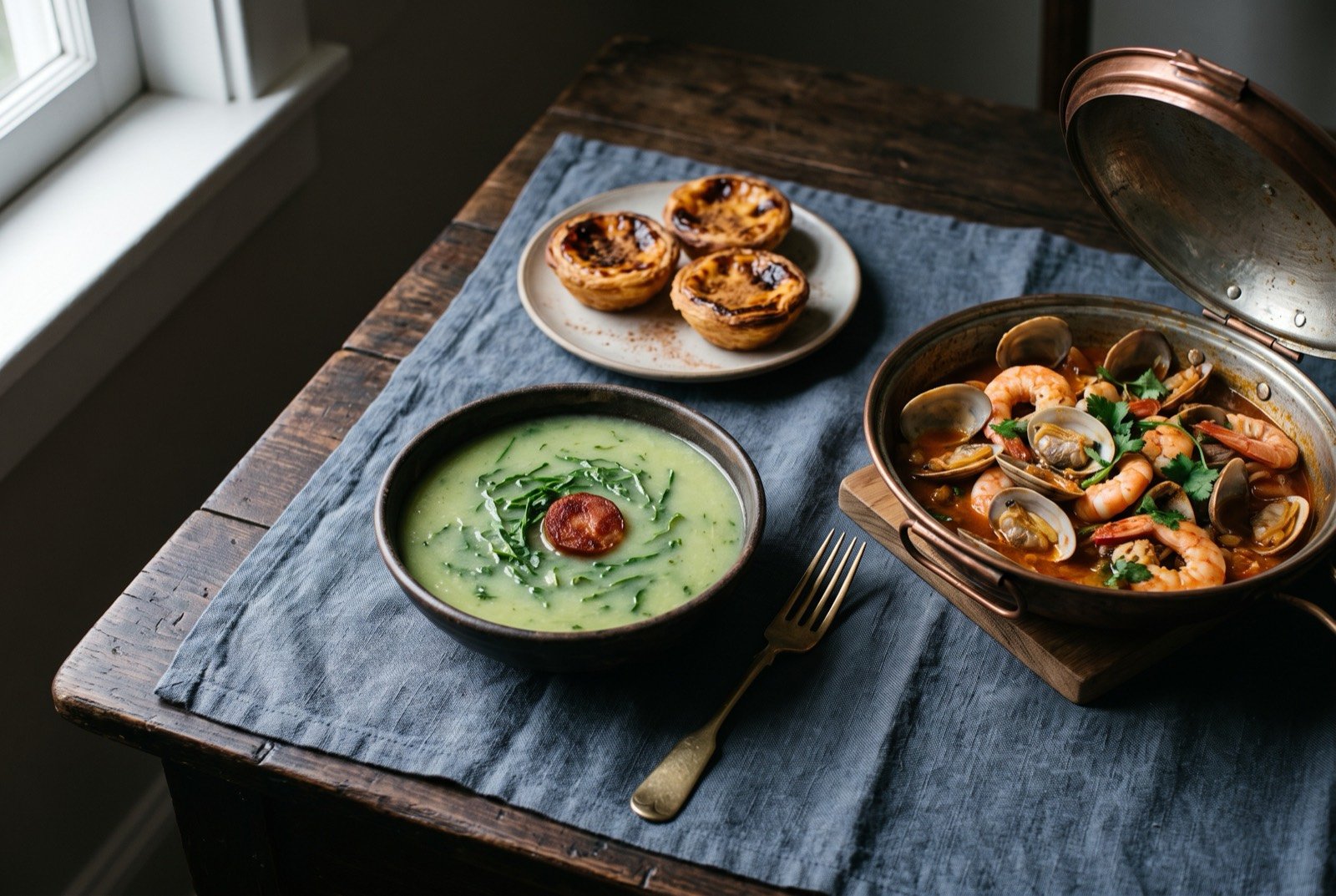
Portugal faces the sea for its protein and inland, to a dry, wheat and cork interior, for its bread and its pig. Salt cod became the national dish not because Portugal fished for it, but because a fasting calendar and an empire's shipping routes made it the one protein that would keep. Every dish as tradition built it, then what a modern chef would change.
Sources and review · What this chapter does not assert · How we research · Spotted something wrong?
A Sense of Place
Minho: the green north, land divided down to the last vine
Minho is Portugal's wettest and greenest province, a country of minifúndios, smallholdings closed in by hedgerows, where vines are trained high on granite posts in the enforcado, ramada and latada systems specifically so the ground beneath can still be farmed for maize and vegetables. This is not decoration: it is a direct answer to land scarcity, letting a farmer "occupy only marginal areas of agricultural land while continuing intensive soil exploitation" on the same plot at once. Minho holds Portugal's most concentrated dairy quotas and was, as recently as the mid-2000s, the country's most profitable milk-producing region. Maize, naturalised into the diet as broa, and dairy are the backbone of the table; the fat is olive oil nearer the coast and lard further inland, and wine rather than vinegar is the region's structuring souring agent, in the marinade the Portuguese call vinha d'alhos.
The Douro: schist, terraces and a wine that decided who owned the valley
The Douro's whole character comes from geology and from trade in roughly equal measure. Its vineyards are cut into the valley's steep sides on schist, held by dry stone walls up to two metres high, and the poor, heat retaining, well drained rock forces vine roots deep, credited directly with the wine's character. The Alto Douro Vinhateiro was inscribed as a UNESCO World Heritage cultural landscape on 14 December 2001, 24,600 hectares across thirteen municipalities, recognised for "the ancestral and continuous action of man" across roughly two thousand years of viticulture. Duriense cooking, away from the wine itself, leans on lard, garlic and bay with the valley's own livestock, cabrito assado no forno de lenha, wood oven roast kid, its most cited signature dish. The quinta, the wine estate, is the region's organising social and economic unit, a "fundamental mode of territorial appropriation" in UNESCO's own framing, not simply a farm.
The Beiras: chestnut, mountain and a cheese set with a thistle
Beira Alta and the Serra da Estrela are mountain, chestnut and pastoral country. Cabrito assado is again the most cited dish, alongside arroz de lampreia, feijoca, a heavy cold weather bean stew, and mel da Serra, the mountain's own heather honey. Chestnut runs through the region "omnipresente," from broths to stews, and the sheep that graze the high pasture supply the milk behind Queijo Serra da Estrela, Portugal's most celebrated cheese, treated in full below.
Alentejo: wheat, cork oak and bread that is never thrown away
The Alentejo is dry, wheat growing, cork and holm oak country, its cuisine built on what its own writers call "os incontornáveis," the unavoidable three: pork, lamb and bread. The fat is olive oil and pork lard; the starch and thickener, repeatedly, is stale pão alentejano, a dense wheat loaf that is never wasted, soaked into açorda and fried into migas rather than thrown out once it hardens. Coentros, fresh coriander, is named directly as "o coração da cozinha do Alentejo," the heart of Alentejo cooking, ahead of mint, oregano, thyme, pennyroyal and savory. Carne de porco à alentejana, pork cubes cooked with clams, potatoes and coriander, is the clearest single illustration of how completely Atlantic shellfish and interior pork cross in this cuisine, and Alentejo's own writers acknowledge real commonalities with Spanish cooking and with the Arab peoples of North Africa without pretending to settle exactly which dishes travelled which way.
The Algarve: the Mediterranean coast that happens to face the Atlantic
The Algarve's own framing of itself runs through the Dieta Mediterrânica rather than through Portugal's Atlantic identity: "simples mas com grande criatividade," simple but highly creative, built on heavy plant use and moderate animal use, with olive oil named explicitly as "o principal elo de ligação," the main connective thread of that diet. The sea supplies fish and shellfish; the barrocal, the limestone foothill belt between coast and hill, supplies citrus, almonds, figs and carob. Regional writing acknowledges, in general terms, that "peoples of varied origin and different faiths passed through and lived in the Algarve, from whom we inherited recipes and methods," without specifying which claim belongs to which layer, and this chapter treats that vagueness as itself worth naming rather than filling in confidently.
Madeira and the Azores, named honestly as short subsections
Both archipelagos carry real, distinct food cultures that deserve their own future volumes rather than a diluted paragraph inside this one, and this chapter treats them as genuine but proportionate subsections rather than pretending to cover either fully. Madeira's food runs on laurel wood skewered beef, basalt griddled bread and sugarcane spirit, all treated below. The Azores' single most striking practice, cozido das Furnas, cooked for hours in pots buried in geothermally heated volcanic soil on São Miguel, is named and explained rather than given as a home recipe, since no UK kitchen can honestly reproduce a fumarole field, and this chapter follows the same discipline this atlas has already used for Iceland's hákarl: understood, respected, not pretended into a recipe it cannot be.
The structural logic, at a glance
| Minho | Douro | Beiras | Alentejo | Algarve | |
|---|---|---|---|---|---|
| Fat | Olive oil, coastal; lard, inland | Lard, olive oil | Lard, sheep's milk fat | Olive oil, pork lard | Olive oil |
| Starch | Maize (broa), potato | Bread, potato | Chestnut, bread | Stale wheat bread | Bread, rice |
| Aromatic | Garlic, bay, wine as acid | Garlic, bay, wine | Mountain herbs, honey | Coentros above all others | Coentros, citrus |
| Protein | Dairy, pork | Kid, game | Kid, sheep's milk cheese | Pork, lamb | Fish, shellfish |
| Defining logic | Land scarcity worked twice, vine above, crop below | Terrace and trade, one valley owned by an export economy | Mountain isolation, chestnut instead of grain | Nothing hard wasted, bread stretched three ways | The Mediterranean diet on an Atlantic coast |
The History in Layers
A fish that had to travel, and a nickname invented in the 1800s
Portuguese fishermen were among the first Europeans working the cod grounds off Newfoundland, discovered by European ships in 1497, and by the sixteenth century crews from Viana do Castelo, Aveiro and the Azores were running seasonal fishing camps along that coast. The underlying reason cod mattered this much runs through the Church calendar rather than through taste alone: early nineteenth century Portugal observed roughly 162 days a year of Church mandated abstinence from meat, and salted, dried cod was the one protein that could reach an inland population with no access to fresh fish and still count as a lean day food. The affectionate nickname "fiel amigo," faithful friend, is documented from a popular pamphlet of 1818, not from any medieval source, and its everyday, nationwide use is a nineteenth century development built on centuries of real but unglamorous consumption, not an invented one. This chapter treats "fiel amigo" as a genuinely old habit given a comparatively recent name, which is a more honest claim than either "ancient" or "invented" alone.
Pombal draws lines in stone: the world's first appellation
The Companhia Geral da Agricultura das Vinhas do Alto Douro was founded by royal charter on 10 September 1756 under the Marquês de Pombal, a direct response to overproduction and a collapse in Port wine's export quality. It held monopoly control over Douro production and export, and a notice of 28 July 1757 ordered the river's banks demarcated into quality zones by 201 granite boundary stones, making the Douro the first legally demarcated wine region anywhere in the world, a full 150 years before the Vinho Verde region followed the same logic in 1908. Small producers and independent merchants actively resisted the Pombaline monopoly at the time, a detail worth keeping rather than letting the appellation read as universally welcomed.
Phylloxera, and the British houses that bought the valley outright
British merchant houses had been trading in the Douro since the seventeenth century, Taylor's founding traced to 1692 and its first direct purchase of Douro vineyard land dated to 1744; Graham's presence in Portugal dates to 1808, its own warehouse business from 1820. Phylloxera struck the valley from 1868, devastating vineyards by the early 1870s until growers learned to graft Portuguese vines onto resistant American rootstock; many smallholders were ruined in the meantime, and terraces abandoned in that crisis and never replanted are still visible in parts of the valley today. It was specifically in the crisis's aftermath that British owned merchant houses began buying quintas outright rather than only trading the fruit grown on them, a real shift in who owned the valley's land that this chapter states plainly rather than treats as incidental to a story about wine.
An empire's marinade, and the word that came home as vindaloo
Carne de vinha d'alhos, meat marinated in wine or vinegar with garlic, salt and paprika or chilli paste, is a genuine Minho dish, still eaten at Christmas in Madeira, and the marinade also served a real practical purpose: sailors packed meat in wine barrels for long voyages, and the wine's slow conversion to vinegar over weeks at sea helped preserve it. Portuguese traders reached Goa in the early sixteenth century following Vasco da Gama's voyages from 1498, and Goa remained Portuguese territory, along with Damão and Diu, until 1961. Goan cooks adapted vinha d'alhos using palm toddy vinegar in place of the wine or vinegar that could not be reliably shipped, folding in tamarind and the region's own chillies, and the dish's name corrupted through Konkani into "vindalho" and then into English "vindaloo." The Goan historian Fatima da Silva Gracias, of Dhempe College, names vinha d'alhos alongside sarrabulho, cabidela and pork feijoada as Portuguese dishes genuinely adapted rather than simply exported into Goan cooking, and describes Portugal's food role there as a conveyer belt for New World ingredients as much as for its own recipes. This dish's full, twice given treatment belongs to whichever future volume covers Goa within the Indian subcontinent's culinary region, not to this one; it is named and cross linked here rather than re-treated.
The Estado Novo's bacalhau, and the settlers who carried piri-piri home
Salazar's regime invested heavily in Portugal's cod fishing fleet from the late 1920s, and by 1958 Portugal was the world's largest cod producer at 59,826 tonnes, still needing a further 25,370 tonnes in imports to meet demand. The Estado Novo presented the fleet as a heroic continuation of sixteenth century maritime achievement, complete with official blessings of the departing ships near the Tower of Belém, and recommended cod's consumption up to three times a week; this is real state propaganda layered on top of a genuinely old habit, not the invention of the habit itself. Piri-piri chicken runs the empire's route in reverse and on a much shorter timescale. Between April 1974 and late 1975, around 471,000 Portuguese citizens returned from the former African territories as they gained independence, 290,504 of them, 61.6 per cent, from Angola and 158,945, 33.7 per cent, from Mozambique, per Portugal's 1981 census; roughly 260,000 people alone were airlifted out of Angola between July and November 1975 in the final weeks before independence. Piri-piri chicken as a popular Algarve restaurant dish only appears from the late 1970s into the early 1980s, brought home by exactly this wave of retornados, which makes even the most Portuguese version of the dish a settler food of living memory, not an ancient Algarve tradition the settlers merely revived.
Galicia across the border, named and not re-treated
Galicia's ría coast sits immediately north of Minho, shares its rain, its shellfish culture and a genuine linguistic and culinary kinship the Portuguese call Galaico-Português, and its full treatment belongs to Volume EU-05, not to this one. Caldo verde and caldo gallego are close cousins built on the same cabbage grown along the same river, and that thread is named here rather than quietly absorbed into a purely Portuguese story.
The Flavour Arsenal
Bacalhau, the fish that is barely Portuguese and entirely Portuguese at once
Bacalhau is not caught in Portuguese waters in any real quantity and never has been; it is dried, salted North Atlantic cod, historically Norwegian and Icelandic, imported and then rehydrated at home, and its national status rests entirely on what centuries of fasting and, later, state propaganda did to a foreign fish once it reached a Portuguese kitchen. Grading runs by size and thickness, with the largest, thickest loins commanding the highest price and holding together best through a long, gentle poach.
Azeite, worked hard rather than saved for garnish
Portuguese olive oil carries ten separate DOP designations, Trás-os-Montes and Alentejo Interior chief among them, with the Alentejo alone producing roughly seventy per cent of the national crop. It is used generously and early in cooking, not rationed to a final drizzle, cooking bacalhau in oil rather than water being one direct example of the principle.
Piri-piri and malagueta, the pepper that travelled twice
Piri-piri is Capsicum frutescens, carried from the Americas into Portuguese Africa and back again, and the fresh or dried pod, the paste and the vinegar based sauce are three distinct, non-interchangeable forms, each doing different work in the kitchens this chapter draws on.
Coentros, the Alentejo's own signature herb
Fresh coriander is worked pounded into a paste with garlic and coarse salt for açorda, and scattered generously and late into shellfish dishes across the Algarve and Alentejo alike, doing the aromatic work paprika or bay does elsewhere in Portugal.
Porco preto alentejano and presunto, the pig that eats only acorns for half the year
The montado, Portugal's own version of the Iberian dehesa, covers the great majority of Portugal's cork and holm oak, 84.6 and 90.2 per cent of the national total respectively concentrated in the Alentejo alone. Porco preto alentejano, DOP protected, ranges free through the montado, and during the montanheira season, November to March, eats almost nothing but acorns, seven to ten kilograms a day. Presunto de Barrancos, DOP since 1995, is unusual within Portugal for being dry cured rather than smoked, cured twelve to twenty four months for a whole ham; further north, Presunto de Chaves, despite its market fame, holds no DOP or IGP status of its own and sits inside the separately protected Presunto de Barroso, an honest correction worth stating rather than assuming the more famous name carries the protection.
Couve galega, cut so fine it goes translucent
Portuguese kale is worked into ribbons "quase transparentes," almost transparent, always cut against the central rib to avoid stringy fibres, the single most load bearing knife cut in this chapter's whole repertoire.
Queijo Serra da Estrela, set with a thistle rather than an animal's rennet
Raw sheep's milk, hand milked and filtered through white cloth, is set not with animal rennet but with dried thistle flower, Cynara cardunculus, roughly 0.2 to 0.3 grams per batch, ground with salt; the curd is cut by hand after 45 to 60 minutes and matured across two distinct phases totalling 45 days.
Vinho verde and Port, one grape economy running two directions
Vinho Verde is a demarcated region, not a style, running nine sub-regions across the historic Entre Douro e Minho territory; the Douro's own fortified wine, aged and blended under British and Portuguese houses alike, is treated in full above.
The Technique Ladder
The argument, from inside
Every technique in this chapter answers a version of the same question: how do you get the most out of an ingredient that was either dried for a five month sea voyage, grown on land too poor to spare a fire indoors, or preserved for a journey with no refrigeration at all. None of it is decorative, and a technically capable home cook who respects exactly what each constraint was solving for can reproduce most of it properly.
Rung 1. Cold water, low heat, and never a rolling boil
Bacalhau's demolha, its soaking, exists to restore water to the dried fish, not only to remove salt, and it must be done in cold water changed frequently; warm water "prematurely modifies the fish's proteins," leaving a rubbery exterior while the centre stays over salted. Once cooked, bacalhau should never be boiled: at a rolling boil the flakes separate and the fish's own fat is lost into the water, so it should be poached gently, ideally in oil rather than water, well below simmering point.
Rung 2. Fire without flame
Sardinhas assadas depend on a specific discipline: good quality charcoal built into a pyramid, lit and left roughly thirty minutes until the ash has gone fully white, the fish salted with coarse salt the day before and cooked in a hinged double grelha so both sides cook without loose turning, moved off direct flame the moment dripping fat causes a flare. This same ember discipline, not an open flame, is what a real Algarve grelhador applies to piri-piri chicken, and it is precisely what most fast casual versions of that dish skip.
Rung 3. Seal it, and let its own liquid do the work
The cataplana, two hinged copper shell halves closing on side latches into a near hermetic seal, functions as a mild pressure vessel: shellfish, cured pork fat, tomato, pepper and onion are layered in raw, the lid sealed, and the trapped steam cooks everything gently in its own and the other ingredients' released liquid rather than in added stock, concentrating rather than diluting the finished dish.
Rung 4. Wine, garlic, and a marinade built to travel
Vinha d'alhos, wine or vinegar worked with garlic, salt and paprika or chilli, is this cuisine's structuring marinade wherever meat needs to keep, whether overnight before frying or, historically, for a full ocean crossing. Rojões' overnight marinade is this technique at its most everyday, and the same logic, differently adapted, is what carried a Portuguese sailor's preserving trick into Goan vindaloo.
Rung 5. Bake hot, and trust the yolk
Portugal's convent pastry tradition runs on a genuine surplus of egg yolks and a genuinely very hot oven; pastéis de nata are baked at roughly 400 degrees Celsius for around twenty minutes, a temperature no domestic oven reaches, which is the real, mechanical reason a home version rarely achieves the same blistered, near burnt leopard spotting across the top.
The Ferment and Preserve Bench
1. Alheira, and a contested origin worth stating plainly
Alheira de Mirandela, the most celebrated version, is made from Bísaro pork or crosses at least half Bísaro, poultry and game meat, regional wheat bread, pork fat and Trás-os-Montes DOP olive oil, smoked over oak and olive wood for up to eight days over a gentle flame. The popular story credits its invention to Jews forcibly converted after 1496 who could not eat pork but needed to appear observant Christian to Inquisition informants, hanging a visually similar smoked sausage made from bread and poultry in their chimneys in place of the pork sausage their neighbours hung. A dedicated Portuguese piece on the subject states plainly that this "pode não passar de uma ideia popular romântica," may be nothing more than a romantic popular idea, since no conclusive facts support it; this chapter repeats the story as a widely told, plausible community narrative rooted in real Inquisition era conditions, and states clearly that no primary documentary proof, an Inquisition record or a period text, has been found connecting the sausage's invention to that specific motive. The documented history is narrower and later: local press references from at least 1957, a provisional Traditional Speciality Guaranteed certificate in 1994, and full EU Protected Geographical Indication status from 2 March 2016, its nineteenth century commercial spread tied concretely to the arrival of the railway at Mirandela.
2. The matança, and the meat it produces
The pig slaughter at the start of winter, producing a year's supply of cured meat, is explicitly communal, neighbours helping with the butchery and the day ending in a shared banquet, and is now rare enough in genuine family practice that it is being actively documented as intangible heritage before it disappears. Presunto de Barrancos, treated in full in The Flavour Arsenal above, and papas de sarrabulho, a winter only pork blood and bread porridge whose own household sources give three practical reasons for its season, the slaughter itself, summer heat spoiling blood based food, and its sheer weight as a meal, both come from this same annual event.
3. Queijo Serra da Estrela, understood in full
Covered in full in The Flavour Arsenal above: raw sheep's milk set with dried thistle flower rather than animal rennet, matured across two distinct phases totalling 45 days. Requeijão, the whey left behind, is a separately DOP protected cheese in its own right, traditionally moulded in small woven baskets wrapped in cabbage or mulberry leaves, a genuine use for what the main cheese's production would otherwise waste.
4. Cozido das Furnas, understood but not attempted
Named in full in A Sense of Place above, and this chapter does not pretend a UK kitchen can honestly reproduce it. Pots of meat and vegetables, sealed, are buried in holes 70 to 120 centimetres deep in geothermally heated volcanic soil around the Furnas fumaroles on São Miguel, and cook for several hours on the earth's own ambient heat, without added water or spices. A slow oven or a covered Dutch oven left overnight at a very low, steady temperature is the closest honest analogy for the mechanism, sealed, gentle, sustained heat with no added liquid, but this chapter states plainly that it is an analogy, not a substitute for the thing itself.
Sourcing in Britain
Verified August 2026. Where a supplier could not be fully confirmed, that is said rather than smoothed over.
The ranked list: what decides great from grim
- Bacalhau, genuinely dried and salted rather than a frozen cod fillet. Lisboa Delicatessen, 54 Golborne Road, London, has a dedicated dry cured fish counter; Portugalia Marketplace and Portugalia Online both ship real dried salt cod, the former stating a North Atlantic Norwegian and Icelandic source directly.
- Presunto, the single highest risk of quiet substitution with Spanish jamón. Atlantico UK and Deli Portugal both stock genuine Portuguese presunto; one prominent retailer marketing itself toward Portuguese buyers, IberGour, in fact sells a Spanish Barrancos style jamón, worth naming as the substitution trap it is rather than assuming the marketing.
- Couve galega, genuinely different from cavolo nero, though not buyable pre cut. The Backyard Larder and Vibrant Veg both sell real couve galega seed and plants, explicitly for caldo verde; no UK retailer was found selling fresh cut leaves ready to cook, so cavolo nero remains the honest substitute for a reader without a garden or the lead time to grow it.
- Piri-piri, real Portuguese brands rather than a generic supermarket hot sauce. Quinta d'Avó, Maçarico and Ferbar are all genuine, UK available Portuguese brands, the latter also selling whole dried pods for a scratch made sauce, via Delícias UK.
- Alheira, genuinely easier to find in the UK than expected. Amazon UK, Delícias UK, Portugalia Online and Atlantico UK all stock it, a positive finding worth stating rather than assuming this unusual product is unobtainable.
- Azeite carrying a real DOP seal, not just a bottle labelled "Portuguese." No UK retailer was confirmed selling a specifically DOP labelled bottle by name; a reader should look for the seal itself on any bottle from a general Portuguese grocer rather than assume the country of origin alone guarantees it.
- Conservas, genuinely crossing into mainstream UK retail now. Minerva sardines are stocked at Sainsbury's and Pinhais at Selfridges, both confirmed live, a real sign this category has moved well beyond specialist diaspora shops.
- Port and Madeira, both well served. Berry Bros & Rudd stocks Taylor's, Graham's and Fonseca directly; The Wine Society stocks Henriques & Henriques Madeira directly.
- The cataplana itself, a real, buyable specialist item. Delícias UK, Atlantico UK and Luisa Paixão all sell genuine hammered copper cataplanas, from roughly £85 to £237, not the unobtainable item such specialist kit sometimes turns out to be.
Where the delis and restaurants actually are
London's Golborne Road, in Notting Hill, and the South Lambeth Road area around Stockwell and Vauxhall, genuinely called Little Portugal, London and home to an estimated 30,000 strong Portuguese community, are the two real concentrations. Manchester and Salford have Taste of Portugal and The Meat House; Great Yarmouth and Peterborough both have real, if smaller, Portuguese grocers and fishmongers serving significant local communities, and Jersey's roughly eight per cent Madeiran and Portuguese population is a genuine, well documented community, though functionally separate from mainland UK sourcing rather than a practical shopping destination for most readers. No Portuguese specific shops were confirmed in Bristol or Southampton, and this chapter does not assert a scene that could not be found.
Kit notes for this volume
A genuine hammered copper cataplana is the one piece of country specific kit worth buying for this chapter, and it is buyable, not aspirational. A Big Green Egg run wide open, or a domestic oven's absolute maximum with a preheated pizza stone, is the only realistic route to pastéis de nata's actual baking temperature. Sous vide earns its place for açorda's egg and for a more even bacalhau demolha and poach. A dedicated spice grinder is worth using for a scratch piri-piri sauce from real dried pods rather than a bottled one.
Voices and Sources
From inside the tradition
- José Avillez, Belcanto, Lisbon, two Michelin stars. On record that he tries "to preserve emotional truth rather than literal recipes," and that respecting tradition "doesn't mean freezing it."
- Henrique Sá Pessoa, formerly Alma, now his own eponymous restaurant at Páteo Bagatela, two Michelin stars carried forward. Works from "o produto e a cozinha portuguesa, mas com uma leitura contemporânea," the product and Portuguese cuisine read contemporarily.
- Alexandre Silva, LOCO, one Michelin star, and FOGO, built entirely around fire. On record that "Portugal has an enormous tradition regarding fire based cooking, but it has never been elevated to where it deserves."
- Nuno Mendes, Lisboeta, London. elBulli trained, and the clearest example of a technically serious, in tradition chef working with Portuguese food specifically in the UK diaspora.
- Fatima da Silva Gracias, Dhempe College of Arts and Science, Goa, author of Cozinha de Goa: History and Tradition of Goan Food, the strongest in tradition source behind this chapter's vinha d'alhos to vindaloo material.
- DGADR, Direção-Geral de Agricultura e Desenvolvimento Rural, the Portuguese government body whose traditional products register underpins this chapter's material on Alheira de Mirandela, Presunto de Barrancos, Queijo Serra da Estrela and several other named designations.
The UK diaspora, honestly assessed rather than assumed
In July 2015, the Times critic Giles Coren reviewed Nuno Mendes's own serious, in tradition restaurant, Taberna do Mercado, not a takeaway chain, and wrote that "Portuguese cooking is the worst on earth," scoring it 2 out of 10, in direct contrast to five star reviews of the same restaurant from the Telegraph and Time Out in the same period. This chapter treats that review as an exhibit of an English palate calibrated by decades of poor takeaway exposure to expect Portuguese food to under deliver, not as evidence of what a serious kitchen actually gets wrong. Mendes was subsequently given his own recipe column in the Guardian. Stockwell's family run restaurants, O Cantinho de Portugal, A Toca and Velho Portugal among them, do regionally specific dishes properly, frango à Guia from the Algarve and porco à alentejana genuinely distinguished on the same menu; the real "bad diaspora food" problem in Britain sits concentrated in the fast casual chain and takeaway tier, not in these community restaurants, and Nando's, founded in Johannesburg in 1987 by a Portuguese Mozambican and a South African, trading nowhere in mainland Portugal itself, is the clearest single case of that tier's distance from the tradition it borrows its name and its chilli from.
Things this chapter has deliberately not asserted
- The cataplana as a documented Moorish inheritance from Al-Andalus. The one piece of real investigation found states plainly that nothing rigorous is known of its origins, and the better dated counter-theory points to a twentieth century Algarve invention, not a medieval one. This chapter presents both and adjudicates neither.
- Alheira's crypto-Jewish origin as settled history. Widely told and plausible given real Inquisition era conditions, but no primary documentary proof, an Inquisition record or a period text, was found connecting the sausage's invention to that specific motive.
- Doces conventuais as a single, unified convent tradition explained entirely by nuns starching habits with egg white. A University of Coimbra researcher, reported by the Portuguese public broadcaster RTP, calls the whole "convent sweets" framing a constructed myth and the starching legend specifically "uma historieta," a little story, with no written evidence behind it. This chapter uses the better documented, narrower cases, Pastéis de Tentúgal's own convent account books and Ovos Moles de Aveiro's documented transmission through Dona Otília Soares, rather than the blanket legend.
- The tripeiros nickname as a settled historical consequence of the 1415 conquest of Ceuta. Portugal's own national press has directly disputed this account as a legend the facts contradict, while noting historians still value it for what it reveals about Porto's civic identity. This chapter reports the legend as legend and the nickname and dish as real regardless.
- Francesinha's 1950s origin story at Daniel David Silva's hands as documentary fact. Consistent across several independent seeming Portuguese food publications, including one that profiles the restaurant directly, but no primary source, a period newspaper mention or a restaurant ledger, was located. Treated as well attested oral and restaurant history, not settled fact.
- Caldo verde's origin in the mid fifteenth century. This specific date is repeated in Portuguese sources despite directly contradicting the potato's own arrival in the country two centuries later; this chapter asserts only the plausible trajectory, a kale broth predating the potato, not the precise date.
- Queijo Serra da Estrela's founding in 1287 under D. Dinis. This date appears in only a single commercial, non-academic source and was not cross verified against any archival or academic citation.
- The precise economic mechanism by which the British Port trade "restructured the regional table." The institutional and ownership history is solidly documented; a documented causal chain from that trade to everyday Douro household food culture is not, and this chapter does not invent one.
- A specific claim that UK bacalhau com natas commonly fails from cheap frozen cod diluted with excess cream. Plausible from the technique principles this chapter documents elsewhere, but no named critic or source was found making that specific diagnostic claim, so it is not asserted here.
- "Nandinho" and "Fogareiro" as real Portuguese piri-piri brands. Neither could be verified to exist in either English or Portuguese language search, and neither appears in this chapter's sourcing section as a result.
Cold water, low heat, and never a rolling boil
Bacalhau's demolha, its soaking, exists to restore water to the dried fish, not only to remove salt, and it must be done in cold water changed frequently; warm...
Fire without flame
Sardinhas assadas depend on a specific discipline: good quality charcoal built into a pyramid, lit and left roughly thirty minutes until the ash has gone fully...
Seal it, and let its own liquid do the work
The cataplana, two hinged copper shell halves closing on side latches into a near hermetic seal, functions as a mild pressure vessel: shellfish, cured pork...
Wine, garlic, and a marinade built to travel
Vinha d'alhos, wine or vinegar worked with garlic, salt and paprika or chilli, is this cuisine's structuring marinade wherever meat needs to keep, whether...
Bake hot, and trust the yolk
Portugal's convent pastry tradition runs on a genuine surplus of egg yolks and a genuinely very hot oven; pastéis de nata are baked at roughly 400 degrees...
The dishes
- Caldo Verde Minho, and now the whole country
- Bacalhau à Brás Nationwide, most associated with Lisbon
- Rojões à Moda do Minho, with Arroz de Sarrabulho Minho, and the matança's own centrepiece dish
- Cataplana de Marisco The Algarve
- Amêijoas à Bulhão Pato The Algarve and Setúbal
- Frango Piri-Piri à Guia The Algarve, and the Mozambican retornado who brought it home
- Francesinha Porto
- Açorda Alentejana The Alentejo
- Pastéis de Nata Lisbon
- Espetada em Pau de Louro Madeira
Sources and review
- Researched
- 2 sources cited
- Reviewed
- Not yet reviewed from inside the tradition
- Cooked
- Not yet cooked and reported
Where this volume comes from
3 research briefs on file for this volume, researched to the rules on How we research. Published 28 August 2026. Last changed 8 September 2026.
The brief's own account of its sources
Part A (north/central): Of ~45 sources, majority (~34-36) Portuguese-language/Portugal-published: official government/regulatory (DGADR specs for Alheira de Mirandela, Presunto de Chaves, Presunto de Barrancos, Queijo/Requeijão Serra da Estrela, Sopa da Pedra de Almeirim), UNESCO Portugal national commission, IVDP, municipal/parish government (Mirandela, Almeirim, Mogadouro, Barrancos), national/regional press (Público, O Mirante, NiT), University of Porto academic paper + student journalism (JPN), Infopédia, Wikipédia PT, food/lifestyle sites/recipe blogs.