Europe · Volume 07
Castile, Madrid, Extremadura & Aragón
The Roast, the Pot and the Acorn Line
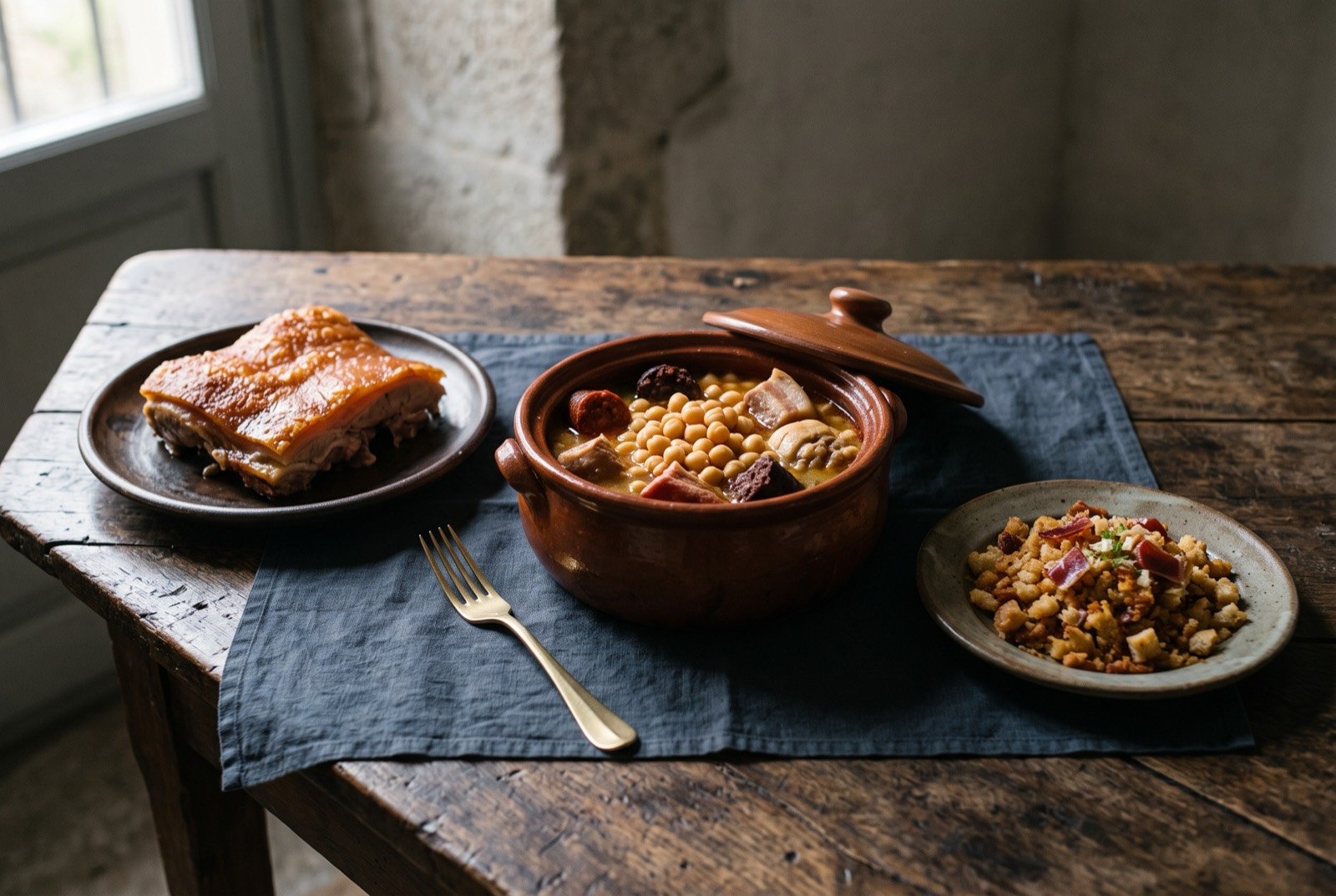
Four landlocked territories joined less by one clean ecology than by a shared logic: a milk-fed animal roasted whole in a wood oven, a chickpea stew built in courses, and a shepherd's way of reviving stale bread, from Extremadura's acorn-fed dehesa to Aragón's Pyrenean foothills. Every dish as tradition built it, then what a modern chef would change.
Sources and review · What this chapter does not assert · How we research · Spotted something wrong?
A Sense of Place
Everything in this chapter sits on the Meseta, Spain's vast interior plateau, a dry, continental landscape of hard winters and harsh summers with none of the Atlantic damp that shapes EU-04's cider-and-cod coast to the north. That climate is the reason this is a cuisine of roast baby meats, slow-cooked pulses and shepherd's stale-bread dishes rather than a fish-and-shellfish table: no coastline means no fresh catch to build a cuisine around, and a hard climate rewards animals slaughtered young, before a lean winter can waste the effort of raising them. No Spanish food historian was found stating that causal chain outright as a settled thesis; it is this atlas's own reading of the plain ecological facts, offered as an argument rather than a quoted consensus.
The institution that organised that plateau's sheep economy for the better part of six centuries was the Mesta, the Concejo de la Mesta, founded formally under Alfonso X el Sabio in 1273 to protect and regulate transhumant herding across the Crown of Castile and to arbitrate the endless friction between herders driving flocks and farmers trying to keep fields intact. The same 1273 charter set the maximum width of the drove roads, the cañadas reales, at ninety varas, 75.22 metres, and Spain still holds roughly 125,000 kilometres of these routes at three widths today, a road network considerably older than most of the towns it passes through. The Mesta's power rested on wool as Castile's principal export to the rest of Europe, and it held real royal privilege: free passage, use of common pasture, exemption from local taxes. On 5 December 2023 UNESCO inscribed transhumance itself on the Representative List of Intangible Cultural Heritage of Humanity, a candidacy Spain led jointly with nine other countries. Madrid keeps the memory alive every October in its Fiesta de la Trashumancia, begun only in 1994, specifically to press the Cortes Generales into passing a law recognising the cañadas as protected public land, when Merino flocks are still driven from the Casa de Campo along the old Cañada Real Galiana, straight through the Puerta del Sol, to Cibeles.
Extremadura shares the plateau's dryness but adds something Castile proper does not have in the same quantity: the dehesa, a genuinely man-made silvopasture landscape of holm oak and cork oak over open pasture across Cáceres and Badajoz, described in Spanish agricultural writing as the product of a "millennial consonance between nature and man" rather than untouched wilderness. During montanera, the acorn-fattening season running roughly from late October to March, each Ibérico pig is allotted two to six hectares of dehesa to forage in, and can put on more than sixty per cent of its final slaughter weight in that period alone. This chapter will not let that romantic image stand alone, though. Extremadura's food identity is inseparable from a documented history of land concentration and mass emigration that this chapter treats honestly rather than as background colour. Nineteenth-century disamortisation concentrated land in a small number of absentee-landlord estates, blocked industrial development, and pushed the rural population into a day-labourer class subject to real, periodic hunger. Between 1955 and 1975 close to half the population of Extremadura left, in what one academic source calls "la gran espantada migratoria," the great migratory stampede, chiefly to industrial Europe and Spanish cities. One especially direct detail from that same research: households facing hunger burned scavenged firewood and esparto grass, sometimes taken furtively from the landowner's own estate, to cook a handful of chickpeas, "lacking meat but well supplied with the bacon from pigs whose slaughter was celebrated once a year in each house." That single sentence is the honest root of why the household matanza, the annual pig slaughter, carries the cultural weight it still does here: it was subsistence, not folklore.
Aragón is where this chapter's grouping logic genuinely strains, and it is worth saying so plainly rather than forcing a false unity onto four provinces that do not all answer to it equally. Aragón's transhumant sheep economy was never governed by the Mesta at all. It had its own, older institution, the Casa de Ganaderos de Zaragoza, founded by royal privilege of Jaime I in 1218, fifty five years before the Mesta existed, and the Crown of Aragón never created a single kingdom-wide herders' body the way Castile did: each locality kept its own. The Casa de Ganaderos held real civil and criminal jurisdiction over livestock disputes through an elected Justicia de Ganaderos, whose rulings were final and could not be appealed. It still exists, celebrated its eighth centenary in 2018, and today runs as a quality-lamb marketing cooperative, a direct organisational line from medieval sheep law to the Ternasco de Aragón brand on a supermarket shelf. Aragón's own geography splits into three genuinely distinct units rather than one plateau, the Pyrenees in the north, the Ebro depression in the centre (itself running from the near-desert Monegros to irrigated river huerta), and the Sistema Ibérico mountains to the south, a division Aragonese reference sources themselves refer to as "las tres Aragonas." Aragón's own food writing describes its cuisine as sitting at a genuine three-way crossroads, Catalan Mediterranean, Basque Atlantic and Castilian high plateau, rather than as a simple extension of the Meseta. Even Aragón's flagship products underline the mismatch within this one volume: Jamón de Teruel is a white-pig ham on an entirely different farming system from Extremadura's acorn-fed Ibérico dehesa, not a lesser cousin of it, and pollo al chilindrón is properly a shared Ebro-valley dish, Rioja, Navarre and Aragón together, rather than an Aragón-exclusive one.
This chapter's honest position, stated once here so it does not need repeating at every turn below: Extremadura's grouping with Castile and Madrid is ecologically sound, since the dehesa genuinely continues eastward into the western Meseta. Aragón's grouping here is administratively convenient, an interior, land-locked territory like the other three, rather than culinarily coherent with them. Its Pyrenean north and Ebro-valley centre pull at least as hard toward Navarre, Rioja and Catalonia as toward the plateau. It sits in this volume because the atlas's own identifier scheme has to put it somewhere, its migas, ternasco and jamón traditions are real and well documented in their own right, and its own institutional history, the Casa de Ganaderos rather than the Mesta, deserves telling on its own terms rather than folded silently into Castile's story.
| Territory | Defining logic | Dishes and products that carry it |
|---|---|---|
| Madrid | The capital's own cocido, built from what the whole plateau supplies | Cocido madrileño, callos a la madrileña, the taberna tradition |
| Castile and León | The Mesta's sheep routes and a wood-oven asador culture | Cochinillo asado, lechazo asado, judiones de La Granja |
| Extremadura | The dehesa, the acorn-fed pig, and a poverty history worth stating honestly | Migas extremeñas, chanfaina, jamón ibérico de bellota, Torta del Casar, pimentón de la Vera |
| Aragón | Its own herders' guild, the Ebro valley, three genuinely different landscapes | Ternasco asado, migas aragonesas, pollo al chilindrón, Jamón de Teruel |
The History in Layers
Cocido madrileño: a genuinely contested lineage, not a settled one
Multiple competing theories exist for cocido's origin and Spanish food writing is explicit that none is proven. One line traces it to the Sephardic adafina, a Sabbath stew of chickpeas, meat and vegetables cooked slowly from Friday to Saturday to respect the prohibition on lighting fires on the Sabbath. Another traces it to the Castilian and Manchegan olla podrida, the dish Cervantes has Don Quixote eat. A third proposes an evolution from Berber couscous. "Los investigadores con mayor bagaje no se ponen de acuerdo sobre el origen de este plato," researchers with the deepest background do not agree. The most commonly repeated line runs adafina to olla podrida to cocido: after the 1492 expulsion, the adafina reportedly survived among Christian and Morisco populations who added pork products, chorizo, morcilla, tocino, abandoning kosher restriction as they did. The fifteenth-century Crónica de los Reyes Católicos by Andrés Bernáldez is cited directly as testimony that conversos "nunca perdieron en el comer la costumbre judaica de manjares y olleta adefina," never lost, in their eating, the Jewish custom of dishes and stewed adafina. This chapter reports that as the leading, widely repeated account rather than settled fact, because the sourcing behind it, however serious the journalism citing it, is not the same thing as a peer-reviewed food-history paper. As of this research, the Comunidad de Madrid has begun proceedings to declare cocido madrileño a Bien de Interés Cultural, citing more than 150 years of documented tradition; this is a declaration in process, not a completed one.
Traditional service runs in three vuelcos, turns: first the broth, usually carrying fideos, then the chickpeas, vegetables and potatoes, then the meats, sausages and bacon, chopped. The staged order is argued in Spanish food writing to be deliberate rather than incidental, broth cleansing the palate, chickpeas providing the base, meats the intense counterpoint, and mixing all three together is described as altering "the sensory experience designed over centuries." Restaurante Malacatín, a fourth-generation Madrid taberna trading in the Rastro district since 1895, gives real, named ratios: tocino, bones, chorizo and codillo simmered in salted water for two hours, then the heat lowered for a further three and a half hours of slow simmering, skimming periodically; chickpeas soaked overnight in warm water with a little bicarbonate; carrots added an hour before the end, potatoes thirty minutes after that. Malacatín serves the classic three vuelcos or unassembled, for diners to build their own, and states its own philosophy as "paciencia y mimo," patience and care, "empezando por los garbanzos," starting with the chickpea.
The chickpea itself is genuinely contested between two named, protected varieties, and this chapter will not conflate them. Garbanzo de Fuentesaúco, from Zamora in Castile and León, is documented from municipal ordinances as early as 1569, held royal favour in the sixteenth century and reportedly reached the Spanish court; it carries provisional IGP recognition from 1996, ratified 2002, prized for a buttery, low-granular flesh and soft skin. Garbanzo pedrosillano, named for Pedrosillo el Ralo in Salamanca's Armuña comarca, has held its own guarantee mark since 2011, prized instead for staying whole through long cooking and absorbing broth well. No single authoritative source says cocido madrileño must use one or the other, and usage genuinely varies by household and restaurant; this chapter treats both as legitimate rather than adjudicating a winner.
A related dish deserves an honest correction here rather than a repeated assumption. Callos a la madrileña, first recorded in the late sixteenth or early seventeenth century as cocina de aprovechamiento, using cheap beef tripe rather than an elite cut, does not traditionally include chickpeas. Chickpeas are a Galician addition to callos; Asturias uses fabes; Andalusia makes it lighter still. A reader who has previously met "callos madrileños" with chickpeas in the bowl has met a regional variant, not the Madrid standard, and this chapter corrects that rather than repeating it.
Cocido maragato: the reversed order, and two theories neither proven
From the Maragatería comarca around Astorga, in León province, historically populated by arrieros, mule-driving traders moving goods between Castile and northern ports, cocido maragato reverses cocido's whole order: meats first, often seven types or more, then chickpeas and vegetables, then broth, then a custard, natillas, to close. Two folk explanations are offered and neither is presented anywhere as proven. One holds that arrieros carried already-cooked meat that kept for days on the road and ate it first, ordering hot broth afterwards only if time allowed, a habit that later migrated into home cooking. The other ties it to the Peninsular War against Napoleon's troops, when meat was eaten first in case fighting interrupted the meal, securing the most important course before anything else. Spanish sources present both as theories, and so does this chapter.
Cochinillo asado: Cándido, a plate, and a genuinely 2024 legal protection
Cándido López Sanz, born in Coca in 1903 and dying in Segovia in 1992, took over the Mesón del Azoguejo in 1931 and built the international reputation of Segovian roast suckling pig over six decades. In 1949 a group of intellectuals and journalists calling itself the Cofradía de los Doce Apóstoles, led by the Segovian politician Francisco Guillén Salaya, first named him "Mesonero Mayor de Castilla," a title King Juan Carlos I formally ratified in 1983. The restaurant is now in its fifth generation. The famous plate-cutting ritual, carving the roast animal with the edge of a plate rather than a knife, is the restaurant's own account of an accident that became theatre: Cándido needed to cut a cochinillo but had no knife to hand, used a plate instead, and the technique proved the crackling's crispness on the spot. In the now-standard telling the plate slipped and shattered on the floor to applause, and Cándido reportedly declared "¡Hoy hemos rematado la faena!", today we've finished the job. The stated culinary logic underneath the showmanship is real: for a plate's edge to cut the animal cleanly, the skin genuinely has to come out very crisp, otherwise the plate could not pierce it at all.
The documented method, independent of the restaurant's own telling, describes roasting in a wide clay cazuela with water, salt and a little pork fat, the animal laid skin-side down on a bed of laurel branches so the skin never touches the vessel directly, then turned, the skin pricked to release trapped air and coated with fat, and returned to the oven. No numeric temperature or time for cochinillo specifically survived this research to the same confidence as lechazo below, and this chapter will not invent a false-precision figure to fill that gap; the reader is better served by the method described plainly. Worth flagging as genuinely recent rather than ancient: "Cochinillo de Segovia" existed only as a regional guarantee mark from 2002, and reached full EU-level Indicación Geográfica Protegida status only on 8 July 2024, after a process reported to have run nearly twenty years. The IGP covers animals born, raised and slaughtered in Segovia province and its immediate neighbours, killed no older than 21 days, at a live weight of 4.5 to 6.5 kilograms, fed exclusively on the sow's own milk.
Lechazo asado: an IGP specification, and an Aranda de Duero oven method with real numbers
IGP Lechazo de Castilla y León specifies live weight at slaughter of 9 to 12 kilograms, age at slaughter up to 35 days, carcass weight 4.5 to 7 kilograms, recognised breeds Churra, Castellana and Ojalada and their authorised crosses, fed exclusively on the mother's milk. The Aranda de Duero wood-oven method, drawn from practitioner recipe sources and corroborated across several independent asadores, holds the oven at around 180°C, heated slowly all morning on seasoned encina, holm oak, aged a full year; the animal is seasoned with nothing but water and a little salt, some cooks adding manteca; roasted roughly forty five minutes flesh-side up, then forty five minutes skin-side up, the oven held at or below 180°C for about three hours total, on the stated local principle that slower is always better, cooked in cazuelas de barro throughout.
Migas: one technique family, three larders, not three inventions
Extremaduran migas are credited to shepherds using hard bread during transhumance, isolated for long seasons with few provisions, with earlier antecedents from the period of Arab occupation recorded as food fit for distinguished guests. In the Vera comarca specifically, migas were customarily eaten on Sundays, both to avoid wasting bread and because no fresh bread was baked that day. Post-Columbian, pimentón de la Vera became an essential addition. The standard composition, consistent across independent sources, runs bread, olive oil, garlic, green pepper, pimentón de la Vera, salt, and chorizo and or panceta, the bread hydrated overnight in warm salted water, then stirred constantly while cooking so it takes up rendered fat without burning.
Manchegan migas require bread at least two to three days old, dampened for hours; the most traditional version, "viuda," widowed, is bread fried in olive oil with garlic and nothing else, a poverty-food baseline to which chorizo, panceta, longaniza and pimentón were added as means allowed, with grapes or melon a classic sweet accompaniment tied historically to vendimia, the grape harvest. This chapter found no strong evidence that Castile proper, as distinct from La Mancha, holds a genuinely separate migas tradition with its own named technique; "migas manchegas" and "migas castellanas" function largely as overlapping labels in the sources reached, both rooted in shepherd and transhumant culture, and this chapter treats them as one Castilian-interior tradition rather than inventing a third.
Aragonese migas are distinguished by longaniza, Aragón's own sausage, rather than chorizo, fried with onion and garlic in julienne, served with fresh black grapes and often a fried egg with a crisp, lacy edge, puntillita. The bread preparation, stale bread lightly dampened, rested overnight, torn by hand rather than cut, fried under constant turning, is essentially identical in method to the Extremaduran version, which is the real point: migas is one shepherd's technique for reviving stale bread, adapted regionally by whichever cured meat the local larder actually held, not three unrelated dishes that happen to share a name.
Ternasco de Aragón: a different animal from lechazo, with a different institutional history
Ternasco is not a regional synonym for lechazo, and the two should never be treated as interchangeable. IGP Ternasco de Aragón specifies slaughter age of 70 to 90 days, carcass weight 8.0 to 13.0 kilograms, authorised breeds Rasa Aragonesa, Ojinegra de Teruel and Roya Bilbilitana, milk-fed from birth with straw and authorised concentrate feed added ad libitum, white firm fat covering at least half but never all of the kidney, pale pink meat. The reader-facing gap between this carcass-weight figure and the higher live-weight figures sometimes quoted elsewhere reflects live weight against carcass weight, not a contradiction. Compared with lechazo's milk-only diet and 35-day maximum age, ternasco is a genuinely older, weaned, larger animal, and both are legitimate, distinct Iberian answers to the question of how to eat a young sheep well, not the same product under two provincial names. As set out above, ternasco's institutional lineage runs through the Casa de Ganaderos, not the Mesta, a real, documented, non-Castilian history this chapter treats on its own terms.
Ternasco asado technique is consistent across independent sources: simple seasoning, salt, olive oil, rosemary and thyme, garlic pushed into small cuts in the flesh, roasted slowly at around 150°C, potatoes cut into thick rounds and roasted alongside in the same fat and juices, laurel and garlic-oil worked into the tray, traditionally in a wood-fired oven. One local framing of the seasoning philosophy is worth quoting for how precisely it states the volume's whole restraint: only the spices that caress the meat, never the ones that cover it.
Pollo al chilindrón: an Ebro-valley dish given a home here, not a Castilian one
The dish is reported to have coalesced in Huesca in the second half of the nineteenth century, but every serious source describes it as summarising cooking traditions common across the whole Ebro valley, Aragón, Navarre and Rioja together, not Aragón alone. The name is popularly linked to a card game called chilindrón, in which the loser paid for the meal. The dish could only exist after the Columbian Exchange reached Spain: pepper entered Spanish cooking roughly 450 years ago, tomato roughly 300. The Navarrese version, txilindrón, differs meaningfully, built on dried and rehydrated pimiento choricero rather than tomato, milk-fed lamb or kid rather than chicken, finished with lemon and parsley. No source found in this research makes a genuinely separate Castilian claim to chilindrón. Following the atlas's own rule that a dish gets one full home and everywhere else names it and links back, this chapter gives chilindrón its full treatment here, in Aragón, while stating honestly that its real home is the Ebro valley as a whole.
Jamón: the dehesa, a colour-coded seal system, and a live industry argument
Spain's Ibérico grading system, under Real Decreto 4/2014, uses four colour-coded seals combining breed purity and feeding regime, administered and audited by ASICI, the sector's own interprofessional body.
| Seal | Designation | Breed | Feeding |
|---|---|---|---|
| Black | Bellota 100% ibérico | 100% Iberian | Free-range dehesa, montanera acorn-fed |
| Red | Bellota ibérico | 50 to 75% Iberian, typically Duroc-crossed | Free-range dehesa, montanera acorn-fed |
| Green | Cebo de campo ibérico | Minimum 50% Iberian | Outdoor dehesa or campo access, grass plus supplementary feed, no montanera requirement |
| White | Cebo ibérico | Minimum 50% Iberian | Intensive feedlot, compound feed only |
The reader-facing rule that matters most: the word "ibérico" alone, without a stated seal colour, can legally describe an animal that is only half Iberian by breed and never saw a dehesa at all. Only the black and red seals mean genuine acorn-fed bellota.
DOP Dehesa de Extremadura recently tightened its own rules beyond that national baseline. From the 2023 to 2024 montanera campaign, applying to animals born from September 2022, it restricted itself to 100% Ibérico only, dropping the 75%-cross category from its own scope, and its regulatory council has framed this explicitly as a response to the rival DOP Guijuelo, in Salamanca, moving the opposite way and lowering its own Ibérico percentage requirement. That is a live, contested industry argument about what excellence in Ibérico jamón actually means, not a settled consensus, and this chapter names it as exactly that rather than repeating one DOP's own marketing as neutral fact. Curing timings, from ASICI's own published figures: salting roughly one day per kilogram of ham weight; drying and settling one to three months, temperature rising and humidity falling gradually; maturation typically two to three years, though the legal minimum is twenty months and real bellota production commonly runs four, five, six years or more; a final calado check, done in minutes by a maestro jamonero probing the ham with a horse-bone needle to read its aroma.
Aragón's own flagship ham, Jamón de Teruel, sits at the opposite end of this same story and is worth stating plainly for the contrast within one volume. It was genuinely Spain's first ham to hold a Denominación de Origen, its regulatory council constituted in 1984, added to the EU's protected-products list in March 1997. It is a white-pig ham, not Ibérico: Landrace by Large White for the maternal line, Duroc for the paternal, chosen for growth rate, hardiness and marbling rather than acorn-fed intramuscular fat. Aragón's flagship cured meat comes from an entirely different farming system from Extremadura's dehesa, and this chapter treats it as a genuinely different product rather than a lesser cousin of jamón ibérico.
Torta del Casar and pimentón de la Vera: two Extremaduran DOPs, one live supply problem
Torta del Casar, DOP since provisional recognition in 1999 and current regulation from 2001, is made from raw ewe's milk, Merina and Entrefina breeds, set with vegetable rennet from wild thistle, Cynara cardunculus, hand-collected within the protected zone around Cáceres, and matured a minimum of sixty days. Worth stating plainly: wild-harvested thistle supply is a genuine, current bottleneck rather than a solved problem, and the DOP has been actively planting dedicated thistle plantations, eight hectares as of this research, planned to reach eighteen by 2027, precisely because the traditional wild harvest cannot reliably meet demand on its own.
Pimentón de la Vera's smoke is a genuine byproduct of how the peppers are dried, not a separate flavouring step added afterwards. Peppers arrived from the Americas in the sixteenth century, and La Vera's smoke-drying method developed in that same century: peppers are laid on slatted wooden floors above a lower hearth compartment, smoked and dried together over holm oak and oak for ten to fifteen days, then stone-milled to a fine, even powder, a process Spanish sources describe as unique in the world for a paprika.
The Flavour Arsenal
Jamón ibérico de bellota. See the colour-seal table above. Buy by the seal colour named on the tag, never by the word "ibérico" alone.
Chorizo de Cantimpalos (IGP, Segovia). Rooted in home slaughter for self-consumption; the first named commercial producers appear in the Cantimpalos industrial register in 1910, with exports to Mexico documented from 1928; IGP status granted 2008, covering 75 municipalities of Segovia province.
Jamón de Guijuelo (DOP, Salamanca). Created in 1986, the first Iberian ham DO in Spain, produced in 78 municipalities in southeast Salamanca at roughly 1,100 metres, a continental microclimate with low humidity considered ideal for slow curing; accounts for roughly sixty per cent of Spain's whole Ibérico ham production.
Garbanzo de Fuentesaúco and garbanzo pedrosillano. Two distinct protected chickpea varieties, not interchangeable names for one bean. See above for how they differ.
Judiones de La Granja. A giant white bean believed brought from the Americas and planted at La Granja de San Ildefonso in the early eighteenth century. A persistent story credits Isabel de Farnesio, Felipe V's wife, with first using it to feed pheasants in the royal gardens, grown afterward as horse fodder before it became human food. The now-classic restaurant preparation, judiones estofados con chacinas, judión beans stewed with cured meats, is credited to the Segovian cook Tomás Urrialde around 1955.
Azafrán de La Mancha (DOP). Arabs are credited with introducing saffron to Spain; first documentary mentions of La Mancha production date to the eighteenth century; DOP status from 1999. The flower lives a single day and must be picked the day it opens, following the local saying "por Santa Teresa, flor en mesa," by Saint Teresa's day, flower on the table. Harvest, monda (stigma removal) and toasting remain entirely manual.
Torta del Casar (DOP, Extremadura). See above.
Pimentón de la Vera (DOP, Extremadura). See above.
Longaniza de Aragón, longaniza de Graus. Documented production traced to the sixteenth century, tied to the matacía, Aragón's own term for the household pig slaughter, paralleling Extremadura's matanza. Jueves Lardero, the Thursday before Lent that opens Carnival in Aragón, is specifically marked by eating longaniza cooked in the pot.
Ribera del Duero and Toro. Two Castilian red-wine traditions built on Tinta del País, the local name for Tempranillo. Ribera del Duero's DO is comparatively young, created 1982, with mid-1990s foreign investment driving modernisation. Toro's DO process ran through the 1970s to 1987, EU-registered in 1989. The widely repeated claim that Toro wine "accompanied Columbus to America" could not be traced to a primary historical source in this research and should be treated as tourism copy rather than fact.
The Technique Ladder
Rung 1. Cold-start, boil, discard, restart: the single move that decides cocido's broth
The most repeated technique across Spanish sources on cocido, and the single biggest lever a home kitchen has: bring the bones, beef and bacon to a rolling boil from cold, then discard that first water entirely, rinse the solids, and restart with fresh water before building the actual stew. Skipping this step is the difference between a clean, bright broth and a cloudy, muddy one, and it costs nothing but a little time and a second pot of water.
Rung 2. Stagger everything by cooking time, or the fastest ingredient ruins the slowest
Cocido's real failure mode is not undercooking, it is cooking everything together from the start. Beef needs roughly 150 to 180 minutes, poultry only 45 to 60, vegetables 20 to 30, and chorizo and morcilla should go in separately for about 20 minutes on their own, both to shed excess fat and to stop their paprika discolouring the whole broth. A home sous vide circulator makes this genuinely easy rather than a juggling act: seal the beef separately at a controlled low temperature for a long, even cook, and build the broth and the poultry on their own timelines, combining everything only at the very end.
Rung 3. Judge the wood-oven roast by moisture control, not by a fixed number
Cochinillo and lechazo both depend on the same mechanism regardless of which asador claims to have invented it: a clay cazuela, or a Big Green Egg's ceramic body doing the same job, holds even heat and buffers moisture far better than a metal roasting tin, which is exactly why the skin crisps without scorching before the meat inside is properly done. A two-stage bake, lower and longer at the start, then hotter to finish the skin, is a legitimate reading of the traditional method rather than an approximation of it, and the Big Green Egg is arguably a closer analogue to a wood-fired clay oven than a domestic electric oven ever will be.
Rung 4. Decouple doneness from crispness with a low-and-slow sous vide stage
The modern route now used by ambitious kitchens for cochinillo solves the reader's two hardest problems separately instead of gambling on one long roast to solve both at once. Vacuum-seal the whole or portioned animal, cook it low for a long time, reports vary between roughly 70°C for twelve hours and 82°C for twenty four, then ice-bath shock it and press it under refrigeration to firm the structure. Only then finish the skin, at high heat, oven, grill or blowtorch, for around thirty minutes, once the skin has been dried completely, since moisture on the surface is the one thing standing between a home cook and proper crackling. This is a genuine decoupling of two separate problems, interior doneness and exterior crispness, not a shortcut around either.
Rung 5. Fix migas by fixing the bread's hydration, not the frying
Every Spanish source consulted agrees on the single technical fact behind bad migas: the bread's hydration before it ever reaches the pan decides everything, and under-soaked bread stays hard inside no matter how long it is fried afterwards. That failure is irreversible once it happens; more oil, more time, more stirring cannot rescue bread that never took up enough water in the first place. This chapter suggests, as its own extension of that principle rather than a documented restaurant technique, that a dehydrator on a low, even setting can standardise a batch of bread's moisture content more reliably than judging staleness by eye, giving a home cook the same starting consistency a shepherd got by trial over years.
Rung 6. Render Ibérico fat and trim as a cooking fat in its own right
Iberian ham fat and trim are treated in Spanish sources as a genuine flavouring fat, not kitchen waste. Melted gently and used in place of olive oil to start a sofrito, it gives rice and stew dishes a real depth generic oil cannot. Browned with onion, garlic and pepper, with crushed tomato added and cooked down for about twenty minutes, then blended and strained, it becomes a sauce base for meat or pasta. Infused cold into extra virgin olive oil over several days, it makes a finishing oil worth reaching for on toast or a salad. Anyone buying a whole jamón in this volume's spirit should never be throwing the trim away.
The Ferment and Preserve Bench
This is not a fermenting cuisine in the way a Central European or Nordic volume is; its defining preservation technology is curing and smoke-drying, not live culture, and this chapter treats them with the same seriousness.
1. Jamón ibérico, the full cure
Salting at roughly one day per kilogram of ham weight, drying and settling for one to three months as temperature rises and humidity falls in careful stages, then maturation typically running two to three years, though the legal minimum is twenty months and real bellota production commonly runs four to six years or more, finished with a calado check, a maestro jamonero reading the ham's aroma in minutes with a bone-thin probe. A home cook cannot replicate this at true scale, but understanding it properly is the difference between buying a genuine bellota ham on its own terms and being sold a marketing story.
2. Pimentón de la Vera, smoke-drying
Peppers laid on slatted wooden floors above a lower hearth compartment, smoked and dried together, not smoked then dried separately, over holm oak and oak wood for ten to fifteen days, then stone-milled to a fine, even powder. The smoke is a genuine byproduct of the drying method, not a flavouring added afterwards, which is exactly why the real product tastes of actual wood smoke and a generic "smoked paprika" usually does not.
3. Torta del Casar, thistle-set curd
Raw ewe's milk set with vegetable rennet from wild thistle, hand-collected within the protected zone, matured a minimum of sixty days. Worth remembering when buying: the wild thistle harvest that makes this cheese possible is a genuine, currently constrained resource, not an infinite one.
Sourcing in Britain
Jamón ibérico. Brindisa sells Ibérico Bellota ham whole-leg and pre-sliced, with a stated specification, 75% Ibérico, roughly 10 to 12 weeks on acorns, cured 30 to 36 months in Guijuelo, that matches genuine DO practice. London Fine Foods and Fine Food Specialist both stock Cinco Jotas Black Label, one of Spain's most reputable bellota producers, including a 7 to 8kg whole leg aged a minimum of 36 months. Jamon.co.uk stocks Simón Martín Jamón Ibérico de Bellota, 24 months, from Salamanca. Ibérico Jamón (established 2018) bundles a free ham stand and carving knife with a whole-leg purchase. R. Garcia & Sons, an established Portobello Road deli trading since 1957, cuts to order at the counter; treat it as a walk-in operation rather than assuming national mail order without checking first. Do not cite "Tierra Bendita" or "Ibericos.com," neither of which could be confirmed as currently trading UK-facing retailers.
Chorizo and morcilla. Basco Fine Foods imports genuine Morcilla de Burgos direct from Spain; Furanxo hand-slices charcuterie in London and carries both morcilla and chorizo. No UK retailer offering PGI-certified Cantimpalos chorizo specifically, as opposed to generic Spanish-style chorizo, was found in this research, and that gap is worth knowing rather than assuming solved.
Pimentón de la Vera. Brindisa's La Chinata Sweet Smoked Paprika DOP and Carmencita's Pimentón de la Vera DOP are both genuine, long-established DOP-certified products, available through UK stockists and worth naming specifically rather than reaching for generic "smoked paprika."
Chickpeas. Iberica Food stocks dried Garbanzos Pedrosillano; Delicioso stocks dried garbanzos from Legumbres El Maragato, a small artisan León producer. Standard UK dried chickpeas are smaller and thinner-skinned than the Castilian garbanzo, which is genuinely worth sourcing specifically for cocido rather than substituting.
Saffron. Amazon.co.uk and La Chinata both stock DOP Azafrán de la Mancha with the certification named explicitly. The fraud risk here is real and worth stating plainly: independent food-fraud reporting cites figures as high as 73 to 90% of saffron sold globally as "Spanish" actually being Iranian saffron repackaged in Spain, since Spain's own production is dwarfed many times over by its saffron exports. Buy whole strands with the named PDO seal, never powder, and never trust the words "Spanish saffron" alone.
Suckling pig and milk-fed lamb. Basco Fine Foods and The Artisan Food Company both sell whole Spanish suckling pig, 4 to 4.5 kilograms, genuinely milk-fed. Basco also sells whole, half and quartered Spanish lechazo. London Fine Foods' Pyrenees milk-fed lamb is French, not the certified Spanish product, and this chapter states that plainly rather than implying otherwise: it is the closest widely available equivalent, not the DO article itself.
Torta del Casar. The Cheese Yard and Los OrigenES both stock it, the latter naming the PDO explicitly. On the live Defra raw-milk restriction, in force since July 2025: it is scoped specifically to France and Italy, triggered by lumpy skin disease outbreaks in cattle, and Spain is not named among the restricted countries in any source found in this research. Torta del Casar appears currently unaffected and importable, though this should be treated as current-as-of-writing rather than permanent, since the restriction has already been partially relaxed once already and could change again.
Kit. Sous Chef UK stocks a proper jamonero ham stand and carving knife, and genuine Spanish terracotta cazuelas with handles, glazed inside and out and safe for oven, hob and microwave, a real Spanish product line distinct from the Mexican clay cazuelas that dominate general marketplace search. For cocido's own vessel, a large domestic stockpot or pressure cooker does the job perfectly well; the dish's vessel is not what separates a great cocido from a mediocre one, ingredient quality and staggered timing are.
What decides great from grim, ranked
- Jamón ibérico de bellota bought by its actual seal colour, black or red, never by the word "ibérico" alone.
- Real DOP pimentón de la Vera against generic smoked paprika, cheap to get right and unforgivable to get wrong.
- Genuinely small, genuinely milk-fed lamb or suckling pig, sourced specifically rather than substituted with an adult animal that will never render the same way.
- Real strand saffron carrying the Azafrán de la Mancha seal, given how much of what is sold as Spanish saffron is not.
- Torta del Casar itself, or an honest admission there is no real substitute for its particular thistle-set, almost-liquid character.
Voices and Sources
This chapter rests on official regulatory and government bodies, MAPA, ITACyL, ASICI, the Gobierno de Aragón, and the DOP and IGP regulatory councils for Torta del Casar, Pimentón de la Vera, Dehesa de Extremadura, Cochinillo de Segovia, Lechazo de Castilla y León and Ternasco de Aragón; on national and regional Spanish digital press, El Español, Infobae España, eldiario.es, El Debate, El Economista, aragondigital.es and COPE Extremadura; on the Michelin Guide's own Spanish-language editorial coverage of Taberna Pedraza, La Tasquita de Enfrente and Cruz Blanca de Vallecas; on named restaurants' own published history, Mesón de Cándido and Restaurante Malacatín; on named chefs, Dani García's own account of cocido technique and Toño Pérez's documented migas extremeñas at Atrio, Cáceres, three Michelin stars; and on genuine academic and archival sources, the Biblioteca Virtual Miguel de Cervantes's two-part ethno-folkloric study of the Extremaduran matanza, a Dialnet paper on Extremaduran emigration, an Instituto Fernando el Católico paper on nineteenth-century Zaragoza livestock, and the Diputación de Badajoz's own regional-studies journal. UK sourcing draws on each named retailer's own site, verified against independent press and review mentions rather than assumed.
Things this chapter has deliberately not asserted
- That cocido madrileño's Sephardic adafina origin is proven fact rather than the leading, widely repeated theory among several genuinely competing ones.
- That "migas castellanas" is a third tradition cleanly distinct from migas manchegas. The sources treat the two as overlapping, and this chapter does too.
- That callos a la madrileña traditionally include chickpeas. They do not; that is a Galician addition.
- That pollo al chilindrón is exclusively Aragonese. It is an Ebro-valley dish shared with Navarre and Rioja, given a home in this volume because the atlas's own rule requires every dish to have one.
- That Toro wine accompanied Columbus to America. This is a widely repeated tourism claim that could not be traced to a primary historical source.
- That the causal chain from Meseta ecology and Mesta economics to this specific cuisine's dish forms is a stated scholarly consensus. It is this atlas's own reasonable synthesis of the ecological facts, offered honestly as such.
- That Aragón's inclusion in this volume rests on the same ecological coherence as Extremadura's does. It does not. Aragón's own institutional and geographic history pulls at least as hard toward Navarre, Rioja and Catalonia as toward the Castilian plateau, and this chapter says so rather than forcing a false unity.
- Any precise numeric oven temperature or time for cochinillo asado beyond what the sourced method genuinely supports; the method is described in full, but no confident number for it was found.
- That cochifrito is a settled Aragonese dish. Most sources tie it more strongly to Navarre, and this chapter has left it out of the full dish treatment on that basis rather than claim it firmly for a territory the evidence does not confidently support.
- That ajoarriero's origin is settled. It is genuinely contested between a Navarre and Aragón muleteers' claim and a competing Maragato (León) claim, and for that reason, and because the strongest sourcing found sat with dishes given full treatment above, it is named here rather than given its own full recipe.
- That there is currently a serious, technique-driven UK restaurant specialising in Aragonese chilindrón, Extremaduran migas, or Castilian lechazo as distinct from cochinillo. There is not, as far as this research could establish. Sabor and Barrafina do serious, credible work on Segovian cochinillo and genuine bellota jamón specifically; the rest of this volume's spine has no comparable UK specialist at the time of writing.
Cold-start, boil, discard, restart: the single move that decides cocido's broth
The most repeated technique across Spanish sources on cocido, and the single biggest lever a home kitchen has: bring the bones, beef and bacon to a rolling...
Stagger everything by cooking time, or the fastest ingredient ruins the slowest
Cocido's real failure mode is not undercooking, it is cooking everything together from the start.
Judge the wood-oven roast by moisture control, not by a fixed number
Cochinillo and lechazo both depend on the same mechanism regardless of which asador claims to have invented it: a clay cazuela, or a Big Green Egg's ceramic...
Decouple doneness from crispness with a low-and-slow sous vide stage
The modern route now used by ambitious kitchens for cochinillo solves the reader's two hardest problems separately instead of gambling on one long roast to...
Fix migas by fixing the bread's hydration, not the frying
Every Spanish source consulted agrees on the single technical fact behind bad migas: the bread's hydration before it ever reaches the pan decides everything...
Render Ibérico fat and trim as a cooking fat in its own right
Iberian ham fat and trim are treated in Spanish sources as a genuine flavouring fat, not kitchen waste.
The dishes
- Cocido Madrileño Madrid
- Callos a la Madrileña Madrid
- Cochinillo Asado Castile, Segovia
- Lechazo Asado Castile and León
- Migas Extremeñas Extremadura
- Chanfaina Extremeña Extremadura
- Ternasco Asado Aragón
- Pollo al Chilindrón Aragón (Ebro valley, shared with Navarre and Rioja)
Sources and review
- Researched
- No outside sources linked
- Reviewed
- Not yet reviewed from inside the tradition
- Cooked
- Not yet cooked and reported
Where this volume comes from
3 research briefs on file for this volume, researched to the rules on How we research. Published 28 August 2026. Last changed 8 September 2026.
The brief's own account of its sources
Roughly 70 to 75% of the substantive claims in this brief rest on Spanish-language sources: national and regional Spanish digital press (El Español, Infobae España, eldiario.es, El Debate, El Economista, aragondigital.
1 dish here carries a time estimated from comparable dishes in this atlas, because no source states one.