Europe · Volume 06
Catalonia, Valencia, Murcia & the Balearics
The Rice Coast
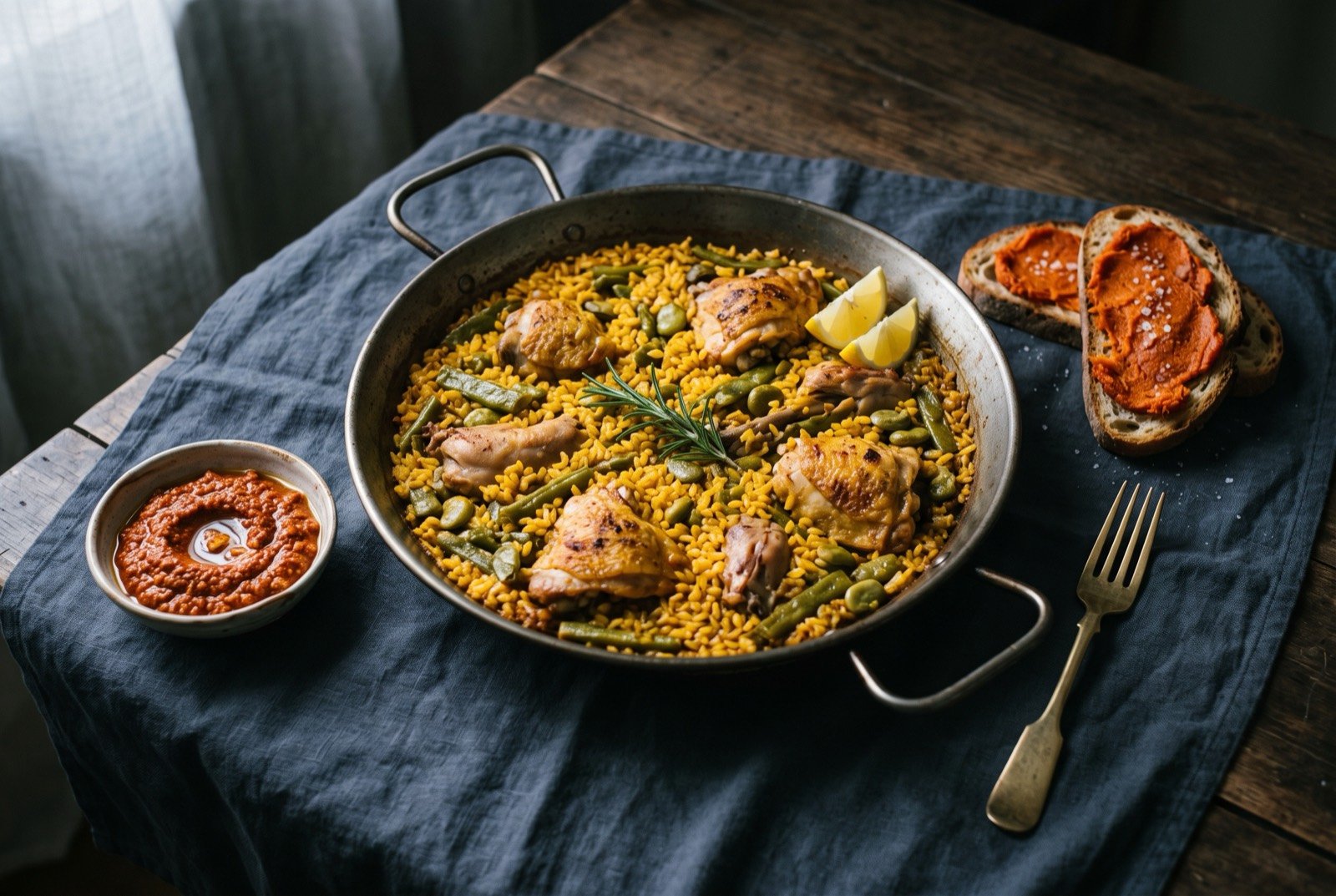
Spain's Mediterranean arc, from Barcelona down through the Valencian huerta and the Murcian steppe to the Balearic Islands, treated as one coast built on absorption cooking, ember and a picada, and one genuine island exception underneath it. Every dish as tradition built it, then what a modern chef would change.
Sources and review · What this chapter does not assert · How we research · Spotted something wrong?
A Sense of Place
Four territories, one coast, and a genuine island exception at the end of it. Catalonia and Valencia share a Mediterranean ecology this atlas has already met three times over: dry hot summers, mild wet winters, garrigue scrubland where grazing and fire have stripped back the native evergreen oak, and the same trilogy of olive, wheat and vine that shapes Italy and Greece. That is not a coincidence and this chapter does not pretend it is. Catalonia's coastal ecology brushes directly against the atlas's already-written Mediterranean volumes, Northern and Central Italy, Southern Italy and Sicily, Greece and Cyprus, without being covered by any of them, since none of those three touch Spain at all. What is different here is what sits on top of that shared ecology: a documented medieval vernacular cookbook tradition older than anything claimed for Provence, a Moorish irrigation engineering project that turned a malarial wetland into the rice bowl of Europe, and, at the far end of the coast, a set of islands that are genuinely their own maritime world rather than Catalonia offshore.
South of Barcelona, the huerta valenciana is the irrigated market-garden plain around Valencia city, watered by the Turia. Its acequias and azudes, small diversion dams, were formalised and expanded under Islamic rule; the Umayyad caliph Abd ar-Rahman III is credited with the major channels off the Guadalaviar, completed under his son al-Hakam II. Water rights on those channels have been governed since the Muslim era by the Tribunal de las Aguas, a farmer-run water court that still sits weekly outside Valencia cathedral and is recognised by UNESCO as Intangible Cultural Heritage of Humanity. Fifteen kilometres further south again, the Albufera is a freshwater lagoon of roughly 21,000 hectares, 17,500 of them rice paddy, the wetland this whole chapter's flagship dish comes from. Murcia's huerta is a smaller, poorer cousin of the same idea: the alluvial plain of the Segura, irrigated by an equally Islamic-built network of acequias and norias, ringed by a genuinely arid steppe that gets under 300mm of rain a year around Calasparra, Mula and Jumilla. The contrast between the two is the whole point of Murcian cooking: an irrigated ribbon of extraordinary abundance dropped into land that otherwise supports esparto grass and dryland cereal.
Catalonia's own logic is different again, and it is a trading logic before it is an agricultural one. Barcelona is a great Mediterranean port, and from the late thirteenth century the Crown of Aragon, the House of Barcelona, expanded through Sicily, Sardinia, Naples and the duchies of Athens and Neopatras, largely on the back of the almogàver mercenary companies, with Catalan and Aragonese resettlement following the conquests. This atlas has already treated the Sardinian half of that story, the Aragonese-Catalan conquest of the island from 1323, as part of Volume Two of Europe's Mediterranean; it is not re-derived here, only flagged as the same imperial network this chapter needs later for a very specific reason involving a pig.
And then the Balearics, which this chapter refuses to treat as a footnote. Catalan sources are explicit that Mallorca and Menorca are "cosines germanes," first cousins, while Eivissa and Formentera diverge sharply enough in cooking, vocabulary and even kitchen tools to be their own smaller story again. Each island guards its own named products under formal protection: Mallorca's own pebre bord paprika, grown nowhere else; Menorca's own DOP olive oil and Mahón cheese; Eivissa's honey. The islands only became Catalan at all from James I's 1229 conquest of Mallorca, with Menorca following by 1287, which is the entire reason Balearic food reads as a dialect of Catalan cuisine and not something unrelated. Menorca then had a genuinely separate colonial experience again, held by Britain for most of the eighteenth century, and that experience left real linguistic and culinary fingerprints still current on the island today, discussed below.
The History in Layers
A cookbook older than the claim usually made for it
The Llibre de Sent Soví, dated to 1324, is one of the oldest vernacular, non-Latin cookbooks anywhere in Europe. It survives in two forms, a shorter Valencian manuscript of 72 recipes and a longer Barcelona expansion of 204, titled the Llibre de totes maneres de potatges de menjar. It already contains, by name, two techniques that still define Catalan cooking eight centuries later: picada, a mortar-pounded paste of toasted nuts used to thicken and finish a sauce, and sofregit, a slow-built base of aromatics fried in fat. It runs to over fifty fish preparations sitting alongside game, deer, boar, pheasant, and poultry up to peacock, treating sea and hill protein within one shared grammar rather than as separate categories. Some of its recipes were copied wholesale into two fifteenth-century Italian cookbooks, Maestro Martino's and Platina's, which means the influence for once ran from Catalonia into Italian recipe literature rather than the reverse, a genuinely unusual direction for medieval Mediterranean food history to run in. A later text, Robert de Nola's Llibre del Coch, printed in 1520, shows clear familiarity with Sent Soví while widening its geographic range.
Rice, and the layer that actually built this coast
Moorish settlers introduced rice cultivation to the Valencian wetlands, though the exact century will not resolve from the sources behind this chapter: some agricultural and tourism sources place it in the eighth century, while the Catalan Wikipedia entry on Arròs de València, citing the DOP's own historical note, places the Arab-built rice paddies at the end of the tenth. This chapter does not pick between them. What both agree on is that Islamic engineers built the paddies, the acequias and the azudes that made rice cultivation possible at all, adding it alongside chufa, aubergine and artichoke to a Roman repertoire of cereal, vine and olive. Jaume I's Reconquista took the Kingdom of Valencia in three campaigns between 1233 and 1245; many Muslims remained as mudéjars under the new Christian rule, and Jaume I repopulated with Aragonese and Catalan families under the Furs de València, a comparatively advanced legal code for its time. The 1525 Expulsion of the Moors then did the crop real damage: the loss of specialist cultivation knowledge is credited with a rise in wetland malaria, which saw rice farming periodically banned or pushed onto genuinely unusable marshland, and the large paddies known today only fully re-emerged from the eighteenth century.
Paella is not as old as its reputation, and that is not a weakness
This is the single most important honesty test in this chapter, and it runs almost exactly parallel to the fabada and cachopo stories this atlas already told in the Basque volume: a real, old ingredient culture, and a considerably younger named dish sitting on top of it. Spanish Wikipedia's own account of paella valenciana's history is unusually well sourced, tracing named documents rather than folk memory. An eighteenth-century manuscript held at Barcelona's Episcopal Library is the first to distinguish a brothier "Catalan style" rice from a drier Valencian one, without yet using the word "paella" for either. In 1760 the Italian traveller Giuseppe Baretti describes a rice dish already containing saffron, pork knuckle, bacon, chorizo, morcilla and egg yolks, a detail worth holding onto for later. Francisco de Paula Martí's 1818 treatise gives the first detailed written method: vigorous heat throughout, testing the liquid level with a wooden spoon, cooking until the grains fully absorb the broth, which is, in essence, the method still used today. The first recipe actually titled "Paella" is only printed in 1857, in La cocina moderna, under the heading "Sartén a la Valenciana (Paella)," already carrying the instruction not to stir past the midpoint and to let the pan rest afterward. In 1896 the Valencian writer Víctor Navarro catalogued 24 regional rice-dish variants, from luxury ingredients to whatever the marshland offered a hungry household: eel, wildfowl, snails, water rats. What this sequence supports is exactly the labourer's-field-dish picture this chapter's brief expected: cooked over whatever local wood was to hand, orange wood is repeatedly claimed though no source pins down precisely when that became customary, with whatever the huerta and the Albufera actually produced that week.
The crop, then, is Moorish. The named, codified dish is a nineteenth-century phenomenon built on top of it, and Spain's own tourism apparatus finished the job: in August 1964 the Ministry of Information and Tourism formally recommended paella to restaurants as a dish for international visitors, and the Concurso Internacional de Paella Valenciana de Sueca, founded in 1961, certified its own "official" competition recipe in 1990, with disqualification for any deviation. Paella was declared a bien de interés cultural under Spanish heritage law only in 2021. None of this makes paella a fake tradition. It makes it, like fabada and cachopo before it, an honest example of the difference between an old foodway and a marketed name for one.
The rival authenticities, and the fight that will not go away
There are, at minimum, two formally codified "authentic" paella recipes competing for the same word, not one. The Consejo Regulador de la Denominación de Origen Arroz de Valencia states ten canonical ingredients, chicken, rabbit, flat green beans, garrofó, tomato, rice, olive oil, water, saffron and salt, explicitly excluding chorizo, onion and seafood from what it will certify as paella valenciana, while allowing garlic, artichoke, duck, pimentón, snails and rosemary as accepted regional variation. Sueca's own competition recipe, scaled to fifteen people and enforced by outright disqualification for deviation, is a separate, independently policed standard. A third project, Wikipaella, is a crowd-and-jury "ADN" certification effort, a civic initiative rather than a government body, that lands on broadly the same ten ingredients as the DOP.
The most public collision of these authenticities happened in public, on the internet, in 2016. On 4 October that year the British chef Jamie Oliver published his own paella recipe, chorizo, peas, carrots and paprika among its ingredients. Spanish Twitter's response combined genuine anger at what read as casual disrespect for a serious culinary tradition with a great deal of mockery, and the episode crossed into the British press as "paellagate," reportedly prompting a wry line from The Guardian that Oliver had achieved something Spanish politics could not, uniting the country, though this chapter has only found that line reported inside Spanish coverage of the episode, not fetched from The Guardian directly, and states it with that caveat attached. What deserves equal billing alongside the outrage is the historical wrinkle almost nobody raised at the time: chorizo is not a purely modern imposter. Baretti's 1760 account and Navarro's 1896 catalogue both include chorizo or morcilla in legitimately old, documented rice preparations. The strict "no chorizo, ever" position is a twentieth-century codification, the DOP's and Wikipaella's, not proof that chorizo never touched a historical Valencian rice dish. This chapter states the modern consensus plainly, because it is what any UK cook sourcing ingredients for a DOP-style paella needs to follow, while noting honestly that the consensus is younger than the ingredient it excludes.
Sobrassada travelled from the islands, not to them
This is the flag this chapter was specifically built to get right, because the wrong version of this story is easy to tell and actively misleading. Sobrassada is widely eaten on the Spanish mainland today, in Valencia and beyond, and a casual reader could reasonably assume that wide adoption implies shared origin, a mainland tradition the Balearics happened to share in. The documented history runs the other way entirely.
The technique itself likely was not invented on the islands at all. The Catalan food historian Jaume Fàbrega traces its likely technical ancestor to a Sicilian and southern Italian pork-preservation method called "sopressa," pressed sausage, with the actual name "sobrassada" more plausibly derived through Occitan than through a direct Italian "salsiccia" root. Fàbrega cites what may be the earliest solid documentary reference of all: a request from King Martí I of the Crown of Aragon for "sobressades" to be sent to him from Sicily, dated to around the turn of the fifteenth century. That places both the word and the product inside precisely the Mediterranean trading network this chapter's opening section named, the same Crown of Aragon reach into Sicily and Sardinia this atlas has already covered as conquest history, arriving in the Balearics as an import before it became a Balearic product at all.
From there the story genuinely does become an island story. By the sixteenth century Mallorca had built its own distinct charcuterie identity around it; the defining red colour and pimentón flavour is specifically an eighteenth-century addition, once American peppers reached the island and were dried locally into pebre bord, the island's own paprika. The highest grade of the product depends on the Porc Negre Mallorquí, the Balearics' only native pig breed, a black or slate-grey animal today maintained via an official herd book precisely so that "sobrassada de Porc Negre" cannot mean, in one Catalan source's own phrase, "any black pig sold with a good story." A widely repeated claim that the breed dates to the talayotic period, roughly 1300 BC, appears only in Spanish-language commercial sources and is not corroborated by more careful sourcing, which describes the breed's precise origin as genuinely uncertain; this chapter does not assert the specific date.
And then the mainland arrives, but late, and by emigration rather than shared invention. Fàbrega documents that the Valencian town of Tàrbena acquired sobrassada specifically through Mallorcan settlers who moved there in the seventeenth century, and that the mainland product still carries names derived from that transplantation, "tàrbenes," "tàrmenes." Industrial-scale expansion onto the peninsula is a twentieth-century development, as sausage factories were established on Mallorca itself; today, in a further irony, roughly 70 per cent of the raw pork used in white-pig-breed sobrassada is bought in from the peninsula because Mallorca's own herd cannot meet demand, meaning the mainland now supplies the pig for an island product it once merely imported. Mallorca's IGP, sought from 1993 and granted in 1996, was the first Spanish cured meat product to win EU protected-origin status, secured precisely to lock in this Balearic primacy against exactly the kind of conflation this chapter was warned against making. Wide mainland adoption is real. It is not evidence of shared origin, and this chapter does not treat it as such.
Mayonnaise, argued properly rather than assumed
Menorca's claim to mayonnaise is better documented than the popular French legend usually allows for, and it deserves the same treatment. The food historian Pep Pelfort has identified, in an eighteenth-century Menorcan manuscript known as the Receptari Caules, compiled by or for the Caules-Mercadal families of Mahón around 1770 to 1780 though its culinary material is thought older still, a recipe numbered 33, "Per fer una salsa de peix crua," combining egg yolk, oil, vinegar, minced onion, parsley, garlic and pepper, which Pelfort describes as the earliest known written description of the mayonnaise procedure. A related, older Menorcan sauce, "all i oli bo," good garlic and oil, is separately documented in an eighteenth-century recipe book, Art de la Cuina, by Fra Roger, a Franciscan cook working in Ciutadella. The popular story, that the Duke of Richelieu's cook improvised the sauce at Mahón after the 1756 siege of Fort Sant Felip, and that "mahonnaise" is a corrupted French rendering of "Mahonesa," is attributed by Catalan sources to the Mahón-born historian Lorenzo Lafuente as its popularising storyteller, and is described in those same sources explicitly as a "llegenda," a legend, while acknowledging that French claimants exist too. This chapter treats the Menorcan case as the better-evidenced one, resting as it does on named historians and named manuscripts, and the French case as attributed legend, without pretending the matter is more closed than it is.
Britain's century on Menorca
Britain held Menorca for most of the eighteenth century, 1708 to 1802 with a French interlude from 1756 to 1763, and the occupation left genuinely durable culinary fingerprints still current in Menorcan speech: gin, pudding, butter, and, most tellingly, grevi, the Menorcan word for a meat sauce, which still carries its English name today. The potato arrived on the island in 1751 specifically because British garrisons needed to feed their soldiers. The British also built Georgetown, today's Es Castell, in Georgian style at the mouth of Mahón's harbour, a piece of the island's built fabric as durable as its borrowed vocabulary.
A working method older than its most famous dish, and a lobster stew younger than its reputation
Mar i muntanya, sea and mountain, pairing shore protein with hill protein in one dish, chicken and lobster, chicken and langoustine, is one of this chapter's spine ideas, and it needs a careful two-part statement rather than one flattering myth. The underlying grammar is genuinely medieval: Sent Soví already treats escabetx as a technique applicable equally to fish and to game, and sits fifty-plus fish preparations directly alongside boar, deer and peacock, evidence of a kitchen entirely comfortable mixing sea and hill within one register. But the specific named dish, and the popular chicken-and-lobster combination people picture when they hear the phrase, is considerably younger: the earliest documented written reference found for this chapter is the 1835 cookbook La cuynera catalana, and the best-known origin story, a Tossa de Mar fisherman's household roasting chicken for a festival and reusing the leftovers with lobster the next day, is a twentieth-century-recorded oral tradition tied to the Costa Brava's earliest tourist trade, not a medieval document. The technique's grammar is old. The dish and its charming legend are not, and this chapter states both halves rather than only the flattering one.
The same lesson, more sharply, applies to Menorca's caldereta de llagosta, the Fornells lobster stew now treated as one of the most prized and expensive dishes on the whole coast. Catalan food-history sources are blunt that "the caldereta de llagosta, as known today, did not exist at the end of the nineteenth century": lobster was originally rejected outright by fishermen, who saw it as worthless because it damaged their nets, and the dish only became fashionable, and valuable, with the arrival of early-twentieth-century tourism, becoming what one source calls a genuine "tourist phenomenon" by 1923. At least one account even places an origin story in Pollença, on Mallorca, rather than at Fornells specifically. This chapter treats Fornells as where the dish is prized today, not as an uncontested birthplace, which is exactly the honesty this coast's food history keeps asking for.
The Flavour Arsenal
Rice and its behaviour
| Bomba | Short-grain rice bred to expand in width rather than length, nearly doubling in size, and unusually forgiving of a few minutes' overcooking without turning to mush; the standard for a paella meant to hold its structure |
| Sénia | Higher in amylopectin, absorbs liquid fast and releases more starch for a creamier result, but punishes imprecise timing far more sharply than bomba, moving from undercooked to gluey in as little as two minutes |
| Albufera | A 2007 hybrid of Bomba and Sénia, bred at the Sueca rice research station specifically for the DOP zone |
| Arroz de Calasparra | Murcia's own rice DOP, the first in Europe, granted 1986, grown in the Segura-Mundo confluence known as the Coto Arrocero, genuinely distinct from Valencia's Albufera rice |
The aromatic base
| Ñora | A dried, sweet red pepper, rehydrated and its flesh scraped from the skin, the base of both a proper sofrito and romesco |
| Pimentón de Murcia | Sun-dried, unsmoked, sweeter and milder than its better-known Extremaduran cousin; the regionally correct paprika for this coast's sofritos, not the smoked La Vera style that belongs further west |
| Saffron | La Mancha's DOP threads, genuinely and widely adulterated in export markets; see Sourcing below for the test that catches a fake in under fifteen minutes |
| Garrofó | A large white lima-type bean, a Valencian landrace of Phaseolus lunatus, grown fresh only in season and central to a DOP-recognised paella |
| Sobrassada pork and pebre bord | The Balearics' own cured, spreadable pork sausage, see The History in Layers above for its real origin, and the ferment bench below for how it is made |
| Xufa | Tiger nut, grown almost exclusively at Alboraya under its own DOP, ground and strained for horchata |
Fish and shellfish
| Anguila | Eel, the Albufera's own catch, the base of all i pebre |
| Sèpia and calamar | Cuttlefish and squid, the working base of a Catalan suquet's sofregit |
| Llagosta | Spiny lobster, the centrepiece of Menorca's caldereta, prized today for a reputation only a century old |
| Bacallà | Salt cod, shredded and torn by hand into esgarraet alongside roasted pepper |
Beans and pulses
| Mongeta del ganxet | A small, kidney-shaped, notably buttery bean from the Vallès, the standard partner to grilled botifarra |
| Haba seca | Dried broad bean, the base of Murcia's michirones, soaked a minimum of twelve hours before it will take a long simmer |
The Technique Ladder
The argument, from inside
Quique Dacosta, three Michelin stars at Dénia, created in 1996 a working solution to a problem this coast's own defining technique creates for restaurant service: rice needs eighteen to twenty minutes of continuous cooking, which does not fit a multi-course tasting menu's rhythm. His fix, cook the rice eight minutes, shock-chill it, hold it, then finish it to order in roughly four more minutes, first presented publicly in 2003 and published in his 2005 book Arroces Contemporáneos, is now used across Valencian and international fine dining. Dacosta's own framing of socarrat is the clearest single statement of this chapter's whole argument: "Le damos protagonismo después de dominarlo," we give it the starring role only once we have mastered it. The crust is not a happy accident to be hoped for. It is a technique to be controlled, and this ladder treats it that way.
Rung 1. Build absorption cooking on evaporation, not on a fixed ratio
A rough rule of thumb holds that rice absorbs roughly its own weight in liquid, but the genuinely variable factor in a wide, shallow paella pan is evaporation, which depends on the pan's diameter, the heat source and the cooking time, and professional sources describe this as effectively uncalculable except by empirical trial with a given pan and burner rather than a fixed number. This is exactly why the pan's shape matters as much as anything in it: a large surface area relative to liquid depth maximises evaporation, letting the rice cook through by absorption while the liquid disappears, rather than boiling in a deep pot where it would simply turn to a risotto-like porridge. Rice is never washed before it goes in, a rule Valencia's rice masters treat as close to sacrilege, because it is exactly the surface starch, heated together with the sofrito's fats, that generates the reaction producing the crust. Dacosta's own stated ratio for a socarrat-bound rice is 160 grams of rice per litre of stock, cooked over higher heat for around twelve minutes rather than the eighteen to twenty a non-crusted rice takes, with oil added "a hilo," in a thin, steady stream, once the stock is absorbed.
What a cook does with this rung. Weigh the pan's actual base diameter before doing anything else, and treat the stock quantity as a starting estimate to be adjusted against that specific pan and that specific burner over a couple of attempts, not as a number to trust blindly on the first try. Never rinse the rice.
Rung 2. Never stir once the rice is in, and never cover the pan
This rule appears in writing as far back as La cocina moderna's 1857 recipe, "no revolver desde la mitad de la cocción," and it survives unchanged in every modern source: rice is scattered evenly across the liquid once, and from that point it is only tilted or shaken if needed, never stirred, because stirring interrupts the direct contact between the bottom layer of grains and the hot pan that a crust depends on, and releases starch unevenly into the liquid above it. Covering the pan is named separately as an equally serious error, since a lid traps steam, cooks the rice unevenly, and produces a pasty result instead of the surface evaporation the whole method depends on.
What a cook does with this rung. Resist every instinct from a lifetime of cooking rice on a hob. Once it goes in, put the spoon down.
Rung 3. Build a real sofregit before anything else happens
A proper sofregit, the slow-fried base of onion, garlic and grated tomato that underlies nearly every dish in this chapter, needs twenty to thirty minutes at medium-low heat to caramelise its tomato and any meat in it properly; rushing it on high heat is named directly, by a working Valencian rice chef, as the single most common failure in a home-cooked paella. Pimentón, when it goes in, is added for only a matter of seconds to a minute at very low heat, since it scorches and turns bitter almost immediately, and stock or water follows straight after specifically to arrest that scorching before it happens.
What a cook does with this rung. Do not let impatience shortcut the sofregit. A high-power blender can rescue a lumpy or under-reduced sofregit at the very end if it has genuinely gone wrong, but it is not a substitute for giving the pan its full twenty to thirty minutes in the first place.
Rung 4. Picada is an emulsifier, not a garnish
Picada, a mortar-pounded paste of toasted almonds or hazelnuts, often with garlic, fried bread and sometimes saffron, stirred into a stew or sauce at the very end of cooking, works by combining fat, oil and the nuts' own released oils, with finely ground starch, the bread, and protein, the ground nut meal, to thicken and emulsify a liquid without flour or cream. It is the shared ancestor of romesco, of the finishing thickener in a suquet de peix, and of the coral-and-almond paste that finishes a caldereta de llagosta, documented as far back as Sent Soví itself.
What a cook does with this rung. A high-power blender will make a smoother picada than a mortar in a fraction of the time, and there is no traditionalist reason to resist it; the technique's logic, fat plus ground starch plus nut protein, survives the change of tool completely intact.
Rung 5. Escalivar is ember contact, not oven roasting
Escalivar, from the Catalan "caliu," embers, is direct-fire cooking of whole vegetables, aubergine, red pepper, onion, sometimes tomato, until the skin blackens and blisters and the flesh steams inside its own jacket. The vegetables are peeled while still warm and never rinsed, since rinsing washes away exactly the smoke flavour and the released juices the technique exists to capture; they are torn by hand rather than cut, dressed simply with good olive oil and salt. Calçotada charring works on the same logic taken further, total blackening of the whole onion over a live wood fire, eaten peeled by hand with a bib and no cutlery, the sweet interior found only once the burned outer layers are stripped away.
What a cook does with this rung. A Big Green Egg run hot with the vegetables set directly near the coals gives genuine ember contact that a domestic oven's dry roasting cannot replicate; resist the urge to wrap anything in foil, which defeats the entire purpose of direct blackening.
Rung 6. Curing sobrassada is fermentation and paprika doing two jobs at once
Sobrassada is made from coarse-ground pork and back fat mixed with salt, roughly 20 to 30 grams per kilo of paste, and sweet pebre bord, around 60 grams per kilo, stuffed into casing and cured over several weeks. During that period the paste ferments and slowly loses moisture, which is what develops its characteristic creamy, spreadable texture rather than a firm, sliceable one. The paprika is doing two jobs simultaneously, contributing flavour and colour, and acting as a genuine antimicrobial agent during the cure, a function typical of cured Iberian charcuterie generally rather than unique to this one sausage.
What a cook does with this rung. This is the ferment bench technique for this volume, treated in full below; a dehydrator held at a controlled low humidity can stand in for the cool, airy larder a Mallorcan household would traditionally have used.
Part Three
The Ferment and Preserve Bench
Sobrassada is this volume's one true ferment, and its full, correctly attributed history is given above: a technique likely arrived from Sicily via the Crown of Aragon's own Mediterranean network, made genuinely and distinctively Mallorcan from the sixteenth century onward, not a mainland tradition the islands merely share in.
To cure at home. Coarse-ground pork shoulder and back fat, mixed thoroughly with salt at roughly 20 to 30g per kilo of paste and sweet pebre bord or Murcian pimentón at around 60g per kilo, plus a little hot pepper to taste, stuffed into natural casing. Hung to cure and slowly dry over several weeks in a cool, airy space, traditionally a Mallorcan larder, during which the paste ferments and loses enough moisture to develop its characteristic soft, spreadable texture rather than becoming a firm, sliceable sausage. A dehydrator, run at a low, controlled temperature with the door propped very slightly for airflow, is a genuinely workable stand-in for that traditional larder in a British kitchen that does not have one. The pimentón is doing double duty throughout the cure, contributing flavour and colour and acting as a real antimicrobial agent, a function typical of cured Iberian charcuterie generally.
Sourcing in Britain
Verified UK retailers, August 2026. Four ingredients decide whether this coast's cooking succeeds or fails at home; the rest matter, but forgive more.
- Genuine bomba or Calasparra rice. Brindisa stocks DOP Calasparra Paella Rice in 500g and 1kg formats direct and via Ocado and Amazon UK; Sous Chef stocks both Bomba and Calasparra rice; IberGour also carries it. Look for the DOP seal itself, not just "arroz para paella" as marketing copy: genuine bomba or Calasparra keeps its shape under a few minutes' overcooking, thanks to unusually high amylose content, where a generic paella rice turns mushy and never develops socarrat properly. Arborio is not a close substitute; it is the one ingredient worth mail-ordering rather than compromising on.
- A correctly sized pan for the actual heat source. Sous Chef's Steel Valencia range and Brindisa's enamelled pans cover most domestic needs; The Paella Company, a dedicated UK specialist, stocks genuine Spanish Garcima and Vaello pans across sizes. A domestic hob ring realistically tops out around 30 to 38cm, since a wider pan only heats evenly at its centre on a single ring, leaving the rice at the edges undercooked; a Big Green Egg suits a 14 to 15 inch pan on a Large, 18 inch on an XL, and Big Green Egg's own UK store sells a dedicated paella pan accessory. Buying a beautiful large pan that does not match the heat source it will actually sit on is the single most common way a UK cook sabotages their own paella before a single ingredient goes in.
- Genuine La Mancha DOP saffron, tested. IberGour and Seasoned Pioneers both carry verified DOP threads. Drop four or five threads into cool water: real saffron bleeds colour slowly, taking ten to fifteen minutes to turn the water deep gold while the threads themselves stay crimson; adulterated saffron, dyed corn silk or safflower among the common substitutes, colours the water almost instantly. Industry testing has found over half of some markets' "Spanish saffron" fraudulent; the DOP seal and a named specialist retailer are the real protection, not the word "Spanish" printed on the packet.
- True IGP sobrassada de Mallorca. Melbury & Appleton, The Spanish Hamper, Delicioso and The Tapas Lunch Company all stock the genuine, IGP-certified product; Melbury & Appleton's delivery is mainland UK only, excluding Northern Ireland and offshore islands, worth knowing before ordering. Check for the actual IGP mark rather than trusting the word "sobrasada" alone, since generic mainland "sobrasada-style" products, often made from ordinary pork with more filler and less real pebre bord, are common in non-specialist delis. 'Nduja is a workable emergency substitute but not a close one: its heat comes from clean, sharp Calabrian chilli, where sobrassada's character comes mostly from smoke, salt and milder paprika.
Further down the list, in rough order of how much they matter. Genuine ñora peppers and Murcian, not La Vera, pimentón from Sous Chef, Brindisa or Melbury & Appleton. Fresh or dried garrofó itself is not obtainable in the UK; well-drained tinned or soaked dried butter beans are a genuinely close substitute, since garrofó is itself a Valencian landrace of the same lima bean species, not an approximation of a different one. Gallo's fideo No. 2, the correct short tubular noodle for fideuà, is stocked by Sous Chef, Iberico Foods and L'Española; broken vermicelli is a workable but noticeably inferior stand-in. Genuine PGI turrón is available year-round, not just at Christmas, from The Tapas Lunch Company, Melbury & Appleton and Basco Fine Foods. Xufa for horchata is the single hardest ingredient on this whole list to source properly: The Tiger Nut Company is the dedicated UK specialist and also bottles a ready-made horchata using genuine Chufa de Valencia, and this is the honest recommendation over trying to build it from generic health-shop tiger nuts, which are not confirmed to be the same variety. Saïm, Mallorcan pork lard, has no verified UK retailer at all; render your own from a butcher-sourced leaf fat, as described in the ensaïmada elevation above, rather than hunting for a shortcut that does not currently exist. Cava is in every UK supermarket and is not worth agonising over.
Voices and Sources
Chefs and restaurants. Quique Dacosta, three Michelin stars at Dénia, whose 2005 book Arroces Contemporáneos and 1996 two-phase rice technique underpin much of this chapter's Elevation sections, and whose own London restaurant, Arros QD in Fitzrovia, is named below as a genuine, checkable UK reference point rather than a generic tapas venue. Ferran Adrià, whose 1993 cookbook El Bulli: El Sabor del Mediterráneo first stated in print the argument this whole chapter, and this whole atlas, keeps making region by region, that technique exists in service of a specific place's flavour rather than as a replacement for it, and whose more recent public remarks on the difference between popular and traditional Catalan food are quoted directly above rather than paraphrased. Oriol Castro, Eduard Xatruch and Mateu Casañas, the ex-elBulli trio behind Disfrutar in Barcelona and Compartir in Girona. Ricard Camarena, whose Valencia restaurant runs on the huerta's own calendar rather than a fixed menu, and whose own words on that submission are quoted above. Joan Roca of El Celler de Can Roca on romesco as Catalonia's own universal sauce. Andreu Genestra on Mallorca and Sílvia Anglada of Es Tast de na Sílvia on Menorca, both building genuinely local, market-driven modern cooking rather than importing a style from elsewhere. Barrafina in London, founded by brothers raised partly on Mallorca, a real and well-regarded diaspora reference point.
Historians and named sources. Jaume Fàbrega, the Catalan food historian whose work underpins this chapter's correction of the sobrassada origin story. Pep Pelfort, whose documentary work on the Menorcan Receptari Caules manuscript underpins the mayonnaise section. Nèstor Luján, the food historian who rediscovered and published Pompeu Gener's 1884 letter on pa amb tomàquet. The Consejo Regulador de la Denominación de Origen Arroz de Valencia and the Consorcio de la Denominación de Origen Calasparra, whose own historical and technical material underpins the rice sections throughout.
Things this chapter has deliberately not asserted
- The exact century Moorish rice cultivation began in Valencia. Sources split between the eighth century and the end of the tenth; this chapter states both without picking one.
- That orange wood was the dated, original fuel for paella. Repeated across sources but with no rigorous dating found for when or why it specifically became standard.
- Either of the two rival Gandia fideuà origin stories, the captain's greed or simply running out of rice, as settled fact; both circulate only in Spanish tourism retellings without an identifiable primary source, and this chapter has accordingly not given fideuà its own full "twice" treatment here, mentioning it only in passing.
- That The Guardian's actual wording on "paellagate" said what Spanish press reported it as saying; this chapter has only found that claim reported secondhand, not fetched from the original.
- That seafood paella is equally, traditionally authentic alongside the DOP's meat-and-vegetable recipe. The DOP and Wikipaella consensus is clear that it is a separate, later, coastal-restaurant variant, and no strong in-tradition defence of seafood paella as equally original was found in the research behind this chapter; this may be a gap in what was searched rather than a settled absence.
- The Ottoman-Turkish "simnel" etymology sometimes given for ensaïmada in English-language food writing. No Catalan-language source consulted supports it, and this chapter follows the Catalan sourcing instead.
- The talayotic, circa 1300 BC, origin date sometimes given for the Porc Negre Mallorquí pig breed. This rests only on Spanish-language commercial sources; more careful sourcing describes the breed's precise origin as genuinely uncertain.
- That Fornells is the uncontested birthplace of caldereta de llagosta. At least one source places an origin story at Pollença on Mallorca instead; this chapter treats Fornells as where the dish is prized today, not as a settled birthplace.
- Any documented use of sous vide, dashi-style stock, or an induction paella pan by a named modern restaurant kitchen on this coast. Extensive searching found no such example; the Elevation sections above apply these tools as reasoned extensions of the technique ladder for a home cook, not as claims that any named restaurant already does this.
- A direct named-chef quote refuting the specific diaspora failures of reheating pre-cooked frozen seafood or substituting turmeric for saffron. The mechanical case against both is sound chemistry and cooking physics, but no chef quote addressing either practice by name was found, and this chapter states the mechanics as inference rather than attributing them to anyone.
Build absorption cooking on evaporation, not on a fixed ratio
A rough rule of thumb holds that rice absorbs roughly its own weight in liquid, but the genuinely variable factor in a wide, shallow paella pan is evaporation...
Never stir once the rice is in, and never cover the pan
This rule appears in writing as far back as La cocina moderna's 1857 recipe, "no revolver desde la mitad de la cocción," and it survives unchanged in every...
Build a real sofregit before anything else happens
A proper sofregit, the slow-fried base of onion, garlic and grated tomato that underlies nearly every dish in this chapter, needs twenty to thirty minutes at...
Picada is an emulsifier, not a garnish
Picada, a mortar-pounded paste of toasted almonds or hazelnuts, often with garlic, fried bread and sometimes saffron, stirred into a stew or sauce at the very...
Escalivar is ember contact, not oven roasting
Escalivar, from the Catalan "caliu," embers, is direct-fire cooking of whole vegetables, aubergine, red pepper, onion, sometimes tomato, until the skin...
Curing sobrassada is fermentation and paprika doing two jobs at once
Sobrassada is made from coarse-ground pork and back fat mixed with salt, roughly 20 to 30 grams per kilo of paste, and sweet pebre bord, around 60 grams per...
The dishes
- Paella Valenciana Valencia
- Arròs a Banda Valencia
- All i Pebre Valencia, El Palmar
- Michirones Murcianos Murcia
- Escalivada amb Pa amb Tomàquet Catalonia
- Calçotada amb Romesco Catalonia, Valls
- Suquet de Peix Catalonia
- Crema Catalana Catalonia
- Sobrassada amb Mel Mallorca
- Ensaïmada Mallorca
- Caldereta de Llagosta Menorquina Menorca, Fornells
Sources and review
- Reviewed
- Not yet reviewed from inside the tradition
- Cooked
- Not yet cooked and reported
Where this volume comes from
3 research briefs on file for this volume, researched to the rules on How we research. Published 28 August 2026. Last changed 8 September 2026.
The brief's own account of its sources
Valencia/Murcia slice: of roughly 30 distinct sources, the substantial majority are Spanish or Valencian/Catalan-language: Spanish and Catalan Wikipedia, the Generalitat Valenciana's agricultural portal, the Consejo Regulador de la DO Arroz de Valencia and DO Calasparra's own historical pages, Región de Murcia Digital, academic PDFs (Guinot/Thomas F. Glick on the huerta landscape), and a cluster of Spanish food-history and regional-tourism sites.
1 dish here carries a time estimated from comparable dishes in this atlas, because no source states one.