Europe · Volume 04
The Basque Country, Cantabria & Asturias
The Cider and Cod Coast
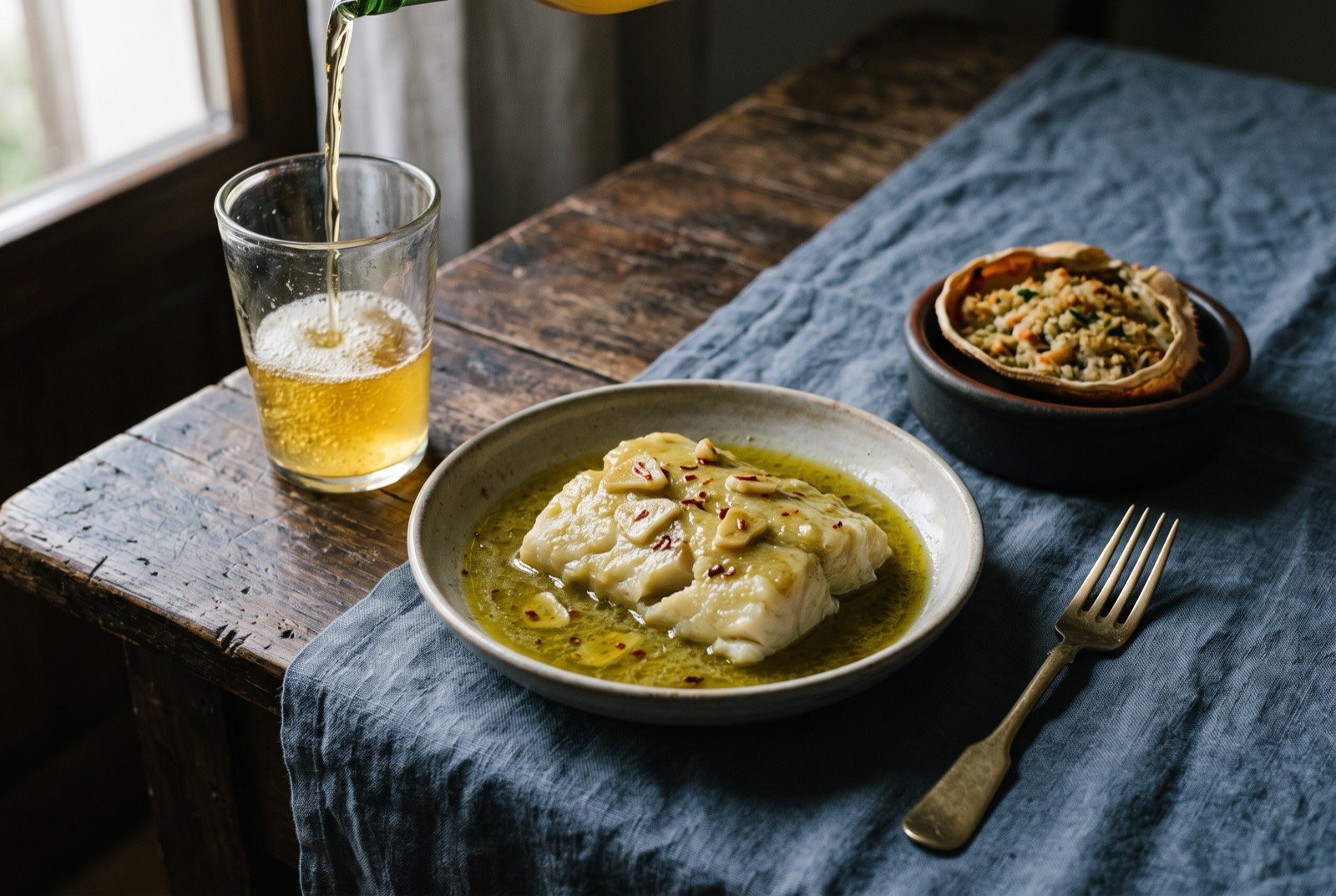
The Basque Country, Cantabria and Asturias, taken seriously. Not three cuisines competing for a name but one shared Atlantic idiom of rain, dairy, cider and salt cod, expressed through three distinct identities, urban and haute in the Basque Country, closer to farmhouse and fishing boat in Asturias and Cantabria, and every dish as tradition built it, then what a modern chef would change.
Sources and review · What this chapter does not assert · How we research · Spotted something wrong?
A Sense of Place
Three politically and linguistically distinct territories, the Basque Country, Cantabria and Asturias, share one Atlantic idiom, and that is not a coincidence, it is ecology. This is "España húmeda," wet Spain: an Atlantic oceanic climate with a mild year-round temperature range, heavy and regular rainfall, cool summers and barely 1,900 hours of sunshine a year, the direct opposite of the Meseta's dry-summer continental climate further south. Mountainous terrain, with orographic rain off the Cantabrian mountains meeting the sea, favours meadow and forest over arable cropping, which is the structural reason this coast runs on dairy cattle and forestry rather than grain. Out of that comes a shared grammar: dairy-based cheeses, cider in Asturias and Cantabria, txakoli in the Basque Country, salt cod and other cured fish, and a bean-based winter stew, fabada in Asturias, cocido montañés in Cantabria, alubiada in the Basque interior.
The Basque Country
Basque food writing consistently frames the cuisine around sea product, lean meats, land produce and dairy. But the defining fact underneath it all is Euskara: a pre-Indo-European language isolate, the only one surviving in Europe, ergative and agglutinative, with roughly 800,000 native speakers today. Its exact origin is genuinely unresolved, connected variously to a surviving pre-Indo-European Mediterranean substrate, to Caucasian languages, or to Armenian, and none of these is settled scholarship. This chapter treats that as an open linguistic question rather than reading continuity into the food from the language's isolation alone, since nothing in the sourcing behind this chapter makes that argument directly.
Cantabria and Asturias
Both were the historic heartland of pre-Roman "castro" hillfort culture, mixed cereal, legume and livestock economies with transhumance to summer highland pasture. Politically, this is also the core of the Kingdom of Asturias, the traditional starting point of the Reconquista from the Battle of Covadonga in 722, reflected in the regional saying "Asturias y Cantabria, lo demás es tierra conquistada," Asturias and Cantabria, the rest is conquered land. A causal link from that "never conquered" status to specific preserved foodways is a plausible inference given the mountainous, historically road-poor terrain, but no scholarly food-history source behind this chapter makes that argument explicitly, and it is offered here as inference, not as a sourced claim.
One coast, three tables
The result is a coast that eats the same underlying things differently. Basque cooking runs through a genuinely urban, port-and-restaurant tradition, Bilbao and San Sebastián both large enough to support a formal haute cuisine centuries deep. Asturian and Cantabrian cooking stayed closer to the farmhouse and the fishing boat for longer, and both regions' most famous dishes, fabada and cocido montañés, turn out on close inspection to be considerably younger, as branded national dishes, than their ingredients. That is not a weakness in the tradition. It is the tradition being honest about the difference between an old foodway and a marketed name for one, and this chapter follows that honesty rather than smoothing it away.
The History in Layers
The cod trade, and the claim that does not survive checking
This is the most important honesty test in this chapter. The popular claim, repeated widely including in Mark Kurlansky's Cod and The Basque History of the World, is that Basque fishermen were fishing the Grand Banks a hundred years before Columbus. It does not survive checking. It traces to one source: a 1647 book published in Bordeaux by the jurist Étienne Cleirac, asserting the claim with no evidence offered. Current Basque historiography agrees no archaeological or documentary proof exists either way; the historian Xabier Alberdi puts it plainly, no proof exists that Basques reached America a century before Columbus, but no evidence rules it out either.
What is actually documented is a strong enough story on its own terms that it does not need the inflated version. Basques first appear in the Newfoundland record in 1517, ten years after Galician fishermen. The ship Catherine d'Urthubie returned from Newfoundland to Bordeaux with 4,500 pieces of cod and 12 barrels of whale oil in 1520. Basque whaling is separately documented on the Cantabrian coast itself from the fourteenth and fifteenth centuries, moving progressively further afield as coastal whale stocks were depleted, to the North Sea, then Iceland, then Labrador. The historian Selma Huxley Barkham did the archival work, in the Oñate and Valladolid archives, then field expeditions from 1977 with the archaeologist James Tuck, that established a documented sixteenth-century Basque whaling station in Labrador, including the wreck of the galleon San Juan, 1565, at Red Bay.
Later trade history is equally solid and considerably less romantic. The Treaty of Utrecht, 1713, ceded French Newfoundland, Acadia and Hudson Bay claims to England, badly damaging Basque fishing access and pushing fishermen toward sardines instead. Pysbe, founded at Pasaia in 1926, ran eight cod vessels until 1974, when 200-mile exclusive economic zones closed the trade down; a 1936 Pysbe cookbook held 212 cod recipes. Canada's 1992 cod moratorium closed the story for good. Basque kitchens still work through around 4,400 tonnes of imported cod a year despite only two Basque cod boats remaining today.
Cider's real depth, and a name invented in 1966
Documented apple cultivation in Asturias reaches back to the founding charter of Oviedo and the monastery of San Vicente in the late eighth century; the word "sicere" for cider appears directly in the Fuero de Avilés in the early twelfth century. By the seventeenth century Villaviciosa alone was producing roughly 6,000 pipas of cider, around 3 million litres, a substantial regional economy centuries before it became a national symbol. Asturian cider culture was declared Spanish national intangible heritage in 2014 and inscribed on UNESCO's Representative List of the Intangible Cultural Heritage of Humanity on 4 December 2024.
Cocido montañés is a genuinely different kind of story, and worth telling as such. Before 1966, what Cantabrians ate was simply potaje de berza or potaje de alubias. In 1966, José Luis Herrero Tejedor, then Delegate of Information and Tourism, renamed the dish "cocido montañés" specifically because Cantabria, unlike Madrid with its cocido madrileño, Asturias with fabada, or the Basque Country with marmitako, had no single dish it could present to tourists as a regional icon. The stew itself, white beans, berza cabbage, chorizo, morcilla, costilla and tocino from the pig slaughter, is genuinely old, traditionally dated to the seventeenth century. The name is a 1966 tourism-board invention. Both facts belong in the same sentence.
Fabes, the bean at fabada's centre, are a genuine New World crop, Phaseolus vulgaris, domesticated in the Americas and brought to Spain from the early sixteenth century; general dietary uptake across Spain, as with the potato and the tomato, did not happen until the nineteenth. Fabes were established in Asturian cultivation by the eighteenth century, but the word "fabada" is first attested in writing only in 1884, in a Gijón newspaper advertisement for fabada served at a local romería. The dish only spread beyond Asturias from the mid-twentieth century, once restaurants began serving regional Spanish specialities more widely.
Cachopo carries the same lesson again, more sharply. According to Eduardo Méndez Riestra, president of the Asturian Gastronomy Academy, cachopo was created by the cook Olvido Álvarez at Bar Pelayo in Oviedo in the mid-1940s, consciously adapted from cordon bleu and San Jacobo, originally filled with cheese, ham and asparagus. It spread from there to coastal restaurants on the Cabo de Peñas and was popularised further by the chef Fernando Martín. Weaker accounts push the dish's origin back to the eighteenth or nineteenth century; they are considerably less well sourced than Méndez Riestra's account and this chapter does not give them equal weight. Cachopo is a 1940s restaurant invention, not a folk-ancient dish, and that in no way diminishes it. It is simply what it is.
Nueva Cocina Vasca, a layer on an older working tradition
Dated to 1976, catalysed by Juan Mari Arzak's address at Madrid's Club de Gourmets alongside Pedro Subijana; both had trained under Paul Bocuse in Lyon and brought Nouvelle Cuisine's market-driven, technique-refined philosophy home, applying it to traditional Basque recipes rather than importing French dishes wholesale. Karlos Arguiñano, Ramón Roteta, Luis Irizar and José Juan Castillo were also part of the founding group, alongside Tatus Fombellida, the sole woman named among the founders, credited with elevating the role of dining-room service. The movement's own stated aims, across the sources behind this chapter, were to recover authentic Basque classics faithfully, resurrect lost recipes through investigation in farmhouses and fishing communities, and create new recipes from local ingredients previously unused in fine cooking, seaweed, sea urchin, scorpionfish among them.
This is worth stating plainly, because it is this whole series' argument showing up in a different country: Nueva Cocina Vasca drew on nouvelle cuisine's principles of simplicity and seasonality, but its own framing was renewal of Basque tradition, not French import. The Basque Culinary Center, founded 2009, operating from 2011, was built by members of that same generation and continues the link between working chefs and formal research, holding the first gastronomy faculty in Spain and the first gastronomy doctorate anywhere.
The Flavour Arsenal
Fish and shellfish
| Bacalao | Salt cod, the coast's founding trade good and still its structural protein, rehydrated by soaking and repeated water changes before cooking |
| Bonito del norte | Albacore tuna, caught in summer, the reason marmitako is a summer dish |
| Anchoas del Cantábrico | Cantabrian anchovy, hand-salted and hand-filleted, Santoña the best-known curing town |
| Kokotxas | The gelatinous throat cut of hake or cod, once a fisherman's use of a discarded part, now a gourmet product |
| Txangurro / centollo | Spider crab, the shell itself used as the serving vessel |
| Percebes | Goose barnacles, hand-harvested directly in the surf zone under strict daily quota |
| Angulas | Baby eel, now a genuine sustainability crisis, see below, and treated in this chapter as a present-tense ethical problem rather than a historical delicacy |
Dairy and cheese
| Idiazábal | Basque raw sheep's milk cheese, DO since 1987, from Latxa and Carranzana breeds; smoking is regional, not universal, and this chapter resists flattening the cheese to mean "smoked" as a rule |
| Cabrales | Asturian blue cheese, DOP since 1981, raw cow's milk or a blend with sheep and goat, cave-aged a legal minimum of two months in the natural caves of the Picos de Europa |
| Fabes de la Granja | The Asturian white bean proper, IGP-protected, distinct from the Galician alubia often substituted for it, including in the UK, see Sourcing below |
Peppers, wine and cider
| Pimientos de Gernika | Small Basque green pepper, DOP since 2007, historically grown to maturity for dried red choricero peppers, now more often picked young and green for frying |
| Pimiento choricero | The dried, mature red form of the same pepper family, rehydrated for sauces such as bacalao a la vizcaína |
| Guindilla | Pickled green Basque chilli |
| Hondarrabi Zuri | The grape behind txakoli, over 95 per cent of plantings in the Getaria DO |
| Manzana de sidra | Cider apple varieties bred for acid and tannin, not eating quality; table apples are explicitly excluded from the Asturian cider DOP |
The Technique Ladder
The argument, from inside
Aitor Arregi, at Elkano in Getaria, grills whole turbot over oak charcoal and bastes it with a condiment his kitchen calls "agua de Lourdes," oil with a slight acidity and salt, kept deliberately secret beyond that description, which mixes with the fish's own collagen at the table to form an instant emulsion. This is pil-pil's logic, gelatine meeting fat under controlled agitation, applied to a whole grilled fish rather than a stewed one, and it is the clearest single example in this chapter of the series' animating idea: the elevation is not imported, it is the indigenous technique understood well enough to be redeployed. Bittor Arginzoniz, at Etxebarri, states his own philosophy directly: ember aroma should be "one more of the aromas composing the dish, not the predominant one, because an aroma can kill a product." Fire, in his kitchen, is a seasoning discipline, not a spectacle, and he favours oak specifically for its subtlety and its slow, long-lasting burn.
Rung 1. Build the pil-pil emulsion on gelatine, not on effort
Cod skin and collagen release gelatine during slow cooking at roughly 55 to 70°C, and that gelatine acts as the emulsifier, functionally equivalent to egg yolk in a mayonnaise, binding olive oil and the fish's own aqueous juices into an oil-in-water emulsion. Skin-on loins are used specifically because collagen concentrates near the skin. The traditional continuous circular agitation of the pan has its own Basque name, gupilada, and it is not decorative, it is what keeps the gelatine and oil in constant enough contact to form and hold the emulsion as it develops. This temperature figure rests on one strong source and would benefit from a second confirming citation before it is treated as an unhedged law of the dish, but the mechanism, gelatine as emulsifier, is corroborated independently.
What a cook does with this rung. Keep the pan genuinely gentle, oil trembling rather than simmering, and agitate constantly rather than occasionally; a sous vide bath set to hold the cod at a steady temperature before the emulsification stage removes the guesswork of judging "trembling" by eye, and a high-power blender can rescue a broken pil-pil by re-emulsifying it with a spoonful of the reserved gelatinous cooking liquid, a modern fix for a problem the tradition itself solved by patience alone.
Rung 2. Treat live-ember heat as a seasoning, not a cooking method
Arginzoniz's own account of ember grilling holds that different woods, and different distances from the coal, are chosen for the specific, subtle aroma they contribute, not simply for heat output; oak's slow burn and restrained smoke are chosen over more aggressive woods precisely because a strong smoke aroma can overwhelm delicate fish and shellfish. The banking of coals, closer and hotter for direct searing, further and cooler for holding, is standard technique across this coast's grill culture, not unique to any one restaurant.
What a cook does with this rung. A Big Green Egg run with lump oak charcoal, banked rather than spread evenly, gives a genuine domestic version of this control, a hot centre and a cooler holding zone on the same fire. Resist the instinct to chase maximum smoke; the target is an aroma that supports the fish rather than replaces its own flavour.
Rung 3. Rehydrate salt cod on a schedule, not by guesswork
Bacalao's preservation depends on drawing water out under salt; rehydrating it well means reversing that process under control, soaked in cold water in the fridge with the water changed two to three times over 24 to 48 hours depending on the cut's thickness, skin-side up so salt drains downward rather than back into the flesh. Rushing this with warm water or too few changes leaves the fish either still too salty or, worse, waterlogged and structurally weak, which then undermines the pil-pil emulsion built on it, since a waterlogged fillet releases its gelatine unevenly.
What a cook does with this rung. Weigh the cut, judge the soaking time against its thickness rather than a fixed number of hours, and taste a small piece of the soaking water itself partway through: if it still tastes strongly of salt, it needs longer.
Rung 4. Understand what a cave is actually doing to Cabrales
Cabrales' cave-ageing is not simply storage, it is a controlled fermentation environment: natural limestone caves in the Picos de Europa hold a stable roughly 90 per cent humidity and 8 to 12°C, conditions that favour the specific moulds responsible for the cheese's blue veining and that a domestic fridge cannot replicate. The DOP's own regulatory council inspects both the dairies and the caves themselves, which is a genuinely unusual level of place-specificity for a cured product to require by law.
What a cook does with this rung. This is not a technique to reproduce at home, it is a technique to respect when buying: genuine cave-aged Cabrales, bought from a specialist who can name the producer, behaves differently on the tongue, a sharper, more mineral finish, than a generic supermarket blue sold under a similar name, and a dish built around it should let it stand rather than burying it in cream.
Rung 5. Marinate whole spice and let time, not heat, do the early work
Basque and Cantabrian marinades for pork and beef, wine, salt, pepper and whole spice worked in overnight, depend on slow penetration under refrigeration rather than a quick surface seasoning; the same logic that governs bacalao's rehydration, controlled, gradual movement of liquid and flavour through the protein, applies here in reverse.
What a cook does with this rung. A dedicated spice grinder earns its keep here: grind whole spice fresh rather than using pre-ground, which loses aromatic oil quickly, and give the marinade its full overnight rest rather than rushing it under vacuum, since the point is slow, even penetration, not speed.
Rung 6. Scare the pot, don't boil it
The traditional technique behind fabada and cocido montañés alike, keeping a bean stew at a bare simmer and adding a splash of cold water periodically, "espantar," to check a rolling boil the moment it threatens, exists because a hard boil agitates the beans against each other and against the pot violently enough to split their skins, releasing starch unevenly and turning the broth cloudy and thin rather than silky. A bare simmer, checked rather than left to run, lets the beans soften from the inside without that mechanical damage.
What a cook does with this rung. A sous vide-adjacent approach, holding the pot at a genuinely low, steady simmer rather than trusting a stovetop dial, reproduces the same protective effect with more precision than the traditional cold-water "scare" while keeping its logic intact.
Part Three
The Ferment and Preserve Bench
1. Salazón: Salting and Drying Bacalao
The founding preservation technique of this whole chapter: fresh cod cleaned, split and heavily salted, then dried, historically the only way North Atlantic catch could reach an inland or southern market before refrigeration. The entire technique ladder's Rung 3 exists because of this ferment bench entry, not the other way round.
2. Anchoas de Santoña
Fresh anchovies cleaned and filleted, laid down in salt for a set period, then washed, dried and hand-worked, sobado, and hand-filleted by specialist workers traditionally called sobadoras and fileteadoras, before packing in olive oil. The commonly repeated claim that this trade dates specifically to 1880, via the Italian salazonero Giovanni Vella, rests only on producer and food-culture sites, not a regional-press or academic source, and this chapter treats it as probably true but not independently confirmed.
3. Cabrales
See Rung 4 above; a full raw-milk blue cheese, legally required to be cave-aged a minimum of two months in the natural caves of the Picos de Europa under the DOP's own inspection regime.
4. Sidra Natural and Euskal Sagardoa
Asturian sidra natural and Basque DOP Euskal Sagardoa are both made from bittersweet, high-tannin apple varieties explicitly excluded from table-apple use, fermented without added sugar, and served flat rather than sparkling, the fizz activated only at the moment of pouring, escanciado in Asturias, from the kupela in the Basque txotx ritual. Both are, structurally, the same idea independently arrived at either side of the same coast: a still cider whose character is finished by the pour itself, not by the bottle.
Sourcing in Britain
Verified August 2026. Where a supplier could not be fully confirmed, that is said rather than smoothed over.
The ranked list: what decides great from grim
- Genuine DOP Idiazábal, checked for the mark specifically. IberGour stocks the genuine article, brand Artzai Gazta, raw Latxa sheep's milk; ships from Barcelona with customs charged in advance, so budget for roughly £21 on top. Lunya and The Tapas Lunch Company are both UK-based alternatives. Neither Neal's Yard Dairy nor Paxton & Whitfield could be confirmed as currently stocking it, despite being the obvious first guess for a prestige London cheesemonger.
- Cantabrian anchovies, named producer over generic "anchovy." Brindisa stocks genuine Cantabrian anchovies from Nardin and Ortiz by name, plus Solevante boquerones, the strongest single UK source found. The Tinned Fish Market and Lunya are credible alternatives, the latter stocking Pujadó Solano, hand-filleted by traditional sobadoras.
- DOP Cabrales, and honestly, only from a specialist. La Fromagerie in Marylebone and The Cheese Lady both stock genuine raw-milk Cabrales. A supermarket blue cheese sold as "Spanish style" is not the same product and this chapter does not pretend otherwise.
- Real bacalao, whole and dried, not just loins. Delícias UK stocks genuine whole dried salt cod, three brands across quality tiers, though it trades as a Portuguese specialist (bacalhau), an identical product under a different national label. Basco Fine Foods is Spanish but stocks only loins, kokotxas and trimmings, worth knowing before assuming it covers whole-fish needs.
- Named-DO txakoli, not generic Spanish white. Bound by Wine runs a dedicated Txakoli collection; Basco Fine Foods names specific producers, Txakoli Blai and Txakoli Zudugarai.
- Genuine Asturian sidra natural, DO-labelled. Beers of Europe and Pure Spain both stock Trabanco, one of the best-known traditional Asturian houses, unfiltered and naturally effervescent.
- Pimientos de Gernika and guindilla, checked by name. Melbury & Appleton stocks named Perello-brand pickled and dried guindilla; the same brand is available more widely at Morrisons, a genuinely nationally available supermarket option. A specific pimiento de Gernika product from Brindisa could not be directly confirmed, despite being the likely first guess.
The honest gaps
Genuine DOP-stamped Asturian fabes. No UK retailer stocking the true, IGP-protected "Granja Asturiana" bean was confirmed in the research behind this chapter. Brindisa's bean stock is Fabas de Lourenza, Galician, a common and reasonable substitute, but not the real thing, and it should be bought and labelled as such, not passed off as fabada's true ingredient. Genuine txangurro, as a prepared Spanish product. No UK importer was found; spider crab, the same species, is actually landed around UK and Cornish waters and historically exported to Spain rather than imported from it, so a British fishmonger's own catch is, in this one case, the more honest route than seeking a Spanish import. Genuine angulas. No legitimate UK retail source exists, consistent with the species' extreme scarcity and price, and this chapter does not pretend otherwise; gulas, a surimi-based imitation and the standard Spanish domestic substitute too, is what The Tapas Lunch Company actually stocks.
Voices and Sources
From inside the tradition
- Juan Mari Arzak and Pedro Subijana, the two principal leaders of Nueva Cocina Vasca, both trained under Paul Bocuse in Lyon before turning that training toward recovering, not replacing, Basque tradition.
- Aitor Arregi, Elkano, Getaria. His restaurant's whole grilled turbot, and its secret "agua de Lourdes," is the clearest expression in this chapter of pil-pil logic redeployed rather than replaced.
- Bittor Arginzoniz, Etxebarri, Axpe-Atxondo. His own stated philosophy of ember aroma as seasoning, not spectacle, anchors Rung 2 directly.
- Eduardo Méndez Riestra, president of the Asturian Gastronomy Academy, whose named, dated account of cachopo's 1940s origin is the strongest single piece of sourcing behind this chapter's honesty about that dish's real age.
- Selma Huxley Barkham, historian, whose archival and archaeological work established the genuine, documented sixteenth-century Basque presence in Labrador, in place of the unsourced pre-Columbus legend.
- Xabier Alberdi, historian, quoted directly on the Basque-discovery-of-America question: no proof it happened, equally no proof it did not.
The UK diaspora
- Donostia and Lurra, both central London, the former reportedly the UK's first Basque restaurant. This chapter could not confirm the name of the founding chef with confidence and does not assert it.
- Eneko Atxa, whose casual London restaurant under his own name extends Azurmendi's sustainability-minded, tradition-rooted approach to a British audience.
- Sagardi London, styled explicitly around Basque grill and cider-house culture, the closest thing this chapter found to a UK sagardotegia.
The gap, named
No Cantabrian or Asturian restaurant or chef of comparable UK note was found in the research behind this chapter. The UK carries real Basque pintxos representation, several restaurants deep; it carries no standalone Asturian cider-house concept and no identified Cantabrian restaurant. This is stated as a gap in what this chapter could find, not as a claim that nothing of the kind exists.
Things this chapter has deliberately not asserted
- That Basque fishermen reached America a hundred years before Columbus. Traces to a single unsupported 1647 claim by a Bordeaux jurist; no archaeological or documentary proof exists on either side per current Basque historiography. The documented story, Basque presence from 1517 to 1520, is treated here as the real one.
- That Idiazábal cheese has 8,000 years of continuous production. Unsupported by any archaeological citation found in the sourcing behind this chapter; the DOP's actual regulatory history extends only to 1987.
- That arroz con leche asturiano is Arab-introduced. Traced to a single uncited consumer recipe source; no primary or academic corroboration was found.
- That casadielles descend from a Roman "nucatus" pastry. Appears on a single tourism-adjacent site with no citation and reads as folk etymology, not history.
- The Simón Gurtubay clerical-error origin story for bacalao a la vizcaína. Recurs in near-identical wording across many sources, suggesting shared copying; presented here as legend.
- Whether "authentic" bacalao a la vizcaína includes tomato. A genuine live disagreement inside the tradition itself, stated as such rather than resolved.
- Precise, single-sourced quantities and timings for fabada asturiana, cocido montañés or cachopo. Technique and ingredients are well sourced above; the exact ratios given are indicative, built from technique description, not from one named, canonical recipe.
- The 1880, Giovanni Vella origin story for Santoña's anchovy-salting trade. Consistent across producer sites but not confirmed against a neutral or academic source.
- The 55 to 70°C pil-pil emulsification figure as a precise, unhedged law. Rests on one strong source; treated here as the best available figure, not a settled constant.
- Txangurro a la donostiarra's Ibarguren origin story, beyond noting it as the most commonly repeated account. The sources behind it largely recycle one another rather than an independent primary record.
Build the pil-pil emulsion on gelatine, not on effort
Cod skin and collagen release gelatine during slow cooking at roughly 55 to 70°C, and that gelatine acts as the emulsifier, functionally equivalent to egg yolk...
Treat live-ember heat as a seasoning, not a cooking method
Arginzoniz's own account of ember grilling holds that different woods, and different distances from the coal, are chosen for the specific, subtle aroma they...
Rehydrate salt cod on a schedule, not by guesswork
Bacalao's preservation depends on drawing water out under salt; rehydrating it well means reversing that process under control, soaked in cold water in the...
Understand what a cave is actually doing to Cabrales
Cabrales' cave-ageing is not simply storage, it is a controlled fermentation environment: natural limestone caves in the Picos de Europa hold a stable roughly...
Marinate whole spice and let time, not heat, do the early work
Basque and Cantabrian marinades for pork and beef, wine, salt, pepper and whole spice worked in overnight, depend on slow penetration under refrigeration...
Scare the pot, don't boil it
The traditional technique behind fabada and cocido montañés alike, keeping a bean stew at a bare simmer and adding a splash of cold water periodically...
The dishes
- Bacalao al Pil-Pil Basque Country
- Bacalao a la Vizcaína Basque Country
- Marmitako Basque Country and Cantabria
- Txangurro a la Donostiarra Basque Country
- Kokotxas al Pil-Pil Basque Country
- Gilda Basque Country
- Txuletón Basque Country
- Fabada Asturiana Asturias
- Cocido Montañés Cantabria
- Cachopo Asturias
Sources and review
- Researched
- 16 sources cited
- Reviewed
- Not yet reviewed from inside the tradition
- Cooked
- Not yet cooked and reported
Where this volume comes from
3 research briefs on file for this volume, researched to the rules on How we research. Published 28 August 2026. Last changed 8 September 2026.