Europe · Volume 08
Andalusia
The Sherry Triangle and the Kitchen Al-Andalus Left Behind
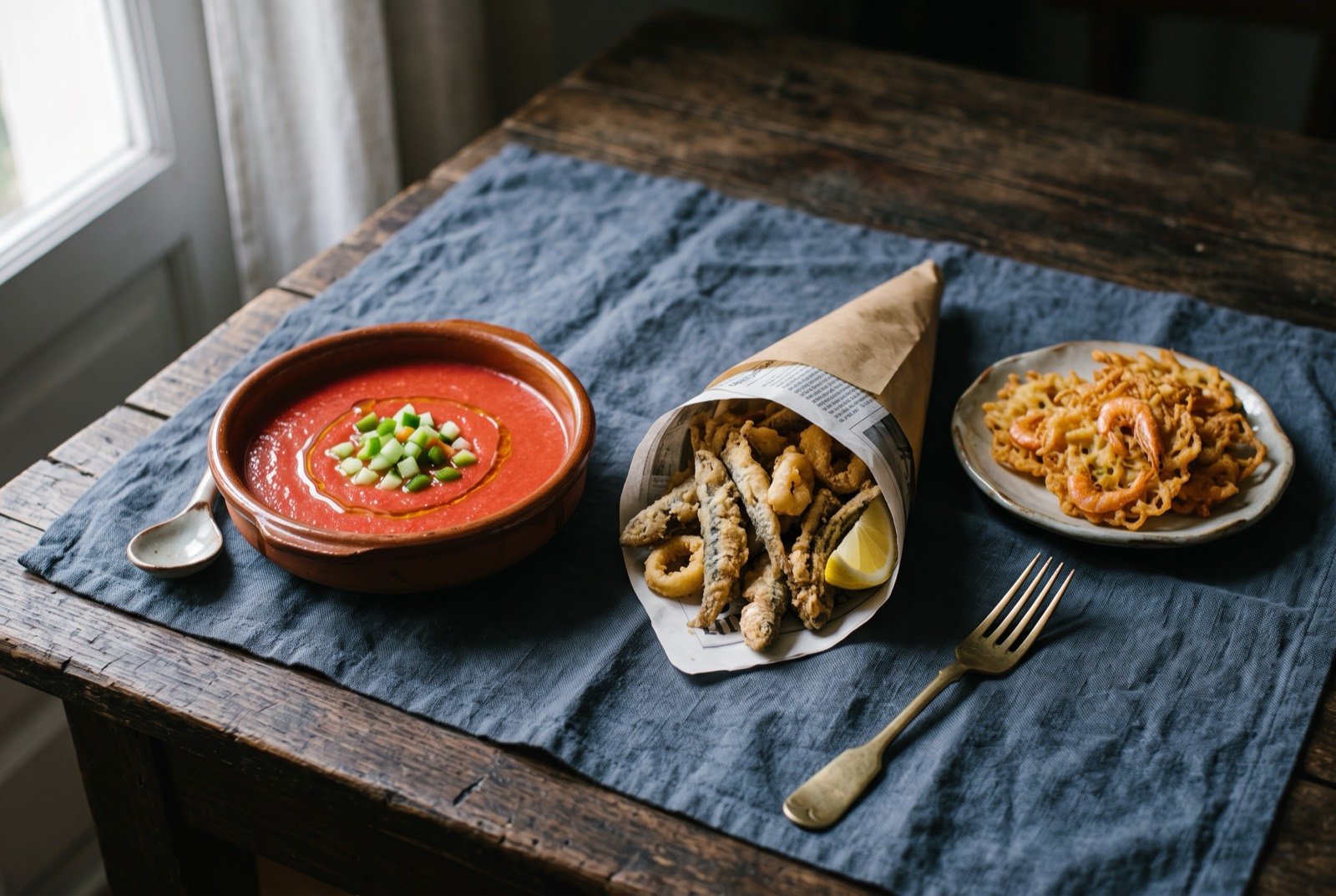
Eight centuries under Al-Andalus rule, from 711 to the fall of Granada in 1492, built the irrigation channels still watering the Alpujarra, planted the rice that still floods the Guadalquivir marshes, and taught the almond, honey and cinnamon trilogy that still fills every Christmas tin. Every dish as tradition built it, then what a modern chef would change.
Sources and review · What this chapter does not assert · How we research · Spotted something wrong?
A Sense of Place
The Guadalquivir valley and the sherry triangle
Andalusia is built around one river. The Guadalquivir rises in the Sierra de Cazorla, in Jaén, and is the only large navigable river in Spain, reaching the Atlantic through the marshes of Doñana between Huelva and Cádiz. Seville sits some eighty kilometres inland on that river and was, until the estuary silted up in later centuries, a working seaport: this single geographic fact explains both Seville's role as capital of Spain's American trade, the Casa de Contratación, and why New World produce, tomato, pepper and potato among it, entered Spanish cooking here first and fastest. West of Seville, where the Guadalquivir meets the sea, sits the Jerez sherry triangle, Jerez de la Frontera, Sanlúcar de Barrameda and El Puerto de Santa María, on a soil called albariza, a near white, chalky marl of calcium carbonate, clay and silica, laid down as marine sediment when this land was seabed. Albariza compacts into a crust after rain that seals moisture several metres down, letting vines survive the dry Andalusian summer without irrigation, and vineyards on it carry the classification Jerez Superior, the zone's top tier. Locally it is treated as the single physical fact that explains sherry's character more than any other. Cádiz province itself faces the open Atlantic rather than the Mediterranean, and its food economy runs on the almadraba, the tuna trap worked along this coast since Phoenician times and still worked commercially today at Barbate, Zahara de los Atunes and Conil, alongside a wider small fish and shellfish economy, anchovy, cuttlefish, shrimp, that underlies the region's whole fried fish culture.
The olive belt and the Alpujarra's Andalusi water
East of Seville, Córdoba and Jaén together form, by area under cultivation, the densest olive belt on earth. Jaén alone carries around sixty six million olive trees across roughly five hundred and fifty thousand hectares, some thirty six per cent of all Andalusian olive land, producing about half of Spain's olive oil and over twenty per cent of the world's; Córdoba province holds a further twenty three to twenty four per cent of Andalusian olive land. Olive oil is Andalusia's fat in a way that has nothing to do with fashion: it is what the land actually grows, and it always has been. Further south, Granada's Alpujarra runs on a water system older than the modern province itself: the acequias, irrigation channels carrying Sierra Nevada snowmelt down through terraced slopes, developed across the eighth to fifteenth centuries under Al-Andalus rule. In Granada and Almería alone, the University of Granada's Laboratorio de Arqueología Biocultural has catalogued some twenty four thousand kilometres of acequia, much of it still in active use over a thousand years later, maintained today by comunidades de regantes, irrigation communities that are the direct institutional descendants of the medieval system. A distinctive Alpujarran feature, the acequia de careo, does not irrigate crops at all: it is run deliberately to let meltwater soak into the mountainside and recharge natural springs lower down, turning the Sierra Nevada into a slow release reservoir centuries before anyone used that phrase. Against this genuinely Andalusi water infrastructure sits a food culture that is emphatically post-Andalusi: the high Alpujarra's cured ham, Jamón de Trevélez, cured above twelve hundred metres because pork was forbidden under Islamic law, and this is not Moorish inheritance dressed up, it is what filled the vacuum after 1492 and especially after the Morisco expulsion of 1609, when Old Christian families from further north resettled the valley and brought pig curing with them. The two systems, Andalusi water engineering and post-expulsion pork culture, sit on the same hillsides without being the same tradition, and this chapter does not blur them.
Málaga's coast and Axarquía
Behind Málaga, the Axarquía hills around Vélez-Málaga carry olive, vine and almond as a historic three crop economy, watered by the same Andalusi-origin acequia network; Islamic irrigation technique between the eighth and tenth centuries let almond and other eastern origin crops establish here in the first place, and almond cultivation in Málaga province today still covers over sixteen thousand hectares. The coast also carried sugar cane, introduced to al-Andalus in the tenth century and long a major Málaga crop before EU accession largely ended cultivation in the 1980s; Frigiliana, on that same coast, is now the only place in Europe still producing miel de caña, cane syrup, by traditional methods, a genuinely surviving Al-Andalus product rather than a historical footnote.
Who the peoples are
In sequence: Phoenician-Punic Gadir, modern Cádiz, traditionally dated to around the ninth century BC though the exact date is genuinely debated among historians; Roman Gades, Corduba and Hispalis, the last two major cities in their own right, Corduba the birthplace of both Senecas and the poet Lucan; a Visigothic interval thinly documented in the sourcing behind this chapter and treated here as a real gap rather than papered over; Islamic al-Andalus from 711, with Córdoba as capital of the Umayyad Emirate and then, from 929, the Caliphate of Córdoba, a city that rivalled Baghdad and Damascus in sophistication at its height; the Nasrid Emirate of Granada, the last Muslim state in Iberia, surviving from 1238 to 1492; Sephardi Jewish communities present continuously from the Roman period through the 1492 expulsion; and the Castilian conquest and repopulation running from Córdoba in 1236 to Seville in 1248 and finally Granada in 1492. Each layer left a food trace, discussed in full below.
The structural logic, at a glance
| Western Andalusia (Seville, Cádiz, Jerez) | Eastern Andalusia (Córdoba, Granada, Málaga) | |
|---|---|---|
| Fat | Olive oil, Lechín de Sevilla the dominant variety | Olive oil, Picual and Hojiblanca dominant |
| Starch | Bread, pan candeal and telera | Bread, and rice from the Al-Andalus period onward |
| Thickener | Bread pounded into oil and vinegar | Almonds pounded into oil, the ajo blanco line |
| Aromatic | Cumin, oregano, sweet paprika in marinades | Saffron, cumin, cinnamon, the Al-Andalus spice set |
| The coast's contribution | Almadraba tuna, small pelagic fish, shellfish | Sugar cane, almonds, the Alpujarra's acequia-fed terraces |
| The sweet trilogy | Convent sugar work from the fifteenth century onward | Almond, honey and cinnamon, the golden trilogy proper |
The History in Layers
Phoenician salt and Roman garum
Gadir was founded by Phoenician traders from Tyre, traditionally after two earlier failed attempts on either side of the Strait of Gibraltar, becoming the principal Phoenician trading hub on the Iberian peninsula. The Phoenicians are specifically credited with already practising almadraba tuna trapping and salazón, salt curing of fish, and with a cult of a salt deity reflecting how central the Cádiz salt pans were to the whole economy. The Romans inherited and industrialised the same fish economy: at Baelo Claudia, near Bolonia in Tarifa, roughly ten salazón factories have been excavated, alternating layers of fish and salt macerated in stone vats over one to three months to produce salted fish and garum, an industry tied directly to almadraba tuna captures in the Strait and the actual reason the town was founded. The University of Cádiz runs active research reconstructing authentic Roman garum recipes from archaeological residue analysis, live academic work rather than only historical description.
The Caliphate, and what it actually left in the kitchen
Córdoba became the seat of the Umayyad Emirate from 756, then of the Caliphate of Córdoba from 929, the period of maximum political and cultural splendour of Al-Andalus, when the city is widely described as rivalling Baghdad and Damascus and surpassing contemporary European cities in sophistication. This is the period, and the Nasrid Emirate of Granada that followed the taifa kingdoms and the Almoravid and Almohad interludes, credited across serious Spanish and Arabic-language scholarship with fixing several things still on the Andalusian table today. Two manuscripts anchor what can actually be verified rather than assumed. The Kitab al-Tabikh fi al-Maghrib wal-Andalus, the anonymous Andalusian cookbook, written in the Almohad period, survives in a 1604 copy held at the Bibliothèque Nationale de France, containing between five hundred and twenty six and five hundred and forty five recipes; it was first translated into Spanish by the arabist Ambrosio Huici Miranda in 1966 and re-edited by the CSIC scholar Manuela Marín in 2005. The Fadalat al-Jiwan fi Tayyibat al-Ta'am wa-l-Alwan, by the Murcian-Andalusi jurist Ibn Razin al-Tuyibi, written around 1260 and containing four hundred and twenty eight recipes, was fully translated by Marín in 2007. Manuela Marín and Expiración García Sánchez, both of the CSIC, are the two scholars whose work this chapter leans on most heavily for anything claiming a genuine textual root rather than a repeated legend; García Sánchez states plainly that olive oil "played a leading role in the Andalusi diet," used sparingly as seasoning in refined cooking and heavily for frying and stews in everyday cooking, a class distinction worth keeping in mind whenever a dish is described as simply "Moorish."
Against those two primary texts, what is solidly attested as arriving or being fixed in this period: rice, appearing in the mid tenth century Calendar of Córdoba and established as a summer crop in the Guadalquivir marshes; sugar cane, arriving in the tenth century and preferring the coast of the medieval Kingdom of Granada; aubergine, from Arabic al-badhinjan, itself from Persian and ultimately Sanskrit, tracing the vegetable's route from India, with more than twenty aubergine dishes recorded in the Andalusi cookbooks; and saffron and cumin, both documented staples, alongside coriander, turmeric, ginger, cinnamon, caraway and clove, per a Dialnet hosted academic survey of Al-Andalus spice use. The acequia irrigation system, covered above, belongs here too: genuinely Andalusi in origin, and still governing Alpujarra and Vega de Granada agriculture today. What is not solidly attested, and is flagged rather than repeated as fact throughout this chapter, is the precise dating of several individual dishes to this period; a great deal of Spanish popular food writing reaches for "the eighth century" as a default date for anything old and Andalusian without a primary source behind it, and this chapter declines to do the same.
1248, and the Sephardi layer specifically
Castile absorbed Córdoba on 29 June 1236, Jaén in 1246, and Seville, the hardest and last of the three, fell on 22 December 1248, after Fernando III's forces, crucially aided by Admiral Ramón Bonifaz's fleet blockading the Guadalquivir to cut off relief by river, forced the city's surrender. The post-conquest repartimiento, the land and property division that followed, brought in foreign merchant communities and assigned a specific quarter, roughly the modern Barrio de Santa Cruz, to Seville's Jewish community, continuously inhabited from 1248 until the 1492 expulsion. That community suffered a violent pogrom in 1391, when Christian mobs entered the Judería and attacked residents, a serious rupture well before the formal expulsion decree; one specific and worth stating fact is that the 1492 expulsion had negligible practical effect in Seville itself, since so few Jews were still living there by that date, conversions following 1391 and subsequent pressure having already sharply reduced the community. This is a genuinely different story from cities where 1492 caused an immediate visible exodus, and worth stating plainly rather than assuming Seville followed the generic national narrative.
The single most credible culinary thread from this community is adafina, the Sabbath stew, its name from Arabic dafina, hidden or buried, referring to the pot being covered and buried in embers to cook slowly from Friday afternoon through Saturday, satisfying the prohibition on Sabbath work. It is the direct ancestor most credibly linked to the puchero and cocido family across Spain, including Andalusia's own puchero andaluz. The historian and chaplain Andrés Bernáldez, writing his chronicle of the Catholic Monarchs, is reported (via secondary sourcing, the original chronicle not independently checked for this chapter) to have noted the persistence of "the Judaic custom of foods and the little pot of adafina" among conversos, contemporary or near contemporary late fifteenth century testimony specifically situated in Seville. After 1492, the dish survived through adaptation by Christian and Mudéjar cooks, who added pork products, chorizo and morcilla, abandoning kashrut and converting a specifically Jewish Sabbath dish into the ancestor of the general Spanish cocido and puchero family. This transmission line, adafina to cocido to puchero, is the best attested claim in this whole thread of the chapter's history and is treated here as solid; the more granular details, exact hour counts, Bernáldez's precise wording, are not, and are not asserted as verified beyond what a primary reading of the chronicle would confirm.
1492 to 1609: what actually changed, and when
The Nasrid capital surrendered on 2 January 1492, when Muhammad XII, known as Boabdil, handed Granada to the Catholic Monarchs, ending both the emirate and Muslim political rule in Iberia. What followed for food is not a single clean rupture, and the strongest single source behind this section, Fernando Rueda's 2006 article in the Spanish-Arab cultural journal Afkar/Ideas, "La pervivencia de la cocina árabe en los fogones de Andalucía," makes the correction worth carrying as a load-bearing claim rather than a footnote: by the time of the definitive Morisco expulsion in 1609 to 1614, enough time had already passed since 1492 that culinary mestizaje had been thoroughly formalised through the converso population and their descendants, in a way strong enough that it survives in Andalusian cooking today. In other words, 1609 was not the moment Moorish food entered Christian Spanish cooking; that had already happened, gradually, across the hundred and seventeen years between the fall of Granada and the final expulsion, carried by people who had converted, forcibly or otherwise, rather than left. Rueda traces two different linguistic fates for Morisco-associated dishes: some kept Arabic-derived names outright because they carried no religious weight, alcuzcuz, couscous, almojábana, alboronía, zahína, arrope; others were given a distancing "moruna" or "morisca" label once the Inquisition made naming something explicitly Moorish imprudent, cazuela moruna, sardinas a la moruna, berenjenas a la morisca, several of them already appearing in Ruperto de Nola's fifteenth century Libro del coch, showing this blending was well underway even before 1492. On the sweet side, Rueda names the "trilogía de oro," the golden trilogy of almond, honey and cinnamon, as an essentially unbroken Arab-Andalusi legacy running straight into Christmas confectionery today, while noting, importantly, that Andalusian cuisine as a whole is not purely Moorish: it is Roman at base, enriched by Al-Andalus, and carries a real Jewish and Castilian layer too, quoting the philosopher Julián Marías's observation that "Christian Andalusia is considerably newer" than the Moorish and Roman layers beneath it. The Morisco population, required to convert from 1502 to 1526, lived under increasing pressure until Philip III's final expulsion, carried out province by province from 1609 to 1614, with Andalusia among the regions most affected.
The Flavour Arsenal
The fat
Olive oil, without qualification, across the whole region. Picual dominates in Jaén, robust, peppery, high in polyphenol; Hojiblanca and Picuda are common further west in Córdoba, softer and rounder; Lechín de Sevilla, around fifty per cent of planted area, dominates the DOP Sierra de Cádiz zone west of the olive belt proper, giving oils of mild to intense fruitiness with light bitterness. In refined Al-Andalus cooking oil was used sparingly as a seasoning; in everyday cooking, then as now, it carries the frying.
Preserved and cured proteins
| Ingredient | What it is, and why it matters |
|---|---|
| Jamón de Jabugo (DOP Jamón de Huelva) | The most famous name, from the Sierra de Aracena, known for intensity and length of finish, the Atlantic humidity of the microclimate giving a particular unctuousness; what "pata negra" usually means in practice, though the term technically only denotes the pure ibérico breed |
| Jamón de los Pedroches (DOP) | Northern Córdoba's holm oak dehesa, generally milder, less salty, sweeter than Jabugo, and often better value |
| Vinos de Jerez | Fino, manzanilla, amontillado, oloroso and Pedro Ximénez, covered in full in the Ferment and Preserve Bench below; not a garnish to this cuisine but a working ingredient |
| Vinagre de Jerez | Under its own Denominación de Origen Protegida since 1994, made exclusively from acetic fermentation of already-qualified Jerez wines |
| Pescado salado del golfo de Cádiz | Salted and smoked fish from the Atlantic gulf, the almadraba tuna trade's direct modern descendant |
The starch
Bread, pan candeal, pan de telera and the mollete, carries most of the region's starch load rather than rice, though rice was introduced to Iberian cultivation in the Al-Andalus period and remains genuinely present in the eastern arsenal. Chickpea flour, harina de garbanzo, is a specific and non-substitutable ingredient in one dish, tortillitas de camarones, rather than a general staple.
The aromatic base and the golden trilogy
Cumin, oregano and sweet paprika, pimentón, form the working spice set for marinades, adobo, in western Andalusia; saffron, cumin and cinnamon, the direct Al-Andalus spice legacy, run through the eastern sweets and some savoury cooking. On the sweet side, almond, honey (specifically miel de caña, cane syrup, not bee honey, an important distinction this chapter states explicitly since "miel" misleads an English reader) and cinnamon form the "trilogía de oro" that Fernando Rueda identifies as the clearest unbroken Arab-Andalusi survival in the whole cuisine, running through tocino de cielo, pestiños, mantecados and the wider convent sweet tradition.
The Technique Ladder
Rung 1. Emulsify cold, without egg
Gazpacho, salmorejo and ajo blanco are all, structurally, an emulsion problem rather than a soup recipe. Bread and, for ajo blanco, ground almonds supply the body; olive oil is worked in gradually, exactly the logic of a mayonnaise, so it binds into a smooth, glossy liquid rather than separating into oil slick and pulp. This is Andalusia's own indigenous cold emulsified sauce, built without egg yolk or cream, doing structurally what a French emulsified sauce does. A high power blender does this at a speed and consistency a mortar cannot match, but the mortar remains the traditional route, and a serious kitchen strains through a chinois afterward either way, since all three soups are served completely smooth in the tradition, not merely blended fine.
Rung 2. Flour only, oil held at temperature
Pescaíto frito's defining technical point, repeated consistently across every source behind this chapter, is that the fish is coated in flour only, never batter, never egg. The flour is a coarser wheat flour specific to fish frying, producing a thin, crisp, dry crust. Ángel León, three Michelin stars at Aponiente, describes his own version of the same principle with more precision than any traditional source offers: a mix of three flours in equal parts, wheat, chickpea and a fine frying semolina; olive oil held at a controlled temperature, he cites around one hundred and seventy degrees; and fish that has only ever touched seawater, never tap water, because otherwise, in his words, it stops tasting of the sea, which is what it is supposed to taste of. This is worth dwelling on for the whole chapter's thesis: pescaíto frito was already a light, high heat, thin coating technique before anyone called it fine dining. León's refinement is precision, flour ratio, oil temperature, water source, not the importation of a French frying method.
Rung 3. Marinate in acid and spice before the pan
Adobo, the marinade behind cazón en adobo, works on a different chemical logic to the plain flour of pescaíto frito: garlic, sweet paprika, cumin, oregano and white wine vinegar, pounded to a paste, tenderise and season the fish before it is floured and fried. Marinating time genuinely varies across sources, from a minimum of two hours to a fuller eight, and this chapter treats the eight hour version as the slower, more traditional home method and the two hour version as a modern shortcut, rather than picking one and presenting it as the only correct time.
Rung 4. Reduce sherry for structure, not for sweetness alone
Pedro Ximénez and oloroso, reduced slowly with sugar over roughly twenty five to thirty minutes at low heat until they reach a caramel or thin honey consistency, do the structural work a French wine jus does without needing stock or a butter mount: the wine's own residual sugar and tannin carries the sauce. Letting the reduction rest overnight is reported to improve flavour concentration and coherence; a late addition of cinnamon or vanilla is a common refinement. Juanlu Fernández's restaurant LÚ Cocina y Alma, two Michelin stars in Jerez, carries over six hundred references of vinos de Jerez and treats sherry as structural to the menu rather than a drinks list afterthought, the clearest fine dining statement of this principle working in Andalusia today.
Rung 5. Braise long, in wine, until the tail falls from the bone
Rabo de toro depends on nothing more sophisticated than time: oxtail, a genuinely tough, connective tissue heavy cut, braised low and slow in red wine, traditionally Montilla-Moriles in Córdoba's own account of the dish, until the collagen has fully broken down into gelatine and the meat falls from the bone. There is no shortcut for this rung; the only variable worth controlling is heat low enough that the liquid never boils hard, since a rolling boil toughens rather than tenderises a cut this size.
The Ferment and Preserve Bench
1. Solera y Criadera, Sherry's Fractional Ageing
Not a home technique, but essential to understand before cooking with or buying sherry. A solera system is a stack of scales, criaderas, of butts, botas, roughly six hundred litre American oak casks: the oldest wine sits in the bottom scale, the solera itself, with progressively younger wine in the criaderas above it. To bottle, a fraction, never all, is drawn from the solera butts; that gap is refilled from the next oldest criadera, which is refilled in turn from the one above it, up to the youngest scale, which receives the new vintage. Because no butt is ever fully emptied, the wine leaving the solera is a blend of many vintages, weighted toward the old, and house style stays consistent regardless of any single harvest. The distinguishing mechanism among sherry styles is flor, a living veil of yeast forming on the wine's surface in a partially filled butt, fortified to around fifteen per cent alcohol, enough to suppress spoilage organisms, not enough to kill the flor. Where flor persists throughout ageing, the wine is a fino; when it thins with age and oxygen reaches the surface, the wine moves into oxidative ageing, browning and gaining nutty, dried fruit character, the specific transition that turns a fino into an amontillado. Oloroso is fortified higher from the start, specifically to prevent flor forming at all.
2. Vinagre de Jerez, DOP Since 1994
Made exclusively from the acetic fermentation of wines already qualified under the Jerez-Xérès-Sherry DO, grown within the same registered vineyards. Ageing follows either a static añadas, vintage, system, kept separate rather than blended across years, or a dynamic criadera-solera system mirroring the wine itself. Anything simply labelled sherry vinegar without the DOP Jerez mark may be a blended imitation, and this chapter treats that distinction as genuinely load-bearing, not pedantic: sherry vinegar's oxidative depth, the thing that makes salmorejo and a proper dressing work, is exactly what a non-DOP substitute lacks.
3. Montanera and the Curing of Jamón
Not a home technique, but the process behind the region's single most expensive and most imitated ingredient. Ibérico pigs destined for the top grade, jamón ibérico de bellota, are finished free-range on acorns during the montanera, the autumn and winter acorn fattening season running roughly November to March; the legs are then salted and air-cured for twenty four to thirty six months or more. Jabugo, in Huelva's Sierra de Aracena, and Los Pedroches, in northern Córdoba, are the two DOPs a British reader should recognise by name, the first more intense and unctuous, the second generally milder and sweeter.
4. Miel de Caña, Cane Syrup
A genuine surviving Al-Andalus product, not an interchangeable "honey": sugarcane, introduced to the Málaga and Granada coast in the tenth century, pressed and its juice reduced slowly to a dark, treacle-like syrup. Frigiliana, on the Málaga coast, is now the only place in Europe still producing it by traditional methods, at the Nuestra Señora del Carmen mill, running since 1725. Black treacle or a light molasses is the honest fallback where miel de caña cannot be sourced in time, stated here as a substitution, not an equivalent.
Sourcing in Britain
Verified August 2026.
Sherry
Fino and manzanilla oxidise fast once opened, faster than most table wine; treat an opened bottle as good for three to five days refrigerated, not weeks, and buy a half bottle for a single dish rather than committing to a full one. Amontillado and oloroso keep for several weeks once open; Pedro Ximénez, both oxidative and very sweet, keeps for months. Verified currently trading UK sources: Brindisa (brindisa.com, Borough Market and Balham), Decántalo UK (decantalo.co.uk, a deep list including Barbadillo, Hidalgo-La Gitana, Lustau and Valdespino), Vinissimus (vinissimus.co.uk), The Wine Society (thewinesociety.com, member-only) and Fine Wines Direct UK (finewinesdirectuk.com), noted for a strong Hidalgo range. González Byass Tío Pepe Fino is stocked at Tesco, Waitrose, Sainsbury's and Morrisons, roughly £14 to £20 for 75cl, and is the one supermarket fino genuinely worth buying rather than a cooking-sherry compromise; check the bottling looks recent and buy from a shop with real turnover. Avoid anything simply labelled "cooking sherry" or "cream sherry," usually not DO Jerez at all, salted and adulterated for shelf stability rather than for cooking. Two names could not be verified as currently trading UK sherry specialists in this chapter's research, "The Sherry Shop" and "Alacena," and should be checked directly before being relied on.
Olive oil
The Artisan Olive Oil Company (artisanoliveoilcompany.co.uk) is a UK specialist stocking harvest-dated, lab-analysed Spanish EVOOs, including an early harvest category worth pointing directly to. Look for a stated harvest date, not just a best-before date, dark glass or tin rather than clear, and ideally a named cultivar: Picual, Jaén's dominant variety, is robust and peppery and stands up to the heat of a Big Green Egg cook in a way a milder oil does not.
Jamón
The grading in order of quality and price: jamón ibérico de bellota (100% or 75% ibérico, acorn-finished, 24 to 36 months or more), jamón ibérico de cebo (same breed, grain-fed, cheaper and less complex), and jamón serrano (not ibérico at all, ordinary white pig), the last most likely to be vaguely implied as "Spanish ham" without the distinction being made clear. Brindisa cures its own Eíriz bellota ham in Jabugo itself. Cinco Jotas, the best-known bellota brand internationally, no longer ships direct to the UK; buy through authorised UK stockists Pure Spain (purespain.co.uk), Fine & Wild (fineandwild.com) or IberGour UK (ibergour.co.uk). Bellota Ltd (bellota.co.uk) and The Black Hoof (theblackhoof.co.uk) both specialise across the cebo-to-bellota range. A whole leg is a serious purchase, budget £300 to £500 for a good bellota leg, up to around £750 for a top Cinco Jotas Black Label leg; pre-sliced vacuum packs from any of the above suit a single dish. A jamonero, ham stand, and a flexible 23 to 25cm ham knife are the one non-negotiable extra if buying a whole leg.
Other ingredients
Sherry vinegar: buy only anything marked DOP Jerez; Melbury & Appleton (melburyandappleton.co.uk) stocks Valdespino Sherry Vinegar DOP, and Brindisa stocks a Valdespino version with PX. Chickpea flour for tortillitas de camarones is straightforwardly available in the UK as gram flour or besan from any South Asian grocer, functionally identical to the Spanish product. Marcona almonds for ajo blanco are worth insisting on by name rather than accepting generic blanched almonds, available through Brindisa, R Garcia & Sons and general delis; their higher fat content and rounder flavour genuinely change the finished soup. Seville bitter oranges: the trade genuinely runs backwards here, Seville exports its bitter oranges to Britain for marmalade far more than Spain itself cooks with them as a savoury souring agent, and this is worth stating to the reader as a real crosslink rather than a coincidence; fresh Seville oranges are seasonal, roughly January to February, from Sainsbury's, Waitrose and Riverford, with frozen organic Seville oranges available year-round from British Frozen Fruit (frozenfruit.co.uk). Miel de caña is stocked by Zerdo (zerdo.co.uk, names Frigiliana specifically), Ultracomida (ultracomida.co.uk) and Amigo Food Group (amigofoodgroup.com), around £9 to £11 for a 460g jar.
UK shops strong on Spanish and Andalusian ingredients
Brindisa, Borough Market and Balham, the reference UK Spanish specialist, full range online. R Garcia & Sons, 248 to 250 Portobello Road, Notting Hill, established 1957, one of London's oldest Spanish delicatessens. Melbury & Appleton, online, useful specifically for DOP-marked items general delis do not always stock. Lunya, Manchester, a large deli counter with a wide sherry, wine, gin and beer selection. Paco Tapas, Bristol, chef Peter Sanchez-Iglesias, one Michelin star continuously since 2018, the strongest, most specifically Andalusian restaurant find in this chapter's research: an extensive, correctly differentiated sherry list matched deliberately to dish, worth naming as somewhere doing this region's technique seriously rather than its clichés.
Kit notes for this volume
The high-power blender is the single most used piece of kit in this volume: ajo blanco, salmorejo and gazpacho all live or die on it building a genuine emulsion, not merely blending vegetables. The chinois follows immediately after for the two soups traditionally served completely smooth. The dehydrator has a real place concentrating salmorejo or gazpacho's tomato base, and rendering or crisping ibérico fat trim. Sous vide suits the tougher cuts on the modernist side of the dish pairs, oxtail specifically, and gentle jamón fat rendering. The Big Green Egg is well suited to grilled fish and seafood in the Cádiz manner, espeto-style, skewered sardines angled over open charcoal, which the Egg can approximate for direct heat and smoke character. A proper mortar and pestle, dolomite or granite rather than the small ceramic ornamental type, is worth adding specifically for this volume: it is the genuinely traditional route into ajo blanco, salmorejo and the adobo paste, giving a fractured, oilier texture the blender's smoother result cannot fully replace, and is presented here as the traditional alternative alongside the blender, in keeping with the book's own tradition-and-elevation structure.
Voices and Sources
From inside the tradition
- Ángel León, Aponiente (El Puerto de Santa María, three Michelin stars) and Alevante (Chiclana de la Frontera, two stars). Known as "el Chef del Mar," and the named source for this chapter's most precisely documented modernist technique, his own account of pescaíto frito's three-flour, seawater-only, controlled-temperature method.
- Juanlu Fernández, LÚ Cocina y Alma, Jerez de la Frontera, two Michelin stars. Describes his own style as "vanguardia de retaguardia," rearguard vanguard, and treats a list of over six hundred sherry references as structural to the menu.
- Paco Morales, Noor, Córdoba, three Michelin stars. Built the entire restaurant on historiographic research into al-Ándalus recipe books, the clearest single example anywhere in Andalusia of this atlas's animating idea that every restaurant technique has an indigenous ancestor.
- Benito Gómez, Bardal, Ronda, two Michelin stars. Trained under Ferran Adrià at Hacienda Benazuza before going independent; describes his own cooking as "muy pura, basada en el sabor," resisting the "local" framing as a pose and calling himself, self-mockingly, "km 1000" rather than "km 0."
- Julio Fernández, Abantal, Seville, one Michelin star held over thirteen years. States his own project explicitly as "cocina andaluza contemporánea" rather than "cocina sevillana."
- Manuela Marín (CSIC) and Expiración García Sánchez (CSIC, Escuela de Estudios Árabes, Granada), the two scholars whose translation and analysis of the Kitab al-Tabikh and Ibn Razin's Fadalat al-Jiwan anchor anything in this chapter claiming a genuine textual Al-Andalus root.
- Fernando Rueda, historian of gastronomy, Academia Gastronómica de Málaga, whose 2006 Afkar/Ideas article, "La pervivencia de la cocina árabe en los fogones de Andalucía," is the single strongest source behind this chapter's account of the 1492 to 1609 transition.
The UK diaspora
Paco Tapas, Bristol, is the one UK restaurant this chapter can name with real confidence as doing Andalusian technique seriously rather than flattening it into generic Spanish tapas. José Pizarro, whose own restaurants deal heavily in Andalusian-repertoire staples, jamón, sherry, gazpacho, done at a properly sourced level, is worth citing as a credible commentator on the wider UK "Spanish restaurant" scene's failure mode; he is himself from Talaván, Cáceres, in Extremadura, not Andalusia, and this chapter does not misrepresent him as an Andalusian chef.
Things this chapter has deliberately not asserted
- That gazpacho, or its pre-tomato bread-oil-vinegar ancestor, dates to "the eighth century" or is otherwise a fixed-date ancient Moorish dish. The tomato version cannot be documented before the mid to late eighteenth century anywhere, and the earliest known written tomato-gazpacho recipe is Mexican, not Spanish.
- That ajo blanco was invented specifically in the eighth century in Al-Andalus. The better supported claim is structural, no post-1492 ingredients, so plausibly an older layer than tomato gazpacho, not a specific date.
- That salmorejo's name derives from Latin salmurium, or any other specific etymology, as settled fact.
- That the tocino de cielo origin story, a Jerez convent, 1324, egg-yolk surplus from wine fining, is historically documented; a named food researcher explicitly disputes it, and this chapter treats it as legend, mentioned in passing as convent sweet tradition rather than given a full recipe treatment on that basis.
- That Sephardi Jews specifically "perfected" the flouring-and-frying technique behind pescaíto frito in medieval souks and ports; widely repeated, not traced to a primary source.
- That rabo de toro originated definitively in Córdoba rather than Jerez, Ronda or Seville; the underlying logic, bull tail as a bullfighting byproduct, plausibly produced genuinely independent versions in all four, and no source resolves priority.
- That berenjenas con miel is a textually documented Al-Andalus dish, rather than a modern reconstruction built from genuinely Al-Andalus ingredients, aubergine, cane honey, both real, but no specific recipe citation was found in either primary cookbook.
- That alboronía was invented for, or named after, the Abbasid princess or queen Burán; this is a Baghdad-court legend, not an Andalusi one, and no primary Andalusi source confirms it.
- That piononos de Santa Fe carry any Al-Andalus legacy despite their Granada-province origin; they are a documented 1897 Catholic confectionery invention, four centuries after 1492, and this chapter deliberately does not include them among the Al-Andalus material for that reason.
- That Ziryab's ninth century court reforms belong to Nasrid Granada; Ziryab operated at the earlier Umayyad court in Córdoba, and sources describing Nasrid dining sometimes invoke him without making that chronological gap clear.
- That any UK restaurant has been documented selling jamón serrano as ibérico; the general Spain-wide fraud pattern is well sourced, a specific UK instance is not.
- That "The Sherry Shop," "Solera & Co" or "Alacena" are currently trading UK sherry specialists, or that "Garcia Baquero" is a UK-available jamón brand rather than the ibérico cheese brand that actually surfaced in search; none could be verified and none is named in the sourcing section above as a live recommendation.
- Miss Tapas, Peckham's, ownership or Sevillian heritage; described in local press but not confirmed against a primary source.
- A precise oil temperature for pescaíto frito from any traditional source; only Ángel León's own stated figure, around 170°C, carries that precision, and this chapter does not retroject it onto the traditional method as historical fact.
Emulsify cold, without egg
Gazpacho, salmorejo and ajo blanco are all, structurally, an emulsion problem rather than a soup recipe.
Flour only, oil held at temperature
Pescaíto frito's defining technical point, repeated consistently across every source behind this chapter, is that the fish is coated in flour only, never...
Marinate in acid and spice before the pan
Adobo, the marinade behind cazón en adobo, works on a different chemical logic to the plain flour of pescaíto frito: garlic, sweet paprika, cumin, oregano and...
Reduce sherry for structure, not for sweetness alone
Pedro Ximénez and oloroso, reduced slowly with sugar over roughly twenty five to thirty minutes at low heat until they reach a caramel or thin honey...
Braise long, in wine, until the tail falls from the bone
Rabo de toro depends on nothing more sophisticated than time: oxtail, a genuinely tough, connective tissue heavy cut, braised low and slow in red wine...
The dishes
- Gazpacho Andaluz Western Andalusia
- Salmorejo Cordobés Córdoba
- Ajo Blanco Malagueño Málaga
- Pescaíto Frito (Fritura Gaditana) Cádiz
- Tortillitas de Camarones Cádiz
- Cazón en Adobo (Bienmesabe) Cádiz
- Rabo de Toro Córdoba, Seville and Jerez
- Espinacas con Garbanzos Seville
- Alboronía
- Remojón Granadino Granada
Sources and review
- Reviewed
- Not yet reviewed from inside the tradition
- Cooked
- Not yet cooked and reported
Where this volume comes from
3 research briefs on file for this volume, researched to the rules on How we research. Published 28 August 2026. Last changed 8 September 2026.
The brief's own account of its sources
Rough split: of roughly 45 distinct sources cited above, I would categorise approximately: 8 to 10 as genuinely strong/local-institutional: the Consejo Regulador's own site (sherry.wine), the DOP's official pliego de condiciones (Junta de Andalucía), BOE (Boletín Oficial del Estado) legal texts on the Vinagre de Jerez DOP and the Sierra de Cádiz olive oil DOP, Museos de Andalucía (Baelo Claudia), Universidad de Cádiz's own research portal, González Byass's and Barbadillo's own bodega sites, the CSIC-published Hispania journal article on the 1248 conquest, and Wikipedia ES articles that were