Iberia · Volume 08, The Sherry Triangle and the Kitchen Al-Andalus Left Behind
Gazpacho Andaluz
Western Andalusia
Illustration
- Time
- Hands on 20 minutes · Waiting 1 hour
- Researched
- Researched from 194 sources in the brief
A correction worth stating plainly rather than smoothing over. The tomato free ancestor of gazpacho is real: a rustic pounded soup of bread, water, olive oil, vinegar, garlic and salt, made in a wooden trough or mortar, eaten by field labourers and shepherds, and a bread-oil-vinegar dish called gazpacho existed in Spain by the seventeenth century, before any tomato content. The specific claim that this proto-gazpacho existed "in the eighth century in al-Andalus," repeated across a great deal of Spanish lifestyle writing, is not traced to any primary medieval source in the research behind this chapter and should be treated as widely repeated tradition, not documented fact. The tomato version is a genuinely different, later question: the earliest known written tomato-gazpacho recipe is not Andalusian, and not even Spanish. It appears in a manuscript by Dominga de Guzmán, a Mexican domestic cookbook author, dated 1749 to 1779. French travel writing from 1816, 1824 and 1840 describes a bread, oil, water and tomato gazpacho as a favourite Andalusian dish, meaning the tomato version was established as recognisably Andalusian by the early nineteenth century at the latest, even though no Spanish-authored recipe from that period survives in writing; the American Mary Randolph published a tomato gazpacho recipe in 1824, plausibly learned through family trade connections to Sanlúcar de Barrameda. This documentation gap most likely reflects who got to write cookbooks, wealthy, often non-Andalusian households, rather than a genuine absence of the dish among ordinary Andalusian cooks earlier; the useful parallel is that the first written paella recipe dates only to 1857 Madrid, and nobody disputes paella's Valencian origin on that basis. Gazpacho in its tomato form cannot be documented earlier than the mid to late eighteenth century anywhere, and not verifiably in Andalusia itself in writing before the early nineteenth century, even though it was very likely being made there before it was written down. This chapter states that plainly rather than reaching for either "ancient Moorish dish," which is false regarding the tomato, or "invented in the 1800s," which overstates the documentation gap as an absence.
As tradition built it
Serves 4. About 20 minutes, plus at least 1 hour chilling.
Ingredients
- 1 kg ripe plum or pear tomatoes
- 1 green pepper, deseeded
- 1 cucumber, peeled
- 2 garlic cloves
- 100 g day-old bread, crusts removed, soaked in a little water
- 100 ml extra virgin olive oil
- 30 ml sherry or wine vinegar
- to taste salt
- as available cold water, to loosen
Method
- Roughly chop the tomato, pepper and cucumber, and put in a blender with the garlic and the soaked, squeezed bread.
- Blitz to a rough purée, then, with the blender running, add the olive oil in a slow stream, so it emulsifies into the mixture rather than sitting on top.
- Add the vinegar and salt, then thin with cold water to a pourable, drinkable consistency.
- Push through a coarse sieve if a completely smooth texture is wanted, though a working home gazpacho is traditionally rougher than salmorejo.
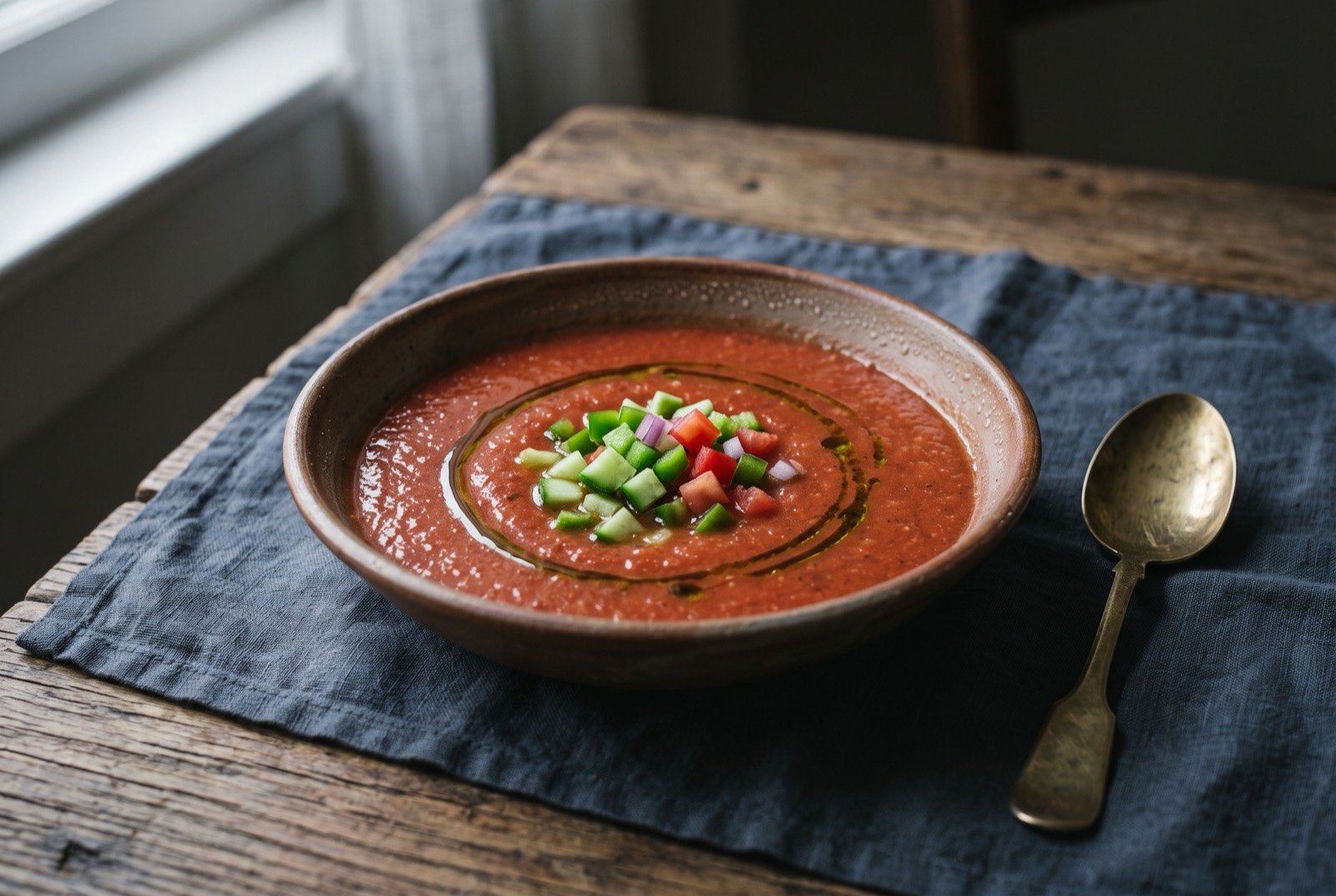
- Chill for at least an hour, ideally longer, and serve very cold, with a scattering of finely diced tomato, pepper, cucumber and a thread of oil.
Notes
No single canonical ratio survived checking in the sourcing behind this chapter, all of it consumer recipe content rather than an institutional or chef source; the ratio above is a sensible working proportion, stated here honestly as a working ratio rather than a verified traditional one.
What a modern chef changes
The emulsion actually treated as an emulsion, and the garnish rebuilt as texture rather than decoration.
Rung 1
Method
- Blend at very high speed for a genuine two stages: once the day before, unblended ingredients combined and left in the fridge overnight to macerate, then blended fully the next day with the olive oil added at that second stage, for a finer, creamier emulsion than a single same-day blend achieves.
- Push everything through a chinois after blending, not before, discarding the pulp rather than serving it, for the completely smooth, glossy texture a fine dining kitchen expects and a home blender alone rarely delivers.
- Build a genuine garnish of diced vegetable, cured jamón fat and a herb oil, rather than the traditional scatter, since a soup this reduced to essentials rewards a few pieces of real, deliberate texture on top.