Iberia · Volume 06, The Rice Coast
Arròs a Banda
Valencia
Illustration
- Time
- 1 hour
- Researched
- Researched from 37 sources in the brief
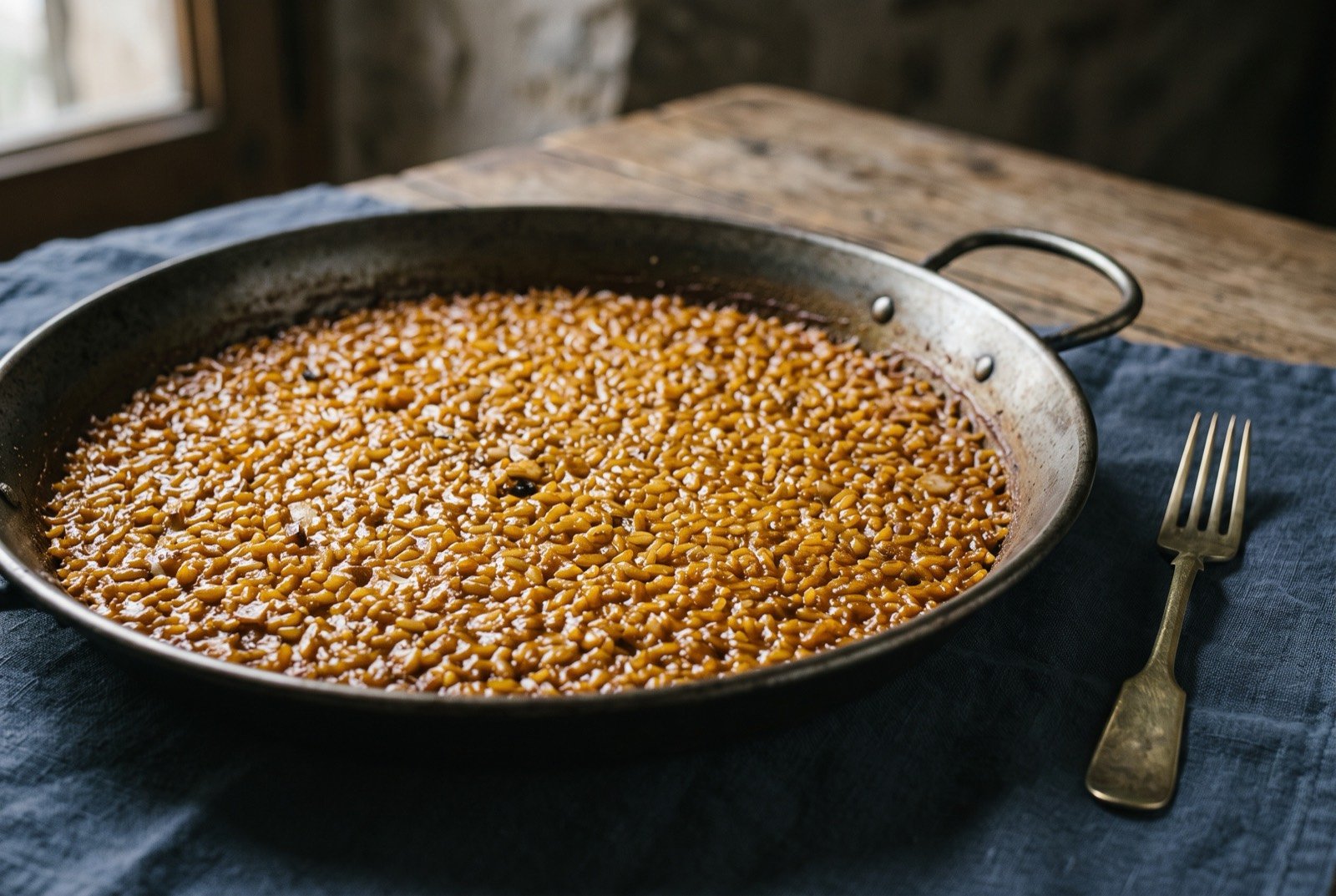
Named for serving the rice "on the side" (a banda) of the fish it was cooked in. A rich stock from rockfish plus monkfish, cod and hake heads and tails; a sofregit of cuttlefish, onion, garlic and grated tomato built directly in the paella pan; rice and saffron cooked in the fish stock exactly as paella's rice is cooked in its own.
As tradition built it
About 40 minutes for the stock, then 18 to 20 minutes for the rice.
Ingredients
- 1kg rockfish, for the stock
- 500g monkfish, cod and hake heads and tails, for the stock
- 400g cuttlefish, chopped, for the sofregit
- 1 onion, chopped
- 3 cloves garlic
- 2 grated tomato
- 320g rice
- a pinch saffron
Method
- Make a stock by simmering the monkfish, cod and hake heads and tails with the rockfish gently for around forty minutes, then strain.
- Build a sofregit of chopped cuttlefish, onion and garlic in the paella pan, add the grated tomato and cook to a jam.
- Add the strained stock and a pinch of saffron, bring to the boil, scatter the rice and do not stir.
- Cook until the liquid is absorbed, roughly eighteen to twenty minutes, finishing with a little extra heat at the end for socarrat if the pan allows it.
Notes
Traditionally the fish and rice were served entirely separately; today most households cook and serve them together.
What a modern chef changes
An onion-free stock, built sous vide and double-strained
Rungs 1 and 3
Method
- Reject onion from the sofregit entirely, using one litre of shellfish stock to 300g of finely cut cuttlefish and a few threads of saffron, arguing the onion muddies a stock that should taste purely of the sea (rung 3 taken to a purist extreme, after Quique Dacosta's own stated version of this dish).
- Build the fish stock itself sous vide: vacuum-seal the bones and trimmings with aromatics and hold at a controlled 85°C for four hours, extracting more collagen and less bitterness than an open simmer, which then sets the rice's absorption more cleanly (rung 1).
- Pass the finished stock twice through a chinois, once through a coarse setting and once fine, for a clarity a home kitchen rarely achieves by straining through muslin alone.