The Americas · Volume 20
Ecuador, the Sierra
Pork, Potato and the Twelve Grain Feast
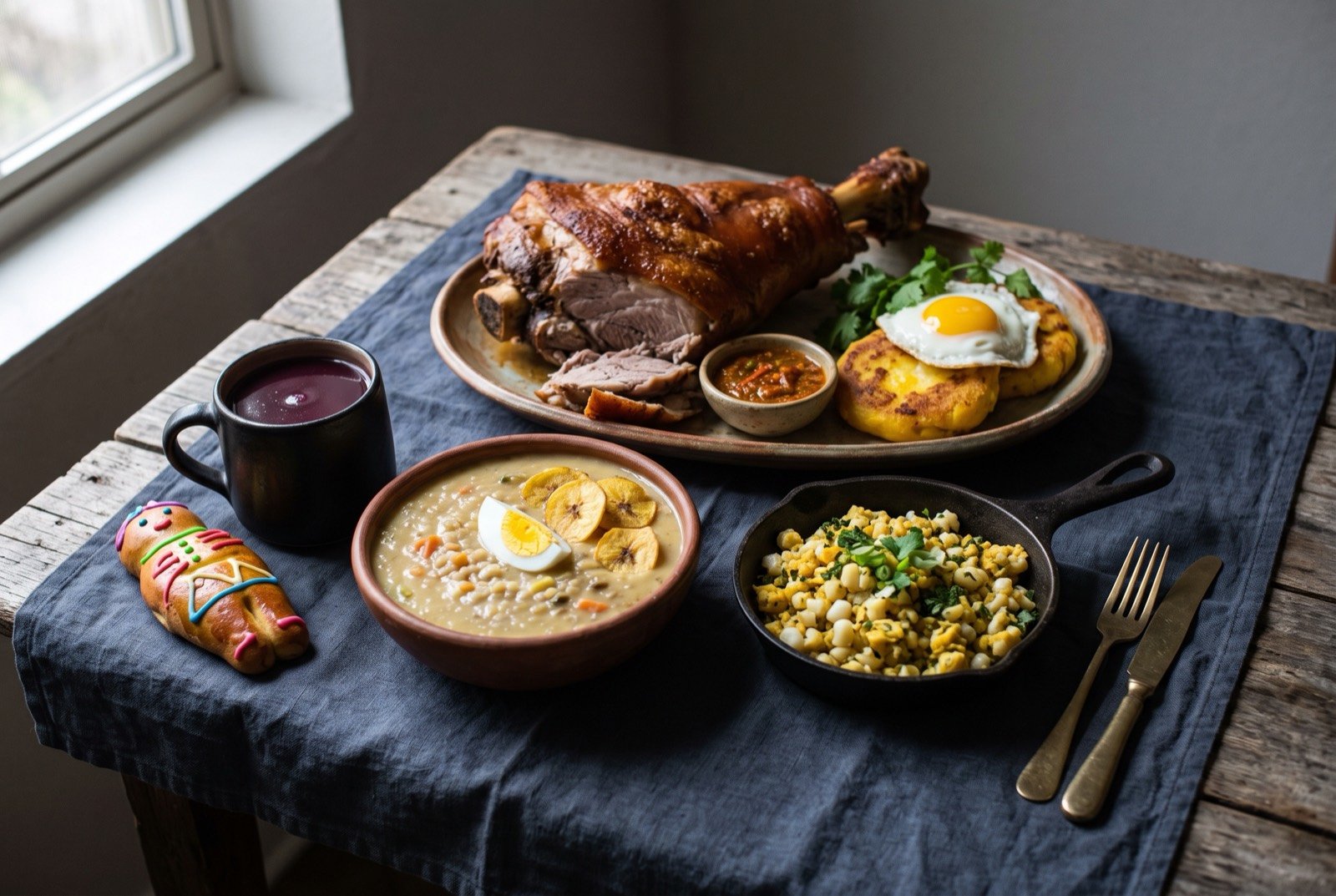
Quito sits at roughly 2,850 metres in an inter-Andean basin, one link in a chain of high valleys running north to south between the eastern and western cordilleras. Alexander von Humboldt, travelling through in the early nineteenth century, named the corridor running north from the city through Cayambe, Otavalo and Ibarra the Avenida de los Volcanes, the Avenue of the Volcanoes, after noticing how neatly the snow capped summits lined up along roughly 350 kilometres. Cayambe stands northeast of the capital; Imbabura dominates the Otavalo valley further on. Above the cultivated ground, the páramo, a high, cold grassland of cushion plants and chuquiragua, marks the ecological line that separates the Sierra from both the Pacific coast a few hours downhill and the Amazon a few hours the other way.
Sources and review · What this chapter does not assert · How we research · Know this better? Tell us
A Sense of Place
Quito sits at roughly 2,850 metres in an inter-Andean basin, one link in a chain of high valleys running north to south between the eastern and western cordilleras. Alexander von Humboldt, travelling through in the early nineteenth century, named the corridor running north from the city through Cayambe, Otavalo and Ibarra the Avenida de los Volcanes, the Avenue of the Volcanoes, after noticing how neatly the snow capped summits lined up along roughly 350 kilometres. Cayambe stands northeast of the capital; Imbabura dominates the Otavalo valley further on. Above the cultivated ground, the páramo, a high, cold grassland of cushion plants and chuquiragua, marks the ecological line that separates the Sierra from both the Pacific coast a few hours downhill and the Amazon a few hours the other way.
This is potato and maize country before it is anything else. Ecuador holds an estimated 350 potato varieties, of which around 14 are commonly found in central highland markets, native varieties such as Uvilla, Yema de huevo, Leona negra, Puña, Calvache, Chaucha colorada, Santa Rosa and Carrizo cultivated mostly above 3,000 metres and prized for flavour and identity as much as yield. Maize appears everywhere as mote, hulled and cooked hominy style, and as choclo, the fresh corn eaten off the cob or ground for sweet tamales. The other great highland tuber is melloco, olluco to Peru, introduced to Ecuador in pre-Columbian times from further south in the high Andes and now the second most important tuber after the potato, customarily cooked together with tender habas and potato in a single pot.
Fat here is overwhelmingly pork derived. Manteca de cerdo, lard, is the base of most refritos, the onion and achiote sofrito that underlies nearly everything, and pork itself, whole roasted, is the cuisine's great festive meat. Dairy is the second axis: Cotopaxi province alone carries around a quarter of the country's cattle, and Cayambe, immediately north of Quito, is a major milk producing zone. The traditional queso de hoja of Cotopaxi and Pichincha, a fresh, stretched curd cheese wrapped in an achira leaf and made with acidified raw milk and indigenous ferments, is a genuinely endangered thing: Ecuador, like most of Latin America, now prohibits raw milk cheese production, and the achira wrapping was never designed to keep the cheese fresh long enough to travel far.
Before either the Inca or the Spanish, this basin was already organised by trade rather than isolation. The Cumbayá valley supplied maize, beans, guaba and fruit; the Inga zone, potatoes and rabbits, meaning cuy country; the Yumbos, from the warmer western slopes, carried salt, ají and yuca up into the cold highland exchange, traded through what is now the Plaza de San Francisco in central Quito. Imbabura province, immediately north, is the heartland of the Kichwa Otavalo people, an estimated population above 65,000, organised into some 157 comunas, Kichwa speaking as a first language, whose textile trade predates the Spanish conquest and has made them one of Ecuador's most internationally connected indigenous peoples. Around Otavalo's Plaza de los Ponchos, cloth and food share the same ground: yahuarlocro, locro de papas, fritada, hornado, carne colorada, choclo con habas, tostado and chochos are sold within a few steps of the textile stalls.
Cuenca, a full day's drive south, is a different city on a different pre-Inca foundation. "Santa Ana de los Ríos de Cuenca" was founded by the Spanish on 12 April 1557 over the ruins of what had been Cañari Guapondelig and, before that, Inca Tomebamba. The Cañari, the pre-Inca people of what is now Azuay and Cañar, are ethnically and historically distinct from the Kichwa speaking peoples of the Quito basin, though Kichwa language eventually displaced their own tongue across the region. Cuenca carries the nickname Atenas del Ecuador, Athens of Ecuador, traced to the nineteenth century essayist Juan Montalvo, worn with real pride for the city's outsized production of poets and letrados, and that self image of a cultured, literary place distinct from Quito's political centre runs straight into how Cuencanos talk about their own food: refined rather than merely hearty. In November 2025 UNESCO named Cuenca a Creative City of Gastronomy within its Creative Cities Network, citing the care given to ingredients, to producers, and to the rituals that turn each dish into a story, sitting alongside the older 1999 recognition of the city's colonial centre as a World Heritage site. Cuenca's own municipal government describes its intangible culinary heritage in four words: gastronomía basada en el mote, a cuisine built on hominy corn, and that single line is the truest short description of what separates the southern table from Quito's.
South again, past Azuay and Cañar, Loja sits on a genuinely different ecology: dry valleys and a western zone edging toward desertification, warm dry air pushing up from the Peruvian desert through the Catamayo basin. It is Ecuador's own frontier province, close enough to Peru that its food, and its coffee, answer to a different set of pressures than the wet, cold Sierra further north.
The History in Layers
Quito fell inside Tahuantinsuyo, and Bogotá never did; that single fact does more work in this chapter than any other. Túpac Yupanqui pushed the Inca frontier north toward the Kingdom of Quito, subjugating the Cañari of Azuay and Cañar in the mid fifteenth century along the way. His son Huayna Cápac made Quito the empire's effective second capital, rebuilding the city and ruling from it for much of his reign; on his death the empire split between his sons Huáscar, who held Cusco, and Atahualpa, who held Quito, and the civil war between them, 1529 to 1532, is the opening the Spanish exploited within the year. What the Inca actually changed in food terms, at the level of an individual dish rather than the empire wide elevation of quinoa to a prestige crop, is genuinely hard to pin down from the sources available for this chapter, and this book would rather say so than invent a tidier story.
The Spanish brought wheat, pork, beef and cattle dairy, none of which existed here before them. From the mid sixteenth century, colonial estates around Quito grew from small chacras into full haciendas, beginning with livestock, pigs, cattle, goats, sheep, aimed at supplying the growing city, then adding wheat and maize. Highland haciendas, with no mining wealth of their own, plugged into the wider colonial economy through the obraje textile system tied to Potosí's silver, the same underlying logic that later made Otavalo's own weaving trade so consequential. Franciscan friars and nuns are specifically credited with bringing European pastry and baking technique into Quito, a wave of mistelas, sweet infused liqueurs, colaciones, sugared sweets, and higos en almíbar, figs in syrup, even as at least one academic account of the period describes real decline in pre-Hispanic cookery running alongside the new fusion dishes. In Cuenca the convent layer produced its own, separately documented sweet tradition, covered below under Corpus Christi.
The religious calendar reshaped highland food in two quite different ways. Fanesca is the clearest case of the Catholic calendar actively building a dish: see below. Colada morada and its bread figures show almost the opposite pattern, a pre-Hispanic funerary practice, argued by Ecuadorian sources to reach back to the Aya Marcay Quilla ceremony, the month of carrying the dead, surviving under a Catholic calendar date, 2 November, rather than being invented by it. A figure of five thousand years for the drink's age appears constantly in Ecuadorian press; it could not be traced here to a primary archaeological source, and this chapter treats it as received wisdom rather than a dated fact. Guaguas de pan, the small bread figures eaten alongside the drink, are by contrast a documented nineteenth century addition, an indigenous elaboration made specifically to commemorate dead children.
Yahuarlocro is the strongest single case of a dish that is Ecuadorian mestizo through and through, neither purely indigenous nor purely Spanish. Locro, a potato soup, is pre-conquest. Sheep, and therefore sheep offal and blood, arrived only with Spanish livestock. The word "yahuarlocro" itself appears in no printed recipe book before 1907, which suggests it stayed a peasant, herding community dish, unwritten, for a long time before anyone thought to record it. The historian Julio Pazos Barrera, born in Baños in 1944, a member of the Academia Ecuatoriana de la Lengua, author of El Sabor de la Memoria and co-author of the Diccionario de las cocinas ecuatorianas, calls the dish emblematic of Ecuadorian mestizaje for exactly that mixture of an Andean base and a colonial import, and his name is worth carrying through this chapter as its most frequently cited in-tradition authority, on both yahuarlocro and fanesca.
Salt cod, bacalao, is the clearest single ingredient marker of the whole colonial trade route running through this cuisine: a fish from the North Atlantic, dried and salted for a Mediterranean and Catholic market, ending up as the meat substitute in a Lenten Andean soup thousands of miles from where it swims. Its arrival, and the argument over what it replaced or displaced, sits at the centre of fanesca below.
The Flavour Arsenal
Achiote. Bixa orellana, the seed that gives nearly every highland refrito its colour and its faint earthy, peppery note, is Amazonian in origin and was used across the Americas as a pigment for at least three thousand years before it became a kitchen staple. It entered the European written record in the mid sixteenth century as "bixa," named for the conquistador Francisco de Orellana. Bought as whole seed and rendered slowly in hot oil or lard, it gives the deep orange base colour behind hornado, llapingacho, locro de papa and almost every soup in this chapter; bought as paste, it is faster but usually pre-blended with other seasoning and needs checking before use.
Tomate de árbol. Tamarillo is the base of Ecuadorian ají in a way that has no real equivalent elsewhere in the Andes: Peruvian ají leans on rocoto, ají amarillo and ají panca, Mexican salsa on the chile itself, but the classic Ecuadorian table sauce is built from ají chilli blended with white or red onion, water and tomate de árbol, finished with cilantro, lime, carrot or boiled chochos depending on the region. Ají cuencano, the south's own variant, swaps water for oil, giving a creamier, richer sauce, and Cuencanos are, by their own account, close and private about the exact recipe: a sandwich there is traditionally "solo pan y carne," just bread and meat, because the ají is doing all the work and the recipe stays inside the family.
Naranjilla. A tropical fruit grown on the Andean slopes of Imbabura, Pichincha, Cotopaxi, Tungurahua and Chimborazo, used mainly for juice, sharp and slightly bitter until sugared. Ecuador's own naranjilla, la de Ecuador, is a genuinely different fruit from the coastal-grown "lulo" sold under the same Spanish name elsewhere in South America, though the two are close enough botanically that recipes travel between them without much adjustment.
Melloco. Ulluco tuberosum, the small, waxy, jewel coloured tuber that ranks second only to the potato in the Sierra kitchen, traditionally cooked with habas and potato in one pot rather than served alone.
Habas. Broad beans, a straightforward staple, fresh or dried, cooked into soups and alongside melloco.
Chochos. Lupinus mutabilis, tarwi, grown between 2,000 and 3,800 metres, its Kichwa-derived name meaning nipple or maternal breast for the shape of the pod. Bitter and mildly toxic raw, it needs days of soaking and rinsing to leach its alkaloids before it is edible, the highland equivalent of the leaching work this atlas has already documented for cassava elsewhere in the Americas. Once treated, it is the base of cevichocho, a cold, lime dressed dish considered typical of Riobamba specifically, its real market presence there independently confirmed by an academic food safety study rather than assumed from a tourist description.
Mote. Hulled, alkaline-cooked hominy corn, documented at the indigenous table since at least 1590, and the ingredient that most sharply divides this chapter's two halves. In Quito it is a side, one plate among several. In Cuenca and Azuay it is the organising idea of the whole table, elevated to three distinct named dishes with three distinct occasions, covered under The Dishes, Twice below.
Queso fresco andino / queso de hoja. A fresh, unaged, barely salted cheese, made without ageing and traditionally acid set rather than rennet set, close in method and character to paneer, a comparison this chapter leans on directly under Sourcing in Britain.
Chicha de jora and other ferments. Covered under Ferment or Preserve Bench below.
Loja coffee. Grown in the Vilcabamba valley at around 1,800 metres, Arabica, sustaining an estimated 16,000 growing families and described by Ecuador's own tourism ministry as a symbol of identity and social cohesion rather than merely an export crop, a genuine ecological and economic marker that separates Loja from the mote-and-maize identity of Cuenca and Azuay just to its north.
The Technique Ladder
Rung 1. 1. The refrito
Onion, garlic and achiote oil, sweated slowly rather than fried hard, is the base of almost every dish in this chapter. The achiote's colour compounds are fat soluble, so a slow, patient render in warm oil or lard pulls far more colour and flavour from the seed than a quick hot fry, which mostly just scorches the outside of the seed and wastes it. Get this stage right, low heat, real time, and the rest of the dish is mostly assembly.
Rung 2. 2. Alkaline cooked maize
Mote is corn cooked in an alkaline solution, traditionally lime or wood ash lye, until the tough outer pericarp loosens and can be rubbed off, the same basic chemistry as Mexican nixtamalisation though the intended result, a whole, chewy, hulled kernel rather than a dough for tortillas, is different. The alkaline treatment does two things a home cook should understand rather than skip: it loosens the hull mechanically, and it changes the corn's chemistry enough to make its niacin nutritionally available in a way raw corn is not, the reason maize-only diets that skip this step historically caused pellagra and maize-eating cultures that included it did not.
Rung 3. 3. Batán grinding
The batán, a flat stone slab with a smaller hand held stone, the "uña," rocked back and forth over the food, is the Andean equivalent of the Mexican metate. Andean cooks who use both routinely say a blender and a batán do not taste the same, and there is a real mechanical reason for that beyond nostalgia: a blender's spinning blade shears and aerates, while a batán's rocking, crushing action ruptures cell walls more slowly and releases oils without whipping air into the paste, producing a denser, more concentrated ají or achiote paste. A high powered blender, pulsed rather than run continuously, and rested between pulses to avoid heat building up, gets closer to this than a standard blend cycle.
Rung 4. 4. Whole animal, two fires
Hornado and chancho a la barbosa are answers to the same problem, a whole pig, crisp skin, tender meat, from two different highland cities. Hornado's Quito method is a long, low, enclosed roast: a slow interior cook that renders fat gradually and keeps the meat moist, followed by a final blast of high heat to blister the skin into cuero crocante, crackling. Chancho a la barbosa's Cuenca method is the opposite logic: continuous, moderate, open fire from below, the whole butterflied pig turning constantly on a spit box roughly a metre above the coals for three to four hours, so the skin crisps gradually throughout the cook rather than at the end, and the smoke itself becomes a flavour the enclosed oven method never gets. Understanding these as two different technical answers, not one dish done properly and one done as a shortcut, is the key to elevating either at home.
Rung 5. 5. Confit and controlled ageing
Quito's serious kitchens (Quitu, Zazú, Tributo) have already done the modernist translation work here: confit as a way to render a tough or small cut meltingly tender without drying it, and controlled dry ageing as a way to concentrate flavour in beef before it ever meets heat. A sous vide bath, held low and for hours rather than a stovetop confit watched over an open flame, is the direct home equivalent, and it is the single technique that most reliably turns a traditional dish into a restaurant grade one without changing what it fundamentally is.
Rung 6. 6. Malting and fermentation
Chicha de jora is built from jora, maize that has been deliberately germinated, malted, before drying and grinding, the same basic principle behind malted barley in beer: germination activates enzymes that convert starch to fermentable sugar, giving the yeast something to work with once the mash is boiled, cooled and left to ferment. A home cook without access to jora flour can approximate the effect with a modest addition of malted grain to a maize mash, though this chapter is honest that it is an approximation, not the real ferment.
The Ferment and Preserve Bench
Chicha de jora. Maize is deliberately germinated, jora, then dried and ground before being simmered in plenty of water for at least two hours, cooled, sweetened with chopped panela and pineapple peel, and left to ferment, covered, for around two days before straining. Optional aromatics, cedrón, hierba luisa, cinnamon, anise, chamomile and clove, are added at the finishing stage rather than during the ferment itself. It carries real ceremonial weight, used at Inti Raymi and San Pedro/San Pablo, and at family occasions from mingas, communal work parties, to weddings, baptisms, Christmas and Carnival, with roots Ecuadorian heritage sources describe as pre-Inca. Quito's own chicha revival is real and current: Sereno Moreno, a bar in the San Blas sector of the historic centre, has been producing and serving fermented chicha for around nine years as the only current Quito venue treating it specifically as a socialising, gathering drink, and has expanded from a straightforward maize base into tuber based chicha as well.
Girón cane spirit. Girón canton in Azuay runs a documented artisanal sugarcane distilling tradition entirely separate from the maize ferments above: cane juice, guarapo, is fermented in wooden vats in dark, shaded locations for around 30 days until it reaches "cero grados," a visible surface bubbling that signals readiness, producing "jarabe cero," which is then distilled into aguardiente. The same ancestral mills, traditionally turned by yoked draught animals, produce chicha, honey, guarapo and panela as co-products of the same cane, a genuinely southern highland tradition worth naming on its own terms rather than folding into the maize ferments above.
Queso de hoja. Covered under the Flavour Arsenal, this fresh, acid set, achira leaf wrapped cheese is closer to a preserve in spirit than in outcome: it is not aged or truly preserved, and its endangerment, driven by Ecuador's ban on raw milk cheese production and the achira leaf's short protective life, is itself a preservation story worth telling rather than a technique to teach.
Sourcing in Britain
Set expectations honestly from the start: Ecuadorian ingredients are a genuinely under-served niche in the UK, thinner than Mexican sourcing and thinner again than Peruvian, and this book would rather say so plainly than pad the list.
The good news first. Panela is a mainstream UK health-food-shop item, stocked by Waitrose and Holland and Barrett under the Bonraw brand among others, no gap at all. Ají amarillo paste, the shared Ecuadorian and Peruvian yellow chilli base, is sold by several UK retailers including Mextrade, MexGrocer and Spices on the Web. Dried mote and choclo, the strongest sourced ingredient in this whole chapter, ride on the coattails of the UK's existing, well established Peruvian grocery trade: El Inti, The Peruvian Shop, trading since 2004 and describing itself as Europe's largest range of Peruvian goods, stocks dried mote and both fresh and frozen choclo. Achiote is available plain, as seed rather than the pre-spiced Mexican cochinita paste a reader might otherwise reach for, from DistriAndina, the Colombian and Ecuadorian run supermarket in Elephant and Castle, and from La Casa de Jack, a Leyton wholesaler that carries a genuinely Ecuadorian labelled range, achiote, mote, chulpe corn, Zhumir aguardiente and Cerveza Pilsener among it. Habas need no special sourcing at all, sold fresh or dried at any greengrocer or Turkish, Middle Eastern or South Asian shop.
Ecuadorian coffee and cacao, genuinely well represented. This is the one category where sourcing specifically Ecuadorian product outperforms the rest of the chapter, because coffee and chocolate buyers already prize Ecuadorian origin on its own terms, independent of any Latin American grocery trade. Makicuna imports green coffee specifically and only from Ecuador, over 25 producers across Loja, Pichincha and Imbabura, and roasted Ecuadorian beans reach consumers directly through Rounton Coffee, Horsham Coffee Roaster and others. Pacari, one of the world's leading fine-flavour chocolate makers and built entirely on Ecuadorian Arriba Nacional cacao, has its own UK storefront. Zhumir, Ecuador's dominant national cane spirit, reaches the UK through La Casa de Jack in wholesale cases with next day London and South East delivery.
The honest gaps. Guinea pig is not obtainable in the UK for cooking, and this was checked directly rather than assumed: UK guinea pig keepers themselves confirm no meat breed supply chain exists here, only pet genetics, and there is no licensed abattoir route or import channel. This is the one dish in the whole atlas so far that genuinely cannot be cooked at home in Britain with the real animal; readers wanting cuy asado need to travel, and this book says so rather than suggesting a substitute that would not remotely be the same thing. Naranjilla is effectively unobtainable too, fresh or frozen, the single UK listing found for this chapter marked permanently out of season at the time of research; a passion fruit and lime combination is the closest approximable stand in, offered here explicitly as a substitution rather than a claim that the real thing is available. Melloco is thinner again, with no confirmed fresh or tinned UK stockist found at all; no vegetable convincingly replaces its particular gelatinous texture, so recipes calling for it in this chapter are written for readers cooking in Ecuador, or from a future trip's suitcase, rather than assuming a UK source exists.
Queso fresco, solved by substitution rather than sourcing. No specific, currently trading UK retailer of queso fresco or queso andino was confirmed; the reliable route is paneer, made by essentially the same acid-set, unaged method, unsalted or only lightly salted and crumbled rather than cubed. Halloumi is sometimes suggested as a paneer substitute for its firmness, but its saltiness and rubbery grilled texture make it the wrong choice here except where a dish specifically wants a cheese that holds its shape directly on heat, which none of the dishes above do. Tomate de árbol, tamarillo, is genuinely buyable fresh from specialist online greengrocers such as Fine Food Specialist, but at roughly £3 to £4 a fruit and a three day shelf life from delivery, it is a special occasion buy rather than a pantry staple, and this chapter's recipes are written with that cost in mind.
Where to shop. Elephant and Castle, and specifically the new Elephant Passage Market on Liverpool Grove, is documented as the largest Latin American retail hub in the UK, with Ecuadorean traders named specifically among its businesses; DistriAndina, at 6 Farrell Court on Elephant Road, is the single most useful named shop for this chapter's ingredients. Seven Sisters Market, also called Pueblito Paisa, above Seven Sisters tube station, is London's other major Latin American hub. Costa Azul, a long standing Ecuadorian restaurant on Rockingham Street near Elephant and Castle, is worth naming here too, not for grocery shopping but as a place to taste the real thing before attempting it at home.
No specialist equipment beyond this atlas's usual kit, Big Green Egg, sous vide, dehydrator, high power blender, chinois and spice grinder, is genuinely required. The batán, the Andean grinding stone named throughout this chapter, has no UK retailer worth naming; a large stone mortar and pestle, already common in British kitchens, is close enough in mechanism for readers who want to try the traditional method on a small batch, and the high powered blender, used in short pulses rather than a continuous run, does the job for everything else.
Voices and Sources
Julio Pazos Barrera, born in Baños in 1944, member of the Academia Ecuatoriana de la Lengua, author of El Sabor de la Memoria and co-author of the Diccionario de las cocinas ecuatorianas, is the single most frequently cited in-tradition authority behind this chapter, quoted across Ecuadorian press on both yahuarlocro and fanesca and treated here as this volume's closest equivalent to a named, trusted culinary historian.
Laylita, an Ecuadorian-American food writer whose site is itself widely cited by Ecuadorian national press, was a repeated source for quantified household recipes, mote pillo and repe lojano among them, and is named here as an in-tradition source rather than a generic recipe blog.
Named market vendors in Cuenca, profiled by El Mercurio de Cuenca in October 2025: Lorena Quintuña, "La Suquita de la 9," selling morocho at Mercado 9 de Octubre; Pedro Briones, "Don Suco," continuing his late father's ceviche stall at the same market; Delia Cajamarca, "Sra. Chévere," hornado; Mariana Escandón, "Señora del Quesillo"; and Rosa Matute, the market's president, defending vendors' interests against municipal redevelopment. These names are carried into this chapter deliberately, because this is exactly the texture of sourcing this atlas asks for: a market is not an abstraction, it is people with names who have been there for decades.
Gloria Ramírez, of Sabores del Austro in Queens, New York, originally from Cuenca, who began by carrying bags of mote in her own suitcase and has since built a full container import business supplying the city's Cuencano diaspora with habas, melloco, mote, queso fresco and chochos that ordinary American supermarkets do not stock, quoted directly on what her shop means to homesick customers.
Contemporary chefs: Alejandro Chamorro and Pía Salazar of Nuema, the first Ecuadorian restaurant ever to appear on Latin America's 50 Best list; Juan Sebastián Pérez of Quitu; Wilson Alpala of Zazú; Luis Maldonado of Tributo, whose dry-aged vaca vieja andina programme informs this chapter's technique ladder directly; and the trio behind Clara. Their work is cited here as evidence of a living, contemporary Ecuadorian technical tradition, not as templates to copy.
Institutional sources: UNESCO's Creative Cities Network citation for Cuenca; the International Potato Center's Ecuador potato variety programme; the Instituto Nacional de Patrimonio Cultural's food heritage material; and Ecuador's own Ministerio de Turismo, particularly for the Girón cane spirit tradition and Loja's coffee economy.
Things this chapter has deliberately not asserted
- That colada morada is precisely five thousand years old. The figure is repeated constantly across Ecuadorian press and could not be traced here to a primary archaeological source; this chapter treats it as received wisdom, not a dated fact.
- That fanesca's twelve apostles, Christ as cod, purity as milk symbolism is documented liturgical origin rather than popular devotional folklore. It is reported here as widely held belief, alongside a competing, less securely dated account of the dish beginning as a pre-Hispanic harvest celebration onto which the Catholic symbolism was later layered; no source found here adjudicates between the two.
- That the Inca changed any specific highland dish in a way that can be distinguished cleanly from what predates their arrival. The empire-wide elevation of quinoa is well attested for the Andes generally; nothing found here pins a comparable claim to an individual Quito basin or Cuenca dish specifically.
- That caldo de patas rose to prominence in Quito specifically because of Colombian migration from the 1980s. This claim comes from a single municipal-adjacent source and is reported here as an attributed claim rather than settled history.
- That Cuenca and Azuay's cuy tradition differs technically from Quito's, in marinade, vessel or presentation. Both traditions are well documented on their own terms; no source found here compares them directly with enough rigour to assert a specific difference. The fuller cross-Andean treatment of cuy asado as a dish in its own right, including any real comparison against Peruvian technique, belongs properly to the not yet written Peru high Andes volume, which shares the same pre-Inca domestication and ritual role; this chapter names and describes Ecuador's own tradition honestly without claiming to have settled that wider question.
- That any named Quito chef sous-vides hornado. The single claim found for this came from a low quality aggregator page and could not be verified against the restaurant's own material or independent press; it is not repeated here as fact.
- That "Fandango," a reported deconstructed chicha, or "chicha vieja," an oak-aged gourmet chicha, exist as described. Both appeared only in a single aggregated search result and could not be independently confirmed.
- That any restaurant in the United Kingdom currently cooks Ecuadorian food at a technical level comparable to Quito's own fine dining scene. What this chapter's research found in London, principally around Seven Sisters and Elephant and Castle, reads as genuine, valued community and comfort food, not a technique-forward reference point, and that gap is reported honestly rather than a restaurant being named that does not merit the comparison.
- That guinea pig, naranjilla or melloco can currently be bought in the United Kingdom, fresh or otherwise, for home cooking. All three were searched for specifically and directly, not assumed absent; none turned up a working UK supply route, and this chapter says so rather than offering a substitute that would misrepresent what the reader can actually achieve.
- That seco de chivo or encebollado belong to this volume as fully treated dishes. Both are genuinely eaten in the Sierra as well as on Ecuador's coast, and are named here for that reason, but their fuller, twice-given treatment belongs to a future volume covering Ecuador's coast, outside this book's current scope.
1. The refrito
Onion, garlic and achiote oil, sweated slowly rather than fried hard, is the base of almost every dish in this chapter.
2. Alkaline cooked maize
Mote is corn cooked in an alkaline solution, traditionally lime or wood ash lye, until the tough outer pericarp loosens and can be rubbed off, the same basic...
3. Batán grinding
The batán, a flat stone slab with a smaller hand held stone, the "uña," rocked back and forth over the food, is the Andean equivalent of the Mexican metate.
4. Whole animal, two fires
Hornado and chancho a la barbosa are answers to the same problem, a whole pig, crisp skin, tender meat, from two different highland cities.
5. Confit and controlled ageing
Quito's serious kitchens (Quitu, Zazú, Tributo) have already done the modernist translation work here: confit as a way to render a tough or small cut meltingly...
6. Malting and fermentation
Chicha de jora is built from jora, maize that has been deliberately germinated, malted, before drying and grinding, the same basic principle behind malted...
The dishes
- Hornado Quito, Ecuador
- Fanesca Ecuador, nationwide Lenten dish
- Llapingacho Ambato, Ecuador
- Locro de Papa The Sierra highlands, Ecuador
- Yaguarlocro The Sierra highlands, Ecuador
- Chancho a la Barbosa Cuenca, Ecuador
- Mote Pillo Cuenca, Ecuador
- Repe Lojano Loja, Ecuador
- Colada Morada and Guaguas de Pan Ecuador, nationwide, Day of the Dead
Sources and review
- Researched
- Researched from 96 sources in the brief
Where this volume comes from
4 research briefs on file for this volume, researched to the rules on How we research. Published 3 September 2026. Last changed 15 September 2026.
The brief's own account of its sources
Roughly 60 to 70 distinct sources were consulted across both research passes. The clear majority, roughly two thirds, are Ecuadorian local or national press and government or institutional sources: El Comercio, El Universo and its Sabor food section, Primicias, El Diario, Vistazo, El Mercurio de Cuenca, Crónica, the Ministerio de Turismo, Quito Informa (municipal), rastro.quito.gob.