The Americas · Volume 21
Colombia, the Andean Interior
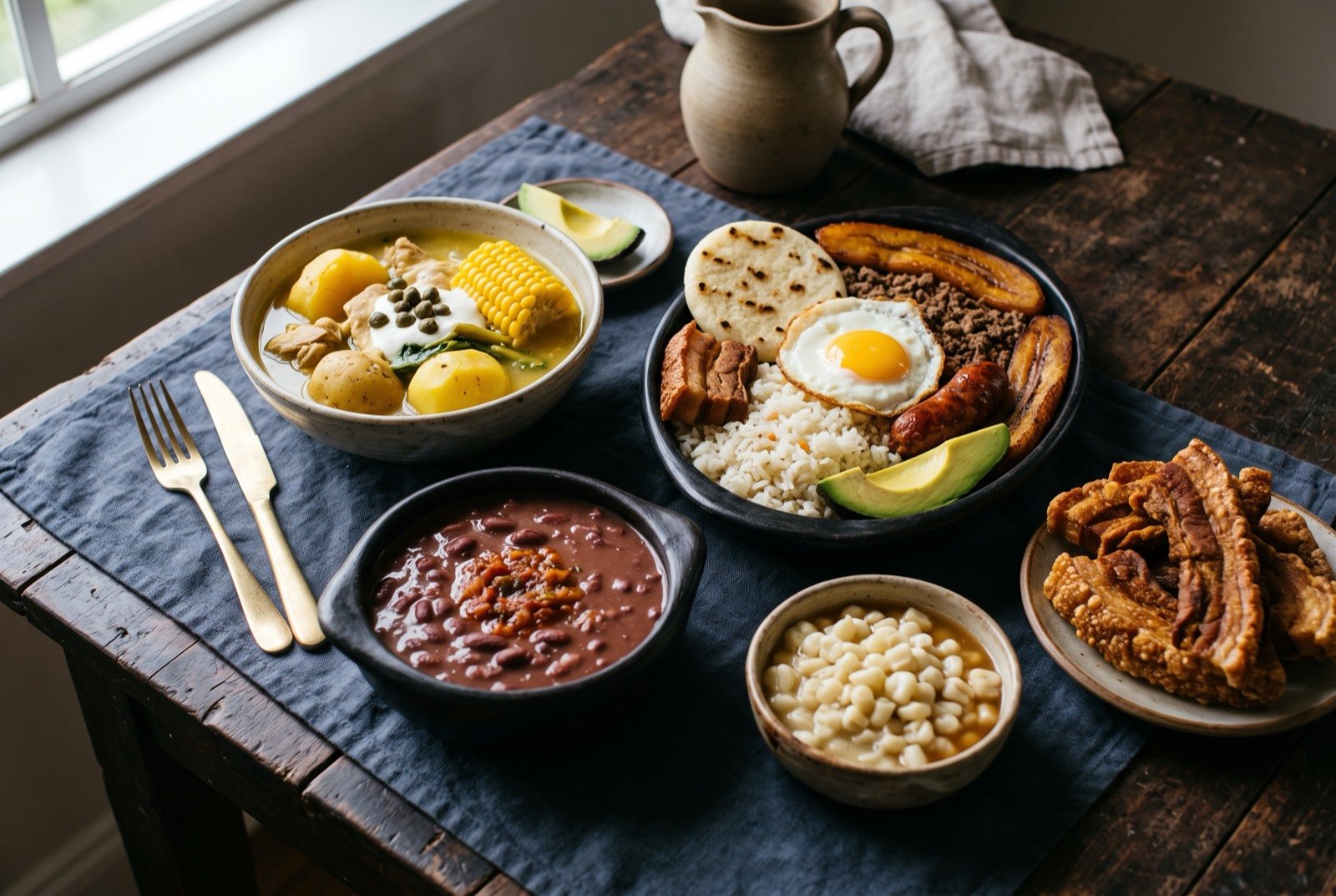
The Inca reached Quito. They never reached Bogotá. That single fact is the reason Colombia's Andean interior is not simply Ecuador's highlands with a border redrawn: it is a food world built by a different pre-Columbian state, the Muisca confederation, on a different logic, and it split again after conquest into at least two distinct tables that still barely resemble each other. Bogotá, Boyacá and Cundinamarca run on potato, wheat at altitude, dairy and a wild herb called guascas that has no real substitute anywhere on earth. Antioquia and the coffee-axis towns its nineteenth century settlers built run on maize, pork, pork lard and a bean bred specifically for this cordillera. A third world, Tolima's, sits between the two and is named honestly in this chapter rather than folded silently into either. Every dish as tradition built it, then what a modern chef would change.
Sources and review · What this chapter does not assert · How we research · Spotted something wrong?
A Sense of Place
Bogotá sits on the southern end of the altiplano cundiboyacense, the largest highland plateau in the Colombian Andes, at an average elevation of roughly 2,650 metres. The savanna was a lake bed in the Quaternary, and its damper soils were given over to potato while the drier, higher ground took wheat and barley once the Spanish introduced them. Gonzalo Jiménez de Quesada, arriving in 1538, named the whole plain "El Valle de los Alcázares" for the density of Muisca bohío settlements he found spread across it. What made this plateau livable at scale before any of that was its vertical range within a short walk: a farmer could move from warm valley floor to temperate slope to páramo without travelling far, so potato ground, wheat ground and pasture all sat within reach of one settlement. That altitudinal stacking, not any border, is what shaped this cuisine, exactly as it shapes every volume in this culinary region.
Antioquia, a few days' walk to the northwest across the Central and Western Cordilleras, offered no such gift. Its terrain is steep and broken, unsuited to the plains agriculture the savanna gave Bogotá almost for free, and its early economy turned instead to gold: alluvial extraction, worked with rudimentary technique, that nonetheless created Colombia's first genuinely prosperous provincial middle class. When that gold economy declined through the late eighteenth and into the nineteenth century, Antioqueño families, mostly too poor to hire labour and relying on their own households to work new land, pushed south and southeast. This colonización antioqueña, intensifying from the 1870s, founded the towns of what is now the Eje Cafetero, Caldas, Risaralda and Quindío, plus the northern edges of Tolima and Valle del Cauca. Coffee became the settlers' crop of choice and, within a generation, the base of the national economy. The whole migration was carried on the backs of arrieros, mule-train muleteers who cut the caminos de herradura that stitched the new towns together commercially before any road did the same job. Paisa identity, the culture of that migration, is repeatedly described by the people who hold it as more than a place of birth: a set of practices, a way of speaking and living, distinct from Bogotá's in ways sharper than accent alone.
The two worlds' arsenals answer to two different logics. In Bogotá, Boyacá and Cundinamarca the fat is dairy far more than lard, the thickener is the disintegrating starch of specific named potato varieties, the essential aromatic is a wild herb, guascas, that nothing else tastes like, and the starch backbone is potato in at least three varieties plus wheat and barley at altitude. In Antioquia and the paisa towns the fat is manteca de cerdo, pork lard, rendered hot enough to fry empanadas and sofrito hogao alike; the starch backbone is maize, principally via the thin white paisa arepa rather than the potato; the base aromatic across nearly the whole repertoire is hogao itself, a cooked tomato and onion sauce built roughly three parts tomato to one part onion, sometimes carrying achiote, cumin or oregano, and genuinely deserving of the name several Colombian cooks give it: the mother sauce of Colombian cooking.
A third world sits between them and deserves naming rather than silent absorption. Tolima, lower and hotter than either the Bogotá savanna or the Antioqueño highlands, gave Colombia lechona, a whole roast pig stuffed with rice, yellow peas and a maize-and-panela paste called insulso, voted the world's best dish by TasteAtlas in 2024 on over 367,000 votes, and tamal tolimense, wrapped in bijao or plantain leaf and tied with a distinctive moño knot. Both trace to Pijao and Muisca maize cookery with Spanish colonial pork, rice and spice layered in afterward. This chapter names Tolima honestly as the Andean interior's third table rather than claiming its dishes for either Bogotá or Antioquia, since neither has a real claim to them.
The History in Layers
The clearest indigenous core in this volume is ajiaco, and its documentation predates any claim that it is a colonial invention dressed up as tradition. The Spanish soldier Bernardo Vargas Machuca recorded a Muisca precursor in the mid-sixteenth century, and by 1660 the Franciscan friar Joaquín de Finestrad described both ajiaco and a maize porridge as Muisca food, explicitly noting that the indigenous version at that point carried no meat. The traditional Bogotá cook María Elsy Giraldo puts the attribution plainly: it is the dish the Muisca prepared, and what the Spanish added afterward, poultry, dairy, capers, European pots, made it, in her own words, a mestizo dish rather than a purely indigenous or purely colonial one. Wheat is the clearest marker of that colonial layer specifically: it was sown on the savanna's drier, higher ground because it needed conditions the potato ground did not offer, but Bogotá's cloud cover and humidity meant local wheat never met demand, and colonial authorities repeatedly restricted grain sales from Tunja province, now Boyacá, to protect the capital's own supply. A cold-land, hot-land exchange grew up around this scarcity: the cold savanna sent meat, wheat and hides down to the tropical lowlands and received panela and fermented cane drink back in return, which is the entire explanation for why panela, a lowland product with no highland growing conditions of its own, is nonetheless everywhere in this chapter's pantry. By the nineteenth century ajiaco already carried Bogotá's own civic prestige, appearing in the city's literary circles and in print by 1893; the city council made that status official in 2004, declaring ajiaco santafereño part of Bogotá's cultural patrimony by formal decree.
Antioquia's history in layers runs on a different fuel entirely, and its best-known dish carries a myth worth dismantling directly rather than repeating. Bandeja paisa is widely said to descend from arriero trail food, a composed plate a muleteer could load with enough calories to survive days on the road. Colombian food writers reject this outright: the Antioqueño arriero was poor, and poverty does not build a plate carrying beans, rice, ground meat, chicharrón, a fried egg, arepa, plantain, chorizo, morcilla and avocado all at once. What the documentation actually supports is a disputed, mid-twentieth-century restaurant and tourism-marketing invention, with at least three competing accounts and no consensus among them. One, from the anthropologist and cook Clara Grisales, places its construction with Cotelco, Colombia's national hotel association, meeting in Bogotá in the 1950s specifically to invent a dish that could represent Antioqueño cuisine to visitors, and Grisales herself is sceptical of the result, saying plainly that calling it representative sits far from what paisas actually ate and eat at home. A second account credits the Bogotá restaurateur Hernando Giraldo, at his restaurant El Zaguán de las Aguas in the 1960s, with piling several dishes onto one plate for a commissioned event and, taken with the effect, keeping it on his menu under the name bandeja for the serving tray itself. A third names an even earlier appearance, in the 1940s, at a different Bogotá restaurant, under the name Plato Marinillo. What every account agrees on, whichever is closest to true, is that the dish was a restaurant and hotel buffet invention from the start, not a home dish scaled up: as one Antioqueño columnist puts it, few paisa households actually cook every component of a bandeja paisa on one night, because it was never built to be cooked that way.
What is not disputed is the economic engine underneath both worlds' modern moment: coffee, planted on the land the Antioqueño settlers opened, and by the early twentieth century the base of the whole national economy. The Eje Cafetero it built now carries UNESCO World Heritage status as the Paisaje Cultural Cafetero, and its regional identity is explicitly traced, by the people who live there, back to that nineteenth century migration rather than to any earlier settlement.
The Flavour Arsenal
Guascas (Galinsoga parviflora) is the single ingredient this chapter cannot compromise on. A wild, weedy herb of the daisy family, its leaves and flowers carry a bitter, faintly aniseed note that María Elsy Giraldo insists is non-negotiable: without it, she says, what you have made is technically a chicken and potato soup, not an ajiaco. Worth a footnote so it is never confused in translation: guasca as a word predates the plant name and derives from Quechua waskha, meaning a cord, chain or leather strap; across most of South America it still only means that. The herb sense is Colombia's own, a coincidence of naming rather than a derivation, and it surfaces confusingly even inside Colombia, where a Boyacá cheesemaker will describe tying a wrapped cheese with "a guasca" made from the plant's own stalk, meaning cord, not herb.
The three potatoes of ajiaco are chosen for a deliberate starch-and-texture logic, not habit. Papa pastusa, originally from Nariño, is high in starch and breaks down fastest, building the soup's white, creamy base. Papa criolla, intensely yellow-fleshed and botanically distinctive among cultivated potatoes for having no tuber dormancy at all, sprouting almost as soon as it forms, also dissolves, reinforcing that same body while carrying the dish's colour and its strongest potato flavour. Papa sabanera, low in starch, is the one variety chosen to survive: it holds its shape while the other two collapse around it, the single textural contrast in an otherwise fully broken-down soup. Two potatoes are sacrificed on purpose for body; one is protected on purpose for bite.
Beyond the potato, three native Andean tubers persist in Boyacá and Cundinamarca specifically, though barely: cubio, a nasturtium relative; ibia, also called oca, the sweetest of the three; and chugua, also ruba. All three have grown in these highlands, intercropped with maize, potato, squash and broad beans, since before the conquest, but Colombian agronomists now flag them as under-used and declining, real agrobiodiversity loss rather than a thriving tradition; research out of Ramiriquí, Boyacá, tracks their consumption falling across three generations, and fieldwork elsewhere in the department found that women hold substantially more of the surviving cultivation knowledge than men do. One dish still carries all three as everyday food rather than museum piece, cocido boyacense, treated in full below.
Fríjol cargamanto, the large red-and-white speckled bean of the paisa table, sits at the opposite end of Colombia's bean world from any generic dried bean: it is a cultivar bred specifically for this cordillera, prized for size and a mild flavour that carries hogao without fighting it. Chicharrón occupies a strange historical position for something now treated as near-luxury: Antioqueño households historically used eggs, offal and tendons for everyday soups rather than pork, because a pig was, in the local phrase, a saving for December, the origin of the region's piggy-bank imagery. The keeper of one well-known Envigado chicharrón restaurant reduces the whole craft to salt only, quality belly from a trusted butcher, very hot oil in moderate quantity, and oil changed once or even twice a day. Manteca de cerdo, pork lard, is the base fat across this whole sofrito-and-fritura world, and hogao, tomato and onion cooked down together, is its base aromatic, present under nearly everything in Part Two of this chapter's Antioquia half.
Two chorizos share a name and nothing else, and this chapter keeps them apart deliberately. Chorizo santandereano belongs to Santander, a genuinely separate eastern identity with its own accent and its own history, not this volume's territory. Chorizo santarrosano, from Santa Rosa de Cabal in Risaralda, squarely inside the coffee axis the Antioqueño settlers built, is the paisa world's own sausage, with more than seventy years as a defined product and a Guinness World Record set in 2011 for a single sausage exceeding 1,917 metres. Panela, unrefined cane sugar, reached Colombia with the Spanish in 1538 and sweetens both worlds from opposite directions: a lowland product carried up to the cold highlands in the historic cold-hot trade, and, in Antioquia, the sweetener of the region's traditionally bitter breakfast hot chocolate.
Two ingredients that a UK reader might reasonably assume belong here do not. Achira starch, the true base of a proper almojábana, belongs to Huila and eastern Cundinamarca, not Boyacá; and hormigas culonas, Santander's toasted leafcutter ant queens, belong to Santander alone, a pre-Columbian Guane tradition harvested each April to June when the ants take their nuptial flight, not a paisa or Cundiboyacense ingredient at all. Both are named here only to keep the arsenal honest about its own borders.
The Technique Ladder
The argument, from inside
Five techniques, each explained by why it works.
Rung 1. The three-potato collapse
Papa pastusa and papa criolla are chosen because they are high in starch and structurally weak, breaking down under sustained simmering into the soup's own thickener; papa sabanera is chosen because it is low in starch and structurally strong, holding its shape through the same heat. Cooking three potatoes with three different starch contents in one pot for the same length of time is not an accident of habit, it is choosing which ingredients dissolve and which survive before the pot ever goes on the heat.
Rung 2. Guasca's two-stage infusion
Ajiaco's guascas traditionally go in twice: half at the start, simmered through the full stock-building time to lay a background note across everything; half only in the final ten minutes, with the shredded chicken returned to the pot, to keep a fresher, sharper aromatic sitting on top of the long-cooked base. This is the same logic as adding half a bunch of herbs to a stock and the other half at the pass, worked out independently by a Bogotá kitchen with no French training whatsoever.
Rung 3. Changua's broth-poach
The dish's egg is not poached separately and added; it is cracked directly into the simmering milk-and-water broth itself, the broth acting as poaching medium and seasoning liquid at once, its temperature the only thing controlling how set the yolk ends up.
Rung 4. Chicharrón's moisture flash-off
Pork skin is dried thoroughly, often refrigerated uncovered overnight to pull surface moisture out, then scored so trapped fat has somewhere to escape, then fried or roasted in very hot fat, at least 190°C, hot enough that the remaining moisture flashes to steam almost instantly. That violent, fast moisture loss is what blisters the skin into crackling rather than merely rendering it into softened pork rind; skip the drying step and the same cut in the same hot fat will render soft rather than crisp.
Rung 5. Jute de papa's cold fermentation
Boyacá's own answer to the freeze-dried chuño practised further south is not frost at all: small potatoes are buried in a pit a metre deep, through which fresh spring or river water is kept running continuously, covered with ferns, and left to ferment underground for two to four months. The mechanism is cold, oxygen-poor, continuously flushed fermentation rather than the alternating freeze and thaw that makes chuño; the result is not a preserved staple eaten out of necessity but a genuine delicacy, still made today above all in the Boyacá town of Mongua, whose residents once carried the nickname "los tragajutes" for their devotion to it.
The Ferment and Preserve Bench
Two preparations, each a genuine fermentation technology rather than a modern flourish.
Chicha de maíz. The Muisca's own fermented maize drink, made and drunk across this territory since before the conquest and still, in the twentieth century, powerful enough a symbol of indigenous and working-class Bogotá that the national government formally banned its sale in 1948, promoting industrial beer in its place. A genuine ferment, not a folk footnote: maize is prepared, sweetened and left to ferment, producing a mildly alcoholic, cloudy drink whose suppression says as much about twentieth century Colombian class politics as its survival says about Muisca continuity.
Guarapo and the trapiche. Fermented sugarcane juice, made in the same lowland trapiches, cane mills, that produce panela, and historically the return good in the cold-hot trade that carried highland wheat and hides down to the tropical lowlands. Cane juice is extracted through a roller mill, clarified with lime to precipitate impurities, then either evaporated down into solid panela or left to ferment lightly into guarapo itself, two products of the same mill and the same juice, one preserved by sugar concentration, the other by alcohol.
Sourcing in Britain
Guascas, the decision that matters most in this whole chapter. There is no fresh UK supply, since the plant grows as a weed at Andean altitude and nobody imports it fresh, but dried guascas is genuinely buyable: Chatica, the London-based Colombian grocer with outlets in Elephant and Castle, Leyton and Maltby Street, stocks El Rey brand at 10g; Latimex Market stocks the Kiska brand at the same size; GiftTree.co.uk carries a third. A recipe needs only a small handful, so one packet, at roughly £5 to £8, goes a very long way. Resist the temptation to substitute a British herb-rack blend of bay, parsley, oregano and a little mint: it gestures vaguely at guasca's bitter, aniseed-adjacent note without ever actually reaching it, and no in-tradition Colombian cook treats the herb as optional. Buy it.
Papa criolla cannot be bought fresh in the UK at all; it is not grown here commercially. Frozen is real, sold through the same Chatica and LaCasadeJack network as a 500g retail pack, though the honest substitute, a small, waxy, yellow-fleshed potato such as Charlotte or Anya, is what most readers will actually reach for, with the caveat that neither carries papa criolla's distinctive buttery, floral flavour.
Masarepa, precooked white cornmeal for arepas, is genuinely well stocked: Sous Chef, Melbury & Appleton and MexGrocer all carry Harina P.A.N. in both white and yellow. Buy white specifically for the paisa arepa in this chapter; yellow leans Venezuelan. Do not substitute ordinary cornmeal or polenta, which are raw rather than precooked and will not behave the same way at all.
Fríjol cargamanto is stocked directly by LaCasadeJack, but the honest substitute here is arguably as good as the real thing: cargamanto is, botanically, a Colombian-bred cranberry bean cultivar, and dried or tinned borlotti beans, sold in every UK supermarket, are the same species group under different regional selection.
Aguardiente Antioqueño, the genuine Colombian brand rather than a generic anise spirit, is buyable through Decántalo UK, Beers of Europe, Wine Art Westbourne and DistriAndina, at roughly £28 to £32 for 70cl.
Chorizo santarrosano-style sausage is the hardest meat in this chapter to source: a raw, coriander-and-garlic pork sausage, not the cured Spanish chorizo a UK supermarket will otherwise sell you. Brixton Village's Colombian carnicería is the one confirmed physical stockist found; failing that, the honest route is a good fresh, coarse, garlicky pork sausage with the casing split and the meat loosened, clearly not the same product. Queso campesino has no confirmed UK stockist under that name at all; paneer, for its mild flavour and its refusal to melt under heat, is the closest working substitute. Hormigas culonas are, realistically, not obtainable outside a novelty listing at Harrods or Selfridges; say so rather than sending a reader on a search that will fail.
Where to shop. London's Colombian community has been through real, recent disruption worth knowing about before sending a reader anywhere specific. The old Elephant and Castle shopping centre, once the dense heart of the city's Colombian shops and cafés, including the long-running La Bodeguita, was demolished in 2021, and as of the most recent reporting several displaced traders remain unplaced while a redeveloped site is due to open in mid-2026. Seven Sisters Market, also called Pueblito Paisa or Latin Village, the other major node, closed in 2020 and has only reopened, as of October 2025, so treat both as recovering rather than settled, and confirm hours before a special trip. Brixton Village and the Latin Market chain, with branches there and on Old Kent Road, are steadier bets in the meantime.
Voices and Sources
On Bogotá, Boyacá and Cundinamarca: El Espectador and El Tiempo for the three-potato logic and ajiaco's documented history; Infobae's Colombia desk, carrying the traditional cook María Elsy Giraldo's own account of ajiaco's Muisca origin and mestizo development; the Universidad Nacional de Colombia's own news service and the Universidad de los Andes for the documented decline of cubios, chuguas and ibia cultivation in Boyacá, and for the gendered survival of that knowledge among campesina women in Turmequé, Ventaquemada and Tibasosa; Colombia.com and Canal Trece for jute de papa, still practised today above all in Mongua; the Instituto Alexander von Humboldt for Muisca cosmology and the myth of Bachué, whose lake of origin, Iguaque, sits inside this volume's own territory.
On Antioquia and the paisa world: El Colombiano, Medellín's own paper and the strongest single source behind this half of the chapter, for the industrialisation of the modern arepa and for chicharrón's actual restaurant technique via La Gloria de Gloria in Envigado; Vivir en El Poblado's food writer Álvaro Molina for the clearest documented rejection of bandeja paisa's arriero-food myth; the anthropologist Clara Grisales, via MDZ, for the Cotelco hotel-marketing account of the dish's real, disputed twentieth century origin; Las2orillas for chorizo santarrosano's documented history in Santa Rosa de Cabal, Risaralda.
Modern elevation, where it actually is: Leonor Espinosa of Leo, Bogotá, Basque Culinary World Prize 2017 and The World's 50 Best's World's Best Female Chef 2022, on the structural economics of Colombian fine dining, that bringing an ingredient from the Amazon to her own kitchen costs more than importing the equivalent from Miami, and on the exported version of Colombian cuisine as "desdibujada," blurred out; Álvaro Clavijo of El Chato, Bogotá, named No. 1 in Latin America's 50 Best Restaurants in December 2025, whose own account of his method, "my cooking is French, my ingredients are Colombian, and my organization is American," is worth reading as a genuine complication of this atlas's own argument rather than its confirmation, and whose insistence on treating a carrot with a langoustine's rigour is the clearest single transferable idea in this chapter; Alexander Correa, the Sogamoso-born chef running a hidden Boyacá-focused kitchen in Bogotá's El Polo, for the dehydrated chugua chip and the twelve-hour cuchuco that develops smoke from time alone rather than any added fire; Miller Prada of Humo, Mayfair, Michelin-starred within eighteen months of opening, whose entire kitchen runs on wood, fire and smoke with no gas or electricity at all, the single cleanest technique transfer onto this atlas's own Big Green Egg found anywhere in this chapter.
Things this chapter has deliberately not asserted
- That bandeja paisa descends from arriero trail food. Colombian food writers reject this directly; the documented history is a disputed mid-twentieth century restaurant and tourism-marketing invention, and this chapter names the competing accounts, Cotelco's 1950s hotel marketing, Hernando Giraldo's 1960s restaurant, and an earlier 1940s appearance as Plato Marinillo, without adjudicating between them.
- That cocido boyacense's structure descends in a documented line from the Sephardic Jewish dish adafina via Spanish olla podrida. This lineage is repeated across Spanish-language food writing generally, but no source found ties it specifically and with primary evidence to Boyacá.
- That achira starch, hormigas culonas or chorizo santandereano belong to this volume's territory. All three were checked and found to belong elsewhere, Huila and eastern Cundinamarca, and Santander respectively, and are named in this chapter only to keep its own arsenal honest about its borders.
- That any single fixed recipe exists for trucha a la boyacense. Lake Tota's real status as Colombia's principal trout-growing water is well documented; what local cooks actually do with the fish is a family of preparations, smoked, garlic, steamed, with crab, rather than one canonical dish, and this chapter has not invented a false canonical version.
- That sous vide is a technique any of the Bogotá or Medellín kitchens named in this chapter's research actually use. None was found naming it despite specific searching; where this chapter's own elevations use it, that is this atlas's own bridging tool, not a claim about what Leo, El Chato or Correa's kitchen does.
- That guascas being hard to find outside Colombia is a documented complaint from any named chef or serious food writer. It is a reasonable inference from this chapter's own UK sourcing research, but no primary source was found making the point on the record, and it is not presented here as one.
- That the Muisca lunisolar calendar's specific months correspond to named planting dates for potato or maize. The calendar's structure is documented; a month-by-month agricultural correspondence is not, and this chapter has not invented one.
The three-potato collapse
Papa pastusa and papa criolla are chosen because they are high in starch and structurally weak, breaking down under sustained simmering into the soup's own...
Guasca's two-stage infusion
Ajiaco's guascas traditionally go in twice: half at the start, simmered through the full stock-building time to lay a background note across everything; half...
Changua's broth-poach
The dish's egg is not poached separately and added; it is cracked directly into the simmering milk-and-water broth itself, the broth acting as poaching medium...
Chicharrón's moisture flash-off
Pork skin is dried thoroughly, often refrigerated uncovered overnight to pull surface moisture out, then scored so trapped fat has somewhere to escape, then...
Jute de papa's cold fermentation
Boyacá's own answer to the freeze-dried chuño practised further south is not frost at all: small potatoes are buried in a pit a metre deep, through which fresh...
The dishes
- Ajiaco santafereño Bogotá, Colombia
- Changua Bogotá, Colombia
- Cocido boyacense Boyacá, Colombia
- Papas chorriadas Boyacá and Cundinamarca, Colombia
- Bandeja paisa Antioquia, Colombia
- Frijoles antioqueños Antioquia, Colombia
- Chicharrón Antioquia, Colombia
- Arepa paisa Antioquia, Colombia
- Mazamorra antioqueña Antioquia, Colombia
- Buñuelos and Natilla Colombia, nationwide
Sources and review
- Reviewed
- Not yet reviewed from inside the tradition
- Cooked
- Not yet cooked and reported
Where this volume comes from
3 research briefs on file for this volume, researched to the rules on How we research. Published 3 September 2026. Last changed 8 September 2026.
The brief's own account of its sources
Bogotá, Boyacá and Cundinamarca section. Roughly 48 to 50 distinct sources are Colombian-published or Colombian-focused in Spanish: national press (El Espectador, El Tiempo, El Heraldo, El Colombiano, La Opinión, Semana, Portafolio), regional and state press (Boyacá 7 Días, Canal Trece, Canal Capital, Radio Nacional de Colombia), government and institutional sources (Gobernación de Boyacá, Ministerio de Cultura, AGROSAVIA, Instituto Humboldt), university and academic sources (Universidad Nacional de Colombia via Agencia de Noticias UNAL and Fronteras de la Historia/ICANH via SciELO