The Americas · Volume 18
Peru, the Coastal Creole, Chifa and Nikkei Kitchen
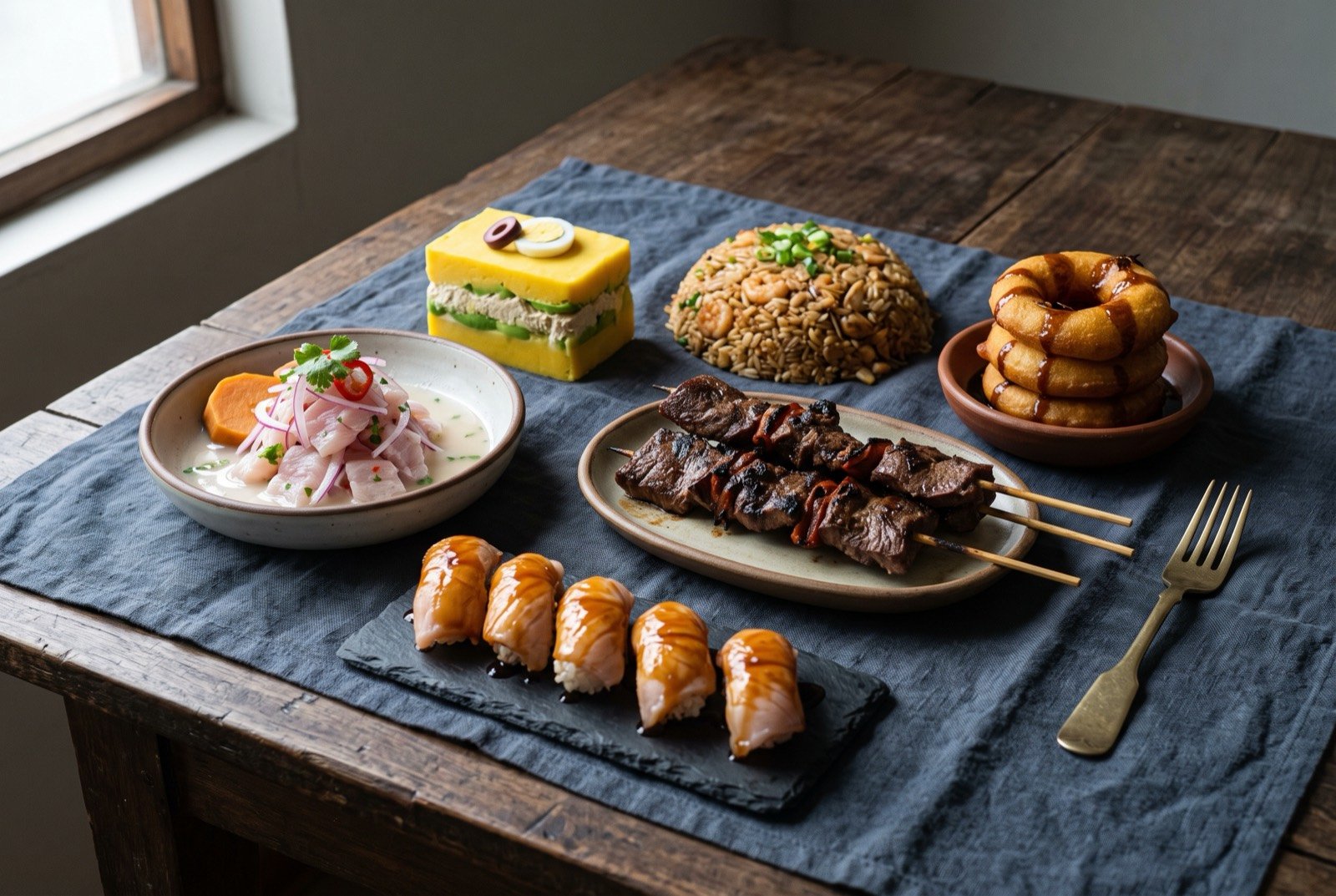
Lima and the Pacific coast run on a different clock from the Peru of Volume AM-17's high plateau: cold-current seafood and citrus, laid over by two migrations the mountains never felt in the same way, Chinese indentured labour from 1849 and Japanese contract settlement from 1899. Not a food culture of ceviche with a chifa takeaway bolted on, but three kitchens, criollo, Chifa and Nikkei, that grew into and against each other on the same short stretch of desert coast. Every dish as tradition built it, then what a modern chef would change.
Sources and review · What this chapter does not assert · How we research · Spotted something wrong?
A Sense of Place
The Humboldt current, shared, not exclusive
Peru's coast runs on the same cold, nutrient-rich Humboldt current already covered from Chile's side in the sibling AM-26 chapter, and that current is the single ecological fact this chapter keeps returning to. It occupies a sliver of the world's ocean surface yet supplies a hugely disproportionate share of the global wild catch, and Peru sits at its most productive stretch: anchoveta drawn from these waters is the largest single-species fishery on earth, the base of a food web that runs up through bonito, corvina and the seabirds and sea lions that work the same current. Both Chile and Peru currently carry roughly seven in ten fish populations below healthy levels, a fact this chapter states plainly rather than assuming a cold current means an inexhaustible one. What the current gives Lima's kitchen that a warmer coast could not is fish firm and clean enough to cure raw in citrus rather than needing heat to make it safe or pleasant, which is the ecological fact underneath ceviche, not a cultural quirk floating free of it.
Lima's desert coast, and the strip beyond it
Lima itself sits on a rainless desert shelf between the Pacific and the Andes, fed not by rainfall but by rivers running down from the mountains through irrigated valleys, exactly the kind of ecology that makes potato, ají and citrus a genuinely local combination rather than an imported one. This chapter's geography runs the length of that coastal strip, not Lima alone: Chincha, Cañete and Ica to the south, where the Afro-Peruvian hacienda economy that shaped anticuchos, tacu tacu and carapulcra was concentrated; Trujillo, Chiclayo and Lambayeque to the north, arroz con pato's home ground; and Lima's own Barrio Chino, centred on Calle Capón, where the first named chifa opened in 1921. The two migration layers sit on top of this same desert-and-valley ecology rather than beside it: Chinese and Japanese contract labourers were recruited specifically for the coastal sugar and cotton haciendas this ecology supports, which is why Chifa and Nikkei read, correctly, as coastal Peruvian cuisines and not as transplanted foreign ones.
A table of the defining logic, read as fat, starch, aromatic and protein, with the two migration layers noted where they changed it:
| Element | The criollo base | What Chifa and Nikkei changed |
|---|---|---|
| Fat | Pork lard, colonial, still present in picarones and turrón; vegetable oil, the modern default; olive oil, a minor colonial import from around 1560 | Sesame oil and rendered pork fat entered through Cantonese cooking; nothing displaced lard or vegetable oil, both traditions layered onto it |
| Starch | Potato (huayro, amarilla, blanca, grown in the highlands but the coastal kitchen's default starch), rice (Spanish colonial arrival, established by the 17th century), yuca, camote, choclo, cancha | Day-old fried rice (chaufa) and wheat noodles (tallarín saltado) turned rice and wheat into a wok staple rather than a boiled side |
| Aromatic base | Ají amarillo and ají panca, red onion, garlic, culantro/cilantro | Kión (ginger), cebolla china (spring onion) and sillao (soy sauce) became routine in ordinary Peruvian home kitchens, not confined to chifa restaurants |
| Everyday protein | Pacific white fish (corvina, lenguado, cabrilla, lorna, chita, and economically bonito), shellfish, beef offal, the Afro-Peruvian legacy cuts, duck on the north coast, chicken | Nikkei applied Japanese sashimi knife technique directly to the same fish; Chifa brought pork and prawn into everyday coastal cooking through the wok |
The History in Layers
Pre-Columbian coastal cooking: what is documented, and what is not
This is where the sourcing discipline matters most, because a genuine, serious dispute sits under one of Peru's best-known culinary claims. Archaeologist Ruth Shady's excavations at Caral and Áspero in the Supe Valley, dated to around 3000 BCE and predating the Moche, reportedly recovered refuse deposits containing raw anchoveta, native ají and salt from the Huacho salt flats alongside yuca and maize, the evidentiary basis for the popular claim that something like ceviche existed millennia before the Spanish arrived. Against this sits a peer-reviewed academic argument (Henry Gayoso-Rullier and Erika Claudia Caballero Liñán, writing in Americanía, Universidad Pablo de Olavide) that raw fish consumption clearly did exist across the ancient and viceregal Andes, but that no documentary evidence links that practice to the specific named dish "seviche": the first written references appear only in the 19th century, exactly the period Peru was building a new national identity after independence, and their reading is that the dish is a 19th century creole creation whose pre-Hispanic origin story took hold because it served that nation-building project rather than because it survives in the historical record. This chapter states both positions, attributed, and does not choose between them. What is not in dispute: independent researcher Sergio Zapata Acha's work on 19th century Peruvian recipe books dates the first written ceviche recipe to 1866 in Arequipa, and an 1860 reference describes "seviche" made with sour orange, salt and chilli, no lime, no onion, none of the corn and sweet potato accompaniments familiar today. Lime replaced sour orange only gradually through the 20th century, and the modern short-cure Lima style is a mid-20th century development, not an ancient one.
The Spanish colonial layer
The Spanish brought cattle, pigs, sheep and the draught animals that made a coastal trade economy possible; onions and garlic; citrus, without which ceviche in its current form could not exist; wheat; rice, established in South America by the 17th century; chickpeas; and olive trees, from around 1560. The generative move criollo cooking runs on is the fusion of these imports with Andean staples already on the coast, potato, ají, maize, rather than either simply replacing the other.
The Afro-Peruvian layer, and the word "criollo" itself
This is the strongest-sourced part of the chapter's history, and it deserves real weight rather than a passing mention. During the colonial period enslaved Africans were given the cuts of animal Spanish landowners discarded, heart, tripe, lungs, liver, and Afro-Peruvian cooks turned that necessity into anticuchos: heavily seasoned to offset strong offal flavours, grilled over open coals, skewered on cane sticks for practical street distribution, beef heart favoured because, sliced thin and marinated, its texture and colour most resembled proper meat. Tacu tacu has the same logic in a different register, leftover rice and beans from the previous day, reworked by enslaved cooks on the haciendas of Chincha and Cañete rather than wasted, formed into a cake and pan-fried. Carapulcra combines an Andean preservation technology, sun-dried potato (papa seca), with an Afro-Peruvian hand for offal broths and ground peanut, a genuine three-layer dish rather than a single-origin one. Turrón de Doña Pepa's standard origin story credits Josefa Marmanillo, an Afro-Peruvian woman from the Cañete valley paralysed in her arms, who recovered mobility after devotion to the Señor de los Milagros and created the turrón in gratitude, distributed during the October procession; this chapter treats it as a devotional narrative rather than documented history, consistent across Peruvian sources but resting on faith tradition rather than a primary record.
The word "criollo" itself is worth pausing on rather than using unexamined. It originally denoted, in the Real Academia Española's definition, a person of European descent born in the colonies; in food writing it broadened to mean the coastal fusion cuisine itself, and in everyday modern use has drifted further still to mean simply "local" or "national" against "foreign." Sharún Gonzales, a PUCP communications instructor writing for the university's human rights institute IDEHPUCP, argues this broadening functions as a real erasure: dishes and cultural forms with clear, documented Afro-Peruvian origin, picarones, anticuchos, the festejo music tradition, the Señor de los Milagros procession itself, get filed simply as "Peruvian" or "criollo" without the specific attribution, a pattern Gonzales connects directly to the community's continuing structural inequality rather than treating as a harmless linguistic drift. This chapter uses "criollo" throughout because it is the standard term in Peruvian food writing, but says here, once, plainly, that a meaningful share of what the word covers is Afro-Peruvian invention wearing a national label.
The Chinese migration and the founding of Chifa
The first 75 Chinese contract labourers, "culíes," arrived in Peru in October 1849 after a voyage of roughly 120 days; the following month the Peruvian government passed the so-called Ley del Chino enabling the trade. Between 1849 and 1874 roughly 100,000 workers from southern China were contracted under indenture, travelling four months from Macao, Hong Kong and Canton, bound for 8, 10 or 14 years, paid roughly half a free labourer's wage, in conditions poor enough that coastal plantation life expectancy is cited, on thin sourcing, at around seven years. Roughly 95% of the coolies were Cantonese-speaking, from Guangdong province; a Chinese-language search behind this chapter's research turned up a detail absent from the English and Spanish record, that recruitment before 1854 drew predominantly on Hakka labourers from Huizhou, Meizhou and southern Fujian, shifting from 1854 onward toward broader Cantonese-speaking recruitment, with Taishan specifically named. The Treaty of Tientsin, signed 1874 and in force from 1876, ended the trade.
Freed labourers moved first into small fondas chinas, documented from 1863 in Camaná and 1874 in Huánuco, serving the popular sectors rather than any elite. The first formal, named chifa is itself a genuinely contested question in Peru's own record: the best-attributed claim, sourced to the Asociación Peruano China, is Kuong Tong, opened 1921 on Calle Capón, credited to Juan Iglesias, also known as Chan Kay Chu, founder of the Tayouc Club and a Chinese consul in Peru, and reputedly the origin of the slang term "taypá," now recognised by the RAE. A rival claim for the long-running San Joy Lao gives founding dates that do not reconcile across sources, 1911, 1927 and 1934 all appear. This chapter states Kuong Tong and 1921 as the better-supported claim, and states plainly that the exact record is not settled.
Sillao, the Peruvian name for soy sauce, descends directly from Cantonese 豉油 and entered the coastal larder with this same migration; kión, ginger, and cebolla china, spring onion, followed the same route. By the mid-20th century Lima alone had, by one 2007-dated figure, over 6,000 chifa restaurants, serving every social register from upscale to the neighbourhood "chifa de barrio," and chifa ingredients had moved into ordinary Peruvian domestic kitchens well beyond the restaurants themselves. Gastón Acurio's own chifa restaurant, Madam Tusán, is as good a measure as any of how thoroughly chifa sits inside, not beside, the national table.
The Japanese migration, Nikkei's formation, and a history the food's later success does not erase
The ship Sakura Maru departed Yokohama and arrived at Callao on 3 April 1899 carrying 790 contracted workers, an event confirmed consistently across Peruvian, Japanese and academic sourcing. A second, smaller ship, the Itsukushima Maru, brought 36 further Okinawan migrants in 1906, a detail surfaced only through this chapter's Japanese-language research and not found in the English or Spanish record. Contracts ran four years on the same coastal sugar and cotton haciendas the Chinese migration had worked before them, Cañete, Chancay, Zaña, Pativilca, Supe and Lambayeque named specifically; terms were nominally better than Chinese indenture, roughly 2.5 pounds sterling monthly with housing and medical care, but a French academic source describes real deception, humiliation and reduced wages in practice, not simple benevolence. Early recruitment drew on Niigata, Yamaguchi and Hiroshima prefectures; from 1906 significant numbers arrived from Okinawa and Kumamoto, and Okinawans became the majority group over time, by one 1941 figure roughly three quarters of Peru's Japanese population, a proportion Peru's own Okinawa Prefectural Association still gives as around 70% of today's Nikkei community.
The community's history includes a chapter its later culinary success should not be allowed to soften. During the Second World War, Peru's government under President Manuel Prado Ugarteche cooperated with the Roosevelt administration to deport roughly 1,800 Japanese-Peruvians to United States internment camps, the largest facility at Crystal City, Texas, built with capacity for 962 families, most of them Peruvian. After the war Peru refused re-entry to most of those deported, leaving many stranded and stateless in the United States; President Alan García formally apologised to Peru's Nikkei community only in 2011. Nikkei cuisine's postwar rise sits against this history of state betrayal, not apart from it, and this chapter names that rather than telling only the success story.
Nikkei cooking itself began in the home, the practical adaptation of a small, then-poor immigrant community using Peruvian ingredients with Japanese technique because Japanese ingredients simply were not available, and only moved into public restaurants from the late 1970s as nisei, the immigrants' children, raised inside this home cuisine, began opening businesses of their own. The clearest, best-documented founding case predates that broader wave: Minoru Kunigami, second-generation Nikkei, opened a seafood restaurant on Calle Paruro in the late 1960s that the public nicknamed "La Buena Muerte" after the church opposite, serving tiradito and sushi-adjacent dishes and widely credited as the founding site of Nikkei cuisine as a distinct restaurant tradition. Tiradito itself is the clearest technical expression of what Nikkei actually is: fish sliced sashimi-thin rather than cubed, sauced at the last moment rather than marinated and cured the way ceviche is, a genuine transplant of Japanese knife discipline onto a Peruvian base, not a Peruvian dish with a Japanese name attached.
Pisco: Peru's fuller case
The sibling AM-26 Chile chapter states Chile's side of the pisco naming dispute and explicitly defers Peru's fuller case to this volume; this chapter carries that case, and, exactly as its counterpart did, does not resolve the dispute between the two countries. Peru recognised Pisco as its first ever denomination of origin on 12 December 1990, formalised the following year by a supreme decree defining the production territory as the coastal zones of Lima, Ica, Arequipa and Moquegua, plus the Locumba, Sama and Caplina valleys of Tacna. Eight grape varieties are designated, split between non-aromatic (quebranta, the dominant variety, concentrated in Ica; negra criolla, mollar, uvina) and aromatic (italia, best suited to Moquegua and Tacna; moscatel, albilla, torontel). Peru deposited its accession to the Lisbon Agreement with WIPO in February 2005, and WIPO issued an international registration certificate for pisco in July that year, though several Lisbon Agreement members Chile lobbied subsequently rejected or only partially accepted Peru's registration, evidence this remains a genuinely live international dispute rather than a settled one. In December 2024, UNESCO's regional Memory of the World committee for Latin America and the Caribbean certified Peru's inscription, in the regional register, of 1587 to 1613 manuscripts held in Peru's General Archive of the Nation documenting grape brandy production and sale in that period; this is a certification of archival documents into a regional heritage register, not an international ruling settling the naming dispute, and this chapter states it precisely rather than inflating it.
Pisco's most famous vehicle, the pisco sour, has its own contested authorship worth stating honestly. The standard account credits Victor Vaughen Morris, an American who opened the Morris Bar on Jirón de la Unión on 1 April 1916, with the drink's origin; the earliest known print references to "pisco sour" are bar advertisements from the early 1920s. A more recent, Peru-sourced complication, drawing on researchers Guillermo Toro-Lira and César Costa Aish, argues that Morris's own version lacked the egg white that defines the drink today, and that Mario Bruiget, a young bartender from Chincha, the same Afro-Peruvian-associated province that runs through much of this chapter's history, was the one who evolved the modern formula, egg white and Angostura bitters included, between roughly 1926 and 1928, in his late teens. On this reading Morris supplied the name and an earlier prototype; the cocktail Peru claims as its own today owes its definitive form to a Peruvian bartender working in his shadow.
The Flavour Arsenal
Ají amarillo and ají panca, the two structural chillies
Ají amarillo, fruit-forward and running roughly 30,000 to 50,000 Scoville units, is the backbone of causa, ají de gallina and most of the sauces that carry this cuisine's colour and heat together; ají panca, dried and low-heat, supplies the smoky, dried-fruit depth underneath anticuchos and the aderezo base of countless coastal stews. Both are worked as fresh purées, dried powders and cooked pastes depending on the dish, and neither substitutes cleanly for the other, amarillo for brightness and fruit, panca for smoke and body.
Culantro and coriander, a naming collision worth untangling
Peruvian coastal cooking's workhorse herb for ceviche, ají verde and most Lima dishes is standard cilantro, Coriandrum sativum, ordinary coriander. True culantro, Eryngium foetidum, a coarser, saw-toothed herb more associated with the Caribbean, appears by name in some dishes, particularly in Piura-influenced northern cooking, but is a minority ingredient here, not the default. English-language recipe writing regularly gets this backwards, calling for "culantro" when coriander is meant; this chapter states the distinction once, plainly, so it does not need restating dish by dish.
Sillao, chifa's fermented import
Sillao descends from Cantonese 豉油, itself tracing back roughly 2,500 years to Western Zhou dynasty fermentation practice, and entered the Peruvian larder specifically with the Chinese migration covered above. It reads today as a Peruvian pantry staple rather than an imported condiment, which is exactly the point: this is a fermentation technology arriving whole with a migrant community and becoming domestic within a couple of generations.
Choclo and camote, the ceviche plate's other half
Choclo, the large-kernel Peruvian corn, and camote, Peruvian sweet potato, are not garnish, they are the acid marinade's structural counterweight on the plate, starch and sweetness against citrus and heat, and their absence is one of the clearest tells of a ceviche made without understanding what the accompaniments are actually doing.
Pisco, covered in full above
See "The History in Layers" for the denomination of origin history, the pisco sour's contested authorship, and this chapter's deliberate refusal to adjudicate the naming dispute with Chile.
The Pacific fish this chapter actually cooks
Corvina, lenguado, cabrilla, lorna and chita are the classic cevichería fish, firm and white-fleshed enough to hold structure under acid; bonito is the everyday, cheaper stand-in in ordinary neighbourhoods, genuinely preferred at the household level over the more industrially significant anchoveta, which is mostly reduced to fishmeal for export rather than eaten directly. Conchas negras, black mangrove cockles gathered from the Tumbes coast in Peru's far north, carry an almost mineral, liver-like intensity that has no real equivalent elsewhere on this coast, let alone off it, a fact this chapter returns to directly in the sourcing section below.
The Technique Ladder
The argument, from inside
Six techniques, each explained by why it works, not only what it does.
Rung 1. Leche de tigre, built as an emulsion, not a marinade poured off
Blending fish trim with lime juice, garlic, onion and ají at high speed for a precise 20 to 30 seconds does not purée the fish smooth, it breaks it down just enough to bind into the citrus and body the sauce, and the result holds for a maximum of around two hours before the raw blended protein oxidises and the flavour turns. This short, controlled blend, and the discipline of using it within that window rather than making it ahead, is the single biggest gap between a home or tourist ceviche and a Lima kitchen's own.
Rung 2. Ceviche's short cure, against the instinct to marinate longer
Real Lima technique cures the fish for roughly one to five minutes, enough for a whitish rim to form on the outside while the centre stays raw, not the ten minutes to overnight many non-Peruvian recipes suggest. Lime is hand-squeezed rather than run through a press, which drags bitter pith oils out of the rind into the juice.
Rung 3. Tiradito's knife-and-timing logic, distinct from ceviche's curing logic
Fish is sliced sashimi-thin, no more than around five millimetres, and the citrus-ají dressing goes on at the very last moment before the plate leaves the kitchen rather than being tossed through, so the result reads as dressed raw fish, not cured fish. This is Japanese knife discipline transplanted whole, not a Peruvian invention wearing a Japanese name, and it rewards a proper slicing knife and a steady hand over any equipment on this reader's shelf.
Rung 4. Causa's potato press, the whole technique in one step
Yellow potato is boiled, then pressed while still warm, ideally twice, to a purée smooth enough to hold no lumps but firm enough to keep its shape once cold, layered with lime, ají amarillo and oil while the potato is still warm enough for fat and acid to bind into it properly.
Rung 5. Anticuchos' long marinade against a fast, hot grill
Five to twelve hours in an ají panca aderezo before the meat ever meets charcoal, basted with the reduced marinade through the cook rather than only before it, a technique built by anticucheras, historically Afro-Peruvian women selling from street corners in colonial Lima, Arequipa and Trujillo, long before it reached a tasting menu.
Rung 6. Wok hei, chifa's high-heat searing
A commercial wok run properly hot exceeds 200 degrees Celsius, cooking food in seconds and building the caramelised, lightly charred flavour of a proper stir fry through fast Maillard reaction rather than through any added smoke or seasoning. This is Cantonese technique specifically, brought by the same 19th century migration that built chifa, and the actionable point for a domestic kitchen is heat and speed: the wok ferociously hot before anything goes in, cooking in short fast bursts rather than a slow sauté.
The Ferment and Preserve Bench
Three preparations, each a real preservation technology rather than a modern flourish laid on top of the cooking.
Papa seca, and carapulcra's inherited technique. Sun-dried potato is an Andean technology carried down to the coast and folded, by Afro-Peruvian hands, into a dish built on ground peanut and offal broth: a genuine three-layer preservation and cooking technology, not a single-origin one, worked here because it is exactly the kind of layered inheritance this coast's cooking runs on.
Escabeche, the criollo pickle. Fish or chicken fried, then held in a vinegar, onion and ají escabeche, a preservation and flavour-concentration technique in one, holding for days rather than hours and improving, by common report, on the second day rather than the first.
Sillao, a fermentation technology arriving whole with a migrant community. Covered in full in the Flavour Arsenal above: soy sauce fermentation, a roughly 2,500 year old Chinese technique, entered the Peruvian pantry with the same 19th century migration that built Chifa, and became domestic within a couple of generations rather than staying a marked, foreign condiment.
Sourcing in Britain
Ají amarillo and ají panca. Ají panca paste is well and reliably stocked: Sous Chef UK carries Chatica's, Mextrade carries Sol Andino's, and it is genuinely easy to find in the UK. Ají amarillo is slightly patchier but real: Sous Chef stocks Chatica's paste, EL INTI, the Peruvian Shop, stocks the Arezzo brand and dried and powdered forms, and Seasoned Pioneers carries a ground version. Fresh ají amarillo is not realistically available in the UK; where the paste genuinely cannot be found, a blend of a mild-to-medium fresh chilli with a spoon of mango or apricot approximates the fruit-and-heat balance, stated here as a compromise, not an equivalence. Ají limo is available frozen and as a puree through Sol Andino and EL INTI, and Sea Spring Seeds sells live plants for a reader with a greenhouse and the patience to grow the real thing.
Pisco. A genuine, striking asymmetry with the sibling AM-26 Chile chapter, worth stating plainly. Peruvian pisco is comfortably available through mainstream UK specialist spirits retailers: Master of Malt carries at least five expressions of Barsol across all three legally defined Peruvian pisco categories, puro, acholado and mosto verde; The Whisky Exchange stocks Macchu Pisco and its sister label La Diablada; Pisco Portón has held UK distribution since at least 2014. Chilean pisco, by contrast, only reached the UK narrowly and recently, via a 2025 distribution deal covered in the Chile chapter. A reader making a proper pisco sour for this chapter has real choice; the Chile chapter's reader does not.
Sillao and chifa seasoning. Genuine Kikko-brand sillao is importable through eBay and Ubuy cross-border listings rather than a settled UK specialist supply chain, and this chapter says so honestly rather than implying a shop-front source that does not currently exist. Sillao is not meaningfully distinct from soy sauce the way ají amarillo is distinct from any pepper sold here, and a standard Chinese light soy sauce, Pearl River Bridge or Lee Kum Kee, is a genuine, honest substitute rather than a compromise. Kión is simply fresh ginger and five spice is standard Chinese five spice, neither presents any sourcing problem at all.
Limón, culantro, choclo and camote. Peruvian limón is not available fresh in the UK and would not survive the freight even if grown for export; regular UK limes, cut with a little zest and, per some diaspora home cooks, a touch of lemon juice, are the honest substitute, though the gap in aroma and acidity is real and this chapter does not pretend otherwise. Standard supermarket coriander, not the coarser Caribbean-style culantro some English recipe writing wrongly calls for, is correct for the great majority of this chapter's dishes. Choclo is genuinely well sourced, frozen whole or as kernels through EL INTI, Sol Andino and LaCasadeJack; camote proper is unavailable, but ordinary UK sweet potato is a low-cost, honest substitute since the dish depends on the sweet-starch contrast more than the specific cultivar.
Fish and shellfish. UK anchovy is a fair stand-in for anchoveta, a different species but close enough in size and oiliness; UK-landed skipjack, small tuna or mackerel are reasonable for bonito. Conchas negras have no real UK equivalent, and this chapter says so plainly rather than offering a scallop or oyster as a false substitute: this is an ingredient to understand, not one this book can hand a reader a working recipe for.
Kit. Tiradito calls specifically for a Japanese yanagiba, the correct tool for a technique whose lineage is openly Japanese rather than indigenous, and this chapter does not force an invented ancestor onto it. A high-power blender is the honest modern substitute for the batán, Peru's own grinding stone, not commercially imported to the UK. Any carbon steel wok suits chifa's high-heat work.
The two decisions that matter most. Real ají amarillo paste over a chilli-and-mango improvisation, since nothing UK-grown replicates its specific fruit-forward heat and the real thing is genuinely, reliably buyable. Real pisco over a generic white grape spirit for a proper pisco sour, since Peruvian pisco is unusually well stocked in the UK and there is no honest excuse for the substitute.
Voices and Sources
Peruvian national and institutional sources: El Comercio, La República, RPP, the state news agency Andina, El Peruano, the official gazette, TVPerú, peru.info and PROMPERÚ, the state tourism and export body, and the Congress of Peru's own communications, for the ceviche and pisco heritage declarations, the pisco denomination of origin, and contemporary restaurant reporting; APEGA, the Sociedad Peruana de Gastronomía, founded 2007, for the institutional history of Mistura and Peru's own gastronomic organising, though this chapter was not able to reach APEGA's own publications directly. One genuine peer-reviewed academic source, Henry Gayoso-Rullier and Erika Claudia Caballero Liñán writing in Americanía (Universidad Pablo de Olavide), for the documentary case against a pre-Hispanic ceviche origin.
Afro-Peruvian voices, prioritised throughout: Sharún Gonzales, PUCP, writing for IDEHPUCP on the erasure the word "criollo" performs; the Museo Afroperuano de Zaña, a UNESCO Site of Memory of Slavery and African Cultural Heritage since 2017; named local food-heritage researchers Rosa Colchado (Zaña) and Carmen Huapaya (Cañete), working through the ACUA programme's "Fogón Afroperuano"; food historian Rosario Olivas Weston, cited throughout Peruvian food writing on Lima's 19th century table, though this chapter reached only third-party citations of her work rather than her books directly, worth a future reader's own pursuit.
Chifa and Nikkei community sources: the Instituto Peruano Chino and the Asociación Peruano China, the two principal institutional voices of Peru's tusán community; the Asociación Peruano Japonesa, via a Gestión interview with its president Abel Fukumoto; discovernikkei.org, the Japanese American National Museum's Nikkei-community-run project; a genuine academic source reached directly, the IFEA (Institut français d'études andines)'s open-access work on Japanese migration to Peru, the strongest single citation behind this chapter's migration numbers; and, reached only through dedicated Chinese-language and Japanese-language search rather than the English or Spanish record, a Chinese-language account of the pre-1854 Hakka recruitment wave and a Japanese-language account naming the Okinawa Prefectural Association's own figures.
Modern chefs and restaurants: Virgilio Martínez and Pía León of Central, whose Mater Iniciativa research operation and altitude-organised menu this chapter treats as a real, if highland-skewed in its own public narrative, model of ingredient research; Mitsuharu "Micha" Tsumura of Maido, whose own framing of Nikkei cuisine as "a cultural mestizaje" rather than either national cuisine wearing the other's ingredients this chapter takes seriously; Gastón Acurio, for both Astrid y Gastón and the institutional legacy of APEGA and Mistura; Rafael Osterling and Palmiro Ocampo, named as further serious contemporary voices; Javier Wong, a bridge figure between chifa's Cantonese technique and Lima's own cevichería tradition; and Grimanesa Vargas, "Tía Grima," the clearest living example of anticuchos' street-food lineage still working today.
Things this chapter has deliberately not asserted
- That ceviche is a pre-Hispanic dish. Archaeological circumstantial evidence sits against a serious academic argument for a 19th century documentary origin, and this chapter states both, attributed, without choosing.
- That causa rellena's name and creation trace to women fundraising for soldiers during the War of the Pacific. Every source that repeats this frames it explicitly as legend, and no primary documentary source was found.
- That papa a la huancaína's railway-construction origin story, including any specific named creator, is settled. Peruvian sources themselves describe this territory as controversial and unresolved.
- That tacu tacu's name derives from Swahili "taka." This appeared on a single non-academic source and is not corroborated elsewhere; the better-attested Quechua reading is used instead.
- That turrón de Doña Pepa's Josefa Marmanillo miracle story is documented history rather than devotional tradition. It is treated here as the latter.
- That leche de tigre has a known inventor. No source credibly names one, and this chapter assigns no credit.
- That anticucherías have any documented connection to the Cementerio Presbítero Maestro district in Lima. This specific claim could not be verified and is not repeated here.
- That the first chifa's exact founding date and restaurant are settled. Peru's own record disagrees, Kuong Tong at 1921 is stated as the better-attributed claim, not a certain one.
- That the exact ratios behind arroz chaufa, tallarín saltado or wonton preparations rest on chef-attributed, professional-kitchen sourcing. The quantities given throughout this chapter are aggregated from Peru-based recipe writing and stated as indicative rather than verified.
- That nigiri acevichado and maki acriollado carry the same depth of documented history as tiradito. They do not, and this chapter says so within the dish entry itself rather than only here.
- That Mitsuharu Tsumura's kitchen at Maido uses sous vide technique. No citable source confirms this, despite direct searching, and it is not claimed.
- That the pisco naming dispute between Peru and Chile is resolved, or that this chapter, any more than its sibling AM-26, has adjudicated it. Neither has, and neither attempts to.
- That the December 2024 UNESCO development settles the pisco naming question internationally. It is a regional Memory of the World certification of 16th and 17th century archival manuscripts, stated here precisely rather than inflated into more than it is.
- That conchas negras, or true Peruvian limón, camote or culantro, can be honestly reproduced in the UK with a substitute. Where no real equivalent exists, this chapter says so rather than offering a false fix.
Leche de tigre, built as an emulsion, not a marinade poured off
Blending fish trim with lime juice, garlic, onion and ají at high speed for a precise 20 to 30 seconds does not purée the fish smooth, it breaks it down just...
Ceviche's short cure, against the instinct to marinate longer
Real Lima technique cures the fish for roughly one to five minutes, enough for a whitish rim to form on the outside while the centre stays raw, not the ten...
Tiradito's knife-and-timing logic, distinct from ceviche's curing logic
Fish is sliced sashimi-thin, no more than around five millimetres, and the citrus-ají dressing goes on at the very last moment before the plate leaves the...
Causa's potato press, the whole technique in one step
Yellow potato is boiled, then pressed while still warm, ideally twice, to a purée smooth enough to hold no lumps but firm enough to keep its shape once cold...
Anticuchos' long marinade against a fast, hot grill
Five to twelve hours in an ají panca aderezo before the meat ever meets charcoal, basted with the reduced marinade through the cook rather than only before it...
Wok hei, chifa's high-heat searing
A commercial wok run properly hot exceeds 200 degrees Celsius, cooking food in seconds and building the caramelised, lightly charred flavour of a proper stir...
The dishes
- Ceviche Coastal Peru
- Tiradito Lima, Peru (Nikkei)
- Causa rellena Lima, Peru
- Anticuchos Lima, Peru (Afro-Peruvian)
- Lomo saltado Peru (criollo-Chifa)
- Arroz chaufa Peru (Chifa)
- Ají de gallina Peru (colonial, from Catalan menjar blanc)
- Tacu tacu Peru (Afro-Peruvian)
- Nigiri acevichado and maki acriollado Peru (Nikkei)
- Papa a la huancaína Peru (contested Huancayo/railway origin)
- Picarones Lima, Peru (viceregal, via Spanish buñuelo)
Sources and review
- Reviewed
- Not yet reviewed from inside the tradition
- Cooked
- Not yet cooked and reported
Where this volume comes from
3 research briefs on file for this volume, researched to the rules on How we research. Published 3 September 2026. Last changed 8 September 2026.
The brief's own account of its sources
Tradition A (criollo, ceviche, causa, anticuchos, pisco). Of roughly 45 distinct sources consulted, an estimated 40 to 45% were genuinely local/in-tradition or official Peruvian: El Comercio, La República, RPP, Andina, El Peruano, TVPerú, peru.info/PROMPERÚ, the Congress of Peru, IDEHPUCP (PUCP), and one genuine peer-reviewed academic article (Universidad Pablo de Olavide, Spain, a rigorous citation-based historical argument specifically about Peruvian ceviche). A meaningful share came from Infobae's Peru desk, treated as medium-trust.