The Americas · Volume 17
Peru, the High Andes
Altitude, Chuño and the Picantería Table
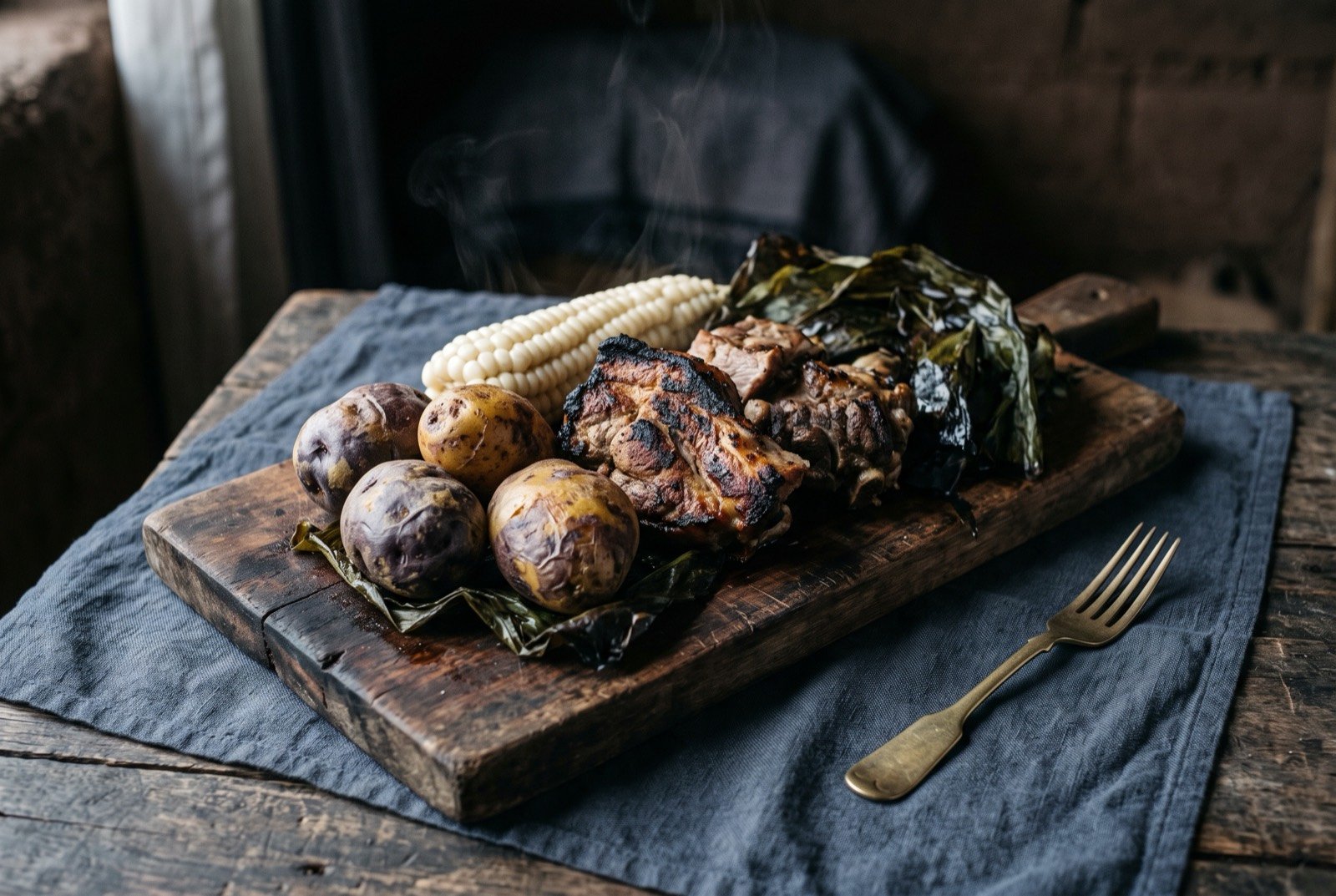
Two tables, Cusco's true highlands above 3,400 metres and Arequipa's mid-altitude volcanic valleys at 2,335, that share one organising fact before they share anything else: altitude decides what grows, what keeps, and how you cook it. This is the chapter that gives the atlas's ecological argument its clearest possible case. Above the frost line, food does not merely come from a place, it comes from a specific band of a mountain, and for two and a half thousand years the people living there have engineered around that fact with a precision that modern food science is only now finding the vocabulary to describe. Every dish as tradition built it, then what a modern chef would change.
Sources and review · What this chapter does not assert · How we research · Know this better? Tell us
A Sense of Place
Cusco, the true highlands
Cusco sits at roughly 3,400 metres, the historic centre of the Inca state and, before that, of a Wari-influenced highland world already organising its farming by elevation. Above roughly 3,800 metres the growing season shortens to almost nothing but frost itself becomes a tool: nights cold enough to freeze a potato solid, days dry and bright enough to sublimate the ice straight out of it, are exactly the conditions chuño and tunta are built on, and exist nowhere useful to a cook much below that line. Between 3,000 and 3,900 metres, the suni and humid puna zones, olluco, oca and mashua do the work potato cannot always do alone, frost-hardy, short-day tubers that between them cover a longer harvest window than potato allows on its own. Above the tuber line entirely, camelid pasture takes over: llama and alpaca, and with them charqui and chalona, dried meat that keeps for a mountain community with no reliable refrigeration and, for centuries, no reliable road either.
Arequipa, the bridge
Arequipa is not the highlands with a coastal ingredient added. It sits low enough, 2,335 metres in a semi-arid valley ringed by three volcanoes, El Misti, Chachani and Pichu Pichu, to grow wheat properly and keep dairy cattle, and its own river valleys, the Majes, Camaná, Ocoña and Tambo, carry a resource no highland kitchen has ever had: camarón de río, a freshwater shrimp fished under a legally enforced closed season and depicted on pre-Inca Mochica and Chimú pottery long before any Inca-era highland dish existed. The city's own irrigated market-garden belt, the Campiña, has fed it since before the Inca arrived, and its colonial identity, built from the white volcanic stone, sillar, quarried from its own volcanoes, gave it a genuine regional independence from Lima that this chapter takes seriously rather than treats as colour. No source calls Arequipa a bridge kitchen outright; this chapter does, because the evidence, wheat and dairy on one hand, river shrimp on the other, camarón and adobo sitting beside rocoto and chicha, supports the description more precisely than either "highland" or "coastal" would alone.
The vertical archipelago, and the state built to run it
The Andean agricultural model, formalised in the anthropological literature as the vertical archipelago, held that a single ethnic group or ayllu did not farm one plot of contiguous land but several, at different altitudes at once, moving people and stores between them rather than trading across what a modern map would call a border. The Inca state built the infrastructure this required at genuine scale: qollqa, stepped granaries along the road network, stored maize, chuño, quinoa and salted meat; tambos, waystations roughly every fifteen to twenty five kilometres along the nearly forty thousand kilometres of the Qhapaq Ñan, held food, wool and firewood for travellers and administrators; andenes, terracing, cover something like a million hectares of Peru even now, reducing frost risk and controlling erosion on slopes no flat-land farming method could use at all. Moray, the Sacred Valley's concentric agronomic terraces, is the best-known surviving example, and it sits at the centre of this chapter's most important modern story, below.
The defining logic, side by side
| Element | Cusco and the southern highlands | Arequipa and the volcanic valleys |
|---|---|---|
| Altitude | 3,400 metres and above | 2,335 metres, mid-altitude |
| Fat | Minimal, occasional lard, camelid tallow | Lard, dairy butter, olive oil |
| Starch | Native potato, chuño and tunta, maize, quinoa | Wheat, potato, rice |
| Aromatic base | Huacatay, chincho, muña, ají amarillo | Rocoto, huacatay, ají panca |
| Everyday protein | Cuy, charqui, mutton, occasional trout | River shrimp, pork, lamb, dairy cheese |
| Signature technique | Earth-oven cooking, freeze-drying | Stone-grinding on a batán, chicha-marinating |
The History in Layers
Before the Inca
Wari influence, radiating from Ayacucho between roughly 600 and 1000 CE, is credited by several sources with intensifying terrace construction across the highlands and with a diet already centred on maize, oca, mashua and potato alongside camelid herding. This chapter states plainly that the sourcing behind Wari-era food history, in what this research reached, is thin, encyclopaedic and blog-tier rather than grounded in Peruvian archaeology directly, and should be read as background rather than settled fact. Further south, in the Colca valley behind Arequipa, the Collaguas and Cabanas peoples had already built roughly nine thousand hectares of terraced, irrigated farmland before the Inca arrived, some of it dated as early as 400 to 500 CE, a system that has stayed in continuous production for over fifteen hundred years without eroding its own soil, one of the genuinely remarkable agronomic facts in this whole atlas.
Conquest, twice over
Around 1450 the Inca state, under Túpac Inca Yupanqui, absorbed the Collaguas and Cabanas into its empire, with Coporaque serving as the local administrative seat; a documented curaca from Mayta Cápac's own royal lineage settled there, married a local woman and built a palace, a genuine piece of Andean political history rather than a flattened story of simple annexation. A century later, in 1540, a second conquest arrived from a different direction: the Spanish captain Garci Manuel de Carbajal founded Arequipa in Pizarro's name, with barely a hundred settlers, at a site the local Quechua-speaking population already called Ari Qipa, specifically to serve as a staging post toward Chile. Wheat and European livestock spread through the highlands from this point on, displacing camelid grazing land and maize cultivation in places where both crops needed the large contiguous plots the old vertical-archipelago land system had never provided in one place. This chapter is honest that the detail of that displacement, as opposed to its broad shape, was not found in this research grounded specifically in Cusco or Arequipa, and is stated here as general Spanish-American colonial agrarian history rather than a locally specific study.
A regional identity built on resistance, not just on stone
Arequipa's own colonial city was built from sillar, the white volcanic tuff quarried from the very volcanoes that ring it, valued from the sixteenth century onward for being light, easy to carve and genuinely resistant to earthquake damage, since it flexes rather than shatters. The Monastery of Santa Catalina remains the standard example. But the city's identity was never only architectural. Arequipeños are recorded as having taken up arms against Lima's centralism more than seven times between independence and the 1850s, and during the War of the Pacific, when Lima itself fell under Chilean occupation between 1879 and 1884, Arequipa functioned as Peru's provisional capital. The popular idea of an "Independent Republic of Arequipa" is not a literal historical fact, a distinction Peruvian sources themselves draw explicitly, but a characterisation of a regionalism intense enough that this chapter takes it at face value as a real cultural force rather than a slogan.
The modern moment, and the inequality inside it
Peru's own gastronomic boom, from the 1990s onward, revalued exactly the ingredients this chapter is built on. Quinoa exports reached thirty seven markets by 2012, led by the United States; native potato exports, snacks, frozen and dehydrated forms among them, tripled in value between 2010 and 2015. But this revaluation has not reached the people who grew these crops as subsistence staples for centuries. Puno, which produces roughly eighty per cent of Peru's quinoa, remains one of the country's poorest regions. A 2025 Peruvian press investigation puts a harder number on the wider picture: 17.6 million Peruvians, more than half the population, face moderate to severe food insecurity, 43.7 per cent of children under three suffer anaemia, and sophisticated cuy preparations now sell in exclusive Lima restaurants at prices that price out the very communities who historically ate cuy as everyday protein. This chapter does not treat the Novoandina movement and its modernist heirs as a settled triumph; the tension is named directly under Voices and Sources, below, rather than smoothed into a single celebratory story.
The Flavour Arsenal
Starches and staples
| Ingredient | What it is |
|---|---|
| Chuño and tunta | Freeze-dried native potato, black (chuño) or white and washed (tunta, also moraya), an indefinite-keeping staple built on frost, sun and, for tunta, weeks of river-soaking |
| Native potato varieties | Papa amarilla, creamy and yellow-fleshed, for purées; huayro, red-skinned with bright yellow flesh, floury, suited to stews and pachamanca; peruanita, a red-and-yellow bicolour skin, typically boiled whole. Peru holds somewhere over three thousand catalogued native varieties, the true figure genuinely contested between sources |
| Olluco, oca, mashua | The lesser Andean tubers, cultivated 3,000 to 3,900 metres, filling the harvest calendar around the potato: olluco the most commercially robust, oca the second most widely grown tuber in Peru after potato, mashua the highest-yielding and easiest to grow of the three |
| Quinoa, kiwicha, kañiwa | The Andean grains proper. Quinoa has adapted to altiplano conditions above 3,800 metres for more than five thousand years; kañiwa is the most altitude-specific of the three, rarely grown outside the 3,800 to 4,000 metre band |
| Maíz blanco gigante del Cusco | Giant white corn from the Urubamba and Calca valleys, large flat kernels, historically tied to sun worship and chicha production, holder of Peru's second-ever protected designation of origin |
| Habas | Fava beans, a staple protein and bulking ingredient in kapchi, solterito and much everyday highland cooking |
| Wheat | Arequipa's own staple, distinct from the maize-and-potato highland economy, grown in the Campiña since before the Inca and baked into pan de tres puntas |
Chillies
| Ingredient | What it is |
|---|---|
| Rocoto | Capsicum pubescens, a genuinely separate species from ají amarillo, not a hotter version of it. Thick-fleshed, black-seeded, roughly 30,000 to 100,000 Scoville units, its heat concentrated in the placenta and veins rather than the flesh, which is exactly what makes rocoto relleno's deseeding technique work |
| Ají amarillo and ají mirasol | Capsicum baccatum, cultivated in Peru for some 8,500 years, the fresh yellow chilli that becomes ají mirasol once dried, the base of ocopa, chupe and much of the wider Peruvian pantry beyond this chapter's own borders |
Leaves and aromatics
| Ingredient | What it is |
|---|---|
| Huacatay | Black basil-adjacent in flavour, used since documented pre-Inca times, central to marinades across both Cusco and Arequipa |
| Muña | Andean mint, grown 2,500 to 4,000 metres, used as an infusion against soroche, altitude sickness, a claim with some real basis in the plant's own digestive and vasodilatory oils rather than pure folklore |
| Chincho and marmaquilla | The two named wrapping leaves of pachamanca, chincho the stronger and more assertive, marmaquilla milder, both doing three jobs at once, aroma, a barrier between food and bare earth, and moisture retention |
| Hierba buena | Spearmint, used to season the broth of timpu alongside muña |
Ferments and preserved proteins
| Ingredient | What it is |
|---|---|
| Charqui and chalona | Dried llama, alpaca or, at lower altitude, beef (charqui), and specifically dried mutton or goat retaining small bone fragments (chalona). Salted lightly or heavily depending entirely on altitude, since frost does at 4,000 metres what salt has to do at 2,000 |
| Chicha de jora | Cusco's malted white-maize beer, sprouted, dried, ground, cooked and naturally fermented |
| Chicha de guiñapo | Arequipa's own, entirely distinct fermented drink, built on forced-germinated purple corn rather than white, ground on a stone batán and fermented typically five to six days, its carmine colour said to have inspired the city's own flag |
| Cuy | Guinea pig, domesticated in the Andes by roughly 2,500 BCE, simultaneously subsistence protein, ritual offering and, in some communities still today, a diagnostic tool in traditional healing |
Dairy and other staples
| Ingredient | What it is |
|---|---|
| Queso paria and the wider fresh-cheese tradition | A fresh cheese with real protected-origin status from Puno, though this chapter is honest that "queso arequipeño" itself names no single agreed product, queso fresco de cabra, queso serrano and queso lluta all appear in the sources depending on the dish |
| Camarón de río | Freshwater shrimp specific to Arequipa's river valleys, unavailable in the true highlands, legally protected under a closed season each southern-hemisphere summer |
| Sal de Maras | Salt evaporated from a hypersaline spring at Maras, near the Sacred Valley, in production for a length of time this chapter deliberately does not assert a precise figure for, see below |
The Technique Ladder
The argument, from inside
Six techniques, each explained by why it works, not only what it does.
Rung 1. Chuño and tunta's natural freeze-drying
This is the technique that anchors the whole chapter. Native potatoes are frozen overnight at altitude, then covered and uncovered across a further two days to cycle them through freeze and thaw; tunta specifically is then soaked in running river water for twenty to thirty days, leaching out the glycoalkaloids that make the raw tuber bitter, before a final five to eight days of pressing and sun-drying and a hand-rubbed peel. The whole tunta cycle runs to roughly fifty days and needs conditions that exist almost nowhere else on earth: altitude above 3,800 metres, night-to-day temperature swings from minus ten to eighteen degrees Celsius, and low atmospheric pressure dry enough to sublimate ice straight to vapour, the same physics a modern industrial freeze-drier uses, discovered and refined by Andean farmers with nothing but frost, sun and running water centuries before the machine existed.
Rung 2. Earth-oven cooking, pachamanca and watia
Pachamanca packs meat and tubers around volcanic stones heated in a pit, sealed under chincho and marmaquilla leaves and earth, and left until the stones' own retained heat has finished the job. Watia is the same idea run by a single farmer in minutes rather than by a whole community over an hour: a dome of hardened earth clods is built over a shallow pit and fired from inside, then collapsed directly onto potatoes dug fresh from the same field, cooking on residual heat alone. Both are genuine, controllable low-and-slow techniques, insulated retained heat doing gentle, extended work rather than a hard direct flame, and both are a real technical precedent for what a sealed sous vide bath or a closed Big Green Egg is actually trying to do.
Rung 3. The batán, Arequipa's stone-grinding tradition
Picanterías still grind their sauces on a batán, a large smooth river stone, rather than in a blender, and this is not conservatism for its own sake: the stone produces a coarser, denser paste with a different mouthfeel to a blade's fine, aerated purée, and Arequipeño cooks describe it as carrying the dish's own soul. Treated properly this is a real alternative texture a high-power blender can approximate but not replicate, worth respecting rather than simply correcting.
Rung 4. Rocoto's sugar-boil deseeding
The rocoto is halved, its seeds and veins removed, since capsaicin concentrates there rather than in the flesh, then boiled and drained three times with two tablespoons of sugar added at each boil. This is precise chemistry, not folk ritual: repeated boiling leaches out capsaicin and residual bitterness while the sugar helps the pepper's own cell walls hold their shape, so a rocoto stuffed after this treatment keeps its structure through a forty five minute bake rather than collapsing.
Rung 5. Charqui and chalona's altitude-responsive drying
The same technique, thin-sliced meat hung to dry in a sunny, ventilated spot, is executed differently depending on where it happens: at high altitude, nightly frost does most of the preservation work and less salt is needed, while at lower elevation more salt and more active protection from insects is required. This is a genuinely climate-responsive technology, not one fixed recipe applied everywhere, and it rewards a cook who understands why the ratio changes rather than one who just follows a single formula.
Rung 6. Chicha fermentation, two distinct traditions
Cusco's chicha de jora malts white maize by sprouting, drying and grinding it before cooking and natural fermentation; Arequipa's chicha de guiñapo forces germination in purple corn instead, ground on the same batán that grinds the picantería's sauces, fermented typically five to six days to a low two to three per cent alcohol. Two genuinely different fermentation logics from two neighbouring food worlds, each a real precedent for a modern kitchen's own controlled ferment.
The Ferment and Preserve Bench
Four preparations, each a genuine, climate-specific preservation technology.
Chuño and tunta. Covered in full on the Technique Ladder above: freeze, cover-and-uncover cycling, river-soaking for tunta specifically, pressing and sun-drying, a fifty-day process for tunta that only the high Andes' own altitude, temperature swing and dry season make possible at all.
Charqui and chalona. Thin-sliced llama, alpaca or, lower down, beef and mutton, hung to dry in sun and wind, salted more or less heavily depending entirely on how much of the preservation work altitude's own nightly frost is already doing.
Chicha de jora. Cusco's malted white-maize ferment: maize sprouted, dried and ground into jora, cooked, and left to ferment naturally, producing a low-alcohol, faintly sour drink used as much as a marinade and souring agent, in dishes such as seco de cordero, as it is drunk on its own.
Chicha de guiñapo. Arequipa's own, entirely distinct ferment, forced-germinated purple corn ground on the same batán that grinds the picantería's sauces, fermented five to six days to a gentle two to three per cent alcohol, its carmine colour said to have inspired the city's own flag, and described directly in Peruvian press as the germ from which the whole picantería tradition grew.
Sourcing in Britain
Chuño and tunta, a genuine correction to what this chapter assumed going in. These are not the unobtainable ingredient they first appear. Two independent UK retailers stock them: El Inti, the Peruvian Shop, sells White Chuño Tunta Moraya, El Plebeyo brand, 500g for £3.84, and Nature Hunter separately stocks whole dried chuño potatoes, 500g for £5.00, with UK-wide delivery. Buy real chuño over attempting a home freeze-thaw approximation; the traditional altitude-driven process is not something a domestic freezer and dehydrator can fully replicate, but it does not need to be replicated when the real thing is a checked, current UK purchase.
Ají amarillo and rocoto, genuinely well stocked and genuinely distinct. Ají amarillo paste is easy: brands including Chatica, La Favorita and America are stocked at Sol Andino Market, Sous Chef UK and MexGrocer. Rocoto is harder but real: El Inti stocks frozen whole rocoto, El Plebeyo brand, 500g for £5.31, the closest thing to fresh rocoto obtainable in Britain, alongside several rocoto paste brands. No fresh, unfrozen rocoto exists in UK retail at all; frozen is the honest ceiling.
Cuy, stated without hedging. It is not illegal to eat guinea pig in Britain, but there is no UK route to it at all. No butcher, specialist meat supplier or importer sells cuy for consumption; UK guinea pig breeding is entirely pet-focused, and the larger meat-breed lines Andean cuy farming depends on do not exist in British breeding stock. There is no honest substitute for this dish's own central ingredient, and this chapter does not pretend one exists.
Charqui and alpaca. Fresh and frozen alpaca meat is genuinely UK-farmed, Kezie Foods and Hill Farm Packington both sell it, though stock runs intermittent. No UK supplier dries alpaca or llama into true charqui; a reader wanting to approximate it would need to buy fresh UK alpaca when available and dry it themselves in a dehydrator, an honest workaround rather than a real substitute, since true charqui's altitude-assisted freeze-thaw drying cannot be replicated at sea level.
Huacatay and muña, both genuinely available. Dried huacatay, Sol Andino brand, is stocked at Nature Hunter and El Inti; dried muña is stocked at El Inti, Los Ficus brand, and was well in stock at time of checking. Huacatay also grows readily in a British garden or greenhouse from seed sold by Hillside Herbs.
Chicha de jora. Raw malted jora corn for brewing from scratch was not found anywhere in UK retail; what is available is a pre-made chicha de jora, Arezzo brand, sold as a cooking liquid rather than a raw grain to ferment, a genuine gap for a reader wanting to brew their own from source.
Sal de Maras and pisco. Both straightforward. Sal de Maras is stocked by Raw Living UK and El Inti among others; pisco is easily found through The Whisky Exchange, Gerry's Wines and Spirits and El Inti itself.
Queso fresco and paria-style cheese, an honest substitution-only category. No Peruvian queso fresco or paria import exists in UK retail. Halloumi or a Danish-Greek-style feta are the closest textural stand-ins repeatedly suggested, but neither replicates queso fresco's own fresh, milky brightness, and given this reader's own kit, making a simple queso fresco at home from whole milk and rennet or citric acid is the more honest route than either shop substitute.
The single decision that matters most. Real chuño or tunta, sourced properly rather than approximated at home, is what lets pachamanca and timpu read as genuinely Andean rather than merely potato-based; real rocoto, even frozen, over a habanero substitute, is what lets rocoto relleno keep its own specific, structural heat rather than becoming a generic stuffed chilli. El Inti, the Peruvian Shop, should be treated as this chapter's anchor retailer: of everything checked for this volume, it carries the deepest and most consistently verifiable catalogue of any single UK source.
Voices and Sources
On the ecology and history of the highlands and Arequipa: the CBC Cusco agroecological guide and a PUCP thesis on tambo storage for the vertical archipelago and state storage apparatus; the Ministerio de Cultura's own Qhapaq Ñan documentation for qollqa; a Universidad Complutense de Madrid academic paper on Colca valley irrigation and Andean ritual for the pre-Inca terracing at Colca; PUCP's Boletín de Arqueología for the Inca-era incorporation of the Collaguas and Cabanas; PromPerú's own technical catalogue on Peruvian Capsicum species for the real botanical distinction between rocoto and ají amarillo; the International Potato Centre, Lima-based and genuinely authoritative, for olluco, oca and mashua agronomy; and LEISA Revista de Agroecología, drawing on the Peruvian INCOPA research project, for the single best technical account of chuño and tunta production found anywhere in this chapter's research.
On the picantería tradition specifically: La República's own coverage of the batán technique and the weekly soup calendar, corroborated by the picantería La Maruja's own account of its seven-day rotation; Andina, Peru's state news agency, for the picantería's 2014 designation as Patrimonio Cultural de la Nación, Peru's own national heritage status, not a UNESCO listing, a distinction this chapter keeps precise; and Andina again, alongside Infobae's Peru desk, for chicha de guiñapo's history and process.
On the modern elevation, where it actually is. Virgilio Martínez and Pía León's Mil, on the rim of the Moray terraces near Cusco, is this chapter's clearest single example of its own animating argument: a restaurant built in direct, transparent partnership with two Quechua-speaking communities, CC Kacllaraccay and Nukkak'as-Misminay, its tasting menu organised explicitly by altitude band, and its own chef naming the watia earth oven directly as the inspiration for the restaurant's whole approach, "the most kilometre-zero cooking" he says he has ever seen. Mater Iniciativa, the Martínez siblings' research arm, states its own position plainly through Virgilio Martínez's words: "We are honoring what they do. We always ask for permission to produce an interpretation." Pía León's Mauka, inside Cusco's Palacio Nazarenas, and her Lima restaurant Kjölle, named for the qolle flower that grows only above 3,000 metres, extend the same lineage. The wider Novoandina movement is conventionally traced to 1986 and the journalist-cook Bernardo Roca Rey, though this chapter states plainly that the sourcing behind that specific founding story is thin, and that no source found cleanly separates a highland-specific strand of Novoandina from Lima's own coastal and fusion strand, a distinction this chapter has had to construct from the restaurant evidence itself rather than cite as an existing category.
The honest critique, not smoothed over. María Elena García's 2013 paper "The Taste of Conquest," in the Journal of Latin American and Caribbean Anthropology, argues that Peru's celebrated gastronomic boom obscures ongoing marginalisation of the indigenous communities and the animals its own food systems depend on. Raúl Matta's 2016 paper in Social Anthropology makes a related case about the country's UNESCO heritage ambitions. Belinda Zakrzewska, writing both in an academic journal and directly in the Peruvian investigative outlet Ojo Público, argues that some chefs reproduce extraction and exclusion, using indigenous knowledge without compensation, while others practise genuine cultural appreciation, and declines to pretend the difference is always obvious from outside. Infobae's Peru desk, in a 2025 piece, states the sharpest version of this tension directly: cuy, once everyday protein for the communities who domesticated it, now sells in Lima's most exclusive restaurants at prices those same communities cannot afford.
On the UK. No specific critique of Britain's own "Peruvian" restaurants for omitting the highlands was found in this chapter's research, and none is invented here. What can be said honestly, from their own public menus, is that London's Peruvian restaurants, built almost entirely around ceviche, causa, lomo saltado and pisco sours, carry almost nothing of this chapter's own table: no chuño, no huatia, no altiplano tuber beyond the odd purple corn drink. That is an observation this chapter makes directly rather than one it attributes to a source that does not exist.
Things this chapter has deliberately not asserted
- That chuño's total production timeline runs to a single agreed figure. Sources gave conflicting counts, a twenty-day total process and a forty-five-day sun-drying stage alone; this chapter follows the more internally consistent LEISA and INCOPA account, roughly fifty days for tunta specifically, and states black chuño's shorter cycle separately rather than blending the two into one number.
- That "chactado" has a single settled etymology. One source traces it to the Aymara chchaktaña, to be crushed; another attaches a similar term to the Quechua for the oven-baked version and a different meaning, to disappear. This chapter does not choose between them.
- That chiri uchu has one fixed, agreed ingredient list. The presence of cochayuyo, and the precise preparation of tullan, the stuffed cuy offal, vary between otherwise credible Peruvian sources, and this chapter presents the dish as genuinely variable by household rather than fixed.
- That chairo belongs to this chapter as a core Cusco dish. Research found it far more solidly documented as a Bolivian, Aymara-Altiplano dish, with the Puno and Cusco side of its history comparatively thin; it is not given a full recipe here for that reason.
- That kapchi de habas is distinctively Arequipeño. It is more consistently documented in this chapter's own research as a Cusco dish and is treated as such rather than claimed for Arequipa.
- That adobo arequipeño is traditionally finished in a bakery's bread oven, a detail sometimes repeated. Every source reached in this research describes cooking in a domestic or picantería clay pot; the bakery-oven claim could not be confirmed and is not asserted.
- That sal de Maras has been produced continuously for a specific number of years, or that its origin is confidently attributable to the Wari specifically. Both claims rest almost entirely on Cusco tourism-industry content rather than local press or academic sourcing, and are treated here as unverified tourism lore rather than checked history.
- That the Novoandina movement's conventional 1986 founding story, credited to Bernardo Roca Rey's Gran Olla Huacachina, is independently confirmed. It rests on thinly sourced Wikipedia-tier material and is presented as the standard account rather than a verified one.
- That any named chef has built a specific modernist technique directly around chicha de jora's fermentation process. No such example was found in this chapter's research; the connection between the technique and modernist practice is this chapter's own observation, not a documented case.
- That "queso arequipeño" names one settled cheese. Peruvian sources use queso paria, queso fresco de cabra, queso serrano and queso lluta somewhat interchangeably depending on the dish, and this chapter treats that as a genuine regional fresh-cheese culture rather than a single named product.
Chuño and tunta's natural freeze-drying
This is the technique that anchors the whole chapter.
Earth-oven cooking, pachamanca and watia
Pachamanca packs meat and tubers around volcanic stones heated in a pit, sealed under chincho and marmaquilla leaves and earth, and left until the stones' own...
The batán, Arequipa's stone-grinding tradition
Picanterías still grind their sauces on a batán, a large smooth river stone, rather than in a blender, and this is not conservatism for its own sake: the stone...
Rocoto's sugar-boil deseeding
The rocoto is halved, its seeds and veins removed, since capsaicin concentrates there rather than in the flesh, then boiled and drained three times with two...
Charqui and chalona's altitude-responsive drying
The same technique, thin-sliced meat hung to dry in a sunny, ventilated spot, is executed differently depending on where it happens: at high altitude, nightly...
Chicha fermentation, two distinct traditions
Cusco's chicha de jora malts white maize by sprouting, drying and grinding it before cooking and natural fermentation; Arequipa's chicha de guiñapo forces...
The dishes
- Pachamanca Cusco, Peru
- Cuy chactado Cusco, Arequipa and Puno, Peru
- Chiri uchu Cusco, Peru
- Timpu (puchero cusqueño) Cusco, Peru
- Rocoto relleno Arequipa, Peru
- Ocopa arequipeña Arequipa, Peru
- Chupe de camarones Arequipa, Peru
- Adobo arequipeño Arequipa, Peru
- Humitas cusqueñas Cusco, Peru
Sources and review
Where this volume comes from
4 research briefs on file for this volume, researched to the rules on How we research. Published 3 September 2026. Last changed 15 September 2026.
The brief's own account of its sources
Cusco and the southern highlands. Roughly 26 of the 30 searches run for this pass were composed and executed in Peruvian Spanish, per house instruction; a handful were deliberately run in English only where the question was itself a UK-market fact, cuy's availability on London Peruvian restaurant menus. Genuine Quechua-language search corpora did not return usable results, but Quechua terms, qollqa, watiya, chchaktaña, sara lawa, are threaded through the Spanish-language sources used.