The Americas · Volume 19
Bolivia, the Altiplano and the Valleys
The Freeze, the Mine and the Valley Maize
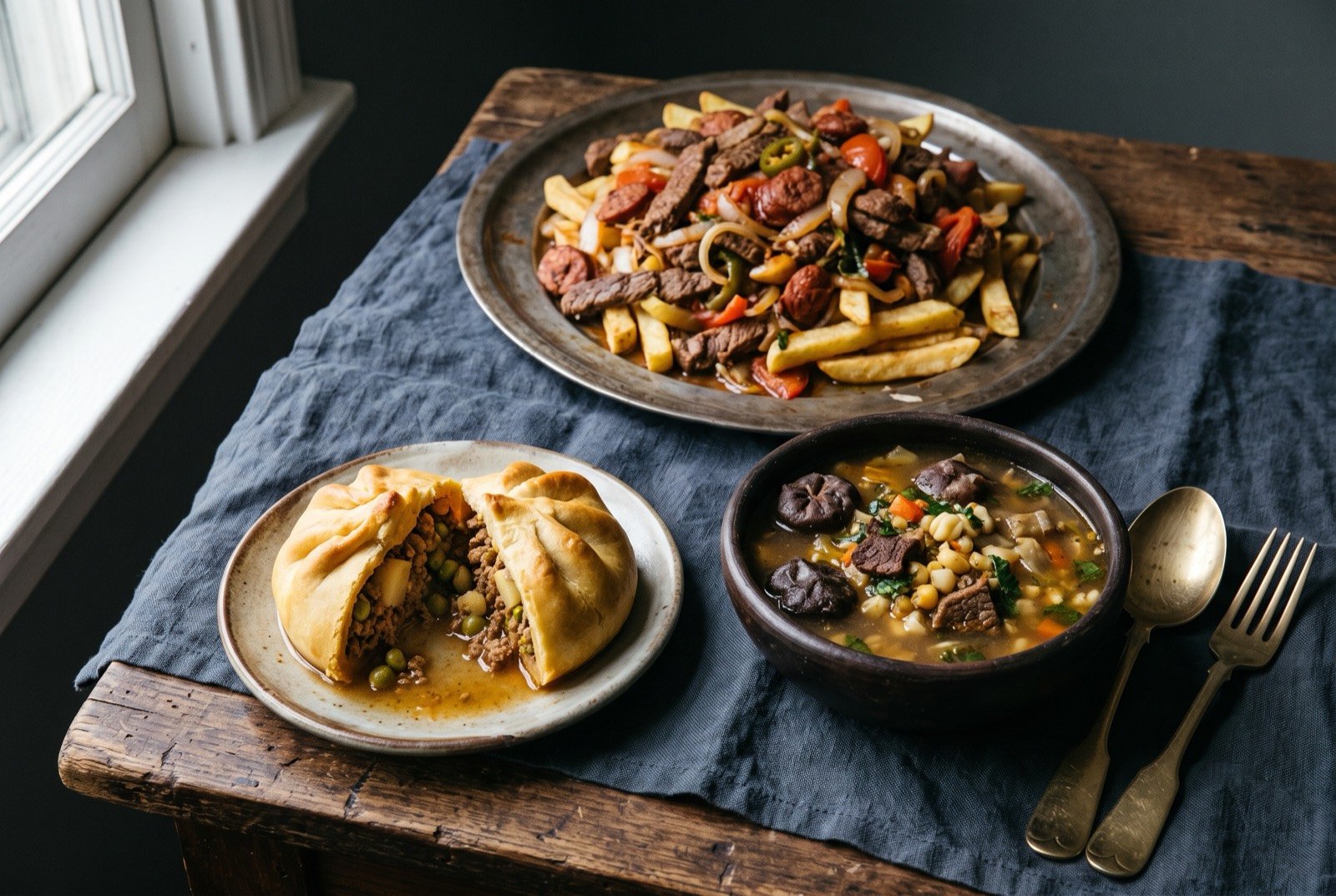
A country built on altitude and answering to two grammars at once. Above 3,600 metres, La Paz and El Alto speak Aymara and cook in preserved potato, frozen and dried on the same diurnal swing that once fed Potosí's silver mines. Two thousand metres lower, Cochabamba and its valleys speak Quechua and cook in fresh and fermented maize, in a landscape wet and warm enough to be called the granary of the whole country. Both worlds were shaped less by the modern Bolivian border than by the Inca state before it and the mining economy after it, and this volume treats them as one country with two kitchens rather than one kitchen with regional variations. Every dish as tradition built it, then what a modern chef would change.
Sources and review · What this chapter does not assert · How we research · Spotted something wrong?
A Sense of Place
Two grammars on one spine of altitude
Bolivia's Andean core runs, roughly, coast to interior in reverse: not a coastline at all, but a spine of altitude falling from the Altiplano's 3,600 to 4,150 metres down through Cochabamba's valleys at 2,500 to 2,800 metres to the wetter, lower interior beyond. La Paz and its twin city El Alto sit on the high side of that spine, in the Aymara-speaking world; Cochabamba sits on the lower side, in Quechua-speaking country. Neither language, nor either kitchen, respects the modern Bolivia-Peru border, which is why this volume's own chairo shares real ground with a Peruvian high-Andes volume this atlas has not yet written, and why it is worth saying plainly at the outset: the ecology and the ethnicity organise this book, not the frontier.
No single source states the fat, thickener, aromatic and starch logic of either kitchen as a formula, so the table below is this chapter's own synthesis from individually sourced facts, not a quotation.
| Element | The Altiplano: La Paz and El Alto | The Valleys: Cochabamba and beyond |
|---|---|---|
| Starch | Potato, above all preserved as chuño and tunta; quinua real from the Uyuni-Coipasa salt-flat zone | Fresh and fermented maize: choclo, mote, chicha; potato remains present but shares the plate |
| Fat | Untu, llama fat, documented mainly in ceremonial use; lard and rendered pork fat in the urban kitchen | Rendered pork fat, the base of chicharrón cochabambino's own cooking method |
| Aromatic | Llajwa, ground locoto and tomato with quirquiña or huacataya | The same llajwa family, plus ají colorado and ají amarillo built into stewed sauces |
| Everyday protein | Charque (dried llama or beef), lamb, beef, chicken | Pork, beef, chicken, with the valley's own fresh-slaughter urban butcher trade |
La Paz and El Alto, the Aymara city and its industrial twin
El Alto was formally founded as a city on 6 March 1985, though its central La Ceja district was organised from 1945; it grew from pastureland into what one Bolivian source calls the stronghold of the country's new Aymara bourgeoisie and its industrial motor, manufacturing running at roughly 15.8% of its economy. It sits directly above La Paz on the Altiplano's rim, and the two cities function as one urban system split across two altitudes, La Paz in the bowl, El Alto on the plateau above it. An academic piece in the journal Nueva Sociedad describes Aymara popular traders negotiating global economy processes from their own history and forms of relationship, a useful corrective to any account of El Alto that treats it only as poverty rather than as the genuine commercial power its own scholars describe. Street food here is organised enough to be certified: over 100 vendors from 25 micro-enterprises across La Paz and El Alto have been certified through the "SUMAQ" tourism and gastronomy programme, with a dedicated tourist circuit through both cities.
Cochabamba, the granary and the culinary capital
Cochabamba Department's name comes from Quechua, roughly "lake plain," Qhochapampa. It is popularly called the granary of Bolivia for its fertility and agricultural range between the Altiplano and the eastern lowlands, and the Valle Alto specifically, covering Punata, Cliza and Tarata, sits at 2,550 to 2,800 metres, receiving only 380 to 480mm of rain a year and relying on irrigation built up across generations, agro-pastoral and maize-dominant, its sales concentrated in weekly provincial fairs, above all at Punata.
Cochabamba's reputation as Bolivia's culinary capital, La Llajta, is worth stating precisely rather than romantically: it is a modern, dated recognition, not an ancient claim. Multiple Bolivian outlets record that the city was formally recognised as "capital gastronómica de Bolivia" in 2011, for its customs and the sheer variety of its dishes. What sits underneath that 2011 recognition is genuinely old: La Llajta is itself a Quechua-Aymara nickname tied to the city's status as an important huaca, a sacred site, within Inca-era regional organisation, and the maize agriculture that made Cochabamba a granary in the first place long predates any tourist-board title.
An organising distinction worth keeping in view
Altitude and language track each other closely across this volume. Charque, the dried meat of the mining camps, belongs to the Altiplano by production and by the departments where it is still eaten, Oruro, La Paz and Potosí, yet it turns up on Cochabamba's own plates as charquekán, carried down by trade and migration rather than grown there. Trancapecho and sopa de maní run the opposite direction: both are documented Cochabamba inventions that have since spread up into La Paz and El Alto's street-food economy, and this chapter treats them as Cochabamba dishes with a later Altiplano life, not as native to the Altiplano. Where a dish crosses the line, it is named as a crossing, not silently assigned to whichever region asked for it.
The History in Layers
The Inca state and the maize colony
Cochabamba's maize table is not an ecological accident. Under the Inca, the valley was substantially depopulated of its original inhabitants and repopulated with mitimaes, transplanted colonist-labourers, and mitayos, corvée labourers, organised into state farms dedicated overwhelmingly to maize, the crop the Inca state prized but which cannot be grown at the Altiplano's higher elevations. The surplus was stored in an estimated 4,000 qollqas, granaries; the labourers who grew it received back only the poorest maize, plus small marginal plots of their own. This is documented, academically sourced history, drawn from Spanish colonial administrative records rather than a folk assumption of unbroken ancient continuity, and it is worth stating exactly that way: Cochabamba's maize identity was built by a state that extracted the best of it elsewhere.
Potosí, the mountain that ate itself, and the food that fed it
Cerro Rico's silver drove a colonial city that reportedly rivalled major European capitals in population, an estimated 120,000 people in the 1570s, rising to 160,000 by 1610. The mita, the colonial forced-labour system, conscripted 12,000 indigenous workers a year, drawn in three seasonal groups of 4,000, and alongside the labourers themselves, distinct groups of indigenous traders specialised in supplying the city with fuel and with food. Two things this chapter can trace directly to that economy, one a technique and one a spirit of place.
Kalapurka. Multiple Bolivian sources describe it as born from miners' need for a hot, fast meal in the frozen dawns around Cerro Rico, a heated volcanic stone dropped directly into a bowl of broth because building and tending an open fire was impractical in that terrain. Careful sources, citing the linguist Rodolfo Cerrón-Palomino, favour an Aymara derivation for the name, qala, stone, plus phurk'a, to roast or singe, over a purely Quechua one, though it is also glossed in Quechua as "boiling stone." Regional cousins exist across the border in Chile and Argentina as calapurca, a reminder that this too is a shared Andean form rather than a Bolivian exclusive.
El Tío. The horned, red-clay figure who is said to guard the interior of the mine is found nowhere else in Latin American Catholic tradition, described by scholars as a hybrid of the Andean Supay and the European devil. Miners make regular offerings, cigarettes, alcohol, coca leaves, so that the mine will not collapse that day; at larger festivals the offering expands to abundant food, ch'alla, the ritual sprinkling of alcohol for better veins, and t'ikanchada, the decoration of work areas with confetti. A peer-reviewed academic account of the cult exists, and this chapter treats El Tío as living devotional practice, not folklore staged for visitors.
The 1781 siege and the two dishes it is said to have produced
Plato paceño and chairo are both traced by Bolivian sources to the 1781 siege of La Paz, led by Túpac Katari and Bartolina Sisa, which lasted over three months. As food ran short inside the city, the mayor, Sebastián Segurola, is said to have ordered nearby hacienda owners to bring in whatever provisions they had, and the improvised combination that resulted, choclo, habas, potato, cheese, is presented as plato paceño's origin. The addition of beef, and the later shift from sheep's or llama cheese to cow's cheese, is dated to the 19th century, and at least one Bolivian source flags this specific detail as "not fully accepted," a useful reminder that even a story this settled in popular memory carries a part that local historians themselves treat as unresolved. Chairo's own popularisation in the city is tied by sources to the same siege, framed as a fusion of Aymara and Spanish cooking that became emblematic over the following two centuries. An alternative, thinner theory derives plato paceño instead from apthapi, the communal shared-food spread; this chapter could not verify it further and does not assert it.
The salteña: an empanada with a disputed mother, and Bolivia's best-documented culinary argument
The popular story credits Juana Manuela Gorriti, an Argentine writer born near Rosario de la Frontera, Salta province, who fled to Bolivia with her family from the Rosas dictatorship. Per the traditionalist writer Antonio Paredes Candia, the family sold empanadas in Potosí or Sucre using a recipe from home, and "the women from Salta's empanadas" became, in time, salteñas. Paredes Candia is credited with the line that the salteña is the empanada of infidelity, "if you don't believe it, just look at its shape."
This chapter does not repeat that story as settled, because two named Bolivian historians have checked it and rejected it. Beatriz Rossells, a Sucre-born historian with a doctorate from the Universidad Central de Venezuela, a researcher at the Universidad Mayor de San Andrés's Institute of Bolivian Studies, and the author of La gastronomía en Potosí y Charcas: siglos XVIII, XIX y XX, examined Gorriti's own published cookbook directly and found that none of the three recipes attributed to her contain ají or papa, "the specific components of Bolivian empanadas." The writer Ramón Rocha Monrroy independently states that the Gorriti recipes "have nothing to do with Bolivian empanadas." Rossells' own strongest positive evidence points elsewhere entirely: the "Libro de cocina de doña Josepha de Escurrechea," dated 1776 and, by her account, the oldest colonial-era cookbook found anywhere in Bolivia, which shows an empanada with caldo already established in Potosí by that date, its potosino cooks folding distinctively American ingredients, papa, ají, into a Spanish pastry form. She calls it plainly "the only colonial recipe book found in Bolivia and the entire region." A rival, less corroborated theory names a different Salta-born woman, Corina Pueyrredón, selling empanadas in Potosí around 1830, and the chef Francisco Aguirre dates a proto-salteña earlier still, to before 1640.
No source in this chapter's research settles the matter outright, and this chapter does not try to either. What can be said honestly: the Gorriti connection is a widely repeated popular etymology that the two historians who actually checked the primary evidence, Rossells and Rocha Monrroy, reject, while the documented 1776 cookbook points to Potosí itself, well before Gorriti's own arrival in Bolivia in the 1830s, as the place where an empanada took on its papa-and-ají Bolivian character. The Gorriti family's own empanadas, sold using a genuinely Salta recipe rather than a Bolivian one, are presumably the seed of the later conflation between the two, and that Salta recipe is a real dish in its own right, Argentina's own empanada salteña, treated in full in this atlas's Argentina and Uruguay volume (AM-25) as the Northwest's own jugoso, wet-filled empanada, a separate dish from Bolivia's salteña rather than its ancestor.
Two dishes to correct against an easy assumption: trancapecho and sopa de maní
Trancapecho is documented consistently as a Cochabamba invention, created by a named vendor, doña Ana "Anita" Camacho, at a stall near Heroínas Avenue and Baptista street, its name drawn from students telling her esto tranca, tranca el pecho, this fills you right up. It belongs with this volume's Cochabamba dishes, not its Altiplano ones, whatever life it has since found in El Alto's markets. Sopa de maní, similarly, traces to a likely Chuquisaca origin as a variant of cazuela de maní, now eaten widely in Cochabamba, with no record placing it before the 19th century; in 2018 a legislative proposal sought to declare it Bolivia's national flagship dish. Neither is documented here as native to La Paz, and this chapter has kept both out of its own Altiplano section accordingly.
Fricasé paceño, a French dish remade in ají
Fricasé emerges, per multiple sources, in the late 19th century, a French dish adapted by paceña cooks with pork, black and white chuño, potato, mote, and considerably more ají colorado than its French original ever carried. The La Paz municipal government declared it Cultural Patrimony in 2014, tied to the city's own festive calendar, and it is widely eaten as a remedy the morning after a night of chicha. It is, among the dishes in this chapter, the clearest case of the reverse of this atlas's usual argument: not an indigenous technique waiting to be elevated, but an imported dish that a Bolivian kitchen made unmistakably its own by the simple, decisive act of adding more chile than the original recipe would have allowed.
The Flavour Arsenal
Chuño and tunta. Fresh potatoes are carried to flat highland ground, chuñunapampa, around mid-June, above 3,800 metres, where night temperatures fall to around minus 5°C. The potatoes freeze overnight and dehydrate under intense daytime sun, up to around 18°C, across a cycle that runs roughly 20 days in total: harvest, selection, laying out for frost, freezing, treading barefoot to press out water and remove the skins, sun-drying over several days, and storage. What results is chuño negro, black chuño. Tunta, also called moraya, is a further-processed variant: after the same freeze-and-press cycle, the black chuño is washed for around seven days in cold running water until it whitens through. This is freeze-drying by sublimation, achieved without a machine, using nothing but the Altiplano's own diurnal temperature swing and its thin, dry, high-UV air as the engine.
Charque, from Aymara ch'arkhi. Dehydrated meat from inspected animals, llama or beef, cut into fillets roughly 1cm thick after deboning and defatting, salted at roughly 0.5 to 15g of salt per kilogram of meat, rested 12 to 24 hours for the salt to penetrate, then dried on cords exposed to sun by day and frost by night, down to around minus 5°C. In colder Altiplano zones, less salt is used and the same product is instead called chalona. The finished meat runs to a water activity of 0.87 to 0.91, total moisture 44 to 45%, its pH rising 0.6 to 0.8 units over fresh meat, together giving it multi-year shelf stability at ambient temperature; drying concentrates the protein from roughly 24.8% raw to around 45% by weight. Oruro is named as Bolivia's main production centre.
Quinua real. Grown specifically in the Uyuni and Coipasa intersalar zone of Oruro and Potosí, at around 3,600 metres, a large grain with comparatively low saponin content. Named varieties include Real Blanca, Toledo, Pisankalla, red-to-brown grained, and Chiara, black grained. A comparative nutritional study found Bolivian-grown quinua real carries higher fibre and mineral content than quinoa grown in eight other countries, attributed to seed handling, soil and the intersalar environment itself.
Locoto, and why it is not the same claim as rocoto. Locoto and rocoto are the same species, Capsicum pubescens; the two names are regional rather than distinct varieties, though real genetic and morphological diversity exists across the plant's range. The etymology tracks language rather than nationality: rocoto from Quechua, rukutu, locoto from Aymara, luqutu. The species' likely centre of origin sits in central-western Bolivia, in the highlands around La Paz, a fact worth stating plainly against any instinct to treat rocoto as the original and locoto as a variant on it. The chilli itself does not tolerate frost and grows best in cloud-forest, yungas conditions, meaning it is carried up into Altiplano cooking from lower altitude rather than grown on the Altiplano itself. Its principal use here is llajwa, ground with tomato and quirquiña or huacataya.
Singani, and its real distinction from pisco. Vines reached Bolivia via missionaries from Peru around 1550, first tested in a valley called Sinkani, in Nor Lípez province, Potosí, the claimed source of the spirit's name. Cultivation reached Tarija in 1584, and production later shifted there for lower cost; Tarija is now Bolivia's largest grape producer. Singani has held Denominación de Origen and Geographical Indication status since Law 1334 of 4 May 1992, which reserves the name exclusively for spirits produced in specified Bolivian regions to defined standards: made exclusively from Moscatel de Alejandría grapes, where Peru's pisco law permits eight varieties; grown at a minimum of 1,600 metres; rested a minimum of six months against pisco's three, both in neutral vessels; each spirit confined to production within its own country's own defined zones. The flavour runs fruity and floral, stone fruit, spice and grass, with an emphasis on freshness over ageing.
Papa lisa, oca and isaño. High-Andean tubers documented by PROINPA, a serious Bolivian agricultural research foundation, as forming the biological basis of food security for farming communities settled between 3,000 and 3,800 metres; papa lisa specifically is drought-tolerant but will not take excess moisture.
Maize, and a correction worth making plainly. Cochabamba is Bolivia's principal producer of white maize for human consumption and holds the country's greatest maize genetic diversity; the Pairumani eco-phytogeographic centre in the department holds over 1,500 maize accessions. The valley's own named white varieties are harinoso del valle, used for choclo, waltaco, also called palta-hualtaco, used for mote, plus local variants precoz, kulli, morochito and chicjchi and a named improved variety, Aychasara 101. "Maíz blanco gigante," the giant white corn sometimes assumed to belong here, is in fact a documented Peruvian varietal from Cusco, and this chapter has not used it to describe Cochabamba's own corn.
Chicha de maíz. Traditional production centres, all Cochabamba valley towns: Tarata, Cliza, San Benito, Arani, Punata, Aiquile. Two production methods are documented. The older, now largely discontinued, involves masticating the maize so that saliva enzymes convert its starch to sugar before bacterial fermentation takes over, the whole batch stored a month in sealed clay vessels. The modern method sprouts the maize instead: grain is spread on cloths with water until it roots, wiñapu, then ground to powder, mixed with water into a paste, sun-dried, and stored in the same sealed clay vessels, its alcohol content depending on how long it ferments there and its colour on which maize variety was used, running to roughly 8% ABV. Three named varieties are used: maíz amarillo, qulli, chullpy, out of 77 documented maize varieties in Bolivia altogether. The Inca-era name is aqha in Quechua, k'usa in Aymara, renamed chicha by Spanish colonisers; the tradition is said to span over 1,500 years and sat at the centre of the Inca ritual calendar, particularly the summer solstice. Chicherías are marked by a white flag on a mast outside, and chicheras, the women who make and sell it, are named directly by Bolivian sources as holding real economic and technical power in the trade, not a decorative role within it.
Chicha's decline is real and this chapter states it rather than romanticising the tradition instead. Bolivian press in 2024 named five factors driving production down; in Tarija specifically, coverage from 2019 describes the drink as at genuine risk of disappearing, citing loss of maize supply, contraband alcohol competition, drought and rural migration. A 2021 initiative, Chicha Taquiña, an industrial brewer sourcing from smallholders across 15 municipalities, is documented as attempting to revive traditional maize cultivation on economic rather than sentimental grounds.
Coca leaf. Acullico, or akhulli in Aymara, holding coca leaves in the cheek with bicarbonate or lye, llujt'a, is described as practised by Andean peoples for roughly 8,000 years; Bolivian Law 864, December 2016, declared the practice Intangible Cultural Heritage of the Plurinational State. Two legal coca markets operate in the country, one in La Paz, one in Sacaba, Cochabamba. Coqueo is used specifically for high-exertion work and to reduce soroche, altitude sickness, hunger and fatigue, a use this chapter states factually and without moralising, and without independently verifying the specific physiological mechanism sometimes attributed to it.
Quesillo, and Cochabamba's own valley cheese. A small fresh cheese made from raw cow's milk, coagulated with pepsin and acid to a maize-kernel-sized curd, dry-salted and hand-formed, rested two to three hours before eating, crumbly rather than melting. Queso criollo cochabambino specifically remains largely a household product, made from a family's own cow's milk historically for self-consumption or barter, sold today mainly through informal market channels rather than industrially. Its clearest named dish use is solterito, a Valle Alto salad of julienned onion, diced tomato and locoto crumbled through with quesillo.
The Technique Ladder
The argument, from inside
Five techniques, each explained by why it works, not only by what it does.
Rung 1. Chuño and tunta's freeze-dry cycle
Detailed in full above: a roughly 20-day sequence of nocturnal freeze and daytime sun-dehydration at above 3,800 metres, with a barefoot treading step to press water and skin from the tuber. The chemistry is genuine sublimation, ice converting directly to vapour under the Altiplano's thin, dry, intensely sunlit air, and it is a controlled, multi-day industrial process developed centuries before any European freeze-drying technology, doing by climate what a modern lyophiliser does by vacuum pump.
Rung 2. Charque's salt-cure and air-dry
Thin-cut, lightly salted meat dried on cords through the same freeze-by-night, sun-by-day cycle, reaching a water activity low enough, 0.87 to 0.91, for genuine multi-year ambient storage. The salt ratio here, 0.5 to 15g per kilogram, is precise enough from the source that it translates directly into a home dehydrator without guesswork.
Rung 3. Kalapurka's hot-stone boil
A heated volcanic stone, plunged directly into a bowl of broth, brings the liquid to a hard, immediate boil without needing sustained fire, a genuine engineering solution to cooking fast and hot in terrain where building and tending an open flame was the harder problem. The stone's thermal mass does in seconds what a burner does over minutes.
Rung 4. The confit-then-render of chicharrón cochabambino
Pork skin is simmered five to six hours until soft; separately, the meat itself is set in a pot with water to cover, salted and seasoned, then cooked over high heat until every drop of that water has evaporated, at which point the meat begins, in effect, to fry in its own rendered fat, stirred constantly so it browns rather than catches. It is a genuine two-stage technique, poach then render, arrived at independently of any French confit tradition.
Rung 5. Silpancho's continuous-crumb pounding
A trimmed beef fillet is seasoned, coated in breadcrumbs and pounded thin, with fresh crumbs worked in continuously through the pounding rather than added once at the start, which is what stops the meat tearing as it flattens toward a large, delicate escalope. It is a precise piece of mechanical technique for a dish whose name literally means "flattened."
Rung 6. Altitude, the constraint every technique on this ladder answers to
In La Paz, at roughly 3,600 metres, water boils at around 85 to 88°C rather than 100°C, falling roughly 1°C for every 300 metres of elevation gained. Boiling and simmering both take substantially longer as a result, rice reportedly needing up to 40 minutes rather than 18 to 20, which is the practical, unglamorous reason pressure cookers are a standard fixture of Andean kitchens: they restore the higher effective cooking temperature altitude otherwise takes away. This is not a technique to romanticise so much as the single environmental fact that made every other technique on this ladder necessary in the first place.
The Ferment and Preserve Bench
Three genuine preservation technologies, none a modern flourish.
Chuño and tunta. Covered in full above: a roughly 20-day freeze-and-sun-dry cycle above 3,800 metres, producing a potato that keeps for years rather than months. Tunta's further week of running-water washing is a second, distinct preservation stage layered onto the first, not a cosmetic finish.
Charque and chalona. Salt-cured, air-dried meat, reaching a water activity of 0.87 to 0.91 for genuine multi-year ambient shelf stability, the salt ratio and drying cycle precise enough from Bolivian academic sourcing to translate directly into a home dehydrator.
Chicha de maíz. A month-long clay-vessel fermentation, either from the older masticated-starch method or the modern sprouted-grain wiñapu method, producing a roughly 8% ABV maize beer with a documented history running to over 1,500 years and a central place in the Inca ritual calendar.
Sourcing in Britain
The single fact that shapes this whole section. There is no dedicated Bolivian grocery retailer in the UK. Direct Bolivian-branded sourcing is confirmed for exactly one product, singani. Everything else routes through Peruvian and Andean grocers whose stock happens to overlap with Bolivian highland cooking, because the ecology and the dish vocabulary, chuño, cancha, ají, habas, are genuinely shared across the Peru-Bolivia altiplano, not because anyone is stocking for Bolivia specifically. This chapter states that plainly rather than implying a Bolivian retail presence that does not exist.
Chuño and tunta. Confirmed via El Inti, The Peruvian Shop, `peruvian-grocery-shop.com`: White Chuño Tunta Moraya, El Plebeyo, 500g, £3.84, the product name itself bundling chuño, tunta and moraya as regional synonyms. El Inti is Paris-headquartered but ships to the UK and Ireland; no UK-based retailer stocking chuño was found, so this is the only confirmed route.
Quinua real. Confirmed and genuinely distinguished from generic quinoa, though via wellness retailers rather than food specialists: Suplments.co.uk stocks Quinua Real White Royal Quinoa, 500g, €6.30, its own product page naming cultivation "near the largest salt desert in the world, the Salar de Uyuni." Naturitas.co.uk lists a Bolivian royal quinoa product too, though its page could not be directly confirmed and should be treated as probably rather than definitely available.
Charque. Not found, and a genuine gap. No UK retailer, Peruvian grocer or specialist butcher sells charque, charqui or any llama or alpaca meat product; llama meat has no approved import route into the UK and is not a category any retailer here stocks. A US-based Bolivian shop exists online but does not ship to Britain. The honest substitute is British biltong or home-dried beef charqui, since the salt-cure-and-air-dry technique transfers directly even where the animal cannot.
Locoto. Confirmed available as seed, for growing, not as fresh or dried fruit for cooking now. South Devon Chilli Farm and Sea Spring Seeds both stock Capsicum pubescens under the name rocoto rather than locoto, the same species and fruit either way. No UK retailer was found selling the pod itself, fresh or dried, so a reader wanting this pepper for a dish next week cannot buy it; they can only grow it for a future season.
Singani. The one genuinely Bolivian-branded product with a real UK retail presence. The Whisky Exchange stocks Singani 63, 75cl, 40% ABV, at roughly £31 to £34; Gerry's Wines & Spirits in Soho stocks the same bottling at £42.50. Every UK listing found is for Singani 63, the Steven Soderbergh-backed Casa Real bottling, effectively the only Bolivian singani with international distribution, so UK availability here is genuinely single-brand.
Ají amarillo and ají panca, as a substitute for Bolivian chilli pastes. No Bolivian brand exists on UK shelves; Peruvian brands, chiefly Chatica, stocked both at El Inti and Sous Chef UK, are the realistic and well-stocked route, the pepper and its culinary use overlapping almost entirely between the two countries' cooking even where the branding does not.
Habas, cancha and yuca. Plain dried habas for cooking are better sourced generically, from Sous Chef UK's plain dried broad or fava bean, or a Turkish or Middle Eastern grocer's ful, than from any Andean-branded product, since El Inti's own "habas" listing is a salted snack rather than a cooking ingredient. Cancha, maíz blanco corn nuts, is strongly stocked at El Inti in three forms, ready-to-eat, raw for home toasting, and a grilling variety, all Peruvian-branded but the same corn used identically in Bolivian cooking. Yuca is no problem at all, fresh and frozen at Tesco and Sainsbury's and at African and Caribbean grocers nationwide.
Bolivia's own restaurant presence in Britain, real but small. Concentrated on Old Kent Road, Southwark, in south east London. Jenecheru London, 206 Old Kent Road, runs a full Bolivian menu under chef Edela Quenta, salteñas, pollo a la canasta, chicharrón de cerdo, sopa de maní, api con pastel for breakfast. Salteñas Martin, also on Old Kent Road, has specialised in salteñas specifically since 2006 and predates Jenecheru as the area's Bolivian food fixture. No Bolivian grocery shop, as distinct from these restaurants, exists anywhere in the UK, a genuine and notable gap this chapter states directly rather than papering over.
The single decision that matters most. Real Bolivian chuño and tunta over any European freeze-dried potato substitute is what lets chairo and fricasé taste of the Altiplano rather than of a generically thickened stew, and El Inti is presently the only confirmed UK route to either. On the valley side, the equivalent decision is queso criollo or a genuine crumbly Latin fresh cheese over a UK supermarket feta or paneer substitute, since it is the one ingredient that lets silpancho's salsa and solterito read as Cochabamba cooking rather than as a generic Latin plate.
Voices and Sources
Bolivian national and regional press, the backbone of this chapter's factual sourcing: Los Tiempos and Opinión for Cochabamba, El Deber and eju.tv for Santa Cruz, El País and Verdad con Tinta for Tarija, Correo del Sur for Sucre and Chuquisaca, El Potosí, Página Siete, La Razón, Ahora El Pueblo and Red Uno more broadly, plus BO-Bolivia Emprende, Economy.com.bo, Ruta 1825, Visión 360 and Unitel for the contemporary restaurant scene.
Beatriz Rossells, Sucre-born historian, doctorate from the Universidad Central de Venezuela, researcher at the Universidad Mayor de San Andrés's Institute of Bolivian Studies, author of La gastronomía en Potosí y Charcas: siglos XVIII, XIX y XX, winner of a 2002 Spanish Academy of Gastronomy prize, is this chapter's single strongest named authority, for the salteña's disputed origin above all. Ramón Rocha Monrroy, writer, independently corroborates Rossells' rejection of the Gorriti story. Fundación PROINPA, a serious Bolivian agricultural research body, is the strongest source for this chapter's tuber and maize material.
Modern elevation. Claus Meyer, co-founder of Noma, founded Gustu in La Paz in 2012 around a "kilometre zero" manifesto using only Bolivian ingredients, alongside the Manq'a cooking-school network training young cooks across El Alto. Kamilla Seidler, Gustu's founding head chef, has described her own approach there as "a new Bolivian cuisine similar to an early New Nordic movement," an honest admission worth keeping in view: Bolivian fine dining's own founding chef named her method partly as an import before Bolivian chefs themselves took over the kitchen. Marsia Taha Mohamed, who ran Gustu's kitchen from 2013 to October 2024 before opening her own restaurant, Arami, with sociologist and sommelier Andrea Moscoso Weise, is this chapter's clearest voice on what gets lost: "We've been ignoring Bolivian produce and turning to imported products... these are ancient techniques, but we're losing them. It's our role as chefs to tell their story and make them a source of pride." Taha's own Sabores Silvestres project, founded 2018 with the Wildlife Conservation Society, has worked with over 50 Indigenous Amazonian communities to document ingredients now finding their way onto La Paz's best tables. Sebastián Quiroga's Ali Pacha, trained through the same Gustu lineage, runs Bolivia's only vegan tasting menu on entirely Bolivian ingredients.
On diaspora restaurants in Britain: Jenecheru London and Salteñas Martin, both on Old Kent Road, are this chapter's two best-attested Bolivian restaurants in the UK. No serious diaspora fine-dining figure comparable to Gustu or Arami's domestic standard was found anywhere abroad in this chapter's research, a real and stated asymmetry with, for instance, Peru's international standard-bearers, not a gap in the research itself.
Things this chapter has deliberately not asserted
- That the salteña descends from Juana Manuela Gorriti's own Salta recipe. Two named Bolivian historians who checked the primary evidence, Beatriz Rossells and Ramón Rocha Monrroy, reject this popular story; this chapter states the dispute and the documented 1776 Potosí cookbook evidence rather than choosing the popular version.
- That plato paceño contains chuño. Every source found for this chapter names fried beef, fried cheese, choclo, potato-in-skin and habas-in-skin, with no chuño among them; an earlier working assumption behind this volume's own scoping notes said otherwise, and this chapter has not carried that assumption forward.
- That chairo belongs exclusively to Bolivia, or exclusively to Peru. Both countries' Aymara and Quechua communities cook a version of this soup, and no source found in this chapter's research directly engages the cross-border question; this chapter treats the dish as shared, following the atlas's own culinary-region logic, ecology and ethnicity over border, rather than as belonging first to whichever volume of this atlas happened to be written first.
- That trancapecho or sopa de maní are native to La Paz or the Altiplano. Both are documented Cochabamba inventions with named or reasonably dated origins there; any presence they have in El Alto's markets today is treated in this chapter as later migration, not origin.
- That "maíz blanco gigante" describes a Cochabamba corn variety. That is a documented Peruvian varietal from Cusco; Cochabamba's own named white maize varieties, harinoso del valle, waltaco and others, are used instead.
- That keperí is traditionally made with lamb, as an earlier scoping assumption behind this volume held. Sources found in researching this chapter describe it inconsistently, sometimes beef, sometimes pork, and no credible in-tradition recipe with real quantities was found for any version; this chapter has not included keperí among its twice-given dishes as a result, rather than guess at a recipe no source actually gives.
- That any named UK shop keeps confirmed, checked stock of fresh or dried locoto pods, as against locoto seed for growing. Seed availability was confirmed at two specialist nurseries; the fresh or dried fruit itself was not confirmed anywhere in the UK, and this chapter says so rather than implying otherwise.
- That Bolivia is currently covered by the Michelin Guide, or that it is not. This chapter's own research could not confirm either claim with a fresh search and has stated the uncertainty rather than asserting an unverified negative.
- That api con pastel's pairing of purple-corn drink and fried pastry has a documented origin story or settled history. This chapter's research found only contemporary event coverage, no food-historical account, and has described the dish without inventing a history for it.
- That any single named Cochabamba or Santa Cruz restaurant is doing modernist Bolivian cooking comparable to La Paz's Gustu, Arami or Ali Pacha. This chapter's research is genuinely La Paz-centred on the contemporary scene, and it says so rather than implying a Cochabamba or Santa Cruz equivalent that this research did not find.
Chuño and tunta's freeze-dry cycle
Detailed in full above: a roughly 20-day sequence of nocturnal freeze and daytime sun-dehydration at above 3,800 metres, with a barefoot treading step to press...
Charque's salt-cure and air-dry
Thin-cut, lightly salted meat dried on cords through the same freeze-by-night, sun-by-day cycle, reaching a water activity low enough, 0.87 to 0.91, for...
Kalapurka's hot-stone boil
A heated volcanic stone, plunged directly into a bowl of broth, brings the liquid to a hard, immediate boil without needing sustained fire, a genuine...
The confit-then-render of chicharrón cochabambino
Pork skin is simmered five to six hours until soft; separately, the meat itself is set in a pot with water to cover, salted and seasoned, then cooked over high...
Silpancho's continuous-crumb pounding
A trimmed beef fillet is seasoned, coated in breadcrumbs and pounded thin, with fresh crumbs worked in continuously through the pounding rather than added once...
Altitude, the constraint every technique on this ladder answers to
In La Paz, at roughly 3,600 metres, water boils at around 85 to 88°C rather than 100°C, falling roughly 1°C for every 300 metres of elevation gained.
The dishes
- Salteña Potosí, Bolivia
- Chairo paceño La Paz, Bolivia
- Plato paceño La Paz, Bolivia
- Fricasé paceño La Paz, Bolivia
- Pique macho Cochabamba, Bolivia
- Silpancho Cochabamba, Bolivia
- Chicharrón cochabambino Cochabamba, Bolivia
- Charquekán Oruro, Bolivia
Sources and review
- Researched
- No outside sources linked
- Reviewed
- Not yet reviewed from inside the tradition
- Cooked
- Not yet cooked and reported
Where this volume comes from
3 research briefs on file for this volume, researched to the rules on How we research. Published 3 September 2026. Last changed 8 September 2026.
The brief's own account of its sources
La Paz/Altiplano pass: roughly 55 to 60% of sources are Bolivian-published (Página Siete, El Deber, La Razón, Correo del Sur, El Potosí, Los Tiempos, Opinión, Ahora El Pueblo, La Patria, Publiagro, PROINPA, ABI, Cervantes Virtual, Bolivian municipal/tourism pages), against roughly 40 to 45% Western-secondary or generalist material (Wikipedia in English and Spanish, Bolivian home-recipe aggregators used only where no stronger source existed, one Mexican gastronomy site for the chuño process).