The Americas · Volume 28
Arctic and Subarctic Foodways
The Marine-Mammal Coast and the Caribou Interior
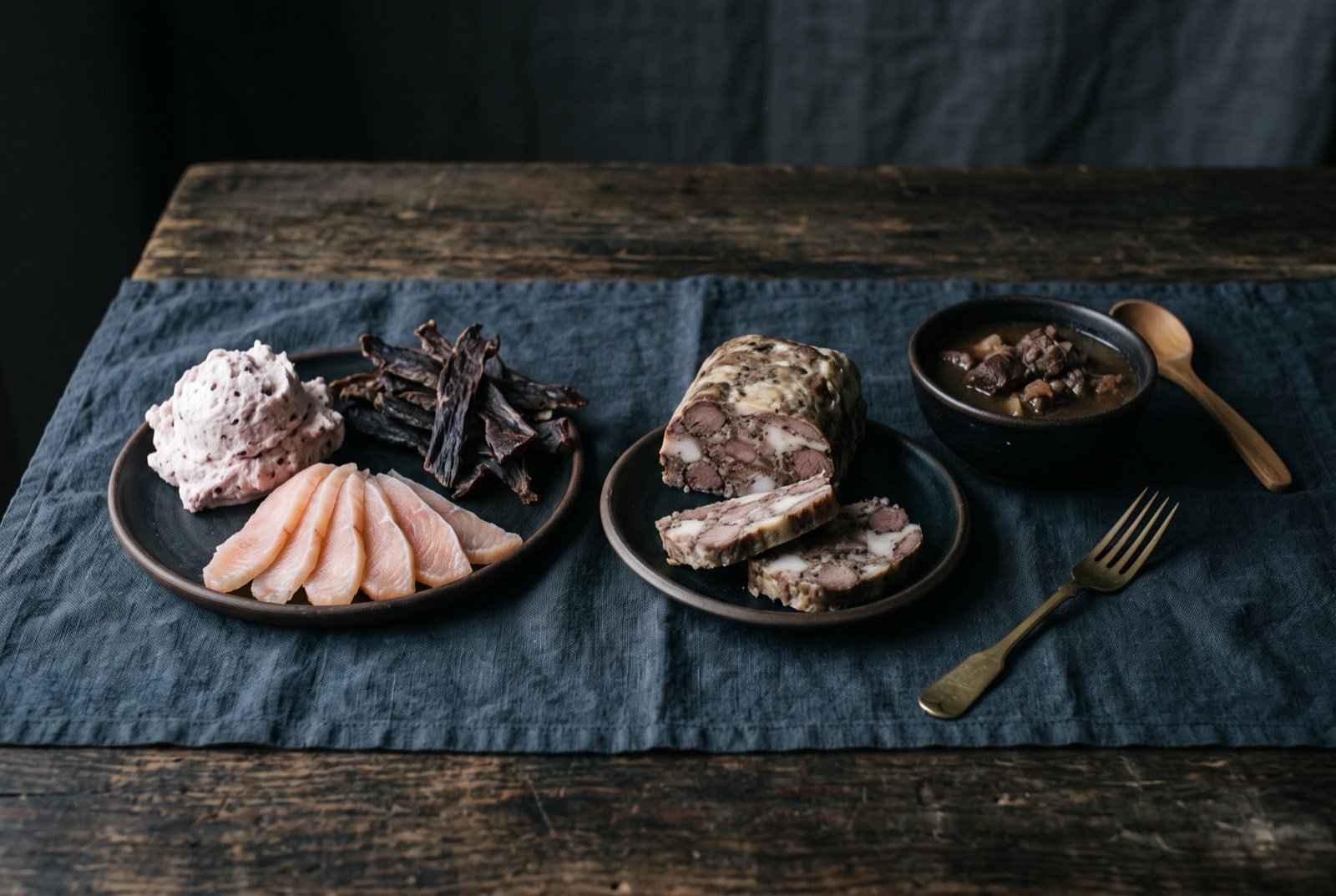
The Americas volume turns here to North America, and it begins deliberately with Indigenous foodways rather than the settler and immigrant cuisines that follow, because the argument this atlas keeps making, that ecology decides a food world before any border does, has nowhere it holds more completely than here. This is a world with no agriculture whatsoever: no wheat, no rice, no potato, nothing planted and harvested, only what is hunted, fished, trapped and gathered from tundra, sea ice and boreal forest. It is also, this chapter argues carefully rather than assumes, not one food world but two. Along the Arctic coast, Inuit, Iñupiat and Yupik peoples built a cuisine on the sea: seal, walrus, whale, char, eaten raw and frozen, fermented in permafrost, rendered for fuel and food together. Inland, across the boreal forest and taiga of the Northwest Territories, Yukon and interior Alaska, Dene and other Athabaskan peoples, above all the Gwich'in, built an entirely different cuisine on the land: caribou, moose, freshwater fish, dried and rendered rather than fermented and eaten raw. The two share a climate and, from a great distance, a reputation. They do not share a larder, a technique, or in any deep sense a history. Every dish here as tradition built it and then with a chef's changes where the sourcing genuinely supports them, and given honestly as tradition alone, with the honesty stated plainly, where it does not.
Sources and review · What this chapter does not assert · How we research · Spotted something wrong?
A Sense of Place
There is no single Arctic and Subarctic kitchen, and the first job of this chapter is to say clearly why not. The working assumption behind this volume's own spine, that muktuk, quaq and akutuq define the whole territory, does not survive research: those are Inuit and Iñupiat dishes of the true Arctic coast, and they are simply absent from the Dene and Athabaskan world a few hundred miles inland, which runs on caribou, moose and dried meat instead. [Peoples and Cultures of the Circumpolar World](https://members.uarctic.org/media/955676/321-3-people-of-the-coast.pdf) This chapter treats that as its actual subject rather than smoothing it into one continuous "Arctic cuisine."
The Arctic coast: a marine-mammal and fish economy
The coast runs from the Bering Strait around Alaska's North Slope, across the Canadian Arctic Archipelago and Hudson Bay, to Labrador. It is tundra and sea ice, and the entire nutritional base of the traditional diet is animal fat and protein, supplemented by wild berries and greens in a short summer window. [Inuit-defined determinants of food security, scoping review](https://pmc.ncbi.nlm.nih.gov/articles/PMC10114254/) Three peoples share this coast without sharing one culture: Iñupiat on Alaska's North Slope and in the Northwest Arctic; Yup'ik and Cup'ik, a genuinely separate people and a separate language from Iñupiaq, in southwest Alaska; and Inuit across the Canadian Arctic, themselves organised into four self-governing or land-claim regions with real dialect and ecological differences between them, the Inuvialuit Settlement Region in the western Arctic, Nunavut (itself split into Kitikmeot, Kivalliq and Qikiqtaaluk), Nunavik in northern Quebec, and Nunatsiavut in Labrador. [About Canadian Inuit, Inuit Tapiriit Kanatami](https://itk.ca/about-canadian-inuit/) Regional food differs enough to be worth naming rather than flattening: Iqaluit leans on beluga and narwhal maktaaq, smoked char and caribou; Rankin Inlet on muskox, caribou and mikku; Cambridge Bay on muskox and Arctic char sold whole, filleted, candied and as jerky; the Mackenzie Delta's Inuvialuit households used whitefish an average 52 times a year and beluga 74 times a year in one dietary study. [Up Here Publishing: A Taste of the Country](https://uphere.ca/articles/taste-country); [Inuvialuit Regional Corporation: Food](https://irc.inuvialuit.com/about-irc/culture/food/)
The structural logic of this kitchen, stripped to its bones:
| Structural role | What fills it | Notes |
|---|---|---|
| Protein and fat | Seal, walrus, whale (bowhead, beluah, narwhal), caribou, Arctic char and whitefish | Fat is not a cooking medium here so much as the caloric currency of the whole diet, in an environment with almost no carbohydrate |
| Preservation | Freezing, wind drying, permafrost fermentation | No plant preservation tradition exists because there are almost no plants to preserve |
| Sweetness and greens | Cloudberries, crowberries, blueberries, sourdock, willow leaves, a short summer window only | The single point in the year this cuisine resembles anywhere else in this atlas |
| Fuel and light | Rendered seal and whale blubber, historically burned in the qulliq lamp | The same fat that feeds people also, for millennia, lit and heated the home |
The Subarctic interior: a caribou and moose economy, not a smaller version of the coast
Cross inland, into the boreal forest and taiga of the Northwest Territories, Yukon and interior Alaska, and the ecology, the people and the kitchen all change together. A 1989 total wildlife harvest estimate for the Northwest Territories came to roughly 232 kilograms of country food per person per year, built on caribou and moose as the primary species, with no marine-mammal complex at all. [AMAP, Hunting, Herding, Fishing, and Gathering](https://www.amap.no/documents/download/1093) Dene Nation represents the Indigenous peoples of Denendeh, organised into five constituent regional groups: the Gwich'in Dene along the Mackenzie Delta with related communities across Yukon and Alaska; the Sahtú Dene around Great Bear Lake; the Deh Cho Dene along the Mackenzie, Liard, Nahanni and Keele rivers; the Tłı̨chǫ Dene between Great Bear and Great Slave Lakes; and the Treaty 8, or Akaitcho, Dene, including the Yellowknives Dene and Denesųłiné. [Dene Nation, Our Nation](https://denenation.com/our-nation/) Dene Nation's own material states plainly there "is no word in the Dene languages for 'wilderness'," because the land is regarded as home wherever people travel, not a place apart from one.
The Gwich'in deserve particular attention because their culture is organised around one animal to a degree unusual even within this volume. Roughly 9,000 Gwich'in people live in 13 villages across northeastern Alaska and northwestern Canada, strung along the migration route of the Porcupine caribou herd (vadzaih), a connection the Gwich'in Steering Committee describes as physical and spiritual "for more than 20,000 years." [Alaska Wilderness League, The Gwich'in and the Arctic National Wildlife Refuge](https://alaskawild.org/the-gwichin-and-the-arctic-national-wildlife-refuge/) The Gwich'in language is reported to hold over 150 distinct words for parts of the caribou. [Northern Caribou, People](https://www.northerncaribou.ca/people/) The structural table here looks almost nothing like the coast's:
| Structural role | What fills it | Notes |
|---|---|---|
| Protein and fat | Caribou above all, moose, freshwater fish (whitefish, lake trout, grayling, coney, loche, char) | Bone marrow and bone grease, not blubber, are the fat of this kitchen |
| Preservation | Smoke-drying over spruce or cottonwood, bone grease rendering | A dry, smoked pantry rather than a fermented, frozen one |
| Sweetness | Blueberries, lowbush cranberries, cloudberries, birch sap | Pounded into dried meat and grease rather than whipped with fat and eaten alone |
| Organisation | The caribou migration itself | Fences, corrals and the whole seasonal calendar were built around intercepting one herd |
Why this chapter treats them as two worlds, not one
The clearest evidence for keeping these separate is negative: this volume's own working assumption, drawn up before research began, put muktuk, quaq, igunaq and akutuq at the centre of the whole chapter. None of those four dishes are Dene. What the Subarctic interior actually eats, dry meat, bone grease, dryfish, jellied moose nose, caribou organ cookery, shares an ecology with nowhere else in this atlas and shares almost no dish with the coast a few hundred miles away. Writing them as one cuisine would have been the easier, more marketable choice, and the wrong one.
The History in Layers
Pre-contact: a millennium or more before any outside contact
Iñupiat and Yupik whaling societies were established at the Bering Strait for roughly a millennium at least before Yankee commercial whalers arrived in the Arctic in the late nineteenth century, using the whale entire: skin, blubber, flesh and organs eaten, baleen and bone for architecture and tools, oil for heat and light. [Iñupiat Heritage Center, National Park Service / North Slope Borough](https://www.nps.gov/inup/) Inland, Dene groups built caribou fences, log, brush or rock structures running for kilometres in a V-shape narrowing to a corral, using imitated wolf calls to drive caribou toward the kill zone while women and children lined the fence and men made the kill at the narrow end. About 47 such fences have been identified in the Sahtu region alone, and one, the Moose Horn Pass fence in the Mackenzie Mountains, has been dendroarchaeologically dated to a chronology running roughly a thousand years. [CBC News, Archaeologists document Dene caribou fences in N.W.T.](https://www.cbc.ca/news/canada/north/archaeologist-sahtu-caribou-fence-1.3902397); [Forests journal, Creating a Millennial-Long Chronology in Northern Canada](https://doi.org/10.3390/f13020221) Pre-contact Dene needed dozens of caribou annually for clothing and shelter alone, not food, which is the structural reason for a mass-harvest technology like the fence rather than single-animal stalking.
Whaling-era and fur-trade contact: a genuine two-way exchange, and a one-way extraction
The nineteenth century brought two very different kinds of outside contact to the two halves of this chapter. On the coast, Iñupiat and Yupik crews joined Yankee whaling ships, supplied food to whalers, and sheltered shipwrecked crews, a real exchange, though commercial whaling's collapse of bowhead populations elsewhere in the Arctic forced some Inuit groups to abandon hunting sites entirely and shift, in the words of the source documenting it, to "a much poorer diet." [Iñupiat Heritage Center, NPS](https://www.nps.gov/inup/) Inland, the Hudson's Bay Company, chartered in 1670, began building posts after the British conquest of Canada, starting with Cumberland House in 1774, and the rival North West Company reached Dene, Cree and Inuit territory in 1778. [Britannica Money, Hudson's Bay Company](https://www.britannica.com/money/Hudsons-Bay-Company) Engagement was uneven: some Dene groups incorporated trapping into subsistence life, others refused it as inferior to the traditional way, and certain Dene men became powerful "trading chiefs" negotiating between the two economies, of whom the Chipewyan leader Matonabbee is the best documented.
This is the layer that brought bannock and tea into both halves of this world, and it is worth being precise about what that means: bannock is a European bread, introduced by Scottish fur traders (the word itself comes from Gaelic bannach), not an Indigenous invention. [The Canadian Encyclopedia, Bannock](https://thecanadianencyclopedia.ca/en/article/bannock) What happened to it afterwards, fried or baked from "meagre rations of flour, fat and water" and carried into the Iñupiaq word palauga and the Gwich'in kitchen alike, became Indigenous foodways in every sense that matters, but this chapter treats bannock itself as belonging to its home volume, AM-38, on the fur trade, and names it here only at its point of entry.
Treaties, and what the words on the page did not say
Treaty 8 (1899) and Treaty 11 (1921) cover most of today's Northwest Territories. The core Dene concern at signing was preserving the traditional way of life, and the federal commissioner is recorded assuring signatories that treaty Indians would remain "just as free to hunt and fish all over as... Canadians." Dene oral history holds that chiefs, unable to read or write English, were told the treaties were expressions of friendship rather than a surrender of land, and that hunting and fishing rights would continue "as long as the sun shines and the river flows." The final text of Treaty 11 in fact gave the federal government power to regulate hunting, trapping and fishing, and to use the land for settlement, mining and trade, and a hundred years on the Dene version of that treaty is still, in the words of one recent piece of northern reporting, contested. [Cabin Radio, Reaffirming the Dene version of Treaty 11, 100 years later](https://cabinradio.ca/66157/news/reaffirming-the-dene-version-of-treaty-11-100-years-later/)
Residential schools: hunger as a documented, not implied, harm
This deserves care and Indigenous testimony rather than paraphrase, on both sides of this chapter. A peer-reviewed study built on residential school survivor testimony to Canada's Truth and Reconciliation Commission records "hunger was never absent" as a consistent theme, and links residential school food deprivation directly to elevated diabetes rates in Indigenous communities today. [Mosby and Galloway, "Hunger was never absent", peer-reviewed](https://pmc.ncbi.nlm.nih.gov/articles/PMC5555756/) One Inuit survivor's words, recorded by Food Secure Canada: "I can't cut up caribou meat; I can't cut up moose meat; work with fish and speak my language. So I was starting to become alienated from my parents and my grandparents; everything." [Food Secure Canada: Food as a Weapon in the Residential School System](https://www2.foodsecurecanada.org/residential-schools-and-using-food-weapon) Andrew Paul, a Dene survivor of the Aklavik Roman Catholic Residential School in the NWT, testified that food there "was rancid, full of maggots, stink." Separately, and documented rather than rumoured, malnourished Indigenous children at residential schools, including in the North, were used without consent as subjects in nutrition experiments, research historian Ian Mosby has traced as a direct precursor to Canada's national Food Guide. [The Conversation: Nutrition researchers saw malnourished children at Indian Residential Schools as perfect test subjects](https://theconversation.com/nutrition-researchers-saw-malnourished-children-at-indian-residential-schools-as-perfect-test-subjects-162986) Nunavut Inuit today specifically identify the resulting loss of hunting and gathering skill as a primary current barrier to healthy eating.
Two mid-twentieth-century catastrophes, named plainly
The shift to store food on the coast was driven above all by Canadian-government-forced settlement of nomadic Inuit into permanent communities after the Second World War, compounded by the government-organised killing of Inuit sled dogs through the 1950s and 60s, which immobilised hunting families and tied them to settlements where HBC-descended grocers had already taken root. [National Observer: Colonialism created food insecurity in the Arctic](https://www.nationalobserver.com/2021/07/16/news/colonialism-food-insecurity-arctic-inuit-nunangat-strategy) By the 2007-08 Inuit Health Survey, store-bought food supplied over 70% of daily energy intake. In Alaska, the flashpoint was the 1961 Barrow Duck-In: Alaska statehood in 1959 required compliance with the Migratory Bird Treaty Act, banning spring waterfowl hunting exactly when Iñupiat families needed it most, and 138 Iñupiat men, women and children brought 138 harvested ducks to the federal game warden and demanded arrest. The protest is credited with real influence on later Alaska Native subsistence law, and in 2018 the US and Canadian governments formally apologised for the ban. [Anchorage Daily News: 'We got it wrong'](https://www.adn.com/alaska-news/rural-alaska/2018/09/13/we-got-it-wrong-government-apologizes-to-alaska-natives-for-banning-migratory-bird-harvests/)
Inland, the Sayisi Dene relocation is one of the best-documented Subarctic food catastrophes in the whole record, though it happened in northern Manitoba rather than the NWT. In 1956 the Canadian and Manitoba governments forcibly relocated the Duck Lake Dene away from caribou lands to Churchill, wrongly blaming them for a caribou shortage; nearly half the resulting "Churchill Chipewyan" population is reported to have died as a direct result, reduced to building shelter from a garbage dump. [CBC News, Forced relocation, isolation, racism: Manitoba's Sayisi Dene survival story](https://www.cbc.ca/news/canada/manitoba/manitoba-sayisi-dene-relocation-1.3722564) The community relocated again, to Tadoule Lake, by 1973; the federal government issued a formal apology and a $33 million compensation package in 2016.
Self-determination, pipelines, and a fight that is still live in 2026
NWT Dene self-government has a clear organising history: sixteen chiefs formed the Indian Brotherhood of the Northwest Territories in 1969, and in July 1975 over 300 delegates at Fort Simpson unanimously adopted the Dene Declaration, asserting the Dene as a distinct nation with a right to self-determination; the Brotherhood renamed itself Dene Nation in 1978. The 1974 to 1977 Berger Inquiry into a proposed Mackenzie Valley gas pipeline concluded the route would threaten caribou the Vuntut Gwitchin depended on for survival, since it crossed the Porcupine herd's calving grounds, and resulted in a development moratorium; protecting caribou is described directly as what galvanised northerners against the pipeline.
That fight has never really ended. The Gwich'in Steering Committee, founded in 1988, calls the Arctic National Wildlife Refuge coastal plain Iizhik Gwats'an Gwandaii Goodlit, "The Sacred Place Where Life Begins," and frames its defence explicitly as a food sovereignty and human rights issue, not only an environmental one. [Gwich'in Steering Committee](https://gwichinsteering.org/) As of 2026 it remains genuinely unresolved: the 2025 "One Big Beautiful Bill Act" requires the US Bureau of Land Management to hold at least four Coastal Plain lease sales by 2035, and the first under that mandate, held 5 June 2026, offered 58 tracts across roughly 688,829 acres and raised only $3.7 million from two small Alaska companies. [Gizmodo, After All That Hype, Trump's Arctic Oil Lease Sale Raised a Laughable $3.7M](https://gizmodo.com/after-all-that-hype-trumps-arctic-oil-lease-sale-raised-a-laughable-3-7m-2000768742) Earthjustice is litigating against the federal leasing programme on Endangered Species Act and National Wildlife Refuge Act grounds, with a case captioned AIDEA v. Gwich'in Steering Committee scheduled for oral argument in September 2026. [Earthjustice](https://earthjustice.org/press/2026/trump-administration-offers-vast-tracts-within-the-arctic-national-wildlife-refuge-to-big-oil-drilling) This is not history. It is a food fight being argued in court while this chapter is being written.
The caribou crisis, told honestly as two different stories
Herd trajectories diverge sharply and this chapter will not flatten them into one story. The Bathurst herd, historically hunted by Tłı̨chǫ, Yellowknives and other Akaitcho Dene, has collapsed from roughly 470,000 in the mid-1980s to as low as 3,600 to 8,000 in the most recent surveys, a decline of up to 98%, and hunting of the Bathurst herd is now completely banned in the NWT. [The Narwhal, Dene Elders guide effort to save vanishing Arctic caribou](https://thenarwhal.ca/arctic-caribou-dene-elders/) The Porcupine herd, central to Gwich'in life, declined 34% between 2017 and 2025 but remains, per the Porcupine Caribou Management Board's own chair, "in the green" and above critical management thresholds. [CBC News, Porcupine Caribou herd has declined](https://www.cbc.ca/news/canada/north/porcupine-caribou-herd-population-estimate-9.7045763) The Tłı̨chǫ Government's own Ekwǫ̀ Nàxoède K'è, "Boots on the Ground," programme pairs elders such as Louis Zoe and Therese Zoe with wildlife officers under the elders' own stated principle, "we watch everything," which the programme holds is "considered more valuable than western science" in many instances.
The Flavour Arsenal
Two arsenals, because two kitchens.
The coast
| Ingredient | What it is | Notes |
|---|---|---|
| Seal (ringed, bearded) | The nutritional backbone of the whole coastal diet | Meat around 2% fat versus 12 to 27% in store meat; liver exceptionally rich in vitamin A, D and folate; oil used as fuel, medicine and dip |
| Walrus | Low-fat meat rich in omega-3s, iron and zinc | Carries real trichinosis risk, requiring tongue testing before eating raw or fermenting |
| Beluga and narwhal | Near-identical nutrient profiles | Maktaaq is the most valuable and most eaten part of both |
| Bowhead whale | The largest and most communally significant catch on the coast | Used entire: skin, blubber, flesh, organs, baleen, bone |
| Arctic char, whitefish | The single most important Nunavut source of omega-3s | One serving of char supplies a full day's vitamin D |
| Caribou (coastal populations) | Taken mainly on spring and fall migration | Liver alone provides several days' vitamin A in one serving |
| Ptarmigan, Canada goose | Ptarmigan year-round, geese from May | Ptarmigan carries roughly twice the iron of caribou meat |
| Cloudberries (aqpik), crowberries, blueberries | An outstandingly rich vitamin C source in a diet with almost none from plants | The short summer window this cuisine gets any plant sweetness at all |
| Sourdock, willow leaves | Wild greens | Used fresh in akutaq and as a fermentation medium for stored berries |
The interior
| Ingredient | What it is | Notes |
|---|---|---|
| Caribou (vadzaih, ekwǫ̀) | The central ingredient of the entire Subarctic tradition | Not the same animal as farmed reindeer, a distinction this chapter's sourcing section insists on |
| Moose | The other major large-game species | Especially significant in Dehcho and interior Alaska territory |
| Whitefish, lake trout, pike, grayling, coney, loche, crookedback | The core freshwater fish set | Loche liver specifically prized; coney historically valued medicinally |
| Bone marrow and bone grease | Rendered from boiled caribou bone | Described in the sourcing as "far superior to lard"; the fat of this kitchen in place of blubber |
| Blueberries, lowbush cranberries, cloudberries | The dominant Subarctic berry set | Pounded into dried meat and grease rather than whipped alone |
| Birch sap and syrup | Boiled down over a fire | Stronger and more bitter than maple syrup; documented Dene practice, though more thinly sourced here than the Alaska tradition |
| Labrador tea | A wild tea plant used medicinally and as a beverage | Named in scope but not independently researched in depth for this chapter |
The Technique Ladder
The argument, from inside
Five rungs, chosen because they are genuinely mechanistic, not merely descriptive, and because between them they cover both halves of this chapter.
Rung 1. Treat fat as the caloric currency, not the seasoning
In a diet with almost no carbohydrate, fat is not richness added to a dish, it is most of the dish's actual energy, and traditional cooks understood and managed that directly: caribou fat and seal oil were measured, rendered and stored with the same seriousness a wheat-based kitchen gives its flour. A modern kitchen working from this cuisine should stop treating fat as a finishing touch and start treating its rendering, its ratio, and its temperature as the primary technical decision in the dish, exactly as the source cultures did.
Rung 2. Control water activity, don't just "dry until it looks done"
A peer-reviewed microbiology study of dried muskox and caribou meat in Kangerlussuaq, Greenland measured a finished water activity (aw) of 0.39 to 0.6 in traditionally wind-dried meat, and states plainly that this level of desiccation, not any additive or salt cure, is what inhibits microbial growth. [Microbiota in foods from Inuit traditional hunting, PLOS One](https://journals.plos.org/plosone/article?id=10.1371%2Fjournal.pone.0227819) A dehydrator with a cheap hygrometer or an aw meter can hit that exact number by measurement rather than guesswork, which is a real, chemistry-grounded elevation of a wind-drying method the traditional cook could only judge by touch and colour, "dull black" in the North Slope Borough's own phrase for finished paniqtaq.
Rung 3. Render bone grease properly, and understand what it is doing
The Dene method: caribou bone split, joints chopped, the broken bone roasted covered for roughly three hours, then the rendered grease poured off. This is a genuine, mechanistic extraction of marrow fat under gentle, even heat, not a stock in the European sense, and a Big Green Egg run low and indirect for the same three hours, with a drip tray to catch the render, reproduces the traditional mechanism closely rather than borrowing a French technique that has nothing to do with it.
Rung 4. Cook the whole animal as a value system, not a nose-to-tail marketing line
Caribou head, tongue, eyes, ears, brain, heart, liver, kidney, stomach and blood are all separately, specifically documented as eaten across this chapter's sources, and Gwich'in elder Elizabeth Kyikavichik describes the organs specifically as "the first thing" a family eats after a successful hunt, not a byproduct. A kitchen taking this tradition seriously treats offal and marrow as the meal's opening course, in the order the hunting culture itself gives them, rather than as a chef's flourish added afterwards.
Rung 5. Understand that fermentation and drying here are safety disciplines with real numbers, not folklore
Government of Nunavut's own guidance, repeated across every marine-mammal fact sheet in its nutrition series, states that botulism bacteria "produces no flavour or smell, so meat can be poisoned and you would never be able to tell." Real, documented anchors exist: igunaq requires the meat held at or below 4°C before burial; mikiġaq, fermented whale meat, maktak and tongue, is stirred from the bottom up two to three times daily for 12 to 14 days in a container that is covered but never sealed airtight. Anyone working from this tradition, even at a remove, should treat those numbers as load-bearing safety information, not colour.
The Ferment and Preserve Bench
This bench works differently from every other volume's in this atlas, and that difference is itself the honest finding. Elsewhere, this section is a working guide: make this at home, here is the ratio, here is the time. Here, the base ingredients, walrus, seal, whale, are illegal to import into Britain in almost every case and have no supply chain regardless (see Sourcing, below), and the fermentation itself carries a real, well-documented botulism risk that traditional practitioners manage through embodied knowledge this chapter cannot responsibly hand a reader who has never done it. So this bench documents rather than instructs.
Igunaq, fermented walrus meat: hunters sew meat and fat back inside the animal's own skin and bury the bundle in or on permafrost, on a stone slab for air circulation, for months before digging it up. Canadian health guidance requires the meat held at or below 4°C before burial, and specifies burial only once cooler autumn temperatures are guaranteed. Warming permafrost is now a genuine, live threat to the practice: Igloolik hunter David Irngaut, quoted in November 2025 reporting, put it plainly: "Nowadays Inuit are digging deeper because the permafrost is no longer easy to reach." [CBC News, As permafrost thaws, a generations-old Inuit delicacy faces new risks](https://www.cbc.ca/news/canada/north/igunaq-fermented-walrus-permafrost-thaw-9.6986033) A confirmed fatality from contaminated beluga occurred in Inukjuak, Nunavik, in 2017.
Mikiġaq, fermented whale meat, maktak and tongue together, is the most precisely timed fermentation this chapter's research found anywhere: roughly 10 lb fresh spring-whale meat, sliced against the grain, combined with cut maktak and tongue in a loosely covered container, never sealed airtight, kept cool and dark, and stirred from the bottom up two to three times daily for 12 to 14 days, credited to Sarah Skin, who notes it becomes "better tasting after one month" with an optional further rest.
The underlying science has been genuinely advanced by Aviaja Lyberth Hauptmann, an Inuk (Kalaallit) microbiologist, whose peer-reviewed work found walrus and seal fermentations dominated by Clostridium species and fish fermentations instead enriching Pseudomonas and Photobacterium, achieved with no salt, no starter culture and no temperature control beyond the traditional cold-and-dark discipline itself. Her own argument is that Western public health framing has focused too narrowly on foodborne-illness risk while these foods "have been and continue to be dietary staples consumed by Inuit without adverse health effects" for those who hold the knowledge properly. [Hauptmann et al., peer-reviewed perspective](https://oaepublish.com/mrr/article/view/4568) This chapter records that argument rather than adjudicating it, and does not offer a home version of either dish.
Sourcing in Britain
The honest headline for this section, tested rather than assumed: most of this chapter's defining ingredients cannot be bought in the UK, for reasons of law, of supply chain, or both, and this chapter says so plainly rather than inventing a sourcing list that does not exist.
The ranked list: what decides real from impossible
1. Arctic char is the one genuine, unqualified sourcing success in this chapter. [The Fish Society](https://www.thefishsociety.co.uk/collections/arctic-char) sells Arctic char fillet steaks, farmed in Iceland, the world's largest producer of farmed char, and sold by a British retailer, a real if imported supply chain rather than a domestic one. 2. Venison is the load-bearing substitute for caribou throughout this chapter's elevations, genuinely and widely available from British butchers, and honestly a different animal, not a stand-in dressed up as the real thing. 3. Farmed reindeer, imported from Finland, is a thin but real UK trade, sold by named specialist butchers including Kezie Foods, Swedish Wild, The Meat Man and Rendalls Online Butcher. Britain's own Cairngorm Reindeer Herd is a tourism operation, not a meat-farming one, and this chapter does not claim otherwise. 4. Grouse substitutes honestly for ptarmigan, which is legally huntable in Scotland but was not found for sale by any UK game dealer searched. 5. Wild duck (mallard, teal) is genuinely and legally available in season from UK game dealers, no substitute required.
What is not available, and why, stated plainly
Seal, walrus, beluga and narwhal are blocked from ordinary UK commerce by retained Council Regulation (EC) No 1007/2009 and the Seal Products Regulations 2010, which ban placing seal products, a category that explicitly includes walrus, on the market. A genuine exemption exists in the regulation itself for products from hunts "traditionally conducted by Inuit or other indigenous communities," requiring a seal catch attestation from Greenland, the Northwest Territories or Nunavut, confirmed as live, operative law by the UK government's own current policy guidance. This chapter names that exemption because it is real and worth knowing, and states equally plainly that no evidence exists of it ever producing a product on sale in Britain. Beluga and narwhal are additionally CITES Appendix II species, with no realistic commercial import route for meat, muktuk or maktaaq. Walrus ivory is separately criminalised for import, export and dealing under the UK Ivory Act's 2023 expansion.
Wild caribou has no UK import or retail route at all, distinct from the farmed reindeer trade above.
Wild goose is tightly restricted: commercial sale of wild-shot goose is licensed only under supervised greylag adaptive-management pilot schemes in Orkney, Uist, and Lewis and Harris; what is sold more widely as "free range goose" is farmed, seasonal, and not the wild bird this chapter's spine names.
Cloudberries are essentially unobtainable fresh in the UK, even in their native Scandinavia they are foraged rather than farmed. [ScandiKitchen](https://www.scandikitchen.co.uk/) sells Wild Cloudberry Jam as an honest, real substitute for a swirl or garnish. Crowberries, by contrast, are a genuinely native British plant, found on Scottish moorland and confirmed by the RHS's own species page, and are worth foraging rather than buying, since no UK retailer selling them was found.
Seal oil is blocked by the same regulation as seal meat; marketplace listings for seal-oil supplements exist online, but this chapter could not confirm their legal standing under the seal-products regime with confidence, and does not recommend seeking them out.
No UK importer of Indigenous Arctic country food was found, and targeted searching turned up only Canadian suppliers, such as Kivalliq Arctic Foods, whose own products ship within Nunavut only. Given the legal position above, this is an unsurprising, checked absence rather than a gap in the research.
Kit
Nothing exotic beyond what this atlas already assumes: a dehydrator with a hygrometer, or a proper water-activity meter, does the real work in this chapter, translating a wind-drying method a traditional cook judged by touch and colour into one a British kitchen can hit by number. A Big Green Egg run low and indirect stands in credibly for the traditional method of slow bone-fat rendering. Nothing here needs a smoker, a sous vide bath is useful only for dish 8, and no piece of specialist Arctic equipment exists that a UK kitchen could source in any case.
Voices and Sources
From inside the tradition
The single strongest source behind this chapter is the North Slope Borough Department of Wildlife Management's own Traditional Foods Recipes, a community-authored collection naming the individual Iñupiat cooks and hunters who hold this knowledge: Sarah Skin, Craig George, Della Tagarook, Emma Huntsman, Mike Pederson, Brian Person and others, several drawn from Serving the North Slope: An Inupiat Cookbook (1990). The Government of Nunavut's Nutrition Fact Sheet Series was produced with a named Inuit-majority working group and embeds direct elder testimony throughout, Abraham Ulaajuruluk, Rachel Uyarasuk, Nellie Hikok and David Oolooyuk among them. Aviaja Lyberth Hauptmann, an Inuk (Kalaallit) microbiologist at the University of Greenland, is the strongest scientific voice in this chapter and argues explicitly for centring Inuit knowledge on equal footing with Western microbiology. On the Subarctic side, the Gwich'in Renewable Resources Board, Dene Nation, the Tłı̨chǫ Government's own caribou-monitoring programme, and Vadzaih: Cooking Caribou from Antler to Hoof, published by the Van Tat Gwich'in Government with the Porcupine Caribou Management Board, carry the same weight for the interior half of this chapter. Named elders and knowledge holders quoted directly across both research briefs behind this chapter include Elizabeth Kyikavichik, Stanley Njootli Senior, Mary Jane Moses, Louis Zoe and Therese Zoe.
The contemporary movement
Sheila Flaherty, Inuvialuk, founder of sijjakkut inc. and the first Inuk chef on MasterChef Canada, and Trudy Metcalfe-Coe and Sierra Conboy, both running country food catering in Ottawa, are the named figures working in Inuit food today that this chapter's research could verify. A named Dene chef currently working inside the NWT itself could not be found, a real gap this chapter states rather than papers over. The Gwich'in Steering Committee, Inuit Tapiriit Kanatami and the Inuit Circumpolar Council carry the policy and advocacy voice behind this chapter's account of the food sovereignty movement.
The gap, named plainly
Yup'ik and Cup'ik cuisine of southwest Alaska received markedly less research depth in this chapter than Iñupiat and Canadian Inuit material, and Athabaskan groups beyond Gwich'in, Koyukon and Tanana, Deg Xit'an, Holikachuk, Upper Kuskokwim, Ahtna, were not researched at all. Both are honest limits of this chapter's research pass rather than a claim that nothing exists to find.
Things this chapter has deliberately not asserted
- That muktuk, quaq, igunaq and akutuq represent the whole of this volume's territory. They are Inuit and Iñupiat dishes of the Arctic coast specifically and are absent from the Dene and Athabaskan Subarctic interior, and this chapter corrects that assumption rather than repeating it.
- A single, standard spice recipe for jellied moose nose. The available sourcing for its exact spicing traces to Western food-media aggregation rather than a verified Indigenous-authored recipe; only its whole-animal, honour-dish framing is asserted with confidence.
- That the mechanical "ice jigger" fishing device is a specifically Dene invention rather than a broader pan-Indigenous Canadian one.
- That Dene bone-grease-based preserved food is simply interchangeable with Plains or Métis pemmican; the precise relationship between the two traditions could not be confirmed.
- A quantified traditional recipe for caribou stew, ptarmigan soup by its Inuktitut name, walrus flipper as a standalone dish, blood soup, or Arctic hare stew; all are confirmed to exist as real, eaten dishes, but this chapter's research could not verify method or quantity for any of them, and none is presented with invented detail.
- That stinkheads, Yup'ik fermented salmon heads, are adequately sourced. The dish is real, but every account found in English was Western food media of the exoticising kind this project's house rules exist to exclude, and no Yup'ik-authored source was located.
- That the Seal Products Regulations' Inuit exemption has ever actually resulted in a product for sale in Britain, beyond confirming the legal mechanism itself is real.
- Any tie between the International Polar Year (2007-08) and a documented public controversy over the word "Eskimo"; no such citable controversy was found, though the broader, unresolved terminology question between "Inuit" and "Eskimo" across Inuit, Iñupiat and Yupik usage is real and is named honestly in this chapter rather than smoothed over.
- Any modernist technique presented as traditional. Every sous vide, dehydrator or stand-mixer substitution in this chapter's Dishes, Twice section is explicitly labelled as a modern substitution for a documented traditional method, never as a discovery this chapter is claiming for itself.
Treat fat as the caloric currency, not the seasoning
In a diet with almost no carbohydrate, fat is not richness added to a dish, it is most of the dish's actual energy, and traditional cooks understood and...
Control water activity, don't just "dry until it looks done"
A peer-reviewed microbiology study of dried muskox and caribou meat in Kangerlussuaq, Greenland measured a finished water activity (aw) of 0.39 to 0.6 in...
Render bone grease properly, and understand what it is doing
The Dene method: caribou bone split, joints chopped, the broken bone roasted covered for roughly three hours, then the rendered grease poured off.
Cook the whole animal as a value system, not a nose-to-tail marketing line
Caribou head, tongue, eyes, ears, brain, heart, liver, kidney, stomach and blood are all separately, specifically documented as eaten across this chapter's...
Understand that fermentation and drying here are safety disciplines with real numbers, not folklore
Government of Nunavut's own guidance, repeated across every marine-mammal fact sheet in its nutrition series, states that botulism bacteria "produces no...
The dishes
- Akutuq Alaska, United States
- Quaq Alaska, United States
- Nikku Arctic Canada and Alaska, United States
- Dry meat and bone grease Subarctic Canada (Dene)
- Jellied moose nose Subarctic Canada
- Pan-fried ptarmigan Alaska, United States
- Palaugaaq Alaska, United States
- Caribou stew Northern Canada (Inuit and Tłı̨chǫ)
Sources and review
- Reviewed
- Not yet reviewed from inside the tradition
- Cooked
- Not yet cooked and reported
Where this volume comes from
3 research briefs on file for this volume, researched to the rules on How we research. Published 3 September 2026. Last changed 8 September 2026.