The Americas · Volume 35
Tex-Mex, the Rio Grande and the Desert Southwest
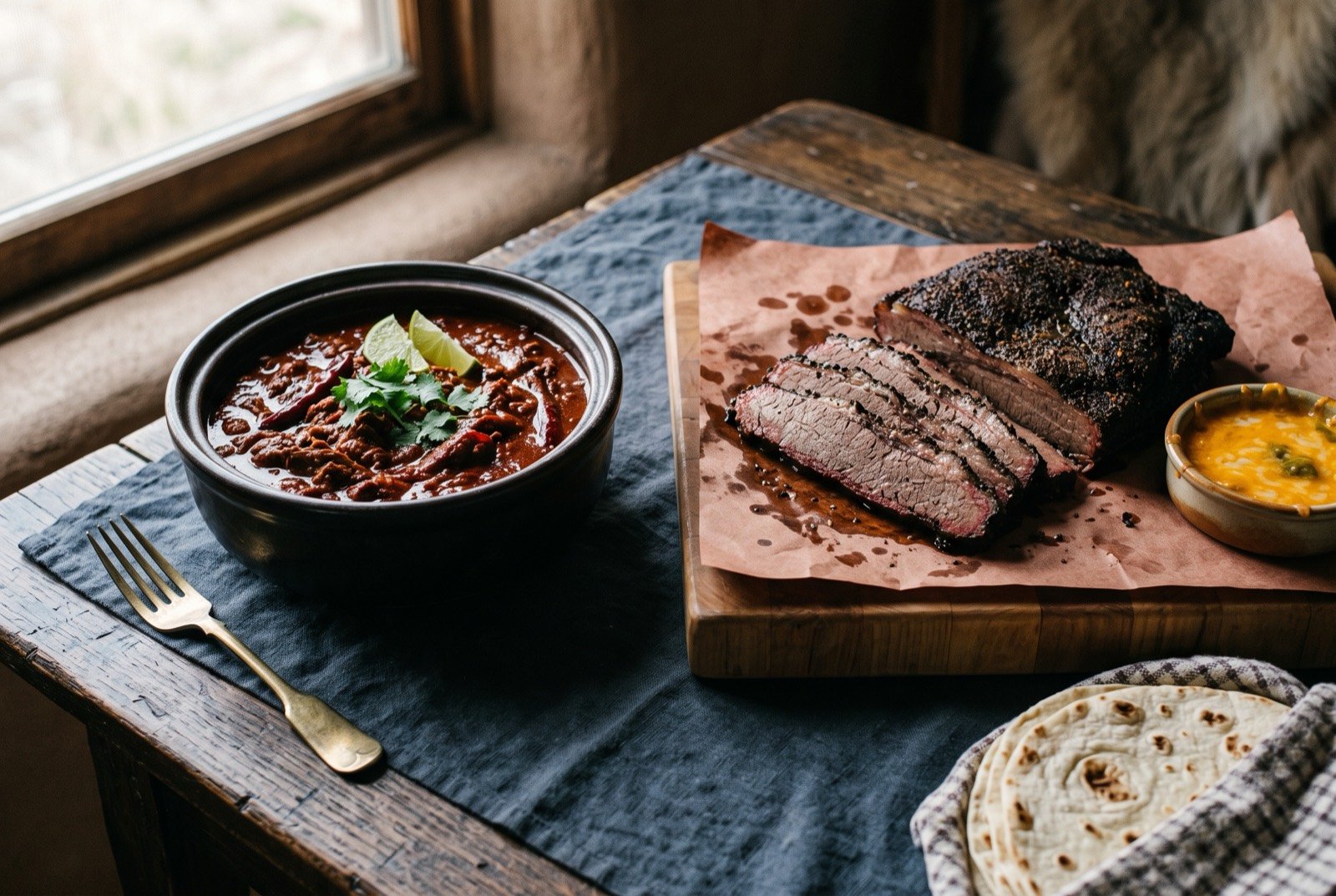
Texas Tex-Mex and the high desert tables of New Mexico and Arizona, taken as two food worlds sharing a border and a love of chile rather than one shared history. A German grocer's chili powder, a Czech and German butcher's meat market turned barbecue nation, a four-hundred-year Hispano-Puebloan hybrid, and a Sonoran border cuisine carried up from Hermosillo, not the Rio Grande, and every dish as tradition built it, then what a modern chef would change.
Sources and review · What this chapter does not assert · How we research · Spotted something wrong?
A Sense of Place
Texas Tex-Mex and the Desert Southwest share a border, a cattle economy and a love of dried chile, and this chapter resists the temptation to treat that as one story. It is two.
Texas Tex-Mex runs on the Rio Grande Valley and San Antonio, a Tejano home-cooking tradition that predates the modern United States, industrialised from the 1890s by a German immigrant grocer's chili powder, and doubled a second time by German and Czech immigrant butchers whose meat markets, built around Lockhart, Elgin and West from the 1840s onward, turned unsold weekly offcuts into what the rest of the country now calls Texas barbecue. Its structural logic is beef, wheat flour and a chile purée built for a Sunday dinner table as much as a chili stand.
New Mexico and Arizona run on a different clock entirely. New Mexico is a four-hundred-year Hispano-Puebloan hybrid: Spanish colonial pork and wheat meeting chile that Native communities in the Rio Grande valley were already growing, the whole system organised around the single most consequential question the state ever put to a legislature, red or green. Arizona's cooking is Sonoran, not Texan: it arrived across the border from Hermosillo, not up the Rio Grande, and Tucson, the continent's longest continuously farmed landscape and its first UNESCO Creative City of Gastronomy, is its proper capital, not Phoenix.
| Structural role | Texas Tex-Mex and Central Texas | New Mexico and Arizona |
|---|---|---|
| Defining starch | Flour tortilla, wheat grown in the region since Jesuit missions in the 1570s; corn tortilla for street food | Blue and red corn, nixtamalised; sopapilla fried dough |
| Defining chile use | Dried pods rehydrated into chili con carne and enchilada sauce; commercial chili powder, a Texas-invented industrial shortcut | Fresh-roasted green chile and dried red pods; "red or green" as an entire regional grammar |
| Defining protein and fat | Beef, a cattle-ranching economy; smoked beef and pork sausage; lard | Pork (carne adovada, and Sonoran cooking generally); beef, air-dried as carne seca |
| Defining historical event | The San Antonio chili queens and Central Texas German-Czech meat-market immigration, 1840s to 1900s | Spanish colonial chile-and-pork adaptation, 1590s to 1700s, in New Mexico; the Hermosillo-to-Tucson Sonoran food migration, chiefly from the 1980s, in Arizona |
| Contested identity question | Is Tex-Mex "real Mexican food"? Diana Kennedy said no; Robb Walsh said that misses the point entirely | Red or green? New Mexico's own official answer, since at least the 1990s, is Christmas: both |
A single origin story does not serve both halves honestly, and this chapter keeps them apart rather than forcing a shared history that neither actually has.
The History in Layers
Tex-Mex, and whether it is real Mexican food
The word "Tex-Mex" did not begin as food language. It abbreviated the Texas Mexican Railway, chartered in 1875, and by the 1920s had drifted to describe Texans of Mexican ancestry; only from around 1949, and firmly by the mid-1960s, did it settle onto the cuisine. Tex-Mex, Wikipedia
Diana Kennedy, the doyenne of English-language Mexican food writing, drew a hard line in The Cuisines of Mexico: "so-called Mexican food north of the border isn't really Mexican food," and she singled out Tex-Mex's heavy cumin as untraditional against the interior Mexican cooking she spent a career documenting. Robb Walsh, the Houston food writer whose The Tex-Mex Cookbook remains the standard history, does not contest her point so much as reframe what it proves: "if it isn't really Mexican food, what is Tex-Mex? The answer has to be an American regional cuisine," and elsewhere, more pointedly, "we can all thank Diana Kennedy for inadvertently granting Tex-Mex its rightful place in food history." Walsh traces the cuisine to Tejano home cooking descending from Spanish mission Indians and Canary Islander settlers in colonial Texas, and states that "culinary folklorists now trace Tex-Mex cooking all the way back to the state's Native American peoples." This chapter presents both positions and settles neither. What it will say plainly is that the argument itself is the tell: nobody spends this much energy defending a cuisine that is merely a corruption of something better. The Splendid Table
The chili queens of Military Plaza
From the 1860s, open-air chili stands run mostly by Hispanic and Tejano women appeared on San Antonio's Military Plaza, cooking chili con carne, tamales and enchiladas over mesquite fires by lantern light and serving from dusk to dawn; Stephen Crane and O. Henry both wrote about them. City Hall's 1889 construction on the plaza pushed the vendors on, first to Haymarket Plaza and later Milam Park, and repeated public-health crackdowns through the 1930s eventually closed them for good, though the exact final year is genuinely contested between sources, some naming 1937 under Mayor Charles Kennon Quin, others "the early 1940s." This chapter names both rather than inventing a false precision. What is not contested is that this was the first place chili con carne became a public, commercial, named dish rather than a home pot, and that it was built and sold by women whose names survive only in fragments, Sadie, Martha, "Sadie Thornhill, Queen of All Queens." Journal of San Antonio
Gebhardt's chili powder, and how the shortcut became an industry
Willie Gebhardt, a German immigrant who settled in New Braunfels in 1885, ran a café where chili was the customers' favourite dish but fresh chile was seasonally limited. He solved it in the way an immigrant grocer would: import dried ancho chiles, grind them with cumin, oregano and black pepper through a hammer mill, and sell the result year round. He called it "Tampico Dust" first, then "Gebhardt's Eagle Chili Powder." By 1896 his San Antonio factory ran five cases a week; by 1915, on the company's own later account, Gebhardt's was the largest spice manufacturer in the world, eighteen thousand bottles a day, shipped as far as London and South Africa. This chapter treats that fact as load-bearing rather than trivia: the standardised spice-rack chili powder sitting in a British kitchen right now has a named inventor, a named town and a traceable date, and it is worth knowing that when the recipes below ask for real dried pods instead. Texas State Historical Association
Breakfast tacos, and the taco war nobody actually wins
The earliest located use of the phrase "breakfast tacos" sits in the 23 July 1975 food pages of The Arizona Republic, describing a tour of San Antonio, not Austin. That did not stop a 2016 Eater Austin article crediting Austin as the phrase's birthplace, which provoked a genuine backlash from San Antonio, an online petition drawing over 1,600 signatures demanding the writer's "exile" for "taco negligence." Journalist Gustavo Arellano, author of Taco USA, put his finger on what the argument was really about: "San Antonio has always been a Mexican city compared to Austin's lily-white image," a city whose own longstanding Mexican-American food culture, Tacodeli, Tamale House, had been made invisible by a segregationist urban-planning history and was now, in the taco war's telling, about to be credited to someone else's city. Historians agree the true origin is too diffuse to give to one place; San Antonio, Corpus Christi, McAllen, Brownsville and Laredo all have a real claim. CNN Travel
What makes a Texan breakfast taco real is less contested than who invented the name for it. Flour tortillas dominate over corn, wheat cultivation here dating to the 1570s and Jesuit missions, so a flour tortilla is Texan-Mexican heritage in its own right, not a later American shortcut. Fillings vary by place: the Rio Grande Valley leans on egg with chorizo, bacon or machacado; migas, scrambled egg with crisp tortilla pieces, onion, tomato and jalapeño, its name simply meaning "crumbs," a resourceful use for stale tortillas descended from both Spanish and Mexican migas traditions, is Austin's own; and, in South Texas specifically, barbacoa, a whole cow's head traditionally cooked overnight in an underground pit for 8 to 10 hours, is a genuine Sunday-morning church-day custom rather than a taco filling invented for tourists. Vera's Backyard Bar-B-Que in Brownsville, cooking barbacoa in-ground since 1977, is named here as living history rather than a recipe below, since barbacoa's fuller treatment belongs elsewhere in this atlas, at the Mesoamerican volumes it shares its deeper history with. Migas, Wikipedia
Fajitas, two claims, and this chapter refuses to pick
Juan Antonio "Sonny" Falcon, an Austin meat market manager, ran the first commercial fajita taco stand at a Diez y Seis fair in Kyle, Texas, in September 1969, and was soon dubbed, and stayed, "The Fajita King." The dish itself, grilled skirt steak, named from faja, "belt" or "strip," was already ranch-hand practice on 1930s South and West Texas cattle land, decades before anyone sold it from a stand. Four years after Falcon's fair debut, Maria "Ninfa" Laurenzo, a widow with five children whose Houston tortilla factory was failing, opened a ten-table restaurant in its front room and started serving grilled skirt steak wrapped in handmade flour tortillas as tacos al carbón, reportedly 250 sold on opening day in 1973. Ninfa's on Navigation is credited, more than anyone else, with the sizzling cast-iron platter presentation that became the national restaurant standard, and with turning skirt steak from a cheap, discarded cut into something restaurants nationally had to pay up for. This chapter states both claims and adjudicates neither: Falcon's a commercial fairground first, Laurenzo's the restaurant that made the dish famous. Austin Chronicle; Houston Chronicle
Queso, dairy, and the honest reason for Velveeta
Spanish colonists brought dairy cattle into the El Paso region in the late 1500s, and cheese entered a Native foodways world already built on corn, squash and chile. The earliest documented printed chile-and-cheese reference is in an 1816 Mexican novel; the first US printed recipe naming "Chiles Verdes con Queso" ran in an 1896 California magazine. San Antonio's Gunter Hotel served chile con queso by 1910; a 1920s San Antonio Woman's Club cookbook carried the first recipe specifically calling for American cheese under that name. Velveeta entered the picture from 1939, not from laziness but from a real kitchen problem: cheddar and Monterey Jack will not melt into a stable, smooth sauce on their own, they break and go oily under heat. A 1949 Ro-Tel advertisement paired canned tomatoes and green chile with processed cheese and cemented the formula most Texans still consider correct. The technique fix for a real-cheese version, given below, is not new invention either, it is a béchamel logic, the same starch-stabilised emulsion any French kitchen already knows, aimed at a Tex-Mex problem.
The meat market that became a barbecue nation
German, Czech and Polish immigrants landed at Galveston through the mid-1800s and travelled the San Felipe Trail inland to found New Braunfels in 1845 and Fredericksburg in 1846, many of them trained butchers opening meat markets for a growing cattle economy. Before mechanical refrigeration, a shop's unsold week-end meat had to be used or lost, and markets began smoking that surplus, brisket, ribs, sausage, to preserve and sell it. Customers ate standing at the counter, on butcher paper, with crackers, no sauce, no fork, a service style born of thrift at a butcher's counter that later became the entire genre's signature aesthetic. Sausage-making is credited to the Czech and Polish thread of this immigration, brisket smoking to the German thread; only through the 1920s and 1930s did these shops become destinations in their own right rather than places that also happened to sell smoked meat.
Three named businesses carry the real chain of title. Kreuz Market, Lockhart, dates to 17 January 1900, when Charles Kreuz Sr bought Jesse Swearingen's meat market for two hundred dollars; its century-long no-forks, no-sauce policy, the old sign reading "No Barbecue Sauce (Nothing to Hide)," lasted until October 2017, when out-of-state visitors unfamiliar with the tradition finally got their fork. Smitty's Market, in the same town, is the literal continuation of the original Kreuz building and pits: Edgar "Smitty" Schmidt bought the business in 1948, and when the family split in 1999 over the Kreuz name, his daughter Nina Schmidt Sells kept the original building and its waist-high brick pits and reopened as Smitty's, still using them today. Southside Market, Elgin, traces to William James Moon's 1882 slaughterhouse and is best known for "Elgin hot guts," an all-beef, coarsely ground link in natural casing, salt, black pepper and cayenne only, credited to pitmaster Bud Frazier, who worked the market from 1902 to 1971; Texas Monthly's own barbecue editor calls the shop's 1882 founding claim "plausible but unconfirmed," a healthy scepticism this chapter shares. Texas Monthly on Kreuz; Southside Market, Wikipedia
The real numbers behind the modern technique, with a necessary caveat: post oak, dried nine to twelve months, burns slower and milder than mesquite or hickory, and is the defining Central Texas fuel. Pit temperature runs 225 to 250°F. The stall, when internal meat temperature plateaus around 145 to 175°F as surface moisture evaporates and cools the meat, can last six to ten hours; wrapping the brisket in porous butcher paper once bark has set, at roughly 150 to 165°F, pushes it through faster than an open pit would, and a whole packer brisket runs 12 to 18 hours total. This chapter should say plainly what the technique brief already flagged: the precise vocabulary here, the stall, the crutch, is modern pitmaster language describing how the style is executed today, not how an 1880s meat market measured anything. Post oak, low heat and patience are the old, continuous thread; the numbers are a recent, careful retrofit onto it.
Czech kolaches, and the Texan invention hiding inside the name
Czech immigrants settled Central Texas and the coastal plains from the 1850s, bringing the kolache, a round yeasted pastry with a central well of fruit preserve or sweetened farmer's cheese. West, Texas, north of Waco, calls itself the Czech heritage capital of the state, and its Czech Stop bakery, open since 1983, is the modern landmark. But the savoury, sausage-stuffed pastry most Texans call a kolache is not, strictly, a kolache at all: it is a klobásník, in the local spelling a klobasnek, a Texan invention credited to Wendel Montgomery of West's Village Bakery in the early 1950s, who by his own daughter's account conceived it as a riff on the hot dog, sausage for frankfurter, kolache dough for bun. Texan usage still applies "kolache" loosely to both, which is worth naming as an inaccuracy rather than smoothing over, since the two pastries, one sweet and Czech, one savoury and Texan, are genuinely different foods wearing the same borrowed name. Food Republic
New Mexico's chile, and the state question nobody expected to matter this much
New Mexico State University's chile breeding programme traces to horticulturist Fabián García, who began standardising varieties in Las Cruces from 1888, and the Chile Pepper Institute, formally established in 1992 under Paul W. Bosland, has released over fifty cultivars since. Big Jim, bred by Dr Roy Nakayama, a man once himself denied entry to NMSU over his ethnicity, working with grower Jim Lytle, is a New Mexican-Peruvian hybrid released in the mid-1970s (sources give 1975 or 1976, an unresolved minor point), mild to medium, and used almost entirely for roasted green chile; individual pods have exceeded fourteen inches and it once held the Guinness record for the largest chile in the world. Sandia, an older, hotter variety, was refined into "NuMex Sandia Select" from 2001 at growers' own request for more consistent heat. Chile Pepper Institute, Wikipedia
New Mexico is the only US state with both an official state question and an official state answer. "Red or green?" was adopted as the state question by the legislature in the 1990s, though the exact legislative sequence is genuinely unsettled between sources this chapter checked, one giving 1995 passed, then vetoed by Governor Gary Johnson, then signed in 1996; another giving 1996 proposed and vetoed, not signed until 1999. Neither account has been checked against the primary New Mexico Session Laws, so this chapter states the disagreement rather than inventing a false precise date. What is certain is the answer New Mexicans actually give when they cannot decide: "Christmas," half red sauce, half green, on the same plate, a real and sensible compromise given that green chile production leans toward the southern Hatch Valley and red toward the aged, dried pods of the north. Barry Popik
Chile roasting at scale is more recent than the tradition feels: the rotating propane-heated drum roaster, tumbling chiles over open flame for four to five minutes until the skin blisters evenly, only reached commercial, store-front New Mexico from 1977, though home roasting over an open flame long predated that. From August to September the smell is distinctive enough that New Mexico named it the official state aroma in 2023. Ristra drying, stringing chile pods to cure through winter, is credited to Spanish settlers as a practical defence against birds and rodents, layered onto Native communities' own pre-existing practice of drying chile before Spanish contact, though the specific ethnic attribution for that earlier practice rests on thin sourcing here and should be checked against this atlas's own AM-30 before it is repeated with confidence elsewhere.
A note on what this chapter deliberately does not re-cover. AM-30, this atlas's Woodlands, Plains and Southwest Indigenous Foodways volume, already carries the fuller, carefully sourced account of Puebloan and O'odham chile cultivation, waffle gardens, tepary beans and the honestly thin evidence behind posole's specifically Pueblo history. This chapter treats New Mexican chile from the Hispano and agri-business angle, the Hatch Valley, the breeding programme, the state symbolism, and sends the reader to AM-30 for the deeper Indigenous thread rather than repeating it at a shallower depth here.
Carne adovada and green chile stew
Carne adovada, pork marinated then slow-braised in a pure red chile sauce with no tomato, its name from Spanish adobar, "to marinate," is described by several sources, none of them scholarly, as descending from Spanish colonial pork preservation, Iberian pigs arriving with the adobar technique in the 1590s, rehydrated ground red chile substituted for a vinegar-based Iberian marinade once New Mexico's cooks found themselves without reliable citrus or vinegar. This chapter treats that story as plausible synthesis, not documented food history, and states honestly that no genuinely in-tradition, New Mexican-authored written source, the kind of primary text this atlas prefers to a food blog, was reached in this research. Green chile stew, pork or beef or chicken simmered with potatoes in a roasted-chile broth, carries the same caveat and the same plausible-but-unverified colonial-synthesis story.
The stacked enchilada, and why blue corn cracks
New Mexico claims the invention of the stacked, rather than rolled, enchilada: flat corn tortillas dipped briefly in hot oil until pliable, layered two or three deep with chile sauce, cheese and onion, and very often finished with a fried egg whose broken yolk works as an informal extra sauce. The reason is partly practical rather than purely traditional: blue corn, historically grown by Native communities in the northern Rio Grande valley, makes a coarser, more crack-prone tortilla than fine white or yellow masa, genuinely harder to roll without splitting, which is as good an explanation as any for why the north stacks rather than rolls. The traditional sauce base is chile caribe, coarsely flaked, crushed rather than fully ground dried red chile, distinct from a smooth chile powder.
Sopapillas, older than New Mexico and not invented there
The fried-dough pillow the state serves with honey did not start in New Mexico. The word derives from Mozarabic xopaipa, "bread soaked in oil," and the earliest documented use of the dish itself, per a carefully sourced Wikipedia overview, is Chilean, attested from at least 1726, its own pumpkin-dough version served with pebre or a dark cane syrup; Peru has its own, called cachanga. New Mexico developed its own distinctive pillow-shaped form, credited to Spanish settlers arriving from the early 1700s and blending with Puebloan technique, sometimes with blue corn flour worked in, but this chapter is careful not to claim the state invented the format, only that it made something genuinely its own out of a pan-Hispanic idea. Sopaipilla, Wikipedia
Frito pie, and the corporation that beat both folk heroes to it
Two cities each tell a founder's story. Santa Fe's version credits Teresa Hernandez, eighteen or nineteen at the time, with bringing her mother's recipe to the Woolworth's lunch counter on the Santa Fe Plaza in the 1960s, slitting a bag of Fritos lengthwise and ladling in homemade red chile con carne, topped with cheddar and onion; she was remembered by name in the Santa Fe press on her death. Texas tells at least two of its own: a folk claim that Daisy Doolin, mother of Fritos inventor Charles Elmer Doolin, invented the dish in San Antonio in the 1930s, and a better-evidenced one, drawn from the Doolin family's own 2011 book, dating the earliest documented Fritos-and-chili recipe to 1949, with the actual authorship unsettled even inside the family's own archive. Frito-Lay's Casa de Fritos restaurant at Disneyland was already selling a "Frito Chili Pie" by 1955. Kaleta Doolin's own conclusion, drawn from company archives few casual retellers have consulted, is the most useful thing this chapter found on the whole dispute: both folk-hero stories, Daisy Doolin's and Teresa Hernandez's, are myths in the strict who-was-first sense, since Frito-Lay itself was already selling the combination-dish concept commercially by 1949, before either individual claim. What survives that correction intact is Hernandez's real, specific role in making the slit-bag street-food format a Santa Fe institution, regardless of who thought of it first. Frito pie, Wikipedia
The Sonoran hot dog, and a story English-language sources keep missing
English-language coverage generally dates the modern bacon-wrapped Sonoran hot dog to Hermosillo in the late 1980s, University of Sonora students its first enthusiastic cart-vendor market. Spanish-language Mexican regional press tells a fuller, earlier story that English coverage largely skips entirely: the hot dog's arrival in Hermosillo is dated to 1947, brought by Cipriano "Nito" Lucero, a Guaymas-born former army chef sergeant, who opened Café Kiki with his wife Luz Celia Ajá and introduced flavours he had picked up in military service; the fully loaded modern construction, including its bolillo-style bun, evolved gradually afterward as competing street vendors sharpened their carts, eventually clustering around Plaza Emiliana de Zubeldía facing the university, known locally as "the Hot Dog plaza." This chapter names the local-language source directly because the gap between it and the English-language version is exactly the kind of thing house rules exist to catch. El Sol de Hermosillo
The dish crossed into Tucson fast: by 2009 one estimate put over two hundred Sonoran hot dog vendors in the city alone, more again in Phoenix. Daniel Contreras, born in Magdalena de Kino, Sonora, opened his first Tucson cart in October 1993 as El Güero Canelo, still sourcing its bolillo-style buns from a Magdalena bakery, a direct Sonoran supply line maintained across the border for three decades. In 2018 the James Beard Foundation gave El Güero Canelo its America's Classics award, its citation calling Contreras "the leading hotdoguero" and Tucson "the American epicenter" of the dish, and framing the whole thing as "the flow of culinary and cultural influences from the U.S. to Mexico and back," which is a more honest description of how borders actually work than either country's food writing usually manages. El Guero Canelo, Wikipedia
The chimichanga, and how much of Tucson's favourite legend is actually true
El Charro Café, Tucson, founded in September 1922 by Monica Flin, is credited by the usual telling with the chimichanga's accidental invention, either that year or, in most versions, the late 1940s or early 1950s, when Flin is said to have dropped a burrito into hot oil and, catching herself about to swear in front of children, turned the exclamation into "chimichanga." That the story cannot agree on its own date by a margin of nearly thirty years is itself the tell that this is restaurant lore rather than a documented event. Macayo's Mexican Kitchen in Phoenix makes an equally accident-based competing claim from the 1940s, and at least two more Tucson restaurants assert their own. Food journalists who have actually looked into it agree on one thing only: nobody can prove where or when it happened. This chapter names El Charro's story because it is the one everyone repeats, names the competing claims because they exist, and declines to certify any of them as fact. Chowhound
Carne seca, and the real difference between Arizona and Texas dried beef
Thin-sliced beef, salted and traditionally sun- or air-dried on rooftops or mesquite-wood racks under screened covers against flies, exploits the Sonoran Desert's extreme dryness in a way Texas machaca, its closest Tex-Mex cousin, quietly does not: Tucson and Sonoran tradition keeps the drying step genuine, closer to true jerky, while Tex-Mex machaca typically skips the drying altogether and simply means moist shredded beef. A documented 1862 diary entry, "pies made of jerked beef & red pepper," is early written evidence of the combination in the Tucson area. Monica Flin's El Charro is named again here, having originally dried its seasoned beef on clotheslines behind the restaurant and later moved the practice to its own downtown rooftop, where it continues today, a rare working link to a pre-refrigeration technique most cities lost decades ago. Tucson's UNESCO Creative City of Gastronomy status, awarded in 2015, cites over four thousand years of continuous agriculture in the region, the longest such record on the continent, and names the Hohokam and O'odham peoples directly as this cooking's deepest root, through Spanish and US colonisation to today's Sonoran-Mexican identity. Tucson Foodie
The Flavour Arsenal
Chiles
Dried New Mexico or Hatch-type red pods. Mild, sweet, with a distinct dried-cherry note that ancho or guajillo, its usual UK substitutes, do not carry. The backbone of carne adovada and red enchilada sauce.
Chile caribe. Coarsely flaked, crushed rather than fully ground dried red chile, the traditional New Mexico enchilada-sauce texture, distinct from a smooth powder.
Fresh green chile. Roasted, chiefly Hatch Valley cultivars (Big Jim, mild to medium; Sandia, hotter), never eaten raw at scale, always blistered and peeled first.
Ancho, guajillo, pasilla, chile de árbol. The Mexican-market dried pods that stand in across this chapter wherever true New Mexico chile cannot be sourced, and which built Texas's own chili con carne tradition directly.
Commercial chili powder. The Texas-invented industrial shortcut, real chile ground with cumin, garlic and oregano, genuinely different from a single-pepper chile powder, and worth using knowingly rather than by default.
Corn and wheat
Wheat flour. Texan-Mexican heritage in its own right, not a later American substitution, tortilla culture here dating to 1570s mission wheat cultivation.
Nixtamalised white and blue corn. Cooked in cal or historically wood-ash lye, then ground; blue corn's coarser texture, genuinely more prone to cracking, is a real, practical reason New Mexico's enchiladas stack rather than roll.
Fat and dairy
Lard. The working fat across both halves of this chapter, from tortilla dough to carnitas to sopapilla batter.
Bacon. The Sonoran hot dog's defining wrap.
American processed cheese. The pragmatic 20th century queso fix for real cheddar's tendency to split under heat; treated here as a genuine technical solution, not a lesser choice.
Meat
Beef. The Texas cattle economy's defining protein, brisket and skirt steak above all, and the all-beef "hot guts" sausage tradition of Elgin.
Pork. Central to New Mexico's carne adovada and to Sonoran cooking generally, its arrival credited, thinly, to Spanish colonial livestock.
Air-dried beef. Carne seca, genuinely dried, distinct from Tex-Mex machaca's usual moist shred.
Spice
Cumin. Tex-Mex's signature note, traced by several food writers, though not to a primary academic source, to 18th century Canary Islander settlers in San Antonio, whose own cooking leaned on cumin in a way closer to Moroccan technique than to central Mexico.
The Technique Ladder
Rung 1. Dried chile pod rehydration and purée
Pods wiped, stemmed, seeded and torn to increase surface area, rehydrated in warm, never boiling, water, since boiling triggers an enzymatic reaction that releases bitter compounds the pod would otherwise keep locked away. Thin-skinned pods (guajillo, pasilla) take fifteen to eighteen minutes; thick-skinned ones (ancho) take twenty to twenty-five. The soaked pods are puréed with some of their own liquid and aromatics, then cooked briefly in a little fat to concentrate the flavour before use. This single technique underpins chili con carne, carne adovada and red enchilada sauce alike, and is the real dividing line, more so than fresh versus packet, between this chapter's cooking and a commercial chili powder imitation of it.
Rung 2. Nixtamalisation
Dried corn cooked in an alkaline solution, cal or historically wood-ash lye, for five to forty-five minutes, then steeped as it cools for twelve to eighteen hours. The alkali loosens and removes the tough pericarp and, critically, unlocks niacin and calcium that raw corn keeps nutritionally and texturally out of reach. The corn is then ground, traditionally on a stone metate, into fresh masa. This is the same chemistry behind every tortilla and tamale in this chapter, and the coarser grind blue corn takes on is, mechanically, why the stacked enchilada exists at all.
Rung 3. Low and slow post oak smoke
A whole packer brisket, salted and peppered in equal coarse measure, smoked at 225 to 250°F for twelve to eighteen hours. Internal temperature plateaus for hours around 145 to 175°F as surface moisture evaporates and cools the meat faster than the smoker can heat it, a real physical phenomenon known as the stall, not a myth; wrapping the meat in porous butcher paper once bark has set, at roughly 150 to 165°F, breaks the stall by stopping further evaporative cooling, and the brisket finishes at 200 to 205°F before a long rest.
Rung 4. Open-flame chile roasting
Whole green chile pods roasted directly over open flame or under a very hot grill until the skin blisters and chars on every side, then steamed in a covered bowl to loosen the skin for peeling. Commercially this is a slowly rotating propane drum, doing the same job at speed and scale; a home hob flame does the identical chemistry, char driving a real Maillard reaction into the pod's skin, at a smaller size.
Rung 5. Screened air-drying
Thin-sliced beef, salted, hung under a screened cover in dry heat rather than direct sun, the Sonoran Desert's low humidity doing the actual work of drying rather than the sun's heat alone. This is a genuinely different mechanism from smoking, moisture removed by airflow, not by heat and smoke together, and it is the real technical difference between proper carne seca and Tex-Mex machaca's shortcut.
Rung 6. Steam-trapped deep frying
A sopapilla's puff comes from pressing the dough gently underwater in the hot oil the instant it lands, trapping steam inside the dough so it balloons hollow rather than simply frying flat; once it bobs to the surface, spooning hot oil over the top finishes the puff evenly.
The Ferment and Preserve Bench
1. Chile powder
Chile powder itself is this cuisine's simplest preserve: dried, ground pods, kept for up to a year in a sealed jar, ready long after the fresh chile season has passed.
2. Chile caribe and whole dried pods
Chile caribe and whole dried pods keep for months at room temperature and are the pantry foundation behind every chile sauce in this chapter.
3. Ristra-strung red chile
Ristra-strung red chile is preservation as decoration: whole pods strung and hung to cure through winter, both a genuine store cupboard and a doorway ornament.
4. Carne seca
Carne seca is, properly done, this chapter's one true air-cured meat, thin-sliced beef dried under a screened cover until it keeps for weeks without refrigeration, the same principle behind any dry-cured meat anywhere, applied here to the Sonoran Desert's own dry heat rather than to smoke or salt alone.
Sourcing in Britain
Verified September 2026. Where a supplier could not be fully confirmed, that is said rather than smoothed over.
The ranked list: what decides great from grim
- Genuine dried New Mexico or Hatch-type red chile pods cannot currently be confirmed as available from any mainstream UK specialist. Cool Chile Co's live range, Mexgrocer UK and Mextrade all stock ancho, guajillo, pasilla, chile de árbol and similar Mexican-market pods, but none currently lists a New Mexico or Hatch pod. Guajillo and ancho are the honest substitute, but they are not equivalent: New Mexico chile's milder, sweeter, dried-cherry-adjacent note is genuinely its own thing.
- Hatch chile itself, in the certified, place-specific sense this chapter uses it, is unavailable in the UK. It is a seasonal, fresh product (late August to September) tied entirely to New Mexico's own roasting infrastructure, and no UK cold-chain importer was found carrying it in any form.
- Blue corn masa harina is a genuine UK success, confirmed by direct retailer check. Sous Chef stocks Naturelo Blue Masa Harina, 1kg, £5.99, reliably in stock. Mexgrocer's own-brand Maseca Blue Corn Flour, 1kg, is cheaper at £3.59 but was out of stock at time of writing.
- Standard white masa harina is a solved problem, better availability than the blue variant. Cool Chile Co's White Masa Harina, 500g, £5.99, and Mexgrocer's Maseca-brand range up to 20kg catering sizes, cover this comfortably.
- True post oak wood, the specific North American species, is not meaningfully available in the UK. English oak is the honest substitute, and not an apologetic one: London's own reference Texas-style barbecue restaurants, Texas Joe's Slow Smoked Meats and SmokeStak, both use English oak rather than shipped-in post oak, citing cost, and both are widely praised for the result.
- Whole packer brisket, point and flat left together, is genuinely obtainable, but as a special order, not a supermarket cut. Turner & George sells a confirmed Packer Cut Brisket at £84 for 6kg; Swaledale sells a dry-aged, grass-fed whole packer brisket widely cited by UK barbecue forums as supplying many of the country's leading smoking restaurants; Dunwood Farm Butchery offers full packer briskets from 4kg. Ask specifically for a "packer" or "whole" brisket and bring a reference photo, since UK butchery traditionally trims the cut differently.
- A genuinely equivalent Czech-Texan all-beef "hot guts" sausage was not found in the UK. Swaledale's Ukrainian Kovbasa, a coarse, smoked pork-and-beef link, is the nearest thing in spirit, but it is a different tradition, beechwood-smoked rather than post oak, and not all-beef; state it as the closest relative, not a substitute.
- Bolillo rolls are not stocked anywhere found in the UK. No UK Mexican grocer carries fresh bakery goods at all. A soft-crusted white roll or a small French-style baguette roll is the honest, close substitute.
UK Texas barbecue, a real and growing scene
Worth naming directly, since it is genuinely strong where UK Tex-Mex specifically is not. SmokeStak (Shoreditch, founder David Carter, who travelled to Houston in 2013 to learn the trade) smokes whole brisket 12 to 15 hours over kiln-dried English oak. Texas Joe's Slow Smoked Meats (London Bridge) uses American-sourced Creekstone Farms briskets on a Southern Pride smoker, again over English oak. In September and October 2026, The Ned in the City of London hosts a limited residency pairing Michelin-starred Austin pitmaster John Bates of Interstellar BBQ with Ali Clem of La Barbecue, worth checking for dates before travelling. Genuine, established Tex-Mex restaurants, as opposed to contemporary Mexican street food chains like Wahaca, are thin on the ground in Britain; state that honestly rather than stretching a chain's menu into something it is not.
Kit
A Big Green Egg is the closest UK equivalent to both a Central Texas offset smoker and a Sonoran carne seca drying rack, its ceramic thermal mass holding a steady low temperature for the brisket rung and its indirect zone useful for a controlled, screened air-dry. A dehydrator stands in for New Mexico's open-air chile drying and for carne seca where rooftop sun-drying is not practical. A sous vide setup earns its keep across this chapter more than almost any other volume in this atlas, for the brisket rest, the carne adovada braise and the green chile stew's meat. A high-power blender and chinois are the direct British equivalent of a molcajete and strainer, essential for every chile purée in this chapter.
Voices and Sources
From Texas
- Robb Walsh, author of The Tex-Mex Cookbook: A History in Recipes and Photos (2004), the standard defence of Tex-Mex as its own regional American cuisine rather than a corruption of Mexican food.
- Diana Kennedy, author of The Cuisines of Mexico, whose dismissal of Tex-Mex, whatever this chapter makes of it, remains the argument every subsequent Texan food writer has had to answer.
- Daniel Vaughn, Texas Monthly's barbecue editor since 2013, the first full-time barbecue editor at any US publication, author of The Prophets of Smoked Meat, and the single most citable authority for this chapter's barbecue history.
- Lisa Fain, "Homesick Texan," whose Seven-Chile Texas Chili recipe is built explicitly to correct the commercial chili-powder shortcut with real dried pods.
- Aaron Franklin, Franklin Barbecue, Austin, the first pitmaster in US history to win a James Beard award, and co-author of Franklin Barbecue: A Meat-Smoking Manifesto.
- Tootsie Tomanetz, pitmaster at Snow's BBQ, Lexington, cooking barbecue since 1966, subject of Netflix's Chef's Table: BBQ and a James Beard semifinalist at age 82.
- Diego Galicia and Rico Torres, Mixtli, San Antonio, whose menu, rotating a single Mexican region every 45 days, is built on travelling to research pre-Hispanic technique directly rather than importing French method.
- Jesse Griffiths, Dai Due, Austin, whose whole-hog butchery classes are the clearest American parallel this atlas has found to its own African-volume argument about whole-animal use.
- Fermín Núñez, Suerte, Austin, whose from-scratch nixtamalisation, dried corn, cal, an eight to twelve hour steep, ground and cooked to order, is the strongest single piece of technique evidence in this chapter's research.
From New Mexico and Arizona
- Fabián García and Dr Roy Nakayama, the founding and defining figures of New Mexico State University's chile breeding programme, the latter himself once denied entry to the university over his ethnicity before becoming the man who bred Big Jim.
- Carmella Padilla, New Mexican food and culture writer, whose stacked blue corn enchilada recipe is the strongest single source for that dish in this chapter's research.
- Mark Miller, Coyote Cafe, Santa Fe, credited as the founder of "Modern Southwestern Cuisine" as a fine-dining category from 1987.
- Fernando Olea, Sazón, Santa Fe, James Beard Best Chef Southwest 2022, whose menu treats mole as a named genre of distinct regional variants rather than one brown sauce.
- Daniel Contreras, El Güero Canelo, Tucson, the James Beard Foundation's own "leading hotdoguero," who has sourced his bolillo buns from a Magdalena, Sonora bakery since 1993.
- Monica Flin, El Charro Café, Tucson, whose 1922 restaurant remains the working, if contested, heart of both the chimichanga legend and Tucson's genuine, still-practised carne seca tradition.
Things this chapter has deliberately not asserted
- That Tex-Mex is, or is not, real Mexican food. Diana Kennedy's and Robb Walsh's positions are both quoted directly; this chapter adjudicates neither.
- The exact year the San Antonio chili queens' stands were permanently closed. Sources split between 1937 and "the early 1940s"; both are named rather than one being asserted with false precision.
- A full, quantities-and-method traditional queso recipe from a source meeting house standard. None was found; the recipe given above is compiled from the well-documented béchamel fix rather than a single named traditional source.
- The precise 19th century numeric detail behind Central Texas brisket smoking, the exact stall temperature, wrap timing or total cook hours as an 1880s meat market would have measured them. All such numbers in this chapter come from modern pitmaster-era barbecue writing describing how the style is executed today, not from historical record. Post oak, low heat and long hours are the genuinely old, continuous thread.
- That German Wiener schnitzel is chicken-fried steak's proven ancestor. The Texas State Historical Association's own Handbook of Texas presents this as one unverified folk theory among several, with no scholarly citation offered, and this chapter treats it accordingly.
- The exact legislative sequence and year behind New Mexico's "red or green?" as official state question. Sources disagree between a 1995-to-1996 and a 1996-to-1999 sequence, and neither has been checked against the primary New Mexico Session Laws.
- The colonial-era historical narrative given for carne adovada's and green chile stew's origin, that Spanish settlers substituted rehydrated red chile for a vinegar-based Iberian marinade by "the early 1700s." This is plausible synthesis repeated across several non-scholarly sources, not documented food history, and no genuinely in-tradition New Mexican-authored written cookbook was reached in this chapter's research to confirm or correct it.
- That New Mexico invented the sopapilla. The dish's earliest documented form is Chilean, attested from at least 1726; New Mexico made a distinctive version of a pan-Hispanic idea, not the original.
- Who actually invented Frito pie. Kaleta Doolin's own company-archive research concludes both the Texas and New Mexico folk-hero stories are myths in the strict sense, since Frito-Lay itself sold the combination-dish concept commercially by 1949; this chapter follows her conclusion rather than either city's preferred legend.
- The chimichanga's origin at El Charro Café, Tucson, as documented fact. The story's own internal date disagrees with itself by nearly thirty years across different tellings, a clear sign of restaurant lore rather than a recorded event; competing claims from Macayo's in Phoenix and at least two other Tucson restaurants are named rather than dismissed.
- A firm UK availability answer for tepary beans, chiltepin, or seed for named New Mexico chile cultivars (Big Jim, Sandia) as grow-your-own options. Tepary beans and chiltepin have limited, confirmed UK seed sources; named New Mexico pod-type cultivars specifically were not confirmed available from any UK seed retailer checked, and this is stated as an open gap rather than a settled negative.
Volume AM-35, North America, Not Just Stew. Research briefs: AM-35-tradition.md and AM-35-modernist-sourcing.md. Sourcing verified September 2026.
Dried chile pod rehydration and purée
Pods wiped, stemmed, seeded and torn to increase surface area, rehydrated in warm, never boiling, water, since boiling triggers an enzymatic reaction that...
Nixtamalisation
Dried corn cooked in an alkaline solution, cal or historically wood-ash lye, for five to forty-five minutes, then steeped as it cools for twelve to eighteen...
Low and slow post oak smoke
A whole packer brisket, salted and peppered in equal coarse measure, smoked at 225 to 250°F for twelve to eighteen hours.
Open-flame chile roasting
Whole green chile pods roasted directly over open flame or under a very hot grill until the skin blisters and chars on every side, then steamed in a covered...
Screened air-drying
Thin-sliced beef, salted, hung under a screened cover in dry heat rather than direct sun, the Sonoran Desert's low humidity doing the actual work of drying...
Steam-trapped deep frying
A sopapilla's puff comes from pressing the dough gently underwater in the hot oil the instant it lands, trapping steam inside the dough so it balloons hollow...
The dishes
- Chile con carne Texas
- Breakfast tacos Texas
- Fajitas Texas
- Chile con queso Texas
- Central Texas brisket Texas
- Elgin hot guts sausage Texas
- Carne adovada New Mexico
- Green chile stew New Mexico
- Blue corn enchiladas New Mexico
- Sopapillas New Mexico
- Sonoran hot dog Arizona
Sources and review
- Researched
- 26 sources cited
- Reviewed
- Not yet reviewed from inside the tradition
- Cooked
- Not yet cooked and reported
Where this volume comes from
3 research briefs on file for this volume, researched to the rules on How we research. Published 3 September 2026. Last changed 8 September 2026.
The brief's own account of its sources
Texas. Of roughly 45 web searches, the strongest material came from the Texas State Historical Association's Handbook of Texas, Texas Monthly's food and barbecue verticals (including Daniel Vaughn's own reporting), named restaurants' own history pages (Kreuz Market, Southside Market), the Journal of San Antonio (University of the Incarnate Word), and Lisa Fain's Homesick Texan, a Texas-specific food writer explicitly building recipes to correct the industrial chili-powder shortcut.