The Americas · Volume 32
Cajun and Creole Louisiana
The Prairie and the Port
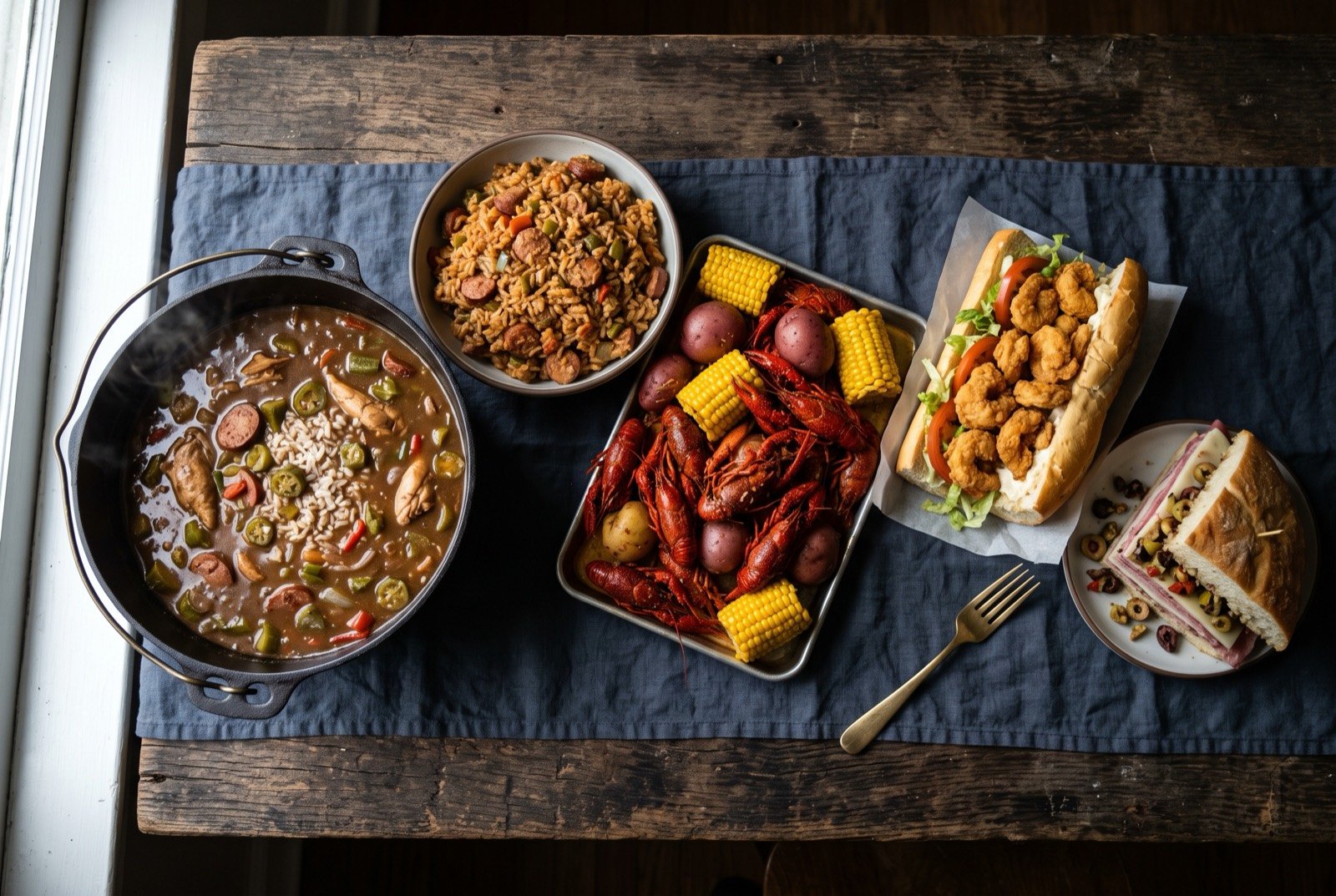
Two food worlds share a state border, a Catholic calendar and a handful of dishes, and this chapter refuses to let either stand in for the other. Cajun Louisiana is a displaced rural people's subsistence cuisine: francophone farmers and fishers, exiled from Nova Scotia in 1755, resettled onto the swamps and prairies of south Louisiana and built a self-sufficient table from what the bayou actually gave them. Creole New Orleans is an urban, trade-built cuisine: a port city refounded three times by three empires, doubled in population by a single refugee wave in 1809, and cooked into being by free and enslaved Black cooks working French technique against African, Spanish and Caribbean ingredients. The popular tourist line, that Cajun food is just spicier Creole food, does not survive checking either history. Every dish as tradition built it, then what a modern chef would change.
Sources and review · What this chapter does not assert · How we research · Spotted something wrong?
A Sense of Place
This is a chapter about two food worlds that happen to share a Catholic calendar and a state border, not one Louisiana cuisine with a rural footnote.
The prairie: a displaced people's subsistence table
The Acadians were deported from Nova Scotia beginning in the summer of 1755, under British colonial governor Charles Lawrence, in an operation historians call le Grand Dérangement. At Grand Pré, British troops lured more than four hundred Acadian men into the local church, which became their holding pen while soldiers rounded up the women and children; families were marched to the coast at gunpoint, often separated by age and sex in the process, and loaded onto overcrowded transport ships. Between ten and thirteen thousand Acadians were deported over the following decade, and some historians estimate as many as half of the roughly fifteen thousand Acadians in the region died from exposure, disease, starvation and violence connected to the deportation. Some historians characterise the episode as a considered instance of ethnic cleansing, a live historiographical position rather than a universally settled one, and this chapter states it as such.
The first substantial group of exiles reached Louisiana in 1764 to 1765, after nearly a decade of wandering through France, the Atlantic seaboard colonies and the Caribbean, and were settled in the Attakapas district, the fertile semi-tropical prairie of south-central Louisiana. Roughly three thousand Acadian exiles migrated to Louisiana in total. Some were later forcibly relocated by the Spanish colonial governor to a site near present-day Natchez, Mississippi, which provoked a rebellion in 1768. The Acadians remained subsistence farmers by disposition and by necessity, producing only enough to survive; by the early 1800s three economic classes had emerged among Louisiana's Acadians, wealthy planters, middle-class farmers and artisans, and a majority who stayed subsistence farmers.
They settled onto genuinely productive, genuinely difficult land. The Atchafalaya Basin, the swamp and floodplain running down the state's centre, is one of the most biologically diverse regions in North America, its wetlands home to alligators, black bears, catfish and crawfish, and functioning as the state's natural flood control and water filtration. Crawfish predate any farming of them: they naturally inhabited the Basin's swamps, burrowing during late-summer dry-down and emerging as spring flooding re-inundated the land, and commercial harvesting of the wild crop intensified through the 1800s, long before anyone thought to farm them deliberately. On the surrounding prairie, around Lafayette, Breaux Bridge, Opelousas and St Martinville, Acadians found rich soil suited to rice and sugarcane, plus kitchen gardens for the onion, celery and bell pepper that would come to flavour a Cajun roux. Pork became the dominant inland meat, smoked, barbequed, stuffed into sausage, rendered into cracklins, while wild game and freshwater fish rounded out a table built on hunting, fishing and trapping rather than on trade.
The port: a city refounded three times, doubled by refugees
New Orleans was founded in 1718 by Jean-Baptiste Le Moyne, Sieur de Bienville, under the French crown. It passed to Spain in 1763, reverted briefly to France, then was sold to the United States in 1803. Spanish rule's real influence on the city is genuinely underrated against the more visible French veneer: it brought a tenfold increase in the enslaved population, roughly twenty nine thousand African arrivals during Spanish rule against near stagnation under the French, Acadian immigration of a separate, later wave (roughly five thousand settlers between 1762 and 1770), and Canary Islander settlement in Ascension and St Bernard parishes. Even the city's look is more Spanish than its French name suggests: post-fire building codes after the fires of 1788 and 1794 mandated stucco exteriors and tiled roofs, so most of what reads as "French Quarter" architecture today is in fact Spanish-mandated construction.
The single event that shaped the city's food more than any other, and the best-evidenced fact in this whole chapter, is the Haitian Revolution refugee wave. Saint-Domingue refugees had been arriving in Louisiana since the revolution began in 1791, but the decisive influx came in 1809, when Spain expelled Saint-Domingue refugees from Cuba following Napoleon's invasion of Spain in 1808. Within two months of May 1809, 5,754 refugees had disembarked in New Orleans, and by early 1810 the cumulative total from this single wave had climbed past ten thousand. It doubled New Orleans's total population and nearly tripled its free population of colour. The wave's composition, roughly one third white elite, one third free people of colour and one third enslaved, meant it carried genuine Saint-Domingue Creole culinary technique directly into the city, in the hands of free and enslaved Black cooks as well as the white Creole households who had employed them.
That refugee city already had a substantial free Black population with real economic and civic weight of its own. Approximately four hundred to eight hundred free people of colour lived in New Orleans through the French period; the number grew past fifteen hundred under Spanish rule, thanks partly to the Spanish legal mechanism of coartación, a right to self-purchase that let two to four per cent of the enslaved population earn freedom annually, a rate that did not exist under French law. By 1810, before the Haitian wave had even fully settled, nearly five thousand free people of colour lived in the city, roughly twenty nine per cent of its population, a far higher proportion than any other city in the American South. Documented occupations include carpenters, ironworkers, seamstresses, midwives, tavern keepers and merchants; named examples of real wealth include the merchant tailor François Lacroix, whose real estate portfolio was valued at over two hundred thousand dollars by 1861, and the planter Andrew Durnford, whose estate was valued at $161,000 in 1850. This population built its own civic infrastructure through the 1830s and 1840s, religious organisations, literary societies, mutual aid societies, schools, including the Sisters of the Holy Family.
It is tempting, and this chapter deliberately resists it, to draw a straight line from this population's wealth and standing directly to a specific technical refinement in the kitchen, the claim, common in tourist retelling, that free people of colour's own household economics were the mechanism that married French roux technique to African and Caribbean ingredient and method. It is a plausible synthesis of the demographic and economic facts above. But 64 Parishes, the Louisiana Endowment for the Humanities' own regional encyclopedia and one of the strongest sources behind this chapter, states plainly that its own entry on free people of colour "contains no information regarding culinary contributions," and no named food historian reached in this chapter's research makes that exact causal argument in citable form. This chapter states the demographic and economic case honestly, and leaves the specific culinary-mechanism claim as this atlas's own argued synthesis rather than a settled historian's fact.
The Code Noir, Louisiana's 1724 slave code, is worth naming for what it actually said rather than what popular memory assumes. It formally recognised the legal category of free person of colour while working to restrict its growth, manumission required Superior Council approval, and freed people who assisted runaway slaves could themselves be re-enslaved. It set minimum food and clothing allowances for enslaved people and gave them a formal right to complain if rations fell short, made Sunday a mandated day off, and forbade enslaved people from selling produce or provisions without written permission, with a fine for anyone caught buying from them in violation. That last clause is worth sitting with: any informal enslaved-run produce economy, the kind romantic market narratives sometimes gesture toward, was in fact illegal under the letter of the law.
Two further waves shaped the port city's table before this chapter's dishes come into focus. Isleños, Canary Islanders, arrived from the 1770s and settled Galveztown in Ascension Parish and St Bernard Parish, dominating that parish's produce and poultry sales in the New Orleans market by 1803 and, per Isleño heritage sources, bringing the chayote, known locally as mirliton, a vegetable that remains distinctively Creole today. And between the 1880s and 1910s, an estimated sixty thousand Sicilians migrated to New Orleans, part of a wider wave that put total Italian immigration to the city at over three hundred thousand between 1870 and 1920. By 1875 the Lower French Quarter was known locally as Little Palermo; by the 1910 census the Quarter itself was eighty per cent residents of Italian descent, who came to dominate the city's fruit trade, running the French Market and Poydras Market stalls and the docks where fruit was unloaded. This is the direct economic backdrop to the muffuletta, below.
A table of the defining logic
| Element | Cajun, rural Acadiana | Creole, urban New Orleans |
|---|---|---|
| Fat | Lard, rendered pork fat, oil for a dark roux | Butter, olive oil, French sauce fats |
| Starch | Louisiana long grain rice, cornbread | Rice, French bread |
| Aromatic base | The holy trinity, sweated hard into a dark roux | The holy trinity, tomatoes, French herb technique |
| Everyday protein | Pork from the boucherie, boudin, andouille, tasso, freshwater fish, crawfish, wild game | Gulf shrimp, oysters, blue crab, imported and trade goods |
| Thickener | Dark roux most often, filé off season | Roux, filé or okra by dish and season, more likely alongside tomatoes |
| Occasion | The crawfish boil, the boucherie, Monday washday beans | The Lenten calendar, Carnival, the civil rights era dining room |
The History in Layers
Gumbo: three traditions, one word, a genuinely open question
Louisiana cooks distinguish gumbo févi, thickened with okra, from gumbo filé, thickened with ground sassafras, from roux based gumbo, a distinction on record since the eighteenth century. Earliest documentary trace: a 1764 court transcript records an enslaved woman named Comba testifying that she gave "un gombeau" to another enslaved person, the earliest known reference to the dish. The French traveller C. C. Robin documented it in narrative form around 1802 to 1804, with the historian Dr Carl A. Brasseaux of the University of Louisiana at Lafayette dating the first specific references to a gubernatorial reception in New Orleans in 1803 and a Cajun gathering on the Acadian Coast in 1804, and it reached print in 1885 in Lafcadio Hearn's La Cuisine Creole.
Which thickener came first is a genuinely contested question, and this chapter will not pretend it is settled. Per Brasseaux, okra was the preferred thickener when in season and filé served as an off season substitute before refrigeration, which suggests the two traditions were originally linked by seasonal availability rather than being separate lineages from the start, though dried okra also turns up in nineteenth century recipes, complicating a clean seasonal story. The most defensible statement this research can support is that filé and okra were both in active seasonal use by the time gumbo is first documented, with roux based gumbo becoming dominant later without a precisely dated transition.
Filé itself is Choctaw, not African or French. The Choctaw dried and finely ground sassafras leaves into a seasoning and thickener and sold it to the Creoles of New Orleans from the earliest days of the French Market. Sassafras leaves are rich in mucilage, the same class of plant compound that makes okra thickening work, which is why filé and okra are functionally substitutes for one another and traditionally never combined in the same pot. Filé is added off the heat for a reason built into its own name: stirred in early, or reheated once already added, it turns viscous, slimy and stringy; added once the pot is off the heat and the temperature has dropped, it gives a sweet, earthy, thyme-like flavour without that ropy texture. This is not folklore. It is the plant chemistry, and it is the technical basis for a rule this chapter repeats without apology: filé goes in last, off the heat, or not at all.
Okra's own route into the dish, and into the word "gumbo" itself, runs through the transatlantic slave trade. The historian Gwendolyn Midlo Hall traces "gombo" to a Bambara language term for okra; enslaved Africans, brought to the colony in large numbers from 1719 onward, carried okra seed and West African rice cultivation knowledge directly with them. This chapter will not smooth over a genuine inconsistency in the record here: other sources, including 64 Parishes' own gumbo entry elsewhere on the same page, instead trace the word to Bantu languages of central Africa, ki ngombo in Kimbundu, and the food historian Jessica B. Harris's synthesis leans the same way. Both West African language families are live candidates in the actual scholarship, and this chapter states the disagreement rather than picking a side to sound more confident than the evidence allows.
Cajun roux, and the chemistry that a home cook actually needs
A roux is fat and flour cooked together, and it does two genuinely different jobs depending how far it is taken. At blond stages it is primarily a starch thickening agent, since the flour's gluten and starch structures are still largely intact. Push it further, toward the "milk chocolate" and darker stages that give Cajun cooking its depth, and the starch granules progressively leach amylose chains that combine into amylose-lipid complexes, which do not thicken a pot the way an intact granule does. A dark chocolate roux carries roughly a quarter the thickening power, by weight, of a white one, which is exactly why a properly dark Cajun roux leans so heavily on the trinity, on stock reduction, and, in some dishes, on filé or okra to finish the job the roux itself can no longer do. The colour itself develops mainly through a Maillard reaction between the flour's proteins and sugars, not through caramelisation, and it is worth being precise about that distinction, since it is the whole reason a dark roux tastes the way it does rather than merely looking burnt.
Étouffée, and how young the dish actually is
Crawfish étouffée feels ancient at the table and is not. It traces to the 1920s in Breaux Bridge, where Yolie and Marie Hébert, daughters of the Hébert Hotel's owners, first served a tomato based dish they called crawfish courtbouillon. In the late 1940s Aline Guidry Champagne, cooking at Guidry's Place in Henderson, reworked the recipe, stripping out the tomatoes, garlic and celery to produce something closer to the modern dish; it went formally onto the menu, by then renamed the Rendezvous Club, in 1950. Pat Huval bought the restaurant in 1952, renamed it Pat's, and helped popularise the dish, including among visiting state governors. One of the earliest printed recipes appeared in Don's Secrets in 1958, and the dish's wider popularity from the 1970s coincided directly with the LSU Agricultural Center's own promotion of crawfish farming in flooded rice fields, an unusually clean example of a state agricultural extension programme and a specific dish's popularity moving together. Étouffée is French for "smothered."
The gumbo z'herbes crossover with the Lowcountry
Gumbo z'herbes, the Lenten, traditionally meatless greens gumbo eaten across Creole New Orleans on Holy Thursday, is the dish this chapter shares most directly with AM-33's Lowcountry and Gullah Geechee volume, and it is worth being precise about which crossover is actually true. Gumbo z'herbes and gumbo févi, the okra thickened dish, are two different preparations sharing one Louisiana word, and the West African crossover relevant to AM-33's own okra soup tradition is the okra thickening lineage specifically, not the greens dish. No source behind this chapter ties gumbo z'herbes, as a named dish, to one specific documented West African antecedent; the honest connection is at the level of the shared root word "gumbo" and the wider category it names, not a recipe to recipe descent, and this chapter says so rather than asserting a lineage the evidence will not carry. What gumbo z'herbes does share, unambiguously, with the rice and legume logic of Hoppin' John and red beans and rice on the other side of the Gulf, is the deeper pattern this whole atlas keeps finding: a dish built from what a plantation economy rationed, made into something worth naming.
Cajun French, thinning fast, revived deliberately
Roughly 250,000 Louisianans aged five and over spoke French at home per the 1990 census; that number had fallen to 142,000 by 2010 and 77,000 by the 2020 survey. French had been Louisiana's everyday public language through the nineteenth century, arriving via three channels, colonial French settlers, enslaved people speaking French African creoles, and the 1765 Acadian exiles; its decline is attributed to Americanisation pressure after the Louisiana Purchase, oil industry in-migration, post First World War nationalism, and a specific 1916 state law banning French from schools. The revival is real and institutional: CODOFIL, the Council for the Development of French in Louisiana, was established by the state legislature in 1968, itself an outgrowth of a cultural turn that began in the 1940s, when Cajun soldiers serving in France during the Second World War found their previously stigmatised home language suddenly useful and validating. CODOFIL's mandate was expanded in the mid-2010s to prioritise immersion and to fold Cajun French, Louisiana Creole and Native dialects into the teaching rather than only standard metropolitan French, and roughly five thousand students were enrolled in Louisiana's thirty two French immersion programmes as of autumn 2022, a twenty three per cent rise over the preceding decade.
Whether this survival still shapes how a dish gets named and talked about in a Cajun kitchen today, this chapter cannot answer with a direct source. What is documented is the language's survival and its institutional revival, not its food vocabulary specifically. But gratons, fraisseurs, boucherie, andouille and étouffée all persist as working kitchen words throughout the in-tradition sources behind this chapter, which is suggestive, even if it falls short of proof.
The Flavour Arsenal
The holy trinity. Onion, celery and bell pepper, Louisiana's own answer to French mirepoix, built from what actually grows here rather than what the classical formula specifies. Carrots do poorly in Louisiana's soil and climate, so bell pepper stood in; celery, part of the original French triad, stayed because it thrives locally. The Catholic-inflected name is widely credited to the Creole chef Paul Prudhomme, at K-Paul's Louisiana Kitchen in the late 1970s, popularising a triad that already existed rather than inventing it; the specific naming story rests on repeated but not deeply sourced secondary accounts, and this chapter holds it lightly rather than stating it as settled fact.
Andouille and tasso. Andouille is coarse-cubed pork shoulder, hand-seasoned with salt, red pepper, black pepper and garlic, stuffed into natural, traditionally beef, casing, cured, then heavily smoked over hardwood, structurally distinct from the French andouille it is named after, an offal and tripe sausage, and from generic supermarket "Cajun sausage," a finely ground, lightly smoked product with none of these steps. LaPlace, in St John the Baptist Parish, calls itself the Andouille Capital of the World, a title conferred by the state governor in the 1970s, and its Andouille Festival dates to 1972. Tasso is boneless pork shoulder, briefly wet cured, rubbed with a cayenne and garlic mix, and hot smoked, used as a seasoning meat rather than eaten as a joint in its own right; the word derives from the Spanish tasajo, jerked meat, entering Louisiana usage during the Spanish colonial period via Malagueño immigrants around New Iberia.
Cracklins, gratons. Pig skin, with fat and sometimes meat still attached, dropped into vats of rendering hog lard, done when the pieces pop, form air pockets called eyes, and float to the surface. Cracklins are a direct byproduct of the boucherie's use of every part of the pig, what came off the top of the lard rendering, historically scooped out, salted and eaten rather than a dish planned from scratch, and the tradition runs especially strong in Acadiana relative to the wider American South.
Sugarcane and cane syrup. Steen's, the state's best documented syrup producer, makes its cane syrup by simple concentration of cane juice through long open-kettle cooking, unrefined and uncrystallised, a genuinely different product from British golden syrup or treacle rather than a rough equivalent.
Chicory coffee. With the port of New Orleans blockaded by Union naval forces during the Civil War, residents stretched scarce imported coffee with ground, roasted chicory root grown locally, a practice paralleled to French use of chicory during the Napoleonic blockades, which suggests a possible transplanted precedent rather than a purely local invention. Louisiana Cookin' magazine, an in-tradition publication, treats the blockade origin story as likely true but possibly embellished rather than fully documented, and this chapter follows that caution rather than repeating it as settled history.
Hot sauce. Tabasco, McIlhenny's sauce made on Avery Island since 1868 and aged a minimum of three years in white oak, Crystal, Trappey's and Louisiana Gold are all aged, vinegar and cayenne mash sauces built from named Louisiana pepper stock, structurally distinct from generic supermarket "Louisiana style" sauces, which are typically unaged blends with no barrel time and no single pepper variety behind them.
The Technique Ladder
The argument, from inside
Nine techniques, ranked roughly by skill investment, each explained by why it works, not only what it does.
Rung 1. Cracklins
Rendering pig skin and fat to the point the pieces pop, form eyes and float; minimal equipment, but real heat tolerance and timing judgement, since a piece pulled too early stays leathery and one left too long turns bitter.
Rung 2. The trinity, sweated hard
Onion, celery and bell pepper in roughly equal parts, prepared for nearly every savoury dish in this chapter. Isaac Toups, a working Cajun chef from Rayne, adds the trinity only once his roux has reached its target colour, then stirs hard and fast, roughly once every five seconds, for about a minute, so the vegetables caramelise against the hot fat rather than gently stew in it, a genuinely different flavour base from a slow-sweated French mirepoix.
Rung 3. Blond and brick roux
The same one to one fat to flour ratio, cooked briefly to a shade darker with a nutty smell for a blond roux, or with tomato paste worked in and cooked until it just starts sticking to the pot base, around ten minutes, for what Toups calls a brick roux, the entry point to darker technique.
Rung 4. Dark roux
The same starting ratio, taken to forty five minutes or more of near-constant stirring to reach a "mahogany" or "milk chocolate" colour, judged, in Toups's own method, against a bar of milk chocolate held up to the pot. Oil rather than butter is used at this stage, since butter's milk solids scorch below the temperature a genuinely dark roux needs to reach. Toups states it plainly: the difference between a great dark roux and burnt garbage is only a minute, and this is the dish's real skill rung, the one place a cook can lose the whole pot in sixty seconds of inattention.
Rung 5. Boudin stuffing
Cooked pork, liver and rice, bound and seasoned in roughly equal parts meat to rice, stuffed into natural casing, a butchery-adjacent skill as much about casing handling as seasoning.
Rung 6. Boudin rouge, named but not given a recipe
Made the same way as standard boudin but with fresh pig's blood folded in, giving an earthy, metallic flavour that carries real cultural stigma today alongside real regulatory obstruction: USDA rules on animal blood collection and transport effectively block small butchers from selling a homemade version commercially, since any blood used commercially must come from a specially inspected facility. It survives today at only a handful of licensed Cajun meat markets. This chapter names it, and will not give it a recipe a home cook could not legally or safely reproduce, the same choice this atlas has made elsewhere for a dish whose tradition has outrun what current regulation or ecology can support.
Rung 7. Filé, off the heat
Technically the simplest step in the chapter, a pinch of ground sassafras stirred in once the pot is off the heat, but conceptually one of the most important: filé's mucilage overdevelops into a stringy, ropy texture if it boils or is reheated, so it is added last, at the table if need be, and never returned to the heat.
Rung 8. The crawfish boil
Sequencing potatoes and sausage first, corn next, crawfish last and only briefly, then reading doneness by the water's return to the boil rather than by a clock, before cutting the heat entirely and letting everything soak, unheated, in the seasoned water for fifteen minutes or more, since it is soaking time, not boiling time, that drives seasoning into the shell and meat. This chapter states plainly that the specific numbers behind this rung, boil time, soak time, seasoning ratio, rest on generalist recipe sourcing rather than a Louisiana institutional source, and gives them as a starting point rather than received law.
Rung 9. The whole hog boucherie
The top of the ladder: a full day's communal butchery and cooking, producing fraisseurs, a stew of heart, kidney, liver and tenderloin, slow cooked backbone, gratons, boudin and more from one animal in a single day, historically organised as food security practice against spoilage before refrigeration. It is genuinely disappearing, not dead: it survives commercially, at operations such as Legnon's Boucherie in New Iberia, which turns out some fifteen hundred pounds of boudin a day using recipes passed down orally and by observation rather than written, and it is being actively revived as a cultural preservation event, a documented example near Arnaudville in the 2020s, rather than practised out of necessity as it once was.
The Ferment and Preserve Bench
Three preparations, each a genuine preservation technology this economy or climate actually demanded, not a modern flourish.
The boucherie itself. Every technique on this bench, cracklins, boudin, tasso, andouille, exists because a whole hog, butchered in a single day before refrigeration, had to be turned into something that would keep. Smoking, curing and rendering are not seasoning choices here, they are the entire reason the boucherie tradition survived long enough for this chapter to document it.
Filé powder. Sassafras leaves, dried and finely ground, a genuinely pre-refrigeration technology allowing a thickener to be stored through the winter months when fresh okra was out of season, and one this chapter has already traced to its Choctaw origin above.
Cane syrup. Steen's own method, simple, unrefined concentration of cane juice through long open kettle cooking, is itself a preservation technique as much as a sweetener, turning a perishable juice into a shelf-stable pantry staple the way sugar boiling has done in plantation economies across this atlas.
Sourcing in Britain
Andouille and tasso, the volume's hardest gap. Genuine Louisiana-made andouille or tasso, imported fresh or frozen, is not reliably available to a UK home cook. Franconian sells an "Andouille Cajun" sausage, finely ground rather than the coarse-cubed cut that defines the LaPlace originals, smoked on-site over unspecified hardwood, in packs of five or ten at roughly £8.50 to £15.50. The Cajun Food Company, a small operation in Buntingford, Hertfordshire, describes itself making genuinely hot-smoked andouille using a barrel smoker, the most promising lead this research found for something closer to the LaPlace style, though its current stock could not be verified directly. No dedicated UK tasso retailer exists at all. The honest, and genuinely workable, recommendation is to make both at home: a Big Green Egg run low and steady over pecan or hickory, the two woods actually used in Acadiana, maps directly onto the cure-and-smoke method both products depend on.
Filé powder. Straightforward. Seasoned Pioneers, a UK spice specialist, sells filé powder from around £3.50, and it appears on Amazon.co.uk from several sellers. This is commercial, mass-market filé rather than the rare, hand-ground product still made by a handful of families around the Cane River in Natchitoches Parish; no UK source for that hand-ground version was found, a real gap worth stating honestly rather than implying the reader can source the artisanal article.
Louisiana hot sauce, a genuine success story. Crystal Hot Sauce is available at £4.99 for 354 millilitres from American Grocer, and Tabasco needs no specialist sourcing at all, sold in every UK supermarket. Zatarain's, McCormick-owned and covering filé, jambalaya seasoning mix and Creole seasoning, is stocked by the same specialist importer and turns up on Amazon.co.uk. Louisiana Gold and Trappey's are both listed by general American food importers, though this chapter could not confirm current pricing for either.
Steen's cane syrup, a genuine gap. No dedicated, currently stocked UK retailer selling Steen's was confirmed; the realistic options are an occasional, unverified eBay listing or ordering directly from the United States with real shipping cost and delivery time attached. British golden syrup and treacle are not equivalents, since Steen's is a first-boil, uncrystallised cane syrup with a genuinely different flavour, and this chapter will not present them as interchangeable.
Chicory coffee. No named US brand, Community Coffee or French Market among them, was confirmed available through a UK retailer. Plain roasted chicory root, sold in UK health food shops as a caffeine-reduction coffee substitute rather than as a Louisiana product, can be blended at home with a dark roast coffee to approximate the New Orleans style, a plausible workaround rather than a confirmed equivalent.
Okra. No issue at all. Frozen and fresh okra is widely stocked by African, Caribbean and South Asian grocers across Britain.
Long grain rice, a genuinely good find. Tilda, the major UK rice brand, sells a dedicated "Tilda USA Long Grain Rice," explicitly marketed as a favourite with Creole and Cajun cooks, sold from small retail packs up to twenty kilogram catering bags. Its own marketing names only "USA" rather than Louisiana specifically, so this chapter states the provenance carefully rather than overclaiming it.
Crawfish, the volume's real limiting factor. The UK's own crayfish population is overwhelmingly the invasive signal crayfish, a genuinely different species from Louisiana's native Procambarus clarkii, not the same animal sold under a different name. This chapter states plainly that a UK reader wanting an authentic boil faces a real ingredient gap that no amount of technique or sourcing effort currently closes; a UK boil, honestly, will be built on signal crayfish, a workable and legal substitute in flavour terms but not the true article, and the chapter would rather say so than let a reader assume otherwise.
Alligator meat. Realistically available only through specialist UK exotic meat importers such as Fine Food Specialist, and even there as an occasional item rather than a routine stock line. Crocodile, a close relative with a comparable flavour and texture, is the more consistently available substitute from the same category of supplier, and the honest recommendation for anyone chasing an alligator sauce piquante.
Kit. The signature Cajun vessel is not cast iron but Magnalite, a thick-walled cast aluminium oval roaster with a vapour-tight lid, prized across Acadiana for even heat and fast response, light enough to move quickly and precise enough to hold a roux at a steady temperature without scorching; Leah Chase herself cooked with one at Dooky Chase's, and one now sits in the Smithsonian. A cast iron Dutch oven is a workable substitute and the default most non-Louisiana recipe writing reaches for, but it holds heat more aggressively than Magnalite, so a roux built in one needs pulling off the heat slightly earlier than Magnalite-trained instinct would suggest. A Big Green Egg genuinely maps onto this cuisine's smoking tradition, since pecan, sold in the UK as a Big Green Egg smoking wood alongside hickory, apple and cherry, is the specific wood used at Jacob's in LaPlace, this chapter's own reference producer.
Voices and Sources
Louisiana institutional and academic sources: 64 Parishes, the Louisiana Endowment for the Humanities' own regional encyclopedia, drawn on throughout for gumbo, filé, jambalaya, free people of colour, Spanish colonial Louisiana, Paul Prudhomme and the po'boy; Southern Foodways Alliance, whose oral history projects, the Southern Boudin Trail among them, and whose interviews with Ted Legnon of Legnon's Boucherie and with Leah Chase herself, anchor this chapter's living-tradition material; the LSU AgCenter, the state's own agricultural extension service, for crawfish and rice production figures; and named academic historians reached through these institutions, Gwendolyn Midlo Hall, Dr Carl A. Brasseaux of the University of Louisiana at Lafayette, C. Paige Gutierrez, Jessica B. Harris and Cynthia Lejeune Nobles.
In-tradition writers and working cooks: George Graham, publishing as Acadiana Table, a Louisiana-native food writer whose account of the Cajun-Creole distinction anchors this chapter's central argument; Isaac Toups of Toups' Meatery in New Orleans, raised in Rayne in Cajun country, whose documented roux technique, via Garden & Gun, is the single most teachable piece of technique in the whole chapter; Donald Link of Herbsaint and Cochon; Leah Chase of Dooky Chase's Restaurant, the Queen of Creole Cuisine, a founding board member and first lifetime achievement award recipient of the Southern Foodways Alliance; and Johnson's Boucanière in Lafayette, whose family lineage runs back to a 1937 Eunice grocery and stands as this chapter's clearest living case of boucherie technique carried forward commercially rather than only remembered.
The contemporary dining scene: the Michelin Guide's first American South edition, launched November 2025, which gave New Orleans its first stars, two to Emeril's under the twenty two year old E.J. Lagasse, the youngest chef ever to hold two Michelin stars, and one each to Saint-Germain, run by Trey Smith and Blake Aguillard, and to Zasu, run by Sue Zemanick; Nina Compton of Compère Lapin, whose own St Lucian upbringing makes plain that Creole identity in this city is plural rather than singular; and Serigne Mbaye of Dakar NOLA, whose menu of Creole and Senegalese dishes is the most direct living link between this volume and this atlas's own Senegal chapter (AM-01).
What Western media got right and wrong: Paul Prudhomme's blackened redfish, created at K-Paul's Louisiana Kitchen in 1980, is real, well documented technique whose popularity had measurable ecological consequences, forcing federal catch limits on Gulf redfish; the diluted, commercial "Cajun seasoning" and the acrid, over-charred "blackened" food it spawned outside Louisiana is a genuinely different thing from what Prudhomme actually cooked, and this chapter keeps the two separate rather than letting the second discredit the first.
Things this chapter has deliberately not asserted
- That Monday's association with red beans and rice is a documented washday custom rather than a widely repeated story. It rests here overwhelmingly on a rice and bean brand's own marketing copy, not on a Louisiana academic, oral history or period press source.
- That the word "gumbo" derives cleanly from one African language family. Sources disagree, some tracing it to Bambara, others to Bantu languages, including within a single institutional source's own entry, and this chapter treats the disagreement as live scholarship rather than resolving it.
- That filé gumbo or roux gumbo can be dated as definitively older than the other. The evidence supports both thickeners in active seasonal use by the time gumbo is first documented, without a clear transition date between them.
- That gumbo z'herbes descends from one specific, named West African dish. The sourced connection runs through the shared root word "gumbo" and its wider category, not a documented recipe-to-recipe lineage.
- That free people of colour's household economics were specifically the technical mechanism that fused French roux technique with African and Caribbean ingredient and method. This is a plausible synthesis of real demographic and economic fact, not a claim this chapter found made by any named food historian.
- That the po'boy's popular "here comes another poor boy" origin story is a contemporary account of the 1929 strike. It was not reported in the local press until roughly forty years later, and the Martin brothers' own earlier telling differs from it.
- That the muffuletta's now-standard origin story, Lupo simply combining ingredients Sicilian dockworkers were already buying separately, is archivally documented rather than a widely repeated, plausible account.
- That boudin rouge is a dish a home cook could or should reproduce. Blood-handling regulation genuinely restricts it to a handful of licensed producers, and this chapter names it without giving it a recipe.
- That Bourbon Street and French Quarter tourist-district cooking is diagnosed here on the strength of Louisiana institutional press. The characterisation rests on tourism-adjacent secondary sources rather than a verified NOLA.com, Gambit or Eater New Orleans piece, and should be read with that caveat.
- That any named Cajun-country chef, outside Johnson's Boucanière's documented living tradition, currently works at the technical or critical level of the New Orleans chefs named in this chapter. The research behind this volume found real critical and awards weight concentrated in New Orleans and could not confirm a comparable figure in Lafayette, Breaux Bridge or the wider Atchafalaya Basin.
- That a UK crawfish boil, built from Britain's own invasive signal crayfish, is the same dish as a Louisiana boil built from Procambarus clarkii. It is a workable, legal, flavourful substitute, not the true article, and this chapter will not pretend otherwise.
Cracklins
Rendering pig skin and fat to the point the pieces pop, form eyes and float; minimal equipment, but real heat tolerance and timing judgement, since a piece...
The trinity, sweated hard
Onion, celery and bell pepper in roughly equal parts, prepared for nearly every savoury dish in this chapter.
Blond and brick roux
The same one to one fat to flour ratio, cooked briefly to a shade darker with a nutty smell for a blond roux, or with tomato paste worked in and cooked until...
Dark roux
The same starting ratio, taken to forty five minutes or more of near-constant stirring to reach a "mahogany" or "milk chocolate" colour, judged, in Toups's own...
Boudin stuffing
Cooked pork, liver and rice, bound and seasoned in roughly equal parts meat to rice, stuffed into natural casing, a butchery-adjacent skill as much about...
Boudin rouge, named but not given a recipe
Made the same way as standard boudin but with fresh pig's blood folded in, giving an earthy, metallic flavour that carries real cultural stigma today alongside...
Filé, off the heat
Technically the simplest step in the chapter, a pinch of ground sassafras stirred in once the pot is off the heat, but conceptually one of the most important...
The crawfish boil
Sequencing potatoes and sausage first, corn next, crawfish last and only briefly, then reading doneness by the water's return to the boil rather than by a...
The whole hog boucherie
The top of the ladder: a full day's communal butchery and cooking, producing fraisseurs, a stew of heart, kidney, liver and tenderloin, slow cooked backbone...
The dishes
- Chicken and Andouille Gumbo Acadiana, Louisiana
- Gumbo z'herbes Tremé, New Orleans, Louisiana
- Jambalaya, Cajun Brown and Creole Red Acadiana and New Orleans, Louisiana
- Crawfish Étouffée Breaux Bridge and Henderson, Louisiana
- Boudin Blanc New Iberia, Louisiana
- Red Beans and Rice New Orleans, Louisiana
- The Crawfish Boil Louisiana
- Po'boy New Orleans, Louisiana
- Muffuletta French Quarter, New Orleans, Louisiana
- Turtle Soup New Orleans, Louisiana
Sources and review
- Researched
- No outside sources linked
- Reviewed
- Not yet reviewed from inside the tradition
- Cooked
- Not yet cooked and reported
Where this volume comes from
3 research briefs on file for this volume, researched to the rules on How we research. Published 3 September 2026. Last changed 8 September 2026.