The Americas · Volume 29
Pacific Coast Indigenous Foodways
Salmon, Cedar and the Acorn World
Two food worlds joined by one coastline: the salmon-and-cedar economy of the Pacific Northwest Coast, Haida, Tlingit, Coast Salish, Nuu-chah-nulth, Heiltsuk and Kwakwaka'wakw among the nations named here, and the acorn-and-fire economy of California, Yurok, Karuk, Hupa, Pomo, Miwok, Ohlone and Chumash, meeting on the Klamath and Trinity rivers where salmon and acorn were kept on genuinely equal footing. This is the atlas's first Indigenous North American volume, and it is written with a caution the other volumes have not needed in quite the same way: these are living, sovereign food cultures belonging to specific nations, not a national cuisine open to free reinterpretation. Every dish as tradition built it, then what a modern chef would change, once as tradition built it, once considered against what a modern kitchen can honestly add, but the second half of that pairing is kept on a shorter leash here than elsewhere in this atlas, and the chapter says so throughout rather than smoothing it over.
Sources and review · What this chapter does not assert · How we research · Spotted something wrong?
A Sense of Place
Start with what a restaurant menu calls invention and what this coastline has practised for thousands of years. Cedar-planked fish, slow, controlled wood smoking, stone-boiled broth held at a steady simmer without a pot, tannin removed from a bitter raw ingredient by patient, repeated water changes until it is sweet enough to eat: a British reader who owns a Big Green Egg, a sous vide bath and a dehydrator will recognise every one of those as a serious kitchen technique. Every one of them is also a Pacific Coast Indigenous technology, developed and refined long before Europe had cooking science to call it by name, and several of them are still practised today, by name, by the nations who developed them. The animating idea that runs through this atlas's African volumes, that every restaurant technique has an indigenous ancestor, holds here with almost uncomfortable precision. The difference, and it matters enough to state at the outset, is that Ghanaian or Ethiopian technique in this atlas gets a restaurant-grade "Elevation" without much hesitation, because that is a live national cuisine inviting exactly that kind of engagement. Pacific Coast Indigenous food is not a national cuisine in that sense. It is the food of specific, sovereign nations, several of it tied to closed ceremony, and a British home cook's Big Green Egg does not get to walk in and improve on the potlatch. Where this chapter offers an Elevation below, it says plainly whether that elevation is documented Indigenous chef practice or this chapter's own reasoned extension, and it does not touch ceremonial food at all.
The Northwest Coast: a salmon economy with a cedar-shaped social order
The Northwest Coast culinary world runs from southeast Alaska to the mouth of the Columbia River, and it is organised, before anything else, by salmon. Five species of Pacific salmon, chinook, sockeye, coho, chum and pink, return in overlapping runs from roughly May through December depending on river system and species, and Indigenous management of those runs, weirs, reef nets, traps that allowed selective and sustainable harvest at a scale rivalling later industrial catches, is what let this region become one of the very few hunter-gatherer societies on earth to build genuine food surplus, permanent villages housing hundreds of people, and a hereditary, ranked social order of nobles, commoners and enslaved people, rather than the small egalitarian bands anthropology once assumed fishing-and-gathering cultures were confined to.
The second organising material is western red cedar, and it is not decorative background but active food technology: steamed and bent into watertight bentwood boxes used for stone-boiling and storage, split into planks for roasting salmon, stripped for the cordage, matting and storage baskets that made preservation and trade possible. The wood is rot-resistant, splits cleanly along the grain, and was treated as a living being owed ritual gratitude when felled, with cutting the tree traditionally a man's task and stripping and processing the bark traditionally a woman's.
Within that shared ecological logic sit nations that are culturally, linguistically and politically distinct, and this chapter tries not to blur them into one voice:
| Nation | Territory | Defining logic |
|---|---|---|
| Haida | Haida Gwaii, off British Columbia's north coast | Salmon, halibut, herring, oolichan, dried herring roe on kelp, k'aaw ponding technique |
| Tlingit | Southeast Alaska and the northernmost BC coast | Haa Kusteeyí, "our way of life," herring eggs, deer, sockeye, halibut, seaweed, distributed to elders first |
| Coast Salish (Musqueam, Squamish, Tsleil-Waututh, Cowichan, Lummi, Samish, Swinomish, Tulalip, Suquamish, Nisqually, W̱SÁNEĆ and others) | Fraser Delta, Puget Sound, southern Vancouver Island | Salmon, cultivated camas prairie, reef-net fishing, clam gardens; dozens of distinct nations, not one people |
| Nuu-chah-nulth | West coast of Vancouver Island | Whaling culture, over 4,000 years documented; halibut, salmon, seal and herring as year-round staples |
| Heiltsuk | Bella Bella (Wágḷísla), central BC coast | Herring as the defining resource, marking the Heiltsuk new year |
| Kwakwaka'wakw | Northern Vancouver Island and adjacent mainland | The potlatch as feast economy, most fully documented here of any of these nations |
California: fire as the technology, acorn as the staple
Before contact, California held one of the densest and most linguistically diverse Indigenous populations in North America, achieved without European-style agriculture: as many as seven entirely unrelated language families among 80 to 90 distinct languages within the state's current boundaries, a diversity greater, by common description, than pre-colonial Europe's. Population estimates for 1769 are contested and should be read as a range rather than a fixed number, Kroeber's early figure of roughly 133,000 revised upward by later demographers toward 300,000 or more. Whatever the precise figure, the scale was sustained without cereal agriculture, which is the case for taking this as a genuinely distinct food system rather than a lesser stage before farming.
The technology behind that density was fire. Cultural burning, the deliberate, seasonally timed, low-intensity burning of oak woodland, grassland, chaparral and riparian corridors, is described by contemporary Indigenous fire practitioners not as a primitive backdrop but as a precise technology with defined, measurable outcomes: better acorn crops, healthier deer and elk populations, cleaner basketry material, reduced pest loads in stored food. Bill Tripp, the Karuk Tribe's Deputy Director of Eco-cultural Revitalization, states that more than 80 per cent of the Karuk Tribe's cultural and medicinal plants depend on fire, and that burning in tanoak stands specifically controls competing vegetation, facilitates gathering and reduces the insects that spoil stored acorn. This practice was outlawed in California for more than 150 years under state and federal fire suppression policy, a policy history that sits directly behind the mission and Gold Rush history below.
Three overlapping sub-ecologies structure the California half of this chapter:
- The oak woodland interior, from the Klamath Mountains south through the Coast Ranges, the Sierra foothills and the Central Valley margin, where acorn was the caloric backbone and deer the primary protein: Pomo, Miwok, inland Ohlone. - The coastal strip, from the redwood coast south past the Bay Area to the Santa Barbara Channel, where shellfish, seaweed and marine mammals supplemented or in places rivalled acorn: coastal Pomo (notably the Kashaya), coastal Miwok, Bay Area Ohlone, and the Chumash of the Santa Barbara Channel, whose plank canoe, the tomol, is discussed below. - The Klamath-Trinity overlap zone, where the Yurok, Karuk and Hupa, and, adjacent to them, the Wiyot on Humboldt Bay, ran genuinely dual economies: salmon and eel from the rivers on the same footing as acorn from the surrounding tanoak and black oak forests. This chapter treats that overlap as its own subject rather than folding it into either neighbouring ecology.
A genuine caveat, worth stating here rather than assuming: the claim that pre-contact California held the highest Indigenous population density in North America recurs across tourist-facing and encyclopaedic sources without an Indigenous-authored source underneath it in this chapter's own research. It rests on Western demographic scholarship, Kroeber and Cook chiefly, and this chapter repeats it as a widely cited figure rather than an Indigenous-sourced assertion.
The History in Layers
Pre-contact sophistication, on both halves of the coast
The Northwest Coast's pre-contact food system combined managed wild salmon fisheries with root gardens and marine mariculture that read, in the ethnographic and archaeological record, as genuine horticulture rather than passive gathering. Coast Salish peoples in the Salish Sea maintained cultivated, weeded and periodically replenished camas fields. Clam gardens, rock-walled intertidal terraces built to expand and improve clam habitat, are documented across Tlingit, Haida, Heiltsuk, Kwakwaka'wakw, Nuu-chah-nulth and Coast Salish territory alike; the fullest first-hand technical account comes from Kwakwaka'wakw Clan Chief Kwaxistalla Adam Dick, trained in clam garden aeration technique by elders who were themselves raised while the practice was still active in the nineteenth century. Reef-net fishing, unique to the Salish Sea, is dated to at least 1,800 years old, devised specifically to intercept the great midsummer sockeye migrations toward the Fraser River using two anchored canoes and a suspended net, timed and read by fishers watching the water rather than by fixed schedule. Cedar-picket weirs, some archaeological examples 5,000 to 6,000 years old, let downstream villages take their share of a run before deliberately opening sections to let fish continue upstream to the next village's weir, a built-in equity mechanism between communities sharing a river.
California's pre-contact food system was, in the words offered by practitioners at a recent intertribal acorn conference, organised around "reciprocal agreements" for resource-sharing between neighbouring groups, a framing offered explicitly to push back on the reductive Western idea of open, uncontested hunter-gatherer access. M. Kat Anderson's influential academic study Tending the Wild, built substantially from interviews with Native Californian consultants describing what their grandparents told them of burning regimes and tending practices, argues that the landscapes early Anglo naturalists like John Muir admired as untouched wilderness were in fact actively managed, fire-shaped, harvested and pruned systems. Anderson is not herself Native, and this chapter treats her book as an academic synthesis of Indigenous knowledge rather than a directly Indigenous-authored source, worth naming as such.
The fur trade, and the missions
On the Northwest Coast, the maritime fur trade of the late eighteenth and early nineteenth centuries, driven by sea otter pelts, brought manufactured trade goods, steel blades fitted to traditional adzes, cloth, metal tools, absorbed selectively into existing material culture rather than replacing it outright. When the fur trade collapsed in the late nineteenth century, Northwest Coast nations were left economically exposed just as settler land dispossession accelerated.
In California, Spanish colonisation, beginning with Mission San Diego in 1769, built a chain of 21 missions up the coast, through Ohlone, Chumash and neighbouring territory directly. The disruption to the acorn-and-fire food system was severe on several fronts at once. Introduced livestock, feral hogs especially, are documented as having eaten tons of raw acorns, depriving non-missionised communities of a primary food source before any coercive labour even began. Indigenous people were compelled into the mission system, in many documented cases through direct military force, and once inside lived under forced labour without wages, while their traditional territories and management practices, cultural burning very much included, were suppressed. Epidemic disease compounded this catastrophically: for the Chumash specifically, a measles epidemic in the winter of 1806 and a diphtheria outbreak between 1800 and 1802 devastated a population that, by 1770, may have numbered between 10,000 and 22,000, falling to just 2,788 mission-registered Chumash by 1831. The Ohlone suffered comparably, an estimated pre-mission population sometimes put at 30,000 falling to roughly 2,500 by 1830 through smallpox, measles and the general upheaval of colonisation.
The potlatch ban, residential schools, and the missionary assault on how food was known
Missionaries identified the potlatch specifically as the chief obstacle to conversion; missionary William Duncan wrote in 1875 that it was "by far the most formidable of all obstacles in the way of Indians becoming Christians, or even civilized." The Canadian government made the potlatch illegal by amendment to the Indian Act effective 1 January 1885, a ban that held until 1951. Enforcement fell hardest on the Kwakwaka'wakw: after a 1922 potlatch at Village Island, 22 Kwakwaka'wakw people received jail sentences at Oakalla Prison Farm, and communities that surrendered their ceremonial regalia, masks, headdresses, robes, rattles, in exchange for suspended sentences saw those items scattered into museum and private collections around the world, the wound that gave U'mista Cultural Centre its founding purpose of repatriation. Because the potlatch was the mechanism through which food surplus was distributed, titles transferred and social order maintained, banning it did not just suppress a ceremony, it broke the redistributive economy that food surplus existed to serve. Residential schools compounded this by removing children from the food knowledge transmission chain entirely, feeding them European-style food and explicitly teaching that their parents' and grandparents' foods were inferior. Nuu-chah-nulth scholar Dr Charlotte Coté, of the Tseshaht First Nation, states this plainly: "What you would see as a traditional diet we had, previous to colonization, we'll never see that again. It's impossible."
The Gold Rush and the California genocide, named without softening
What followed Mexican secularisation of the missions in 1834 and, decisively, the 1848 discovery of gold, is not a softer story. Historian Benjamin Madley's peer-reviewed research, the standard academic account, documents that California's Indian population fell from perhaps 150,000 to 30,000 between 1846 and 1873, with state militias, United States Army units and organised vigilante groups killing as many as 16,000 California Indians directly, supported with legal protection, financial subsidy, weapons and manpower from state and federal officials. For the nations centred in this chapter, the Wiyot Tribe on Humboldt Bay offers a documented, dated atrocity directly within that period: on 26 February 1860, a group of white men descended on Duluwat/Tuluwat Island during the Wiyot people's World Renewal ceremony and killed as many as 250 people, mostly women, children and elders. This is not marginal to the food history. Cultural burning, deer and elk hunting territories, salmon fishing rights and acorn gathering grounds were all directly disrupted or seized during this period, on top of the direct killing, and this chapter states that plainly rather than treating the mission and Gold Rush sections as scene-setting for a recipe.
Commercial fishing, dispossession, and the rights fight that followed
By the turn of the twentieth century, more than 200 salmon canneries operated between California and Alaska, and combustion engines, monofilament nets and fish traps let non-Indigenous commercial operations intercept salmon before it ever reached the in-river sites Indigenous fishers had always used. Colonial and state governments then shifted the conservation burden onto Indigenous fishers themselves, criminalising the very traps and weirs that had sustainably managed these runs for millennia, while non-Indigenous commercial fishing continued unrestricted.
The rights fight that followed is not history in the settled sense, it is the direct ancestor of the food sovereignty movement covered in the modernist half of this chapter. In Washington State, the landmark 1974 Boldt Decision, United States v. Washington, reaffirmed treaty rights to fish at "usual and accustomed grounds and stations," allocated 50 per cent of the harvestable catch to treaty tribes, and made those 19 tribes co-managers of the state's fisheries. In Canada, R. v. Sparrow (1990), brought by Musqueam fisherman Ronald Sparrow, established that the Musqueam right to fish for food, social and ceremonial purposes predates the Canadian constitution and takes priority after conservation; R. v. Gladstone (1996), brought by Heiltsuk men Donald and William Gladstone, confirmed a pre-contact Heiltsuk practice of commercial herring trading and established an ongoing Aboriginal right to commercial herring harvest. Contemporary Heiltsuk fishery management is genuinely co-governed as a direct result: after a 2015 Heiltsuk occupation of the federal fisheries office in Bella Bella, Fisheries and Oceans Canada agreed to put Heiltsuk observers on test boats and hereditary chief advisors into every decision, and by 2018 had suspended the industrial commercial herring roe fishery entirely, allocating the harvest exclusively to Heiltsuk harvesters.
In California, the removal of four dams on the Klamath River, completed in 2024, the largest dam removal project in US history, was pursued by the Yurok and Karuk tribes over four decades of advocacy explicitly as ecological and cultural restoration, reopening roughly 400 miles of historic salmon and lamprey eel habitat. Yurok and Karuk technicians now operate sonar monitoring stations on the river themselves.
The Flavour Arsenal
Cedar, the material that is also an ingredient
Western red cedar, Thuja plicata, is not a seasoning in the conventional sense, but it flavours everything it touches: the faint resinous, slightly sweet smoke of a cedar-planked fish, the specific character of water boiled in a cedar bentwood box, the aroma carried into stored food wrapped in cedar bark or matting. It is rot-resistant, splits cleanly along the grain for planking, and was treated with ritual gratitude when felled. A British home cook can buy the genuine species, not a substitute, see Sourcing below.
Oolichan grease, the coast's own rendered fat
Oolichan, or eulachon, a small, extraordinarily oily anadromous smelt, is rendered into t'ilx, a fat so central to Nisga'a, Nuxalk and neighbouring economies that historic trade routes over the Coast Mountains are still called grease trails. The Nisga'a name three distinct products from the same fish: digit, smoked; digidim lax-sk'an loots', sun-dried; and t'ilx, the rendered grease, each a genuinely separate preparation rather than interchangeable forms of "smelt." Colour ranges from pale gold to nearly black depending on how long the fish fermented and how long it was cooked, and different families and nations guard particular combinations of ripening time, cooking time and skimming technique as proprietary knowledge. Among the Kwakwaka'wakw and Nuxalk, oolichan grease, there t'łi'na, carried such status that a family's wealth was measured by whether they had it, and giving t'łi'na was considered the highest honour one chief could pay another at a potlatch.
Herring roe, on kelp and on hemlock
Herring return to spawn along the coast in late March to early April, and archaeological evidence documents roughly 10,000 years of continuous herring-egg harvest on the northern Northwest Coast. Kelp fronds or hemlock boughs, weighted with rocks, are set into the water at spawning sites, and the herring lay their eggs directly onto them. Heiltsuk practice distinguishes two kelp types by name, y̓ák̓a, stringy kelp, a delicacy with fine fronds, and q̓áq̓ḷ̓ís, giant kelp, thicker roe layers, the commercial product, while roe set specifically on hemlock is h̓a̓ṇ́t. Haida practice, k'aaw, waits three days after spawning before collecting, tied to the concept of Yahguudang, respect. This chapter is careful not to present "k'aaw" as one shared pan-regional word: Sitka Tlingit terminology for herring eggs is g̱áax'w, a different term entirely, and that difference is worth knowing rather than smoothing over.
Camas, the sweet bulb that is toxic until it isn't
Camas, Camassia quamash and C. leichtlinii, is toxic to inedible when eaten raw, its bulbs dense with inulin, a fibre the human gut cannot break down, alongside soapy-tasting saponins. Long, slow pit-roasting converts that inulin into fructose, which is what makes the bulb sweet, digestible and storable, and Coast Salish nations across the Salish Sea maintained cultivated, weeded, periodically replenished camas fields rather than simply gathering wild stands. Less than 1 to 2 per cent of Washington's original camas prairie survives.
Soapberries, whipped by their own soap
Soapberries, Shepherdia canadensis, contain saponins, the same soapy compound found in camas, which is what allows crushed berries mixed with water to be whipped, traditionally with a peeled willow whisk, into a stable foam compared to whipped cream, sweetened with camas, fireweed, salal or thimbleberry to offset the wild fruit's variable bitterness.
Acorn, California's grain-equivalent staple
Several oak species were used, and preference varied by nation and by what grew locally rather than by one "best" acorn. Tanoak, properly Notholithocarpus densiflorus, a genus distinct from true oaks despite the common name, was prized by the Yurok, Hupa, Karuk, Pomo and Ohlone; its thicker shell and comparatively high tannin content preserved the stored acorn better over a full year. Among the Kashaya Pomo the tanoak tree carries the name chishkale, "beautiful tree." California black oak, Quercus kelloggii, was favoured in the Klamath-Trinity region and the Sierra foothills for its high fat content, and is one of the two species Karuk and Yurok cultural burning specifically targets. Coast live oak, Quercus agrifolia, was the favoured acorn of Bay Area Ohlone peoples, a single mature tree capable of yielding over 200 pounds of acorns in an October harvest. Valley oak, Quercus lobata, produces the largest acorns and the lowest tannin content of the major California species, needing less processing where it was available.
There is no single universal term for acorn mush across California, and the widely circulated word "wiiwish" is specifically Southern California Takic, Luiseño and Cahuilla, not a term belonging to any of the nations this chapter centres, and this chapter does not use it as a stand-in. Karuk acorn soup is xuun, documented in the Karuk Tribe's own language curriculum. Chochenyo Ohlone acorn soup is paamu and acorn flatbread yuu-pitlaš, terms recovered by Vincent Medina's work reconstructing the Chochenyo language from 1920s and 1930s recordings of its last fluent speakers.
Pinole, the seed flour that rivalled acorn
Pinole, made from parched, ground seeds, chia, Salvia columbariae, prominent among them, was, per one ethnobotanical argument specific to the Bay Area, arguably as important a starch source for the Ohlone as acorn itself. Ripe seed heads were beaten into a burden basket with a paddle-shaped seed beater, then parched by tossing hot coals together with the seed in a flat tray, winnowed in the wind, and ground to flour eaten dry, as a gruel, or pressed into portable travel cakes. The Chumash made a comparable chia pinole, thinned with water as a drink or thickened into dried cakes; the Pomo made pinole too.
The Technique Ladder
The argument, from inside
Six techniques, spanning both ecologies, each explained by why it works, not only what it does.
Rung 1. Cedar plank roasting
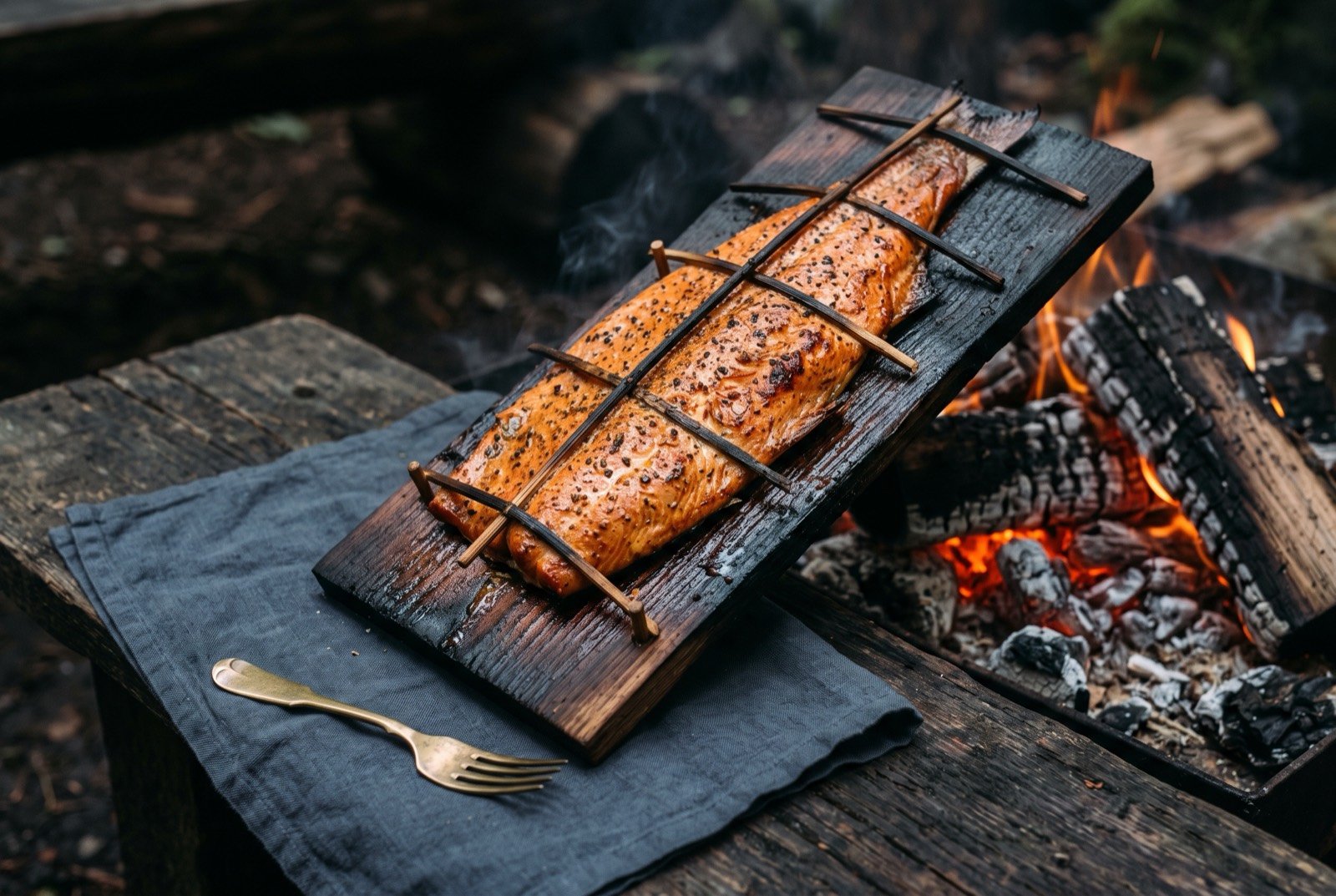
A water-soaked cedar plank, propped near rather than over an open fire, cooks fish by radiant heat and slow smoke rather than direct flame, drying and lightly smoking the flesh at once, a genuine dual-purpose technology for a people who needed today's meal and next winter's supply from the same fire.
Rung 2. Bentwood box and hot-rock stone-boiling
A single cedar plank, kerfed and steamed until pliable, folds into a watertight box; rocks heated red-hot in a fire are lifted and dropped into the water-filled box, swapped out as they cool, to bring liquid to a sustained, controlled boil with no metal pot at all, the coast's own version of a held, steady heat.
Rung 3. Oolichan grease rendering
A week or more of controlled fermentation before the fish are ever heated is not spoilage, it is the technique: it breaks down the tissue so the oil separates and rises cleanly during the long stir that follows, a genuinely managed fermentation-then-render process predating any European equivalent.
Rung 4. Camas and inulin conversion
Twenty four to forty eight hours of steady, moist heat in a stone-lined earth pit converts the bulb's inedible, indigestible inulin into sweet, digestible fructose, a slow chemical transformation with no shortcut, and no amount of high heat substitutes for the time it takes.
Rung 5. Acorn leaching
Ground acorn meal, spread in a sand basin or a tightly woven basket, has water poured through it repeatedly, sometimes for the better part of a day, sometimes for up to three days tethered in a flowing stream, until the water-soluble tannins are carried away and the meal tastes sweet rather than bitter, a controlled, monitored process rather than a single soak.
Rung 6. Basket cooking with hot stones
California's coiled basketry, sewn tight enough with an awl to hold liquid, is filled with leached acorn meal and water, and fist-sized fire-heated stones are lifted with wooden tongs, dropped in, and stirred continuously so they do not scorch the basket wall, swapped for fresh hot stones until the mush reaches a rolling boil, a distinct cooking technology from ceramic pot cooking, not a lesser substitute for one.
The Ferment and Preserve Bench
Two preparations, each a genuine preservation technology rather than a modern flourish, plus one storage system worth understanding on its own terms.
Oolichan grease, t'ilx. Fish are left to ferment or "ripen" for roughly a week, Nisga'a practice, to as long as four to fourteen days, Nuxalk practice at Bella Coola, where the fermentation container is called the stink box, traditionally in a pit, a cedar box or a canoe. After fermentation the fish are transferred to a vat, historically a watertight wooden box or canoe heated with hot rocks, and stirred in water for a long process, one documented account describes over 12 hours, until the tissue breaks down and the oil separates and rises to the surface, where it is skimmed off. Colour, from pale gold to nearly black, is a direct function of ripening time and cooking time, and different families and nations guard particular combinations as proprietary knowledge, meaning there is no single correct recipe, only family and nation traditions.
Smoke-dried salmon. Whole fish are split, the backbone removed, and the fish hung over a slow fire inside a dedicated smokehouse for several days without a salt brine at all in the traditional Coast Salish method. At Suquamish, the process runs over continuously burning green alder wood specifically because it produces the most smoke, the fire kept burning and monitored around the clock for roughly a week. Only a handful of tribal members are documented as still retaining full smokehouse knowledge in some communities, worth stating honestly rather than implying this technique is uniformly thriving everywhere it once was.
Acorn granary storage. Dried acorns were stored in large elevated granaries, among the Sierra Miwok called cha'ka, structures standing eight feet or more, woven from poles, grapevine and brush stems on a raised platform to keep contents off the ground and away from rodents, lined with pine needles and wormwood whose scent repelled insects, and roof-thatched with fir or cedar boughs to shed rain and snow. In the northwest overlap zone, Yurok, Karuk, Hupa and Tolowa granaries followed a broadly similar principle, sometimes built from willow specifically for the salicin in the wood, which also repels insects. This is a year-long storage system, not a short-term measure, built to carry a whole autumn's harvest through to the next.
Sourcing in Britain
The single decision that matters most. Real wild Alaskan sockeye salmon, Oncorhynchus nerka, over farmed Atlantic salmon, Salmo salar, sold as "wild" or "Scottish." These are different species, not interchangeable, and the good news is genuine: Waitrose stocks wild Alaskan sockeye as a mainstream own-brand line, fresh, frozen and smoked, MSC-certified, not a specialist rarity a reader has to hunt for. Seafresh UK also stocks frozen wild sockeye fillets. King and coho salmon specifically are thinner on the ground, no UK retailer was confirmed stocking them fresh or frozen in this chapter's research, so treat their availability as unconfirmed rather than assumed.
Cedar. Genuinely better than expected, and worth stating with real confidence: food-grade Western red cedar, Thuja plicata, the actual species used across the Northwest Coast, is grown commercially in Britain and sold as grilling and salmon planks, CO2 Timber's UK-sourced planks among them. This is not a "closest available" substitute, it is the same species used for planking, boxes and smoking on this coast, one of the strongest sourcing stories in this whole chapter.
Seaweed and kelp. Genuinely available, but the species match is honestly weak. The Cornish Seaweed Company sells dried kelp, identified on its own site as Laminaria digitata, along with bladderwrack, sea spaghetti, dulse and nori. None of these are the giant kelp or bull kelp Pacific herring roe harvesting actually uses, both very different large brown kelps, and this chapter does not claim Cornish kelp is a working substitute, only that a genuinely harvested UK kelp exists for a reader who wants the general idea of the food rather than a precise match.
Herring roe, halibut, geoduck. Herring roe sold separately from the fish, rather than roe-in-fish as buckling, was not confirmed available from any UK retailer in this chapter's research, and should be treated as unconfirmed rather than assumed unavailable, since Billingsgate specialist stalls were not reachable within this research's scope. Halibut is a genuinely strong equivalence: UK fishmongers stock Atlantic halibut, Hippoglossus hippoglossus, a separate species from Pacific halibut but a close biological relative with near-identical flesh character. Geoduck, by contrast, is a clean negative for fresh product: no UK fishmonger stocks it fresh or live, and the only confirmed UK-deliverable option is canned, imported geoduck, which changes the dish entirely and should be named as a compromise rather than a substitute.
Venison and elk. UK venison is genuinely, widely available across red, roe, fallow, muntjac and sika deer from established game suppliers, no caveat needed. Elk needs a careful species note: the one confirmed UK product is canned Latvian elk, which is moose, Alces alces, not the American elk or wapiti, Cervus canadensis, relevant to this chapter's nations. Selling that product as a straight elk substitute without naming the species difference would mislead a reader.
Acorns. A foraging and home-processing proposition only, not a retail product matching the right species. English and sessile oak are genuinely different species from tanoak, black oak or valley oak, with a different tannin and flavour profile, and no UK retailer of prepared or leached acorn flour was confirmed. A reader keen to try the leaching technique itself can do so with UK oak acorns, but should understand from the outset that the result will not taste like the Californian tradition this chapter describes, only demonstrate the same technique on a different ingredient.
Confirmed unavailable, stated plainly. Oolichan/eulachon: no UK import or retail source of any kind, a clean negative. Wapato: technically obtainable as an ornamental pond plant under a Schedule 9 legal listing, but with no UK culinary market whatsoever. Soapberries: no UK nursery or food retailer stocks the plant or the fruit.
Camas, and the safety point worth stating directly. The correct edible species, Camassia quamash, is sold as an ordinary garden bulb by several mainstream UK retailers, including J. Parker's and Bunkers Hill Garden Shop, the latter explicitly listing "Camassia esculenta (quamash)." This is a genuine and slightly startling availability, since it means the right plant is sitting in UK garden centres sold purely for its flowers. The safety point that follows is real, not decorative: death camas, a different and highly toxic North American genus, closely resembles Camassia in the ground before flowering, and the two are reliably told apart only by flower form and bulb stickiness. Death camas itself is not established in the UK, so the practical risk here is lower than in its native range, but this chapter states plainly that camas should never be gathered from the wild, anywhere, without secure species identification, and that a UK reader seeing Camassia bulbs at a garden centre should not assume every camas-type bulb is automatically safe.
Kit. Stones for pit-roasting need no dedicated retailer, clean, dense, non-porous river stone or granite is the only real requirement, and never anything with trapped moisture that could fracture explosively under heat. Smokers suitable for cold or hot smoking salmon are widely and unremarkably available as standard UK barbecue kit.
Voices and Sources
Chefs, cooks and organisations working in this tradition today: Sara Calvosa Olson (Karuk), author of Chími Nu'am: Native California Foodways for the Contemporary Kitchen (Heyday, 2023); Vincent Medina (Muwekma Ohlone) and Louis Trevino (Rumsen Ohlone) of Café Ohlone by mak-'amham, Berkeley; Rob Kinneen (Tlingit), author of the Fresh Alaska Cookbook and outreach director for NATIFS; Jack Strong (Confederated Tribes of Siletz Indians), executive chef at JORY; Julia Parker (Kashaya Pomo, married into the Yosemite Miwok) with Beverly R. Ortiz, It Will Live Forever: Traditional Yosemite Indian Acorn Preparation; Valerie Segrest (Muckleshoot) with Elise Krohn, Feeding the People, Feeding the Spirit: Revitalizing Northwest Coastal Indian Food Culture; Leigh Joseph, Styawat (Skwxwú7mesh/Squamish Nation), with Nancy J. Turner, "The Old Foods Are the New Foods!" (Frontiers in Sustainable Food Systems, 2020); Inez Cook (Nuxalk Nation) of Salmon n' Bannock, Vancouver; Paul Natrall (Squamish Nation) of Mr. Bannock; Roberta Olson (Haida) of Keenawaii's Kitchen, Skidegate.
Tribal governments, cultural institutions and revitalisation organisations: the Sitka Tribe of Alaska; the Nuu-chah-nulth Tribal Council and its Uu-a-thluk fisheries department; U'mista Cultural Centre, Alert Bay; the Karuk Tribe's Píkyav Field Institute and Department of Natural Resources; the Yurok Tribe's Food Sovereignty Program; the Cultural Fire Management Council, founded by Margo Robbins (Yurok); the Kashia Band of Pomo Indians; the Swinomish Indian Tribal Community; the W̱SÁNEĆ Leadership Council; Northwest Treaty Tribes; the Northwest Tribal Food Sovereignty Coalition, hosted by the Northwest Portland Area Indian Health Board; the Muckleshoot Food Sovereignty Project.
Things this chapter has deliberately not asserted
- That "k'aaw" is one pan-regional term shared identically by Haida, Tlingit and Heiltsuk peoples for herring roe on kelp; the Sitka Tlingit term found in this research, g̱áax'w, differs, and that needs direct nation-by-nation confirmation this chapter's research could not complete.
- Any single, precise technical recipe for cedar plank salmon, exact plank dimensions, distance from fire, cook time, attributable to a named nation; what this chapter gives is a composite drawn mostly from secondary sources.
- A specific, technique-level, nation-attributed account of traditional geoduck or sea urchin roe preparation; both are documented as eaten, neither as prepared any particular way by any particular nation, in this chapter's research.
- Wapato as centrally important to the Northwest Coast nations this chapter centres; the strongest sourcing ties it to the lower Columbia and Chinookan-speaking peoples, who sit outside this chapter's remit.
- A Haida- or Tlingit-specific potlatch structure comparable in detail to the Kwakwaka'wakw account this chapter gives; that sourcing was Kwakwaka'wakw-specific, from U'mista Cultural Centre, and this chapter does not generalise it further.
- "Wiiwish" as a term belonging to any of the seven California nations this chapter centres; it is Southern California Takic and Kumeyaay usage, and Chumash and Sierra Miwok words for acorn mush specifically were not found despite dedicated search.
- Manzanita cider, or the Sierra Miwok deer-disguise hunting technique, as practices belonging to the Yurok, Karuk, Hupa, Pomo, Ohlone or Chumash specifically; both are documented for other nations only in this chapter's research.
- That the appropriation and erasure this chapter's research turned up is adequately documented from a Pacific Coast voice specifically; the clearest on-record critique of a named Pacific Northwest restaurant found in this research came from Karlos Baca, a Tewa/Diné/Ute chef from the Southwest, not this coast, and this chapter states that gap rather than letting his critique stand in for a coastal one it could not find.
- That a genuinely comprehensive roster of contemporary Nuu-chah-nulth, Kwakwaka'wakw, Yurok, Pomo or Miwok chefs and restaurants exists; this chapter's research found real gaps here and states them rather than implying even coverage across every nation it names.
- The precise population figures for pre-contact Northwest Coast or Californian Indigenous nations; every figure in this chapter is stated as a range or attributed to a specific named scholar's estimate, because the underlying demographic scholarship itself disputes exact numbers.
- That this chapter's own "Elevation" sections represent documented Indigenous chef practice unless stated as such; several are explicitly this chapter's own reasoned extension of a documented traditional mechanism, and are labelled that way throughout rather than left ambiguous.
Cedar plank roasting
A water-soaked cedar plank, propped near rather than over an open fire, cooks fish by radiant heat and slow smoke rather than direct flame, drying and lightly...
Bentwood box and hot-rock stone-boiling
A single cedar plank, kerfed and steamed until pliable, folds into a watertight box; rocks heated red-hot in a fire are lifted and dropped into the...
Oolichan grease rendering
A week or more of controlled fermentation before the fish are ever heated is not spoilage, it is the technique: it breaks down the tissue so the oil separates...
Camas and inulin conversion
Twenty four to forty eight hours of steady, moist heat in a stone-lined earth pit converts the bulb's inedible, indigestible inulin into sweet, digestible...
Acorn leaching
Ground acorn meal, spread in a sand basin or a tightly woven basket, has water poured through it repeatedly, sometimes for the better part of a day, sometimes...
Basket cooking with hot stones
California's coiled basketry, sewn tight enough with an awl to hold liquid, is filled with leached acorn meal and water, and fist-sized fire-heated stones are...
The dishes
- Cedar Plank Salmon Pacific Northwest Coast, Canada and USA
- Herring Roe on Kelp (k'aaw) Northwest Coast, Haida, Heiltsuk and Tlingit territories, Canada and USA
- Bentwood Box Clam and Shellfish Bake Northwest Coast, Tlingit, Haida, Heiltsuk, Kwakwaka'wakw, Nuu-chah-nulth and Coast Salish territory, Canada and USA
- Camas Bulb Pit-Roast Salish Sea, Coast Salish territory, Canada and USA
- Whipped Soapberries (sxusem) Interior and Coast Salish territory, Canada
- Acorn Soup (xuun) Klamath-Trinity region, Karuk territory, USA
- Acorn Bread (yuu-pitlaš) Rumsen and Chochenyo Ohlone territory, San Francisco Bay Area, USA
- Venison and Elk Yurok territory and wider Pacific Coast, USA
- Pinole San Francisco Bay Area, Ohlone, and Chumash and Pomo territory, California, USA
Sources and review
- Reviewed
- Not yet reviewed from inside the tradition
- Cooked
- Not yet cooked and reported
Where this volume comes from
4 research briefs on file for this volume, researched to the rules on How we research. Published 3 September 2026. Last changed 12 September 2026.
The brief's own account of its sources
Part One, the Pacific Northwest Coast. This research ran roughly 30 web searches and around a dozen direct page fetches, biased throughout toward tribal government sites, tribally-owned news outlets, cultural centres and academic ethnobotany/ethnography, and away from generic food and travel blogs.